UAS- Starting Fall 2026, the University of Alaska Southeast will offer in-state tuition to all undergraduate students–enabling more learners to access an education.
The new Alaska Unlocked initiative makes UAS financially accessible to students who currently don’t live in the state but want hands-on experience in fields such as marine biology, Indigenous arts and languages, aquaculture, outdoor studies, marine transportation, and environmental sciences.
“For students who dream of a once-in-a-lifetime adventure in Alaska, this is an unparalleled opportunity. We are thrilled to invite students from all over the country to bring their unique backgrounds to UAS and add to the remarkable communities we have in Southeast Alaska,” said Chancellor Aparna Palmer.
The university is known for its immersive learning opportunities that go beyond the classroom. With Alaska Unlocked, these can take place in person, online, or in a hybrid format. In-state tuition applies to all undergraduate courses of study, including bachelor’s, associate’s, certificate, and technical programs.
The application period for the Fall 2026 semester is now open. Prospective students interested in receiving in-state tuition through this program can find out more at Alaska Unlocked.
NOTN- The Juneau School District has launched a “Buy a Brick” campaign to help fund playground equipment at the Dzantik’i Heeni campus, where several of the city’s programs were relocated after school consolidation.
“Through the consolidation the year before last at the Juneau School District, our optional programs were moved to the Dzantik’i Heeni campus, which had previously been a middle school.” Said Juneau school district Director of Operations Kristy Germain, so we now have Montessori Borealis, which has pre-K and kindergarten through eighth grade, and we also have the Juneau Community Charter School, which is kindergarten through eighth grade, and additionally our Yaakoosge Daakahidi alternative high school, but the playground is primarily for our elementary program.”
While the playground will primarily serve elementary students, it will also be open to children in the surrounding Lemon Creek and Switzer neighborhoods, Germain says the school district partnered with the city engineering department for public design and safety concerns.
“The cost is substantial,” Germain said “We have received funding from the City Assembly, they authorized an ordinance to put $735,000 specifically toward the site preparation and the concrete base and the safety surfacing for the playground, and that’s just the safety surfacing. So the equipment is an additional cost. So the Juneau school district is taking the lead on fundraising for the actual playground equipment.”
The Buy a Brick fundraiser allows residents and businesses to purchase engraved bricks that will be installed at the site.
“We are partnering with Brick Markers, and they’re a company that has worked with other organizations in Juneau, I think notably, Rotary Park and the 911 Memorial use the same company.” Germain said, “Those bricks are holding up, so that’s a good testament to them. But we have established various levels so that individuals and community members are able to purchase a brick, and we’re also looking to our business community to support this endeavor.”
Proceeds will go toward the cost of equipment, which Germain said could push the project’s total cost beyond $1 million once installation, shipping, and materials are factored in.
The district plans to launch an online portal for the fundraiser within the week, with brick sales running through December. Officials hope to purchase and receive equipment in time for installation next summer.
“We are running into some timelines for purchasing the equipment in time for it to arrive to be installed this summer. So that is why we have a tight timeline.” Said Germain.
Community support has already begun. Juneau’s Rotary clubs recently donated $30,000 toward musical play equipment and are organizing volunteer work parties to help install it.
For those unable to buy a brick, Germain said there will be other ways to contribute, including volunteering at fundraising booths or helping with community outreach.
Alaska pollock, shown here from a harvest, make up the nation’s top-volume single-species commercial seafood catch. Alaska pollock, harvested mostly in the Bering Sea but also in the Gulf of Alaska, are processed into fish sticks, fish burgers, imitation crab meat and other common fish products. (Photo provided by NOAA)
For the organization that oversees commercial fisheries in federal waters off Alaska, the most significant impact of the federal government shutdown might materialize in December.
That is when the North Pacific Fishery Management Council is scheduled to issue harvest limits for Alaska pollock – the nation’s top-volume commercial harvested species – and other types of groundfish harvested in the Bering Sea and Gulf of Alaska, such as Pacific cod and sablefish.
The Bering Sea and Gulf of Alaska pollock harvests start in January.
To set the groundfish harvest levels, the council relies on federal scientists’ analysis of fish stocks in the ocean, work that is based in large part on scientific surveys conducted over the summer.
But during the shutdown, most National Marine Fisheries Service employees, including the scientists who analyze survey data to assess the conditions of commercially targeted fish stocks, are furloughed.
On Wednesday, the last day of the council’s October meeting, the members considered how to deal with scientific uncertainty if the government shutdown prevents completion of the detailed analysis that is usually provided in time for the December meeting.
Council member Nicole Kimball referred to a warning issued eight days prior by Bob Foy, director of the NMFS Alaska Fisheries Science Center, the organization that does the stock assessments. Foy said then that a shutdown lasting more than five days would compromise the ability to complete stock assessments and that a shutdown beyond 15 working days would “dramatically impact” those assessments.
The 15-day threshold is not too far away, Kimball said.
“How does the council and the public understand what to expect in December, in between the October and December meeting, relative to stock assessments?” she asked.
Diana Evans, the council’s deputy director, said impacts are yet to be determined, but the public will be notified of them as soon as possible.
“We don’t think we can answer that until we have a better sense of exactly where we land and how many days of work are remaining between the time that government workers are back and able to resume that work and the meeting,” she said.
Advocates with environmental organizations said they worry about shutdown effects on scientific information needed for harvest decisions, which would add to the effects of mass firings and retirements at NMFS and other agencies.
“I’m terrified at the prospect of flying blind into the next fishing season, especially as the Trump administration has decimated the ranks of scientists who monitor the health of our oceans,” Cooper Freeman, Alaska director of the Center for Biological DIversity, said by email. “I’m especially worried about fisheries like the massive pollock trawl fleet that has been harvesting millions of tons annually at the expense of the larger ecosystem.”
“The first challenge with this shutdown is the instant level of uncertainty it creates. Normal processes face delays that can easily impact or inhibit active fisheries. Potential staff losses will exacerbate that,” Michelle Stratton, executive director of the Alaska Marine Conservation Council, said by email.
“But beyond the concern for continuing day to day services, are those major efforts — like stock assessments and (total allowable catch) setting — that rely on substantial NMFS staff input, data processing and expert analysis. If this continues to the point where we are unable to set catch limits for the start of the 2026 seasons, we’ll be in seriously uncharted territory, and could well see massive economic impacts to our fishing communities and fleets,” she said.
The shutdown forced the council to rearrange its October meeting because federal representatives were unavailable to present information.
One major agenda item was postponed: review of a work plan for assessing essential fish habitat. Other items on the agenda were abbreviated.
The shutdown has already affected fishery management operations to some degree, said council member Jon Kurland. As Alaska regional director for NMFS, Kurland is one of a small group of agency employees remaining at work during the shutdown.
Kurland, in comments last week at the start of the meeting, said some services have been unavailable during the shutdown, such as the processing of harvest quota transfers.
NMFS is still doing basic management of ongoing fisheries, monitoring and closing them as needed, and is supported by contractors, he said. But that level of work has its limits, he said.
“If there are significant unforeseen problems, we will have limited ability to address those. Fingers crossed,” he said then.
Election materials are seen at the Alaska Division of Elections headquarters in Juneau. (Photo by James Brooks/Alaska Beacon)
NOTN- Juneau Mayor Beth Weldon says city officials are already preparing for possible spending cuts following Tuesday’s municipal election, where early results show voters favoring two tax-limiting propositions that could significantly reduce city revenue and potentially the cost of living for residents.
“If you’re looking at our website to see the election results, just hit the tab the button that says election, and then you’ll see preliminary results.” Said Weldon, “Up at the top it says 21% Well, that’s 21% of our registered voters. So typically we end up with somewhere between 9 to 10%, this is a little bit of a bigger ballot, so we might get as much as 12,000 votes. So it’s not 21% of the vote. I would say it’s somewhere between 40 to 50%.”
Speaking Wednesday morning, Weldon said due to high voter turnout, preliminary numbers for Ballot propositions 1 through 3 won’t likely change.
“Ballot Proposition 2, taking the sales tax off food, that’s not going to change. The seasonal sales tax is not going to change. Proposition 1 has a possibility of changing, but is likely going to stay that way.” Weldon Said.
She noted that while full election results won’t be certified until mid-October, most races appear decided. Only the tight Assembly District 2 race between incumbent Wade Bryson and challenger Nathaniel “Nano” Brooks, separated by three votes in preliminary results on Wednesday remains too close to call.
Weldon said the city had anticipated either outcome and began planning for both scenarios before the election. “We’ll just evaluate and figure out where we can fill the hole with cutting services a bit and other things, the biggest hit to the budget was taking sales tax off food without filling that hole. So that’s, you know, somewhere around $8 million.” Weldon said, “It’s easy to cut $8 million one time, but it’s a little more difficult to cut it year after year after year. But we’ll just go back to work and our finance means will be pretty interesting.”She said.
The City and Borough of Juneau’s next update on unofficial election results is expected Friday. Certification is scheduled later this month.
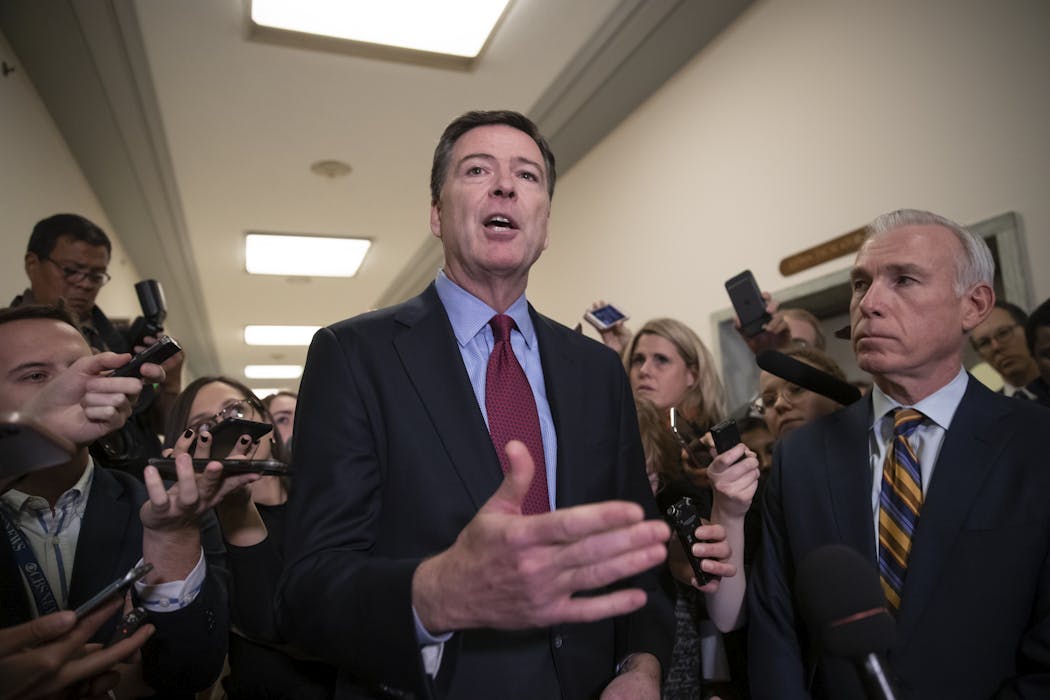
Former FBI Director James Comey speaks to reporters on Capitol Hill in Washington on Dec. 7, 2018.AP Photo/J. Scott Applewhite
Former FBI Director James Comey was indicted by a federal grand jury on Sept. 25, 2025 – only the second time in history an FBI director has faced criminal charges.
The indictment came just five days after President Donald Trump took to social media to demand that Comey be prosecuted, and three days after Trump installed a former aide as the prosecutor to bring the case.
Legal experts across the political spectrum describe this as an unprecedented political prosecution that breaks fundamental democratic norms and mirrors tactics used by authoritarian leaders worldwide.
As a professor of law, I think Comey’s indictment is momentous because it tests a principle that has protected American democracy for 50 years: Presidents should not direct prosecutors to charge their political enemies.
When leaders can abuse the justice system to target critics and investigators, the rule of law collapses.
On Sept. 20, Trump posted on Truth Social demanding prosecution: “What about Comey, Adam ‘Shifty’ Schiff, Leticia??? They’re all guilty as hell… We can’t delay any longer… JUSTICE MUST BE SERVED, NOW!!!”
After the indictment, Trump called Comey “one of the worst human beings this country has ever been exposed to.”
The Fifth Amendment protects against vindictive and selective prosecution. To prove vindictive prosecution, a defendant must show through objective evidence that the prosecutor acted with “genuine animus” and that the defendant would not have been prosecuted except for that hostility.
Comey listens to the committee chairman at the beginning of the Senate Intelligence Committee hearing on Capitol Hill on June 8, 2017, in Washington. AP Photo/Alex Brandon
As the U.S. Court of Appeals for the 4th Circuit explained in United States v. Wilson in 2001, the government cannot prosecute someone to punish them “for doing what the law plainly allows him to do.” When circumstances create a realistic likelihood of vindictiveness, the burden shifts to the government to justify its conduct.
After Comey’s indictment, Jordan Rubin, a former prosecutor in the Manhattan D.A.’s office, stated: “If the Trump administration’s prosecution of James Comey isn’t ‘selective’ and ‘vindictive,’ then those words have lost all meaning.”
Additionally, three former White House ethics counsels – Norman Eisen, Richard Painter and Virginia Canter – wrote to Congress after Comey’s indictment, saying that in the U.S. “a president should never order prosecutions of his enemies. That happens in Putin’s Russia, and it has happened in other dictatorships, but not here. Until now.”
They concluded: “If the Trump administration can do this, then no American is safe from political prosecution.”
Broken judicial norms
For 50 years since the Watergate scandal that exposed President Richard Nixon’s abuses of power, American presidents have followed a core principle: They must not interfere in decisions about who gets investigated or charged, especially not for political reasons.
The three former ethics counsels emphasized that during their service, they “never once saw” Presidents George W. Bush, Barack Obama or Bill Clinton “suggest that the Department of Justice should prosecute a specific person, much less a political adversary.”
Comey was indicted on two counts – one count of making a false statement to Congress and one count of obstruction of a congressional proceeding, both in connection with his testimony before a Senate committee in September 2020.
The procedural breakdown reveals how fundamentally this case violates norms.
Career prosecutors wrote a memo in September 2025 stating they could not establish probable cause to charge Comey. When Siebert refused to proceed, Trump removed him and installed Lindsey Halligan, Trump’s former personal defense attorney. She has no prosecutorial experience.
Three days later, Halligan brought the indictment. She signed it alone – no career prosecutors put their names on it, as is usually done. The grand jury rejected one of the three charges prosecutors tried to bring, a rare signal of weak evidence.
Comey’s son-in-law, Troy A. Edwards Jr., a federal prosecutor in the same office where Halligan now works, resigned immediately, stating he was leaving “to uphold my oath to the Constitution.”
Prosecuting former law enforcement officials who investigated the country’s leader is not typical of democracies. It is a hallmark tactic of authoritarian rulers seeking to consolidate power.
Russia under Vladimir Putin provides the starkest example. Opposition leader Alexei Navalny was poisoned by security services, imprisoned on politically motivated charges and ultimately died in prison in 2024. Even the lawyers who defended Navalny faced criminal prosecution.
Russian President Vladimir Putin, right, and Hungarian Prime Minister Viktor Orban attend a joint news conference outside Moscow on Feb. 17, 2016. Maxim Shipenkov/Pool Photo via AP
And Hungary’s Viktor Orban created the Sovereignty Protection Office with powers to investigate any organization or person it suspects of receiving foreign support to influence public life or the democratic process. Orban also installed a loyalist chief prosecutor under whose office “numerous high-profile allegations of corruption have been either quietly shelved or investigated perfunctorily before being dropped,” according to EU Today.
The pattern is clear: When leaders can use the justice system to protect themselves, whether by prosecuting investigators, refusing to investigate corruption or intimidating the judiciary, democratic institutions erode and the rule of law becomes a tool of political control rather than a constraint on power.
What this means for America
Legal experts predict Comey will be acquitted – the evidence is weak and the political interference is blatant.
But as a scholar of legal ethics, I believe the damage is already done.
Trump has shown he can force prosecutors to charge his enemies. Future government officials now face an impossible choice: investigate powerful people, as Comey did, and risk prosecution, or decline to investigate and allow corruption to flourish.
Yet there may be a silver lining: When governments break norms this brazenly, they often create legal vulnerabilities.
Legal commentator Ed Whelan has pointed out that Halligan’s appointment may violate a 1986 Office of Legal Counsel memo authored by then-Deputy Assistant Attorney General Samuel Alito, which concluded that only one interim U.S. attorney appointment is permitted under the statute. Former interim U.S. Attorney Erik Siebert had already served that term. If Halligan wasn’t validly appointed, the indictment may be legally void.
The precedent this case sets affects every American. As the former ethics counsels wrote after Comey’s indictment: “No American should have to go through the experience of being prosecuted under these circumstances, and the rest of us should not have to live in fear that it may also happen to us.”
Cassandra Burke Robertson does not work for, consult, own shares in or receive funding from any company or organization that would benefit from this article, and has disclosed no relevant affiliations beyond their academic appointment.
Former FBI Director James Comey pleaded not guilty to two criminal charges in a federal court in Alexandria, Virginia, on Oct. 8, 2025. The charges allege that Comey lied to Congress in September 2020 when he stood by earlier testimony that he did not authorize a leak of an FBI investigation involving Hillary Clinton.
Numerouslegalcommentators on both the leftand right have argued that Comey’s indictment is little more than the Trump administration seeking vengeance on one of the president’s perceived enemies. They allege that the president has it out for Comey, who investigated Russian interference in the 2016 presidential election and was fired by Trump in 2017.
The president’s own words support the idea that the Trump administration is targeting Comey. In a social media post on Sept. 20, 2025, Trump directed Attorney General Pam Bondi to move forward with prosecutions against Comey, Democratic U.S. Sen. Adam Schiff and New York Attorney General Letitia James: “They’re all guilty as hell, but nothing is going to be done. …JUSTICE MUST BE SERVED, NOW!!!”
If the case against Comey is exceedingly weak – and little more than a political prosecution – then, in my view as a scholar of the U.S. legal system, it should result in the dismissal of charges by the judge or a not guilty verdict by the jury.
But even when an individual is not convicted, the process of defending against charges can itself be a form of punishment, as renowned legal scholar Malcolm Feeley pointed out almost 50 years ago.
Here’s how the criminal justice process punishes even innocent people.
During what’s called “discovery,” the prosecution and defense investigate the evidence the other side plans to rely on. There are also pretrial motions in which the parties ask judges to dismiss charges and accept or exclude evidence.
The defense and prosecution may also meet to discuss a plea bargain, wherein the accused may plead guilty in exchange for a lesser sentence or reduced charges.
If there is no plea bargain, then the case moves to trial, which is itself a complicated process. If a defendant is found guilty, they can mount an appeal to higher courts in an attempt to have their conviction overturned.
To help navigate this process, criminal defendants typically hire a lawyer.
But individuals who can afford to pay for their own lawyer face a substantial financial burden for attorney services and court fees. An experienced criminal defense lawyer can charge more than US$1,000per hour, with fees quickly adding up. This means that mounting a legal defense can easily cost tens of thousands of dollars.
On top of this, it takes a great deal of time to prepare for a criminal case. While lawyers and their staff do much of the legwork for trial preparation, a client works with their attorneys to help formulate a defense.
And this time can come at a tangible cost in the form of lost wages, which harms their day-to-day lives. Put simply, every hour spent preparing for trial is an hour defendants could spend working or enjoying their lives.
Patrice Failor, center, wife of former FBI Director James Comey, is embraced by daughters Claire Comey, left, and Maurene Comey at the courthouse in Alexandria, Va., where James Comey was arraigned and pleaded not guilty on Oct. 8, 2025. Chip Somodevilla/Getty Images
Stress and embarrassment
It’s not pleasant being charged with a crime.
The criminal process, which typically lasts months, takes a toll on one’s mentalhealth. This is largely driven by the uncertainty surrounding the outcome of a criminal trial and the possibility of losing one’s freedom if convicted.
In addition, there is a social stigma that comes with being accused of a crime. This can result in reputational damage, anxiety and embarrassment.
The Trump administration appears to recognize this reality.
According to a CBS News report, this was to have included “‘large, beefy’ agents … ‘in full kit,’ including Kevlar vests and exterior wear emblazoned with the FBI logo.” Apparently, the plan was aborted after several FBI supervisors refused to cooperate, viewing it as inappropriate. One agent was disciplined for insubordination after refusing to go along with the plan to embarrass Comey in this way.
Not all criminal defendants suffer the same
The extent to which criminal defendants experience the criminal justice process as a form of punishment varies from person to person.
But these costs may be incredibly significant for other people who have been, or are likely to be, targeted by the Trump administration.
The high costs of lawyers’ fees are well known to the president. For instance, his political action committee spent millions of dollars on attorneys’ fees in an unsuccessful effort to defend Trump from criminal charges in New York.
In addition, people no doubt experience the psychological stress and stigma of a possible criminal conviction differently. But regardless of one’s wealth, the lost time spent preparing a criminal defense is something that cannot be replaced.
The recognition that the criminal process is itself a form of punishment is one of the reasons that the Department of Justice has maintained independence from the president. By violating the tradition of staying out of politics, the Justice Department in the Trump administration has opened the door for the president to seek retribution on his perceived political enemies.
The mere act of putting them through the criminal process ensures that they suffer, regardless of their guilt or innocence.
Paul M. Collins Jr. does not work for, consult, own shares in or receive funding from any company or organization that would benefit from this article, and has disclosed no relevant affiliations beyond their academic appointment.
The View co-host Alyssa Farah Griffin is pregnant!
She and her fellow co-hosts may be targets of a raving despot, but they’re taking time to share happy news.
Alyssa and her husband have been on a fertility journey. To share this news, she brought him to the show.
And she reminded everyone that one of her co-hosts had predicted this news not that long ago.
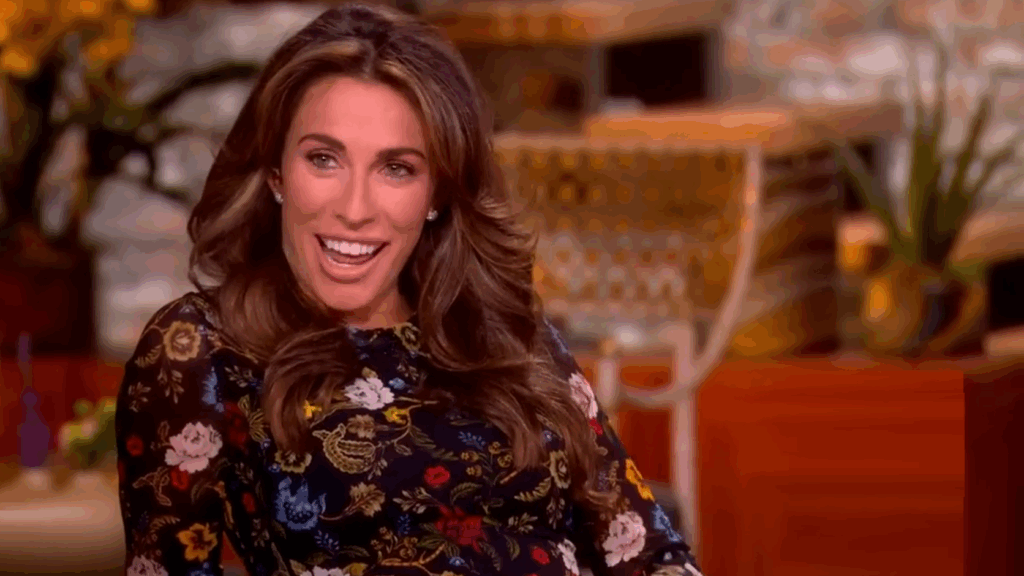
On ‘The View,’ Alyssa Farah Griffin breaks the news that she is pregnant. (Image Credit: ABC)
Yes, Alyssa Farah Griffin is pregnant with Baby #1!
Alyssa Farah Griffin and husband Justin Griffin are expecting their very first child.
During the Wednesday, October 8 Hot Topics segment of The View, she broke the news that she is pregnant.
The Griffins are expecting a son.
And the due date is in February 2026.
After Alyssa broke the news, her fellow co-hosts showered her with congratulations.
During the clip, Alyssa snuck in the information as the co-hosts discussed embarrassing moments.
She referred to a viral moment when Whoopi Goldberg had stopped mid-sentence to ask if she might be pregnant.
Alyssa broke the news by asking Whoopi if she would like to revisit the question. And, indeed, the legendary actress would.
Everyone congratulated Alyssa, showering her with hugs.
Her husband, Justin, was in The View‘s audience, and stood up as the crowd celebrated the news along with the co-hosts.
After previously sharing her suspicions, Whoopi Goldberg experienced joyous vindication on ‘The View’ in October 2025. (Image Credit: ABC)
She shared her IVF journey
In addition to sharing the news on The View, People published an interview about Alyssa Farah Griffin’s pregnancy on the same day.
“Baby Griffin is on the way and we’re just so excited — and terrified,” the television host expressed.
“It’s starting to feel very real,” she noted.
Alyssa shared: “This past week, I felt the baby kick for the first time, and immediately I grabbed Justin’s hand and he felt and I was like, ‘Oh my gosh, what’s happening?!’ It was magical.”
She credited The View with giving her the schedule flexibility to make fertility appointments and, now, prenatal appointments.
The co-hosts of The View celebrate Alyssa Farah Griffin as she announces her first pregnancy. (Image Credit: ABC)
According to Alyssa, her fertility specialist really filled her with confidence — assuring her from the start that she would become a parent.
When she got the call confirming her pregnancy, she was actually in the midst of celebrating her birthday.
She and her doctor ended up crying together over the phone.
“She knew how hard it was, but she made it easy on us,” Justin chimed in.
He praised: “She was really fantastic.”
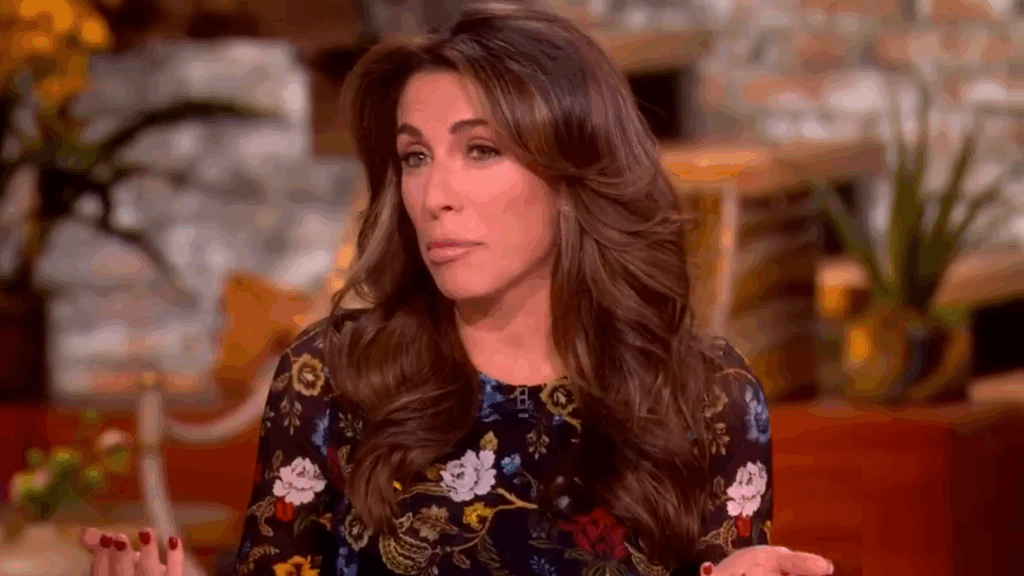
For the October 8, 2025 episode of ‘The View,’ Alyssa Farah Griffin had some big news to share. (Image Credit: ABC)
Congratulations!
Alyssa Farah Griffin is actually only 36, which may come as a surprise to some. (We double-checked; she was born in 1989)
But people of many ages can go on their own fertility journeys — and mid-30s is actually “late” for a pregnancy, believe it or not.
Alyssa was very direct about how IVF was a bit of a “roller coaster.”
The injections alone can alter mood and behavior in a way that, she freely admitted, may have been unpleasant for those around her.
Now, however, she is pregnant. Just as Whoopi predicted.
The news was later confirmed by Gatti’s boxing coach, Moe Latif:
“It is unfortunately not a rumor or a joke. Arturo is gone,” Latif wrote, according to People magazine.
“I’d appreciate if you stop reaching out at this time,” he added.
A tragic family history
Gatti Jr. was just one year old when his father was found dead under mysterious circumstances in July 2009 in Porto de Galinhas, Brazil.
While the elder Gatti’s death was ruled a suicide, The Ring magazine reports that an examination by renowned forensic pathologist Dr. Michael Baden revealed that Gatti did not hang himself.
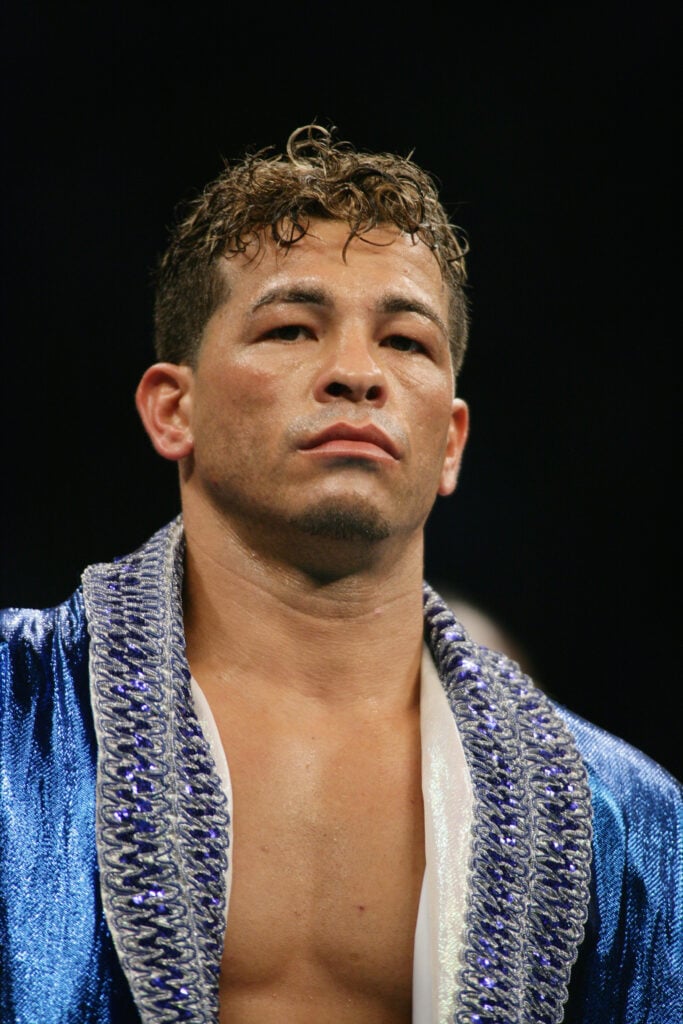
Arturo Gatti looks on against Floyd Mayweather Jr. during the WBC Super Lightweight Championship fight at Boardwalk Hall on June 25, 2005 in Atlantic City, New Jersey. (Photo by Al Bello/Getty Images)
On Zito’s Instagram post, commenters offered condolences to the family while expressing utter shock and bafflement:
“How can this happen again?? So sad I love his dad !! True warrior!” one commenter wrote.
“Check in on your family and friends from time to time friends, you never know the demons people fight everyday and the sweetest people are usually the ones going through things, May God bless the Gatti family,” another added.
“No words can say how my heart aches hearing this. RIP BABY BOY,” a third offered.
Our thoughts go out to the Gatti family during this enormously difficult time.
We will have further updates on this developing story as new information becomes available.
If you or someone you know is experiencing suicidal thoughts, call or text 988, or chat at 988lifeline.org 24 hours a day, seven days a week.
One day after her sister Freida told folks she’d been “up all night praying” for the star, the legendary artist addressed concerns about her recent health issues in a video posted to social media.
In short? She’s not dead, Parton claims.
(Instagram)
Talking to fans from the set doing some commercials for the Grand Ole Opry, the singer said that “lately everybody thinks that I am sicker than I am,” continuing as follows:
“Do I look sick to you? I’m working hard here! Anyway, I wanted to put everybody’s mind at ease, those of you that seem to be real concerned, which I appreciate.
“I appreciate your prayers, ’cause I’m a person of faith. I can always use the prayers for anything and everything. But I want you to know that I’m okay.”
Parton went on to note that some of her “problems” were connected to the aftermath of her husband Carl Dean’s death in March, when she neglected her own health.
The spouses were married for 58 years before Dean passed away on March 3 at age 82.
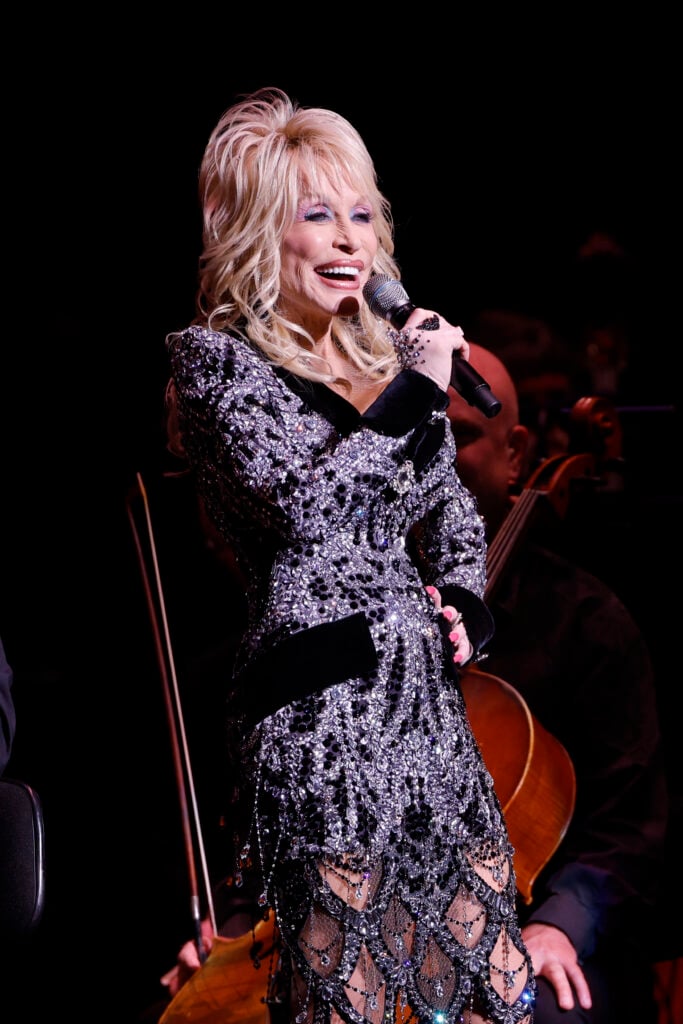
Dolly Parton speaks onstage at Dolly Parton’s Threads: My Songs In Symphony World Premiere at Schermerhorn Symphony Center on March 20, 2025 in Nashville, Tennessee. (Photo by Jason Kempin/Getty Images)
“Back when my husband Carl was very sick, that was for a long time, and then when he passed, I didn’t take care of myself, so I let a lot of things go that I should’ve been taking care of,” she went on.
“So anyway, when I got around to it, the doctor said, we need to take care of this. We need to take care of that.
“Nothing major, but I did have to cancel some things so I could be closer to home, closer to Vanderbilt [University Medical Center], where I’m kind of having a few treatments here and there, but I wanted you to know that I’m not dying.”
Parton is 79 years old.
She announced on September 28 that she had to postpone her residency — which was scheduled to run from December 4 to December 13 at the Colosseum Theater at Caesars Palace — until September 2026 due to “health challenges.”
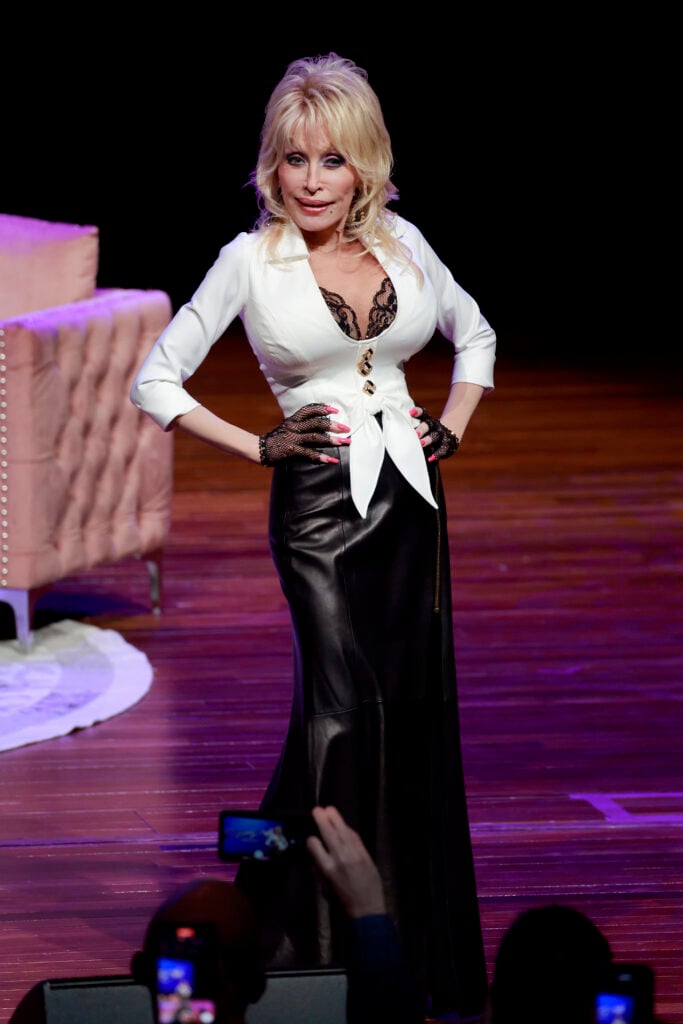
Dolly Parton attends “Dolly: An Original Musical” fireside chat and press conference at The Fisher Center for the Performing Arts on January 28, 2025 in Nashville, Tennessee. (Photo by Jason Kempin/Getty Images)
“My doctors tell me that I must have a few procedures,” the icon explained in her Instagram post. “As I joked with them, it must be time for my 100,000-mile check-up, although it’s not the usual trip to see my plastic surgeon!”
“In all seriousness, given this, I am not going to be able to rehearse and put together the show that I want you to see, and the show that you deserve to see. You pay good money to see me perform, and I want to be at my best for you.”
Fair and reasonable and, yes, a tad bit concerning.
But Parton’s sister made things even more concerning when she asked for the aforementioned prayers… prior to clarifying that she didn’t mean to cause panic.
Dolly Parton attends the opening of Country Music Hall of Fame® and Museum’s new exhibit ‘Dolly Parton: Journey of a Seeker’ at Country Music Hall of Fame and Museum on May 19, 2025 in Nashville, Tennessee. (GETTY)
Concluded Parton this time around, after assuring fans she had no plans to retire:
“There’s just a lot of rumors flying around, but I figured if you heard it from me, you’d know that I was okay.
“So anyhow, that’s what I wanted to say and I’m not ready to die yet. I don’t think God is through with me and I ain’t done working. So I love you for caring, and keep praying for me.”
Joan Kennedy — who was married to Senator Ted Kennedy for 22 years — has passed away.
The death comes amid a tumultuous year for the Kennedy family, have been divided along ideological lines since the appointment of Robert F. Kennedy Jr. as secretary of the Department of Health and Human Services.
Joan Kennedy was 89 years old.
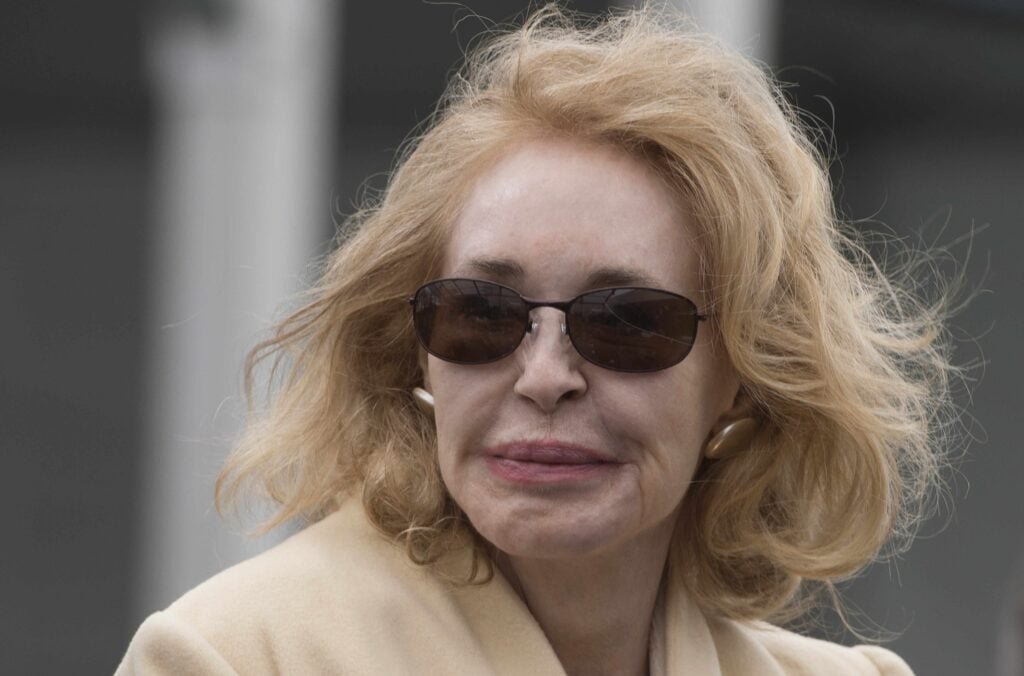
Joan Bennett Kennedy, the first wife of US Senator Ted Kennedy, attends the dedication of the Edward M. Kennedy Institute for the United States Senate in Boston, Massachusetts, March 30, 2015. (Photo credit should read JIM WATSON/AFP via Getty Images)
Joan Kennedy’s son shares news of her death
News of Joan’s passing comes courtesy of her son, Patrick Kennedy, and his wife, Amy:
“Mrs. Kennedy was a classically trained pianist, an advocate for mental health and addiction recovery, and a quiet pioneer in publicly addressing challenges with alcoholism and depression at a time when few others would,” the couple wrote, adding:
“Her courage and candor helped break stigma and inspired others to seek help and healing. Her impact on the arts, mental health advocacy, her beloved Boston community, and the nation will be remembered by many.”
No cause of death has been made public.
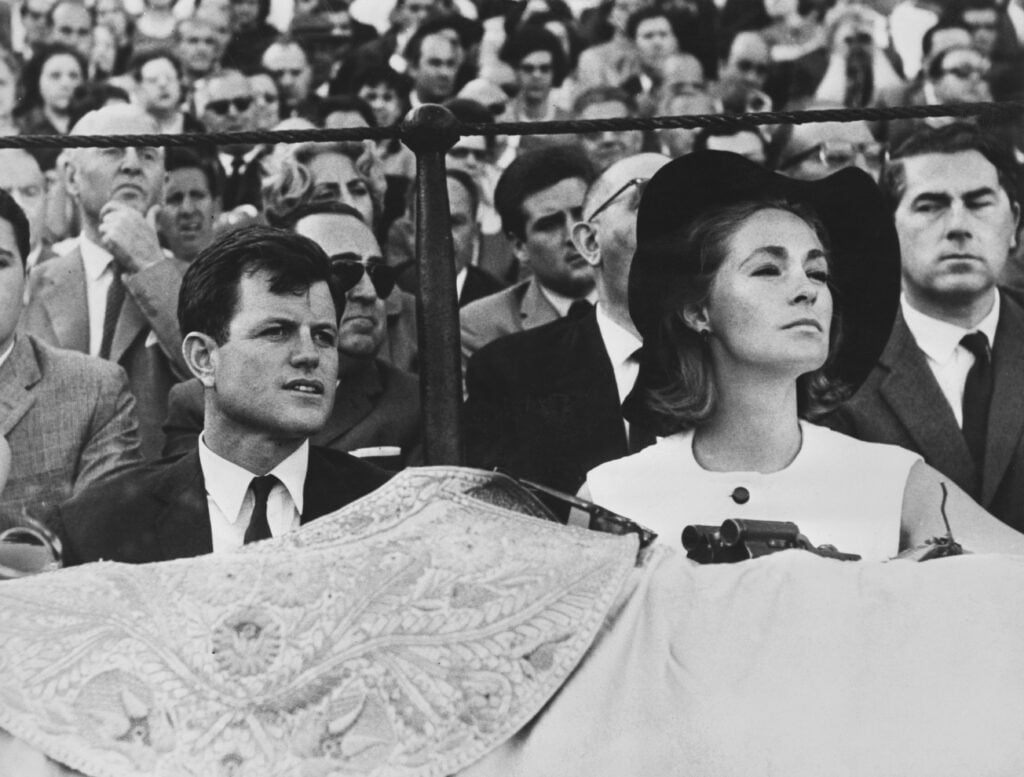
US Senator Ted Kennedy watches a bullfight in Seville with his wife Joan Bennett Kennedy, 21st April 1965. (Photo by Express/Hulton Archive/Getty Images)
Joan Kennedy’s tumultuous life in the spotlight
Once one of the nation’s most famous political spouses, Kennedy struggled with alcoholism and mental health issues, and she inspired millions by going public with these challenges.
While she stood by Ted Kennedy throughout the infamous Chappaquiddick scandal that nearly derailed his career, signs of the couple’s estrangement were impossible to hide by the time he challenged Jimmy Carter for the Democratic presidential nomination in 1980.
A popular bumper sticker at the time read, “Vote for Jimmy Carter, Free Joan Kennedy.”
Three years later, the couple would finally divorce under the strain of Ted’s numerous public scandals and extramarital affairs
Born Virginia Joan Bennett on September 2, 1936, Kennedy worked as a model in television ads before being introduced to Ted Kennedy by his sister Jean in 1957.
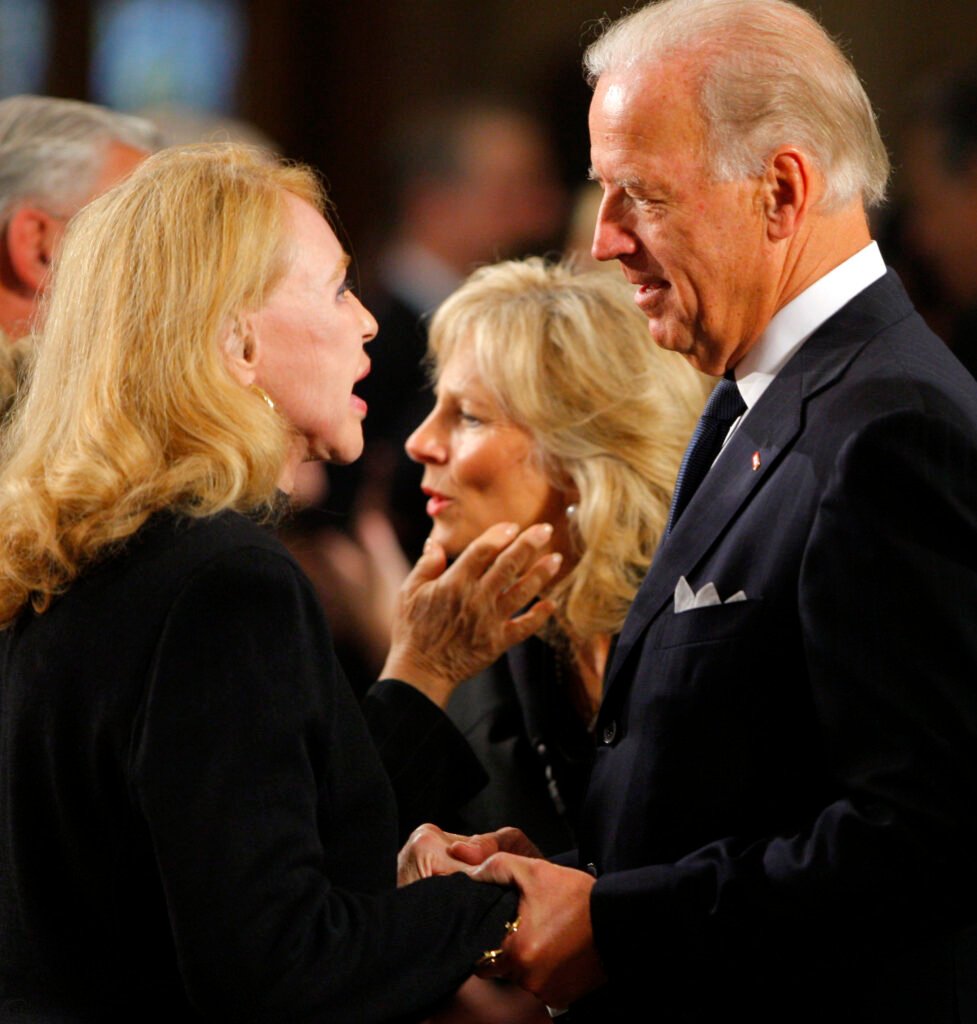
U.S. Vice President Joe Biden (R) and his wife Jill (C) talk with U.S. Senator Edward Kennedy’s ex-wife Joan Kennedy (L) during funeral services for Sen. Kennedy at the Basilica of Our Lady of Perpetual Help August 29, 2009 in Boston, Massachusetts. (Photo by Brian Snyder-Pool/Getty Images)
After suffering a fall in Boston’s Beacon Hill neighborhood, Joan became one of the first high-profile American women to publicly acknowledge her addiction.
Kennedy gave interviews to People and McCall’s magazines discussing her struggles with alcoholism and reported that she’d gotten sober with the help of Alcoholics Anonymous.
Reinventing herself after the public dissolution of her marriage, Joan earned a Master’s degree in Education from Lesley College University in 1982 and later published a book entitled The Joy of Classical Music.
She is survived by two of her children, her eldest, Kara Kennedy, having passed away in 2011.
Our thoughts go out to the Kennedy family during this enormously difficult time.