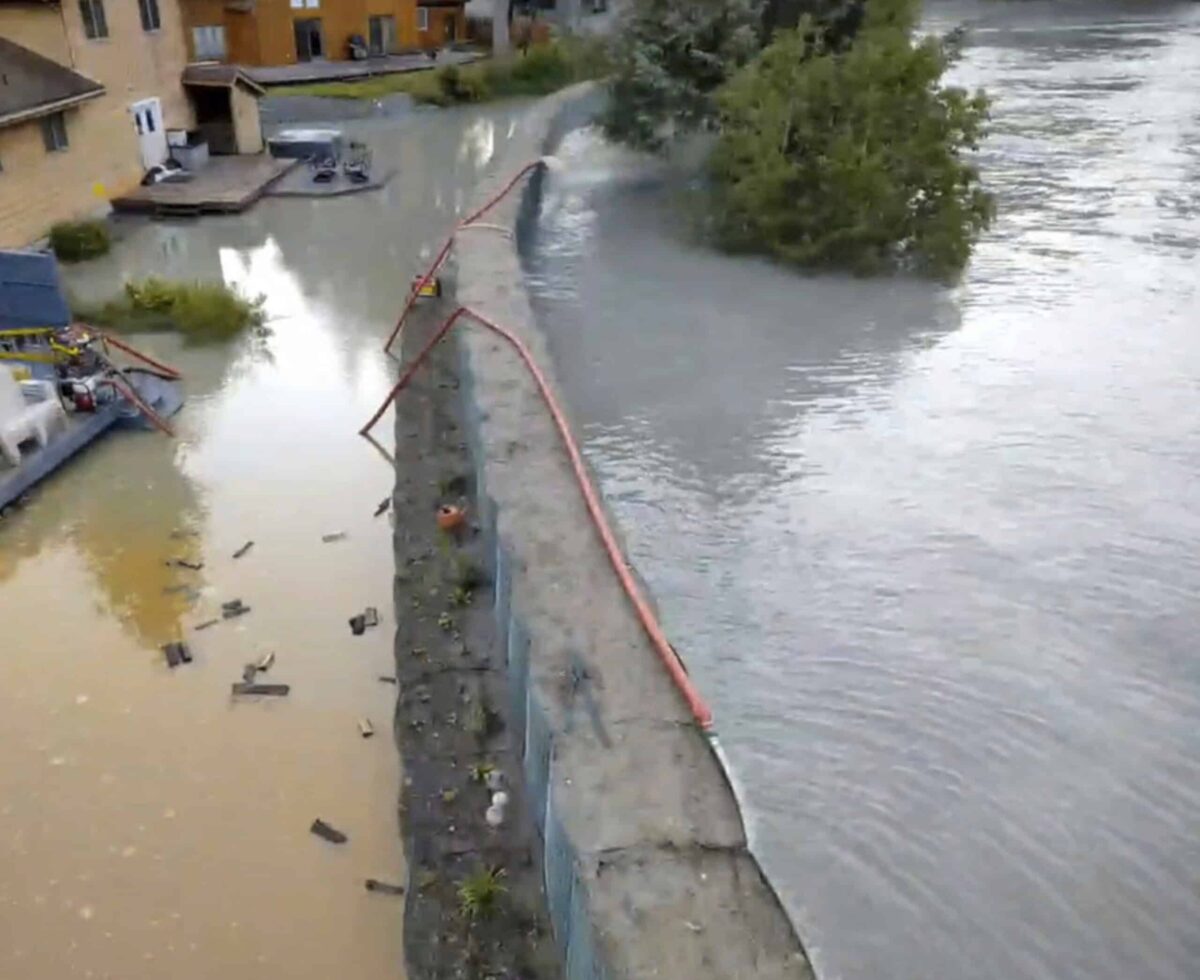
This drone image provided by the City and Borough of Juneau shows flooding from a release of water and snowmelt at Mendenhall Glacier covered some roads and threatened homes along the Mendenhall River in Juneau, Alaska on Wednesday, Aug. 13, 2025. (City and Borough of Juneau via AP)
This drone image provided by the City and Borough of Juneau shows flooding from a release of water and snowmelt at Mendenhall Glacier covered some roads and threatened homes along the Mendenhall River in Juneau, Alaska on Wednesday, Aug. 13, 2025. (City and Borough of Juneau via AP)
AP- New sandbag-style barriers installed along a river in Alaska’s capital city held back record levels of flooding and prevented widespread damage after an ice dam at the nearby Mendenhall Glacier released a massive amount of rainwater and snowmelt downstream, officials said Wednesday.
Water pooled on several streets and in some yards in Juneau after the Mendenhall River crested earlier in the day, and high water was expected to persist for hours. But many residents in the flood zone evacuated ahead of peak water levels, and there were no damage reports similar to the last two years, when flooding was rampant and some homes washed away.
The barriers “really have protected our community,” Juneau City Manager Katie Koester told a news conference. “If it weren’t for them, we would have hundreds and hundreds of flooded homes.”
The Mendenhall Glacier is about 12 miles (19 kilometers) from Juneau, home to 30,000 people in southeast Alaska, and is a popular tourist attraction due to its proximity and easy access on walking trails. Homes on the city’s outskirts are within miles of Mendenhall Lake, which sits below the glacier, and many front the Mendenhall River, into which the glacial outburst flowed.
Juneau, which is accessible only by boat and plane, is 570 miles (917 kilometers) southeast of Anchorage, Alaska’s largest city. The flooding won’t impact Friday’s summit in Anchorage between President Donald Trump and Russian President Vladimir Putin.
Basin flooding is a yearly worry
Flooding from the basin has become an annual concern since 2011 and has gotten worse in recent years. It happens because a smaller glacier near Mendenhall Glacier retreated — a casualty of the warming climate — and left a basin that fills with rainwater and snowmelt each spring and summer, dammed by the glacier.
When the water builds up enough pressure, it forces its way under or around the ice dam, enters Mendenhall Lake, and flows down the Mendenhall River.
The city saw successive years of record flooding in 2023 and 2024, with flooding extending farther into the Mendenhall Valley.
A large outburst can release some 15 billion gallons of water, according to the University of Alaska Southeast and Alaska Climate Adaptation Science Center. That’s the equivalent of nearly 23,000 Olympic-size swimming pools. During last year’s flood, the flow rate in the rushing Mendenhall River was about half that of Niagara Falls, the researchers say.
Barriers are installed
City officials responded to concerns from property owners this year by working with state, federal and tribal entities to install a temporary levee along roughly 2.5 miles (4 kilometers) of riverbank in an attempt to guard against widespread flooding. The 10,000 “Hesco” barriers are essentially giant, reinforced sandbags intended to protect more than 460 properties, said emergency manager Ryan O’Shaughnessy.
But the measure was not without critics. Two homeowners have sued, complaining that the government was taking their property to erect the barriers without compensating them.
On Tuesday and Wednesday, some water seeped into yards through drains that had been installed under the barriers. In other spots, trees floating down the river struck and damaged the barriers, officials said.
The U.S. Army Corps of Engineers is at the start of what’s expected to be a yearslong process of studying conditions in the region and examining options for a more permanent solution, such as a levee. The timeline has angered some residents, who say it’s unreasonable.
Outburst floods are expected to continue as long as the Mendenhall Glacier acts as an ice dam to seal off the basin, which could span another 25 to 60 years, according to the university and science center researchers.
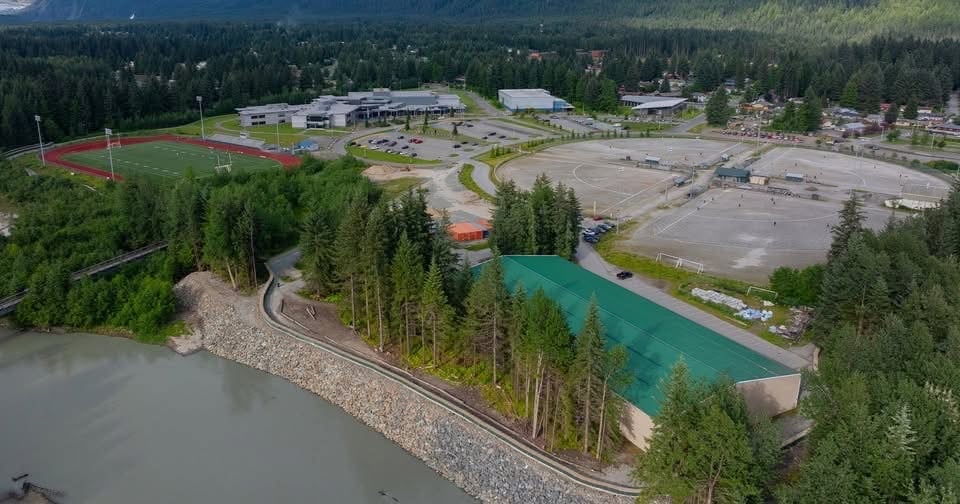
The Juneau School District office in downtown Juneau.
(Photo courtesy City & Borough of Juneau)
The Juneau School District office in downtown Juneau.
(Photo courtesy City & Borough of Juneau)
NOTN- The Juneau School District has canceled all classes for Thursday, Aug. 14, citing ongoing flood warnings for the Mendenhall River and the need to assess damage in the Mendenhall Valley area.
JSD released a statement this morning, The district said it will continue to monitor the situation and notify families of any changes through automated calls, emails, texts, its mobile app and its website. “The safety of our staff and students is always our number one priority.”
The National Weather Service’s flood warning remains in effect until 8 a.m. Thursday. Three district schools are located in the affected area. Officials said the delay will allow Unified Command and safety crews to evaluate conditions before students return.
Classes for grades 1–12 are scheduled to begin Friday, Aug. 15, while the first day of kindergarten will be Monday, Aug. 19.
The Mendenhall River reached its peak crest at 16.65 feet around 7:15 a.m. this morning, according to the National Weather Service.
Sean, a meteorologist with the National Weather Service, confirmed that water levels are expected to gradually recede throughout the day.
“We’ve determined that a crest occurred of around 16.65 feet, around 710, 7:15, this morning.” Said Sean, “From that point though, it will still take 15 to 45 minutes for areas further downstream to also observe this crest in river.”
No additional rainfall is forecast for Juneau through Friday, which should help stabilize river conditions.
“We will see water levels continue to drop, so through today and tomorrow, and even into Friday, we are not having any additional rainfall, so there should be no extra input into the basin.”
The National Weather Service operations, photo courtesy of the National Weather Service.
NOTN- As of this morning, the Mendenhall River remains in major flood stage due to the ongoing release from Suicide Basin and three days of heavy rain. As of 5 a.m., the river was at 15.78 feet and rising.
Forecasters expect it to crest between 16.25 and 16.75 feet late this morning, with the highest likelihood near 16.75 feet around 8 a.m. The river is expected to drop below flood stage by Tomorrow.
According to the City and Borough of Juneau, HESCO barriers have not been breached, officials reported ponding water on Meander Way and Marion Drive, which is not a breach of the barriers themselves.
According to CBJ this is water seepage at the barriers and crews have installed water pumps.
City and staff continue to monitor conditions and will provide updates as things change.
A person walks past a homeless encampment in the Skid Row community in Los Angeles in June 2024. Mario Tama/Getty Images
Homelessness is on the rise in the United States, and in some places, it is becoming more common for the police to arrest someone for sleeping or living in a public space.
The ruling reversed earlier federal appeals court rulings from 2019and 2022 that determined cities cannot enforce anti-camping laws against homeless people if there are not enough shelter beds available for them.
As someone who has spent more than a decade researching homelessness and speaking with unhoused communities, I have seen firsthand how enforcement of such laws imposes unavoidable hardships on homeless people and makes it harder for them to find a stable home.
The rate of unsheltered homelessness, meaning homeless people who are sleeping in places that are not meant for humans to rest in, like parks or cars, is the highest in California.
After the Supreme Court’s decision, California Gov. Gavin Newsom issued an executive order in July 2024 that directs state agencies and departments to adopt new policies that remove homeless encampments. Those are temporary outdoor living spaces used by homeless people, often on public or private property.
Nevertheless, many cities are enforcing existing and new bans on homeless encampments more aggressively than before the Supreme Court decision – despite evidence that such enforcement is not effective in dealing with the problem of homelessness.
Instead, encampment sweeps and camping bans typically displace people from one area to another, while discarding or destroying their personal belongings in the process, such as identification cards, medications and sleeping gear.
This approach also wastes public resources by paying groups to throw away people’s belongings instead of investing that money into actual housing solutions, like creating more affordable housing options.
San Francisco is an example of an American city with a relatively large homeless population that has taken a more aggressive approach to enforcing bans on homeless encampments over the past year.
San Francisco identified approximately 8,300 homeless city residents in 2024.
In June 2025, I conducted a survey of 150 homeless people in San Francisco. About 10% of those people who gave a reason for a recent arrest reported being jailed for lodging without permission. Another 6% said they were arrested for trespassing.
In the same survey, which is part of an ongoing project, 54% of homeless San Francisco residents reported being forced to move from a public space at least once.
Another 8% reported being cited for another reason related to trespassing.
A less aggressive path in Portland
Other western American cities with large homeless populations have taken slightly different approaches to removing homelessness encampments since June 2024.
Other homeless people in Portland have received police citations for other offenses, like trespassing.
As part of my June 2025 study, I surveyed 150 homeless Portland residents. About 49% of respondents reported having been arrested at some point in their lives. Though no respondents were arrested for camping in a prohibited place, 68% of people I spoke with reported that police or other government officers forced them to leave a public space at some point over the past year.
And 13% of those who gave a reason for being cited by police said it was for camping in a prohibited place. Another 11% of homeless people were cited for some other reason related to living without shelter.
As part of the study, I also interviewed residents who had been arrested while living on the street. One Portland resident I interviewed – who asked not to be named to preserve their anonymity – told me they lost the chance to rent an apartment because they were arrested in 2023 on a preexisting, unrelated warrant after a police officer checked their ID – just days before they were supposed to pick up their keys.
“Many unhoused people have warrants simply for failing to appear after being cited for sitting or resting in public space,” they said. “I was supposed to go get the keys and, bam, I got picked up. I was arrested and went to court. Just me being in jail for five, six or five days screwed it all. I didn’t show up to get the keys, and then (the landlord) couldn’t get ahold of me, and they had no idea what was going on.”
The weeklong jail stay not only pushed this person back onto the street, but it also put them back onto a waiting list for housing – where they remain in 2025.
A volunteer helps a person into his tent after relocating him from one park to another in Grants Pass, Oregon, in March 2024. AP Photo/Jenny Kane
Looking ahead
The Supreme Court’s 2024 ruling did not mandate that cities criminalize homelessness. But it effectively gave cities the green light to do so without fear of violating people’s constitutional protections.
The effects of this ruling will be further felt with President Donald Trump’s July 24, 2025, executive order that ended federal support for approaches like Housing First, a policy that prioritizes providing homeless people with housing, before any other needed help. The order also calls for involuntarily committing homeless people with mental illness to mental health institutions.
As more cities consider tougher encampment ordinances, I think it is worth considering if more punitive measures really address homelessness. Decades of evidencesuggest they won’t.
Instead, arresting homeless people often deepens their poverty, increases displacement and diverts public funding away from the real solution – stable, affordable housing.
Stephen Przybylinski does not work for, consult, own shares in or receive funding from any company or organization that would benefit from this article, and has disclosed no relevant affiliations beyond their academic appointment.
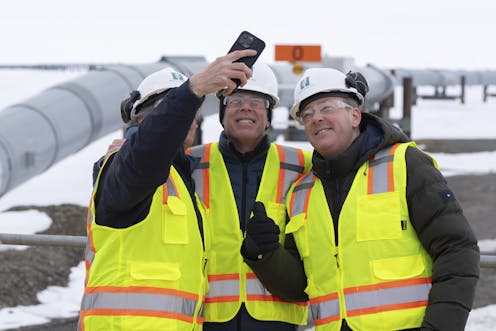
U.S. Interior Secretary Doug Burgum, left, takes a selfie with Energy Secretary Chris Wright, center, and EPA Administrator Lee Zeldin in front of the Trans-Alaska oil pipeline.AP Photo/Jenny Kane
The Trump administration’s plan to unravel many of the nation’s climate policies hinges on rescinding what’s known as the endangerment finding. But its strategy for doing that appears to run afoul of several federal laws.
The endangerment finding is a 2009 determination by the Environmental Protection Agency that six greenhouse gases, including carbon dioxide, contribute to climate change and therefore pose a threat to public health and welfare.
The scientific evidence of these threats has gotten stronger in the years since the endangerment finding was made. That evidence is laid out in multiple national and international reports written by hundreds of scientists who reviewed the data and research.
I have served in the federal government and on numerous scientific federal advisory committees, and I’ve seen firsthand the rigorous requirements that federal agencies are supposed to meet so that scientific information they disseminate can be trusted by the public.
The Energy Department and the EPA seem to have run afoul of four laws in particular that may be tricky for the administration to get around.
1. Has the Energy Department produced a credible report?
A casual reader might think the Energy Department climate report is credible.
Its inside cover affirms that it “is being disseminated … in compliance with” the Information Quality Act. The word “disseminated” means that this is a final report and not just a draft.
The Information Quality Act, passed by Congress in 2000, requires “ensuring and maximizing the quality, objectivity, utility, and integrity of information (including statistical information) disseminated by Federal agencies.”
The author annotates the title page of the Energy Department’s report. Christopher Frey
This law is the basis for federal guidance on scientific peer review for all agencies. It also requires agencies to provide the public with an opportunity to request corrections in final reports if they were not properly developed or lack balance, accuracy and objectivity. The agency decides whether to grant the request, but there is an appeals process.
One author of the Energy Department’s report stated that the report was reviewed by “eight scientists/administrators employed by the DOE.” However, this does not meet the government’s standards for implementing the law, which requires a public record of review by scientific experts not affiliated with the department that issued the report.
2. Agencies cannot cherry-pick groups to give answers they want
The Federal Advisory Committee Act of 1972, or FACA, addressed concerns that “special interest groups” could “exercise undue influence” in promoting “their private concerns” on “matters in which they have vested interests.”
The law requires a public process for creating and appointing groups to advise the government and requires that the properly appointed group operates in public view and takes public comments along the way.
According to the DOE’s own guidance, “FACA applies when a group is asked to render advice or recommendations as a group and not a collection of individuals.”
Thus, the group chosen to write the department’s report falls within the scope of FACA. The law requires that a committee representing a fair balance of viewpoints be chartered under FACA and that members be appointed only after a public nomination process with public opportunity to comment on the list of candidates.
Once appointed, a balanced group is also required to deliberate in public and receive public comments in formulating their report. That didn’t happen.
3. Federal agencies cannot be arbitrary or inconsistent in rulemaking
The Administrative Procedure Act of 1946 requires federal agencies to allow public participation in rulemaking processes and to follow consistent procedures and practices when developing regulations.
Agencies are expected to examine relevant data. They must not only follow applicable laws, such as FACA, but also must follow procedures established to implement those laws, such as balanced membership of the committee and opportunity for public comment when formulating the report.
Four federal laws that apply to the EPA’s effort. Christopher Frey
4. Science Advisory Board review is also required
The EPA is also subject to the Environmental Research, Development and Demonstration Authorization Act of 1978. The act mandated that the EPA must establish a Science Advisory Board. It also requires that agency make available to its Science Advisory Board relevant scientific and technical information on any “proposed criteria document, standard, limitation, or regulation.”
The board must be given time to review the scientific and technical basis of the proposed action – in this case, the disseminated Energy Department report – now that the EPA is using this report to inform its regulatory action.
Under the Information Quality Act, the EPA may not develop a regulation based on a draft report.
The EPA’s Science Advisory Board website lists zero members as of mid-August 2025. On Jan. 28, 2025, the EPA dismissed all of the board’s previous members. Nominations for new board members were due on June 2. At best, it will be months before the EPA can seat a new Science Advisory Board because of time needed to complete the selection, appointment and ethics review processes.
An annotated screenshot of the EPA’s Science Advisory Board website shows no members as of Aug. 11, 2025. EPA
Either the EPA could follow the law and suspend any proposed actions until the Science Advisory Board is available, or accept legal risk for not following the Environmental Research, Development and Demonstration Authorization Act.
What’s next?
These laws exist to protect the public by preventing the federal government from being unduly influenced by narrow interests when disseminating evidence that informs policy decisions. Science-based agencies such as the Energy Department and the EPA have a legal requirement to follow the science.
The public has a chance to comment on the EPA’s proposal to rescind the 2009 endangerment finding and greenhouse gas vehicle standards until Sept. 15, 2025. And although the Energy Department disseminated its report as a final version, the department is accepting public comments on the report through Sept. 2.
Because the Energy Department report is presented as final, it is also subject to the “request for correction” process under the Information Quality Act within 60 days of its initial release.
Given the Energy Department report’s legal vulnerabilities, the Trump administration could consider withdrawing the report and starting over with a legally and scientifically valid approach. If these vulnerabilities are not corrected and the EPA rescinds the endangerment finding based on the Energy Department report, years of litigation are likely to slow the administration’s efforts.
Dr. H. Christopher Frey is currently a professor of environmental engineering at North Carolina State University. He has served on numerous scientific advisory committees, including the U.S. Environmental Protection Agency FIFRA Scientific Advisory Panel (2004-2006), Science Advisory Board (2012-2018), and Clean Air Scientific Advisory Committee (2008-2015). He was chair of CASAC from 2012 to 2015. He has served on study committees of the National Academies of Science, Engineering, and Medicine. He served at EPA from 2021 to 2022 as Deputy Assistant Administrator for Science Policy and from 2022 to 2024 as Assistant Administrator for Research and Development and Science Advisor. While in federal service he co-chaired the National Science and Technology Council Committee on Environment.
Over the din of crackling wires and grumbling engines, the president made his case for revitalizing the country’s roads, ports, airports and rail lines.
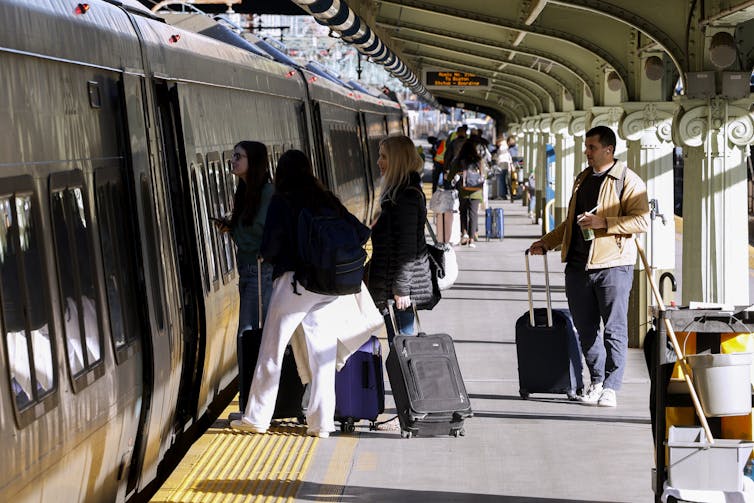
Behind Biden sat rows of gleaming Amtrak trains. Among them was a prototype of NextGen Acela, a sleek machine engineered to deliver the fastest passenger service in American history.
As the author of a book on the Northeast Corridor, the rail line that connects Boston, New York, Philadelphia and Washington, I know this new train cannot come soon enough for many seaboard riders, even though it launches at a time of diminished political will for passenger rail.
Red headrests distinguish first-class cars from business class on the NextGen Acela trains. Courtesy of Amtrak
Gone is Amtrak’s White House champion, railfan-in-chief Biden, replaced by Donald Trump, whose one-time adviser, Elon Musk, called Amtrak a “sad situation,” and who proposed replacing the government-owned carrier with private competitors.
Former President Joe Biden delivers remarks at an Amtrak 50th anniversary event in Philadelphia in 2021. AP Photo/Patrick Semansky
NextGen Acela promises an American rail renaissance in a moment when federally sponsored trains are fighting for their lives, as Biden’s infrastructure ambitions fall to an administration bent on cutting government costs.
These contradictions, however, are nothing new.
Not-so-fast trains
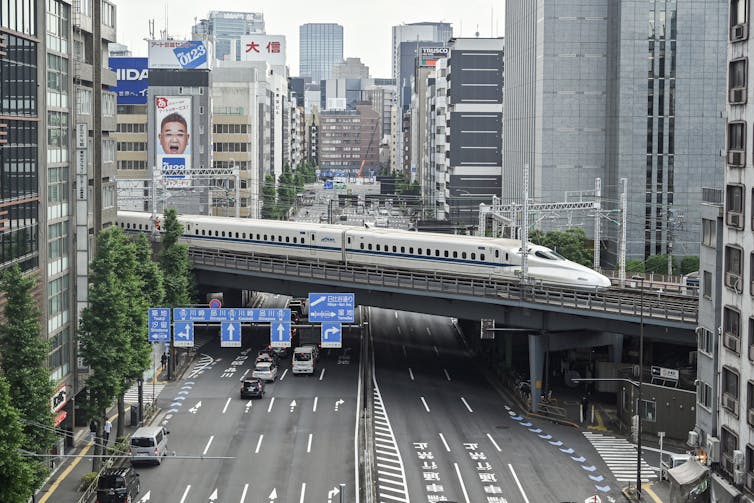
America’s love-hate relationship with fast trains stretches back to October 1964, when Japanese National Railways opened its Shinkansen high-speed line between Tokyo and Osaka.
Americans wanted their own bullet train but were reluctant to pay the massive infrastructural costs of a Shinkansen system. When Congress passed the High-Speed Ground Transportation Act of 1965, it prioritized the development of trains over the reconstruction of tracks, power systems and maintenance facilities.
On Dec. 20, 1967, a gas turbine train manufactured by United Aircraft topped 170 mph while testing in New Jersey. But when the so-called TurboTrain entered service, it managed an average pace of just 63 mph on the weaving track between New York and Boston.
The electric-powered Metroliner, which began service in 1969, boasted similar potential but rarely held triple-digit speeds in service and broke down so often that its carrier, the Penn Central Railroad, struggled to keep the trains running between New York and Washington.
Technical flaws aside, both the TurboTrain and Metroliner were a hit with northeastern riders, so much so that Amtrak retained the Metroliner brand until 2006, long after it had retired the ‘60s-era trains.
Reflecting in 1999, rail journalist Don Phillips expressed disbelief “that those dogs were actually popular with the riding public.”
The birth of Acela
Amtrak opened a new era of high-speed rail in 2000 when it launched Acela Express.
Derived from France’s acclaimed TGV design, Acela carries passengers at speeds up to 150 mph on the Northeast Corridor.
Like the Metroliner before it, Acela suffered from design problems and mechanical faults, including cracked yaw dampers and brake discs, which temporarily sidelined the trains.
And yet riders flocked to the service. Acela became one of Amtrak’s most popular and lucrative trains – so attractive that it lured business travelers off regional airlines.
When Acela entered service in 2000, Amtrak trains claimed just 37% of air-rail traffic between New York and Washington. By 2021, it had 83%. Between New York and Boston, that figure jumped from 20% to 75%.
Acela trains are popular and lucrative for Amtrak, in part because they draw so many business travelers. Anna Moneymaker via Getty Images
Acela 2.0
Now, NextGen Acela takes up the fraught legacy of American high-speed rail. What can we expect of the new train?
NextGen is faster than the original Acela but will not set any world speed records. Its top velocity of 160 mph falls short of global benchmarks set by China’s Fuxing, which hits 217 mph, and Japan’s newest Shinkansens, which reach 200 mph.
With better tracks and signals, NextGen could conceivably ramp up to 186 mph, though such speeds won’t be possible anytime soon.
For now, NextGen will make do with an imperfect corridor. The train’s lightweight design means faster acceleration and lower energy consumption. An enhanced dynamic tilting system will let carriages lean into curves on the corridor’s twisting track, so they lose less speed on turns. The original Acela also tilted, but not as much.
The NextGen Acela bathrooms are more spacious and have more touchless features than the previous design. Courtesy of Amtrak
The upgraded onboard experience includes winged headrests, seat-side USB ports and 5G Wi-Fi. More importantly, each NextGen train can seat 82 more passengers than its predecessor. When Amtrak’s full fleet of 28 NextGens enters service, sending the first-generation trains into retirement, Acela service capacity will have increased by 4,728 seats.
This figure may be the train’s greatest achievement in a congested region at a time when Amtrak is posting record ridership.
The effects of the Northeast’s post-pandemic passenger surge are nowhere more visible than the Philadelphia rail yard where Biden spoke four years ago. Amtrak is constructing a new maintenance shop beside the Schuylkill River that will service NextGen trains and cement Philly’s role in the railroad’s addition of a million annual seats to its non-Acela corridor trains. Powered by conventional electric locomotives, these slower, cheaper “Regionals” accounted for 77% of corridor ridership in 2024 and will continue to carry the bulk of northeastern passengers.
Meanwhile, a quarter-mile south of the maintenance shop, America’s third-busiest passenger hub, 30th Street Station, is receiving a generational overhaul with a new food court, exterior plaza, shops and underground access to rapid transit.
These projects demonstrate the economic power of fast, frequent trains in Philly and throughout trackside communities of the Northeast. America’s embattled but resilient high-speed rail tradition may never be the world’s best, but even incremental improvements, like NextGen, cannot help but transform the places they serve.
For Amtrak’s corridor region, the stakes have never been higher.
Paul Staehle says that he has an obsessed stalker who’s harassing him.
And, the notorious 90 Day Fiance alum says, she’s telling people that she’s his girlfriend.
It gets worse. No, really, it gets worse.
In a video, the woman has gotten Paul’s face and name tattooed onto her actual human body.
In August 2025, Paul Staehle appeared on lengthy YouTube Live sessions to discuss his alleged stalker. (Image Credit: YouTube)
Paul Staehle says that his crazed stalker won’t take ‘no’ for an answer
We normally wouldn’t say this to Paul Staehle, given his 90 Day Fiance history, but … maybe he should run.
Okay, so Paul went on YouTube Live with John Yates on two nights in a row.
This is where he detailed this experience.
Yates is a 90 Day Fiance blogger. He can be controversial and has a penchant for drama to rival most reality stars, but he also has a lot of access in the 90 Day world and Paul was (as always) willing to talk.
Even though Paul and ex-wife Karine Martins have been over for quite a while, he still spends much of his time in Brazil, where being an American has made it easier for him to work.
There, according to Paul, he met a woman named Rubia.
He says that they are not dating and have never dated. Rubia, on the other hand, seems to think that the two are in a relationship — and claimed that Paul tried to knock her up.
“I mean, she’s tattooed my face on her leg,” Paul described.
“I think I seen the video of it. [She] tattooed my name on her arm.”
The woman in question, Rubia, reached out to Yates, insisting that she was “not imagining this connection.”
She claimed that Paul Staehle had suggested that she make a social media account to document their alleged relationship.
Additionally, she told Yates that Paul was only denying their romance to conceal it from Karine.
Paul strongly denied this.
He also said that he has heard from people close to him that Rubia has allegedly contacted and even threatened them.
Wearing a yellow shirt and sitting in front of trash bag-covered windows, Paul Staehle appears to grow angry. (Image Credit: TLC)
Now, Paul did admit to having met Rubia. According to him, they met up at a mall, took what amounted to a fan photo, and “didn’t even eat anything.”
He did not consider it to be a date.
“I mean, now we’re ‘dating’ and then there’s tattoos,” he lamented.
Paul added: “She tried to say that she was, you know, blessed by God with our baby at one point. I was like, this has gone too far.”
From time to time, Paul Staehle seems to just … take off running. Viewers do not really understand it. (Image Credit: TLC)
He’s not interested — or even single
As it happens, Paul Staehle shared that he is “already involved with somebody.” Anyone wondering if they can make it romantically should remember that the guy who wore a condom to go swimming has had a series of relationships, including a marriage.
Paul also offered the general advice that people should wait until they are in a relationship (a real one) before considering a tattoo of the other person.
Let alone multiple tattoos.
“You know, she deserves to find somebody who’s going to treat her right and treat her good,” Paul emphasized of Rubia. “That’s obviously not going to be me. … I’m just not interested, sorry.”
And to touch on what many consider to be the biggest scandal in the history of Hollywood.
It’s been two decades since the veteran actress announced her separation from then-husband Brad Pitt… almost entirely due to his relationship back then with Angelina Jolie.
Those familiar with this controversy will recall that it was, truly, the most talked-about thing EVER.
Jennifer Aniston arrives for the 30th Annual Screen Actors Guild awards at the Shrine Auditorium in Los Angeles, February 24, 2024. (Photo by VALERIE MACON/AFP via Getty Images)
“It was such juicy reading for people,” Aniston told Vanity Fair in an interview published August 11. “If they didn’t have their soap operas, they had their tabloids.”
Indeed, this was the height of the supermarket tabloid.
These days, many consumers get their entertainment news and celebrity gossip from social media or websites such as this one (thank you!).
Over 20 years ago, though?
Folks would purchase magazines and read all about affairs such as the one between Pitt and Jolie, which dominated pretty much every cover for months and months.
Jennifer Aniston arrives at PaleyFest LA 2024 – “The Morning Show” at Dolby Theatre on April 12, 2024. (Photo Credit: Kevin Winter/Getty Images)
“It’s a shame that it had to happen, but it happened,” Aniston added. “And boy did I take it personally.”
As for her mindset at the time? As for how she handled her romance being analyzed and picked apart? And then how the whole world bore witness to what many believes to have been a fairy tale marriage?
“Just pick yourself up by the bootstraps,” she explained to the aforementioned outlet. “And keep on walking, girl.”
Aniston and Pitt got married in 2000 and divorced in 2005.
The same year the spouses called things off, Pitt moved on with Jolie… and the new couple even posed for pictures together in a spread for W magazine, titled “Domestic Bliss,” depicting them as married with kids.
In the wake Pitt and Jolie’s 2005 photoshoot was released, Aniston told Vanity Fair shortly after, “There’s a sensitivity chip that’s missing.”
Jennifer Aniston speaks onstage during the 30th Annual Screen Actors Guild Awards at Shrine Auditorium and Expo Hall on February 24, 2024. (Photo Credit: Matt Winkelmeyer/Getty Images)
Aniston, to her immense credit, has never really blasted her ex in public. She’s always at least seemed to remain on decent terms with Pitt.
“Journalism back then felt more like a form of a sport,” she added this week in regard to the tabloid universe back in the day.
“There’s obviously some PTSD we all have, which is why these [interviews] scare me. How are they going to misinterpret my words or take something out of context? And one line nowadays…”
Jennifer Aniston arrives for the 81st annual Golden Globe Awards at The Beverly Hilton hotel in Beverly Hills, California, on January 7, 2024. (Photo by MICHAEL TRAN/AFP via Getty Images)
As Aniston — who also opened up in this chat about the death of Matthew Perry — noted, it’s hard not to be impacted by headlines.
“We’re human beings, even though some people don’t want to believe we are,” the Emmy winner said. “They think, ‘You signed up for it, so you take it.’ But we really didn’t sign up for that.”
(This should be familiar to anyone who has watched Kody attempt to get along with his actual wives and other family. Is it any surprise that strangers in high-stress situations didn’t find him agreeable?)
After Brianna sort of broke the ice, it was Gia’s turn to speak out.
On The Real Housewives of New Jersey, Gia Giudice smiles politely before things turn sour. (Image Credit: Bravo)
She’s not name-dropping him
“I can’t even name the person that I really did not get along with on this cast,” Gia Giudice admitted during the latest episode of her Casual Chaos podcast.
“There were definitely some people that would get under your skin a little bit,” she understated. “And you guys will see that on the show.”
Note that she did not name Kody Brown. However, Gia did drop a a pair of hefty hints about the notoriously off-putting TLC star.
“You guys have all been talking about him already,” Gia offered as the first clue. “So, I’m sure you could assume who it is.”
As for the second clue, she gushed about how she had grown so close to Brianna during filming.
It isn’t always true that two friends will hate the same person. But, most of the time, if a guy is really ticking off one person, those closest to them will loathe him.
This could be for the same reasons, or just out of solidarity.
Making quite the facial expression, Kody Brown listens to his one remaining wife on ‘Sister Wives.’ (Image Credit: TLC)
Brianna absolutely addressed Kody by name
Meanwhile, Brianna was much more blunt than Gia Giudice was about Kody Brown. She told her fans that she “didn’t know” who the Sister Wives villain was when they met.
“And we didn’t necessarily ~get along well~ lmao you will see,” she teased.
Special Forces might sound like the sort of show that 30 Rock would have concocted as a fake show, but the teases about this friction make for a great promo.
Conflict enthusiasts will have to wait until September 25 for the Season 4 premiere, however.