Ukrainian forces are increasing the intensity of long-range drone strikes deep into Russia, according to data released by Moscow, ahead of Friday's planned meeting between Presidents Donald Trump and Vladimir Putin in Alaska.
Ukrainian forces are increasing the intensity of long-range drone strikes deep into Russia, according to data released by Moscow, ahead of Friday’s planned meeting between Presidents Donald Trump and Vladimir Putin in Alaska. (Photo courtesy ABC News)
LONDON – Ukrainian forces are increasing the intensity of long-range drone strikes deep into Russia, according to data released by Moscow, ahead of Friday’s planned meeting between Presidents Donald Trump and Vladimir Putin in Alaska.
Russia’s Defense Ministry reported downing another 59 Ukrainian drones overnight into Monday morning, with Moscow Mayor Sergei Sobyanin reporting that at least nine craft were shot down en route to the capital.
Russia’s federal air transport agency, Rosaviatsiya, reported temporary restrictions on flights at airports in Penza, Nizhny Novgorod, Kaluga, Volgograd and Saratov during the overnight attacks.
Monday’s figures bring the total number of long-range Ukrainian drones claimed shot down by Russian forces in August to 1,337 — with a daily average of more than 121 drones each day.
Moscow only provides data on the number of drones it claims to have shot down, and not the overall number of Ukrainian craft launched. Neither Ukraine nor Russia provide public information on the scale of their own cross-border drone attacks.
In July, the total number of Ukrainian drones claimed downed over the course of the month was 3,008, with an average of just over 97 craft per day.
Ukraine’s air force, meanwhile, said Russia launched 100 drones into Ukraine overnight into Monday morning, of which 70 were intercepted or suppressed.
Thus far in August, the intensity of Russian strikes on Ukraine appear to have eased. The first 11 days of this month have seen Moscow launch a daily average of 74 drones and one missile into Ukraine, compared with record-breaking July figures of 201 drones and around six missiles per day.
Ukrainian President Volodymyr Zelenskyy and his officials have said Kyiv will continue and expand its long-range strikes in an effort to force Moscow to the negotiating table.
“They in Russia must clearly feel the consequences of what they are doing against Ukraine,” the president said in a statement posted to Telegram in May. “And they will. Attack drones, interceptors, cruise missiles, Ukrainian ballistic systems — these are the key elements. We must manufacture all of them.”
It is not clear whether Zelenskyy will attend Friday’s summit in Alaska. There, Trump and Putin are expected to discuss proposals to secure a ceasefire and potentially to end Russia’s full-scale invasion, which it launched in February 2022.
Zelenskyy has insisted that any negotiations must include Ukraine. Kyiv will also not officially cede any territory, accept limitations on its armed forces, or jettison its ambitions to join NATO and the European Union, Zelenskyy has said.
Putin, though, is demanding that Ukraine cede several regions — not all of which are controlled by Russian troops — in the south and east of the country, accept curbs on the size and sophistication of its military and be permanently excluded from NATO.
Russia’s demands, Zelenskyy has said, constitute an attempt to “partition Ukraine.”
Ukrainian Presidential Press Service on June 27, 2024, in which Ukrainian President Volodymyr Zelensky looks on during a signature ceremony of Agreement on Security Cooperation and Long-term Support between Ukraine and Estonia during the European Council Summit. )Ukrainian Presidential Press Service/POOL/Sputnik/AFP via Getty Images)
Speaking from the White House on Friday, Trump suggested a settlement could include “some swapping of territories.”
Zelenskyy swiftly rejected the proposal, saying Ukraine “will not give Russia any awards for what it has done” and that “Ukrainians will not give their land to the occupier.”
On Monday, Zelenskyy appealed for more pressure on the Kremlin. “Russia is prolonging the war and therefore deserves stronger pressure from the world,” he wrote on Telegram.
“Russia refuses to stop the killings and therefore should not receive any rewards or benefits,” he added.
Sam Russell, Assistant Chief of Administration at CCFR, talks through flood mitigation efforts at August 11 meeting
NOTN- Unified Command is ramping up flood preparations in Juneau, issuing evacuation advisories for at-risk neighborhoods, completing key flood barriers, and closing trails and parks as water levels continue to rise.
in a meeting at the Juneau Police Department, the multi-agency response involving the City and Borough of Juneau, Central Council of the Tlingit & Haida, and state and federal partners told media they were focused on safety, protecting infrastructure, and providing timely public information.
Officials moved the response from “ready” to “set” phase this week, meaning residents in potential inundation zones should be prepared to leave if conditions worsen.
Responders urged residents to have a go-bag ready, review evacuation plans, and sign up for alerts.
Teams are distributing door hangers with QR codes linking to flood maps and emergency updates, and a hotline staffed by responders went live.
The Red Cross has opened an evacuation shelter at Floyd Dryden Gymnasium.
Construction crews have completed Phases 1 and 1A of the HESCO barrier system along the Mendenhall River, but Phase 1B remains on hold due to the lack of property agreements with private landowners.
Closures are also in effect for the pedestrian bridge at Diamond Park, parts of the Montana Creek Trail system, the Brotherhood Bridge Trail, and the Nugget Falls Trail at the glacier. Additional trail closures will be triggered as the lake rises, including the paved Egan Drive path near Brotherhood Bridge once water reaches 10 feet.
Alaska Electric Light & Power plans targeted power cuts in areas that flood, including specific lift stations. Neighborhoods protected by HESCO barriers will not lose power unless inundation occurs. Water and sewer service is not expected to be disrupted.
School officials are coordinating closely with Unified Command and may close schools, release students early, or cancel classes depending on flood warnings from the National Weather Service.
Real-time modeling and flood forecasts are available at JuneauFlood.com.
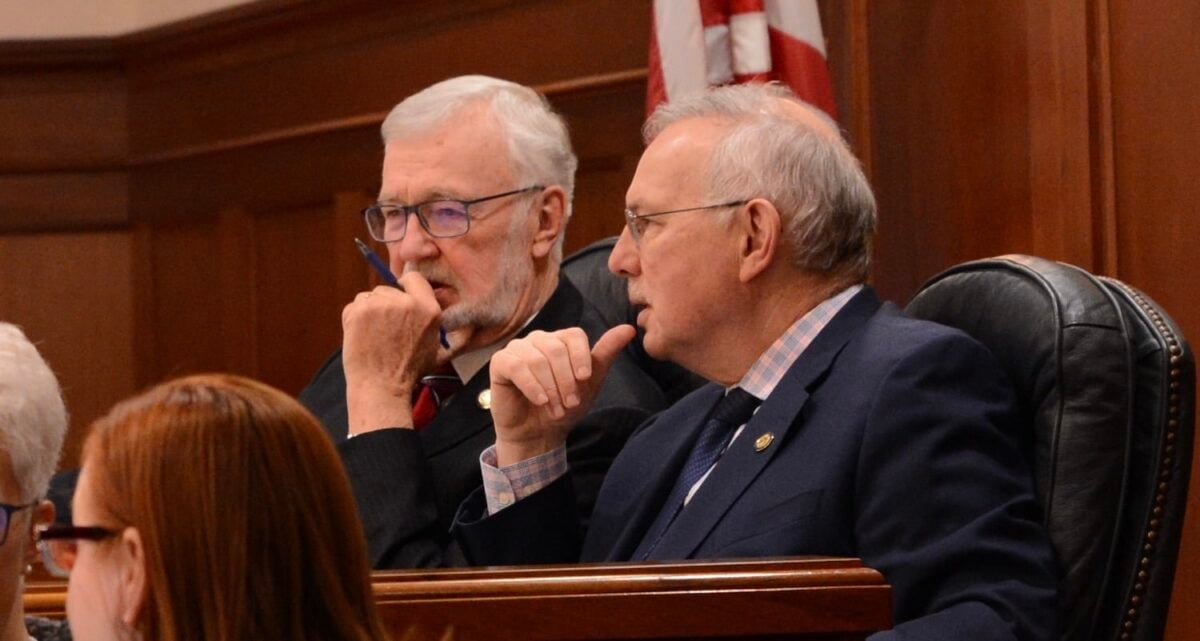
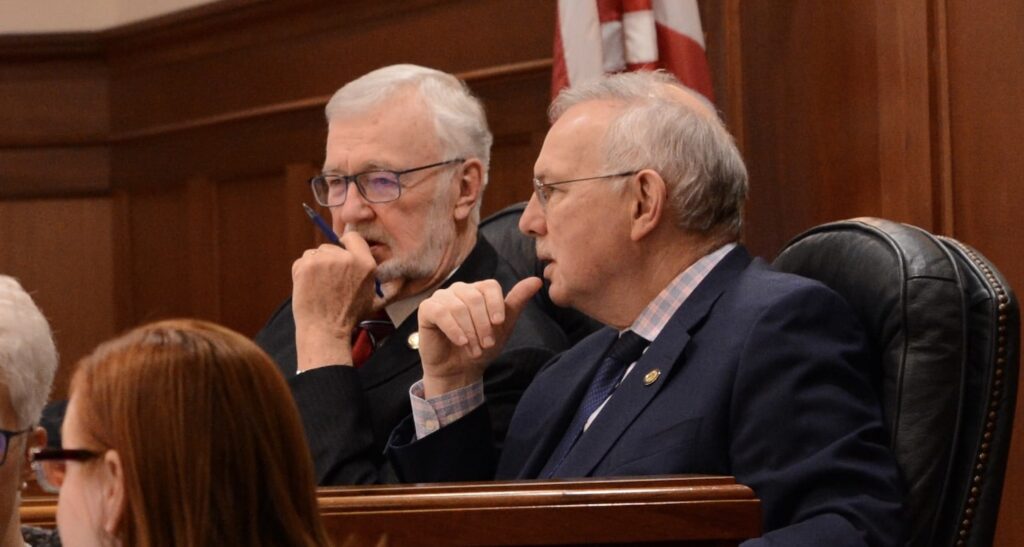
Senate President Gary Stevens, R-Kodiak, and Speaker of the House Bryce Edgmon, I-Dillingham, await an address from U.S. Sen. Lisa Murkowski, R-Alaska, on Tuesday, March 18, 2025. (Photo by James Brooks/Alaska Beacon)
By: James Brooks, Alaska Beacon
Senate President Gary Stevens, R-Kodiak, and Speaker of the House Bryce Edgmon, I-Dillingham, await an address from U.S. Sen. Lisa Murkowski, R-Alaska, on Tuesday, March 18, 2025. (Photo by James Brooks/Alaska Beacon)
Alaska Gov. Mike Dunleavy’s move to establish a state Department of Agriculture during the ongoing legislative special session appears to be turning into a fight over executive power, and it could be ultimately decided by the courts.
Last week, as the special session opened in Juneau, Dunleavy signed an executive order intended to establish the Alaska Department of Agriculture by moving parts of the Alaska Department of Natural Resources into a separate agency.
Alaska is one of only two states without a cabinet-level agriculture department, and Dunleavy has said he wants to create one in order to help the growth of farming in the state. Creating a cabinet-level agriculture department was the top priority of a state “food security” task force in 2022 intended to encourage farming here.
The governor’s order would take effect Jan. 1 and is almost identical to one Dunleavy issued this spring.
Under the Alaska Constitution, lawmakers can stop an executive order if they vote to dismiss it within 60 days. Legislators did just that with the spring order, voting 32-28 in March to deny the governor’s original order.
At the time, and since then, legislators have said that they prefer to enact a state department via law because it allows them to include their own ideas and comments of the public.
“The problem with an executive order is that we can’t amend an executive order,” said Senate President Gary Stevens, R-Kodiak, “and there’s some things that I think folks want to do.”
This month, when Dunleavy repeated the order, legislators refused to accept it.
Stevens and Speaker of the House Bryce Edgmon, I-Dillingham, said in a letter to the governor that introducing an executive order during a special session is unconstitutional, and that repeating an already disallowed order is also unconstitutional.
“This falls in the category of so many things during Dunleavy’s tenure as governor, where he has tried to push the boundaries with the Legislature. And we’re at the point now where we’re tired of being pushed around,” Edgmon said by phone on Friday.
Jeff Turner, the governor’s communications director, said by email on Friday that the letter still stands as the governor’s view and nothing has changed since then.
“His sort of threat to go ahead anyway is a little disconcerting,” Stevens said. “The legislative process, though long … winds up with a better answer because the public will have a chance to testify in the committee hearings, and we’ll all have a chance to discuss it and try to figure out the best way going forward. Unfortunately, an executive order is really sort of a ham-handed way to organize a new department. I really hope the governor allows us to move ahead and do it on our own through the legislative process.”
Legislators could meet in joint session and again vote down the governor’s executive order, but doing so would be an implicit acknowledgement that the governor has the ability to issue a valid executive order during a special session.
“We’ve heard that from our legal folks,” Stevens said, “that establishing a precedent like that could be dangerous in the future. Any governor then could do something without the Legislature really being involved. … and so we’re really concerned about precedents.”
Those differing positions have created a standoff: Legislators are refusing to accept the order as valid, and the governor’s office has said that if legislators don’t vote it down, Dunleavy will take that as acceptance. He said he will go ahead with plans to create the department on Jan. 1.
If he does that, Stevens said that the issue is likely to go to the courts.
Edgmon said that lawmakers are prepared to stand their ground.
“The Legislature believes its decision to send the executive order back to the governor is based on firm ground, and we fully intend to defend our institution’s ability to do its work,” he said.
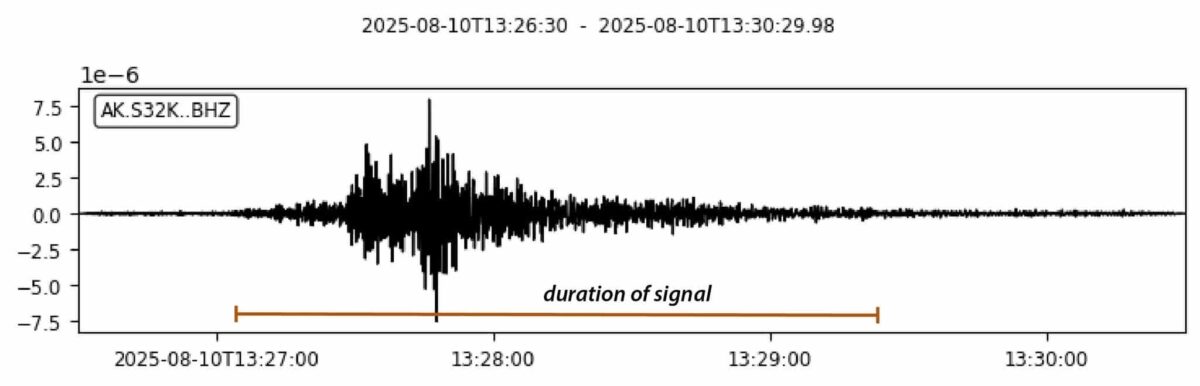
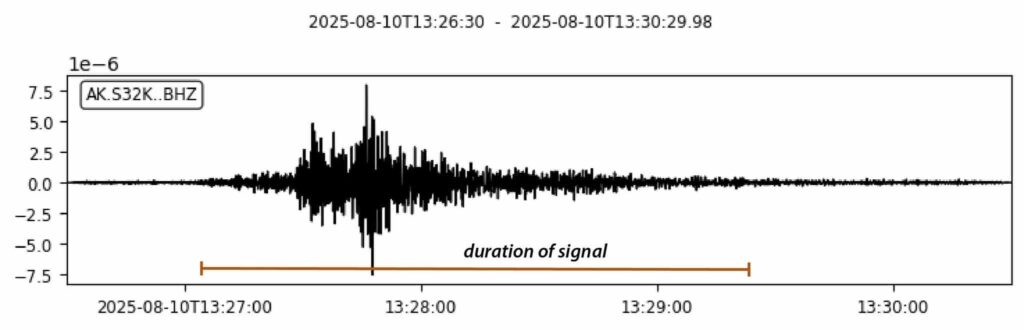
NOTN- A Landslide struck around Endicott Arm, just South of Juneau early Sunday, producing 10 to 15 foot waves according to the Alaska Earthquake Center, they say the waves were observed across the region.
According to the Alaska Earthquake Center the local Tsunami rolled through Endicott Arm just after 5:30 AM following a significant landslide in the region, where several tens of millions of cubic meters of rock struck the water.
Ghanaian special forces take part in U.S. military-led counterterrorism training near Jacqueville, Ivory Coast, on Feb. 16, 2022. AP Photo/Sylvain Cherkaoui
This dismantling of the country’s terrorism and extremism prevention programs began in February 2025. That’s when staff of USAID’s Bureau of Conflict Prevention and Stabilization were put on leave.
And on July 11, the countering violent extremism team at the U.S. Institute of Peace, a nonpartisan organization established by Congress, was laid off. The fate of the institute is pending legal cases and congressional funding.
President Donald Trump in February had called for nonstatutory components and functions of certain government entities, including the U.S. Institute of Peace, to “be eliminated to the maximum extent consistent with applicable law.”
These cuts have drastically limited the U.S. government’s terrorism prevention work. What remains of the U.S. capability to respond to terrorism rests in its military and law enforcement, which do not work on prevention. They react to terrorist events after they happen.
As a political scientist who has worked on prevention programs for USAID, the U.S. Institute for Peace, and as an evaluator of the U.S. strategy that implemented the Global Fragility Act, I believe recent Trump administration cuts to terrorism prevention programs risk setting America’s counterterrorism work back into a reactive, military approach that has proven ineffective in reducing terrorism.
The Islamic State has expanded through a decentralized model of operations. It has networks of affiliates that operate semi-autonomously and exploit areas of weak governance in places such as Mali and Burkina Faso. That makes them difficult to defeat militarily.
To understand why terrorism and extremism continue to grow, and to examine what could be done, Congress charged the U.S. Institute of Peace in 2017 to convene the Task Force on Extremism in Fragile States.
This bipartisan task force found that while the U.S. military had battlefield successes, “after each supposed defeat, extremist groups return having grown increasingly ambitious, innovative, and deadly.”
The task force recommended prioritizing and investing in prevention efforts. Those include strengthening the ability of governments to provide social services and helping communities identify signs of conflict – and helping to provide tools to effectively respond when they see the signs.
The report contributed to the Global Fragility Act, which Trump signed in 2019 to fund $1.5 billion over five years of prevention work in places such as Libya, Mozambique and coastal West Africa.
Programs funded by the Global Fragility Act included USAID’s Research for Peace, which monitored signs of terrorism recruitment, trained residents in Côte d’Ivoire on community dialogue to resolve disputes, and worked with local leaders and media to promote peace. All programming under the act has shut down due to the elimination of prevention offices and bureaus.
What the US has lost
The State Department issued a call for funding in July 2025 for a contractor to work on preventing terrorists from recruiting young people online. It stated: “In 2024, teenagers accounted for up to two-thirds of ISIS-linked arrests in Europe, with children as young as 11 involved in recent terrorist plots.”
In the same month, the department canceled the program due to a loss of funding.
It’s the kind of program that the now defunct Office of Countering Violent Extremism would have overseen. The government evidently recognizes the need for prevention work. But it dismantled the expertise and infrastructure required to design and manage such responses.
Lost expertise
The work done within the prevention infrastructure wasn’t perfect. But it was highly specialized, with expertise built over 2½ decades.
Chris Bosley, a former interim director of the violence and extremism program at the U.S. Institute of Peace who was laid off in July, told me recently, “Adequate investment in prevention programs isn’t cheap, but it’s a hell of a lot cheaper than the decades of failed military action, and more effective than barbed wire – tools that come too late, cost too much, and add fuel to the very conditions that perpetuate the threats they’re meant to address.”
For now, the U.S. has lost a trove of counterterrorism expertise. And it has removed the guardrails – community engagement protocols and conflict prevention programs – that helped avoid the unintended consequences of U.S. military responses.
Without prevention efforts, we risk repeating some of the harmful outcomes of the past. Those include military abuses against civilians, prisoner radicalization in detention facilities and the loss of public trust, such as what happened in Guantanamo Bay, in Bagram, Afghanistan, and at various CIA black sites during the George W. Bush administration.
Counterterrorism prevention experts expect terrorism to worsen. Dexter Ingram, the former director of the State Department’s Office of Countering Violent Extremism who was laid off in July, told me: “It seems like we’re now going to try shooting our way out of this problem again, and it’s going to make the problem worse.”
Rebuilding a prevention-focused approach with expertise will require political will and bipartisan support.
U.S. Reps. Sara Jacobs, a Democrat from California, and Mike McCaul, a Texas Republican, have introduced a bill that would reauthorize the Global Fragility Act, extending it until 2030. It would allow the U.S. government to continue preventing conflicts, radicalization and helping unstable countries. The measure would also improve the way various government agencies collaborate to achieve these goals.
But its success hinges on securing funding and restoring or creating new offices with expert staff that can address the issues that lead to terrorism.
This analysis was developed with research contributions from Saroy Rakotoson and Liam Painter at Georgetown University.
Kris Inman does not work for, consult, own shares in or receive funding from any company or organization that would benefit from this article, and has disclosed no relevant affiliations beyond their academic appointment.
Kourtney Kardashian and Travis Barker attend the 75th Primetime Emmy Awards at Peacock Theater on January 15, 2024 in Los Angeles, California. (Photo by Neilson Barnard/Getty Images)
This time around, In response, Kourtney playfully denied the claims.
“Eating pancakes,” she quipped. “And jumping off cliffs.”
One could argue that Kardashian isn’t exactly issuing a denial here.
But this sort of retort has become Kourtney’s norm amid endless chatter that she’s expecting once more.
Kourtney Kardashian attends the runway for the Boohoo X Kourtney Kardashian fashion show during September 2022 New York Fashion Week: The Shows on September 13, 2022 in New York City. (Photo by Arturo Holmes/Getty Images for NYFW: The Shows)
Weeks earlier, for example, Kardashian fired back at similar pregnancy speculation by writing online:
“Or breast-feeding, eating gelato, focaccia, pasta, not working out and living my best damn life, baby.”
The veteran star shares 21-month-old son Rocky Thirteen Barker with husband Barker… as well as Mason Disick, 15; Penelope Disick, 13; and Reign Disick, 10; with ex Scott Disick.
Kourtney Kardashian is 46 years old and likely all set on the parenting front.
Travis Barker and Kourtney Kardashian attend The 2022 Met Gala Celebrating “In America: An Anthology of Fashion” at The Metropolitan Museum of Art on May 02, 2022 in New York City. (Photo by Dimitrios Kambouris/Getty Images for The Met Museum/Vogue)
The Poosh founder has often been outspoken when it comes to her postpartum body.
“Dear new mommies,” Kourtney wrote in an April 7 Instagram Story.
“Your body is beautiful at all stages. During pregnancy as we are glowing and growing, postpartum as we are healing and shrinking, and then the period I find the hardest as our bodies are still adjusting. And if you’re breastfeeding, that’s a whole other part of it.
“I try to be kind to myself as my body finds a new normal. The pressure put on us to bounce back when everything is new and different isn’t realistic. Life is beautiful.”
Travis Barker and Kourtney Kardashian Attend the Ribbon Cutting Ceremony at the Newly Opened Crossroads Kitchen at The Commons at Calabasas on October 13, 2022 in Calabasas, California. (Photo by Alberto E. Rodriguez/Getty Images for The Commons at Calabasas )
Kourtney — who has also dealt with questions over whether Justin Bieber is her baby daddy — is also still breastfeeding her son. Proudly.
“World Breast-feeding Week! 21 months and going strong,” she wrote via her Instagram Stories on Friday, sharing a nursing snapshot.
“I told my baby, we would breast-feed when he was in my tummy every day after doctors told me he probably wouldn’t be able to breast-feed…
“I prayed about it, and I believed it. Blessed and grateful for this beautiful life and experience together with my baby.”
It’s safe to say we did not see the following coming.
On August 8, Collin Gosselin uploaded a heartfelt and surprising message to his seven brothers and sisters — including the ones he reportedly hasn’t spoken to in YEARS.
(TikTok)
“Born to be a team, us against the world,” Collin — brother to Alexis, Aeden, Hannah, Leah and Joel, as well as 24-year-old twins Mady and Cara — wrote over an old family photo shared to TikTok.
The post then switches to a snapshot (above) of Collin Gosselin driving alone in his car.
The text beneath the second photo says, “Forced to do it alone, and wonder everyday what our lives could’ve looked like.”
The 21-year added Adele’s ballad “Hometown Glory” to the post and wrote in the accompanying caption:
“Forced apart, pitted against each other. All the fame and money in the world, but what about kids being kids?”
During his interview with Entertainment Tonight, Collin Gosselin spoke frankly about the horrors of his childhood. (Image Credit: YouTube/Entertainment Tonight)
The former reality television star continued as follows:
“I will always love them more than anything. The tears I shed behind closed doors, thinking about the memories we could’ve shared. I love you guys.”
There is A LOT behind this message.
In 2016, mother Kate Gosselin sent her son to a program for what she said were his “special needs,” telling People Magazine back then:
“(There’s) a fairly fluid diagnosis of what those needs are, but he needs to learn certain strategies to help him deal with things. This has been a struggle we’ve had for a very long time, and it’s one I’ve dealt with on my own.”
Kate Gosselin of ‘Kate Plus Date’ speaks onstage during the TLC portion of the Discovery Communications Winter 2019 TCA Tour at the Langham Hotel on February 12, 2019 in Pasadena, California. (Photo by Amanda Edwards/Getty Images for Discovery)
Collin eventually penned a letter to his dad Jon, who eventually managed to get Collin out of this program.
Over the past several years, Collin and sister Hannah have lived with Jon while the rest of their siblings have lived with their mom — and there’s been next to no contact between any of them.
“It was a very, very emotionally abusive relationship,” Collin told The U.S. Sun in a video interview in 2024.
“My mother had a room built in our unfinished section of the storage basement. She had a room put up with cameras in it, a tiny window in the corner and it was bolt-locked from the outside. It was like a containment room, and it had a mattress on the floor and that’s how I lived…
“When my mother would put me in that room multiple times, she had zip-tied my hands and feet together and bolt-locked the door, turned the lights off and had cameras there just watching me.”
Collin Gosselin made some shocking allegations about his mother during a recent interview. Shocking, but not surprising. (Image Credit: Entertainment Tonight)
Previously, in 2022, a tear-soaked Collin told TODAY: “I have not spoken to my siblings in probably five or six years now. It’s tough.”
For her part, Kate has denied most of Collin’s allegations, citing his wayward behavior any time the topic has been raised.
“Unfortunately, I believe Collin remains a very troubled young man who continues to need a lot of help,” Kate wrote in July 2023. “His brothers and sisters and I have not been directly involved in his life due to his history of unpredictable behavior and violent tendencies toward us.”
Added Kate back then of Collin and her ex-husband:
“I’ve kept quiet for a LONG time but I’m tired of Collin and Jon controlling what has become my narrative— and it’s ALL false. Time to take back my own story!”
Kate Gosselin at The Levi’s Store Times Square on June 11, 2019 in New York City. (Photo by Michael Loccisano/Getty Images)
Collin has said that his mother “drove a social barrier between” him and his siblings.
This new video appears to be his first step in ages to breaking down that barrier.
In October 2024, the young man made it clear he was open to a conversation with his mother… in the hope it could lead to a reunion with his other family members.
“First and foremost, my relationship with my brothers and sisters is of top priority to me,” Collin told this outlet.
“And I think the only way that my mother and I would be able to reconnect and fix our relationship in the future is, if she would just come forward with the truth and all the things that she has kept under wraps.”
If you drink tomato juice regularly, you may enjoy many of the health benefits the nutritious beverage offers. But there’s a downside if you have GERD.
Health Digest – Health News, Wellness, Expert Insights
As she approaches her mid-40s, Ivanka Trump has traded her yoga-and-Pilates era for a more intense strength-training routine, which she shared on Instagram.
Health Digest – Health News, Wellness, Expert Insights