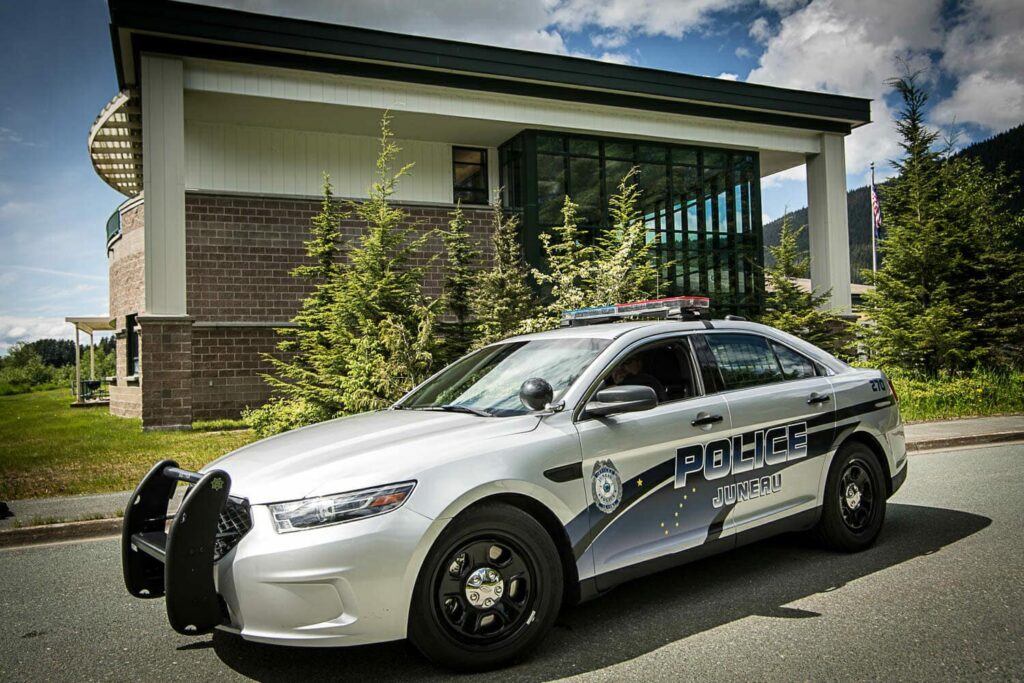
According to the proposed ordinance, when an officer-involved shooting occurs that causes death or serious injury to an officer or someone else, Juneau Police Department would release body-worn camera footage no later than 30 days after the incident. (Photo courtesy City & Borough of Juneau website)
(Photo courtesy City & Borough of Juneau website)
NOTN- The Juneau Man who was knocked unconscious during an arrest in July is now suing the city and Former JPD Officer Brandon LeBlanc, alleging he used excessive force.
The case was opened November 13, and assigned to Judge Amanda Browning according to court documents.
Christopher Williams Jr. is represented by attorney Jeffrey Barber.
No response from the City and Borough of Juneau or Brandon LeBlanc has been filed in the publicly available record as of November 18.
The video of the arrest was posted to social media, prompting widespread public outcry, from city leaders, Tlingit and Haida, and even prompting peaceful protest as well as policy and training reforms within the Juneau Police Department.
Williams was medevaced to Anchorage after being taken to the ground outside the Douglas Library.
A GoFundMe was set up for Williams’ recovery in August and raised $4,692.
LeBlanc resigned from the department a day before the body camera footage was released, and the state office of special prosecutions did not file criminal charges.
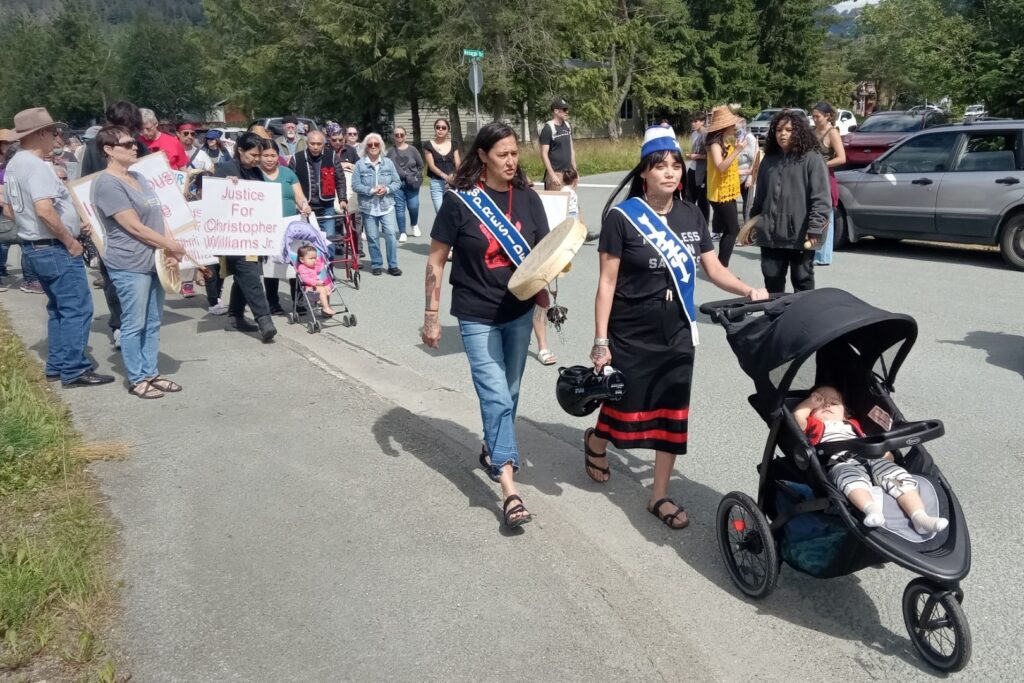
Nearly 100 protesters peacefully called for accountability and systemic police reform following his arrest with organizer Jamiann S’eiltin saying the incident reflects a broader pattern of violence against Indigenous people.
“This isn’t something new,” S’eiltin said in July. “This has been going on since almost time immemorial, since the arrival of Western European settlers. So, just want to put that out there that we are brutally attacked 10 times more than the national average.”
The Alaska state crime lab in Anchorage seen on May 6, 2024. (Photo by Yereth Rosen/Alaska Beacon)
State and local law enforcement officials announced a breakthrough on a more than 25 year old cold case in Juneau this summer, thanks in part to a DNA analysis tool at the Alaska Scientific Crime Detection Lab.
Darryl Bruce Fawcett, an Alaska Native man, was 28 years old when he went missing in 1999. His remains were found by divers in the Gastineau Channel in 2004. In July, with the help of a tool that analyzes DNA from bones, officials said they were able to compare a sample with a family member’s DNA and identify Fawcett.
Darryl Bruce Fawcett was identified in July of 2025, after going missing in 1999. (Photo from Juneau Police Department’s missing persons page)
“It is pretty rare, especially (with) that amount of time to have passed,” said Juneau Deputy Chief Krag Campbell, in August. “So I’m just happy that the family was able to get some closure on this.”
The forensic method is not new, but the Alaska Scientific Crime Detection Laboratory was able to adopt it with new federal grant funding, said crime lab chief David Kanaris. Forensic scientists are able to extract DNA from bones or teeth, which can be compared to DNA of a missing person or relative to make an identification.
Previously, bone samples would be sent out-of-state for testing, usually to the University of North Texas, Kanaris said. The state may continue that practice as needed. “We saw real value in bringing on an ability to do most of the work here in Alaska, where we can,” he said.
Cheryl Duda, a forensic scientist and DNA technical leader at the crime lab, said this forensic method is one of many that investigators use when unidentified remains are recovered.
“For many years now, our laboratory has been able to do testing on a very wide variety of body tissues like blood, saliva, hair roots and skin cells, but all of those are very soft tissue types,” she said. “What is different about this technology that we’re bringing online is it’s a method to extract DNA from bones.”
Duda said that first, any unidentified remains reported to the state go through the Alaska State Medical Examiner’s Office, which determines first if they are human or animal. If deemed human, and a bone or tooth is recoverable, the agency will send a sample to the crime lab for analysis. The DNA is then entered into a national DNA database, the Combined DNA Index System, commonly called CODIS, where investigators can search for a match.
The database can compare the sample with samples of known missing persons, family members, or other samples that law enforcement has collected from crimes or that have been submitted by the public.
“That’s the big first step for us, is generating this profile in the hopes of getting that match or that association in state, so that we can report those results,” Duda said.
Jennifer Foster is a forensic scientist and supervisor at the crime lab, and said that the next step requires coordination across agencies. State employees work with the Federal Bureau of Investigation that governs CODIS, other forensic labs, and local and state law enforcement departments conducting investigations. “So there’s a lot of communication,” she said.
Officials at the crime lab say they’re working on a list of remains to be tested from the Alaska Medical Examiner’s Office, and cases are prioritized as they come into the lab. Once DNA samples are entered into the national database, the search continues.
“So that profile routinely searches every night,” Duda said. “It does missing persons searches monthly. Relatives of missing person searches monthly. So as long as it doesn’t need to be removed for whatever reason, it stays in there and will search.”
Austin McDaniel, director of communications for the Alaska Department of Public Safety, said the state has analyzed three more cases since August, but no identifications have been made.
McDaniel said each case of unidentified remains is prioritized as it comes in through the Medical Examiner’s office, and investigators pursue and coordinate leads for identification. He said the new tool won’t necessarily unlock the state’s cold cases.
“If pulling DNA from bone fragments would have been helpful before, you know, either the crime lab or the medical examiner could have sent that out to other labs to have it completed. So I wouldn’t say there’s, like, this huge backlog of cases that just haven’t ever been worked,” he said.
There are currently 60 unidentified persons cases open in Alaska, according to the National Missing and Unidentified Persons Database, which goes back to 1968. The most recent unidentified remains on that list are bones found in a creek on Aug. 24 in Anchorage.
McDaniel said new DNA samples also get shared with the national database by the public through commercial at-home genetic testing, which can be shared with law enforcement. “That’s usually a box people can check, something like that might happen. Or maybe we go through and have family members reach out to us and offer familial DNA samples that can be compared against,” he said.
McDaniel said local law enforcement investigators can request the DNA analysis as they pursue leads. “An investigator from any number of agencies, not just the Troopers, as they’re trying to go through and maybe work on some of these cases they might go through to reach out to a family member proactively that they suspect might be related to the decedent, and see they can collect a voluntary sample from from them,” he said.
Kanaris, as head of the crime lab, acknowledged these are sensitive cases, especially as Alaska grapples with a crisis of missing and murdered Indigenous people. Alaska Native residents are disproportionately victims of violent crime. At least 27% of the 1,268 known cases on the state’s Missing Persons Clearinghouse database, managed by the Alaska Department of Public Safety, involve Alaska Native people.
“We have worked with the tribal liaisons, understanding that a lot of these bones may come from Alaska Native remains,” Kanaris said. “And so we want to handle these samples as sensitively as we can and be as culturally aware as we can.”
He said another benefit of having this DNA analysis tool in the state’s crime lab, is handling cases more promptly.
“They’re going to involve less transit time. The bones are going to stay in state, and they will, hopefully, be able to be returned to the families for closure as soon as possible. That would be one of the benefits of this,” he said.
“I’d like to see us be able to work as many of the samples, not just with bones, but across the board, with forensic science samples in Alaska, at the Alaska crime lab,” he said. “So I think this is a big step forward for us.”
NOTN- Juneau Mayor Beth Weldon said city officials are taking new safety precautions after a man previously banned from City Hall returned during Monday night’s Assembly meeting and caused alarm among members as well as an hour delay preceding this month’s reorganization meeting.
Weldon said the man, who has a history of making threatening remarks toward the city, appeared wearing a mask and goggles, carrying a backpack, and taking photos while standing close to Assembly members.
“He’s been trespassed from City Hall and showed up yesterday and was menacing to the assembly, looming over them and taking pictures of us.” Said Weldon “It just was very uncomfortable for all of us, because we knew his history.”
Police escorted the man out peacefully, and Weldon said he will now be trespassed from all city meeting spaces, including Centennial Hall and City Hall.
She emphasized that the incident was not connected to ongoing public testimony about the controversial Telephone Hill redevelopment project, which has drawn strong emotional responses but no threats.
“The testimony from Telephone Hill residents has been very heartfelt,” Weldon said. “At no time have we felt threatened by them.”
The meeting did however, mark the close of the 2025 municipal election cycle as newly elected members were officially sworn into office.
Ella Adkison began her first full term as Areawide Assemblymember, Greg Smith started his final three-year term representing District 1, and Nathaniel “Nano” Brooks took office for his first term in District 2. On the School Board, Steve Whitney and Melissa Cullum each began three-year terms, while Jenny Thomas will serve two years to complete an unexpired seat.
Voters approved two citizen-led propositions, one lowering the property tax cap from 12 to 9 mills, and another creating sales tax exemptions for food and essential utilities, both tax measures will be in place November 20.
A third measure, proposing a seasonal sales tax, failed.
According to the proposed ordinance, when an officer-involved shooting occurs that causes death or serious injury to an officer or someone else, Juneau Police Department would release body-worn camera footage no later than 30 days after the incident. (Photo courtesy City & Borough of Juneau website)
(Photo courtesy City & Borough of Juneau website)
NOTN- The Alaska Department of Law’s Office of Special Prosecutions will not file criminal charges against former Juneau Police Officer Brandon LeBlanc for his use of force during a July 30 arrest that left a man unconscious and later medevaced out of Juneau for his injuries.
The decision follows a review of an Alaska State Troopers investigation into the incident, in which Officer LeBlanc took Christopher Williams Jr. to the ground during an arrest.
Williams struck his head on the pavement, was knocked unconscious, and was later medevaced to Anchorage for treatment.
Special Assistant Attorney General reviewed body camera footage, civilian video, officer interviews, and other evidence, and in a Statement from the office of Special Prosecutions, concluded that prosecutors could not prove beyond a reasonable doubt that LeBlanc’s use of force was unjustified under Alaska law.
While acknowledging that Williams was seriously injured, the Office of Special Prosecutions determined that LeBlanc’s actions did not constitute deadly force and that the takedown maneuver used was considered a “nondeadly control tactic in law enforcement”, The state found LeBlanc believed he needed to gain control of Williams, who according to the statement, appeared intoxicated and was actively resisting being handcuffed.
The report noted that although LeBlanc’s comments during the incident including a threat to “slam” Williams and a remark after the takedown, raised questions about his motivations, the totality of circumstances did not meet the legal threshold for criminal charges.
The letter also criticized the City and Borough of Juneau’s decision to publicly release body camera and in-car video footage of the incident before the investigation was complete, saying the release occurred “over the explicit objection” of both the Department of Public Safety and the Department of Law. Prosecutors warned that such releases could jeopardize future cases by affecting jury impartiality.
The Office of Special Prosecutions said its review was limited to whether LeBlanc’s actions violated criminal law and did not address possible policy or disciplinary issues within the Juneau Police Department.
The State’s letter concluded:
“The State will not file criminal charges against JPD Officer Brandon LeBlanc relating to the July 30, 2025, use of nondeadly force against Christopher Williams Jr. in Juneau, Alaska.”
NOTN- A 35-year-old man was hospitalized early Wednesday after police say he was likely struck by a vehicle on Vintage Boulevard.
The Juneau Police Department said officers received a report around 12:37 a.m. of an unconscious man lying in the roadway near First Bank. When first responders arrived, the man regained consciousness but had injuries to his face, hands and legs.
Pieces of a vehicle were found nearby, and investigators, as well as relatives on Facebook believe the man had been hit by a car.
NOTN- Ketchikan police shut down the Visitor’s Bureau on Front Street Wednesday morning after a suspicious device was discovered on a wooden bench outside the building.
Officers responded around 8:12 a.m. and worked with Port Security to establish a perimeter. Video footage from inside the building was reviewed while the area remained closed to the public. A Carnival cruise ship was docked nearby at the time, but passengers had not yet disembarked. They were instructed to stay onboard and avoid the port side of the vessel closest to the device.
Police photographed the device and consulted with an Explosive Ordnance Disposal technician, who determined it was safe to move. Officers then removed it and secured it off-site.
The area reopened and operations returned to normal at 9:47 a.m. The Ketchikan Police Department says it maintained communication with the U.S. Coast Guard during the incident. The case remains under active investigation until the device can be fully examined by an EOD specialist
9/11 Memorial ceremony at Glacier Valley Rotary Park, Photo by Greg Knight/NOTN
September 11, 2025, 24 years after the day the world changed forever. 9/11.
Across the State of Alaska, remembrances were held in many boroughs and communities. In Juneau, one of the largest remembrances in the state was held at Riverside Rotary Park in the Capital City.
Capital City Fire Rescue Chief Rich Etheridge spoke to why the day of remembrance is so important, even more than two decades later.
“So many people gave their lives, had lives taken, and it was the one moment in our history that I was aware of where we all came together, not just as a nation, but as a world, to stand up and look out for each other.” Ethridge said, “It was a moment in time that lasted for a little bit, and it started to fade. And so, you know, we’ve all promised never to forget that day and those events and really live up to what it was and celebrate the heroes that charged in, even though they knew that it was a one way trip.”
Alaska Representative Andi Story, whose District 3 seat ranges from Juneau north, attended the event.
“So many people lost their lives that day, and we need to let the families know that we care for them.” Story said, “We haven’t forgotten so many people went and served and tried to move our country more towards peace. And their efforts are admirable, and they suffered for it, and we need to stand with them.”
We remember. But what does it mean to remember now, after two decades, a new generation, and the scars that never fully heal? The story of 9/11 isn’t just about history; it’s a living question.
How do we keep honoring the past without being chained to it?
NOTN- A trial is scheduled to begin this week for a man accused of fatally shooting another man in the Mendenhall Valley in 2023.
Court records show 46-year-old Andre P. Lawrence is set to appear before Juneau Superior Court Judge Amy Mead on Wednesday.
He is charged with first- and second-degree murder in the death of 23-year-old James T. Newman.
Newman was found dead from a gunshot wound on Cinema Drive on the night of July 20, 2023.
Investigators said video surveillance showed him approaching a black Dodge pickup before collapsing. A witness later identified Lawrence as the driver.
Police said the truck linked to the shooting had blood on the driver’s side door.
Lawrence was arrested the next morning at a residence on Riverwood Drive after what police described as an overnight investigation.
If convicted, Lawrence could face up to 99 years in prison.
NOTN- A 57-year-old woman visiting Alaska on a cruise was killed Thursday morning when a car accelerated through a guard rail, struck her and plunged into Ketchikan Creek, city officials said.
The woman, from Auburn, Indiana, was pronounced dead at the scene. Her husband, also a cruise passenger, was with her on her trip.
The city said the family has been notified.
Three other people, including the driver, were taken to the island’s hospital. One remained in critical condition Thursday afternoon, while the other two were released with minor injuries.
The crash happened around 8:40 a.m. at the Centennial parking lot near Historic Creek Street, a popular downtown destination for tourists. The vehicle went through a wooden fence and dropped about 10 feet into the creek below, damaging a nearby walkway.
The cause of the crash remains under investigation.
Photo of Mendenhall glacier in autumn, taken by Rosary Lombardo
NOTN- After two recent deaths on trails near the Mendenhall Glacier, Juneau police are urging hikers to take precautions and understand the challenges search-and-rescue teams face in southeast Alaska.
Juneau Police Chief Derek Bos said such cases fall into one of two categories, people who vanish in the wilderness, often requiring search-and-rescue efforts, and those whose disappearances are suspicious or criminal in nature.
“Alaska State Troopers actually have jurisdiction over search and rescues in all of Alaska.” said Bos, “When we get those calls in, initially, it’s deferred to AST for them to conduct search and rescue operations and begin the initial stages of that investigation, we also are privileged in Juneau to have Juneau mountain rescue, which is a very professional, wonderful entity that does a great job of search and rescues. And so they work in collaboration with AST on those initial stages of a missing person who’s gone hiking and just not come back.”
JPD supports both groups and shadows their work in case the missing person case later becomes a criminal investigation.
Bos also noted that southeast Alaska poses difficulties for search teams. Dense vegetation, steep mountainsides and shifting winds complicate efforts by ground crews and even trained search dogs.
“It doesn’t take much to look around and see that we are in a very densely vegetated area, and it’s very vertical. So it’s not like looking for somebody in the plains of Kansas.” Bos said, “There’s a lot of visual obstructions, there’s altitude challenges, there are different wind patterns. So even using search and rescue dogs, if you’re above a scent and the scent is below you, it might blow up on the wind, but if the dog is below the scent and the scent is going up, you might miss it. There’s significant challenges through every aspect of a search and rescue in Southeast Alaska.”
Community members often play an important role, he added, since hikers can help narrow down search areas if they remember where they saw someone.
“A huge thing for us with the public is, if you see this individual on a trail, call us and tell us, let us know where you saw them and when you saw them, that helps us narrow down the search area, and gives a better point of where that person was last seen, so that we can start search efforts in a more specific location.”
Police are urging residents and visitors to share their plans before heading out on local trails.
“If you don’t communicate that, it could be days before anybody identifies that you’re missing, and it just delays search efforts.” Bos said, “And if you’re hurt in the woods or have an illness in the woods, you want help as quickly as possible, self induced accountability is pivotal for any kind of hiking or adventures in Southeast Alaska.”