Representative Sara Hannan, Andi Story and Senator Jesse Kiehl (from left to right) at Thursday evening’s Town Hall.
NOTN- Juneau residents turned out Thursday evening for a legislative town hall at the Mendenhall Valley Library with Juneau’s delegation.
State Senator Jesse Kiehl and Representatives Sara Hannan and Andi Story met with constituents to share updates from the current legislative session and hear directly from the community.
“Mostly, the reason we’ll do this is to hear your questions or hear your comments. By golly, we need to hear from you. You’re who we work for.” Said Kiehl Thursday morning.
Attendees asked about a range of issues facing Juneau and the state including disaster response, Representative Andi Story assured constituents that the legislature is speaking with Alaskaa ‘s congressional delegation to come up with long-term mitigation plan for glacier lake outburst floods.
“Everyone’s living with a lot of stress, it’s emotionally draining when its your home.” Story said, “We know August is coming around, we’re trying to repair the HESCO barriers, we are trying to do what we can.”
Most prevalent was the budget, and more specifically, the Governor’s recently proposed fiscal plan, currently making its way through the legislature.
“What we have to do is have a balanced budget.” Story said, “We don’t have to pass any policy at all, but every year we have to come together to provide a balanced budget to meet our constitutional budget requirement.”
The Governor’s sweeping fiscal plan includes Alaska’s first statewide sales tax in more than four decades. The proposal would create a year-round sales tax, 4% in the summer and 2% in the winter, running through 2034.
“It would add on top of local sales tax, and it would override any local sales tax decisions.” Kiehl said, “So Juneau voters just voted to take sales tax off of food. This will put sales tax back on all food, that’s an issue.”
If adopted the tax could potentially raise over 800 million dollars a year by the early 2030s.
The plan also includes a constitutional amendment to set a “50-50” Permanent Fund Dividend, which would amount to roughly $3200 per recipient.
“What the governor used to propose, was just take more than we can sustain out of the earnings reserve. Great, big draw.” Kiehl said, “So I applaud the Governor for saying, okay, that old idea of his doesn’t work. His proposal takes that cap, and it says we’re going to draw 5% we’re going to split it 50-50, between public services and PFDs. but you can only do that if we spend even less on services than we do now.”
Kiehl said the Governor’s proposal could underfund schools and building maintenance.
“The state’s going to crumble and fall down if we do that, the math doesn’t work.” He said,”Could we protect a dividend? Yeah, but the simple fact is, we’re not gonna get the votes to raise taxes to increase the PFD from where it’s been. We should stabilize the PFD, but if we’re talking about adding taxes to Alaskans and Alaska businesses, we’re not going to do that to pay out a bigger check than we’ve been paying.”
Representative Hannan hinted at an opportunity for residents to publicly testify at a Senate Finance meeting next Thursday, this has yet to be confirmed on the Alaska State Legislature website.
The meeting took place in person and was live-streamed on Facebook.
The Juneau School District office in downtown Juneau.
(Photo courtesy City & Borough of Juneau)
The Juneau School District office in downtown Juneau. (Photo courtesy City & Borough of Juneau)
NOTN- The Juneau School District is seeking public input as it begins its search for a new superintendent, asking parents, staff, students and community members to weigh in on priorities and desired leadership qualities.
First reported by the Juneau Independent, the district released an online feedback survey Wednesday, designed to guide the Board of Education as it recruits candidates to lead the district.
Participants are asked to describe strengths of the Juneau community and school district that prospective superintendents should know, as well as the most significant challenges facing the district.
The survey also asks respondents to identify the qualities, skills and characteristics they believe are necessary for the next superintendent to be successful.
In addition, respondents are asked to rate the importance of various areas of experience, including prior superintendent experience, work as a classroom teacher, familiarity with Alaska’s public education system, knowledge of school finance and facilities, and understanding of the district’s culture and community.
District officials say the feedback will help inform the board’s decision-making as it evaluates candidates and determines what leadership qualities best align with the district’s needs.
Current Superintendent Frank Hauser will be stepping down June 30, he said this when asked what he was most proud of in his tenure as Superintendent, “I think that we’ve done a lot of great work here, the Juneau school district staff, are some of the best staff in the world. Consolidation was hard, those are really tough decisions. But I think looking at the future, we’re on much better financial footing.” He said, “There are still challenges with the budget, but I think putting together a fiscal plan that is more focused, and having opportunities for kids, and even through the consolidation, being able to maintain those opportunities for our students and still see growth, those are the things I’m really proud of. We made it through, and we’re in a better position than we were going in.”
What will Superintendent Hauser do next? He says he’s not sure yet, but he hopes it will continue to include advocacy for education in the state.
“I have spent the last 28 years in public education, advocating for public education, I’m Alaska educated, and I will continue to advocate for public education. I don’t know in what capacity that will be right now, but it is something that I believe in.”
NOTN- Juneau’s Recycling Center remains closed today and, according to CBJ, will remain closed indefinitely while critical replacement parts are shipped to the city to repair damaged equipment.
The center, has been closed due to problems with its recycling baler.
Recycleworks said parts have been ordered to repair the center’s baler, the parts are on the way to Juneau, but no timeline has been given for when repairs will be completed or when the center will reopen.
During the closure, staff are working on deferred maintenance projects and manually baling accumulated recyclable materials already on site.
The center closed through the city’s major snow storm, and when it reopened closed once more due to a surplus of recyclables.
The center serves as a primary drop-off location for community recycling and has experienced intermittent closures in recent years due to equipment and operational challenges .
City officials acknowledged the inconvenience for residents and said updates will be posted daily here, as repairs progress.
Cars are driven on Fourth Avenue in downtown Anchorage on Oct. 7, 2024. (Photo by Yereth Rosen/Alaska Beacon)
Alaska’s population rose slightly between 2024 and 2025 and is now at its highest level since 2017, the Alaska Department of Labor and Workforce Development announced Wednesday.
Alaska had an estimated 738,737 people as of July 1, 2025, the department said in its annual state population estimate.
The rise comes despite a revision that erased thousands of international immigrants that the U.S. Census mistakenly believed had moved to Alaska.
Last year, relying on Census figures showing that thousands of people had migrated to Alaska from other countries, the department estimated Alaska’s population at more than 741,000 people.
Since then, and after prodding from Alaska state demographer David Howell, the Census Bureau retroactively lowered the number of international migrants that came to Alaska, and this year’s state population estimate is significantly lower than the one published last year.
“We think (that) is more accurate given that people crossing the southern border aren’t very often making their way to Alaska,” Howell said.
With the extra residents removed and a new baseline in place, the state’s population grew on a year-over-year basis because the number of births in the state exceeded the number of Alaskans who died.
That natural increase — births minus deaths — of 3,389 people was greater than the number of people who moved out of the state.
Between 2024 and 2025, 1,740 more people moved out of Alaska than moved here. It was the 13th consecutive year of negative net migration in Alaska, extending the longest streak of negative net migration since 1945.
Overall, the state’s population grew by 0.22%. That was less than the nation as a whole (0.5%). Compared with the other 49 states and the District of Columbia, Alaska’s population growth ranked 40th.
South Carolina (1.5%), Idaho (1.4%) and North Carolina (1.3%) had the highest growth rates among states. Vermont (-0.29%), Hawaii (-0.15%) and West Virginia (-0.07%) had the lowest and were among five states that posted population declines.
The U.S. Census Bureau has slightly different figures than the state — it estimated a 0.1% population gain between 2024 and 2025 — but the Alaska Department of Labor conducts surveys of military bases and group homes that the Census Bureau does not, Howell said. For that reason, he believes the state’s estimate is more accurate than the Census Bureau’s.
Overall, Howell said, Alaska seemed to simply extend existing population trends between 2024 and 2025.
“We’re continuing to see losses in the working-age population. … We’re really starting to see declines in the school-age population. It was growing slightly at the beginning of this decade, but at this point, there’s about 1,000 more 17-year-olds than there are 4-year olds. And so we’re just going through aging,” he said.
Alaska’s median age is 37.1, one and a half years older than it was at the start of the decade. Haines, the state’s oldest community, has a median age above 50.
As the state ages, the number of new births is dropping and the number of deaths is rising.
Howell and the Department of Labor and Workforce Development are predicting that the state’s population will start dropping steadily by the year 2050.
The number of births in the latest population estimate is the lowest since the trans-Alaska oil pipeline was built. The number of deaths dropped slightly last year, but Howell said there may be a morbid reason for that: The COVID-19 pandemic peaked in Alaska in 2021-2022 and may have killed elderly Alaskans who would have died later.
This year’s state population estimate retroactively updated the population change between 2021-2022, turning it from a small gain into a decline.
On a borough and city level, existing trends continued in the latest forecast. The Matanuska-Susitna Borough continues to be the fastest-growing large area of the state, the population of Anchorage is relatively flat, the Interior’s population is growing slightly and Southeast Alaska’s population is falling.
A road sign marks the road towards the Lower Kuskokwim School District offices and the Bethel High School. October 9, 2023. (Photo by Claire Stremple/Alaska Beacon)
While Alaska school districts are seeing improvements in kindergarten to third grade students’ reading proficiency, which officials credit to the Alaska Reads Act, some districts are struggling to access state managed funds for a federal grant program aimed at supporting literacy programs, teacher development, and student learning.
School districts awarded CLSD grants in 2025
Alaska Gateway School District
Aleutians East Borough School District
Anchorage School District
Bering Strait School District
Bristol Bay Borough School District / Chugach School District
Copper River School District
Cordova City School District
Dillingham City School District
Galena City School District
Iditarod Area School District
Kake City School District
Kashunamiut School District
Kenai Peninsula Borough School District
Kodiak Island Borough School District
Kuspuk School District
Lake and Peninsula Borough School District
Lower Yukon School District
Mount Edgecumbe High School
North Slope Borough School District
Northwest Arctic Borough School District
Petersburg Borough School District
Pribilof School District
Southeast Island School District
Yakutat School District
Yukon Flats School District
Yukon–Koyukuk School District
Lawmakers with the House Education Committee heard from two district superintendents about the successes and challenges of the Comprehensive Literacy State Development grant program — which in 2024 awarded $50 million to Alaska schools over five years.
In 2025, roughly half of Alaska’s districts, or 27 school districts, qualified for these grant funds administered through the Alaska Department of Education and Early Development, according to the department.
The program is aimed at advancing literacy for children from birth through 12th grade students, including pre-literacy skills, reading and writing. The program focuses on districts with disadvantaged children, including those living in poverty, English language learners and students with disabilities.
While all Alaska districts are required by state law to implement the Alaska Read’s Act, the policy did not come with additional state funding, said Rep. Rebecca Himschoot, I-Sitka, co-chair of the education committee, in an interview on Monday. She said some districts are struggling to fund the kindergarten through third grade reading initiatives. “I would like to see us supporting schools so that everybody gets the support they need to implement the law the way it was written,” she said.
The program isn’t new, but it has more money and it’s funding more districts now. In 2019, nearly one third of Alaska districts were awarded $25 million over five years, according to DEED.
“The literacy grant is a really powerful tool that is going to help the districts that it’s in, a lot,” Himschoot said. “I’ve heard a lot of gratitude from superintendents about having this opportunity for those who have it, but we did hear about some bumps in the rollout of it.”
District officials’ testimony prompted Himschoot to send a list of questions to DEED about how the grant is managed.
Michael Robbins, superintendent of the Bristol Bay Borough School District, which serves approximately 135 students, said the grant has been crucial for implementing the Alaska Reads Act, particularly supporting teachers’ training professional development, which helps retention. “The grant supports training, coaching and leadership development grounded in research-based instruction, including the science of reading,” he said.
“It creates consistency across classrooms in schools, helps prevent problems before they grow, and ensure that limited resources are utilized where that matters most,” Robbins said.
But Robbins said in implementing the grant, districts need more “clear, timely and reasonable guidance around allowable use of grant funds” from DEED.
He said the district would like to use the money for professional services vendors to provide training to teachers, and funding to attend conferences. “The approval process has been particularly cumbersome as some districts have had to resubmit their application multiple times, which takes valuable time from our grant leaders and administrators, as well as delaying the implementation of important activities,” he said.
Officials with DEED did not attend the legislative hearing, but department spokesperson Bryan Zadalis said by email on Monday that the department recognizes the importance of clear guidance, which is communicated through multiple channels including webinars and office hours. “DEED also aligns state-level guidance with federal updates as they are released to ensure accuracy and compliance, which can at times require sequencing information rather than issuing it prematurely,” he said.
In addition, Robbins, who formerly served as the superintendent of the Ketchikan Gateway Borough School District, said that that district did not qualify for grant funding. “The need was there, but the resources are not,” he said. “We need to find ways for all districts and all students to have access to the same level of support and opportunity.”
Robyn Taylor is superintendent of the Petersburg School District which serves approximately 420 students, and was awarded $350,000 per year through the grant program. She testified to lawmakers and echoed the need for equity in supporting reading programs across Alaska’s school districts. She said Petersburg still continues to have challenges with implementing the Alaska Reads Act, which she called “a real tension.”
“In Petersburg alone, between FY 25 and FY 26 we eliminated one of our three elementary reading interventionist positions, positions that were directly supporting Reads Act implementation and student outcomes,” she said. She said the district was told that CLSD funds were for supplementing programs not replacing funding.
“(The) restriction makes it difficult to use this grant to maintain positions or systems that are already working but are no longer financially sustainable under current funding structures,” she said.
Taylor and Himschoot both emphasized that districts who did not qualify for funding need support with the administrative work to apply. They said some schools should have easily qualified for the funding, but didn’t in part because they lack proper documentation of their students’ need for free or reduced school meals, which is one of the federal poverty guidelines. “It’s not that they don’t have kids in need,” Himschoot said. “It’s that they haven’t been identified through the paperwork, because they don’t have the capacity in their district to go chase that down.”
Zadalis said the grant process is a competitive one. He said the primary source of education funding is through the state’s funding formula, but districts may also access state or federal funding through other grants focused on literacy efforts.
Taylor said Petersburg students are making gains in reading proficiency, and the district is committed to continuing improvements beyond the grant cycle. “What we are asking for is greater flexibility, clearer and earlier guidance,” she said. “And increased trust in districts to make decisions that reflect local context and student needs.”
Department of Homeland Security Secretary Kristi Noem at a Nashville press conference on July 18, 2025, to discuss arrests of immigrants during recent Immigration and Customs Enforcement sweeps. (Photo by John Partipilo/Tennessee Lookout)
Alaska’s senior Senator, Republican Lisa Murkowski, told reporters on Tuesday that Department of Homeland Security Kristi Noem should “probably” step down. Murkowski is one of a handful of Senate Republicans calling for further investigation into the killing of U.S. citizens by Immigrations and Customs Enforcement personnel and ICE conduct in Minneapolis.
She is the second Republican in the U.S. Senate, after Thom Tillis of North Carolina, to call for Noem’s resignation.
“She has, through her words — and I think in her actions — she’s taken a direction that has not been helpful to the situation, and I don’t think that it helps the country,” Murkowski said.
“Accountability goes all the way to the top, and I think you have a secretary right now that needs to be accountable to the chaos and in some of the tragedy that we have seen,” she added.
Her comments come after a massive surge of federal agents has been operating in Minneapolis as part of the Trump administration’s immigration crackdown. Their actions include an unknown number of arrests and two fatal shootings in three weeks, prompting widespread protests.
Murkowski voted to confirm Noem’s appointment last January. Noem faces mounting bipartisan criticism after House Democrats co-sponsored articles of impeachment against her.
Republican Sen. Dan Sullivan and Rep. Nick Begich III did not immediately respond to questions about Noem’s leadership from the Alaska Beacon on Tuesday.
Murkowski has not supported calls from a faction of progressive Democrats in Congress to defund the agency. She voted in support of the Republican-drafted budget package earlier this year that sent almost $85 billion to the agency, giving it a larger budget than the U.S. Marine Corps.
“You’ve got all these cries to say, ‘We can’t give another penny to ICE.’ Well, the fact of the matter is ICE has the resources that they will need. What it comes down to is: What are they doing with the money? And that’s where it comes to the management, that’s when it comes to who is controlling it, that’s when it comes to who is ultimately in charge and accountable,” she said.
Congressional response to ICE action in Minneapolis
Alaska’s congressional delegation is split in its response to the ICE action and the killing of Alex Pretti in Minneapolis over the weekend.
In a Sunday statement, Murkowski called for a “comprehensive, independent investigation” of the killing, which she said is necessary to build back public trust. Her statement called on Congressional committees to fulfill their oversight duties in hearings.
“ICE agents do not have carte blanche in carrying out their duties,” she said in the statement.
“The tragedy and chaos the country is witnessing in Minneapolis is shocking,” Murkowski’s statement said, and added that the killing of another U.S. citizen “should raise serious questions within the administration about the adequacy of immigration-enforcement training and the instructions officers are given on carrying out their mission.”
Sullivan’s office is closely monitoring reports out of Minneapolis following the fatal shooting, according to a statement through spokesperson Devyn Shea. Sullivan stopped short of calling for an independent investigation of ICE actions.
“He believes we should gather all the facts and investigate the incident before drawing conclusions — to ensure accountability, restore public trust, and prevent future confrontations that result in loss of life,” his spokesperson wrote.
“Senator Sullivan strongly supports our law enforcement and their ability to do their jobs. He also believes that any loss of life is tragic and hopes that the temperature in Minnesota on both sides can be lowered and that the situation between protestors and law enforcement deescalates and the violence dissipates,” the statement said.
Silver Prout, a spokesperson for Begich’s office, said he will not speculate, but “allow facts to be established through appropriate investigative processes.”
“Congressman Begich supports law enforcement’s ability to carry out their duties safely and without interference from agitators,” Prout wrote on Tuesday. “This includes a responsibility to ensure transparency and accountability in the commission of those duties.”
Prout said Begich supports “appropriate” Congressional oversight of federal law enforcement and that safe communities are a top priority of Begich’s.
“If anything, recent events have underscored the need for additional funding to ensure law enforcement has the tools, personnel, and training needed to complete their job,” she wrote.
Congressional candidates speak out
Some congressional candidates have issued statements in response to the violence and unrest in Minneapolis. Former U.S. Rep. Mary Peltola, a Democrat challenging Sullivan, called for an independent investigation into the death of Alex Pretti, as well as increased Congressional oversight for ICE and funding for local law enforcement in Alaska.
“Nothing is more important than the safety of our communities,” she wrote on social media on Monday.
“What’s happening right now in the Lower 48 does nothing to make us safer here in Alaska. In Alaska, we respect the rule of law and lawfully carrying a firearm never justifies deadly force by federal agents,” the post said.
On Monday, the campaign of Democratic candidate Matt Schultz, who is challenging Rep. Begich for Alaska’s sole House seat, called on Congress to respond to the killings of U.S. citizens by ICE.
The statement urged that ICE be withdrawn from Minnesota and for its personnel to be better trained. It accused the Trump administration of deploying them “as a cudgel for settling petty partisan grudges.”
“I’m troubled by the silence and inaction of too many of our leaders here in Alaska,” the statement said, specifically attacking Begich and another candidate, independent Bill Hill. “It is time to speak up and show up for our fellow Americans, immigrants, and the Bill of Rights.”
Hill gave a statement on social media on Monday, saying that Americans should be able to exercise their 1st and 2nd Amendment rights without “being killed by their government.”
“Our congressman needs to stand up and fight for an independent investigation into the shooting of Alex Pretti. Until that happens, ICE should get the hell out of Minneapolis,” the statement said.
Corinne Smith and James Brooks contributed reporting to this story. This story has been updated.
According to the proposed ordinance, when an officer-involved shooting occurs that causes death or serious injury to an officer or someone else, Juneau Police Department would release body-worn camera footage no later than 30 days after the incident. (Photo courtesy City & Borough of Juneau website)
NOTN- Juneau police arrested a 22-year-old man Monday night after reports that a rifle had been fired from a home on Radcliffe Road.
Police say officers were called to the 2100 block of Radcliffe Road, where a caller reported their roommate, Ethan Hagh, had fired a single round from an AR-15-style rifle out of a window.
The caller and other occupants were able to safely leave the residence but were unsure where Hagh had gone at the time of the report.
Officers searched the area for several hours, using drones and a public address system in an attempt to locate Hagh.
Those efforts were initially unsuccessful.
Just before 7:30 p.m., officers encountered Hagh walking back toward the residence. He was detained without incident. Police later found an AR-15-style rifle inside the home and a pistol on Hagh’s person.
No injuries were reported.
Hagh was taken to Lemon Creek Correctional Center and charged with one count of second-degree misconduct involving weapons and two counts of third-degree assault related to domestic violence and one count of reckless endangerment, according to the statement released by JPD.
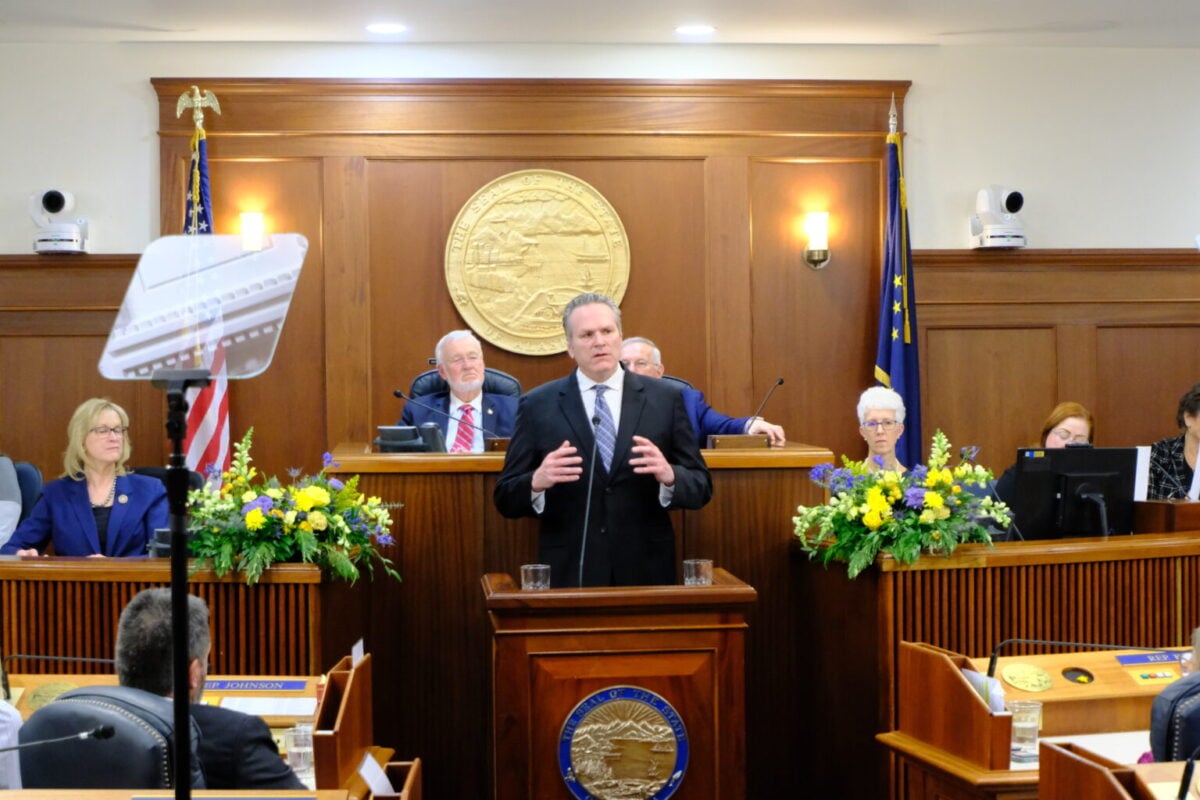
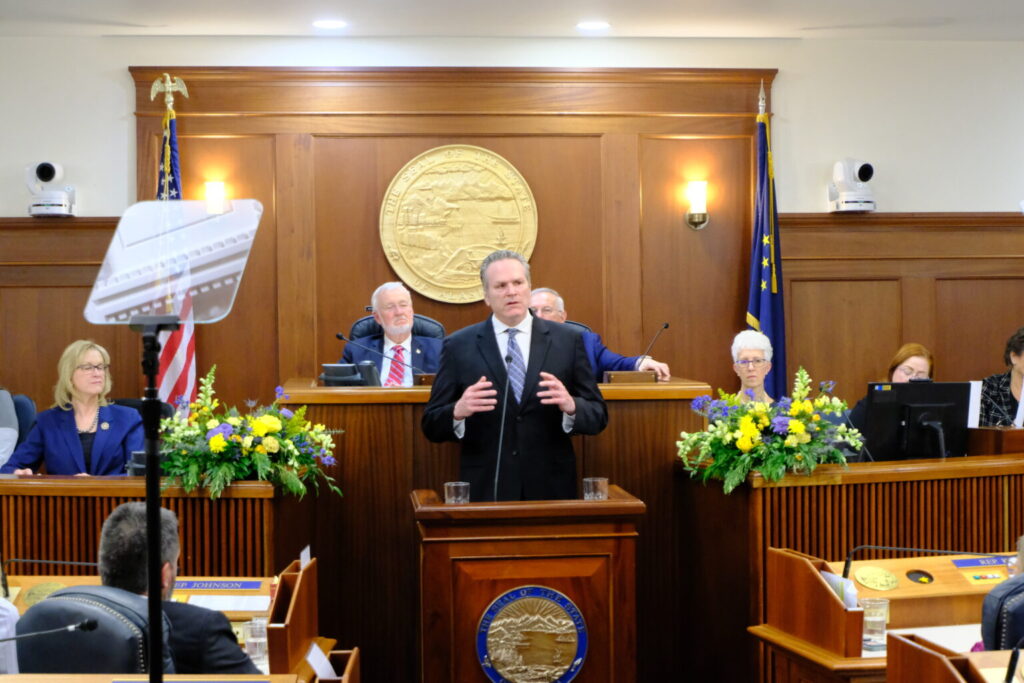
Gov. Mike Dunleavy gestures during his State of the State address on Jan. 22, 2026. (Photo by Corinne Smith/Alaska Beacon)
Gov. Mike Dunleavy has proposed a 4% statewide summer sales tax, effective through 2034, as part of his plan to bring Alaska’s state revenue and expenses in line for the long term.
If adopted, the sales tax would be Alaska’s first statewide, general-purpose levy since state legislators abolished Alaska’s income tax in 1980.
Alongside the tax bill, the governor has proposed a tighter state spending cap and a constitutional amendment that would guarantee a Permanent Fund dividend lower than scheduled by current law but above what legislators have approved in recent years.
“This comprehensive plan is designed to bridge the next seven years by stabilizing state finances, limiting spending growth, restoring a rules-based PFD, and sharing responsibility through targeted, time-limited revenue measures that support investment and predictability,” the governor wrote in a letter to state lawmakers.
Since 2015, persistently low oil prices and plateaued oil production from the North Slope have dogged state lawmakers who have struggled to balance Alaska’s need for services with the desire to pay large Permanent Fund dividends.
While most of Alaska’s general-purpose state revenue comes from the Alaska Permanent Fund, oil remains the No. 2 source of flexible spending money for the state, leaving the annual budget process subject to the vagaries of global markets.
Senate Bill 227, containing the bulk of the governor’s plan, was introduced on Monday and referred to the Senate Finance Committee for further discussion. An identical version will be introduced in the House on Wednesday.
The most fiscally consequential item in the bill is the sales tax, which would peak during the summer tourist season and drop to 2% between October and March.
That tax is expected to raise as much as $815 million per year for state services and the Permanent Fund dividend by Fiscal Year 2032.
Dunleavy’s proposed budget for the fiscal year that begins July 1 — fiscal year 2027 — is about $7.75 billion and has a deficit of almost $1.5 billion.
The Dunleavy administration expects that revenue from oil production and a proposed trans-Alaska natural gas pipeline will compensate for the phaseout of all the taxes in the long term.
Under SB 227, the state’s corporate income tax would fall to zero in 2031; the sales tax wouldn’t expire until 2034, leaving individual Alaskans paying higher tax rates than corporations for a period.
“Normally, sales tax is left to local governments. So I know it was a hot issue in Anchorage when the Mayor proposed that, so I think it is going to hit a lot of households,” said Sen. Lyman Hoffman, D-Bethel and co-chair of the Senate Finance Committee.
Sen. Bill Wielechowski, D-Anchorage, applauded Dunleavy on Monday for putting forward a fiscal proposal, even if he disagrees with some of the components.
“The governor’s putting out a bill. I commend him for that. He’s putting out, you know, he’s throwing out ideas. I give him credit for that,” he said.
Wielechowski and other legislators said they want to fully analyze what the governor is proposing before opining on it.
“There are a lot of parts to this bill, and the No. 1 thing for me — without a complete analysis — is it’s really unclear on how this is going to affect hard-working Alaskans,” said House Minority Leader DeLena Johnson, R-Palmer. “It is my No. 1 priority to make sure everyday Alaskans aren’t on the losing end of this.”
The Alaska Municipal League, which represents local governments across Alaska, is particularly interested in the governor’s proposal.
The League has previously said it would prefer a statewide income tax to a sales tax.
In almost every part of Alaska, except for Anchorage, sales taxes are a pillar of services.
Many cities and boroughs exempt certain things, like food and utilities. Under the Dunleavy proposal, the state would be in charge of collecting sales taxes and would remit money to cities and boroughs.
Local exemptions and sales tax caps could vanish in the process, with the state instead determining what is taxed and not.
“This is a 56-page bill that we are still going through. Sales tax is a major component of that, but sales tax shouldn’t be thought about independently from the other components,” said Nils Andreassen, director of the league.
In addition to the sales tax, SB 227 temporarily raises the state’s minimum oil tax, adds a surcharge of 15 cents per barrel of oil produced on the North Slope and adds part of the corporate sales tax update that Dunleavy vetoed last year.
Andreassen noted that regardless of its source, tax revenue flows into the state’s general fund for any number of uses.
“All taxes are connected at some level,” he said.
The governor’s plan for the Permanent Fund dividend, enclosed in a constitutional amendment proposal separate to SB 227, is similar to one he proposed in 2021.
Currently, the state’s No. 1 source of general-purpose revenue is an annual transfer from the Permanent Fund to the state treasury. In FY27, that transfer will be worth $4 billion.
The “50-50 dividend” proposed by the governor would reserve half of that transfer for dividends, or about $2 billion, if it were in place this year.
That amounts to roughly $3,200 per PFD recipient, based on the number of recipients in 2025.
Under a current, disused formula in place since the 1980s, the dividend would be about $3,800 per recipient.
That formula hasn’t been used since 2015, and lawmakers have instead set the amount by fiat, typically using a figure that can be paid with available revenue after services are covered.
Legislators can ignore formulas in state law because the state’s annual budget bill is a law, and when one law conflicts with another, the newer law takes precedence.
Putting a dividend formula in the constitution would bind future governors and legislatures, and put the dividend atop the annual budgetary priority list, alongside education and other constitutionally mandated functions.
Adopting a constitutional amendment requires two-thirds of the House, two-thirds of the Senate, and approval by voters in the next general election.
Alaskans have not adopted an amendment since 2004, and the Legislature hasn’t put one before voters since 2016.
NOTN- The major topic discussed at the Committee of the Whole meeting last night was proposed changes to governance at Eaglecrest Ski Area, which has struggled for years with operational instability and deferred maintenance.
Juneau Mayor Beth Weldon said she introduced an ordinance that would shift the Eaglecrest board from an empowered governing body to an advisory role under a newly established City and Borough of Juneau Eaglecrest Recreation Area Department. The change would give the city more direct oversight over operations and capital investments.
“My ultimate goal is to try to save Eaglecrest. If anybody knows my history, both my kids grew up in Eaglecrest. In fact, my youngest son continued ski racing in college.” She said, “Eaglecrest is a great place to learn how to ski, but they have struggled with operational instability and management challenges for many years. So this tells me there’s a structural problem.”
She emphasized that the proposal is not a reflection on the current board, but rather an effort to ensure the ski area’s long-term survival.
“Currently, the board that we have is a very strong board, but despite having more year-round staff than ever before, Eaglecrest has still struggled with basic ski operations, amplified by long-term neglect of equipment and deferred maintenance.” Said Weldon, “And I think in order for Eaglecrest to survive, it needs a little shake-up, and the only shake-up we can really do is to have more city oversight.”
Without additional city control, Weldon warned, major repairs may not be financially feasible.
A joint meeting is scheduled for early March between the city’s Committee of the Whole and the Eaglecrest board to address these proposals and gather further input.
“We’re going to have a joint meeting where we’ll sit and talk to the Eagle Crest board, and then I think a couple weeks later, it’ll be back in front of the Committee of the Whole and we can decide what we change.” Said Deputy Mayor Greg Smith, “I’ve heard a lot about it. It shows how much people care about Eaglecrest.”
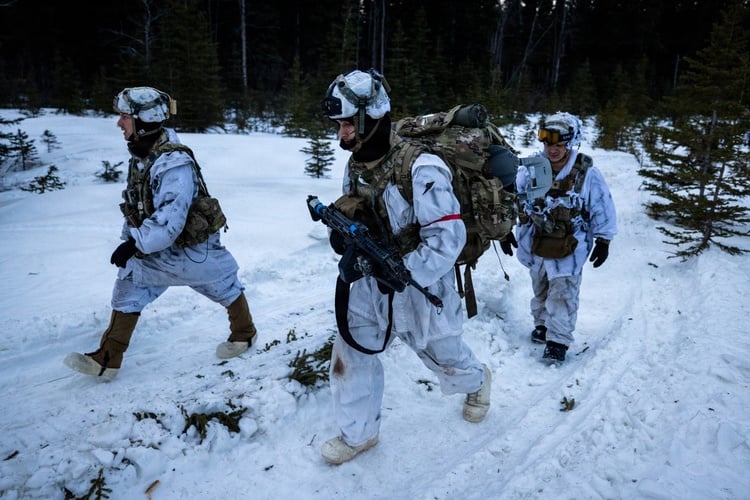
U.S. Army Soldiers with the 11th Airborne Division, load Air Force C-130 Hercules aircraft in preparation for deployment into the Joint Pacific Multinational Readiness Center’s 25-02 training exercise, Fairbanks, Alaska, Jan. 23, 2025. (U.S. Army Photo by Master Sgt. Justin P. Morelli)
A Democratic state lawmaker from Anchorage loudly denounced the actions of U.S. Immigration and Customs Enforcement’s surge in Minnesota while speaking on the Alaska House floor on Friday.
Rep. Andrew Gray, D-Anchorage, is a military veteran and co-chair of the Legislature’s Joint Armed Services Committee.
“The facts are that our government is out of control. Norms have been broken at an alarming rate, and the world is watching us in shock,” he said.
Gray’s remarks were met by loud desk-thumping — a form of applause — and came on a day when thousands of Minnesotans marched in subzero weather and held a general strike to show their opposition to ICE efforts in their state.
Tensions are particularly high after several shootings by federal officers, including one in which an officer killed a mother of three.
The remarks came one day before federal agents fatally shot another Minneapolis resident on Saturday, prompting nationwide protests throughout the weekend.
Up to 1,500 active-duty troops of the U.S. Army’s 11th Airborne Division, based in Anchorage, have been ordered to stand by for possible deployment to Minneapolis — Minnesota’s largest city — according to National Public Radio.
In those letters, Gray and Kawasaki say they are receiving “enquiries … from the Alaskan people” and pose a series of questions.
How long will the 11th Airborne be in Minnesota? How does a deployment fit in the division’s mission to defend the United States against foreign threats? Could soldiers be detaining suspected undocumented people? Would the 11th Airborne fight the Minnesota National Guard if Gov. Tim Walz activates it to defend protesters?
“Fifteen hundred active-duty soldiers may be sent from Alaska to Minnesota to protect ICE agents as they continue their efforts to arrest and detain suspected undocumented immigrants,” Gray said, “But who really needs the protection? Is it the ICE agents, or is it the folks who are terrified to leave their homes, to go to work, to pick their kids up from school or to actually show up at their immigration appointments?”
While Gray’s comments appeared to have the support of many legislators in the chamber — judging by the desk-pounding applause — there was at least one dissenting voice.
Rep. Jamie Allard, R-Eagle River, is a veteran, the spouse of a veteran, and a Latina, she said, explaining that she had also sent a letter to Gen. Cogbill, but her letter was to remind him that he is not legally obligated to answer the Legislature’s questions or testify in the Capitol.
Allard said she has been deployed overseas with the military and with the U.S. State Department.
“I experienced things when I worked for the US State Department, of women being abused, hit — watched them get their teeth knocked in, where I had to stand by and couldn’t do anything,” she said.
“We have a lot going on in our country, dividing, saying we’re this or we’re that. We’re all Americans, but it doesn’t mean that it’s okay to have riots across our country. If the military and the federal government and the Department of War and the 11th Airborne Division decide that it’s best to go to Minnesota, that’s what we need to do,” she said.
Allard’s comments were met by quieter but noticeable desk-pounding, with the loudest coming from Rep. Kevin McCabe, R-Big Lake.
He said afterward that he thinks Gray incorrectly described some aspects of ICE’s work in Minnesota. For example, Gray said ICE detained a five-year-old in Minnesota.
“There’s a little bit more to the story, McCabe said.
“We shouldn’t be messing around in another branch of the government in their bailiwick,” he said. “The worst people in Alaska to manage the National Guard is probably the state Legislature.”