President Donald Trump speaks as he meets Saudi Arabia's Crown Prince Mohammed bin Salman in the Oval Office of the White House, Tuesday, Nov. 18, 2025, in Washington. (AP Photo/Evan Vucci)
(AP Photo/Evan Vucci)
NOTN- “The vote totals for the Fake Dan Sullivan, plus the other “slug” that the Dems put on the Ballot, should be immediately given to the REAL Dan Sullivan, and the Election is over – He easily wins. There is no other fair solution! President DJT.” Trump wrote on his social media platform Truth Social on Thursday.
Alaska election officials are still counting early and absentee ballots and await more results from key races on the general election ballot, including the bitterly fought U.S. Senate campaign with Mary Peltola holding a very slight lead over Incumbent Dan S. Sullivan.
A ballot measure seeking to repeal Alaska’s unique system of open primaries and ranked vote general elections was also too early to call.
If no candidate wins more than 50% of first-choice votes, rankings will come into play. Alaska accepts ballots from overseas voters for up to 15 days after the election, making Nov. 18 the date targeted by state elections officials to tabulate under the ranked vote system.
The Alaska State Capitol is seen during the last week of the 2025 session on May 19, 2025. (Photo by Corinne Smith/Alaska Beacon)
Anchorage Republican Cathy Giessel will be the next Alaska Senate President for the upcoming 35th Alaska State Legislature, according to an announcement from a bipartisan coalition of senators on Wednesday.
Senate Majority Leader Cathy Giessel, R-Anchorage, is seen during an at ease on the Senate floor on May 7, 2026. (Photo by Corinne Smith/Alaska Beacon)
Giessel showed a comfortable lead with 61% of the vote in her bid for re-election, as of Wednesday afternoon results, and has served in the Senate since 2011. She previously served as Senate President from 2019 to 2022, and as Senate Majority Leader and chair of the Senate Resources Committee from 2023 to 2026.
The bipartisan Senate coalition, first formed in 2022 under Kodiak Republican Gary Stevens, is moving to form the Senate Majority coalition in the next Legislature. But its membership and numbers are not confirmed as thousands of votes are still being counted by the Alaska Division of Elections, and winners choosing which caucus to join.
The majority coalition must have at least 11 members to be a majority in the 20 member chamber. Final election results are scheduled to be certified on Nov. 25.
In an interview, Giessel said the top priorities for the next Senate will include public education funding, reviving a public pension system, election reform measures and energy.
While Alaska state revenues have seen a surge with the high price of oil, Giessel said the bipartisan Senate leadership will take a “balanced” approach to state spending.
“We are aware that there is going to be excess funding or excess revenue, but we are not going to go on a spending spree. This is something that we all agree on. This is going to be constrained. We’re going to be focusing on the priority budget items first,” she said.
Giessel said the coalition has not formally spoken with the Democratic gubernatorial frontrunner Jonathan Kreiss-Tomkins yet, but meetings would likely begin later this month.
The coalition named Senator-elect Louise Stutes, a Kodiak Republican, as Senate Majority Leader. Stutes is a first-time candidate for the Senate representing the district which includes Kodiak Island, the southern Kenai Peninsula and Prince William Sound communities, but she has served in the Alaska House since 2015. She has so far received 48.6% of the vote, as of Wednesday afternoon, a significant lead over Republican Heath Smith with 39.7%.
Another senator-elect that is still unconfirmed is Dillingham independent and House Speaker Rep. Bryce Edgon. He has been appointed as co-chair of the powerful Senate Finance Committee.
Rep. Bryce Edgmon, I-Dillingham, is seen during debate on the operating budget on Apr. 13, 2026. (Photo by Corinne Smith/Alaska Beacon)
As of Wednesday afternoon, Edgmon received 36.1% of the vote to represent one of the state’s largest districts that extends from Western Alaska to the Aleutian Islands. He led Republican Darren Deacon who got 26.8%, and Democrat Wissilie Guy who received 24.8%. Many absentee-in-person and by-mail ballots from the rural region have yet to be counted.
Anchorage Democrat Bill Wielechowski, who ran unopposed, will be the Senate Rules Chair. He has served in the Senate since 2007, and has chaired the Rules Committee since 2023.
Juneau Democrat Jesse Kiehl, who was not up for re-election this year, will be co-chair of the Senate Finance Committee, of which he has been a member since 2023. He was first elected to the Senate in 2018.
Wielchowski said in a statement with the announcement the team has experience representing communities across the state as well as working together and across party lines.
“This is the message that Alaskans have continued to send us to address the many needs for a stronger Alaska future,” he said. “This coalition will continue to focus on lowering costs for families, ensuring Alaska receives its fair share for our resources, election reform, and making sure that every community across the state, urban and rural, has a seat at the table.”
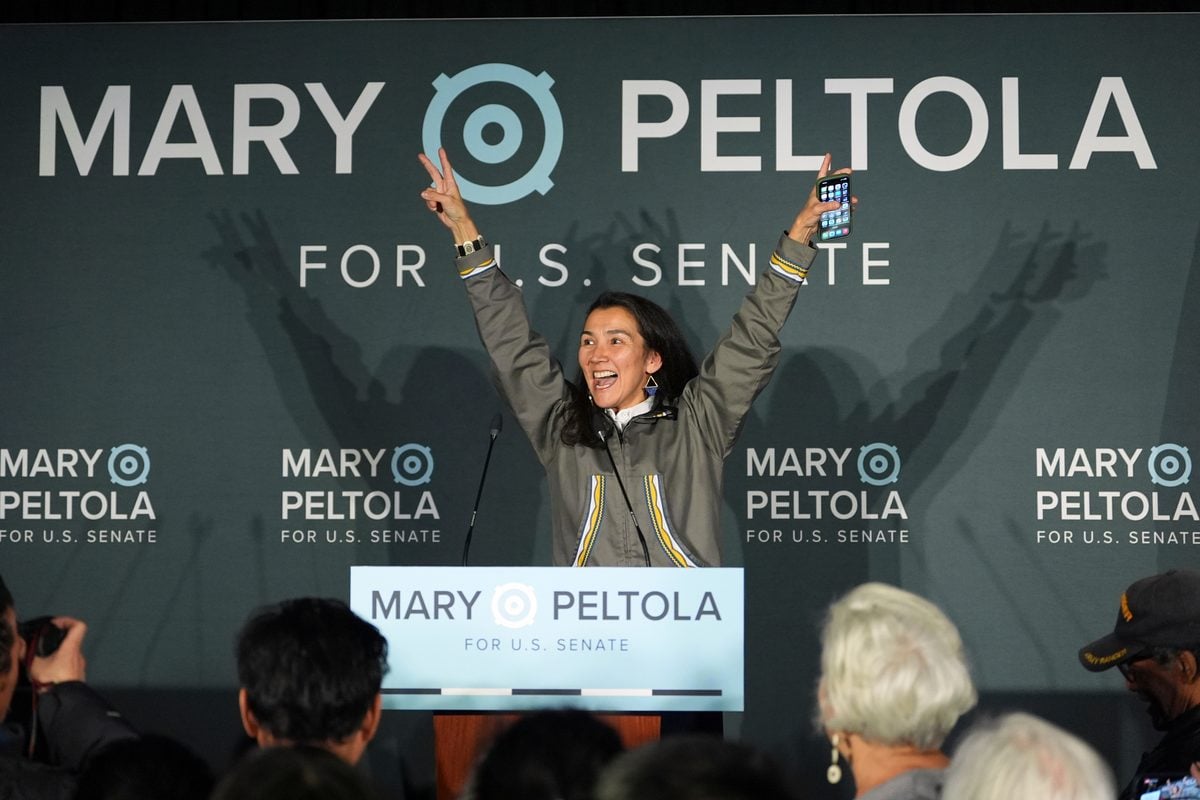
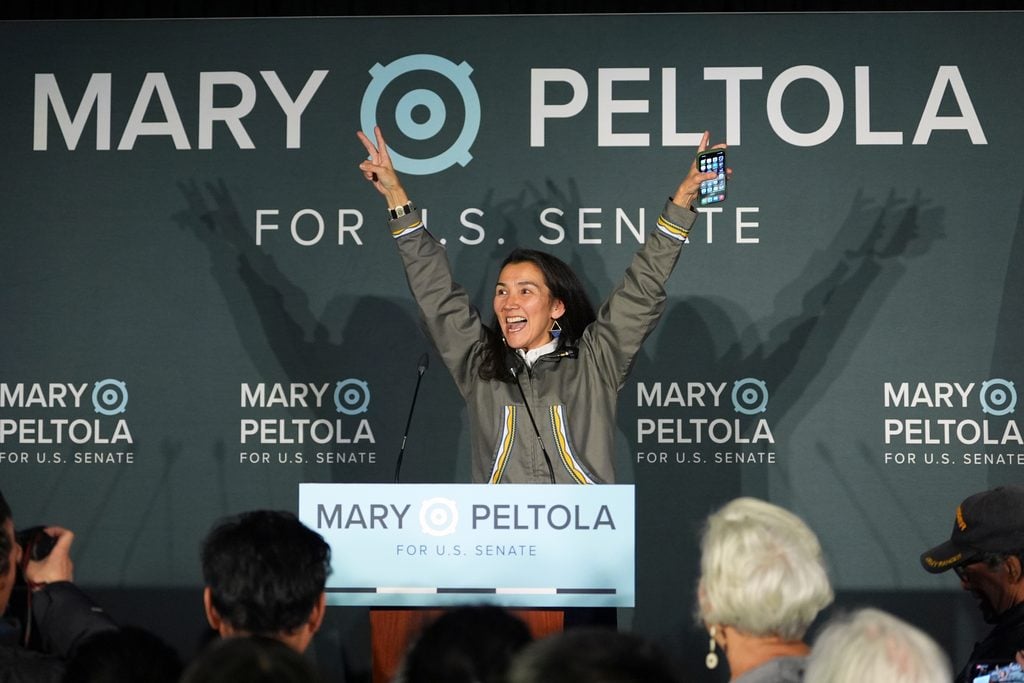
Alaska Democratic Senate candidate Mary Peltola speaks at an election night event Tuesday, Nov. 3, 2026, in Anchorage, Alaska. (AP Photo/Lindsey Wasson)
Alaska Democratic Senate candidate Mary Peltola speaks at an election night event Tuesday, Nov. 3, 2026, in Anchorage, Alaska. (AP Photo/Lindsey Wasson)
JUNEAU, Alaska (AP) — Alaskans settled in Wednesday to await more results from key races on the general election ballot, including a bitterly fought U.S. Senate campaign and an open seat for governor.
A ballot measure seeking to repeal Alaska’s unique system of open primaries and ranked vote general elections also was too early to call.
If no candidate wins more than 50% of first-choice votes, rankings will come into play. Alaska accepts ballots from overseas voters for up to 15 days after the election, making Nov. 18 the date targeted by state elections officials to tabulate under the ranked vote system.
The major candidates in the Senate race are two-term Republican Sen. Dan Sullivan and Democratic former Rep. Mary Peltola.
In the governor’s race, former state lawmaker Jonathan Kreiss-Tomkins is trying to become the first Democrat elected to the office in a generation. He faces three other Republicans, including business owner Bernadette Wilson, who was endorsed by President Donald Trump.
Litigation and allegations of partisan tricks rocked the Senate race
The contest dominated headlines ahead of Tuesday’s election and attracted the attention of the U.S. Department of Justice.
With less than two weeks before Election Day, the agency sued at President Donald Trump’s direction seeking to block certification of the race if Sullivan loses. The lawsuit cited potential confusion with another Sullivan on the ballot, retired teacher Dan J. Sullivan.
Suspicions long held by the senator and his supporters that the lesser-known Sullivan was running to sow confusion gained new life last week, when The New York Times reported that top political aides to Peltola appeared to be involved in recruiting him.
The report was based on interviews with a former Peltola campaign manager, who was fired shortly before the August primary. It also cited text messages and campaign finance documents indicating that an operative trying to recruit candidates was paid by a group backing Peltola.
Peltola denied any involvement. Dan J. Sullivan, who has denied running at the behest of Democrats, has not responded to messages seeking comment in the last week.
The senator elevated the issue in his closing argument to voters and questioned Peltola’s denials.
On Wednesday his campaign expressed confidence in Sullivan’s chances, “despite the biggest election cheating scandal in the history of Alaska” and “despite a bloodbath for Republicans everywhere else in the country.”
Sullivan and Peltola say the vote count will take time
Both campaigns urged patience as the ballot count continues.
Peltola addressed supporters Tuesday night after news broke that Democrats had won enough seats to gain control of the Senate. She was joyful — even taking a selfie with the crowd — but said it will take time for the state to count ballots.
Alaska allows up to 10 days to receive absentee ballots sent from within the U.S., a timeline that can be critical for ballots from rural Alaska communities that are often accessible only by air or water and rely on air service for mail delivery.
“It’s going to take a long time to make sure we’re counting every vote from every far-flung hinterland community, from every tiny outpost, from all of our service members serving overseas, our young people going to colleges,” Peltola said.
Democrat seeks to reclaim governor’s office
Kreiss-Tomkins expressed excitement about the early vote results when speaking to supporters on election night, saying, “What a night this is for the future of our state.”
He cast himself as a consensus builder in the race to succeed term-limited Republican Gov. Mike Dunleavy and said he would work across party lines to address the state’s challenges.
State Republican leaders urged their voters to rank the three GOP candidates in the race to maximize the party’s chances of success.
But Trump, speaking at a rally in support of Republican candidates including Sullivan and Wilson last month in Wasilla, called ranked voting a “scam.” And he railed on social media against the other two Republican gubernatorial candidates, former Anchorage Mayor Dave Bronson and former state Attorney General Treg Taylor.
Wilson said in a statement Wednesday that she was “cautiously optimistic for the days ahead.”
Alaska’s last Democratic governor was Tony Knowles, who had back-to-back terms from 1994 to 2002. The state had an independent governor from 2014 to 2018.
Ballot measure seeks to repeal unique elections process
Alaskans were asked to decide for the second time in two years on a ballot measure seeking to repeal the open primary and ranked vote general election system.
Voters approved the system in 2020, and it took effect for elections in 2022. Voters narrowly rejected a repeal effort two years ago.
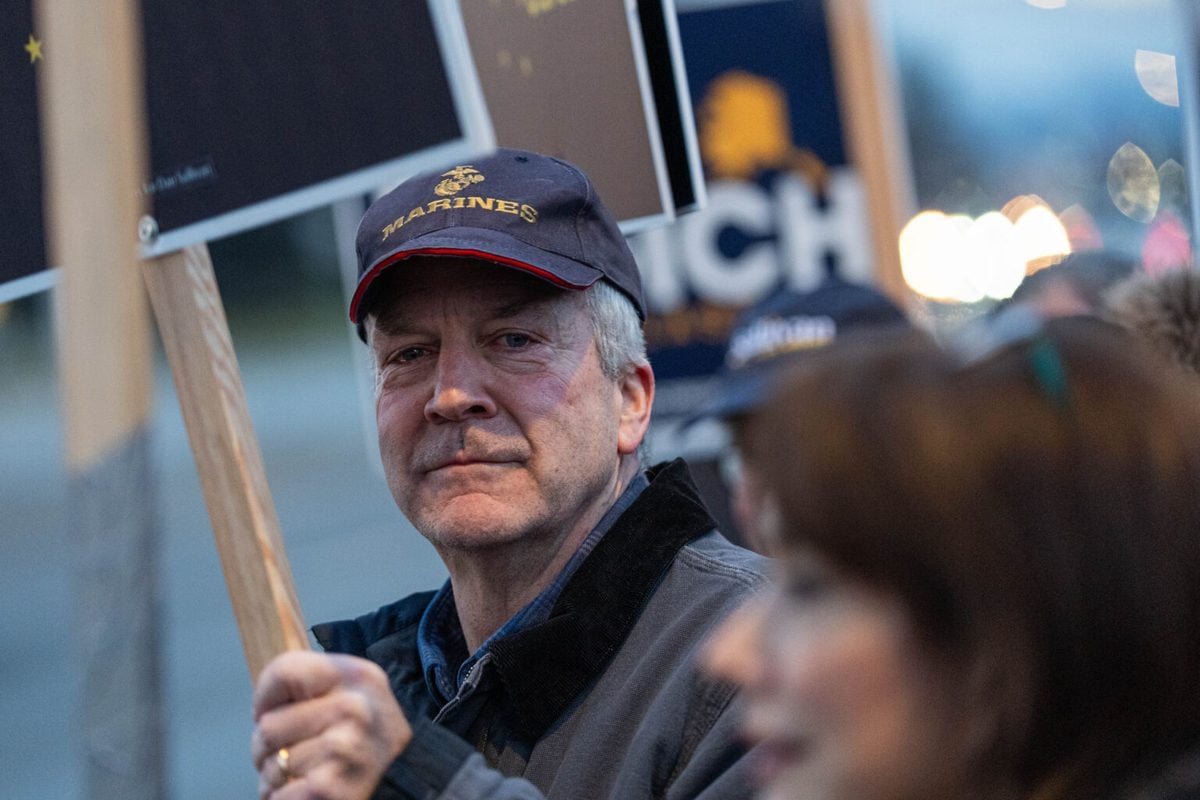
Sen. Dan Sullivan, R-Alaska, waves signs on Election Day, Tuesday, Nov. 3, 2026 in Midtown Anchorage. (Photo by Loren Holmes/Alaska Beacon)
By: James Brooks, Alaska Beacon
Sen. Dan Sullivan, R-Alaska, waves signs on Election Day, Tuesday, Nov. 3, 2026 in Midtown Anchorage. (Photo by Loren Holmes/Alaska Beacon)
This article is developing and may be updated.
If Republican U.S. Sen. Dan Sullivan wins re-election, Alaska’s ranked choice runoff system may deserve part of the credit.
Early Wednesday morning results published by the Alaska Division of Elections show Democratic challenger Mary Peltola leading Sullivan by 626 first-choice votes, but according to preliminary data published at 2:45 a.m. by the Alaska Division of Elections, Sullivan will gain hundreds more redistributed votes than Peltola if the race goes to a ranked choice runoff.
That scenario may change. The Division of Elections said Wednesday morning that 20,000 early votes remain uncounted, and as many as 40,000 absentee ballots may still need to be counted and added to the 215,341 votes already recorded by early Wednesday morning.
Under Alaska’s election system, if a general election candidate has more than 50% of the first-choice votes, they win outright, without a need to use ranked choice voting.
A Peltola win would help Democrats expand their control of the U.S. Senate, while a Sullivan win would at least mildly limit Democratic gains in the Senate during this week’s midterm elections.
Using RCTab, an open-source analysis and auditing tool, the Alaska Beacon analyzed a data file showing how 204,530 Alaskans ranked the four candidates for U.S. Senate as of Wednesday morning.
Sullivan would gain 2,728 votes when Republican challenger Gerald Heikes and independent Dan J. Sullivan are eliminated.
Peltola, meanwhile, would gain 1,868 votes from the same eliminations.https://flo.uri.sh/visualisation/30804352/embed?auto=1
These figures come with major caveats.
The cast vote record doesn’t include ballots cast on Election Day at the 131 voting precincts without ballot scanners. Those precincts are primarily in rural areas that favor Peltola.
Altogether, about 11,000 ballots listed in the state’s first-choice results Wednesday morning are not included in the cast vote record.
The record also doesn’t include the early and absentee ballots that haven’t been counted at all.
Despite those gaps, the cast vote record does illustrate voting trends, including the way Heikes voters preferred Sen. Dan Sullivan as an additional choice.
Election Day figures show Dan J. Sullivan is the first candidate eliminated, and of 3,426 votes for him in the cast vote record, 991 would be distributed to Peltola. Sullivan would get 560 and Heikes would get 627. Another 608 would be dropped because of misvoting or because the voter picked no other candidate.
That result indicates little, if any, voter confusion between the incumbent Republican senator and Dan J. Sullivan, who was listed as Daniel J. Sullivan Jr. on the ballot.
Members of the Republican Party in Alaska and nationally have claimed without evidence that a Peltola victory would be fraudulent because of confusion.
A federal judge dismissed a lawsuit filed by the U.S. Department of Justice about the issue; that decision is now on appeal to the 9th U.S. Circuit Court of Appeals.
Democrat Mary Peltola waves to passing motorists on Election Day, Tuesday, Nov. 3, 2026 in Midtown Anchorage. (Photo by Loren Holmes/Alaska Beacon)
This article was last updated Nov. 4 at 2:55 a.m.
Alaska’s closely watched U.S. Senate race remained too close to call early Wednesday morning as Democratic challenger Mary Peltola led incumbent Republican Dan Sullivan by only a few hundred votes with thousands more remaining to be counted.
The result of the race could extend already-enormous Democratic gains in the Senate or offer a gram of relief to Republicans who endured heavy losses on Election Day.
With 394 of 401 precincts reporting results Tuesday night, Peltola had 48% of voters’ first-choice votes. Sen. Dan S. Sullivan had 47.7%.
“I’m confident when all the votes are counted, I will have the honor of representing you in the United States Senate,” Sullivan told supporters in a speech Tuesday night.
As of 3 a.m. Wednesday, the candidates were separated by just 626 votes out of 213,873 cast.
Independent challenger Dan J. Sullivan had 1.7%, or 3,583 votes, and Republican challenger Gerald Heikes had 2.3%, or 4,821.
Sen. Dan Sullivan, R-Alaska, addresses supporters on election night, Tuesday, Nov. 3, 2026 at the Hotel Captain Cook in downtown Anchorage. (Photo by Loren Holmes/Alaska Beacon)
Thousands of absentee and early votes cast before Election Day remain uncounted, as do some votes from rural precincts believed to favor Peltola.
“The results are not going to be fast, but Alaskans are patient,” Peltola told supporters at an Election Day rally. “We just want to make sure the folks from the Lower 48 know it won’t be hours. It won’t be days. It will be weeks. It will be weeks. We know this. We know this. This is how it’s always been. This is normal. This is Alaska normal.”
Sullivan’s narrow lead followed a series of Democratic victories in U.S. Senate races across the country Tuesday night. If Peltola prevails, she is expected to be the 55th or 56th Democratic senator in a large Democratic majority. If Sullivan wins, he would be a member of a shrunken Senate Republican caucus that will now be in the minority.
In addition, if Peltola prevails, she and U.S. Sen.-elect Peggy Flanagan, D-Minnesota will be the first female indigenous Senators in American history.
Talking to supporters after polls closed Tuesday, Sullivan thanked his staff, family and volunteers before he lambasted Peltola, alluding to a New York Times article that said she was verbally and physically abusive to staff.
“We are not the kind of campaign office or official congressional office that burns through 25 people in two years … we’re not blowing through 25 people after they get physically and emotionally abused, but I’m digressing. But you know what the hell I’m talking about,” he said.
“We have run a campaign based on our record, and character, and truth, and integrity, and respect for Alaskans, and that’s what Alaskans want,” Sullivan said.
Mary Peltola greets supporters on election night, Tuesday, Nov. 3, 2026 at a Mary Peltola watch party in downtown Anchorage. (Photo by Loren Holmes/Alaska Beacon)
Some Republican officials said before the first results that they would challenge the legality of a Peltola victory, citing a different New York Times article that said Democratic campaigners recruited independent candidate Dan J. Sullivan in an attempt to siphon votes from the incumbent Dan S. Sullivan.
The U.S. Department of Justice escalated a criminal investigation about the Dan J. Sullivan recruitment on Election Day, sending subpoenas to Democratic campaigners cited in the reporting.
But late Tuesday, President Donald Trump — who ordered civil challenges against Peltola — told the Times he would not challenge the results of the election.
How does Alaska’s election system work?
In Alaska, all candidates for an office run in a single primary election. The four who get the most votes — or everyone, if there are four or fewer candidates — advance to the November general election.
In that election, voters rank the candidates in order of preference.
If a candidate gets at least 50% of the first-preference votes, they win.
If none have 50%, the candidate with the fewest first-choice votes is eliminated. Voters who picked them have their votes go to their second choice.
The eliminations continue until only two candidates are left, and the person with the most votes wins.
“No one from the Lower 48 is going to tell us anything about ourselves or our state. I’m looking out at this room of hundreds of people who are smart people and know exactly who they’re voting for,” Peltola told supporters in a speech after the polls closed.
Peltola’s speech was about 13 minutes long. At one point, she took a selfie with the crowd, many of whom were holding campaign paddles with her face.
She repeatedly stated that she and supporters are part of a broader movement that is immune to Outside influence.
“I see hundreds of people in this room who do not care how much money Elon Musk has put into this race. We do not care. We do not care what Elon Musk thinks,” Peltola said. “We know exactly how we feel. We know exactly what we think. We are standing up. We are fighting back. And it just feels so good to be part of this movement.”
Jonathan Kreiss-Tomkins speaks with a reporter before voting on Election Day, Tuesday, Nov. 3, 2026 at the University of Alaska Anchorage. (Photo by Loren Holmes/Alaska Beacon)
Jonathan Kreiss-Tomkins speaks with a reporter before voting on Election Day, Tuesday, Nov. 3, 2026 at the University of Alaska Anchorage. (Photo by Loren Holmes/Alaska Beacon)
This article was last updated at 2:50 a.m. Wednesday.
Alaska is on course to have its first Democratic governor since Tony Knowles left office almost a quarter-century ago.
According to incomplete, preliminary results published Tuesday night by the Alaska Division of Elections, Jonathan Kreiss-Tomkins had 49% of the vote among four people competing to replace Republican Gov. Mike Dunleavy, who is term-limited and unable to run for re-election this year.
While 393 of 400 precincts have reported results from Election Day, thousands of early and absentee votes remain to be counted in coming days.
Kreiss-Tomkins and three Republicans — Bernadette Wilson, Dave Bronson and Treg Taylor — advanced from an August primary election that winnowed the field of candidates from 17 to four.
Wilson, the leading Republican candidate, received the endorsement of President Donald Trump during an October rally in Wasilla. She has 29.1% of the vote according to the latest update, with Bronson at 14.1% and Taylor at 7.4%.
Earlier in the day, Kreiss-Tomkins spoke with reporters before casting his ballot in his home precinct at the University of Alaska Anchorage Student Union on Tuesday morning.
“We’re really proud of the campaign that we’ve built — a lot of hard work, very much a team effort across Alaska,” he said. “No matter the outcome, I feel great about the process to get here.”
Jonathan Kreiss-Tomkins exits a voting booth on Election Day, Tuesday, Nov. 3, 2026 at the University of Alaska Anchorage. (Photo by Loren Holmes/Alaska Beacon)
After the August primary, the second Democratic finalist, former state Sen. Tom Begich, withdrew from the race in order to consolidate Democratic support behind Kreiss-Tomkins.
That withdrawal promoted former Attorney General Taylor into the final four, but Lt. Gov. Nancy Dahlstrom disqualified him for failing to complete a financial disclosure on time. Days later, Dahlstrom reversed her decision, an act that restored Taylor’s candidacy.
Between August and Election Day, the four finalists for governor campaigned across the state and participated in more than a dozen forums and debates. While not every candidate participated in every event, voters had ample opportunity to compare the four.
Kreiss-Tomkins said after 10 months of campaigning and speaking with thousands of Alaskans his No. 1 takeaway was how difficult it is for many Alaskans to get by. He said he’s made a “very, very long list” of issues he wants to tackle, and he’s committed to work across partisan divides for Alaskans, including with the Trump administration.
“I’m excited to work with anyone and everyone — Trump administration to the House and Senate and the Legislature to all other partners in and out of government, for potentially some really big wins for Alaska,” he said.
Wilson turned reporters away from her Election Day event in Anchorage. Outside, Miracle Woko and Jaymee Wheeler said they were impressed with Wilson’s commitment to Biblical values.
Bernadette Wilson, Republican candidate for governor, waves signs on Election Day, Tuesday, Nov. 3, 2026 in Midtown Anchorage. (Photo by Loren Holmes/Alaska Beacon)
“I really believe that Bernadette is the right leadership to take over from Mr. Dunleavy. I think she really has a good plan to prosper Alaska, and of course we want our PFDs. We don’t want to be taxed, and I think that she really believes,” Wheeler said.
Dalton Polizzi, a Republican voting at the Alaska Zoo in South Anchorage’s Hillside area, said the U.S. Senate race was the “biggest one that I think most people are concerned about.” He wasn’t able to pay as much attention to the other races.
“As far as the governor is concerned, I’m not 100% sure about the JKT thing because I am a registered Republican, but I do know that, for example, Trump endorsed Bernadette, so that definitely gained a little bit of traction.”
He said he voted for Sullivan and Wilson, but he left the state legislature spaces blank.
Late Tuesday, hundreds of Kreiss-Tomkins’ supporters packed the Broken Blender bar in downtown Anchorage, with dozens more people lining up down the block. The atmosphere was celebratory, and TV screens tuned to NBC News gave updates on Democratic wins throughout the night.
Around 10:45 p.m., with results showing him having 48.8% of first-choice votes, Kreiss-Tomkins addressed the crowd, first thanking his family, his partner Sophie and campaign team, then all his supporters.
Jonathan Kreiss-Tomkins shakes hands with a supporter at an election night party Tuesday, Nov. 3, 2026 at the Broken Blender in downtown Anchorage. (Photo by Loren Holmes/Alaska Beacon)
But he said the campaign is a means to an end, and that is “making this state better and solving problems” — and the work will start on Nov. 4.
“We’re going to make public education in Alaska excellent everywhere,” he said, to cheers and applause.
“We’re going to make balanced budgets sexy again,” he said smiling. “Zac (Johnson) and I will be delivering a budget to the Alaska Legislature, and that budget, for the first time in years, will be balanced. And we’re going to restore the basic institutions that keep Alaska moving, like the ferry system.”
How does Alaska’s election system work?
In Alaska, all candidates for an office run in a single primary election. The four who get the most votes (or everyone, if there are four or fewer candidates) advance to the November general election.
In that election, voters rank the candidates in order of preference.
If a candidate gets at least 50% of the first-preference votes, they win.
If none have 50%, the candidate with the fewest first-choice votes is eliminated. Voters who picked them have their votes go to their second choice.
The eliminations continue until only two candidates are left, and the person with the most votes wins.
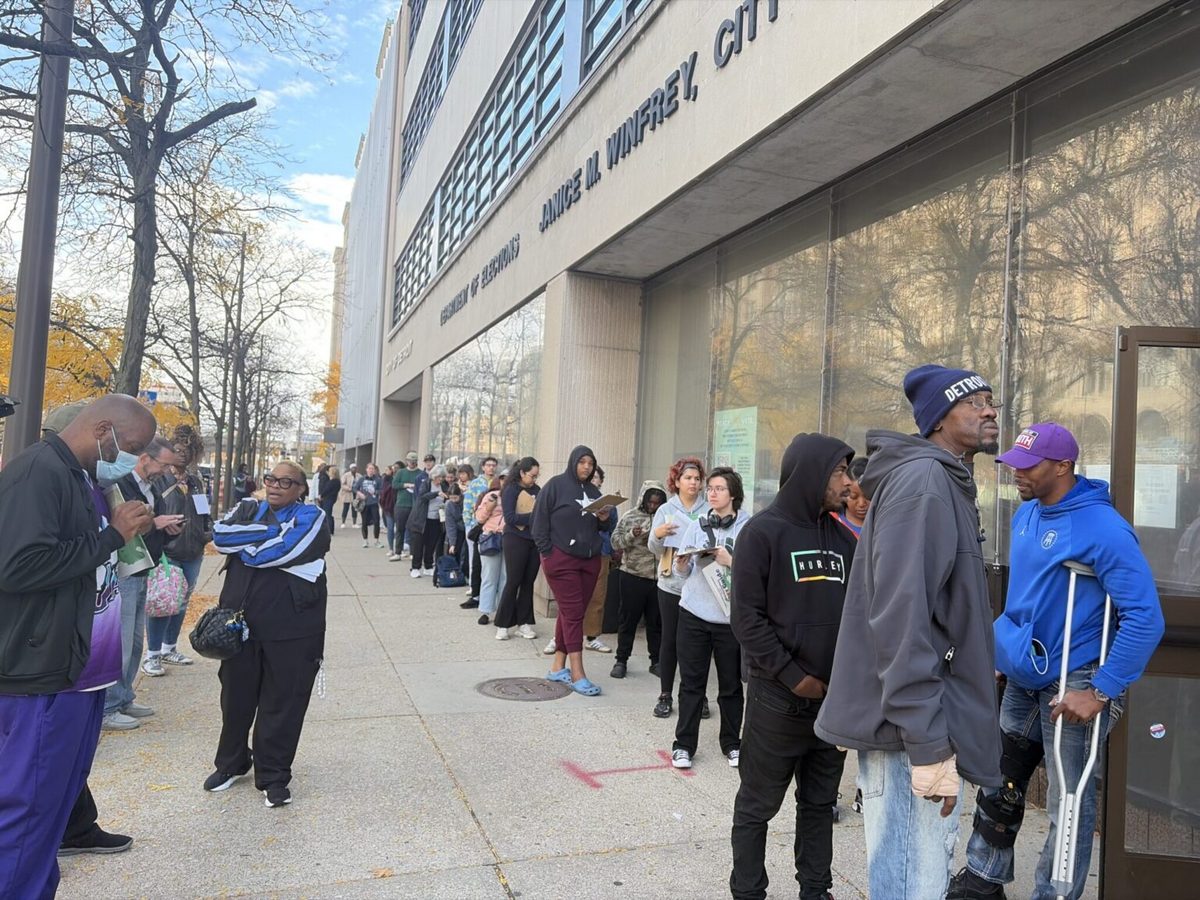
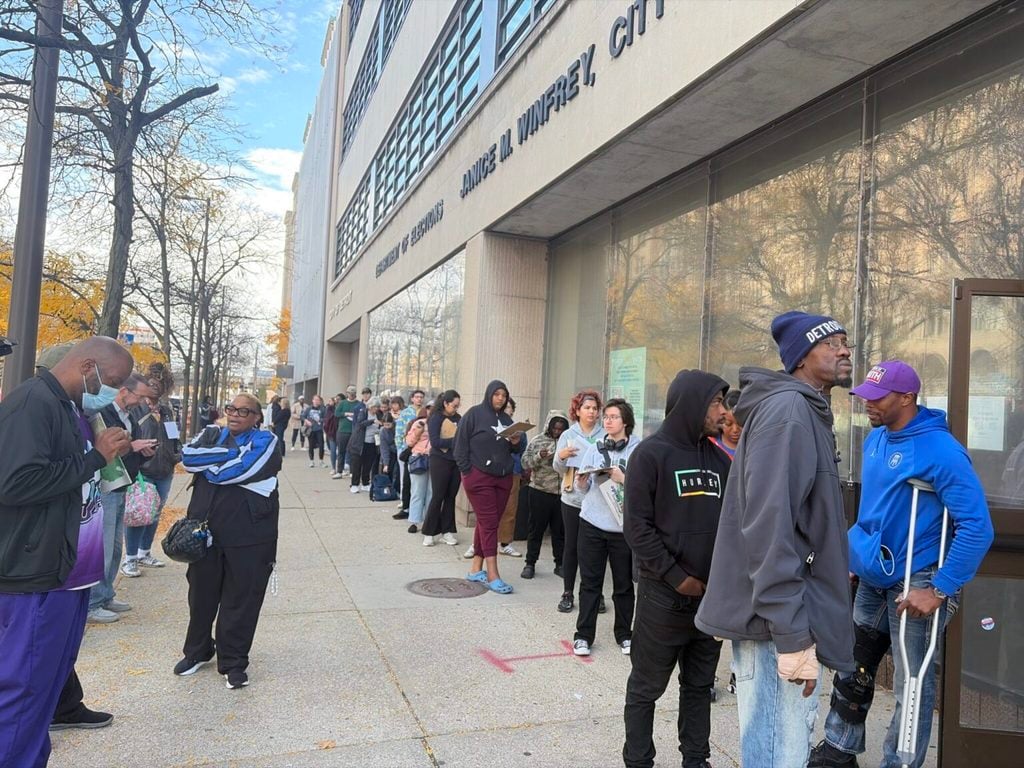
Michigan’s 2026 race for U.S. Senate was one of the most watched in the nation. In this photo, voters wait in line outside the Department of Elections in Detroit on Nov. 3, 2026. (Photo by Janelle D. James/Michigan Advance)
WASHINGTON — In a stunning upset, Democrats ousted Republicans and flipped control of the U.S. Senate Tuesday night, effectively establishing a barricade for President Donald Trump’s agenda for the last two years of his term.
Democrats will now have the power to block many of Trump’s nominees, both executive and judicial, including if a spot opens on the U.S. Supreme Court bench.
The decisive rebuke of Trump became apparent just after 11:30 p.m. Eastern, when The Associated Press called the Iowa Senate race for Democrat Josh Turek, who clinched the open seat over Republican candidate Ashley Hinson.
Voters increasingly grew dissatisfied as the midterms approached with high gas and diesel prices, and overall inflation, driven up by Trump’s stalled war in Iran and erratic tariff policies. The economic woes, which also include increasing food prices and skyrocketing healthcare costs, hung over Republican candidates as they campaigned in recent months.
Trump immediately posted on Truth Social, “I’m going to become a Political Pundit, both good and bad, on the reasons these Candidates won and lost!”
The president reportedly said he will accept the results, according to reporting from the New York Times.
Earlier in the evening a White House official said on background that Trump’s mood remained “defiant.”
Senate Minority Leader Chuck Schumer, D-N.Y., called the results Tuesday night “a generational remake of the Senate map.”
Kansas shocker
A political earthquake rattled Kansas, where Democratic candidate Adam Hamilton sailed past incumbent Republican Sen. Roger Marshall, marking the first time Kansans have elected a Democrat in nearly a century.
Marshall, an OB-GYN, had released his closing argument Sunday in a brief video during which he defended his former medical practice for sending clients who carried unpaid balances to collection agencies.
Speaking directly to the camera, Marshall said during the one-minute ad, “To ensure that 40,000 Kansans would still have access to care, we did have to keep the lights on. So we occasionally handed some accounts over to a collection agency, just like nearly every private medical practice does.”
The issue had dogged Marshall’s campaign since the New York Times reported in September that the Kansas doctor had filed lawsuits against more than 700 patients with unpaid bills. Patients were arrested in 81 of the cases for missing court dates.
The patients filed a class action lawsuit against Marshall Thursday, Kansas Reflector reported.
In Iowa, Democratic state legislator Turek defeated Hinson, a GOP member of the U.S. House, to win the open Senate seat — delivering another massive setback for Republicans.
Turek will now be the first Democratic senator to represent Iowa in more than a decade.
The two-time Paralympic gold medalist and state representative received an early endorsement in July from former President Barack Obama. The two appeared in a campaign ad playing basketball.
Iowa was Trump’s next-to-last in-person campaign stop on his whirlwind schedule to support midterm candidates in several reliably Republican states.
Upsets all over the map
In a major upset, Dr. Annie Andrews, a Democrat, won the Senate race in South Carolina, defeating Republican Sen. Darline Graham.
Graham had been appointed in July to serve out the remainder of her late brother Lindsey Graham’s term.
Andrews will be the first Democratic senator to represent South Carolina in more than 20 years.
Texas voters also delivered another staggering upset in electing Democrat James Talarico by a wide margin over Texas Attorney General Ken Paxton. The flip of deep red Texas to blue signified a major blow for Trump, who backed Paxton in the GOP primary over four-term Sen. John Cornyn.
Paxton, who has served as Texas attorney general since 2015, was impeached by the Texas House in May 2023 on charges of bribery, disregard of duties and several other articles of impeachment. The Texas Senate acquitted Paxton of all charges the following September.
Paxton was indicted on state fraud charges in 2015. He reached a $300,000 settlement deal to end the state probe in 2024.
In North Carolina, in yet another upset that had been predicted in polling, Democratic former Gov. Roy Cooper won the Senate race in the Tar Heel State, flipping the open seat held by retiring Republican Sen. Thom Tillis.
Cooper had faced GOP candidate Michael Whatley, who previously chaired the Republican National Committee and the North Carolina Republican Party.
Tillis announced in June 2025 he would not seek reelection after Trump vowed to primary him because he voted “no” on the “One Big Beautiful Bill Act,” the president’s major tax and spending cuts package.
In the Buckeye State, Democratic former Sen. Sherrod Brown won his Senate seat back, defeating incumbent GOP Sen. Jon Husted in another major upset for Republicans.
Brown spent 18 years in the Senate but lost his reelection bid in 2024 to Ohio Republican Sen. Bernie Moreno.
Moreno’s seat was formerly held by Vice President JD Vance before Vance was elected on the Republican presidential ticket with Trump in 2024.
Trump and Vance headlined multiple rallies throughout Ohio in support of Husted. Trump’s campaign stops for Husted drew attention last month for his repeated remarks about Husted’s physical appearance, with a focus on his backside.
More races
Democratic Sen. Mark Warner retained his seat in Virginia, according to a race call by The Associated Press just after 7 p.m. Eastern.
Georgia Democratic Sen. Jon Ossoff also kept his Senate seat, the AP called shortly before 8 p.m. Eastern.
Massachusetts Democratic Sen. Ed Markey also kept his Senate spot, the AP called, as did Democratic Sens. Jack Reed of Rhode Island, Chris Coons of Delaware, Cory Booker of New Jersey, John Hickenlooper of Colorado, Ben Ray Luján of New Mexico and Jeff Merkley of Oregon.
Juliana Stratton, a Democrat, also won the Senate race in Illinois.
New Hampshire Democrat Chris Pappas won the Senate race there, keeping a seat that was held by Democratic Sen. Jeanne Shaheen, the AP called. Pappas ran against Republican John Sununu.
Republican seats
In Florida, incumbent Republican Sen. Ashley Moody pulled ahead of Democratic candidate Angie Nixon, according to an AP race call, after precincts in the Florida panhandle tallied results.
The race between Moody and the progressive state representative was unexpectedly close in the Republican stronghold. Progressives flocked to Florida to stump for Nixon, including independent Sen. Bernie Sanders of Vermont and Democratic U.S. Rep. Alexandria Ocasio-Cortez of New York City. Nixon’s platform was closely aligned with but not identical to the national Democratic Socialists of America.
West Virginia GOP Sen. Shelley Moore Capito won the Senate race in the Mountain State, AP called shortly before 9 p.m. Eastern.
In another expected win for the GOP, Wyoming Republican U.S. Rep. Harriet Hageman cruised to victory for a seat in the upper chamber.
Kentucky GOP U.S. Rep. Andy Barr won his Senate race in the Bluegrass State, AP called.
In Oklahoma, Republican U.S. Rep. Kevin Hern won a Senate seat in the reliably red state.
In Arkansas, GOP Sen. Tom Cotton won his Senate race, AP called.
Alabama GOP U.S. Rep. Barry Moore won his Senate bid in the ruby red state.
In Tennessee, Republican Sen. Bill Hagerty won his Senate race.
Ahead of Election Day, the Cook Political Report with Amy Walter had identified close contests in Alaska, Iowa, Kansas, Maine, Michigan, Ohio and Texas.
Trump’s Republican party vied to hold on to its narrow majority in the House and maintain control in the Senate, where the party currently holds 53 Senate seats. Tuesday’s results delivered Democrats the majority in the upper chamber.
Here’s a closer look at some of the remaining hotly contested races:
Alaska
Former Democratic Rep. Mary Peltola is up against incumbent GOP Sen. Dan S. Sullivan in Alaska.
Trump’s Department of Justice preemptively sued the state’s election officials to try to block them from certifying the Senate election results if Dan S. Sullivan loses by a smaller margin than the number of votes cast for Dan J. Sullivan.
A federal judge in Alaska dismissed the case Sunday, citing the federal government’s failure to explain how it had the authority to bring the case.
Dan J. Sullivan’s candidacy was challenged earlier in the year in state court, and Alaska’s Supreme Court ruled in June he could remain on the ballot.
The Trump administration vowed to appeal.
The New York Times reported Oct. 28 that Democratic operatives recruited Dan J. Sullivan to be a spoiler candidate. States Newsroom has not independently verified the allegations.
Peltola denied any knowledge of the alleged scheme, according to Alaska Beacon.
Michigan
Republican Mike Rogers and Democrat Abdul El-Sayed are vying for the Senate post in another open race that the Cook Political Report shifted from “toss-up” to “lean Democrat” on Monday. Rogers, if elected, would be the first Republican to serve as senator for the Wolverine State since 2001.
In an unexpected move Sunday, El-Sayed’s primary opponent, Rep. Haley Stevens, endorsed Rogers, a former member of the U.S. House. Stevens told reporters in a joint press conference with Rogers Sunday she changed her mind because “we have to stand with country.”
“We can’t stand with hate, we can’t stand with Hasan Piker,” she said, referring to the far-left influential streamer and known Israel critic who appeared at El-Sayed’s primary campaign events.
The shake-up reportedly shocked many Democrats.
Senate Minority Leader Chuck Schumer called Stevens’ flip a “despicable betrayal” in a post on X Sunday.
The race has been among the ugliest of the 2026 midterm cycle. El-Sayed detractors have accused the former Detroit public health official of antisemitic statements.
Trump and other Republicans, including Rogers, have repeatedly hurled Islamophobic attacks at El-Sayed. Rogers described El-Sayed during an Oct. 26 campaign event as “the most radical extreme candidate in the country” and said he is “pretty close” to the nearly century-old political Islamist group the Muslim Brotherhood, which El-Sayed denies.
Maine
In Maine, incumbent GOP Sen. Susan Collins is defending her seat against Democratic nominee Troy Jackson in another highly competitive Senate race. The results of that election could be delayed days — or even weeks — from Election Day due to the odds favoring a ranked-choice runoff, according to Maine Morning Star.
Jackson entered the race as a late candidate after the Democrats’ initial choice, Graham Platner, ended his campaign in July following multiple allegations of sexual assault.
Collins has held the seat for nearly three decades.
Jackson was mobbed by national press at his final campaign stop in South Portland. He told reporters he’s very hopeful given “the amount of people turning out, the way things are going, the way people are talking.”
“In the end, people want change and I think people see me as a change candidate, for what’s going on in this country, I feel really good about it, I really do.” He also optimistically predicted that the race wouldn’t go into a ranked-choice runoff and that either he or Collins would get above 50% of votes.
Jennifer Shutt , Jonathan Shorman and Eesha Pendharkar contributed to this report.
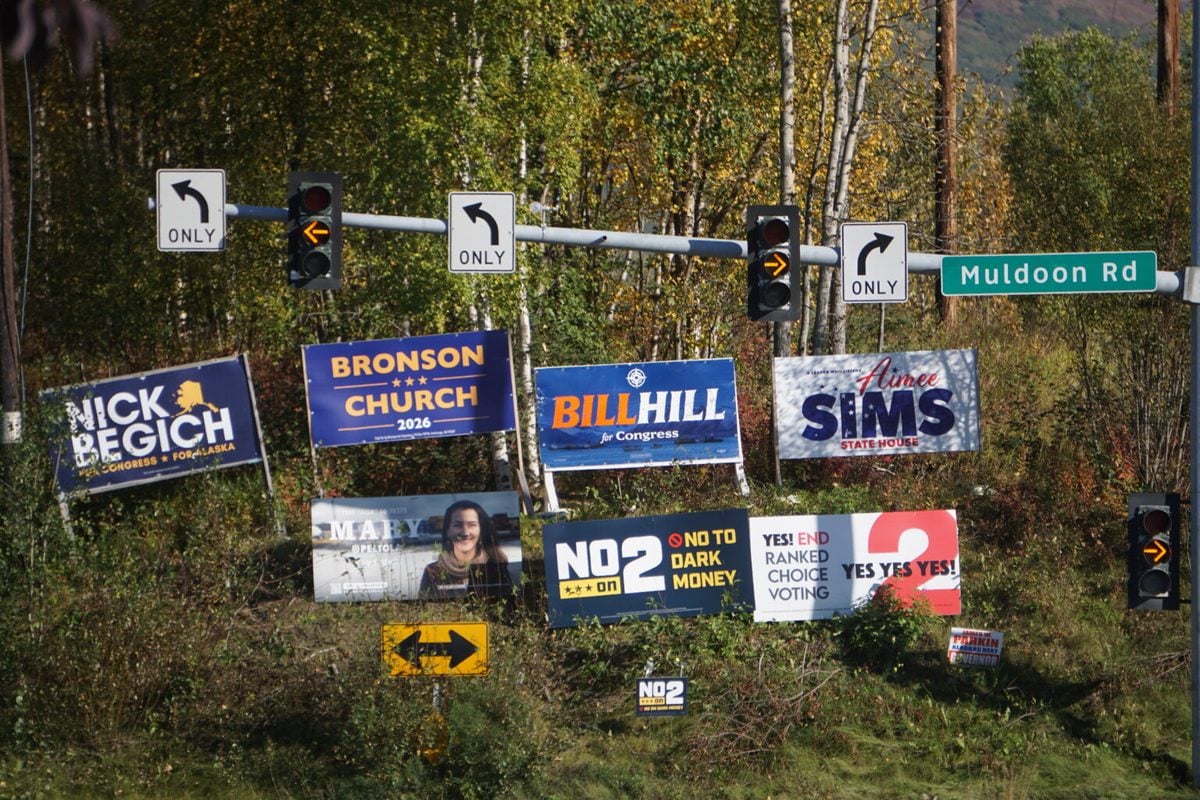
Campaign signs crowd a slope on Sept. 23, 2026, at the intersection of Muldoon Road and Northern Lights Boulevard in Anchorage. (Photo by Yereth Rosen/Alaska Beacon)
On Tuesday, Alaska could elect its first Democratic governor since 2002, roll back the clock on the way it conducts elections, help decide control of the U.S. House and Senate for the final two years of President Donald Trump’s second term and possibly elect the first Indigenous woman to the Senate.
Here’s what to consider when voting and what to watch for as the results come in:
U.S. Senate
In a four-person race, incumbent Republican Dan S. Sullivan is being challenged by Democratic candidate Mary Peltola, independent Dan J. Sullivan and Republican Gerald Heikes.
Polling throughout the race has indicated Peltola has a small lead over Sen. Sullivan, but the difference has been consistently within the margin of error, indicating that either could win. Dan J. Sullivan and Heikes are each expected to get less than 3% of the vote.
As a result, Alaska’s Senate race is one of a relative handful of toss-up seats that could decide whether Republicans or Democrats control the Senate.2026 Voter Guide
The candidates, the ballot measures, and the tools you need to cast your vote.
Sen. Sullivan has been a reliable supporter of President Donald Trump and the Senate’s Republicans; if Peltola were to win, it would increase the chances of a Democratic takeover. Peltola has campaigned on an anticorruption platform and appears likely to support Democratic efforts to investigate the Trump administration.
While both Peltola and Sullivan support oil and gas drilling on federal land in Alaska, other Senate Democrats oppose such drilling and could override Peltola.
In addition, Peltola has said she would support restrictions or a ban on deepwater trawling in federal waters near Alaska, but Democratic control of the Senate could put Sen. Patty Murray, D-Washington, in control of the Senate committee that handles fisheries, and Murray has supported the trawl industry.
During his latest term, Sullivan has successfully advocated for a vast expansion of the U.S. Coast Guard and military in Alaska, bringing hundreds of millions of dollars in construction projects to the state.
The Trump administration and other Republicans have indicated that they may seek to dispute the legitimacy of a Peltola victory, citing a New York Times article that reported Democratic campaigners recruited Dan J. Sullivan as a spoiler who could siphon votes away from Sen. Sullivan.
The chance of a successful challenge would fall if Peltola defeats Sen. Sullivan by a margin that is larger than the number of votes received by Dan J. Sullivan.
In addition, if Sen. Sullivan is re-elected, there would be no challenge.
Governor
Democratic candidate Jonathan Kreiss-Tomkins and three Republicans — Bernadette Wilson, Dave Bronson and Treg Taylor — are seeking to succeed Gov. Mike Dunleavy, a Republican who is term-limited and unable to run again this year.
While ranked choice voting could allow Republican votes to transfer from a lower-finishing Republican to a higher-finishing one, historical trends show many Republicans are unwilling to rank more than one or two candidates, and polling indicates Kreiss-Tomkins has high odds of becoming the first Democratic governor of Alaska since Tony Knowles left office in 2002.GET THE MORNING HEADLINES.SUBSCRIBE
Kreiss-Tomkins has campaigned on an ambitious series of policy goals, including the restoration of a pension plan for teachers and state employees, advance funding for public schools, a multimillion-dollar bond issue for electrical improvements across the state, a temporary ban on new large-scale computing data centers, changes to the way the state conducts elections and restrictions on trawl fisheries.
The election of a Democrat could cause ripple effects in the state’s relationship with the Trump administration, which has withheld federal payments to Democratic-led states, including disaster relief money.
Wilson, who President Donald Trump has endorsed and polls have indicated is the leading Republican candidate, has advocated a more aggressive push toward policies pursued by Dunleavy during his eight years in office, including more funding for the Permanent Fund dividend, even if it means breaking an eight-year-old limit on the size of transfers from the Alaska Permanent Fund.
Taylor, attorney general under Dunleavy, has proposed policies mostly in line with Dunleavy, as has Bronson. Both men have advocated a harder limit on spending from the Alaska Permanent Fund, as has Kreiss-Tomkins.
Ballot Measure 2
The general election ballot includes two ballot measures, but Ballot Measure 3 is a largely inconsequential revision to the state’s existing ban on noncitizen voting.
Ballot Measure 2, conversely, would have major impacts in the state. If passed, it would repeal the state’s current system of elections, in which all candidates for an office run together and the top four vote-getters advance from the primary to the general election, which uses ranked-choice voting.
In place of that system, Alaska would return to party-run primaries, where political parties set the rules for who may participate. One candidate from each party would advance to the general election, and ranked choice voting would not be used.
In addition, the state would no longer have a law requiring third-party political donors to disclose the source of their money; contributors would be able to give money anonymously.
Because of a conflict with Ballot Measure 1, passed during the August primary election, enacting Ballot Measure 2 likely also would eliminate a limit on direct financial donations to governor candidates, allowing donors to give unlimited amounts of money in governor races. A final ruling on that elimination would take place after the election.
U.S. House
Unlike in the Senate, Alaska’s U.S. House race is unlikely to be decisive in determining control of one half of Congress. National polling indicates Democrats are likely to take control of the chamber.
Incumbent Republican Rep. Nick Begich III is being challenged by independent candidate Bill Hill, federally-imprisoned Democratic candidate Eric Hafner and Libertarian Jim McDermott.
The Alaska Democratic Party opposes Hafner and is urging party members to back Hill instead. Nevertheless, pre-election polling indicates Hafner could get 5% or more of Alaskans’ first-choice votes, and analysts believe that helps Begich’s re-election chances.
Begich, first elected in 2024, has been a reliable vote for President Donald Trump and Republicans in the House.
Hill has not said whether he would join Republicans or Democrats in the House but has said he would not serve under current Speaker of the House Mike Johnson, R-Louisiana.
Alaska Legislature
Both the Alaska Senate and Alaska House are currently controlled by coalition majorities; the majority in the Senate includes Republicans and Democrats, while the one in the House includes Democrats, independents and Republicans.
Over the past two years, the coalitions have been in conflict with Dunleavy, who vetoed more than 25% of all legislation passed by the House and Senate, a record since statehood.
If the coalitions continue and Kreiss-Tomkins is elected governor, the state’s legislative and executive branches would be aligned on major issues including school pensions and funding.
If the coalitions continue but a Republican is elected governor, or if Kreiss-Tomkins is elected but enough Republicans are elected to the Legislature to form a majority, some kind of discord is likely to continue.
U.S. Sen. Dan Sullivan, R-Alaska, speaks at a rally featuring President Donald Trump on Tuesday, Oct. 13, 2026, in Wasilla. On Oct. 22, Trump ordered the U.S. Department of Justice to file a lawsuit that would prohibit anyone but Sullivan from being certified as the winner of the U.S. Senate election. (James Brooks photo/Alaska Beacon)
By: James Brooks, Alaska Beacon
U.S. Sen. Dan Sullivan, R-Alaska, speaks at a rally featuring President Donald Trump on Tuesday, Oct. 13, 2026, in Wasilla. On Oct. 22, Trump ordered the U.S. Department of Justice to file a lawsuit that would prohibit anyone but Sullivan from being certified as the winner of the U.S. Senate election. (James Brooks photo/Alaska Beacon)
A federal judge has dismissed a lawsuit filed by the Trump administration that sought to block the state of Alaska from declaring a winner in the state’s U.S. Senate election.
In a 20-page order issued Sunday morning, U.S. District Court Judge Sharon Gleason said the federal government failed to explain how it has the authority to bring its lawsuit.
“Therefore, this court lacks jurisdiction and the United States’ amended complaint must be dismissed,” Gleason wrote.
Less than two hours after Gleason’s judgment, the federal government said it would appeal to the 9th U.S. Circuit Court of Appeals.
Legal experts had expected the result because the federal government’s arguments were legally questionable.
President Donald Trump said last week he ordered the filing of the case, which asked a judge to stop the state from declaring anyone but incumbent Republican Sen. Dan S. Sullivan the winner.
Gleason is an appointee of President Barack Obama and the most senior federal judge in Alaska.
Polling averages indicate Democratic candidate Mary Peltola is slightly ahead of Sullivan in a race that could help determine whether Democrats or Republicans control the Senate.
Dan J. Sullivan and Republican Gerald Heikes of Palmer are the third and fourth candidates in the four-person Senate race.
The Alaska Beacon has not independently verified the Times’ reporting.
Peltola denied personal involvement after the Times reporting indicated she was aware of the recruitment, which involved an intermediary. Since the Times published its article, the federal government and the state have announced criminal investigations but have not said what crime may have been committed or whom they are investigating.
Dan J. Sullivan’s candidacy had been challenged earlier this year in state court, but the Alaska Supreme Court ruled in his favor.
No way to preserve ballot secrecy, Gleason says
In written arguments filed since last week, attorneys representing the federal government had argued without evidence that Alaska voters might be confused by the presence of two candidates named Dan Sullivan and sought an order that would require the state to set aside all votes for Dan J. Sullivan, pending further investigation.
The state of Alaska, Peltola’s campaign, a national Democratic group and two nonpartisan voting organizations opposed that request.
In written filings, they said the action requested by the federal government would not prove any possible confusion.
“No pattern of ballot markings will reveal any voter’s reason for voting for Daniel J., regardless of how the voter ranks the candidates on the ranked-choice ballot,” state attorneys wrote. “And the ballot markings will be the only evidence of voters’ intent. Ballots cannot be associated with voters to allow the state or federal government to follow up with Daniel J. voters about their true intentions. Like every state in the union, Alaska protects the secrecy of the ballot by law, and such an investigation would require violating that secrecy.”
In response, the federal government could not explain how it would keep Alaskans’ votes secret.
“The absence of any explanation from the United States as to how its requested relief could redress its alleged injury while simultaneously maintaining the secrecy of the ballot is telling,” Gleason wrote. “Simply, the Court cannot grant the United States the relief it seeks because the United States has failed to establish the redressability prerequisite for Article III standing.”
Federal attorneys suggested the state could segregate votes for Dan J. Sullivan to allow the counting of others, “but requiring the segregation of ballots cast by voters for Daniel J. Sullivan so that these voters can be further investigated by law enforcement is not a remedy that this Court can or should order as it clearly (violates) Alaskans’ right to a secret ballot,” Gleason wrote.
Ordinarily, a plaintiff could amend a rejected legal complaint to show how it has standing, but in this case, Gleason said that would be unfair to Alaska because the election is so near.
Appeal is possible but may be moot
The Democratic Senatorial Campaign Committee, which was named in the Times article as one of the organizations recruiting spoilers, had intervened in the lawsuit alongside the Peltola campaign and the state of Alaska.
“Today’s ruling is a victory for democracy and a clear message to Donald Trump and Senate Republicans: No one, no matter how powerful, can toss out free and fair elections just because they don’t like the result,” said DSCC executive director Devan Barber in an emailed statement.YOU MAKE OUR WORK POSSIBLE.SUPPORT
While the federal government has appealed Sunday’s decision to the 9th Circuit, action in that court may not take place until after Election Day.
If incumbent Sen. Dan S. Sullivan wins the election, or if Peltola wins by a margin that is larger than the number of votes received by Dan J. Sullivan, an appeal could be moot.
In addition, there is some indication that the 9th Circuit may be unwilling to overturn the rejection. On Oct. 26, a three-judge panel from the 9th Circuit rejected an emergency order filed by the federal government against California elections officials. A lower court had also dismissed the federal lawsuit against California.
In that ruling, one of the concurring judges wrote, “On balance, given the record and because Plaintiff has offered no workable plan of any kind as to how the remedy it seeks could be accomplished in practice without potential catastrophic consequences to California’s ongoing election, the equities between the parties and the public’s interest do not weigh in favor of granting the requested relief.”
Through Saturday, almost 15% of registered Alaska voters had already cast ballots for the general election. Turnout is expected to be near 50%, based on trends over the past two midterms. https://flo.uri.sh/visualisation/30636856/embed?auto=1
Correction: A prior version of this article incorrectly attributed a quote from a 9th U.S. Circuit Court of Appeals decision on Oct. 26. The quote should have been attributed to one judge, not a three-judge panel in a ruling on an emergency order.
NOTN- The Juneau Planning Commission has unanimously approved a scaled-down version of Huna Totem Corporation’s planned Áak’w Landing cruise ship dock and waterfront development in downtown Juneau.
The commission voted Tuesday to amend its 2023 approval, allowing the company to reduce the size of the upland facilities, eliminate underground parking and reconfigure bus staging and parking areas.
In a story by KTOO, officials with Huna Totem Corporation say construction costs have climbed from an estimated 150 million dollars to more than 250 million, largely due to steel tariffs and market volatility.
The revised project would still include a welcome center, waterfront shops and restaurants, a small cultural center, a park and event space.