By: James Brooks, Corinne Smith and Yereth Rosen
This article was last updated at 2:50 a.m. Wednesday.
Alaska is on course to have its first Democratic governor since Tony Knowles left office almost a quarter-century ago.
According to incomplete, preliminary results published Tuesday night by the Alaska Division of Elections, Jonathan Kreiss-Tomkins had 49% of the vote among four people competing to replace Republican Gov. Mike Dunleavy, who is term-limited and unable to run for re-election this year.
While 393 of 400 precincts have reported results from Election Day, thousands of early and absentee votes remain to be counted in coming days.
Kreiss-Tomkins and three Republicans — Bernadette Wilson, Dave Bronson and Treg Taylor — advanced from an August primary election that winnowed the field of candidates from 17 to four.
Wilson, the leading Republican candidate, received the endorsement of President Donald Trump during an October rally in Wasilla. She has 29.1% of the vote according to the latest update, with Bronson at 14.1% and Taylor at 7.4%.
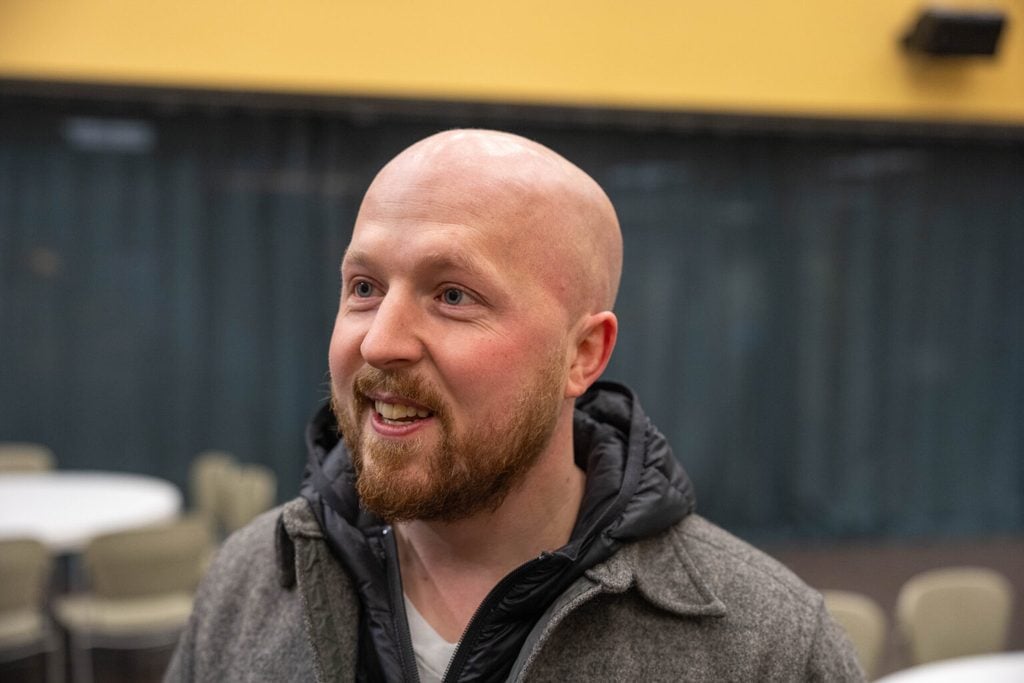
Earlier in the day, Kreiss-Tomkins spoke with reporters before casting his ballot in his home precinct at the University of Alaska Anchorage Student Union on Tuesday morning.
“We’re really proud of the campaign that we’ve built — a lot of hard work, very much a team effort across Alaska,” he said. “No matter the outcome, I feel great about the process to get here.”

After the August primary, the second Democratic finalist, former state Sen. Tom Begich, withdrew from the race in order to consolidate Democratic support behind Kreiss-Tomkins.
That withdrawal promoted former Attorney General Taylor into the final four, but Lt. Gov. Nancy Dahlstrom disqualified him for failing to complete a financial disclosure on time. Days later, Dahlstrom reversed her decision, an act that restored Taylor’s candidacy.
Between August and Election Day, the four finalists for governor campaigned across the state and participated in more than a dozen forums and debates. While not every candidate participated in every event, voters had ample opportunity to compare the four.
Kreiss-Tomkins said after 10 months of campaigning and speaking with thousands of Alaskans his No. 1 takeaway was how difficult it is for many Alaskans to get by. He said he’s made a “very, very long list” of issues he wants to tackle, and he’s committed to work across partisan divides for Alaskans, including with the Trump administration.
“I’m excited to work with anyone and everyone — Trump administration to the House and Senate and the Legislature to all other partners in and out of government, for potentially some really big wins for Alaska,” he said.
Wilson turned reporters away from her Election Day event in Anchorage. Outside, Miracle Woko and Jaymee Wheeler said they were impressed with Wilson’s commitment to Biblical values.

“I really believe that Bernadette is the right leadership to take over from Mr. Dunleavy. I think she really has a good plan to prosper Alaska, and of course we want our PFDs. We don’t want to be taxed, and I think that she really believes,” Wheeler said.
Dalton Polizzi, a Republican voting at the Alaska Zoo in South Anchorage’s Hillside area, said the U.S. Senate race was the “biggest one that I think most people are concerned about.” He wasn’t able to pay as much attention to the other races.
“As far as the governor is concerned, I’m not 100% sure about the JKT thing because I am a registered Republican, but I do know that, for example, Trump endorsed Bernadette, so that definitely gained a little bit of traction.”
He said he voted for Sullivan and Wilson, but he left the state legislature spaces blank.
Late Tuesday, hundreds of Kreiss-Tomkins’ supporters packed the Broken Blender bar in downtown Anchorage, with dozens more people lining up down the block. The atmosphere was celebratory, and TV screens tuned to NBC News gave updates on Democratic wins throughout the night.
Around 10:45 p.m., with results showing him having 48.8% of first-choice votes, Kreiss-Tomkins addressed the crowd, first thanking his family, his partner Sophie and campaign team, then all his supporters.

But he said the campaign is a means to an end, and that is “making this state better and solving problems” — and the work will start on Nov. 4.
“We’re going to make public education in Alaska excellent everywhere,” he said, to cheers and applause.
“We’re going to make balanced budgets sexy again,” he said smiling. “Zac (Johnson) and I will be delivering a budget to the Alaska Legislature, and that budget, for the first time in years, will be balanced. And we’re going to restore the basic institutions that keep Alaska moving, like the ferry system.”
How does Alaska’s election system work?
In Alaska, all candidates for an office run in a single primary election. The four who get the most votes (or everyone, if there are four or fewer candidates) advance to the November general election.
In that election, voters rank the candidates in order of preference.
If a candidate gets at least 50% of the first-preference votes, they win.
If none have 50%, the candidate with the fewest first-choice votes is eliminated. Voters who picked them have their votes go to their second choice.
The eliminations continue until only two candidates are left, and the person with the most votes wins.