







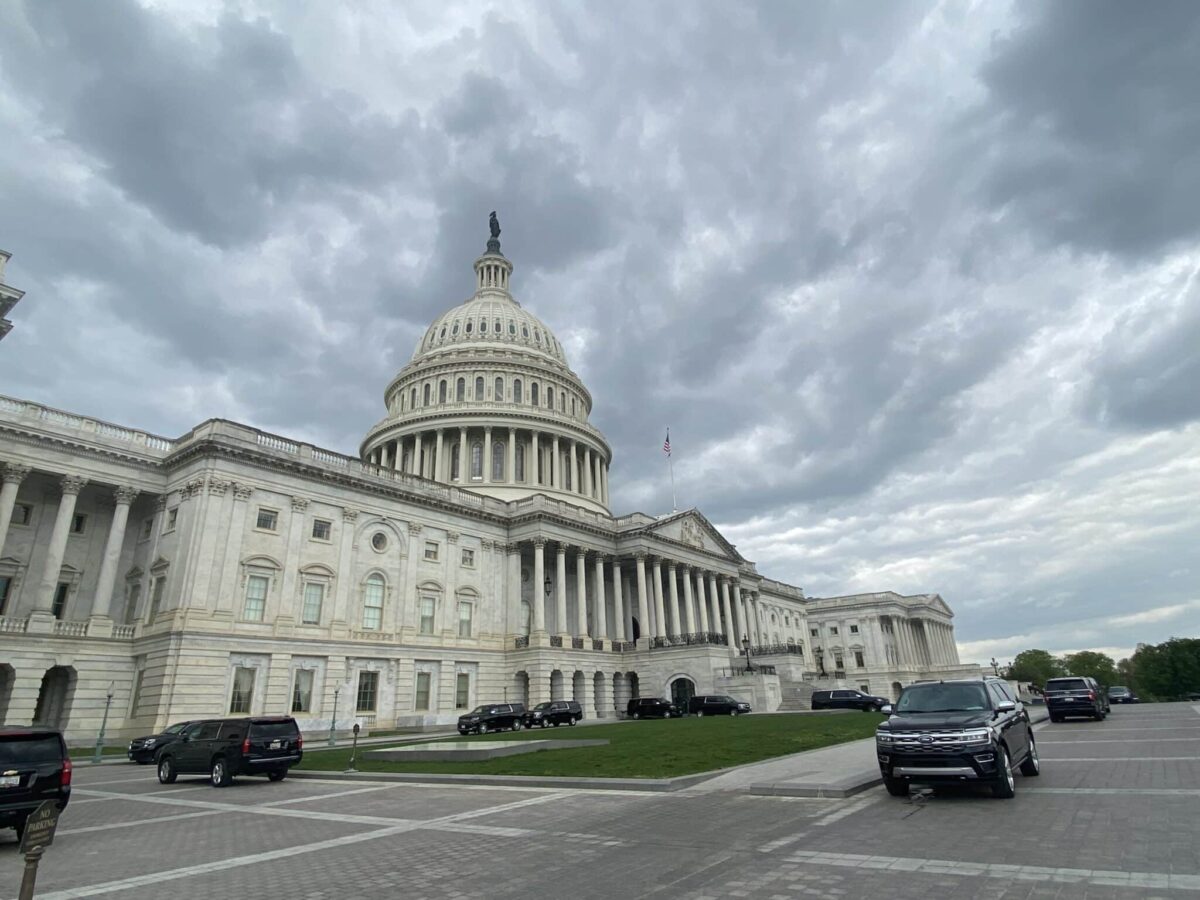
NOTN- A 57-year-old woman visiting Alaska on a cruise was killed Thursday morning when a car accelerated through a guard rail, struck her and plunged into Ketchikan Creek, city officials said.
The woman, from Auburn, Indiana, was pronounced dead at the scene. Her husband, also a cruise passenger, was with her on her trip.
The city said the family has been notified.
Three other people, including the driver, were taken to the island’s hospital. One remained in critical condition Thursday afternoon, while the other two were released with minor injuries.
The crash happened around 8:40 a.m. at the Centennial parking lot near Historic Creek Street, a popular downtown destination for tourists. The vehicle went through a wooden fence and dropped about 10 feet into the creek below, damaging a nearby walkway.
The cause of the crash remains under investigation.
An early voting station is set up in the atrium of the State Office Building in Juneau, Alaska on Monday, Aug. 5, 2024, the first day of early voting for the 2024 Alaska primary election. (Photo by James Brooks/Alaska Beacon)
By: James Brooks, Alaska Beacon
An early voting station is set up in the atrium of the State Office Building in Juneau, Alaska on Monday, Aug. 5, 2024, the first day of early voting for the 2024 Alaska primary election. (Photo by James Brooks/Alaska Beacon)
A document submitted by the Alaska Division of Elections to the U.S. Department of Justice in response to a nationwide data request names 70 possible noncitizens who voted or attempted to vote in state or local Alaska elections since 2015.
Noncitizen voting remains extraordinarily rare, nationwide figures show, and Carol Beecher, director of the Alaska Division of Elections, said there is no evidence that noncitizen voting changed the result of last year’s elections here.
Ahead of last year’s elections, Donald Trump and other Republican politicians said they believed large numbers of non-U.S. citizens would seek to vote and influence the result of elections.
Since becoming president, Trump has asked Congress to impose citizenship checks on all potential voters. His Department of Justice has asked all 50 states for copies of their voter lists in order to create a national government database.
Alaska turned over its voter list and other documents to the U.S. Department of Justice last month.
In response to a public records request filed by the Alaska Beacon, the Alaska Division of Elections provided copies of documents it delivered to federal authorities.
Most of the documents, including a copy of the state’s official voter list, were already public. The voter list, for example, is available for purchase from any state elections office and doesn’t include sensitive information beyond a voter’s name, how often they’ve voted, and where they live.
The state’s inactive voter list — showing people whose voter registrations have been flagged for review and possible removal — is also a public record, but it isn’t commonly circulated. Inactive voters can’t cast a ballot without additional ID checks.
WHERE’S THE LIST?
Ordinarily, the Alaska Beacon publishes copies of the documents it obtains via public records requests, but in this case, we’re not publishing the list.
The inactive voter list contains the names and addresses of tens of thousands of Alaskans who have committed no wrongdoing, and we believe the potential harm outweighs the benefit of publishing it.
The list may become available from other sources or news outlets, but because people may be listed as “noncitizens” due to paperwork errors or other innocent mistakes, and because we aren’t able to verify the citizenship of all 541 people, we’re not publishing it.
The inactive voter list provided to the DOJ and to the Beacon is from August. It includes 541 people whose voter records were tagged “NC” for non-citizen.
But it’s not clear whether these Alaskans are noncitizens or were on the list because of mistakes.
Carol Beecher, director of the Alaska Division of Elections, said some people may have been erroneously labeled, so it isn’t correct to say that there were 541 noncitizens registered to vote.
“As we get more information, things change. So what I’m telling you today on a number may change tomorrow because of new information that we got,” Beecher said in an extended interview on Wednesday.
Stephen Kirch, the division’s spokesperson, said by email that “the DOE cannot say with any degree of certainty whether the current number of NC-coded entries is ‘abnormal’ or ‘unusual’ in a historical context. This is because the number is a moving target and not a static one; it is not tracked.”
The inactive voter list shows only people whose records have been flagged for additional attention and isn’t confirmation that they are not citizens. It may include people who filled out paperwork incorrectly or registered to vote shortly before becoming a citizen.
“It’s really hard to say whether this particular number (541) is a problem, because there’s so many questions behind even that particular number,” said Mara Kimmel, a former immigration attorney who now works as executive director of the Alaska chapter of the American Civil Liberties Union.
That total also might miss noncitizens who are on the active voter list but haven’t yet been identified.
Carol Beecher, the new director of the Alaska Division of Elections, answers questions from reporters on Thursday, Feb. 16, 2023. (Photo by James Brooks/Alaska Beacon)
Beecher said she considers the “NC” tag to be “kind of like a file drawer. You put things into that file based on the status when you put it in there. But that could change.”
Kimmel said that the issue is “never as easy as it seems or as it would be framed. … Noncitizens voting has become a real political hot-button issue.”
In her experience, “there’s so much confusion and misinformation that is born out of a benign desire to participate in your new home.”
In Alaska, residents can register to vote by contacting the Alaska Division of Elections. Residents are also asked if they want to register when they update their driver’s license, get a new driver’s license, and apply for the annual Permanent Fund dividend.
As Beecher explained, if someone attests that they’re not a citizen through one method but says they are a citizen via a different method, that gets the attention of authorities.
“When we have gone in there and looked and contacted them, we have found that usually it was a mistake,” she said.
In other cases, particularly with the state’s “motor-voter” program, the mistake might come from a typo or someone’s misunderstanding of the rules, particularly if they don’t speak fluent English, as might be the case with new immigrants.
The Division of Elections doesn’t have investigative powers, which means voting officials rely on an applicant’s sworn oath about their citizenship. There’s no automatic double-checking, and it’s federally unconstitutional for the division to ask for proof of citizenship.
“All we get is the affirmation, and however frustrating that can be for everyone out there to say, ‘Well, why can’t you make sure?’ Well, we are not given that authority. So essentially, the division takes people at their word is really what it comes down to,” Beecher said.
If someone’s registration is flagged by a complaint or because of a discrepancy in the records, the division forwards the case to the Alaska Department of Law for investigation.
“We provide them with documents if they request that, as pursuant to an investigation, but if not, we may never hear from them,” Beecher said of the investigation.
Smith was born in American Samoa, an island territory in the South Pacific. Its residents are U.S. nationals — having some of the same legal rights as other Americans — but aren’t citizens.
During the subsequent investigation, Alaska State Troopers learned of 10 other American Samoans who had voted in Alaska. The state charged them with civil crimes in April, and this week, they were indicted.
All 10 are labeled noncitizens on the inactive voter list supplied to the Beacon and Department of Justice. They, and another 60 other people, are shown as having voted or attempted to vote at least once during the past 10 years.
It isn’t clear whether all of those ballots were actually counted. Many are labeled as “questioned,” meaning that they were subject to additional ID verification. Beecher said “it’s possible” that some were counted but that she didn’t have numbers.
She believes “very few” noncitizens have voted.
“I’m speaking very anecdotally, because I don’t have those kinds of numbers for you, but our sense is that it’s very small. And I think the underlying reason for that is because there is no nefarious intent out there to try to sway an election. It’s people who either — and this is my personal opinion — they’re confused about the rules or somehow ended up marking something that they didn’t understand,” Beecher said.
If the noncitizen-tagged voters on the inactive list had still been active, they would have represented just 0.09% of Alaska voters.
Last year, 340,981 Alaskans voted in the state’s November general election. The division’s inactive list shows six noncitizens either voted or attempted to vote in that election.
In Michigan, officials announced in April that they had found 16 credible cases of noncitizen voting out of about 5.7 million votes cast overall, or one per every 360,000 votes.
Sen. Bill Wielechowski, D-Anchorage and a supporter of election reform legislation in Alaska, noted that the rate of noncitizen voting in Alaska is likely well below the rate at which legitimate voters are being disqualified because of problems with the state’s absentee voting system.
“Any time you have people who are voting that shouldn’t be voting, that’s cause for concern,” Wielechowski said in an interview Wednesday.
“But at the same time, we’ve got hundreds of people that we know of, actually thousands of people who were disenfranchised,” he said, referring to the state’s regular practice of disqualifying absentee ballots because of submittal errors.
“In rural Alaska, we had 10% or 15% of the population in rural Alaska that was disenfranchised a couple of years ago, legitimate voters who were disenfranchised because of a bureaucratic technicality that’s not even checked. So I think there’s bigger problems,” Wielechowski said.
In 2023, Rep. Sarah Vance, R-Homer, proposed legislation that would have required the Division of Elections to cross-check the state’s voter rolls with a national citizenship database.
“I always like to presume innocence, but we have to put the safeguards in place, and by having the division use those databases as a check and balance, I think that’s a very simple way to make sure that we’re crossing our T’s and dotting I’s,” Vance said Wednesday.
She noted that current Speaker of the House Bryce Edgmon, I-Dillingham, won his 2006 primary election via a coin toss that followed a tied election.
“When you look at how slim some of our elections are, how tight races can be, these numbers matter,” she said.
The Alaska Senate stripped out Vance’s citizenship provision and passed a revised bill, but the Republican-led House failed by a single vote to take up the legislation on the last day of the regular session in 2024. The bill died at the end of the session, and lawmakers started anew this spring.
In recent years, the Alaska Department of Law has requested funding for a part-time elections investigator. The Legislature has not approved that request.
“We shouldn’t have anyone voting in our elections on any level who shouldn’t be,” Vance said.
“This is important and significant because we want to make sure that we protect the sovereignty of every individual’s vote,” she said.
U.S. Coast Guard Cutter Polar Star (WAGB 10) (left) sits moored next to U.S. Coast Guard Cutter Healy (WAGB 20) at Coast Guard Base Seattle, Aug. 25, 2024. The Polar Star and Healy are routinely deployed to Arctic and Antarctic locations to support science research or help resupply remote stations. (U.S. Coast Guard photo by Lt. Chris Butters)
The U.S. Coast Guard announced Tuesday that it has awarded a $137 million contract for the first phase of a project intended to allow its Seattle base to host two new heavy icebreakers.
The contract, awarded to The Whiting-Turner Contracting Company, covers dredging of the Coast Guard’s Slip 36 and construction of two ship berths capable of hosting the new icebreakers, formally known as Polar Security Cutters.
The first of those ships, the Polar Sentinel, is expected to be complete in 2030. When accepted into the Coast Guard, it will be the service’s first new heavy icebreaker since the Polar Star was commissioned in 1977.
The Coast Guard operates the federal government’s icebreaker fleet, and the Polar Star is key to supplying American research bases in Antarctica from its Seattle home port.
A second and third heavy icebreaker were fully funded with $4.3 billion included as part of the Republican budget package approved by Congress and President Donald Trump earlier this year.
The budget package also included $300 million for port construction in Juneau to support the newly commissioned Coast Guard icebreaker Storis, a converted oilfield services ship. Until that work is complete, the Storis will be homeported in Seattle.
The Republican budget package, known as the “Big Beautiful Bill Act,” includes billions of dollars for shoreside port facilities like those in Juneau and Seattle.
Additional phases of work are expected in Seattle, which is expected to be the home port of four new major Coast Guard cutters, the service said in a written statement.
Photo of Mendenhall glacier in autumn, taken by Rosary Lombardo
NOTN- After two recent deaths on trails near the Mendenhall Glacier, Juneau police are urging hikers to take precautions and understand the challenges search-and-rescue teams face in southeast Alaska.
Juneau Police Chief Derek Bos said such cases fall into one of two categories, people who vanish in the wilderness, often requiring search-and-rescue efforts, and those whose disappearances are suspicious or criminal in nature.
“Alaska State Troopers actually have jurisdiction over search and rescues in all of Alaska.” said Bos, “When we get those calls in, initially, it’s deferred to AST for them to conduct search and rescue operations and begin the initial stages of that investigation, we also are privileged in Juneau to have Juneau mountain rescue, which is a very professional, wonderful entity that does a great job of search and rescues. And so they work in collaboration with AST on those initial stages of a missing person who’s gone hiking and just not come back.”
JPD supports both groups and shadows their work in case the missing person case later becomes a criminal investigation.
Bos also noted that southeast Alaska poses difficulties for search teams. Dense vegetation, steep mountainsides and shifting winds complicate efforts by ground crews and even trained search dogs.
“It doesn’t take much to look around and see that we are in a very densely vegetated area, and it’s very vertical. So it’s not like looking for somebody in the plains of Kansas.” Bos said, “There’s a lot of visual obstructions, there’s altitude challenges, there are different wind patterns. So even using search and rescue dogs, if you’re above a scent and the scent is below you, it might blow up on the wind, but if the dog is below the scent and the scent is going up, you might miss it. There’s significant challenges through every aspect of a search and rescue in Southeast Alaska.”
Community members often play an important role, he added, since hikers can help narrow down search areas if they remember where they saw someone.
“A huge thing for us with the public is, if you see this individual on a trail, call us and tell us, let us know where you saw them and when you saw them, that helps us narrow down the search area, and gives a better point of where that person was last seen, so that we can start search efforts in a more specific location.”
Police are urging residents and visitors to share their plans before heading out on local trails.
“If you don’t communicate that, it could be days before anybody identifies that you’re missing, and it just delays search efforts.” Bos said, “And if you’re hurt in the woods or have an illness in the woods, you want help as quickly as possible, self induced accountability is pivotal for any kind of hiking or adventures in Southeast Alaska.”
Claire Stremple, seen here on Tuesday, Sept. 2, 2025, in Juneau, has been named the new editor of the Alaska Beacon. (Photo by James Brooks/Alaska Beacon)
Claire Stremple, a former Alaska Beacon reporter and the current managing editor of public radio station KTOO-FM in Juneau, has been named the Beacon’s new editor.
The Beacon is an affiliate of the national nonprofit States Newsroom, which conducted the hiring process.
“We are thrilled to welcome Claire back to the Beacon as editor and look forward to more great reporting from our talented team under her leadership,” said Chris Fitzsimon, publisher and CEO of States Newsroom, in a written statement.
Stremple worked at the Beacon from spring 2023 through fall 2024 after prior work as a reporter for KTOO and KHNS-FM public radio in Haines.
While at KTOO, she won the Alaska Press Club’s 2022 Public Service Award for reporting that exposed a large backlog at Alaska’s Division of Public Assistance. After leaving the Beacon in 2024, she returned to KTOO as its editor.
Fitzsimon said he selected Stremple from among many applicants based on her leadership at KTOO, her prior experience at the Beacon, and her commitment to Alaska journalism.
By phone, Stremple said she wants to return to the Beacon because she enjoyed working with its reporters, “and I think that the capitol is a really exciting place to be doing state politics news reporting. I think there’s a lot of opportunity for investigative work there, and that prospect is really exciting to me. So it’s really exciting to be back with the team and be back in the capitol.”
She added, “I do want to continue Andrew Kitchenman’s work, because I think his work and vision have been pretty exemplary and impactful in the state and for other media networks.”
Alaska Beacon reporting is donation funded and can be reprinted for free by newspapers, radio stations, TV stations and news websites.
Stremple intends to work from Juneau, her current location, but said she could change locations if needs warrant.
NOTN- An Italian man is missing after falling into a rushing stream on Mendenhall Glacier and being swept into a narrow opening in the ice, authorities said.
Alaska Wildlife Troopers said they received a report around 1:45 p.m. Tuesday that the man had slipped into the water and disappeared into a roughly 2-foot-wide vertical hole. The two people traveling with him told officials they could no longer see him once he fell inside.
Juneau Mountain Rescue deployed a technical ice rescue team, which determined the hole was filled with fast-moving water and too dangerous to search.
Authorities said efforts are ongoing to notify the man’s next of kin in Italy.
Pictured above, the Asian Giant hornet, or Murder Hornet, and pictured below is the Native Yellow Horned Horntail.
NOTN- online speculation on Facebook about Murder hornets, also known as Asian giant hornets, in Juneau, Alaska Department of Fish and Game Officials are clearing things up.
While Asian giant hornets, often dubbed murder hornets, are a federal species of concern because of their threat to native pollinators, no positive reports have been confirmed in Alaska, said Tammy Davis, invasive species program coordinator for the state Department of Fish and Game.
“We would rather get 100 reports of something that ends up being native than miss one report of an invasive,” Davis said. “If you see something suspicious, report it.”
Davis says individuals may frequently confuse the invasive hornet with native insects such as the yellow-horned horntail. Though large and equipped with what looks like a stinger, the insect’s rear appendage is actually an ovipositor used to lay eggs in dead or dying trees.
“The commonly misidentified native species is a yellow-horned horntail, it has a long abdomen, they also have what is called an ovipositor, but it looks like it might be a stinger, and it’s used for laying eggs.” Said Davis “They don’t sting, and they’re a natural part of our forest ecology, and they’re really important for recycling in the forest environment. The female wasp uses that ovipositor, and she plunges that under the bark of dead and dying trees so that she can lay her eggs, so something that seems like a really scary Murder hornet turns into a really sweet Wasp that’s trying to help our forest.
Residents can report invasive species by calling the state hotline at 1-877-INVASIV or by filing a report online through the Alaska Department of Fish and Game. Reports are shared with state, federal, and local partners through the Alaska Invasive Species Partnership.
In addition to insects, state biologists are monitoring threats such as European green crabs, recently detected in Ketchikan with the University of Alaska Southeast “It was on the last day during our last survey that one of the professors found a tiny, little green crab, and then one of the students found another one.” said Davis in the next couple weeks, everybody was looking for green crab and finding them, and the map drastically changed.”
according to NOAA, The green crab is considered one of the most invasive species in the marine environment. It has few predators, aggressively hunts and eats its prey, destroys seagrass, and outcompetes local species for food and habitat.
“Information is power, and good information is even more powerful,” Davis said.
The U.S. Supreme Court, on Oct. 9, 2024. (Photo by Jane Norman/States Newsroom)
In 2012, Alaska State Troopers arrested Fairbanks pilot Ken Jouppi and seized his aircraft after charging him with bootlegging for shipping beer into the dry community of Beaver.
Now, after 13 years of legal disputes, the state’s decision to seize Jouppi’s airplane could be headed to the U.S. Supreme Court.
The Institute for Justice, a libertarian-leaning nonprofit public interest law firm, last week asked the Supreme Court to consider overturning an Alaska Supreme Court ruling from April. That ruling declared that the state’s decision to seize Jouppi’s plane was not an excessive fine for bootlegging.
The “petition for a writ of certiorari” — a formal document asking the U.S. Supreme Court to take up the issue — was filed last week, an official with the Institute confirmed on Tuesday afternoon.
The odds are against Jouppi — the Supreme Court takes only about 1% of the cases it receives. If cases filed with a fee waiver are excluded — those usually come from prisoners representing themselves in a last-ditch appeal — the acceptance rate is 5% or less.
Now 85 and retired, Jouppi was a longtime air taxi pilot in Fairbanks when he planned to ferry a passenger and her groceries from that hub city to Beaver, a village in the Interior.
Before takeoff, an Alaska State Trooper noticed a six-pack of beer visible in the baggage. Beaver had outlawed the sale, consumption and importation of alcohol in 2004. Troopers searched the plane and found three cases of beer — two Budweiser, one Bud Light — intended for the passenger’s husband, the local postmaster.
Jouppi was indicted on bootlegging charges, convicted, and sentenced. His sentence included three days in jail and a fine. State prosecutors asked that he be required to forfeit his plane, but the trial judge declined.
The state appealed that decision, and the Alaska Court of Appeals ruled in 2017 in the state’s favor. The Appeals judges sent the case back to the trial court, which again refused to order the plane’s forfeiture, citing the U.S. Constitution’s excessive fines clause.
The appeals court ordered additional proceedings by the trial court, but both Jouppi’s attorneys and state prosecutors instead asked the Alaska Supreme Court to take up the issue, which it did last year before issuing a written opinion in April.
“We hold, as a matter of law, that the owner of the airplane failed to establish that forfeiture would be unconstitutionally excessive,” wrote Justice Jude Pate on behalf of the court, which ruled unanimously in the state’s favor.
Pate and the court said that Alaska legislative debates showed that state lawmakers placed a high priority on punishments for bootleggers, and thus the seizure of an airplane was not excessive, even though a relatively small amount of beer was involved.
“Alcohol abuse in rural Alaska leads to increased crime; disorders, such as alcoholism; conditions, such as fetal alcohol spectrum disorder; and death, imposing substantial costs on public health and the administration of justice. Within this context, it is clear that the illegal importation of even a six-pack of beer causes grave societal harm,” the ruling states. “This factor strongly suggests that the forfeiture is not grossly disproportional.”
In their request for the U.S. Supreme Court to examine the case, Jouppi’s attorneys argue that the federal justices should decide whether courts should consider the seriousness of an offense in abstract, or if they should take into account a specific defendant’s circumstances.
The Alaska Supreme Court “examined the gravity of the defendant’s offense at a stratospheric level of abstraction,” they argue, when justices should have taken into account the circumstances.
The Alaska justices relied on a federal decision from the 11th U.S. Circuit Court of Appeals, Jouppi’s attorneys note, but Alaska is within the 9th U.S. Circuit Court of Appeals.
Judges for the 9th Circuit have considered the Excessive Fines clause of the Constitution and concluded that it is critical to “review the specific actions of the violator rather than by taking an abstract view of the violation.”
Because of those two differing interpretations of the Constitution, Jouppi’s attorneys say, the case is ripe for the U.S. Supreme Court to consider.
No date has been set for a court conference to determine whether Jouppi’s case will be considered by the U.S. Supreme Court.
If the court declines to consider his case, the Alaska Supreme Court decision will stand.
NOTN- According to a release, on August 31, 2025, at 9:30am, Alaska State Troopers were notified of an overdue hiker in the Juneau area.
Thomas Casey, age 69 of Arizona, was last seen Saturday morning and was reported to be on a hike.
No details about where he was going or when he would be back were provided.
His phone was pinged and it returned to a remote spot between Thunder mountain trail and Nugget Creek trail.
Juneau Mountain Rescue and SEADogs were contacted and 6 crews including 3 dog teams and 6 ground searchers were put in the field to start searches at the trail heads and the location of the ping. At 5pm September 1, Juneau Mountain Rescue and SEAdogs located Thomas deceased from injuries obtained from a fall.
He was located near the Mendenhall Glacier on the west side off the trail. The updated location for the cell phone was provided by RCC and Apple emergency services.
The body is being sent to the State Medical Examiner’s Office. Next of kin has been notified.
A voter in Alaska's special U.S. House primary election drops their ballot into a box on Saturday, June 11, 2022 as a poll worker observes. (Photo by James Brooks/Alaska Beacon)
A voter in Alaska’s special U.S. House primary election drops their ballot into a box on Saturday, June 11, 2022 as a poll worker observes. (Photo by James Brooks/Alaska Beacon)
NOTN- Juneau residents planning to vote in the city’s upcoming municipal election must register by Sunday, Sept. 7. That is also the deadline to update a mailing address with the state Division of Elections.
Anyone who will turn 18 by Election Day, Oct. 7, is eligible to vote but must still register by the Sept. 7 deadline. Alaska law allows residents to register up to 90 days before their 18th birthday.
The Oct. 7 election is being conducted by mail, but voters can check their status or update information
On September 19, ballots for this election will be mailed to registered Juneau voters at the mailing address they have on file with the State of Alaska Division of Elections. If you’re not sure about your registration status or mailing address, you can check online at myvoterportal.alaska.gov.
Vote Centers will open for in-person voting starting on September 22. The last day to vote is Tuesday, October 7.