Categories
Alaska News juneau Juneau Local Juneau Local Ketchikan Local News Feeds Sitka Local

Alaska Senate advances bill to allow surrender of infants in climate-controlled boxes 

By: Sean Maguire, Alaska Beacon

Sen. Robert Myers, R-North Pole, speaks on House Bill 57 in the Alaska Senate on Monday, April 28, 2025. (Photo by James Brooks/Alaska Beacon)

The Alaska Senate last week advanced a bill that would allow for the anonymous surrendering of infants in so-called infant safety devices.

The boxes are located on the exteriors of buildings. They are climate controlled and monitored by video. When the device is opened, a 911 request is automatically made. 

Alaskans have been able to surrender infants since 2008. Newborns must be given directly to police officers, firefighters, doctors or other medical personnel. They are then turned over to the Alaska Office of Children Services for adoption. 

In Alaska, an infant must be aged 21 days or younger to be surrendered legally. 

North Pole Republican Sen. Robb Myers is the lead sponsor of Senate Bill 9. It would allow newborns to be surrendered in climate-controlled boxes, located outside police stations, fire departments, hospitals and other locations. 

Myers said that around one baby a year has been surrendered in Alaska since 2008. Despite that, three infants have been found abandoned in Alaska since 2013: Two were found dead; one newborn was discovered alive in Fairbanks in a box in winter.

Myers said safe surrender devices would help save lives. Parents can feel shame or the fear of potential recognition when giving a child to another person, he said. The climate-controlled boxes are intended to remove that barrier.

The Anchorage Fire DepartmentCity of Fairbanksthe Alaska Children’s Trust and other groups support the legislative change.

The Alaska Senate advanced the bill on an 18-2 vote. Sens. Bert Stedman, a Sitka Republican, and Löki Tobin, an Anchorage Democrat, voted no.

Tobin said the anonymity of surrendering a child into a baby box could lead to abuse of women. She said the boxes introduce the potential that traffickers could surrender babies without a mother’s consent.

“The potential misuses for these devices far outweigh the benefits,” Tobin said.  

All 50 states allow for the surrendering of infants. Almost half of states allow for newborns to be surrendered in baby boxes, which has accelerated since Roe vs. Wade was overturned, particularly in Republican-led states

If the bill passes, the Alaska Department of Public Safety would be tasked with drafting regulations for the placement of infant safety devices. Each infant safety device is estimated to cost $16,000. That excludes surveillance and security costs, which state officials say could be “significant.”

SB 9 now advances to the House for its consideration. Similar legislation has been advancing through that legislative chamber.

Categories
Alaska News

Alaska Senate advances bill to allow surrender of infants in climate-controlled boxes 

Sen. Robert Myers, R-North Pole, speaks on House Bill 57 in the Alaska Senate on Monday, April 28, 2025. (Photo by James Brooks/Alaska Beacon)

The Alaska Senate last week advanced a bill that would allow for the anonymous surrendering of infants in so-called infant safety devices.

The boxes are located on the exteriors of buildings. They are climate controlled and monitored by video. When the device is opened, a 911 request is automatically made. 

Alaskans have been able to surrender infants since 2008. Newborns must be given directly to police officers, firefighters, doctors or other medical personnel. They are then turned over to the Alaska Office of Children Services for adoption. 

In Alaska, an infant must be aged 21 days or younger to be surrendered legally. 

North Pole Republican Sen. Robb Myers is the lead sponsor of Senate Bill 9. It would allow newborns to be surrendered in climate-controlled boxes, located outside police stations, fire departments, hospitals and other locations. 

Myers said that around one baby a year has been surrendered in Alaska since 2008. Despite that, three infants have been found abandoned in Alaska since 2013: Two were found dead; one newborn was discovered alive in Fairbanks in a box in winter.

Myers said safe surrender devices would help save lives. Parents can feel shame or the fear of potential recognition when giving a child to another person, he said. The climate-controlled boxes are intended to remove that barrier.

The Anchorage Fire Department, City of Fairbanks, the Alaska Children’s Trust and other groups support the legislative change.

The Alaska Senate advanced the bill on an 18-2 vote. Sens. Bert Stedman, a Sitka Republican, and Löki Tobin, an Anchorage Democrat, voted no.

Tobin said the anonymity of surrendering a child into a baby box could lead to abuse of women. She said the boxes introduce the potential that traffickers could surrender babies without a mother’s consent.

“The potential misuses for these devices far outweigh the benefits,” Tobin said.  

All 50 states allow for the surrendering of infants. Almost half of states allow for newborns to be surrendered in baby boxes, which has accelerated since Roe vs. Wade was overturned, particularly in Republican-led states

If the bill passes, the Alaska Department of Public Safety would be tasked with drafting regulations for the placement of infant safety devices. Each infant safety device is estimated to cost $16,000. That excludes surveillance and security costs, which state officials say could be “significant.”

SB 9 now advances to the House for its consideration. Similar legislation has been advancing through that legislative chamber.

SUPPORT: YOU MAKE OUR WORK POSSIBLE

Categories
Alaska News

Organizers say boost from 50th Alaska Folk Festival means this year’s is even bigger

One might expect the 51st Alaska Folk Festival to be a bit tamer than the landmark 50-year bash, but organizers say last year’s golden anniversary get-together set the stage for an even bigger week of music, dance and other activities this year.

“The 50th brought so many new members into the fold,” said Josh Fortenbery, president of the festival’s board, while he and others were setting up Centennial Hall on Sunday for shows starting Monday evening. “And so a lot of people that were excited about the thing last year — or maybe hadn’t been in a while, or never been before — all signed up as members last year. So we have the largest membership we’ve ever had. And so I think that allows us to keep building every year and make it keep getting bigger and better, without ever compromising the idea that it’s always going to be free.”

The festival opens at 6:30 p.m. Monday in the main Centennial Hall ballroom with a 15-minute set by the Juneau Community Chorus and is scheduled to close sometime after the 9 p.m. Sunday concert by featured guest performer Willi Carlisle with a traditional crowd singalong of “Goodnight Irene.” Other workshops and dance band events are scheduled during the week in Centennial Hall’s other rooms and the adjacent Juneau Arts and Culture Center, plus a variety of non-official and “after-hours” events at venues throughout downtown.

Among the new — or least not previously remembered — features at this year’s festival is a neon backdrop of a guitar and stars, a “50 Years of Folk Fest” that will be screened twice on Saturday at KTOO’s studios, and life-size puppets Carlisle is bringing with him as part of his act.

“We need two people to operate these backpack puppets,” said Annie Bartholomew, another festival board member and longtime Juneau musician. “I think it’s a raccoon and a king, and they fight each other.”

Carlisle, 36, who performed a 15-minute set during the 2019 festival, may also be the first person in such a slot who has returned as the festival’s guest artist, Bartholomew said.

Born in Kansas and now based in Arkansas, Carlisle performs “traditional folk music for 21st century problems,” according to a Grammy.com feature following the release of the second of his four current albums. His website proclaims “singing is healing” and “by singing together, he believes we can begin to reckon with the inevitability of human suffering and grow in love.”

Fortenberry said that kind of presence is what motivated the invitation from the festival’s board.

“I think just in the current sort of political climate — the feeling of sort of dread and civil unrest and disconnection — his joy and his model of trying to just bring everyone to the fold just really fits what we think we need sort of culturally right now,” Fortenberry said. “So it’s just a really apt pick for the times we live in.”

The rest of the lineup on the main stage features a multitude of well-known local musicians in 15-minute slots that, as usual, are fully booked with a long standby list (about 85 artists on Monday morning, according to the festival’s website).

The official poster for the 51st annual Alaska Folk Festival, designed by Ketchikan artist Savannah LeCornu. (Alaska Folk Festival)

This year’s poster was designed by Savannah LeCornu, a self-taught Ketchikan artist who is Tsimshian, Haida, and Nimiipuu (Nez Perce), according to the festival’s website. The poster features silhouetted musicians in a zig-zagging line of northern lights above Juneau’s nighttime cityscape.

Dance music is scheduled Thursday through Saturday evenings at the JACC, with four or five bands performing each night. This year’s feature dance band is The Red Hots, a quartet from North Carolina, with Connor Maguire serving as the featured guest caller for that band and some of the other dance performances.

Bartholomew said her banjo teacher, Riley Baugus, is a member of The Red Hots who has toured with musicians such as Willie Nelson and Alison Krauss.

“He’s a great teacher, and the guys he plays with are all really cool,” Bartholomew said. “It’ll be great getting him to dance and teaching people, and bringing in some authentic North Carolina, old-time dance Appalachian stuff.”

She said she’s also familiar with Maguire, having been to dances he’s called in California and Idaho.

“He looks like a lumberjack,” Bartholomew said. “I’m afraid he’ll move to Juneau because he’ll just fall in love with it. But he’s really boisterous and fun.”

Fortenbery said he was barely able to squeeze in the roughly 30 individuals or groups wanting to conduct workshops Saturday and Sunday. Offerings range from introductory sessions on music theory and square dance calling to applying for Rasmuson Foundation Individual Artist Awards, the latter being among the notable new additions.

“This is about the most workshop applications I’ve ever received,” he said.

This story was originally published by the Juneau Independent.

The post Organizers say boost from 50th Alaska Folk Festival means this year’s is even bigger appeared first on Chilkat Valley News.

Categories
Alaska News

Ketchikan loses out in competition for free tunnel to airport

Ketchikan is not getting a free, mile-long, 12-foot-diameter tunnel to link the community with its airport across the water.

The Ketchikan Gateway Borough had been one of 16 finalists for a national company’s offer to pay for building a tunnel but did not measure up in the final decision. The Boring Co. will be moving forward with projects in New Orleans, Baltimore and Dallas, selecting three winners rather than the original plan for a single winner of the Tunnel Vision Challenge.

The company, which was founded by Elon Musk, announced the contest winners in a late-night March 23 post on its X social media account.

Ketchikan’s 45-page entry, one of 487 submitted to the company, had proposed four options for tunnel access between Revillagigedo and Gravina islands, linking the town to the airport.

The company’s post on X said the next step for the three winners will be for The Boring Co. “and the project stakeholders (to) enter into a rigorous diligence process.” That will include meetings with “elected officials, regulators, community leaders and business leaders,” in addition to geotechnical borings and utility and subsurface infra investigation.

The company said it would pay 100% of the cost of the due-diligence effort, adding that it would build all three “if all three are feasible.” But, if only one of the tunnels is feasible, it would build just the one.

Ketchikan’s effort started in January, when Assembly Members Rodney Dial and Sharli Arntzen talked of addressing long-standing issues surrounding the aging ferry system between Revillagigedo and Gravina islands.

Dial discovered The Boring Co. contest that promised to finance and construct one mile of 12-foot diameter tunnel infrastructure for the winning project.

The interest in a hard link such as a bridge or tunnel across Tongass Narrows goes back decades. It increased with construction of the state-owned and borough-operated Ketchikan International Airport on Gravina Island in 1973.

Currently, borough-operated shuttle ferries serve the airport.

The post Ketchikan loses out in competition for free tunnel to airport appeared first on Chilkat Valley News.

Categories
Alaska News

May 1 fare increase on state ferries, first since 2022

Tickets to ride the Alaska Marine Highway System will go up a little more than 2% effective May 1, the first fare increase since 2019.

That 2019 increase instituted “dynamic pricing” of higher fares on popular routes, much like airlines and hotels price their rates to maximize revenues.

But dynamic pricing was not popular among ferry riders and the state rescinded the fare structure in 2022, leaving tickets unchanged since then.

Craig Tornga, marine director for the state ferry system, told legislators last month that it’s important for the marine highway to keep up with inflation.

The fare increase will raise the cost of a car and driver between Wrangell and Ketchikan by $6, from $213 to $219. A car and driver between Wrangell and Bellingham, Washington, will increase next month by $30, from $1,364 to $1,394.

The system’s operating budget for calendar 2026 is about $170 million, with almost half expected from the federal government and the rest from ticket sales and the general fund. The ferries have never paid their own way from the fare box, always needing state or federal dollars to cover the difference.

A new budget issue is that this year’s federal money is late, and the state may need to front tens of millions of dollars until the federal aid comes through. The Trump administration has delayed since last year opening the ferry funding program at the Federal Transit Administration to grant applications.

The ferry system has enough state money to cover its expenses into July, Dom Pannone, director of program management and administration, told the state Senate Transportation Committee on March 19.

The soonest the federal aid might come through is August or September, he told lawmakers, which would require the state to cover up to $30 million for two months until the federal check arrives.

Committee members asked Pannone how sure he was that the federal grant program would open soon enough for Alaska to receive the money by late summer or early fall, limiting the state’s risk. “We have high confidence,” he said, though he added “confidence can never be 100%.”

At the committee hearing, Tornga also briefed legislators on the ferry system’s ongoing efforts to recruit and retain more workers aboard the ships. The system has suffered from chronic crew shortages the past several years.

As of February, the ferries were short about 40 crew in licensed positions from full staffing of 336, he reported.

The state has embarked on several recruiting, training and scholarship programs to bring in more licensed crew, including investing in employees who want to attend maritime school to move up to more skilled positions.

“We want to promote our own employees to move up,” Tornga said.

In addition to dealing with crew shortages and delayed federal funding, the ferry system is managing an aging fleet.

Bids are due at the end of May for construction of a replacement ferry for the 62-year-old Tustumena, which serves Gulf of Alaska communities. The federally funded replacement had been estimated at more than $300 million, though Tornga declined to provide the Senate Transportation Committee with an updated number.

“I don’t want bidders to know,” he said. “It’s an expensive vessel.”

Until a new ship comes online, Tornga said they would try to keep the Tustumena out of rough storms that would twist the hull and risk damaging the welds that have accumulated over the years.

The Columbia, which serves Southeast Alaska, is almost as old, built in 1973. “We want to keep it going until we get a mainline replacement,” which could be eight or nine years, he told legislators.

Work will start next winter on a long list of repairs, rebuilds and maintenance aboard the Columbia, he said, starting with replacement of the “obsolete firefighting systems” and replacing leaky windows and rusted steel.

The post May 1 fare increase on state ferries, first since 2022 appeared first on Chilkat Valley News.

Categories
Alaska News

Why federal efforts to get sensitive voter data face resistance

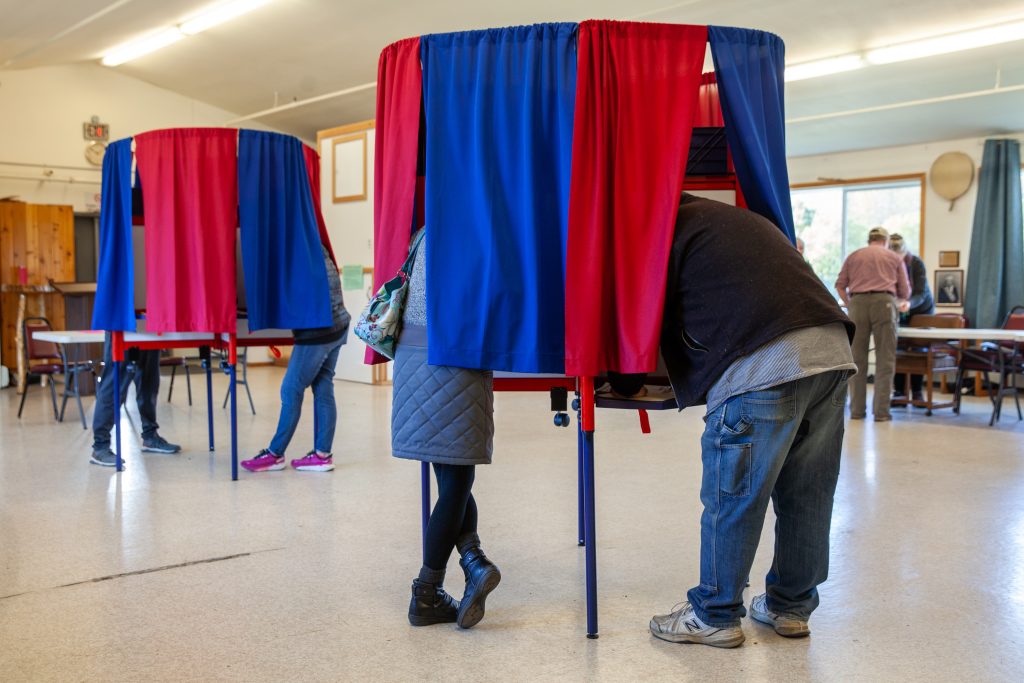
A sign posted on Aug. 18, 2024, outside of the Alaska Division of Elections office in Midtown Anchorage directs voters to the polling place inside. (Photo by Yereth Rosen/Alaska Beacon)

A sign posted on Aug. 18, 2024, outside of the Alaska Division of Elections office in Midtown Anchorage directs voters to the polling place inside. (Photo by Yereth Rosen/Alaska Beacon)

In May 2025, the U.S. Department of Justice began sending letters to state governments demanding copies of statewide voter registration lists. The request was unprecedented: It demanded not only publicly available voter data, such as names and addresses, but also sensitive information, including driver’s license and Social Security numbers.

That data is considered highly sensitive because it can be used to commit identity theft, access financial or government records, and facilitate targeted harassment or intimidation, particularly if the data were mishandled or leaked.

Underlying these requests is the Trump administration’s stated goal of rooting out fraudulent and illegal voting. With voter data in its hands, the DOJ seeks to identify ineligible voters and mandate state election officials to remove those voters from the rolls.

States have responded in a variety of ways. Some have fully complied with the requests, some partially complied, and many outright refused to provide any voter information. For the latter states, the Trump administration has taken the fight to court and sued to get the information, claiming that federal law requires the states to hand it over.

The majority of cases are still going through the courts.

I’m an election law scholar who focuses on election administration. This battle over voter data has raised numerous questions about the Trump administration’s motives, the legality of its actions and, more generally, the role of the federal government in election administration.

The DOJ has a tough road ahead in convincing election officials and judges across the country that all of its demands in these cases are constitutionally legitimate.

Federal power grab

States have exclusive authority to govern and administer state and local elections. The federal government, on the other hand, historically has played a much more limited role in election regulation and administration. By constitutional design, Congress may regulate only the “time, place, and manner” of federal elections – in other words, the procedural elements of elections for federal offices.

And even then, states hold concurrent authority to regulate federal elections.

Nevertheless, in his second administration President Donald Trump has sought to expand the federal government’s control over elections. In February 2026 he called on Congress to “nationalize” elections. He has also made an administration priority the passage of the SAVE America Act, a bill that would mandate states to turn away any voter without documentary proof of U.S. citizenship.

Trump’s initiatives apparently stem from conspiratorial allegations that the 2020 presidential election was rigged against him, resulting in fraudulent and illegal voting that gave Joe Biden the presidency. And they are ultimately what animates the DOJ’s crusade for voter information from the states, with Attorney General Pam Bondi having recently stated that “accurate, well-maintained voter rolls are a requisite for the election integrity that the American people deserve.”

So far, the DOJ has sent requests to at least 48 states and the District of Columbia demanding their complete voter registration lists – information on every individual registered to vote in the given state.

In doing so, the DOJ has asked the states to sign onto an agreement under which they agree to remove within 45 days any voters that the DOJ flags as ineligible. But by signing this agreement, a state is effectively handing over the administration of its voter rolls to the federal government.

DOJ’s legal arguments

Only 12 states – Alaska, Arkansas, Indiana, Louisiana, Mississippi, Nebraska, Ohio, Oklahoma, South Dakota, Tennessee, Texas and Wyoming – have fully complied with the requests, handing over to the DOJ private information such as the driver’s license and Social Security numbers of their registered voters.

Five states, meanwhile, have provided publicly available voter information – name, address and party affiliation – to the DOJ while withholding more sensitive information. The remaining 31 states of the 48 to receive requests, along with the District of Columbia, have refused to give any voter list to the federal agency.


The DOJ has sued 29 states for refusing to hand over voter lists and has also sued the District of Columbia, sparing only Iowa, Alabama and South Carolina. Only one sued state – Oklahoma – has thus far capitulated to the DOJ.

In these lawsuits, the DOJ cites three legal sources that supposedly give the agency the right to request voter information from state officials.

First, the DOJ points to a provision of the National Voter Registration Act of 1993 that requires states to “make available for public inspection” all records necessary to ensure the accuracy of their voter registration lists. As critics note, though, this provision does not require states to reveal sensitive voter information. All 50 states are, in fact, currently in compliance with the act’s mandate.

Second, the DOJ invokes the Help America Vote Act of 2002 and its requirement that all states must maintain a computerized, statewide voter registration list. Nevertheless, no provision in that law provides explicit authority to the federal government to request these registration lists from state officials.

Finally, the DOJ has argued that the states have an obligation under the Civil Rights Act of 1960 to comply with the agency’s demands. Specifically, Title III of the act permits the U.S. attorney general to request for inspection “all records and papers” kept by state election officials relating to “any application, registration, payment of poll tax, or other act requisite to voting.”

While perhaps the strongest of the three arguments, that title of the Civil Rights Act goes on to require the attorney general to offer a “statement of the basis and the purpose” of their request.

In the DOJ’s requests to states, Bondi has apparently provided zero justification as to why the states must hand over sensitive voter information to the DOJ. Indeed, any stated purposes appear unrelated to the Civil Rights Act’s aims of combating racial discrimination.

U.S. Attorney General Pam Bondi testifies before the Senate Judiciary Committee during her confirmation hearing on Jan. 15, 2025. (Photo by Chip Somodevilla/Getty Images)

What’s possible

There are further legal questions regarding whether the states could even comply with the DOJ’s proposed 45-day deadline for removing declared ineligible voters.

For example, the National Voter Registration Act forbids states from removing people from the voter rolls in certain instances without first providing notice and waiting two federal election cycles – a timeline well beyond 45 days.

In the 29 targeted states, federal courts have thus far dismissed four lawsuits in California, Georgia, Michigan and Oregon. Oklahoma, as noted above, has settled its case with the DOJ. While the remaining lawsuits have yet to fully play out, the DOJ likely faces less-than-sympathetic judges in these cases.

Even if the DOJ loses in court, though, the federal government may continue attempting to receive states’ voter information through other means.

The SAVE America Act, for instance, currently under consideration in the U.S. Senate, contains a provision that incentivizes states to submit their voter registration lists to the U.S. Department of Homeland Security on a quarterly basis or otherwise subject their residents to stringent voter ID laws. Should Congress pass the act, the executive branch would have much clearer federal authority to force voter data from state election officials.The Conversation

John J. Martin, Assistant Professor of Law, Quinnipiac University

This article is republished from The Conversation under a Creative Commons license. Read the original article.

Categories
Alaska News Featured Juneau News juneau Juneau Local Juneau Local Ketchikan Local News Feeds Sitka Local

Juneau seeks public input on $24.5M cruise passenger fee spending plan

NOTN- Juneau officials are asking residents to weigh in on how millions of dollars collected from cruise ship passengers should be spent in the coming year.

The City and Borough of Juneau has released draft recommendations for allocating Marine Passenger Fee revenue and is accepting public comments through May 3.

Each cruise visitor to Juneau pays $13 in fees, which must be used for projects that support the tourism industry or address its impacts on the community.

“Really what people need to know is we get $13 per passenger, and that these funds are restricted on how they can be used.” Said Tourism Manager Alex Pierce, “Every year I get messages that are like, ‘how come we can’t spend this money on my street in the valley, busses drive on it, and it needs to be repaved, and I want to spend passenger fees there.’ The funds are actually restricted by the US Constitution. So under the US Constitution, the fees have to serve the vessel itself. That gets a little bit complicated when you get into human cargo. So we’ve always kind of had a push pull with where and how we can spend this money.”

City officials say the current proposal would allocate about $24.5 million across operating, grant and capital projects.

Recommended spending includes funding to offset increased demand on city services such as police, fire and emergency response, along with street maintenance, parks and expanded bus service during the busy cruise season.

Other proposed projects focus on infrastructure improvements in downtown Juneau, including upgrades to the water system, expansion of public Wi-Fi, maintenance and extension of the seawalk, and additional public restrooms.

All comments received by the May 3 deadline will be reviewed alongside the draft recommendations before being sent to the Assembly Finance Committee on May 6. The plan will then move to the full Assembly for consideration as part of the city’s upcoming budget process.

Residents can submit comments by email or mail to the city manager’s office.

Categories
Alaska News Featured Juneau News juneau Juneau Local Juneau Local Ketchikan Local News Feeds Sitka Local

Metals mining in Alaska still a big source of jobs, money and exports, report says

By: Yereth Rosen, Alaska Beacon

 Kinross’s Fort Knox mine outside of Fairbanks in seen in this undated photo. Fort Knox produced 239,508 ounces of gold in 2024, according to the Alaska Department of Labor and Workforce Development, and it is one of the state’s six major mines. (Photo provided by Kinross Gold Corporation)

Metals mining has a prominent place in Alaska history. Today, it remains a prominent economic driver in the state.

Over the past decade, the metals mining sector has made up 3% to 4% of Alaska’s gross domestic product, and those mined metals rival Alaska seafood as top exports from the state, according to a state Department of Labor and Workforce Development analysis.

Metals such as zinc produced at the Red Dog mine in Northwest Alaska, silver produced by the Greens Creek Mine in Southeast Alaska and gold, lead and copper produced by various mines, now support an industry worth close to $3 billion a year, according to the analysis, published in the current issue of Alaska Economic Trends, the department’s monthly research magazine.

Alaska has six major metals mines, three of which produce more than one type of metal, and hundreds of small placer operations.

Among the mined products coming from Alaska is germanium, a byproduct of zinc that is classified as a critical mineral and used in electronics. In 2024, the Red Dog mine produced about 10 tons of germanium, according to the analysis, making it a critical source to the nation because China cut off deliveries of its germanium. That year, the Red Dog mine was the only U.S. mine producing germanium, though prior to 2023, a Tennessee mine was also producing the mineral, said Karinne Wiebold, the state economist who wrote the Alaska Economic Trends report.

Mining's share of Alaska's gross domestic product has grown considerably, as this graph shows. The graph includes values for metals mining and mining of coal, gravel and sand, but it does not include oil or gas production. Dollar figures are inflation-adjusted to 2024. (Graph provided by the Alaska Department of Labor and Workforce Development research and analysis section)
Mining’s share of Alaska’s gross domestic product has grown considerably, as this graph shows. The graph includes values for metals mining and mining of coal, gravel and sand, but it does not include oil or gas production. Dollar figures are inflation-adjusted to 2024. (Graph provided by the Alaska Department of Labor and Workforce Development research and analysis section)

The value of Alaska’s mining sector, including coal, gravel and sand as well as metals, actually peaked in 2011 at nearly $3.5 million and close to 5% of the state’s gross domestic product. That peak reflected extremely high metals prices and the startup of the Kensington gold mine in Southeast Alaska.

Still, mining has been a strong economic factor in Alaska for the last two decades, after jumping in value in 2006. Every year since then, its total value to the state has generally been above $2 billion and usually accounted for 3% to 4% of Alaska’s gross domestic product.

Metals mining has also become a big employment driver as well, according to the analysis.

There were 3,533 metal mining and support jobs in Alaska in 2024, the most recent data available, and jobs in the sector grew by 37% over the past decade, compared to an overall state job growth rate of 0.3%, Wiebold’s analysis said.

The average metal mining job paid $135,000 in 2024, well above the state average of $71,000 that year and second only to the average pay for workers in the oil and gas sector, the analysis said.

But a large percentage of mine workers are not Alaska residents. Wiebold’s analysis puts resident hire at 56%. That puts the non-resident hire percentage in the metals mining sector well above the state average.

In 2024, the most recent year for which data is available, 22.9% of workers in the state were not Alaska residents, according to an annual report published by the Department of Labor and Workforce Development. That is the highest percentage since such records began in state average, which is the highest percentage since records started in the 1990s.

A visitor to the Donlin Gold mine site on June 23, 2025, touches core samples collected from exploration work. (Photo by Yereth Rosen/Alaska Beacon)
A visitor to the Donlin Gold mine site on June 23, 2025, touches core samples collected from exploration work. Donlin is one of the major Alaska projects that could be developed in the future. (Photo by Yereth Rosen/Alaska Beacon)

Wiebold noted that the nonresident hire in the mining sector is about the same as that in the oil and gas sector, which in 2024 was 40.5%, according to the state’s report.

Mining and oil and gas work in Alaska is conducive to nonresident employees because it is generally conducted at remote locations, typically with rotating schedules of two weeks on and two weeks off, she said.

“This combo means most folks don’t live near the mine and have to commute and stay at the worksite, and that there is not a significant time/cost/commute savings for living in the state,” she said by email. “As a result, miners from out of state can work in Alaska and live somewhere less expensive or more appealing to them.”

Another reason for the high percentage of nonresidents lies in Alaska’s demographics, she said. “In the last several years, with Alaska’s working age population fairly stagnant after a decade of significant declines, more jobs are being held by out of state workers,” she said.

The sector is poised for future growth, with projects like the Donlin gold mine in Southwestern Alaska, the Graphite One graphite mine in Northwestern Alaska and, potentially, the commercialization of the copper-rich but isolated Ambler Mining District in Northwestern Alaska.

But none of those proposed mines can be expected to be developed quickly, and development itself is uncertain, Wiebold’s article said.

“Mines take years to come to fruition — exploration, feasibility studies, environmental reviews, and permitting are expensive, and all have the potential to derail a project. Public concerns and controversy can also slow or stop development,” the article said.

Categories
Alaska News

Metals mining in Alaska still a big source of jobs, money and exports, report says

Kinross's Fort Knox mine outside of Fairbanks. (Kinross photo)

Kinross’s Fort Knox mine outside of Fairbanks in seen in this undated photo. Fort Knox produced 239,508 ounces of gold in 2024, according to the Alaska Department of Labor and Workforce Development, and it is one of the state’s six major mines. (Photo provided by Kinross Gold Corporation)

Metals mining has a prominent place in Alaska history. Today, it remains a prominent economic driver in the state.

Over the past decade, the metals mining sector has made up 3% to 4% of Alaska’s gross domestic product, and those mined metals rival Alaska seafood as top exports from the state, according to a state Department of Labor and Workforce Development analysis.

Metals such as zinc produced at the Red Dog mine in Northwest Alaska, silver produced by the Greens Creek Mine in Southeast Alaska and gold, lead and copper produced by various mines, now support an industry worth close to $3 billion a year, according to the analysis, published in the current issue of Alaska Economic Trends, the department’s monthly research magazine.

Alaska has six major metals mines, three of which produce more than one type of metal, and hundreds of small placer operations.

Among the mined products coming from Alaska is germanium, a byproduct of zinc that is classified as a critical mineral and used in electronics. In 2024, the Red Dog mine produced about 10 tons of germanium, according to the analysis, making it a critical source to the nation because China cut off deliveries of its germanium. That year, the Red Dog mine was the only U.S. mine producing germanium, though prior to 2023, a Tennessee mine was also producing the mineral, said Karinne Wiebold, the state economist who wrote the Alaska Economic Trends report.

Mining's share of Alaska's gross domestic product has grown considerably, as this graph shows. The graph includes values for metals mining and mining of coal, gravel and sand, but it does not include oil or gas production. Dollar figures are inflation-adjusted to 2024. (Graph provided by the Alaska Department of Labor and Workforce Development research and analysis section)
Mining’s share of Alaska’s gross domestic product has grown considerably, as this graph shows. The graph includes values for metals mining and mining of coal, gravel and sand, but it does not include oil or gas production. Dollar figures are inflation-adjusted to 2024. (Graph provided by the Alaska Department of Labor and Workforce Development research and analysis section)

The value of Alaska’s mining sector, including coal, gravel and sand as well as metals, actually peaked in 2011 at nearly $3.5 million and close to 5% of the state’s gross domestic product. That peak reflected extremely high metals prices and the startup of the Kensington gold mine in Southeast Alaska.

Still, mining has been a strong economic factor in Alaska for the last two decades, after jumping in value in 2006. Every year since then, its total value to the state has generally been above $2 billion and usually accounted for 3% to 4% of Alaska’s gross domestic product.

Metals mining has also become a big employment driver as well, according to the analysis.

There were 3,533 metal mining and support jobs in Alaska in 2024, the most recent data available, and jobs in the sector grew by 37% over the past decade, compared to an overall state job growth rate of 0.3%, Wiebold’s analysis said.

The average metal mining job paid $135,000 in 2024, well above the state average of $71,000 that year and second only to the average pay for workers in the oil and gas sector, the analysis said.

But a large percentage of mine workers are not Alaska residents. Wiebold’s analysis puts resident hire at 56%. That puts the non-resident hire percentage in the metals mining sector well above the state average.

In 2024, the most recent year for which data is available, 22.9% of workers in the state were not Alaska residents, according to an annual report published by the Department of Labor and Workforce Development. That is the highest percentage since such records began in state average, which is the highest percentage since records started in the 1990s.

A visitor to the Donlin Gold mine site on June 23, 2025, touches core samples collected from exploration work. (Photo by Yereth Rosen/Alaska Beacon)
A visitor to the Donlin Gold mine site on June 23, 2025, touches core samples collected from exploration work. Donlin is one of the major Alaska projects that could be developed in the future. (Photo by Yereth Rosen/Alaska Beacon)

Wiebold noted that the nonresident hire in the mining sector is about the same as that in the oil and gas sector, which in 2024 was 40.5%, according to the state’s report.

Mining and oil and gas work in Alaska is conducive to nonresident employees because it is generally conducted at remote locations, typically with rotating schedules of two weeks on and two weeks off, she said.

“This combo means most folks don’t live near the mine and have to commute and stay at the worksite, and that there is not a significant time/cost/commute savings for living in the state,” she said by email. “As a result, miners from out of state can work in Alaska and live somewhere less expensive or more appealing to them.”

Another reason for the high percentage of nonresidents lies in Alaska’s demographics, she said. “In the last several years, with Alaska’s working age population fairly stagnant after a decade of significant declines, more jobs are being held by out of state workers,” she said.

The sector is poised for future growth, with projects like the Donlin gold mine in Southwestern Alaska, the Graphite One graphite mine in Northwestern Alaska and, potentially, the commercialization of the copper-rich but isolated Ambler Mining District in Northwestern Alaska.

But none of those proposed mines can be expected to be developed quickly, and development itself is uncertain, Wiebold’s article said.

“Mines take years to come to fruition — exploration, feasibility studies, environmental reviews, and permitting are expensive, and all have the potential to derail a project. Public concerns and controversy can also slow or stop development,” the article said.

Categories
Alaska News

Gold Medal Hall of Fame completes a marriage dream

Tim Wilson and wife Marie Beierly pose with their 2026 Walter Soboleff Award and 2026 Gold Medal Hall of Fame medal, respectively, on Friday, March 27, 2026, at the 77th Gold Medal Basketball Tournament in the Juneau-Douglas High School: Yadaa.at Kalé George Houston Gymnasium. Wilson is a 2018 GMHOF inductee, making the couple the first husband and wife to earn the honor. (Courtesy/Klas Stolpe, Juneau Independent)

“I was surprised, I was pretty content just being a Hall of Fame wife,” Juneau Lions Club President Marie Beierly said after being selected into the Gold Medal Hall of Fame. “This was definitely something we did not expect, and we just enjoyed the years we have been involved with Gold Medal. I guess it is kind of like a second honeymoon.”

Beierly was part of the 2026 Hall of Fame class inducted March 27 during the 77th annual Juneau Lions Club Gold Medal Basketball Tournament in Juneau.

She was inducted as a radio play-by-play announcer, the same as her husband — Juneau Lions Club past president Tim Wilson was noted for his induction in 2018, along with his playing career for Klukwan and Lions Club work. They are the first husband and wife in the Gold Medal Hall of Fame.

“I am just so happy for Tim,” Beierly said. She laughs. “Oh my, that sounded like bragging… I am happy for his honor.”

That same day last week, Wilson received one of the tournament’s highest honors, the Dr. Walter A. Soboleff Award for Lions Club leadership, motivation, spirit and outstanding volunteer work and pride in communities throughout Alaska.

Wilson was visibly shaken when standing with all the present Hall of Fame members as the honor was announced, he began to recognize the list of volunteerism being read for the 2026 Soboleff winner.

“I do not know what to say,” a tearful Wilson said later that night. Each question asked resulted in more tears and deflections to those whom he credited for his involvement in the Lions Club. “I… I am really overcome… But I am just so happy for Marie, for her award… For her to join her father in the hall, that means so much to me.”

Marie’s father, Bob (Robert Paul Beierly II, 1940-2009) Beierly, was inducted posthumously into the Gold Medal Hall of Fame in 2010. Her mother, Flora Mae Beierly (1942-2021), was a Lions Club volunteer. Bob Beierly was a long-time Gold Medal radio announcer and is responsible for the journey daughter Marie and son-in-law Tim are still traveling.

Marie, too, was visibly shaken as she sat at the announcers’ booth court-side and the impact of her induction began to sink in.

“So surprising, so unexpected,” she said. “I wasn’t sure what to do. Thought of my dad… I thought of Tim.”

What she did was receive the congratulations of a gym full of fans and players and shook the hands of Hall of Fame members standing on court until reaching her husband, who placed the GMHOF medal around her neck and the two embraced.

“You know,” she said. “I have been working at Gold Medal longer than I have known Tim.”

The tie that binds this all together started back at Haskell Indian Nations University in  Lawrence, Kansas in 1993. That college has a long-standing Memorandum of Understanding (MOU) with the University of Kansas focusing on education, service and research.

The two shared a public speaking class, and Tim looked over and smiled at Marie.

“I didn’t like him,” Marie said. “I didn’t like him at all. I thought he was full of himself.”

And persistent.

Marie ran track and cross-country. Tim played football. Their practice times overlapped as much as their classroom times.

A dinner after practice did not help.

“I still did not like him,” Marie said, laughing. “But he just kept glaring at me in class and I kept ignoring him to make him mad enough to stop bothering me.”

Tim stated, “The more she ignored me the more I wanted to keep bothering her.”

Marie was a senior from Alaska in her last semester, Tim a freshman from Bartlesville, Oklahoma.

“Eventually I started talking to him,” Marie said. 

Marie finished her studies at the University of Alaska Southeast and Tim at Kansas, but after the semester he came to Juneau and she introduced him to Gold Medal. The two were married in 1995.

At first Tim was just ushering people to seats and helping wherever needed.

“He did try announcing a few times and he was pretty good at it,” Marie said. “He got to know the players and his voice really projects really loud so everybody in the gym can hear him. He kind of put that on the backseat and started really getting deeply involved with Lions Club. Just really sitting and listening and learning.”

Bob Beierly was already a Lions Club member and announcing the tournament.

Walter Soboleff persuaded Marie to join her father as a member in 1996.

Marie had already been helping her father since 1974.

“My dad was the radio announcer and I just kept coming to the games with him,” she said. “One day he says, ‘Sit by me, I need you to help spot these players for me. You tell me who made the shot and tell me how many fouls.’ So I did, and we worked out this hand system and then I would whisper in his ear the player’s name and he would announce it. And I had to be really quick because his eyesight was getting a little poor, so was his hearing. After years of that, he says, ‘I need to take a break. Here, take the mic.’ I was like, ‘What, no, the game’s still going on.’ So, I started announcing myself, doing the shot by each player and timeout, the whole thing. And when I was really nervous or scared he would ask me to tell him what happened in the game and said he needed another break and I got more comfortable with it. Then he finally said, ‘I can’t do this anymore. You have to take over from me.’ And I did.”

Marie said a moment that stands out to her is a championship night in the 2019 masters bracket game between Kake and Hoonah. Kake’s Kip Howard made the winning shot from half court.

“It went in, buzzer beater, Kake won,” Marie said. “Nobody could hear me over the mic. The entire gym was roaring, applauding, and I say, ‘The new master bracket champions, Kake…’ No one can hear me.”

She said an emotional realization was seeing some of the current players and remembering seeing them as young kids pretending to be their favorite Gold Medal basketball player, or announcer.

“Throughout the years when I was announcing there was sometimes a child sitting right next to me every single game I announced,” Marie said, motioning in the direction of current JDHS senior Raynonna Fraker. “She is a senior graduating this year and she was one of my announcers last year, but she can’t do it this year because she’s really busy as a senior. She’s got lots of activities going on and I look at her I was like, oh my god, she was one of those little kids that was sitting right next to me every single game.”

Marie noted that the nature of the game can involve a bad call, and she tries to keep the crowd in line and entertained.

“A lot of people remember my dad,” she said. “They love the energy that he would give back to the crowd. And I try to do the same. The new thing for me this year is the jokes.”

Her jokes, very old-school corny, always include her own laughter bursting out before she says the punchline and results in even more fan-friendly laughter when the joke is revealed.

Tim Wilson is overcome with emotion as Gold Medal Hall of Famers Marie Beierly, Jason Schull and Jean Jackson applaud during his selection as the 2026 Walter Soboleff Award winner on Friday, March 27, 2026, at the 77th Gold Medal Basketball Tournament in the Juneau-Douglas High School: Yadaa.at Kalé George Houston Gymnasium. Wilson is a 2018 GMHOF inductee, making the couple the first husband and wife to earn the honor. (Klas Stolpe / Juneau Independent)

Tim remembers his first Gold Medals. The announcing was a family thing with Bob, Marie, and her brothers Robert (1964-2013) and Thomas.

“As the years went on, it was actually her dad that introduced me to the Lions Club and took me to my first meeting,” Tim said. “He told me, ‘If you just sit there and shut up, you might learn something.’ Those were his exact words. That was my introduction to the Lions Club. And then I had Lions like Ted Burke and Janet Burke and Steve Brandner. I never realized it at the time, but it was kind of like they were grooming me one day to be able to do what I am doing now. I never really realized it for a long time just how much they meant to our club and the tournament and for them to teach me and lead me…I mean, everything, everything I do is because of them. It is what they taught me. And if I am not sure about something, I always ask myself, ‘What would Ted do? What will Steve do?’ And to this day I have called them.”

Tim’s accomplishments that earned the Walter Soboleff Award far exceed his Gold Medal work that allows the club and tournament to run smoothly. They include dressing as the Grinch for Light Flights to entertain kids waiting for the helicopters, picking up youths for Shop with a Cop, wrapping and delivering Christmas gifts to those in need, collecting and shipping clothes to a small western Alaska community struck by a catastrophic storm and receiving the Lions International Melvin Jones Award for exemplary service to the club and community. He spent his own money to give away special blankets at this year’s tournament.

He noted that when the Walter Sobleff Award winner’s accomplishments reached a second sentence, “I just started shaking my head. I love the Lions and sometimes I stretch myself too far above volunteering for things or volunteering us for things. My wife will tell you she’ll be the first one to say, ‘Stop it. Slow down.’ I love our tournament, I love what we do.”

Two minor health scares brought him to the realization “that I can have others help me do some of the things we need done.”

Last week, during a brief moment to sit after the awards, he noted this year’s proudest moment among the Gold Medal faithful, when he looked at the packed crowd on the first day, that increasingly pushed the seating to its limits.

“Four days of ferries had been canceled,” Tim said. “We had three days of flights being canceled. But look at the gym. I mean it’s packed. We had to open up the balcony. It’s hot in there so we are opening up the doors. Our players and our fans, they are the greatest. I mean, you look at them and you look at the gym and you’re wondering, how did they get here? How did they do it? And they went above and beyond. They were chartering flights. I heard that they were calling for extra catamarans. They called to see if they could get another ferry scheduled. I used fishing boats. Fishing boats. They’re taking fishing boats in that weather, in those seasons, they’re bringing fishing boats from Haines. I know what Stuart DeWitt brought his boat from Haines. I mean, are you kidding? We have the best fans in the world. The best fans. And, you know, if they are willing to go above and beyond like that to show their support for their community and for the tournament. Then we should be too.”

It was actually a day later before Tim and Marie realized they were the first husband and wife in the Gold Medal Hall of Fame. Their daughters Lijo and Jazz, who also volunteer, pointed out that distinction to them.

On the final day of Gold Medal, Marie asked Tim what he thought their parents would think of how far they had come.

“I am sure they would be proud,” he said.

What both have noticed is the new era of youth and Gold Medal, of social media and fitting in. This year was marred by communities losing loved ones to suicide and substance abuse. Special attention was given to let young fans and players know that they were special, that they were loved and they are needed in this world.

“It is hard,” Marie said. “My dad’s philosophy…when he was younger he saw these two kids fighting downtown, like fist fighting, beating the tar out of each other. He said to them, ‘You got this much energy you come back and see me tomorrow at this time.’ And he put a basketball in their hands. And he made them play basketball.”

She mentions the two youths’ names and that from then on her father took the two lads and others to play in youth tournaments at Sitka.

“Gold Medal is a great relief for a lot of people,” Marie said. “And it has been a long exhausting winter. Coming to Gold Medal and just forget about roofs collapsing or shoveling and coming to the gym and burning off all that energy, rooting for your favorite player or your favorite team. We need things like Gold Medal or Celebration.”

Tim never expected to hear his name in the same sentence as Walter Soboleff.

“I never expect to receive anything for doing this,” he said. “I have always said that at Gold Medal we are all family and friends. And we proved that the other night when tragedy struck Hydaburg and we did a five-minute blanket dance and raised over $2,400 in less than five minutes. And it is things like that which makes this all worth it.” 

New Gold Medal Hall of Fame selection Marie Beierly kisses husband Tim Wilson during his selection as the 2026 Walter Soboleff Award winner on Friday, March 27, 2026, at the 77th Gold Medal Basketball Tournament in the Juneau-Douglas High School: Yadaa.at Kalé George Houston Gymnasium. Wilson is a 2018 GMHOF inductee, making the couple the first husband and wife to earn the honor. (Klas Stolpe / Juneau Independent)

The post Gold Medal Hall of Fame completes a marriage dream appeared first on Chilkat Valley News.