The Mendenhall River as it crests on Thursday, Aug. 13, 2026. (Photo by Clarise Larson/KTOO)
Mendenhall Valley residents in the flood zone celebrated Thursday afternoon as the Mendenhall River crested at a level well below initial predictions. The event was much less destructive than disastrous floods that struck over the past three years.
The flood crested at 14.7 feet on the Mendenhall Lake gauge at 2:15 p.m., according to the National Weather Service. As floodwaters started to recede Thursday afternoon, only a handful of residents reported damage.
“We have crested officially, and we are now on the way back down — we did it, Juneau,” said Zoe Kaplan, a meteorologist with the National Weather Service, during a livestream just before 3 p.m.
Ann Lind lives in the flood zone on Marion Drive. She said she had been anxiously waiting for the flood all spring and summer. Last year, her home flooded when drainage pipes failed and water leaked through the floodwall.
“For months it was like this slow-moving bullet coming straight at me, and didn’t know if it was going to be a hit or a miss,” she said. “And today, it’s a miss.”
Lind said the water didn’t even touch the HESCO barriers that make up the flood wall in her backyard.
“This flood this year is the scenario we all wanted — we all hoped for,” she said.
A pump pipes water over the flood wall on Killewich Drive as the flood crests on Thursday, Aug. 13, 2026. (Photo by Clarise Larson/KTOO)
A couple of riverfront homeowners on Killewich Drive said their crawl spaces flooded this year due to seepage, but they were able to pump out the water.
Riverfront homeowners on Killewich Drive pump water out of their crawl spaces on Thursday, Aug. 13, 2026. (Photo by Clarise Larson/KTOO)
View Drive residents saw the worst flooding, as they have every year. This is the second year in a row they were left without the protection of the flood wall constructed by the City and Borough of Juneau and the Army Corps.
Mandy Mallott lives at the end of the street. Last year, she and her neighbors set up their own flood wall made of HESCO barriers and an earthen berm in an attempt to protect their homes. She said her home was spared, but there was still a lot of damage throughout the neighborhood.
On Thursday afternoon, she said she and others who put up barriers on the street didn’t see flooding in their homes.
A man walks across the top of HESCO barriers as the Mendenhall River rises on Thursday morning, Aug. 13, 2026. (Photo by Clarise Larson/KTOO)
“The emotions that are running through us are a big sense of relief and thankfulness to our friends and our neighbors that we got through the night and this gorgeous day together,” Mallott said.
Malachi Thorington also lives on View Drive, where he said his house and his next-door neighbors’ flooded this year, but not as badly as in the past.
Downstream on Meadow Lane, near Juneau International Airport and the mouth of the river, Bob Jacobson watched the flood from his son’s deck overlooking the river.
He described watching a tree strike the barriers across the river — just minutes before — to two U.S. Army Corps officials who had just arrived at the barrier.
Army Corps crews chainsaw a log that struck a HESCO barrier across from Meadown Lane on Thursday, Aug. 13, 2026. (Photo by Corinne Smith/Alaska Beacon)
Within minutes, Army Corps crews chainsawed the log away from the barrier. Pumps were stationed along Meadow Lane but did not need to be turned on as the flood peaked.
The HESCO barriers below Brotherhood Bridge are new. There was some seepage, but neighbors said it was nothing compared to last year when water rose up the bank and into yards and some driveways, just feet from homes.
An industrial-sized pump pipes water over the flood wall on Meander Way as the flood crests on Thursday, Aug. 13, 2026. (Photo by Clarise Larson/KTOO)
Jeff Garmon is the meteorologist in charge at the Weather Service in Juneau, and he lives on Meander Way — a street that’s been hit hard by flooding in the past. As the flood peaked, he had minor pooling in his backyard, which was piped back over the HESCO flood wall by pumps provided by the U.S. Army Corps of Engineers.
Jeff Garmon walks to his backyard, where an industrial-sized pump pipes water over the flood wall on Meander Way as the flood crests on Thursday, Aug. 13, 2026. (Photo by Clarise Larson/KTOO)
“We’re fortunate this year we didn’t have an atmospheric river going into this,” Garmon said. “I think that was our saving grace.”
Garmon said he’s proud of how the city, Army Corps, U.S. Geological Survey, University of Alaska Southeast researchers, the Central Council of the Tlingit and Haida Indian Tribes of Alaska, flood advocacy groups and countless others worked collaboratively to support residents in the flood zone.
“It’s something Juneau should be proud of — that as a community we came together,” he said.
The bill, said Speaker of the House Bryce Edgmon and Senate President Gary Stevens, lacks the support to advance in either body.
“The caucus is really not at this point, really not interested in having to rush a bill,” Stevens said.
“The votes just aren’t there,” Edgmon said. “The Senate made it very clear that they need more time than what could be allotted.”
Glenfarne, the firm acting as the project’s lead developer, has said that a tax break is necessary to finance the pipeline. Glenfarne had said that it was planning to reach a final investment decision on the first phase of the project by the end of this year.
It has already missed several self-imposed deadlines, and it isn’t clear whether it will again change its plans. The company did not respond to a request for comment on Thursday.
As proposed, the pipeline project would be built in two phases, with the first completed no sooner than 2029. The first phase would deliver gas from the North Slope to Southcentral Alaska for in-state use. The second phase would allow international exports.
Official estimates state that the total project will cost as much as $54.5 billion, making it one of the largest natural gas projects in the world. Unofficial estimates are significantly higher.
The governor released his proposal 17 days into a 30-day special session about pipeline taxes. This is the third special session of 2026 devoted to the issue; the second special session ended in July after the state House voted down a compromise bill.
The governor’s new bill appears similar to that failed compromise. It would replace the state’s petroleum property tax with a tax on gas shipped through the pipeline, a change that would help the project pencil out financially, and it would cap the cost of gas for in-state use and shield the state from cost overruns.
It also includes a 2% corporate income tax on certain privately owned oil and gas companies that don’t pay the state’s existing corporate income tax. That’s a little over a fifth of the size of a similar tax proposed by the Senate.
The so-called “pass-through entities” tax was a key condition of skeptical state Senators and helped last month’s compromise bill pass the Senate.
But business-friendly trade groups and legislators opposed the tax increase, causing it to fail in the House, and Dunleavy said before the House vote that he would veto the Senate’s version if it reached his desk.
“This bill is a compromise that removes a significant barrier to moving the gas line forward,” he said in a written statement.
But the compromise appears to have satisfied no one.
A coalition of trade groups and the Alaska Chamber of Commerce issued a letter opposing it, and Stevens said by phone on Thursday that lawmakers will need to review the governor’s changes.
In a Tuesday news conference with reporters, Stevens said 2% is “not very much. … We need to do a careful analysis of that. I think the intention of the Senate was a higher tax than that.”
The 35th Alaska State Legislature is scheduled to convene in January, after this fall’s election. Incumbent Gov. Mike Dunleavy is term-limited and will leave office in January. The Legislature will have new leaders, too. Stevens is retiring and Edgmon is running for Senate.
“I think we’ve reached the point, honestly, where we need to turn it over to the new governor, whoever that would be, and a new legislature,” Stevens said.
Glenfarne, the development firm that owns 75% of the pipeline project, did not respond to a request for comment on Thursday about the governor’s latest proposal and did not answer a question asking what it thinks about the potential for there to be no bill this year.
Earlier this year, Glenfarne officials said the tax break is necessary for the project to obtain financing.
Some state legislators say Glenfarne supported a prior compromise bill but subsequently withdrew its support under pressure from the oil and gas company Hilcorp.
In response to a request for comment about the latest bill, Hilcorp spokesman Matt Shuckerow said the company doesn’t support the governor’s proposal.
“The underlying issues with this structurally incomplete and insufficiently developed income tax language remain unchanged and unresolved,” he said by email. “Hilcorp supports the Alaska LNG Project, but legislation intended to improve the project’s commercial viability should not impose a new tax that increases the cost of producing its gas, further complicates long-term investment and commercial negotiations, and challenges Cook Inlet development at a time when continued investment is critical to maintaining reliable natural gas supplies.”
Late Wednesday, the leaders of the 21-person coalition in charge of the state House issued a statement declaring that “intractable differences have emerged on the Governor’s bill relating to property tax relief for the gas line. The proposed HB 4001 does not appear to have the support needed to pass the Alaska House, with opposition being expressed by both Majority and Minority members.”
The 19-person, all-Republican House minority caucus responded with a letter asking the Majority to call the House back to Juneau anyway in order to continue talking about the gas pipeline.
House Minority Leader DeLena Johnson, R-Palmer, said the letter doesn’t mean that all members of the minority support the governor’s bill, just that they want to continue talking about the issue and trying to find a path forward.
But Edgmon said that doesn’t make sense.
“It costs a lot of money to reconvene the Legislature,” he said. “It doesn’t make fiscal sense to just go down and talk about something with no resolution at hand, or no means to achieving a resolution, and so here we are.”
Peltola, a Democrat, received a letter signed by53 trawl interests and nationwide fishery stakeholders urging her to withdraw the proposed legislation saying, “These new federal mandates and timelines are utterly unworkable.”
This time around, Peltola’s push is a campaign policy platform, not a proposed congressional bill. While Sullivan’s Act fits that description, the trawl sector apparently views him as its strategic shield against Peltola.If they aggressively attack his bill, they could politically weaken their strongest ally in Washington.
There are fundamental differences between the two bills.
Peltola’s approach leans toward statutory restrictions that would force the government to draw hard lines on where trawling is allowed — the goal is to stop “multi-species collapse.” It would make changes to language loopholes in the outdated Magnuson-Stevens Act, such as “minimizing bycatchto the extent practicable.” Her proposal would remove “to the extent practicable” as it is widely regarded as the phrase that allows trawlers to declare under the law that they “are doing the best they can” to reduce bycatch. It has been included in management decisions for decades as a way for the trawl sector to avoid more stringent bycatch rules. Peltola’s approach calls for restructuring the North Pacific Fishery Management Council to dilute trawler influence, and adding seats for subsistence and small-boat fishermen. It calls for investment in Alaska seafood processing innovation, fish by-product utilization and seaweed and shellfish mariculture.
Sullivan’s bill offers industrialized trawlers a heavily subsidized pathway to compliance rather than an eviction notice. It requires stricter operational rules like mandatory salmon excluders — devices built into trawl nets that can allow salmon to escape — and tougher seafloor contact accountability. It focuses heavily on using advanced data, real-time technology and gear innovations to mitigate bycatch and ecosystem impacts without adding regulatory burdens. Crucially, it includes massive federal carrots: funding for a flume tank, electronic monitoring upgrades and streamlined Exempted Fishing Permits that allow vessels to conduct experimental fishing activities that would otherwise be prohibited.
Instead of resorting to angry rebuttals, the trawl sector has outsourced its messaging to new advocacy fronts likeThe Truth Alaska, Sustaining Alaska’s Future and the Alaska Pollock Fishery Alliance. One originates in Texas; the others are fronted by former state directors for Republican Congressional delegates Sen. Sullivan and Rep. Nick Begich III.
This strategy lets the trawl sector counter anti-trawl sentiment without making it look like they are fighting a sitting US Senator. They reframe the debate as “supporting science and Alaska jobs,” allowing Sullivan to position himself as the reasonable middle ground.
During his tenure, Sullivan has been one of Big Trawl’stop recipients of campaign contributions. He obfuscates the fact that those cash cows all are homeported in Seattle or Oregon.
In recent social media ads, for example, he calls for reining in chum salmon bycatch by “holding foreign fleets accountable,” knowing full well that foreign fleets have been banned from Alaska waters out to 200 miles since the mid-1970s.
It looks like Sullivan’s prime objective is maintaining the reliable donor flow from the Outside trawl sector. His sudden campaign year concern about reducing trawl bycatch and protecting Alaska’s marine ecosystem has as much staying power as a fish out of water.
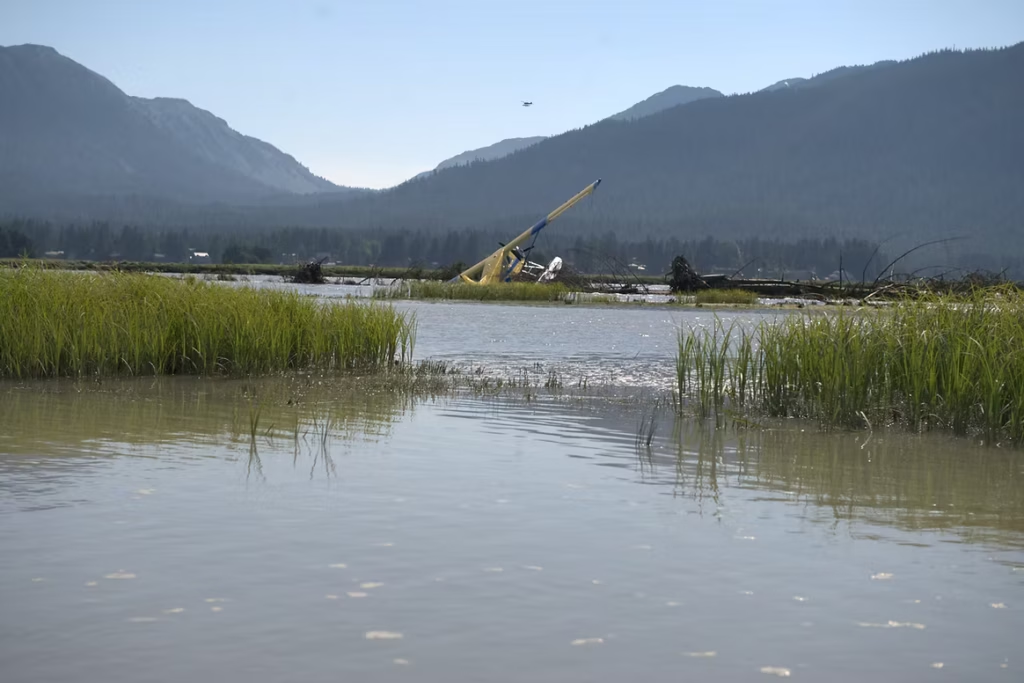
An Alaska Seaplanes floatplane made an emergency landing at the mouth of the flooded Mendenhall River immediately after takeoff from Juneau International Airport on Thursday morning. The uninjured pilot was rescued after the aircraft was carried by the river’s force into trees lodged downstream.
Capital City Fire/Rescue retrieved the uninjured pilot using a rescue boat. Alaska Seaplanes stated he “is with Alaska Seaplanes personnel now, who are actively working to recover the plane from Mendenhall…
Photo courtesy of Susan Walker, Juneau Community Collective
NOTN- An Alaska Seaplanes floatplane made an emergency landing in the Mendenhall River this morning, with no injuries reported.
The company says a de Havilland Beaver, tail number N777DH, made the emergency landing at about 11:17 a.m., shortly after taking off from the floatplane pond at Juneau International Airport.
According to a Facebook post, there was one pilot aboard and no passengers. The pilot was unharmed and is now with Alaska Seaplanes personnel.
The aircraft landed safely but later drifted into a floating root ball in the river. Alaska Seaplanes personnel are working to recover the plane.
The company says additional information will be provided as it becomes available.
Preschool children line up to go outside at the Ralph Hawley Head Start Center in Emeryville, Calif., in December. The Trump administration has proposed major changes to the Head Start program. (Photo by Florence Middleton for CalMatters)
The Trump administration is pushing a total overhaul of Head Start that could fundamentally reshape the 60-year-old program that has provided childcare and key support for America’s lowest-income families.
A new proposed rule released last week put more than 1,400 regulatory provisions that govern how Head Start is implemented on the chopping block. Across the country, 1,600 Head Start grant recipients provide quality care for disadvantaged children, as well as support for families by connecting them to health insurance, job training, developmental screenings, specialist referrals and postpartum support.
This latest proposal is aimed at cutting red tape and allowing more flexibility in the programs, the administration said.
“There’s 1,600 providers across the country facing different conditions, and our proposed rule will reduce their paperwork. It will streamline duplicative statutory requirements and give them flexibility for things like personnel and workforce decisions, as well as licensing relief,” said Alex Adams, the assistant secretary at the Administration for Children and Families (ACF), on a call with reporters.
But Head Start providers and experts say the proposal may actually make it harder for programs to operate and transform Head Start to look more like commercial childcare than an anti-poverty program.
“Families lose the assurance that Head Start means the same thing everywhere, and taxpayers lose a clear measure of impact that Head Start funding should have,” said Celena Roldan Sarillo, the president of Start Early, a nonprofit that advocates for quality early learning.
Secretary of Health and Human Services Robert F. Kennedy Jr. said on a call with reporters to announce the changes that “it is important to protect” Head Start, which is administered by HHS and was created in part by Kennedy’s uncle Sargent Shriver during the Lyndon B. Johnson administration. Kennedy wants to see more nutrition and physical activity requirements added to Head Start, and agrees the new rules could streamline it and open seats for more children.
That messaging, however, is misleading, said Yvette Sanchez Fuentes, the senior vice president at Start Early.
“At first glance, these proposed changes might not seem so terrible, but as you dig deeper into it, what we will find is that there really are a lot of changes that will impact what is the heart of Head Start,” Sanchez Fuentes said, adding that the performance standards are not just red tape, “they really are the foundation for how we ensure that programs across the country are supporting children, families and communities in the way that they want best.”
Here is a breakdown of what the administration is proposing to change for Head Start.
Overall, how is this proposal changing Head Start?
Fundamentally, the changes would have Head Start operate much more like other childcare centers under state and local rules. Because quality is such an important benchmark in Head Start, its rules are more stringent than the rules governing other childcare options — in many places, those differences would disappear.
“States didn’t design their childcare programs to serve the population that Head Start serves. They design those to regulate private businesses and set a floor for safety, like they regulate hospitals or restaurants, not to prepare a high-need community for school,” said Katie Hamm, who oversaw the Head Start program under the Biden administration.
Are there any immediate impacts to my child’s Head Start program?
No. The public has until October 6 to comment on the proposed rule before HHS reviews the comments and issues a final rule. That review process can take time — months or longer — in addition to any legal challenges that may arise, so it’s unlikely, though not impossible, for changes to happen this year.
How would classrooms change?
One of the biggest changes in the proposal is eliminating Head Start’s teacher-to-student ratios. One of Head Start’s quality initiatives is that it offers more individualized care — each teacher is in charge of a smaller number of students than in most other childcare settings. The policy is both about safety and support for low-income kids, some of whom need more focused attention.
Under the proposed changes, an estimated 80 percent of children currently in Head Start would be subject to worse ratios. The maximum number of toddlers per teacher would more than double in nine states: Arkansas, Florida, Georgia, Kentucky, Louisiana, Mississippi, Nevada, North Carolina and Texas.
The proposal also removes the cap on group sizes, so it’s likely classrooms would have more children.
Another big change: All instruction will have to take place in English instead of offering bilingual support to children who are not native speakers. More than a quarter of children in Head Start come from homes where a language other than English is spoken.
The only exception is for Head Start programs on Tribal lands.
Are there any changes that impact health and safety?
Yes.
Detailed requirements on how to prevent lead exposure are gone and replaced with a broader requirement that programs prevent children from being exposed to lead in water and paint in however way they see fit.
A requirement that a bus monitor be on board any buses transporting children at all times has also been removed.
Other detailed rules on facilities, safety training, hygiene, disaster preparedness and equipment and materials are also gone; instead programs are instructed to follow state laws in those areas.
Is discipline changing under the new regulations?
Currently, children generally cannot be expelled from Head Start. The proposed rule would remove that prohibition and allow programs to set their own disciplinary rules, as long as they align with state and local requirements. Head Start would still need to provide children with any behavioral problems with screenings and referral services.
The administration said it made these changes because when the expulsion and suspension rules were first implemented in 2016, many states did not have their own rules governing those issues. Since then, many states have adopted their own.
“These proposed changes are not an endorsement of suspension and expulsion as approaches to address persistent and serious behavioral concerns; rather, the intent is to allow programs to determine their own discipline policies, within the context of state and local licensing requirements,” the rule says.
Are there changes related to health support?
Head Start typically offers a variety of mental health and health screenings as part of its program requirements. For example, within 30 days of enrollment, programs have to check that a family has insurance or ongoing medical care; within 45 days it needs to check for or conduct vision and hearing screenings; within 90 days, it needs to check on whether children have immunizations up to date, have had their well-child pediatrician checkup and had dental visits. Programs also require that children brush their teeth at school. All of those specific requirements are gone under the proposed rule.
Many mental health supports, such as a monthly mental health consultation, would go away.
So while the requirement from the Head Start Act — that programs support families with a comprehensive array of health services — remains, the set rules on how to achieve that, like the timeline requirements, disappear. Advocates say this could lead to inconsistent care and less accountability.
How does this impact children with disabilities?
Similarly, the proposed rules require that Head Start programs comply with all applicable federal and state regulations in providing services to children with disabilities, but eliminates much of the structure for how to provide those services.
What about impacts on unhoused children?
The proposed rule removes a provision that allows families experiencing homelessness to simply confirm their situation and thus qualify for Head Start. Families that are unhoused may also be in situations where they are living with someone else or in a temporary structure — situations they could rarely prove through documentation.
Under the new rules, families and children would have to provide some documentation.
Would newborn and pregnancy services be impacted?
Yes. Early Head Start, which services low-income pregnant people and children under the age of 3, would lose a lot of tailored requirements. Newborn home visits would still be required, for example, but the requirement that they happen within two weeks of birth was dropped.
Also gone is a requirement around addressing racial and ethnic disparities in birth outcomes. Currently, programs must track demographic data on pregnant people, identify any disparities and provide services to close those gaps. The administration said cutting that requirement is in line with its mission to cut back on diversity, equity and inclusion programs, and claims programs said it was beyond the scope of what they could reasonably be expected to do.
Would parent involvement change?
Possibly.
The way Head Start works now, parents are actively engaged with much of the decision making at individual centers. Each center is required to have a parent committee that has power in advising the school on activities, policies and services, and the regulations determine how those must function.
Under the proposed rule, those committees would be optional, and the rules that govern how they operate would also be eliminated, which the administration said were designed to give programs more flexibility.
Are there any new rules being suggested?
Yes, and they largely have to do with nutrition and physical activity.
Programs will be required to offer 30 minutes of physical activity, ideally outside, for every three and a half hours of classroom instruction. That would expand the existing general requirement that programs “recognize physical activity as important to learning and integrate intentional movement and physical activity into curricular activities and daily routines.”
The current Head Start regulations require that programs generally fulfill a third to a half of children’s daily nutritional needs with meals at Head Start. Three- to 5-year-olds must get healthy meals and snacks that conform to U.S. Department of Agriculture (USDA) guidelines, and meals should be culturally appropriate as well as developmentally appropriate — infants and toddlers are fed according to their individual needs and readiness.
Under the new proposal, they will also be required to offer nutrient-dense whole foods within the framework of the USDA Child and Adult Care Food Program meal standard, ensuring that “all the meals are aligned with the dietary guidelines,” Kennedy said.
What is the new addition around “healthy marriage”?
One of the less-talked-about additions the administration is proposing is providing educational material to children that “demonstrates healthy marriage as a positive good,” in concert with new strategies to engage parents in their kids’ learning, and particularly fathers, the rule says.
“This proposed change to current requirements reflects ACF’s commitment to supporting strong families as the cornerstone of a healthy society,” the administration said.
If the rule is finalized, do programs have to adhere to it?
It’s unclear.
Adams emphasized that programs can continue to operate as they currently are if they wish to. In the areas where the administration is adding new requirements, however, such as nutrition and physical activity, programs would have to make changes.
“If a program likes its ratio, it can keep its ratio. If a program likes its group size, it can keep its group size. This does not require them to do anything different. As I said, flexibility is permission; it’s not a mandate,” Adams said.
“If they truly mean, for example, a program can decide to keep the ratios that exist in the regulations today, the regulation should say that. It should say programs have a choice,” Hamm said. “It doesn’t say that, and so that’s a problem for a lot of reasons.”
Head Start centers receive grants from the federal government to offer services — it’s unclear what assurance there is that the administration will offer grants to programs that choose to adhere to prior rules.
There’s already some evidence HHS could target programs it deems to be in misalignment with the Trump administration. Earlier this year, the agency tried to withhold funding to Head Start programs that used words like “women” and “race” in their grant applications, what it perceived to be diversity, equity and inclusion initiatives that have been a target of the administration.
Head Start programs in Illinois, Pennsylvania, Washington and Wisconsin sued and a judge granted them a preliminary injunction, blocking the Trump administration from cutting funding while the case is litigated.
“When grants get negotiated or when there are grant competitions, and HHS is selecting a grantee, they have a lot of power in that,” Hamm said. “Oftentimes, a Head Start grant feels like they need to comply with what’s being asked of them.”
Why is the administration pursuing these changes?
Since the start of the Trump administration, Head Start has faced upheaval.
Project 2025, the policy blueprint for President Donald Trump’s second term, advised eliminating the program, claiming it lacked positive outcomes and was rife with abuse. A leaked White House budget in early 2025 showed the administration was hoping to eliminate it altogether before massive backlash from Head Start parents and alumni persuaded the administration to change course.
But programs continued to face financial challenges. Funding was cut off at the start of 2025 as part of a government-wide freeze, leading some to close their doors. Then in April of last year, the administration closed five of the 10 regional offices that support Head Start programs.
Last summer, the administration released a proposed rule that would bar undocumented children from Head Start entirely. The proposal is on pause due to ongoing litigation.
Adams said the goal of the proposed rule is to provide flexibility in the program, not dismantle it.
“In broad strokes, what we are trying to accomplish is we built this rule around trusting local leaders to make the decisions that are best for their local communities,” he said.
If the changes were enacted across programs, the administration estimates a savings of $2.2 billion that would be reinvested in the program to open as many as 236,000 new Head Start spots. There is no national repository of waitlist data on Head Start, though programs are required to be filled and maintain an active waiting list.
“We’re trying to ensure that programs have the flexibility not just to meet their community needs, but to start clearing out some of their waitlists, ensuring more children are served,” Adams said.
How could these changes impact childcare staff?
The administration is proposing a reduction in how much money programs can spend on administrative overhead, lowering it from 15 percent to 5 percent.
The justification, Adams said, is “so that more money is reaching children and families, and less is going to administrative overhead, like administrator salaries or administrative offices.”
But childcare providers have argued that the reduction will actually mean less money to operate Head Start — money that goes to things like buses and human resources, or to conduct background checks and fix the refrigerator when it breaks.
“Don’t believe that somehow that 15 percent makes our Head Start directors rich. It does not. Everyone I know in Head Start, including myself, has never become rich from being a Head Start employee,” said Lori Pittman, the co-founder of the Washington State Parent Ambassador Program and a former Head Start parent.
By the administration’s own analysis, the changes could lead to a reduction in teaching staff at centers across the country. Other workforces that would be hit: home visit staff, health and mental health personnel, child development specialists and bus monitoring staff.
Is there any new money for Head Start under the proposal?
No. Funding for Head Start has remained flat for the past three years — about $12 billion — even though operating costs and inflation have risen.
How can I comment on the regulations?
Comments in the federal registrar can be submitted here. The open comment period will close October 6.
Pink salmon — the backbone of the Southeast seine fleet — finally started to show up the first weekend of August, after what state biologists were comparing to the poorest early returns on the books.
“Pink salmon’s been — up until this last week — pretty poor so far,” Troy Thynes, the Southeast Alaska management coordinator for the Alaska Department of Fish and Game, said last week. He described strong escapement and harvest in District…
(Courtesy/Sven Beattie) Jess Beattie and Savannah “Sven” Cuthbertson married on the Klehini River on August 3.
Jess Beattie and Savannah (Sven) Cuthbertson, now Beattie, were married on the Klehini River on Aug. 3. Jess wore a psychedelic floral shirt. Sven, a stunning wedding gown and Xtra Tuffs. The party set out from 36 Mile Haines Highway in nine rafts and two packrafts in search of the ideal location. The Beatties found the perfect delta…
Haines and Klukwan schools were among 304 statewide that met adequate yearly progress (AYP) requirements of the federal No Child Left Behind Act. The state Department of Education announced the results this month, along with a list of the 193 schools that failed to demonstrate adequate proficiency.
Haines students have exceeded math and language proficiency requirements in each of the three years that testing has been mandated, said superintendent Charlie Jones. “We’re…
It’s not news that political campaigns are rife with bogus ads, fake stories, and unsubstantiated attacks, but the level of subterfuge in this election cycle has unfortunately reset the bar. A Republican-backed super PAC is spending hundreds of thousands of dollars to create and post mailers in support of someone named Carol Hafner, who is listed as a Democrat on the Alaska Senate race ballot, despite living in South Dakota. Hafner’s son Eric, supposedly running…










 Riverfront homeowners on Killewich Drive pump water out of their crawl spaces on Thursday, Aug. 13, 2026. (Photo by Clarise Larson/KTOO)

 An industrial-sized pump pipes water over the flood wall on Meander Way as the flood crests on Thursday, Aug. 13, 2026. (Photo by Clarise Larson/KTOO)