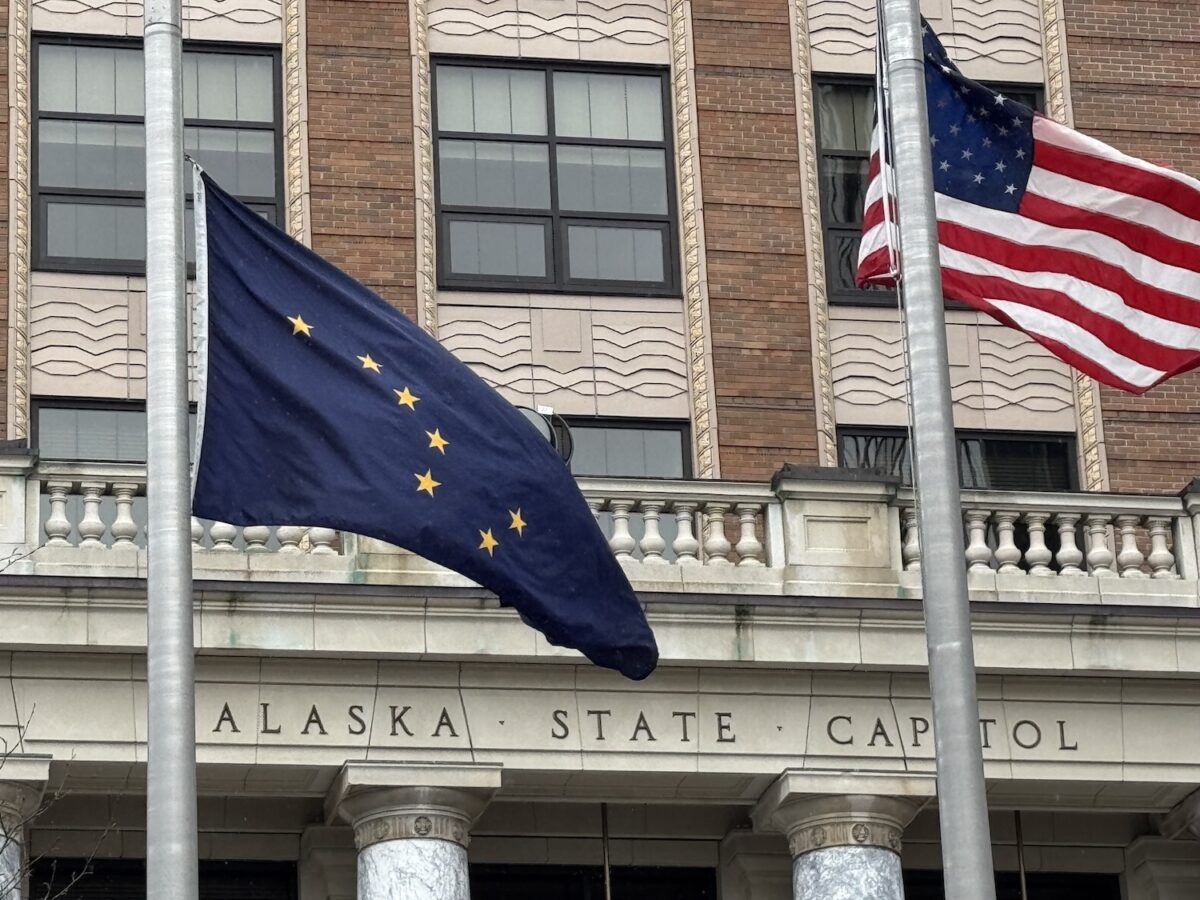
The Alaska and American flags fly in front of the Alaska State Capitol on Tuesday, April 22, 2025. (Photo by James Brooks/Alaska Beacon)
Corinne Smith, Alaska Beacon
The Alaska and American flags fly in front of the Alaska State Capitol on Tuesday, April 22, 2025. (Photo by James Brooks/Alaska Beacon)
The Alaska House of Representatives voted to approve a revised bill to reinstate a pension system for all Alaska public sector employees, following passage by the Senate on Tuesday. The bill now heads to Gov. Mike Dunleavy’s desk for consideration.
With just 21 days to go in the second year of the 34th Legislature, the governor has 15 days, excluding Sundays, to approve or veto the bill, or allow it to become law without his signature.
A spokesperson with Dunleavy’s office declined to comment on the governor’s position on lawmakers’ pension plan on Wednesday.
If enacted, the bill would revive the state’s defined benefit retirement system that was eliminated in 2006, a top priority of both the multipartisan Senate Majority and House Majority caucuses.
The proposed defined benefit system would be open to all state employees, including teachers, public safety workers and public employees of cities and boroughs statewide. Those municipal employers have six months to decide whether to participate in the program or opt out beginning in January, and the new program would be launched in July 2027.
Within the new plan, retirement for teachers and public employees would be possible at age 60 or any age after 30 years of service. For public safety officers, including police and firefighters, it would be age 50 with 25 years of service, or age 55 with 20 years of service.
The House narrowly passed the bill along caucus lines by a vote of 21 to 19 on Wednesday. The Senate passed the bill with significant revisions the day before, by a vote of 12 to 8.
Sen. Cathy Giessel, R-Anchorage, a longtime proponent of reviving the plan, said it took two decades of work in the Legislature and praised the House vote at a news conference on Wednesday.
Sen. Cathy Giessel, R-Anchorage, smiles at the news that the House concurred with the Senate’s bill and approved a new state pension plan at a news conference on Apr. 29, 2026. (Photo by Corinne Smith/Alaska Beacon)
“We are pleased that it was successful. And it was designed to be a modest, and yet secure, pension for retirement. And it had some amendments made on the floor that kind of made it a little bit more moderated. Choice was put in for employers, which is a big deal,” she said.
But she pointed out that the governor has yet to weigh in: “We still have one more stop, though. We have the big red pen potentially. So we’ll see what happens.”
House Majority Leader Rep. Chuck Kopp, R-Anchorage, carried House Bill 78, and told the Anchorage Daily News that he’s discussed the proposed plan with Dunleavy and members of his staff and is “encouraged” by those conversations.
House Majority Leader Rep. Chuck Kopp, R-Anchorage, speaks in support of a state pension plan on Apr. 29, 2026. (Photo by Corinne Smith/Alaska Beacon)
Kopp, speaking on the House floor Wednesday, said the new plan is entirely separate from the old plan, and has been revised with safeguards to prevent future unfunded liabilities.
“Do we want to continue down this path, with high turnover, constant vacancies and a growing strain on public services?” he added. “Or do we want to move forward with the plan that’s been vetted, improved and supported by both chambers, a plan that’s involved a lot of collaboration and compromise, and a plan that reflects Alaska’s long term interests.”
State lawmakers voted to axe the state’s defined benefit contribution plan in 2006, after the system accrued a multi-billion dollar shortfall that was misreported by a state actuary. Alaska sued the actuary, Mercer, for $1.8 billion in damages for miscalculating liabilities and settled in 2010 for $500 million. But, opponents of the bill noted, the state still owes billions of dollars on the old system and is on track to pay it off in 2039.
Proponents of the bill say the new pension system is structured differently to avoid repeating the same mistakes — it includes mechanisms to adjust contributions up and down, safeguards in the form of three actuaries checking each other’s work and no healthcare insurance benefits — to prevent the pension system from going underfunded.
Health insurance benefits, a major driver of ballooning costs of the old pension system, isn’t included in the new proposal. Under the new plan, employers would pay into a health reimbursement fund of up to 3% of teachers salaries and 4% of public sector workers’ salaries to supplement Medicare for those over age 65.
On Wednesday, members of the all-Republican House minority put up a potential technical hurdle by voting against the effective date clause of the bill, which needed a two-thirds majority vote to pass. That sets up a potential conflict between the effective date written in the bill and the Alaska Constitution, which says that the bill would be enacted within 90 days after the governor’s signature without a two-thirds majority vote to do otherwise.
A caller reported smoke alarms going off in the 400 block of Fourth Avenue. The volunteer fire department responded.
A caller reported someone banging on their door in the 100 block of Dalton Street early in the morning. An officer was advised.
Haines Borough police assisted another agency in Haines.
Tuesday, April 14
A caller reported a person driving a motorcycle on the beach on River Road. Officers responded.
Thursday, April 16
A caller reported that a neighbor at Third Avenue and Union Street had copious amounts of garbage in their garage and the door was open. An officer was advised.
A caller in the 1000 block of the Haines Highway reported unsecured trash and was worried about it being a bear attractant. An officer responded.
A caller reported a person trespassing on their property in the 1000 block of the Haines Highway. An officer took the call.
An OnStar automatic notification of a vehicle accident at 25 Mile Haines Highway was received by dispatch. Police, the Haines Volunteer Fire Department and Klehini Valley Fire Department responded.
A caller reported stolen property from their vehicle in the 100 block of Third Avenue. An officer was advised.
A caller reported a subject throwing lumber off the dock into the water. An officer responded.
Friday, April 17
A caller reported damage to their vehicle after a vehicle backed into them on Main Street. An officer responded.
A caller reported harassing and threatening behavior from neighbors in the 1000 block of the Haines Highway. An officer responded.
Saturday, April 18
A caller reported smoke in their house in the 30 block of Tower Road. The Haines and Klehini Valley volunteer fire departments and police responded.
The Haines Volunteer Fire Department performed a post-fire follow-up in the 30 block of Tower Road.
There were two 911 hangup calls, no canine calls, 14 EMS calls and 27 burn permits issued during this reporting period.
Monday, April 20
Caller reported a vehicle parked for a week in front of the entrance to a business in the 200 block of Main Street. An officer responded.
A caller in the 70 block of Deishu Drive reported multiple vehicles speeding in the area. An officer was advised.
A caller in the 1900 block of the Haines Highway requested a welfare check on a family member.
A caller in the 400 block of Main Street reported a stolen bicycle. A description was obtained and an officer advised.
A caller reported that a customer left without paying for services on Main Street. The customer returned and paid.
Tuesday, April 21
A caller reported moose in the Tlingit Park area. An officer was advised and a Nixle alert was sent out.
A caller reported the suspicious behavior of a customer a Mile 3 Haines Highway. An officer responded.
An officer checked out an abandoned vehicle at Port Chilkoot.
A caller reported items missing from a property in the 30 block of the Haines Highway. An officer took the call.
Wednesday, April 22
A caller in Haines reported a scam on social media. They were given the information for the FBI’s Internet Crime Complaint Center.
A driver on Beach Road was given a verbal warning for not meeting requirements to display a license plate.
An officer put a 72-hour notice on an abandoned vehicle on Beach Road.
A caller in the 100 block of Dalton Street reported a suspicious phone call. An officer responded and performed a welfare check.
An officer checked a license plate during a vehicle stop.
Thursday, April 23
A caller reported a moose on Fifth Avenue. A Nixle alert was sent out.
An officer issued a trespass notice in the 800 block of Spruce Grove Road.
Friday, April 24
A caller reported a parking violation on Main Street. An officer contacted the vehicle’s owner.
A caller in Klukwan reported a vehicle fire. The Haines Volunteer Fire Department and state park ranger responded and extinguished the fire.
A caller reported a boulder obstructing traffic on Lutak Road. The state’s Department of Transportation and an officer responded. A Nixle alert was sent out.
A caller on Small Tracts Road was given a verbal warning for not meeting taillight requirements.
An officer was advised of an abandoned trailer on the side of Mud Bay Road.
Saturday, April 25
A caller reported a person driving a motorcycle on the mud flats near Pyramid Island. An officer took the call.
Officers were advised of a disabled vehicle on the side of Raven Road. It was not obstructing traffic and the vehicle was later retrieved by the owner.
A caller reported the door of a public building in the 600 block of the Haines Highway was open after hours. Officers responded.
Officers performed a tag check on an abandoned vehicle on Second Avenue.
There were three 911 hangup calls, one canine call, nine EMS calls, and 38 burn permits issued during this reporting period.
The Alaska and American flags fly in front of the Alaska State Capitol on Tuesday, April 22, 2025. (Photo by James Brooks/Alaska Beacon)
The Alaska House of Representatives voted to approve a revised bill to reinstate a pension system for all Alaska public sector employees, following passage by the Senate on Tuesday. The bill now heads to Gov. Mike Dunleavy’s desk for consideration.
With just 21 days to go in the second year of the 34th Legislature, the governor has 15 days, excluding Sundays, to approve or veto the bill, or allow it to become law without his signature.
A spokesperson with Dunleavy’s office declined to comment on the governor’s position on lawmakers’ pension plan on Wednesday.
If enacted, the bill would revive the state’s defined benefit retirement system that was eliminated in 2006, a top priority of both the multipartisan Senate Majority and House Majority caucuses.
The proposed defined benefit system would be open to all state employees, including teachers, public safety workers and public employees of cities and boroughs statewide. Those municipal employers have six months to decide whether to participate in the program or opt out beginning in January, and the new program would be launched in July 2027.
Within the new plan, retirement for teachers and public employees would be possible at age 60 or any age after 30 years of service. For public safety officers, including police and firefighters, it would be age 50 with 25 years of service, or age 55 with 20 years of service.
The House narrowly passed the bill along caucus lines by a vote of 21 to 19 on Wednesday. The Senate passed the bill with significant revisions the day before, by a vote of 12 to 8.
Sen. Cathy Giessel, R-Anchorage, a longtime proponent of reviving the plan, said it took two decades of work in the Legislature and praised the House vote at a news conference on Wednesday.
Sen. Cathy Giessel, R-Anchorage, smiles at the news that the House concurred with the Senate’s bill and approved a new state pension plan at a news conference on Apr. 29, 2026. (Photo by Corinne Smith/Alaska Beacon)
“We are pleased that it was successful. And it was designed to be a modest, and yet secure, pension for retirement. And it had some amendments made on the floor that kind of made it a little bit more moderated. Choice was put in for employers, which is a big deal,” she said.
But she pointed out that the governor has yet to weigh in: “We still have one more stop, though. We have the big red pen potentially. So we’ll see what happens.”
House Majority Leader Rep. Chuck Kopp, R-Anchorage, carried House Bill 78, and told the Anchorage Daily News that he’s discussed the proposed plan with Dunleavy and members of his staff and is “encouraged” by those conversations.
House Majority Leader Rep. Chuck Kopp, R-Anchorage, speaks in support of a state pension plan on Apr. 29, 2026. (Photo by Corinne Smith/Alaska Beacon)
Kopp, speaking on the House floor Wednesday, said the new plan is entirely separate from the old plan, and has been revised with safeguards to prevent future unfunded liabilities.
“Do we want to continue down this path, with high turnover, constant vacancies and a growing strain on public services?” he added. “Or do we want to move forward with the plan that’s been vetted, improved and supported by both chambers, a plan that’s involved a lot of collaboration and compromise, and a plan that reflects Alaska’s long term interests.”
State lawmakers voted to axe the state’s defined benefit contribution plan in 2006, after the system accrued a multi-billion dollar shortfall that was misreported by a state actuary. Alaska sued the actuary, Mercer, for $1.8 billion in damages for miscalculating liabilities and settled in 2010 for $500 million. But, opponents of the bill noted, the state still owes billions of dollars on the old system and is on track to pay it off in 2039.
Proponents of the bill say the new pension system is structured differently to avoid repeating the same mistakes — it includes mechanisms to adjust contributions up and down, safeguards in the form of three actuaries checking each other’s work and no healthcare insurance benefits — to prevent the pension system from going underfunded.
Health insurance benefits, a major driver of ballooning costs of the old pension system, isn’t included in the new proposal. Under the new plan, employers would pay into a health reimbursement fund of up to 3% of teachers salaries and 4% of public sector workers’ salaries to supplement Medicare for those over age 65.
On Wednesday, members of the all-Republican House minority put up a potential technical hurdle by voting against the effective date clause of the bill, which needed a two-thirds majority vote to pass. That sets up a potential conflict between the effective date written in the bill and the Alaska Constitution, which says that the bill would be enacted within 90 days after the governor’s signature without a two-thirds majority vote to do otherwise.
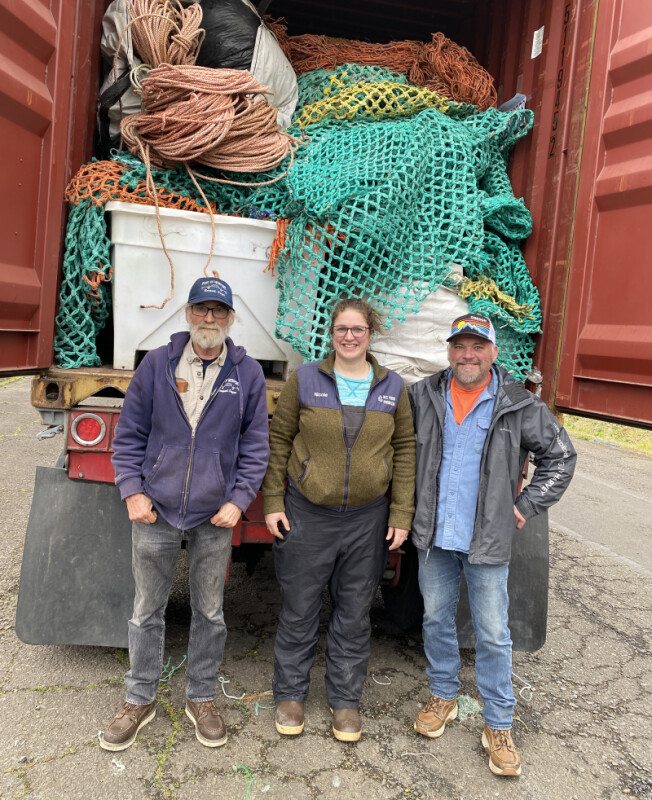
Brian Shaw (left) and Eric Klose stack retired commercial fishing nets for shipment to Ukraine, where they will be used to entangle Russian drones before they can explode — protecting soldiers in trenches and civilians in markets and homes. (Ground Squirrel Ventures photo)
This article originally appeared in National Fisherman and is republished here with permission.
Worn-out commercial fishing nets and lines from America’s Pacific Northwest are getting a new life protecting soldiers and civilians in Ukraine from exploding Russian drones.
These nets are hung over doorways and windows to entangle the drones before they can hit a target and explode.
On Wednesday, April 22, Nicole Baker of Net Your Problem, an Alaska-based maritime recycling firm, was in Newport, Ore., overseeing the loading of 29,000 pounds of worn-out trawl, gill, and seine nets and crab line from harvesters into a 40-foot container headed for Ukraine. The load included 19 trawl nets, four bags of seine web, one bag of gillnet web, and three bags of line.
Net Your Problem got involved last year when contacted by a Boston-based venture capital and private equity firm looking for commercial fishing nets to send to Ukraine. Nets from Net Your Problem became part of the firm’s first container load of nets to Ukraine.
“I could never have imagined this is what would happen to these nets, and I can’t think of a more fulfilling way to use them,” Baker said. “It’s literally saving people’s lives.”
“My sister is an ICU cardiac nurse, and she saves people’s lives. Now I do too,” she said.
The venture capital firm, Ground Squirrel Ventures, is a network of angel and seed stage investors founded by Eric Klose in 2018.
Klose said he learned on an earlier visit to Ukraine that discarded fish nets could save lives in the trenches of war zones and in buildings in besieged cities.
Eric Klose, founder of Ground Squirrel Ventures in Boston, stands inside a container being filled with retired commercial fishing nets for shipment to Ukraine, where they will be used to entangle Russian drones and prevent them from exploding and killing soldiers and civilians. (Ground Squirrel Ventures photo)
Klose hardly considers himself a hero, though. “I’m letting people do a lot and also keeping fishing nets out of the ocean,” he said. “I love that this also is saving lives and spreading freedom and democracy. I am just helping to connect people, and I am able to fund the shipping cost,” he said.
Klose, who earned a degree in public administration from the Harvard Kennedy School of Government, has friends in the Boston area of Ukrainian heritage.
On a trip to Ukraine with a group of graduate students, he sometimes slept in basement bomb shelters in Kyiv and also saw extensive war damage in Kharkiv.
He spoke with aid groups who were bringing clothing, medical supplies, and other needed items to Ukraine and asked what else was needed. “Fish nets,” they told him. They put him in touch with another volunteer in Vancouver, Canada, who was sending fish nets, medical supplies and more.
In December 2025, Ground Squirrel Ventures assembled its first container load of fish nets, including those from Net Your Problem, and shipped them to Ukraine. Volunteers there put the word out that more nets were available, and soldiers began collecting them to cover doors and windows to entangle Russian drones.
Other discarded nets, once used in crop farming and commercial fisheries across Europe, are also being used to cover roadways in Ukraine. CNN reported in January on Ukrainian soldiers raising nets donated by French fishermen and volunteer groups in Brittany to cover roads and protect vehicles traveling to and from supply lines. The nets are also used to protect hospitals, generators, and shopping areas with canopies of netting.
Ukrainian soldiers shelter in a trench protected by discarded commercial fishing nets; a Russian drone is entangled in the netting, preventing it from reaching its target and exploding. (Ground Squirrel Ventures photo)
Oleksandr Tolokonnikov, deputy head of the Kherson Military Administration, told CNN in November that the Russians are launching an average of about 2,500 unmanned aerial vehicles every week. CNN also reported that Life Guardians, run by Klaas Pot in the Netherlands, has sent over 8,000 tons of nets to Ukraine. Additional nets were donated by Norwegian Volunteer Air and Pickups For Peace in the United Kingdom.
Ground Squirrel Ventures’ main focus is on impact-driven investments in climate mitigation and frontier markets. The firm manages a portfolio of 30 companies and operates with a team that includes Brian Shaw as portfolio and operations manager.
As of April 21, Shaw said Ground Squirrel Ventures was working on shipping its second container of about 10 tons of retired commercial fishing nets to Ukraine, with two more container loads planned over the next three months.
“This is our own way of supporting human dignity and the rights of people,” said Shaw. “We are just people living our lives, and we found a need. I am a problem solver by nature.”
“The goal is somewhere in the range of four to six containers a year,” he said. “A lot of fishermen and companies would previously have dumped these nets in their yard.”
“This provides a way for these nets to have a second life. Soldiers will hang them in windows of buildings they are working in.” The nets are also being used over community open markets and other civilian areas to tangle Russian drones and prevent them from hitting targets and exploding.
“Ukrainians are trying to free their own country, which does not seem like too much to ask,” Klose said.
Back in the Pacific Northwest, Baker said she plans to keep participating in the project. Fishing vessel owners and others who are interested can find more information online here.
Nicole Baker, founder of Net Your Problem, with Robin Ripka and Don Moon of the Port of Newport. (Net Your Problem photo)
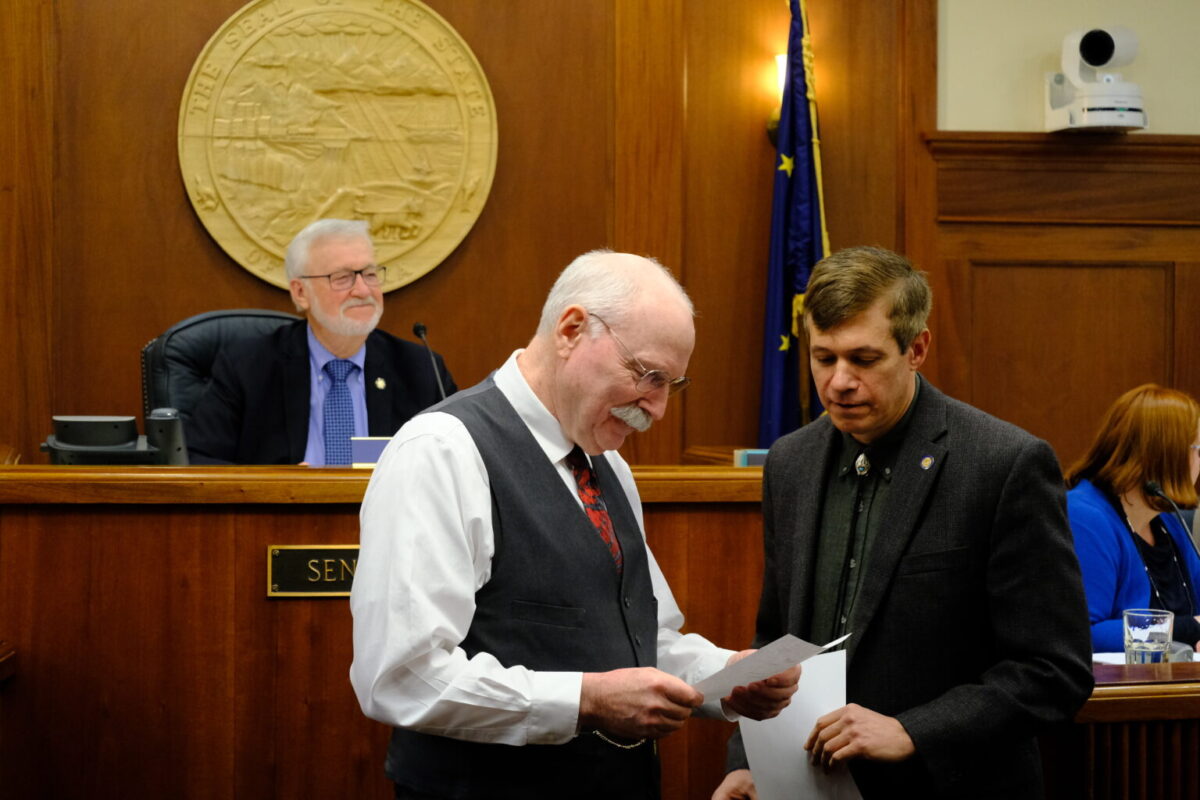
Sens. Bert Stedman, R-Sitka, Bill Wielechowski, D-Anchorage, discuss a proposed pension bill, with Sen. President Gary Stevens, R-Kodiak, seen in the background on Apr. 28, 2026. (Photo by Corinne Smith/Alaska Beacon)
Members of the Alaska Senate voted to approve a long-awaited pension bill on Tuesday, amid debate on the cost of the new public retirement benefits system and responsibilities of the state and local community employers.
The Senate passed a revised version of a pension plan approved by the House last year. The vote was 12 to 8. Twenty years after lawmakers eliminated a public pension system, the vote marks the closest lawmakers have come to restoring a defined retirement benefit for thousands of Alaska’s public sector employees.
Sen. Cathy Giessel, R-Anchorage, speaks about Senate Bill 88, the Senate majority’s public employee pension proposal, on Wednesday, March 1, 2023. (Photo by James Brooks/Alaska Beacon)
“It strikes me as a historic day,” said Sen. Cathy Giessel, R-Anchorage, after the vote. She has been working on the issue for several years. “When you figure 33 different offerings to correct this over the years — yeah, we’ve been trying for a long time.”
If enacted, the bill would reinstate a defined benefit retirement system for Alaska state employees, as well as teachers, public safety workers and municipal employees statewide.
Supporters said the retirement benefit is crucial for hiring and retaining a skilled public sector workforce in Alaska for the long-term, while detractors say the uncertainty around the cost to the state and local municipalities isn’t worth the risk.
Sen. Mike Cronk, R-Tok, is seen at a Senate Finance Committee meeting on Apr. 24, 2026. (Photo by Corinne Smith/Alaska Beacon)
Senate Minority Leader Sen. Mike Cronk, R-Tok, said he opposes increasing state spending.
“We look at our federal government, we’re going to be $40 trillion upside down. That’s totally unacceptable,” he added. “And for adding this kind of burden for the future, generated cost is something that I just can’t be a part of. I know we have a problem. I think there are other solutions out there that can help this problem.”
The move was applauded by the state’s largest public employees union, the Alaska State Employees Association, which represents roughly 8,500 public employees.
“The impact is almost difficult to overstate,” said Heidi Drygas, its executive director, by phone on Tuesday. “Our membership overwhelmingly supports a defined benefit pension. And I think this will mean security for them, so that they can feel comfortable staying in their state jobs. It will attract more employees to work for the state.”
The bill passed the House last May, and the revised version now goes back to the House for a concurrence vote, before heading to Gov. Dunleavy’s desk for consideration.
The governor has been critical of previous pension proposals. Dunleavy receives a state pension for his previous employment as an educator and superintendent.
If the bill becomes law, current state employees would be allowed to switch from a defined contribution or a 401(k) style retirement plan to the new system. Retirement for teachers and public employees would be possible at age 60 or any age after 30 years of service. For public safety officers, including police and firefighters, it would be age 50 with 25 years of service, or age 55 with 20 years of service.
“Every other state offers a pension for at least some of the public servants. We do not,” Giessel said on the Senate floor. “And we are seeing the results. We ask our public employees to do difficult work, often in the hardest conditions. The question is whether we will give them a reason to build a career here.”
After several hours of debate, the Senate approved several amendments, including a change to allow cities and boroughs to choose whether to opt out of the new defined benefit retirement plan, instead of opt in.
“It’s better policy for local governments to follow the state’s lead,” said Sen. Matt Claman, D-Anchorage, who sponsored the provision. “If they don’t like our choice, they’re certainly allowed to make their own choice and opt out, but if they don’t take any action, they’re in.”
That means local cities and boroughs can choose whether to opt out of the plan, if enacted, between January and June of 2027, and then the new system would begin July 1 next year.
Under the revised bill, employees would contribute 8% of their pay to the pension plan. Employers would pay up to 22.5% for public sector employees, and up to 12.5% for teachers. Senators debated the cap and arrived at 22.5%, noting municipality officials public testimony and concern about cost.
Employers would also pay into a health reimbursement fund of up to 4% of workers’ salaries to supplement Medicare for those over age 65. Disability and death benefits would be included.
If passed, the bill would revive Alaska’s state pension that was eliminated in 2006, after the state ran into a multi-billion dollar shortfall and unfunded liabilities in the retirement system.
Sen. Bert Stedman, R-Sitka, a co-chair of the Senate Finance Committee, opposed the bill, citing the risk that the state will repeat the mistakes of the early 2000s.
Sen. Bert Stedman, R-Sitka, speaks against a bill to revive the state’s pension system on the Senate floor on Apr. 28, 2026. (Photo by Corinne Smith/Alaska Beacon)
“This proposal in front of us today diminished the benefit to the retired employee when it goes underfunded. Yeah, it won’t go unfunded until people retire. Normally, it takes about 30 years, but we’ve got 20 years already with the current defined contribution. So about 10 years out,” he said.
A recent estimate by the state’s actuary, Gallagher, projected state costs to total $467 million for the first 13 years, until FY 2039.
Stedman said the state is also still on the hook to pay billions to account for the old pension system. But Giessel said the new pension system has built in safeguards to prevent it from going underfunded, according to the actuary’s analysis.
“Even with a never before seen ‘black swan’ event of three consecutive years with zero investment returns, even then this pension holds up,” she said.
Giessel and other lawmakers cited the state’s current ballooning costs paying state employee overtime to cover vacancies and essential public services, called “premium pay.”
“It is costing us over $200 million a year in premium pay,” she said. “Just to keep basic services running — that number has grown nearly 80% in the past five years. We have, in effect, turned Alaska into a training ground, a place where people come, gain experience and then leave.”
Sen. Bill Wielechowski, D-Anchorage, described a crisis of families leaving the state, in part due to a lack of stable retirement. Alaska has seen more than a decade of consistent outmigration, according to state data.
“There has been a quiet, heavy crisis unfolding all across Alaska, in our schools, in our state office buildings, in our courts, in our communities all across Alaska, it’s the sound of a door slamming shut. Another family packs up to leave,” Wielechowski said on the Senate floor.
“We talk a lot about fiscal responsibility in this chamber, but I ask you, what is responsible about watching our most precious resource, our people walk out the door?”
Supporters of the pension plan also pointed to the state’s struggle with high turnover rates, including up to 30% of teachers in urban and rural districts alike each year.
Sen. Löki Tobin, D-Anchorage, and chair of the Senate Education Committee, said the high unseen costs of turnover of educators is magnified throughout the state.
Sen. Löki Tobin, D-Anchorage, speaks in support of a new state pension plan on Apr. 28, 2026. (Photo by Corinne Smith/Alaska Beacon)
“Because of high teacher turnover, we’re already paying $20 to $30 million a year,” she said. “We can either continue to pay that in turnover costs, or we can fund a quality retirement program that retains our quality educators, attracts new quality educators, and ensures that our kids get the best education they deserve.”
Senators in support of the pension plan noted a recent state audit of Alaska state government that reported hundreds of millions lost in federal reimbursements or incorrectly accounted for due to a variety of factors, including “staff turnover,” “competing priorities” or “inadequate supervisory review.”
Wielechowski pointed to one example of the Alaska Department of Military and Veterans Affairs underreported disaster spending for federal reimbursement by $297 million. The error was corrected once identified by auditors, according to the report.
“Dozens of projects incorrectly reported. And that’s just that’s just a fraction of the inaccuracies and the mistakes,” Wielechowski said.
Opponents of the pension bill pointed to other factors contributing to high turnover like work environment, leadership and a need to raise salaries.
That included Cronk who said he receives a pension after teaching for 25 years. “I would say focus should be on our pay,” he said.
Drygas, with the state’s public employees union, said while the pension plan is one important part of Alaska’s workforce issues, she sees it as crucial for stemming the tide of outmigration from the state.
“I cannot tell you how many people, just personal, friends and acquaintances that I know, that are leaving state service in particular because they can’t retire here. They can’t live on the retirement that our state offers,” she said. “So I think a lot of us are hopeful that, you know, five or 10 years in the future, if this legislation should pass and become law, we’ll see a turnaround in our state workforce again.”
A man carries a child after parking an all-terrain vehicle outside of the Norton Sound Regional Hospital in Nome on April 10, 2026. The hospital has a designated parking area for ATVs and snowmachines, which are heavily used for routine transportation in rural Alaska. (Photo by Yereth Rosen)
All-terrain vehicles are ubiquitous in Alaska, especially in rural areas, where they make up a key mode of transportation.
That heavy use, often on uneven terrain, leads to high numbers of injuries and deaths from ATV accidents, according to state health officials. In recent years, Alaska’s ATV-related fatality rate has been four times the national average.
The Alaska Division of Public Health’s epidemiology section released a bulletin Tuesday detailing that toll.
From 2019 to 2024, Alaska’s rate of ATV-related fatalities was quadruple the U.S. rate — 1.6 per 100,000 people in Alaska, versus 0.4 deaths per 100,000 people nationally.
During that period, the state recorded 4,421 ATV-related visits to hospital emergency departments. Seventeen percent of those cases involved traumatic brain injury, 40% involved breaks to bones other than the skull and 17% involved lacerations. Some patients had multiple types of injuries, the bulletin said.
Children were frequent victims of ATV accidents; 30% of the recorded emergency department vehicles for ATV-related injuries were among patients under 18 years of age, according to the bulletin.
Children and adolescents accounted for 15% of the state’s 71 ATV-related deaths recorded in the study years, the bulletin said.
Northern and Southwestern Alaska had the highest rates of ATV-related injuries requiring emergency department treatment, followed by the Matanuska-Susitna Borough. Such injuries were most likely to occur in the summer and late spring months, according to the statistics presented in the bulletin.
The statistics analyzed in the bulletin concern four- or three-wheeled ATVs, utility terrain vehicles and multi-passenger vehicles known as “side-by-sides.” They do not include snowmachines or motorcycles. And they do not include injuries that went untreated at any emergency department, the bulletin notes.
With so many young people at risk, operators of the vehicles should take care to abide by several precautions, the bulletin said. Riders should use helmets, follow speed limits and avoid intoxicants, and vehicles should not carry more passengers than their stated capacities, the bulletin said.
According to the Division of Motor Vehicles, ATVs used on public roadways must be registered, and people driving them must be licensed. But those rules and others, including one requiring passengers to wear helmets, are often ignored. The Alaska State Troopers have at times reminded residents of laws concerning ATV use.
The troopers’ public education campaign is ongoing.
“State law prohibits operating a vehicle while under the influence of an intoxicating substance whether you are on or offroad. We also strongly encourage riders to follow all safety guidelines — this includes ensuring that equipment such as headlights, taillights, and brakes are in proper working order. Wearing a helmet and other protective gear, including goggles, gloves, long pants, and over‑the‑ankle boots, is also highly recommended,” trooper spokesperson John Dougherty said by email.
Some municipalities have ordinances governing ATV use that are stricter than state law, he noted.
An invasive northern pike is shown to have its stomach stuffed with tiny juvenile salmon. Invasive northern pike are well-established on the Deshka River, where they are eating their way through the supply of salmon and other fish. As tempertures have risen, pike are eating more, a new study found. (Photo provided by the Alaska Department of Fish and Game)
Invasive northern pike have wreaked havoc in Southcentral Alaska rivers and lakes. Introduced illegally in the 1950s, they have been devouring juvenile salmon and other native species.
Now a University of Alaska Fairbanks study warns that matters could get even worse.
As temperatures rise in waterways, invasive pike eat more, said the study, published in the journal Biological Invasions. And as temperatures continue to rise, that trend will continue, the study said. Based on expected temperature trends, invasive northern pike will eat 6% to 12% more by the end of the century, the study said.
“We expect there will be significant warming in the future, and the amount of fish that pike consume is going to increase with it,” Benjamin Rich, who led the study while earning a master’s degree at UAF’s College of Fisheries and Ocean Sciences, said in a statement released by the university.
The UAF study found that over the past decade, northern pike of all age classes ate more as waters warmed. The increase was most dramatic in year-old pike, which upped their intake by about 63% over the period.
The study site was the Deshka River, a Matanuska-Susitna Borough waterway that is an important feeder to Cook Inlet and commercial fisheries there. The 44-mile river, a tributary of the Susitna River, is also a cherished destination for Southcentral Alaska sport anglers.
It is famous for its abundance of salmon — or it has been. Salmon in the Deshka is a lot less abundant now than in the past.
The decline is a decades-long problem that affects king salmon in particular. State and federal biologists have cited numerous reasons for the decline.
The presence of invasive pike is one of them; pike have eaten a lot of juvenile king salmon, also known as Chinook, and coho salmon, also known as silver salmon.
A pair of juvenile Chinook salmon emerge from the stomach of a northern pike caught on the Deshka River in Southcentral Alaska. (Photo by Benjamin Rich/U.S. Fish and Wildlife Service)
Heat stress is also among the myriad causes of declines. The Deshka is particularly vulnerable to heat. It is in a flat area and not glacier-fed, and it is known to be one of the warmest river systems in the Matanuska-Susitna Borough.
It is the subject of ongoing temperature monitoring and studies by the U.S. Fish and Wildlife Service, the conservation group Cook Inletkeeper and others.
In 2019, a record-hot year in Alaska, waters in the Deshka were particularly warm — exceeding 81 degrees Fahrenheit that July, according to readings by Cook Inletkeeper.
Warmer temperatures, along with speeding pike metabolism and spurring more food consumption, appear to be sharpening the northern pikes’ predation skills, said Erik Schoen, a UAF fisheries biologist and a study co-author.
Fish, which are cold-blooded animals, have varying physiological responses to heat, Schoen said. Compared to salmon, which get sluggish in warm temperatures, northern pike thrive and become speedier swimmers, he said.
“If it keeps getting warmer, they get much better at catching salmon,” he said. “They’re amazing ambush predators.”
Deshka pike are actually eating less salmon than they did in past years, analysis of stomach content shows. But that is not because they are turning away from salmon; rather, it is evidence of salmon declines in the river.
The abundance of adult king salmon in the Deshka dropped by 42% over the past decade. At about the same time, the biomass of juvenile salmon eaten by northern pike decreased by 30% to 74%, depending on age class.
Do not expect the pike to go away if they deplete all the salmon, warned Schoen, who grew up in Anchorage and spent a lot of time fishing in the Deshka.
Rather, they will turn to other fish, as they appear to have done in the Deshka, such as whitefish and rainbow trout. If they can’t eat fish, they eat flies, he said. Northern pike are even known to eat birds, such as eagle chicks and ducklings, small mammals like voles and shrews — and, on occasion, each other.
“Once they wipe out the salmon, the pike don’t die off because they run out of food,” Schoen said.
Two Chinook salmon, also known as king salmon, migrate up the Deshka River in this undated photo. The Matanuska-Susitna Borough river is a popular spot for sport anglers, but its salmon runs, especially its runs of Chinook salmon, have dwindled. (Photo by Katrina Liebich/U.S. Fish and Wildlife Service)
Northern pike are native to the Interior and northern parts of Alaska, but they are not part of the natural ecosystem south of the Alaska Range. The first introduction was about seven decades ago, prior to statehood, and traced to the Bulchitna Lake, which is part of the Susitna River drainage. Through the following years, flooding and reproduction spread the fish to new places. And they have proved persistent, showing up not just around the Matanuska-Susitna Borough but also in Anchorage and, to biologists’ dismay, on the Kenai Peninsula.
As entrenched as the pike infestation is in the Matanuska-Susitna Borough, the salmon picture there is not beyond hope, Schoen said.
Pike prefer areas with slow-moving waters and lots of plants. That means areas with swift-flowing waters and gravelly banks are much less likely to be invaded by pike, and there are several such pike-resistant spots in the borough.
Even though it can’t get rid of all the pike, the Alaska Department of Fish and Game has had some success suppressing the invaders in certain important Matanuska-Susitna spots, Schoen said.
One is Alexander Creek, a 40-mile waterway that was one of the most important Northern Cook Inlet freshwater sites for king and silver salmon.
A multiyear program launched by the department resulted in removal of more than 25,000 Northern pike from Alexander Creek by 2021, according to a department report. Salmon numbers have improved. But pike remain a persistent problem, and suppression should continue, the report concluded.
Through its activities as part of the Alaska Invasive Species Partnership, a multiagency organization, the department is pursuing a long-term plan to control northern pike.
An invasive northern pike is shown to have its stomach stuffed with tiny juvenile salmon. Invasive northern pike are well-established on the Deshka River, where they are eating their way through the supply of salmon and other fish. As tempertures have risen, pike are eating more, a new study found. (Courtesy/Alaska Department of Fish and Game)
Invasive northern pike have wreaked havoc in Southcentral Alaska rivers and lakes. Introduced illegally in the 1950s, they have been devouring juvenile salmon and other native species.
Now a University of Alaska Fairbanks study warns that matters could get even worse.
As temperatures rise in waterways, invasive pike eat more, said the study, published in the journal Biological Invasions. And as temperatures continue to rise, that trend will continue, the study said. Based on expected temperature trends, invasive northern pike will eat 6% to 12% more by the end of the century, the study said.
“We expect there will be significant warming in the future, and the amount of fish that pike consume is going to increase with it,” Benjamin Rich, who led the study while earning a master’s degree at UAF’s College of Fisheries and Ocean Sciences, said in a statement released by the university.
The UAF study found that over the past decade, northern pike of all age classes ate more as waters warmed. The increase was most dramatic in year-old pike, which upped their intake by about 63% over the period.
The study site was the Deshka River, a Matanuska-Susitna Borough waterway that is an important feeder to Cook Inlet and commercial fisheries there. The 44-mile river, a tributary of the Susitna River, is also a cherished destination for Southcentral Alaska sport anglers.
It is famous for its abundance of salmon — or it has been. Salmon in the Deshka is a lot less abundant now than in the past.
The decline is a decades-long problem that affects king salmon in particular. State and federal biologists have cited numerous reasons for the decline.
The presence of invasive pike is one of them; pike have eaten a lot of juvenile king salmon, also known as Chinook, and coho salmon, also known as silver salmon.
A pair of juvenile Chinook salmon emerge from the stomach of a northern pike caught on the Deshka River in Southcentral Alaska. (Photo by Benjamin Rich/U.S. Fish and Wildlife Service)
Heat stress is also among the myriad causes of declines. The Deshka is particularly vulnerable to heat. It is in a flat area and not glacier-fed, and it is known to be one of the warmest river systems in the Matanuska-Susitna Borough.
It is the subject of ongoing temperature monitoring and studies by the U.S. Fish and Wildlife Service, the conservation group Cook Inletkeeper and others.
In 2019, a record-hot year in Alaska, waters in the Deshka were particularly warm — exceeding 81 degrees Fahrenheit that July, according to readings by Cook Inletkeeper.
Warmer temperatures, along with speeding pike metabolism and spurring more food consumption, appear to be sharpening the northern pikes’ predation skills, said Erik Schoen, a UAF fisheries biologist and a study co-author.
Fish, which are cold-blooded animals, have varying physiological responses to heat, Schoen said. Compared to salmon, which get sluggish in warm temperatures, northern pike thrive and become speedier swimmers, he said.
“If it keeps getting warmer, they get much better at catching salmon,” he said. “They’re amazing ambush predators.”
Deshka pike are actually eating less salmon than they did in past years, analysis of stomach content shows. But that is not because they are turning away from salmon; rather, it is evidence of salmon declines in the river.
The abundance of adult king salmon in the Deshka dropped by 42% over the past decade. At about the same time, the biomass of juvenile salmon eaten by northern pike decreased by 30% to 74%, depending on age class.
Do not expect the pike to go away if they deplete all the salmon, warned Schoen, who grew up in Anchorage and spent a lot of time fishing in the Deshka.
Rather, they will turn to other fish, as they appear to have done in the Deshka, such as whitefish and rainbow trout. If they can’t eat fish, they eat flies, he said. Northern pike are even known to eat birds, such as eagle chicks and ducklings, small mammals like voles and shrews — and, on occasion, each other.
“Once they wipe out the salmon, the pike don’t die off because they run out of food,” Schoen said.
Two Chinook salmon, also known as king salmon, migrate up the Deshka River in this undated photo. The Matanuska-Susitna Borough river is a popular spot for sport anglers, but its salmon runs, especially its runs of Chinook salmon, have dwindled. (Photo by Katrina Liebich/U.S. Fish and Wildlife Service)
Northern pike are native to the Interior and northern parts of Alaska, but they are not part of the natural ecosystem south of the Alaska Range. The first introduction was about seven decades ago, prior to statehood, and traced to the Bulchitna Lake, which is part of the Susitna River drainage. Through the following years, flooding and reproduction spread the fish to new places. And they have proved persistent, showing up not just around the Matanuska-Susitna Borough but also in Anchorage and, to biologists’ dismay, on the Kenai Peninsula.
As entrenched as the pike infestation is in the Matanuska-Susitna Borough, the salmon picture there is not beyond hope, Schoen said.
Pike prefer areas with slow-moving waters and lots of plants. That means areas with swift-flowing waters and gravelly banks are much less likely to be invaded by pike, and there are several such pike-resistant spots in the borough.
Even though it can’t get rid of all the pike, the Alaska Department of Fish and Game has had some success suppressing the invaders in certain important Matanuska-Susitna spots, Schoen said.
One is Alexander Creek, a 40-mile waterway that was one of the most important Northern Cook Inlet freshwater sites for king and silver salmon.
A multiyear program launched by the department resulted in removal of more than 25,000 Northern pike from Alexander Creek by 2021, according to a department report. Salmon numbers have improved. But pike remain a persistent problem, and suppression should continue, the report concluded.
Through its activities as part of the Alaska Invasive Species Partnership, a multiagency organization, the department is pursuing a long-term plan to control northern pike.
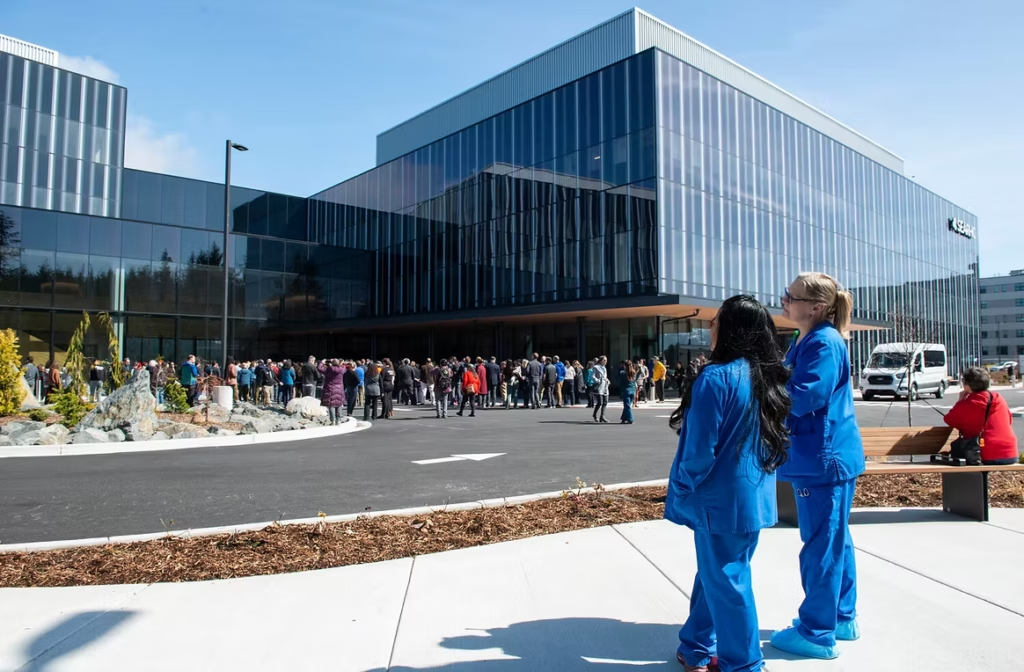
SEARHC workers look over the new SEARHC Medical Center on Japonski Island during a ribbon-cutting ceremony Thursday, April 23, 2026. Hundreds of people turned out to see the new 234,528-square-foot hospital, double the size of the existing building. The ceremony included speeches by SEARHC executives and Indian Health Service Deputy Director Benjamin Smith as well as Tlingit songs and dances. (James Poulson / Daily Sitka Sentinel)
SEARHC cut the ceremonial ribbon on its new $300 million Mt. Edgecumbe Medical Center in Sitka on April 23.
The event for the five-story, 234,528-square-foot facility featured a traditional blessing, a welcome and addresses by leaders of SEARHC and the Sitka community.
Charles Clement, SEARHC president and CEO of 14 years, said in his remarks, “This has been a real challenging project to pull together, beginning to end.”
“It has come to represent much more than a building for me,” said Clement, of Metlakatla. “It represents our commitment to our patients, our commitment to our communities, our commitment to our employees.”
SEARHC designed and constructed the medical services building. In 2020 SEARHC was selected by the U.S. Indian Health Service for the Indian Health Service Joint Venture Construction Program, which provides long-term funding for staffing and operation of the new hospital.
The hospital is about twice the size of the building it replaces but will have the same number of patient beds. That’s due to funding and license requirements, Clement told the Sitka Sentinel.
“To qualify as a critical-access hospital, it has to be 25 beds or less,” he said.
Services at the new building will start May 4, with departments making the transfer in May and June.
The new hospital comes 10 years after the city of Sitka entered talks with SEARHC about consolidating the services provided by SEARHC and city-owned Sitka Community Hospital. After long negotiations and voter approval in a city election, the Sitka Community Hospital’s buildings, grounds and business were sold to SEARHC in 2019, and SEARHC pledged to continue, and expand, the health and medical services available to the public.
Health care has become the largest sector of the Sitka economy, with total earnings at $67.3 million (782 jobs) in 2024, according to a Rain Coast Data presentation last year.
Growth in health care continues in Sitka. At the ribbon-cutting, the deputy director of the Indian Health Service, Benjamin Smith, announced that IHS will work with SEARHC in a joint venture to develop a new long-term care facility on the Sitka campus.
Clement told the Sentinel the project would “replace the long-term care facility over (at the Sitka Community Hospital building) with a newer, larger facility here on SEARHC campus.” Initial plans are for the facility to have 35 beds in the long-term care unit, up from the 19 beds SEARHC currently offers in a building at the former Sitka Community Hospital site.
In the interview, Clement also addressed SEARHC plans in other Southeast communities.
The tribal nonprofit plans to build “a small critical-access hospital” in Haines, he said, “based on the model that we developed in Wrangell.”
SEARHC opened its $30 million Wrangell hospital in 2021. It’s about one-fifth the size of the new Mt. Edgecumbe facility.
“We’re building a new medical office building (in Wrangell) to consolidate onto a single campus,” Clement said. “We have multiple facilities all over town, and we have enough land there to bring it all into a medical campus.”
The health care provider also plans to build eight rental units in Wrangell to house its traveler staff.
In Klawock, “we’re doing a lot of site work down there to get ready to do another clinic replacement, with a goal eventually developing, if we can make it work, long-term care and a critical-access hospital there,” Clement said.
Sitka will remain a hub for medical services in Southeast, and continues to be the only SEARHC location offering labor and delivery services, Chief Operating Officer Martin Benning told the Daily Sitka Sentinel.
“Everything that’s over at the current hospital is moving in here by the end of June,” Benning said.
As for the future of the old SEARHC hospital building and the Sitka Community Hospital building, Benning said, “We haven’t nailed anything down definitively, we’ve just been focused, ‘Let’s get this done,’ and then we’ll figure out, ‘What do we do?’”
Back at the old SEARHC hospital building on April 23, long-time employees and patients gathered around cafeteria lunch tables to reflect on the history of the building that began as a naval hospital in World War II.