By: Corinne Smith, Alaska Beacon
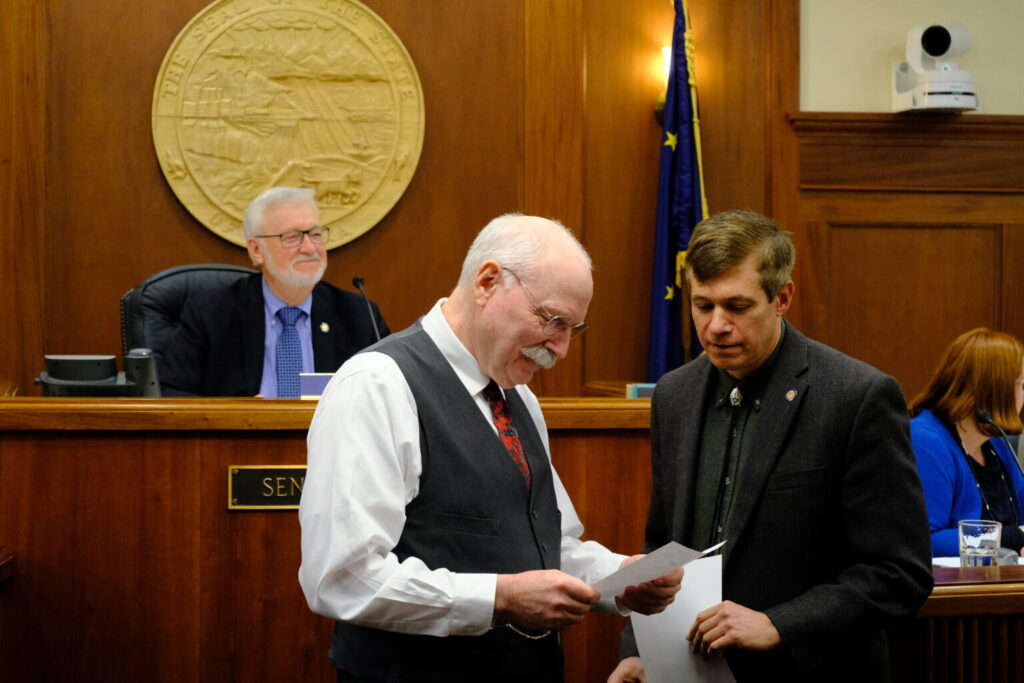
Members of the Alaska Senate voted to approve a long-awaited pension bill on Tuesday, amid debate on the cost of the new public retirement benefits system and responsibilities of the state and local community employers.
The Senate passed a revised version of a pension plan approved by the House last year. The vote was 12 to 8. Twenty years after lawmakers eliminated a public pension system, the vote marks the closest lawmakers have come to restoring a defined retirement benefit for thousands of Alaska’s public sector employees.

“It strikes me as a historic day,” said Sen. Cathy Giessel, R-Anchorage, after the vote. She has been working on the issue for several years. “When you figure 33 different offerings to correct this over the years — yeah, we’ve been trying for a long time.”
If enacted, the bill would reinstate a defined benefit retirement system for Alaska state employees, as well as teachers, public safety workers and municipal employees statewide.
The move comes as the state struggles to fill positions across state departments, including public safety, corrections and in education roles.
Supporters said the retirement benefit is crucial for hiring and retaining a skilled public sector workforce in Alaska for the long-term, while detractors say the uncertainty around the cost to the state and local municipalities isn’t worth the risk.

Senate Minority Leader Sen. Mike Cronk, R-Tok, said he opposes increasing state spending.
“We look at our federal government, we’re going to be $40 trillion upside down. That’s totally unacceptable,” he added. “And for adding this kind of burden for the future, generated cost is something that I just can’t be a part of. I know we have a problem. I think there are other solutions out there that can help this problem.”
The move was applauded by the state’s largest public employees union, the Alaska State Employees Association, which represents roughly 8,500 public employees.
“The impact is almost difficult to overstate,” said Heidi Drygas, its executive director, by phone on Tuesday. “Our membership overwhelmingly supports a defined benefit pension. And I think this will mean security for them, so that they can feel comfortable staying in their state jobs. It will attract more employees to work for the state.”
The bill passed the House last May, and the revised version now goes back to the House for a concurrence vote, before heading to Gov. Dunleavy’s desk for consideration.
The governor has been critical of previous pension proposals. Dunleavy receives a state pension for his previous employment as an educator and superintendent.
If the bill becomes law, current state employees would be allowed to switch from a defined contribution or a 401(k) style retirement plan to the new system. Retirement for teachers and public employees would be possible at age 60 or any age after 30 years of service. For public safety officers, including police and firefighters, it would be age 50 with 25 years of service, or age 55 with 20 years of service.
“Every other state offers a pension for at least some of the public servants. We do not,” Giessel said on the Senate floor. “And we are seeing the results. We ask our public employees to do difficult work, often in the hardest conditions. The question is whether we will give them a reason to build a career here.”
After several hours of debate, the Senate approved several amendments, including a change to allow cities and boroughs to choose whether to opt out of the new defined benefit retirement plan, instead of opt in.
“It’s better policy for local governments to follow the state’s lead,” said Sen. Matt Claman, D-Anchorage, who sponsored the provision. “If they don’t like our choice, they’re certainly allowed to make their own choice and opt out, but if they don’t take any action, they’re in.”
That means local cities and boroughs can choose whether to opt out of the plan, if enacted, between January and June of 2027, and then the new system would begin July 1 next year.
Under the revised bill, employees would contribute 8% of their pay to the pension plan. Employers would pay up to 22.5% for public sector employees, and up to 12.5% for teachers. Senators debated the cap and arrived at 22.5%, noting municipality officials public testimony and concern about cost.
Employers would also pay into a health reimbursement fund of up to 4% of workers’ salaries to supplement Medicare for those over age 65. Disability and death benefits would be included.
Senators debate pension plan, Alaska’s workforce challenges
If passed, the bill would revive Alaska’s state pension that was eliminated in 2006, after the state ran into a multi-billion dollar shortfall and unfunded liabilities in the retirement system.
Sen. Bert Stedman, R-Sitka, a co-chair of the Senate Finance Committee, opposed the bill, citing the risk that the state will repeat the mistakes of the early 2000s.

“This proposal in front of us today diminished the benefit to the retired employee when it goes underfunded. Yeah, it won’t go unfunded until people retire. Normally, it takes about 30 years, but we’ve got 20 years already with the current defined contribution. So about 10 years out,” he said.
A recent estimate by the state’s actuary, Gallagher, projected state costs to total $467 million for the first 13 years, until FY 2039.
Stedman said the state is also still on the hook to pay billions to account for the old pension system. But Giessel said the new pension system has built in safeguards to prevent it from going underfunded, according to the actuary’s analysis.
“Even with a never before seen ‘black swan’ event of three consecutive years with zero investment returns, even then this pension holds up,” she said.
Giessel and other lawmakers cited the state’s current ballooning costs paying state employee overtime to cover vacancies and essential public services, called “premium pay.”
“It is costing us over $200 million a year in premium pay,” she said. “Just to keep basic services running — that number has grown nearly 80% in the past five years. We have, in effect, turned Alaska into a training ground, a place where people come, gain experience and then leave.”
Sen. Bill Wielechowski, D-Anchorage, described a crisis of families leaving the state, in part due to a lack of stable retirement. Alaska has seen more than a decade of consistent outmigration, according to state data.
“There has been a quiet, heavy crisis unfolding all across Alaska, in our schools, in our state office buildings, in our courts, in our communities all across Alaska, it’s the sound of a door slamming shut. Another family packs up to leave,” Wielechowski said on the Senate floor.
“We talk a lot about fiscal responsibility in this chamber, but I ask you, what is responsible about watching our most precious resource, our people walk out the door?”
Supporters of the pension plan also pointed to the state’s struggle with high turnover rates, including up to 30% of teachers in urban and rural districts alike each year.
Sen. Löki Tobin, D-Anchorage, and chair of the Senate Education Committee, said the high unseen costs of turnover of educators is magnified throughout the state.

“Because of high teacher turnover, we’re already paying $20 to $30 million a year,” she said. “We can either continue to pay that in turnover costs, or we can fund a quality retirement program that retains our quality educators, attracts new quality educators, and ensures that our kids get the best education they deserve.”
Senators in support of the pension plan noted a recent state audit of Alaska state government that reported hundreds of millions lost in federal reimbursements or incorrectly accounted for due to a variety of factors, including “staff turnover,” “competing priorities” or “inadequate supervisory review.”
Wielechowski pointed to one example of the Alaska Department of Military and Veterans Affairs underreported disaster spending for federal reimbursement by $297 million. The error was corrected once identified by auditors, according to the report.
“Dozens of projects incorrectly reported. And that’s just that’s just a fraction of the inaccuracies and the mistakes,” Wielechowski said.
Opponents of the pension bill pointed to other factors contributing to high turnover like work environment, leadership and a need to raise salaries.
That included Cronk who said he receives a pension after teaching for 25 years. “I would say focus should be on our pay,” he said.
Drygas, with the state’s public employees union, said while the pension plan is one important part of Alaska’s workforce issues, she sees it as crucial for stemming the tide of outmigration from the state.
“I cannot tell you how many people, just personal, friends and acquaintances that I know, that are leaving state service in particular because they can’t retire here. They can’t live on the retirement that our state offers,” she said. “So I think a lot of us are hopeful that, you know, five or 10 years in the future, if this legislation should pass and become law, we’ll see a turnaround in our state workforce again.”