The sign at the entrance to the University of Alaska Fairbanks campus welcomes students on Sept. 20, 2023. (Photo by Yereth Rosen/Alaska Beacon)
The University of Alaska will be required to provide advance notice before increasing student fees and an itemized list of fees charged to students and families under new legislation passed by the Alaska Legislature.
The legislation, House Bill 176, passed the Alaska House in February and the Senate over the weekend, across bipartisan lines. The bill now heads to Gov. Mike Dunleavy for consideration.
Rep. Ashley Carrick, D-Fairbanks, sponsored the bill and said it seeks to increase transparency.
Rep. Ashley Carrick, D-Fairbanks, talks on the floor of the Alaska House of Representatives on Friday, Feb. 6, 2026. (James Brooks photo/Alaska Beacon)
“While the fee categories and the amount of the consolidated fee are required to be published online, it is often extremely difficult to find the amount allocated to each category,” she said in a statement introducing the bill. “Students can see the general categories their fees pay for, but they usually do not see the dollar amount paid for each service, such as student activities or recreation.”
If approved by the governor, the bill would also require the Board of Regents to provide 30 days of notice before increasing student fees or new fees are introduced.
Sen. Rob Myers, R-North Pole, sponsored the companion bill in the Senate.
“The bill is rooted in a simple principle: students deserve to know exactly what they’re paying for. Greater transparency leads to greater accountability, and accountability builds trust in our institutions. At a time when the cost of higher education continues to rise, students and families deserve clear and accessible information about how their money is being spent,” he said on the Senate floor on Sunday.
If approved by the governor, the changes to university fee disclosures would be enacted in July 2027.
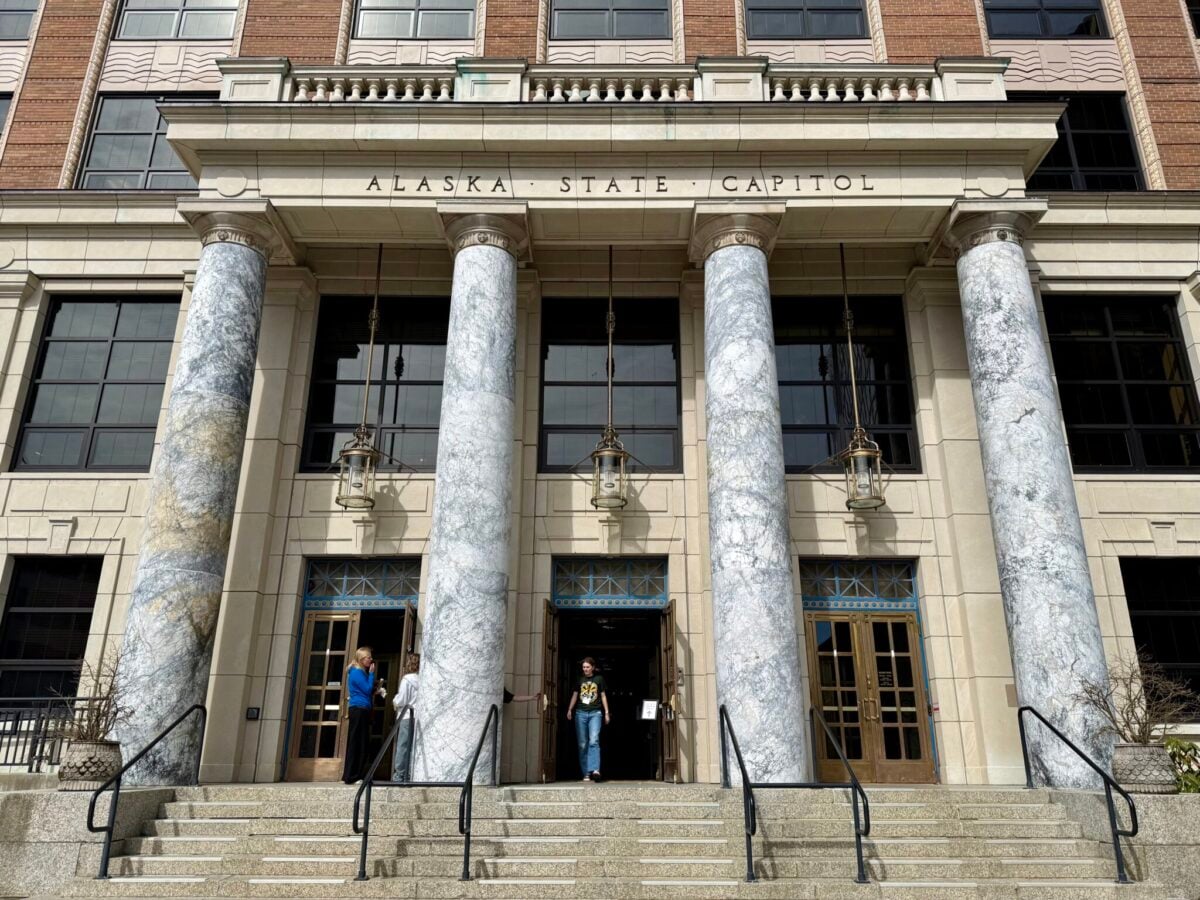
The Alaska State Capitol is seen on Tuesday, Nov. 25, 2025. (Photo by James Brooks/Alaska Beacon)
The Alaska Legislature approved new legislation to ensure greater oversight for Alaska youth in psychiatric facilities, including increased protections for foster youth.
One bill would shorten the deadline for foster youth to receive court hearings after being institutionalized and another would increase reporting requirements for youth in psychiatric institutions, among other provisions.
Lawmakers approved a bill that would shorten the deadline for court hearings for foster youth from 30 days to seven days of being admitted, following high-profile news reports, lawsuits and federal investigations around foster youth languishing for weeks, or even years, in psychiatric facilities. The bill requires youth to have a court appointed attorney, and to have subsequent case reviews by the court every 30 days.
The Alaska House passed House Bill 36 unanimously last year, and the Senate approved the proposal on Saturday by a vote of 19 to 1, with Sen. Rob Yundt, R-Wasilla absent. The bill now moves to Gov. Mike Dunleavy for consideration.
Sen. Forrest Dunbar, D-Anchorage, sponsored the legislation in the Senate and called the legislation part of an effort to address a dark chapter in Alaska history.
Sen. Forrest Dunbar, D-Anchorage speaks on the Senate floor on Mar. 25, 2026 (Photo by Corinne Smith/Alaska Beacon)
“For too long, these placements have occurred with insufficient oversight, limited recourse for the children involved and inadequate advocacy on their behalf,” he said Saturday. “House Bill 36 helps ensure meaningful due process protections for those in foster care.”
The issue was at the center of a lawsuit, Kwinhagak v. State,which reached the Alaska Supreme Court. It focused on the case of a 14-year-old Alaska Native foster youth from Sitka who was hospitalized in North Star Behavioral Health in Anchorage and went 46 days before a court held a hearing on her hospitalization. In 2024, the Supreme Court ruled the time was “far too long to satisfy due process.”
Dunbar quoted the ruling, in part, on the Senate floor. “In its opinion, the court stated, ‘There is no doubt the children in OCS custody are at substantial risk of being hospitalized for longer than they need, or when they do not need to be hospitalized at all,’” he said. “Clarifying the legal protections for a vulnerable population of children in state custody is of the utmost importance.”
The bill also creates a new state license for treatment foster homes, to provide treatment services through Medicaid for youth with medical, behavioral or developmental conditions. Proponents of the bill said it would help create more home-based care, and align with national standards.
Another bill unanimously passed by the Senate on Saturday, House Bill 52, would enact requirements that aim to increase oversight and transparency, and reduce risk of abuse or neglect for all Alaska children in psychiatric facilities. The House approved the bill in April.
Sen. Matt Claman, D-Anchorage, pointed to a 2022 U.S. Department of Justice investigation that found that Alaska children are institutionalized at high rates, in part due to a lack of community-based services. “These findings demonstrate an urgent need for transparency and parent guardian involvement at the psychiatric hospitals that serve Alaskan youth with behavioral health care needs,” Claman said on Saturday.
The legislation — now also on Gov. Dunleavy’s desk — would require all Alaska minors in psychiatric facilities have access to confidential communication with parents or legal guardians for two hours per week. The facility must facilitate that communication.
The bill would require the Alaska Department of Health to conduct unannounced inspections of psychiatric facilities in the state twice a year, including interviews with at least half of the minor patients, and make an annual report to the Legislature.
All facilities would be required to report their use of seclusion or restraints on minors — including physical, mechanical or chemical restraints — to the state each year, and to minors’ parents or legal guardians within 72 hours. “Chemical restraint” would be defined in the law as a medication used to control the behavior or restrict the freedom of a patient, not a medication used to treat an underlying psychiatric illness.
Rep. Maxine Dibert, D-Fairbanks, speaks in favor of the override of House Bill 69 on Tuesday, April 22, 2025. (Photo by James Brooks/Alaska Beacon)
Rep. Maxine Dibert, D-Fairbanks and the bill’s sponsor, highlighted Alaska’s unique history, and particular legacy of trauma for Alaska Native children forced into institutional settings.
“The institutionalization of children with behavioral health challenges can last weeks, months, or even years,” Dibert said in a statement introducing the bill. “Such long-term placement is devastating for all families and is especially traumatic for Alaska Native families who experienced the harm of family separation when the government forcibly removed their loved ones and sent them to boarding schools.”
Lawmakers in the House amended the bill to include a requirement for the state to conduct wellness checks on youth when conducting facility inspections. If inspectors found incidents of abuse or neglect, they would be required to report them to parents or guardians, state authorities and law enforcement. Members of the Senate Finance Committee removed the provision citing confidentiality concerns and pointed to mandated reporting requirements for instances of abuse already in place. Some members of the all-Republican minority opposed the changes, and voted against the bill.
The House voted to approve the changes made by the Senate by a vote of 26 to 14, and passed the bill on Sunday.
If approved by the governor, the bill would be enacted in July 2027.
Senate President Gary Stevens, R-Kodiak, and Senate Minority Leader Mike Cronk, R-Tok, and Sen. George Rauscher, R-Sutton, are seen during a break in debate on a pension plan on Apr. 28, 2026. (Photo by Corinne Smith/Alaska Beacon)
State lawmakers are acting to fix technical errors affecting the boundaries of several Alaska wildlife refuges and other public areas.
The errors were caused by the fact that the areas’ actual edges don’t match descriptions in state law and will be fixed if Senate Bill 230 is enacted by Gov. Mike Dunleavy.
The state Senate approved SB 230 by an 18-0 vote on Saturday, with two legislators excused absent. Because the House approved the bill on a 40-0 vote Friday, the Senate’s vote sends the bill to the governor for veto or enactment.
SB 230 was originally written by Sen. George Rauscher, R-Sutton, to address “a critical piece of land that was inadvertently omitted from the original legislation” for the Jonesville Public Use Area in his district in 2018.
At the request of Rep. Andy Josephson, D-Anchorage, the bill was expanded to cover similar technical changes for laws designating the state refuges at Cape Newenham, Izembek, Palmer Hay Flats, and the critical habitat areas at Port Moller, Egegik, Pilot Point, Fox River Flats, and Kachemak Bay.
“The added changes do not add or extend any land that has been recently acquired, nor does it make any policy changes. It simply corrects boundaries that were previously done in error, as well as the Jonesville bill, which originated this,” Rauscher said.
The Alaska State Capitol in Juneau is seen on Apr. 24, 2026. (Photo by Claire Stremple/Alaska Beacon)
Less than two years after Alaskans approved a ballot measure creating a mandatory sick leave law, the Alaska House of Representatives has voted to partially repeal it.
By a 22-18 vote on Saturday, the House approved an amendment that would cancel the law’s application for seasonal workers and for workers employed by a business with nine or fewer employees. The cancellation would take effect immediately, if the bill is signed into law.
Seasonal workers are defined as those who work at a specific job for less than six months per year.
All of the House’s Republican members voted for the amendment, including Reps. Chuck Kopp, R-Anchorage, and Louise Stutes, R-Kodiak, who are members of the House’s predominantly Democratic majority caucus. Speaker of the House Bryce Edgmon, I-Dillingham, also voted for the amendment.
All of the House’s Democratic members and its remaining independents opposed the amendment.
The amendment was to House Bill 193, which would create a mandatory paid leave program for new parents, starting in 2030. That bill advanced from the House on a 36-4 vote and was scheduled for a hearing in the Senate Finance Committee on Monday afternoon.
The four opposition votes all came from Republican lawmakers in the House’s minority caucus.
It was not immediately clear whether the bill had the necessary support to pass the Senate before the end of the legislative session on Wednesday night.
The amendment, introduced by Rep. Julie Coulombe, R-Anchorage, was largely identical to House Bill 161, a rollback measure that failed to advance in the Capitol this year despite significant lobbying efforts from business groups.
The state’s fishing industry, tourism industry, construction industry, the state chamber of commerce and several local chambers of commerce all haveadvocated HB 161.
Speaking ahead of the vote, several Republican lawmakers said they were heeding that call and voting yes on the amendment to HB 193.
“It’s actually been my number one priority since I got back here this year,” said Rep. Will Stapp, R-Fairbanks, speaking about the rollback.
Much of the desire for the rollback, Stapp explained, is because during its first year, seasonal employees saved their sick leave until the end of their term, then used it right before their departure, leaving employers short-staffed.
“That is creating a workforce crisis at the end of the season that is going to progressively get worse and worse and worse for our fishing industry, for our tourist industry, for our construction industry,” he said.
Speaking on the floor ahead of the vote, Coulombe said she had hoped to cancel sick leave for all workers at businesses with fewer than 50 employees, but she received a legal memo indicating that doing so would be illegal because Alaska’s constitution prohibits the Legislature from repealing a ballot measure within its first two years, and such a large exemption would have covered roughly half of the state’s workers.
Rep. Sarah Vance, R-Homer, said the sick leave law is “gutting the small businesses in my community.”
“We need to be listening to our business community right now, that so many of them (came to us) and said, ‘We need help,’” she said.
Rep. Zack Fields, D-Anchorage, was among the lawmakers who urged the House to reject the amendment.
“I think it’s very problematic to substantially gut a ballot initiative less than two years after it was passed by voters,” he said.
Exempting seasonal workers means exempting multinational tourism and fishing businesses that operate in Alaska, he noted.
“Do we really need to exempt all the employees of massive multinational businesses like Holland America Princess?” he asked.
During the COVID-19 pandemic emergency, fish processing plants and cruise ships were hotspots of infection and disease. Outside the COVID-19 pandemic, tourism occasionally brings waves of influenza and norovirus to coastal communities.
“When we have a tourism dependent economy, it is not in our interest to push sick people to come to work when they’re serving food, when they’re doing hospitality,” Fields said.
In 2024, Rep. Genevieve Mina, D-Anchorage, was one of the key organizers behind the sick leave ballot measure. Like her Democratic colleagues, she opposed the sick leave rollback but ultimately voted for the underlying bill even though it contained the rollback.
“The bill is a great bill, and you can just see the strong bipartisan support,” she said. “This whole building is an area of trying to figure out compromises and figuring out the ways where we can do good things that are supportive for families and can really address these issues about migration that our state has been facing. It’s not over for the bill or for paid sick (leave), so we’ll just see what happens on the Senate side.”
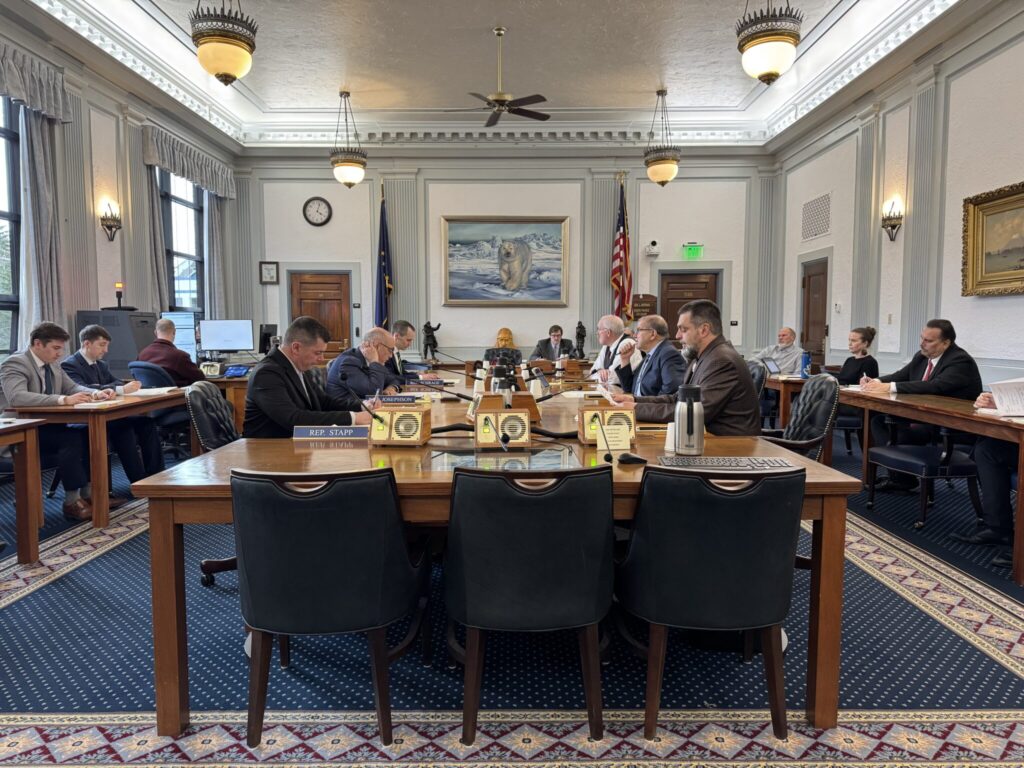
The Alaska Legislature's operating budget conference committee is seen on Monday, May 11, 2026. (James Brooks photo/Alaska Beacon)
By: James Brooks, Alaska Beacon
The Alaska Legislature’s operating budget conference committee is seen on Monday, May 11, 2026. (James Brooks photo/Alaska Beacon)
Alaska lawmakers are planning to vote on a $13.9 billion compromise state operating budget that includes a $1,000 Permanent Fund dividend and a $200 energy rebate.
In a 4-2 vote Sunday morning, a panel of House and Senate negotiators finalized a deal that combines two different versions of the budget — one passed by the Senate and the other by the House — preparing legislators for a final vote before the last regular day of the legislative session on Wednesday.
Once passed by the Legislature, the budget will go to Gov. Mike Dunleavy, who may sign it or use his line-item veto powers to eliminate or reduce specific items. The governor has never let a budget go into law without some vetoes.
Legislators convened in January with the expectation that they would be facing a massive deficit in fiscal year 2027, which starts July 1.
The Iran war, and the subsequent closure of the Strait of Hormuz, has sent oil prices soaring, resulting in hundreds of millions of dollars in extra revenue for the state.
That eliminated the projected deficit, but lawmakers don’t expect to have much left over for the Permanent Fund dividend.
While a payment formula from the 1980s remains in state law, legislators since 2016 have adopted a “surplus dividend” approach, paying the dividend with what’s left over after services are covered.
The final compromise version of the budget closely resembles the Senate plan, but the one-time bonus was slightly increased, to $200, in an amendment proposed over the weekend.
The final version of the budget also contains $144 million in one-time bonus payments for public schools across the state, including $29 million intended to offset the high cost of heating fuel.
The one-time bonus is less than the House proposed but higher than the Senate’s figure.
The budget also proposes to fund a heating assistance program for Alaskans, increase Medicaid reimbursements for medical providers, send additional money to cities and boroughs, and increase funding for wildfire response.
Altogether, the budget balances if Alaska North Slope oil prices average at least $75 per barrel in FY27. The average price since March is above $100 per barrel.
The operating budget advancing to a final vote is the last of four budget bills that lawmakers approve in an ordinary year.
The state’s supplemental budget — making changes to fiscal year 2026 — was adopted in March and signed by the governor in April. The $2.5 billion capital budget, which funds construction and renovation projects statewide, is awaiting a final vote in the Senate.
Alaska’s comprehensive mental health budget is moving in parallel to the operating budget and is expected to pass when the operating budget does.
The bridge that will allow vehicles to pass over the Pretty Rocks landslide at Denali National Park is seen in early August 2025 as it was being slowly pulled into place. The onoing thaw-induced landslide, which accelerated and made the road impassable late in the summer of 2021, prompted the bridge project. The bridge project is expected to be completed in 2026. (Photo provided by the National Park Service)
The Interior Department is taking public comment on a proposal that would allow up to 160 vehicles per day on a restricted section of the Denali Park Road during the peak summer tourist season.
The current limit, set in 1986, allows 10,512 vehicles from the Saturday before Memorial Day to the second Thursday after Labor Day. That’s roughly 100 vehicles per day.
Tour buses do not count against the current seasonal limit, but they would count against the new daily limit, reducing the practical effect of the change.
The new limit was proposed in a vehicle management plan finalized in 2012. Under that plan, the 160 vehicle-per-day limit represents the “maximum level” of vehicle use that could be supported while maintaining the park’s quality.
Last year, President Donald Trump issued an executive order directing Interior Secretary Doug Burgum to “review all of the Department’s recreational access rules and take steps to rescind any that unnecessarily restrict recreation in national parks.”
In a news release announcing the proposed Denali Park Road rules, Burgum said, “Denali is one of America’s crown jewels, and Americans should have every reasonable opportunity to experience it. This proposed rule removes outdated restrictions, improves transparency, and ensures access decisions are driven by sound management rather than unnecessary bureaucracy.”
All park visitors can access the first 15 miles of the Denali Park Road, but the stretch beyond the Savage River checkpoint is restricted during the tourist season. Permits apply to that stretch, which continues to Kantishna, a community at the end of the road, 92 miles from its start.
Since 2022, the road has been blocked at Mile 43 by a slow-moving landslide at a location known as Pretty Rocks. A bridge bypassing that landslide is expected to be complete this summer.
Until that bridge reopens, tour buses will travel no farther than Mile 43. Eielson Visitor Center is closed, as is Wonder Lake Campground.
Trips to Mile 42 will begin May 20; until then, traffic is limited to the Teklanika Rest Area at Mile 30.
The Alaska Legislature’s operating budget conference committee is seen on Monday, May 11, 2026. (James Brooks photo/Alaska Beacon)
Alaska lawmakers are planning to vote on a $13.9 billion compromise state operating budget that includes a $1,000 Permanent Fund dividend and a $200 energy rebate.
In a 4-2 vote Sunday morning, a panel of House and Senate negotiators finalized a deal that combines two different versions of the budget — one passed by the Senate and the other by the House — preparing legislators for a final vote before the last regular day of the legislative session on Wednesday.
Once passed by the Legislature, the budget will go to Gov. Mike Dunleavy, who may sign it or use his line-item veto powers to eliminate or reduce specific items. The governor has never let a budget go into law without some vetoes.
Legislators convened in January with the expectation that they would be facing a massive deficit in fiscal year 2027, which starts July 1.
The Iran war, and the subsequent closure of the Strait of Hormuz, has sent oil prices soaring, resulting in hundreds of millions of dollars in extra revenue for the state.
That eliminated the projected deficit, but lawmakers don’t expect to have much left over for the Permanent Fund dividend.
While a payment formula from the 1980s remains in state law, legislators since 2016 have adopted a “surplus dividend” approach, paying the dividend with what’s left over after services are covered.
The final compromise version of the budget closely resembles the Senate plan, but the one-time bonus was slightly increased, to $200, in an amendment proposed over the weekend.
The final version of the budget also contains $144 million in one-time bonus payments for public schools across the state, including $29 million intended to offset the high cost of heating fuel.
The one-time bonus is less than the House proposed but higher than the Senate’s figure.
The budget also proposes to fund a heating assistance program for Alaskans, increase Medicaid reimbursements for medical providers, send additional money to cities and boroughs, and increase funding for wildfire response.
Altogether, the budget balances if Alaska North Slope oil prices average at least $75 per barrel in FY27. The average price since March is above $100 per barrel.
The operating budget advancing to a final vote is the last of four budget bills that lawmakers approve in an ordinary year.
The state’s supplemental budget — making changes to fiscal year 2026 — was adopted in March and signed by the governor in April. The $2.5 billion capital budget, which funds construction and renovation projects statewide, is awaiting a final vote in the Senate.
Alaska’s comprehensive mental health budget is moving in parallel to the operating budget and is expected to pass when the operating budget does.
The Alaska State Capitol in Juneau is seen on Apr. 24, 2026. (Photo by Claire Stremple/Alaska Beacon)
Less than two years after Alaskans approved a ballot measure creating a mandatory sick leave law, the Alaska House of Representatives has voted to partially repeal it.
By a 22-18 vote on Saturday, the House approved an amendment that would cancel the law’s application for seasonal workers and for workers employed by a business with nine or fewer employees. The cancellation would take effect immediately, if the bill is signed into law.
Seasonal workers are defined as those who work at a specific job for less than six months per year.
All of the House’s Republican members voted for the amendment, including Reps. Chuck Kopp, R-Anchorage, and Louise Stutes, R-Kodiak, who are members of the House’s predominantly Democratic majority caucus. Speaker of the House Bryce Edgmon, I-Dillingham, also voted for the amendment.
All of the House’s Democratic members and its remaining independents opposed the amendment.
The amendment was to House Bill 193, which would create a mandatory paid leave program for new parents, starting in 2030. That bill advanced from the House on a 36-4 vote and was scheduled for a hearing in the Senate Finance Committee on Monday afternoon.
The four opposition votes all came from Republican lawmakers in the House’s minority caucus.
It was not immediately clear whether the bill had the necessary support to pass the Senate before the end of the legislative session on Wednesday night.
The amendment, introduced by Rep. Julie Coulombe, R-Anchorage, was largely identical to House Bill 161, a rollback measure that failed to advance in the Capitol this year despite significant lobbying efforts from business groups.
The state’s fishing industry, tourism industry, construction industry, the state chamber of commerce and several local chambers of commerce all haveadvocated HB 161.
Speaking ahead of the vote, several Republican lawmakers said they were heeding that call and voting yes on the amendment to HB 193.
“It’s actually been my number one priority since I got back here this year,” said Rep. Will Stapp, R-Fairbanks, speaking about the rollback.
Much of the desire for the rollback, Stapp explained, is because during its first year, seasonal employees saved their sick leave until the end of their term, then used it right before their departure, leaving employers short-staffed.
“That is creating a workforce crisis at the end of the season that is going to progressively get worse and worse and worse for our fishing industry, for our tourist industry, for our construction industry,” he said.
Speaking on the floor ahead of the vote, Coulombe said she had hoped to cancel sick leave for all workers at businesses with fewer than 50 employees, but she received a legal memo indicating that doing so would be illegal because Alaska’s constitution prohibits the Legislature from repealing a ballot measure within its first two years, and such a large exemption would have covered roughly half of the state’s workers.
Rep. Sarah Vance, R-Homer, said the sick leave law is “gutting the small businesses in my community.”
“We need to be listening to our business community right now, that so many of them (came to us) and said, ‘We need help,’” she said.
Rep. Zack Fields, D-Anchorage, was among the lawmakers who urged the House to reject the amendment.
“I think it’s very problematic to substantially gut a ballot initiative less than two years after it was passed by voters,” he said.
Exempting seasonal workers means exempting multinational tourism and fishing businesses that operate in Alaska, he noted.
“Do we really need to exempt all the employees of massive multinational businesses like Holland America Princess?” he asked.
During the COVID-19 pandemic emergency, fish processing plants and cruise ships were hotspots of infection and disease. Outside the COVID-19 pandemic, tourism occasionally brings waves of influenza and norovirus to coastal communities.
“When we have a tourism dependent economy, it is not in our interest to push sick people to come to work when they’re serving food, when they’re doing hospitality,” Fields said.
In 2024, Rep. Genevieve Mina, D-Anchorage, was one of the key organizers behind the sick leave ballot measure. Like her Democratic colleagues, she opposed the sick leave rollback but ultimately voted for the underlying bill even though it contained the rollback.
“The bill is a great bill, and you can just see the strong bipartisan support,” she said. “This whole building is an area of trying to figure out compromises and figuring out the ways where we can do good things that are supportive for families and can really address these issues about migration that our state has been facing. It’s not over for the bill or for paid sick (leave), so we’ll just see what happens on the Senate side.”
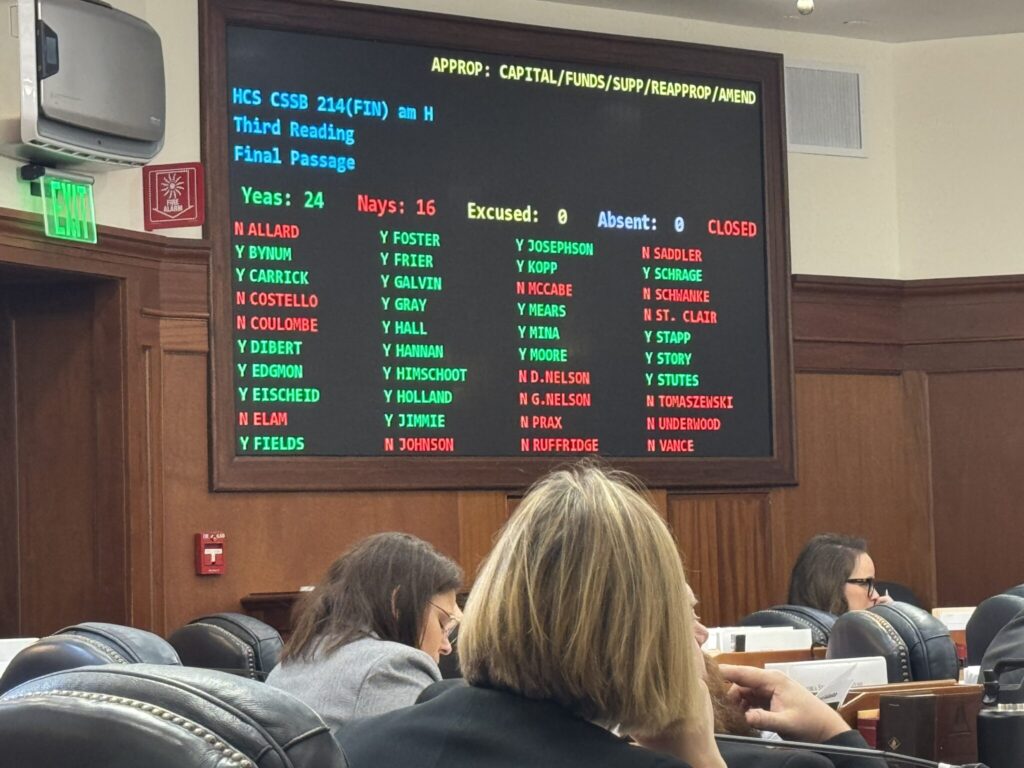
House lawmakers watch the voting board Friday, May 15, 2026, on the floor of the Alaska House of Representatives as they vote for the state’s capital budget. (James Brooks photo/Alaska Beacon)
Days before the end of their regular legislative session, the Alaska Legislature has almost finalized the state’s annual capital budget, one of four regular budget bills that pass through the Capitol annually.
Passed by the state House in a 24-16 vote on Friday, the capital budget contains $2.5 billion in spending, including $323 million for drinking water projects, $148.3 million for K-12 public school repairs and construction and $42.5 million for the University of Alaska.
Various federal programs are expected to pay for the bulk of the bill — $1.8 billion in total. State accounts would be used to pay for the remainder.
Even with the increase, spending remains short of what’s needed to cover deferred maintenance. Two years ago, the statewide deferred maintenance backlog was estimated at $2.4 billion, with $180 million per year needed to keep that figure from increasing.
The part of this year’s budget devoted to deferred maintenance is near that amount — it does not significantly reduce the backlog.
The capital budget covers spending in fiscal year 2027, which starts July 1. If oil prices are higher than predicted during the first half of that year, the state would earn millions of dollars in extra revenue, and the bill calls for diverting that money to a variety of maintenance and construction projects statewide.
Rep. Calvin Schrage, I-Anchorage and co-chair of the House Finance Committee, speaks Friday, May 15, 2026, on the floor of the Alaska House of Representatives. (James Brooks photo/Alaska Beacon)
“This capital budget, to be honest, is in some ways a huge step forward over last year,” said Rep. Calvin Schrage, I-Anchorage and co-chair of the House Finance Committee in charge of the capital budget.
“We see a much larger investment in being able to address some of our key areas in the state, but it also, I will recognize, does not go far enough, given the levels of deferred maintenance and other needs throughout our state,” he said.
Before the final vote, House lawmakers spent two days considering possible amendments to the bill but adopted only two. The most substantial restored some federal funding for the West Susitna Access Project, a proposal to build a road into the western Matanuska-Susitna Borough in order to support mining projects.
Rep. Kevin McCabe, R-Big Lake and a booster of the project, thanked his colleagues for restoring that money but said he couldn’t vote for the bill because it didn’t contain full funding for the access project.
Even then, “It’s a decent bill. It’s got things in there for just about everybody,” McCabe said.
Before that vote, House and Senate leaders negotiated an agreement that would allow the House to add no more than $100 million in projects funded by general-purpose state dollars to the capital budget.
The House-passed version abides by that agreement, and Senate aides familiar with both the budget and the agreement said they do not expect senators to object to the House’s additions.
House and Senate lawmakers are negotiating a compromise operating budget and a compromise mental health budget; those are expected to pass from the Capitol on Wednesday, the last day of the regular session. Legislators and Dunleavy previously approved the supplemental budget, the first of the four regular budget bills.
After being transmitted to the governor, all budget bills are subject to his line-item veto powers. Dunleavy may eliminate or reduce specific items in the budget but cannot add any or increase their amounts.
The University of Alaska Southeast campus in Juneau as seen on May 25, 2022. (Photo by Lisa Phu/Alaska Beacon)
The Alaska Legislature approved legislation to add a faculty member to the University of Alaska Board of Regents, the body that oversees policy and management of the state’s public university system.
The Alaska Senate passed House Bill 10 by a vote of 18 to 2 on Friday, which now goes to Gov. Mike Dunleavy for consideration.
If approved by the governor, the legislation would add a full-time, tenured faculty member to the eleven-member board for a two-year term, after a selection process and appointment by the governor and confirmation by the Legislature.
Rep. Ashley Carrick, D-Fairbanks, talks on the floor of the Alaska House of Representatives on Friday, Feb. 6, 2026. (James Brooks photo/Alaska Beacon)
Rep. Ashley Carrick, D-Fairbanks, whose district includes the University of Alaska Fairbanks, sponsored the bill and said the seat would provide important representation for university faculty on the board.
“Over the past 10 years, the University of Alaska has navigated some of the most difficult financial and social challenges. Throughout those challenges, the Board of Regents has been in the driver’s seat, making difficult decisions to preserve the integrity of the University. During those difficult discussions, University faculty have strongly desired a greater role in the decision-making process,” she said in a statement applauding the bill’s passage.
“The addition of a faculty regent complements the existing student regent, who is given the same power, duties and respect that all other board members receive. I am pleased to see this bill pass the Legislature to provide parity in University system decisions,” she said.
But an amendment to the bill earlier this month puts an expiration date on the changes. They would last for only for six years, until 2033. The revised version has a sunset provision, and would allow the Legislature to review and either approve an extension of the faculty regent seat or allow the policy to expire and the Board of Regents to return to eleven members.
The House passed the revised bill by a vote of 23 to 17.
Nominees for the faculty regent position would be selected through elections in the faculty senates of the three universities — University of Alaska Anchorage, Fairbanks and Southeast — and a list of six nominees would be advanced to the governor to appoint a finalist who would then be subject to confirmation by the Legislature.
Members of the Board of Regents serve eight year terms, and are appointed by the governor and confirmed by the Legislature, except for student representatives who are nominated from their campus and serve two year terms.