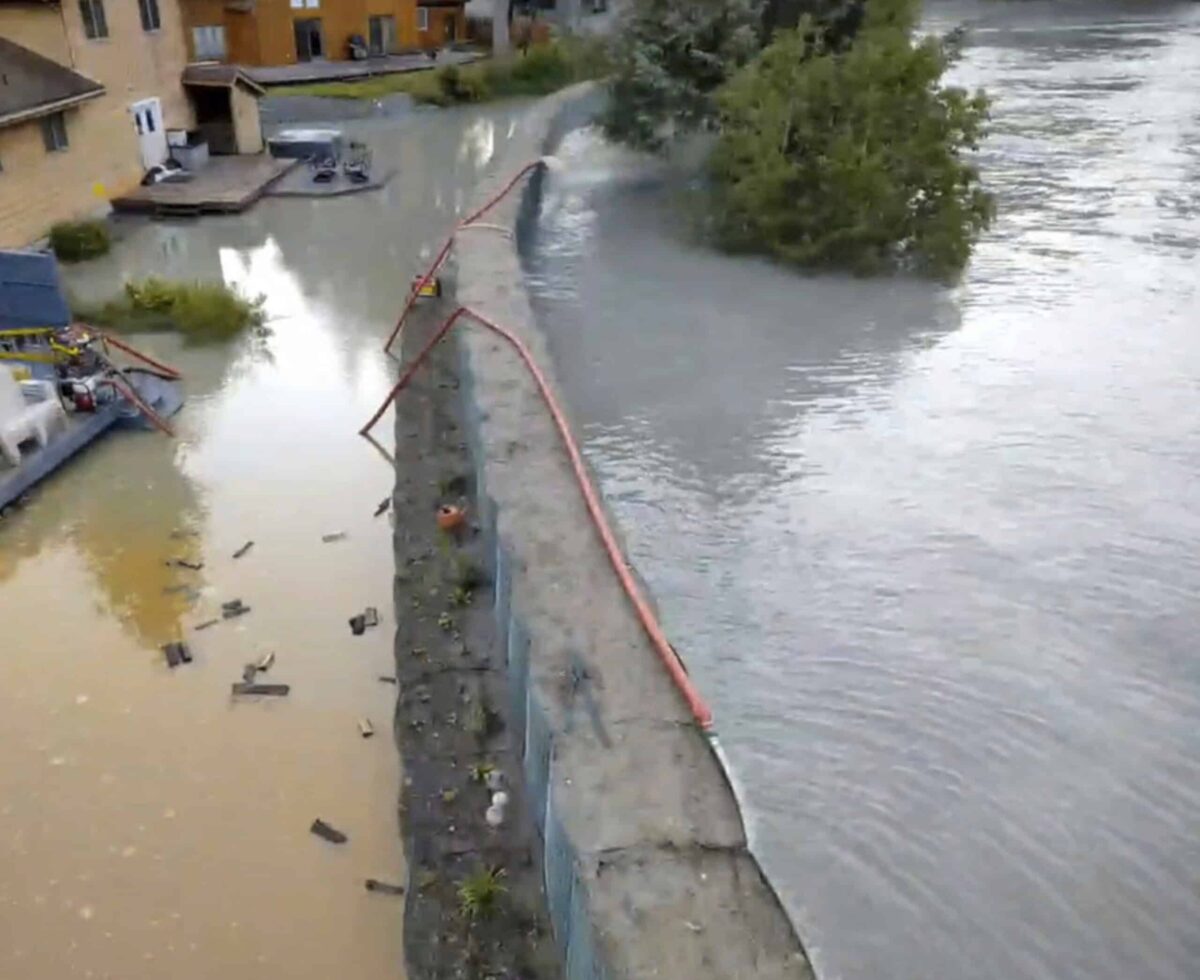
This drone image provided by the City and Borough of Juneau shows flooding from a release of water and snowmelt at Mendenhall Glacier covered some roads and threatened homes along the Mendenhall River in Juneau, Alaska on Wednesday, Aug. 13, 2025. (City and Borough of Juneau via AP)
This drone image provided by the City and Borough of Juneau shows flooding from a release of water and snowmelt at Mendenhall Glacier covered some roads and threatened homes along the Mendenhall River in Juneau, Alaska on Wednesday, Aug. 13, 2025. (City and Borough of Juneau via AP)
CBJ- The City and Borough of Juneau (CBJ) Assembly Committee of the Whole (COW) Worksession scheduled for Monday, July 20 at the Andrew Hope Building has been cancelled for both topical and timing reasons. CBJ will move the planned agenda topics to a future COW worksession after the 2026 glacial lake outburst flood (GLOF).
The Special COW meeting was originally scheduled to provide updates and allow for assembly discussion on topics related to the annual threat of glacial lake outburst flooding events. The meeting included an update from the U.S. Army Corps of Engineers, a discussion of flood protection costs and potential funding mechanisms, and flood preparedness updates from the CBJ Emergency Management and Tlingit & Haida Public Safety offices.
“With a 2026 GLOF just days to weeks away, all three of our agencies (USACE, Tlingit & Haida and CBJ) are talking with residents daily about mitigation, preparation and how they can stay safe,” shared City Manager, Katie Koester. “We understand that our flood vulnerable neighbors are dedicating their focus and time to the flood just ahead of us, and realized there was nothing in the planned meeting agenda that couldn’t wait until after the waters have receded and residents have more capacity to tune in and share their input.”
The July 20 COW was scheduled to take place in the Council Chambers of the Central Council of the Tlingit & Haida Indian Tribes of Alaska in the Andrew Hope Building.
“We are honored that President Peterson and the Central Council invited the Assembly to conduct our meeting in their Executive Council Chambers showcasing the strong spirit of collaboration between our two governments,” said CBJ Deputy Mayor Greg Smith. “We are already looking for the next opportunity to meet and discuss these critical issues that impact Juneau’s residents, including tribal citizens in their Chambers.”
Updates regarding GLOF mitigation solutions and flood preparedness are regularly shared on the CBJ, USACE and Tlingit & Haida social media pages. Flood planning resources, including evacuation maps, are available at bit.ly/juneaufloodready. CBJ is also hosting sandbag distribution events tomorrow (July 18) and on all subsequent Saturdays until the 2026 GLOF.
A black bear clings to a tree trunk in Wrangell-St. Elias National Park and Preserve in this undated photo. (Photo provided by the National Park Service)
Rep. Garret Nelson, R-Sutton, chased a black bear away from Rep. Julie Coulombe, R-Anchorage, in front of the Alaska State Capitol during a late-night encounter this week.
“It was a real safari night,” Nelson said on social media.
According to Coulombe, she was walking toward the Assembly Building, home to apartments used by legislators, when she saw the bear approaching her on Wednesday night.
“I am not good with bears. They freak me out,” she said by phone on Friday.
Nelson, who had just climbed in a ride-sharing car, asked the driver to stop, got out of the car and bluff-charged the bear, holding his cellphone in front of him to film the encounter.
Nelson posted the video on social media afterward, jokingly writing, “Just attack the bear first! You can get your free life advice with me whenever you want. It might end up with a serious injury (maybe death)….yes. But as my brother Geremy says, if you come out with a good story, it’s worth it.”
His ride-sharing driver posted a separate, similar video that corroborated the event.
Asked about the incident by phone, Nelson confirmed that he isn’t encouraging people to run at bears.
“I’m not advising people to randomly charge bears. I just weighed the risk and figured that one I outweighed that bear by probably 150 pounds, and he was already on his way out,” Nelson said.
Bear sightings are common in downtown Juneau during the spring, summer and fall, including near the state Capitol. Earlier this month, a downtown Juneau resident shot a bear out of a tree, injuring it. The Alaska Department of Fish and Game later killed the animal.
The department recommends that people who encounter a bear in the wild should “avoid it and give the bear every opportunity to avoid you.”
Coulombe said the bear was trotting toward her before Nelson got out of the car, started filming and chased the animal away.
“All I could think of was I was just going to run back into the Capitol because, I mean, I had really nowhere else to go,” she said.
Afterward, Coulombe said, “I was like, ‘My hero.’ He was so proud of himself. ‘You know, I saved you, Julie. I say I saved you,’ and he did.”
Nelson said that while the situation worked out for him, his tactics shouldn’t be repeated.
“Don’t charge bears. This is a do as I say, not as I do situation,” he said.
Yes, The 1975 frontman Matty Healy wed model Gabbriette Becthel over the weekend.
And as you might have guessed, Swifties have some very strong opinions about this turn of events.
Gabbriette Bechtel at H&M Hosts H&M&LA Music Festival at Ace Mission Studios on April 09, 2025 in Los Angeles, California. (Photo by Kayla Oaddams/WireImage)
Now, Matty and Gabbriette had been engaged for about a year, and they almost certainly made their plans and booked their venue well before they knew Taylor and Travis’ date,
Even so, Healy and Bechtel are being accused of trying to steal Swift and Kelce’s thunder.
It’s ridiculous, but so is most online discourse in 2026.
“Amazing how matrimony suddenly becomes a speedrun when your ex gets hitched first,” wrote one user on X (formerly Twitter).
“If nobody knows who you are without your ex being mentioned, and you call TMZ and other tabloids to take pictures of your wedding, and your entire family whines to the Daily Mail about your ex, you are a waste of oxygen,” another wrote, referring to the time that Healy’s mom opened up about Swifties harassing her son.
“Matty really saw the headlines for the last two weeks and said, ‘Hold my beer.’ The shade of it all is honestly impressive,” a third person wrote, adding:
“I mean, good for them, but the proximity to Taylor’s wedding is giving me major main character syndrome vibes.”
“The timeline is TIGHT. Taylor’s wedding was literally weeks ago and Matty said “nah I’m going NEXT,” a fourth chimed in.
You get the idea. A surprising number of social media users are convinced that Matty intended to shade Taylor with his choice of wedding date, which is unlikely for numerous reasons.
For one, Taylor and Matty dated for about a month three years ago. And while the brief fling might have inspired some scathing lyrics on her Tortured Poets Department album, it’s unlikely that he’s still stewing about it.
On top of that, Taylor and Travis kept a tight lid on their wedding plans until a few weeks before the big day.
It would have been impossible for Matty and Gabbriette to plan their wedding around Taylor’s.
In other words, Swifties might be looking for drama where there isn’t any. Which is kinda their thing.
Kai Trump is the teenage granddaughter of Donald Trump.
Don Jr., her father, seems to be a chip off the ol’ block.
Recently, a video of him referring to her as “sexy” has made the rounds.
It is, understandably, not going over well.
Donald Trump Jr. and his daughter Kai Madison Trump on January 19, 2025. (Photo Credit: Scott Olson/Getty Images)
‘Does getting makeup make me look sexy like you?’
In recent days, a video of Don Jr. has resurfaced on social media.
As you can see in the clip, Donald Trump’s eldest son is sitting and getting styled before making a public appearance.
In the green room chair beside him is his teenage daughter, Kai Trump.
Due to various cultural factors, Don Jr. seems to feel the need to explain why he is getting makeup on his face. (As if his father is not, famously, one of the most conspicuously made up men on the planet.)
It is what he says in the clip that turns people’s stomachs.
As you can see in the video, Don Jr. asks Kai if the makeup will “make me look sexy like you?”
This was about two years ago, meaning that Kai was only 17 at the time. (She is currently 19.)
Kai, who was focused on her phone at the time, did look up and laugh at her father’s remark.
To be clear, this is not quite the same as Don Jr. saying something graphic about his daughter or something like that. He is attempting to crack a joke because he feels insecure about the world seeing him wear makeup.
But it’s also very understandable, given the context, why so many people find this video unsettling or downright disgusting.
‘If Ivanka weren’t my daughter, perhaps I’d be dating her’
Naturally, people are comparing Don Jr.’s remarks to those of his father.
Donald Trump, who has been found liable for both the sexual abuse and ensuing defamation of writer E. Jean Carroll, is a notorious monster.
He is mentioned countless times in the Epstein Files, and not incidentally.
Additionally, Trump Sr. is extremely well known — long before he got into politics to dismantle the United States and sell it for scrap — for seeming to lust after one of his own daughters.
“If Ivanka weren’t my daughter, perhaps I’d be dating her,” is not a compliment. It is a repulsive statement made by a repulsive man.
As we mentioned earlier, this clip is a couple of years old. Many of the commenters are aware of that, but perhaps missed the video at the time.
(You may recall that something similar happened with James Woods recently, with a new generation of people discovering the allegations against him.)
It isn’t just a grotesque reminder that the Trumps are a creepy bunch. This is also a reminder of their brazen hypocrisy.
With the backing of Don Jr. and others, the Trump campaign and now the Trump regime are cracking down on human rights at a federal level, targeting the LGBTQ+ community after labeling them “groomers.”
It is a vague label when used as a weapon like this, distorted beyond its original meaning. But traditionally giving age-inappropriate compliments to a minor teenager could be textbook grooming, even if that was not Don Jr.’s intention.
One of the hallmarks of conservatism is the belief that there is an in-group whom laws should protect but not restrict, and an out-group whom laws should restrict and not protect. Don Jr. sees calling his minor daughter “sexy” as harmless but might see a Pride parade as an obscenity.
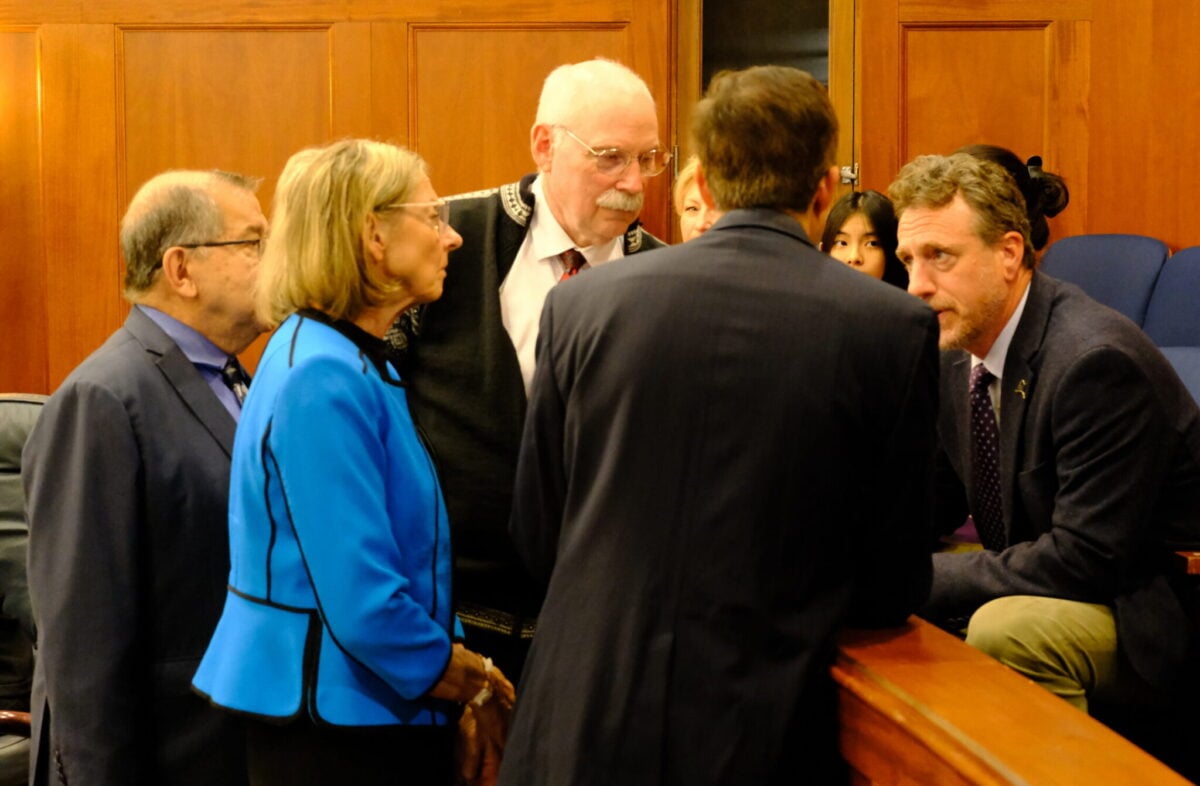
State senators crowd around Matt Kissinger, commercial director of the Alaska Gasline Development Corp., shortly before lawmakers voted Thursday, July 16, 2026, on a compromise version of a tax break intended to benefit the trans-Alaska natural gas pipeline. (Corinne Smith photo/Alaska Beacon
On Wednesday, one day before the Alaska Legislature voted on a multibillion-dollar tax break for the proposed trans-Alaska gas pipeline, Rep. Calvin Schrage, I-Anchorage, gave the pipeline’s lead developer a sneak preview of the bill.
For weeks, Schrage had been in charge of negotiating a compromise version of the tax break that could get approval from the state House, Senate and Gov. Mike Dunleavy.
He walked Glenfarne Alaska President Adam Prestidge through the compromise, explaining section by section how skeptics in the state Senate had given ground on labor issues and project timing. Skeptics also were no longer insisting that the pipeline be subject to a revised tax on privately held oil and gas firms.
Given those changes, Schrage asked: Could Glenfarne support the bill?
According to Schrage, Prestidge said it could, and Glenfarne would publish a news release to that effect.
Glenfarne disputes Schrage’s account, and that difference in perspectives appears to have contributed to a failed vote on Thursday that killed the bill — and possibly with it, the current version of the gas pipeline project.
“The governor’s probably in a bad mood,” said Sen. Bert Stedman, R-Sitka, “but he was definitely told on several occasions when we were negotiating this bill that this is our last and final offer. The bill goes down, it’s dead. There’s no playing around.”
Glenfarne has repeatedly said that changes to the state’s petroleum property tax are needed in order to get financing for the pipeline project, which is expected to cost as much as $54.5 billion.
The bill wouldn’t have guaranteed a pipeline, but as Rep. Will Stapp, R-Fairbanks, said earlier this year, the lack of a bill would guarantee not having a pipeline.
The tax break would require the state and local governments to forgo more than $10 billion in revenue over 30 years, and some legislators are skeptical of the proposal. Getting their votes required a compromise.
A tax revision, variously called an “S Corp tax” or “pass-through entities tax” would apply certain income taxes to some companies that don’t currently pay them. It was included in the pipeline bill to win the votes of skeptical lawmakers, but prior versions of the tax have drawn opposition and led to an impasse.
On Thursday, after Schrage told fellow lawmakers that Glenfarne supported the new version, a bipartisan, bicameral committee voted 4-2 to advance it to the full House and Senate.
No news release came, and Schrage talked to Prestidge again.
Hilcorp, an oil and gas firm owned by billionaire businessman Jeffery Hildebrand, is the operator of the Prudhoe Bay and Point Thompson oil and gas units on the North Slope. Those units would supply gas for the pipeline that Glenfarne intends to build.
Hilcorp is also the company that would be most affected by the revised tax.
“What I heard from Glenfarne is that Hilcorp told them that if they came out in support of the bill, that they would make all their contractual negotiations impossible for them, and essentially threatened to use their future negotiations, which they knew they would have to enter into, to leverage them and and make things incredibly difficult,” Schrage said.
After Thursday’s committee vote, pro-development groups issued a statement asking legislators to vote down the revised bill, citing the tax revision and its potential effect on natural gas prices in the state.
“When you tax entities that are providing you with a commodity, it will increase the end cost of said commodity,” said Steve Wackowski, president and CEO of the Alaska Oil and Gas Association, a trade group that signed the statement.
Before the state Senate voted on Thursday afternoon, lawmakers there learned that Glenfarne and the Alaska Gasline Development Corp. — a state-owned firm developing the pipeline with Glenfarne — might have issues with the S Corp provision after all.
AGDC owns 25% of the gas line project, while Glenfarne owns 75%.
They called for a brief break in order to talk with Prestidge and Matt Kissinger, the commercial director of AGDC, in private.
Kissinger told senators that AGDC was fine with gasline-related provisions of the bill but had no comment on the pass-through provision because AGDC isn’t a tax-paying entity.
“They wouldn’t touch that with a 10-foot pole because they answer to the (governor),” said Sen. Bert Stedman, R-Sitka on Friday.
By phone to senators on Thursday, Prestidge said Glenfarne opposed the S Corp provision.
Members of the 14-person Senate majority caucus left that meeting with no agreement on whether or not to pass the bill. It ultimately passed the Senate by a single vote after Sen. Matt Claman, D-Anchorage, changed from “no” to “yes.”
Before the House could vote, Gov. Mike Dunleavy issued a statement saying he opposed the latest version of the bill and would veto it if it passed the House.
No veto was needed: Only 19 members of the House voted for the bill, two short of what was needed to advance it.
Only one of the House’s 21 Republicans — Rep. Louise Stutes, R-Kodiak — voted for the bill; all of the House’s Democrats and independents voted for it. That flipped a vote on a prior version, when opposition came from a handful of Democrats and independents.
Several Republicans who voted against the bill said they did so because it would affect companies that are drilling for oil and gas in Cook Inlet — Hilcorp, as well as HEX and Furie. Armstrong Oil and Gas, a firm active on the North Slope, would also be affected.
Partially because of corporate secrecy and partially because of the haste with which the compromise advanced, there was no information on how much each company would pay.
In addition, members of the all-Republican House minority caucus were excluded from the closed-door negotiating that led to the compromise bill. The exact text of the final version came as a surprise to them.
“All of a sudden, we would have a tax on our three most important companies, which would be Hilcorp, HEX, and Armstrong,” said Rep. Kevin McCabe, R-Big Lake. “I think (voting no) was the right thing to do, and my whole caucus apparently agrees, as well as the Senate minority.”
Schrage, who voted for the bill, disagreed.
“The bill worked for Glenfarne and would have allowed them to keep moving the project forward and given them a shot. They were happy and pleased with the work product. I don’t think they ever loved the S Corp provision, but it didn’t harm them. And it was only when Hillcorp came in to essentially leverage the parties at play that everything fell apart,” Schrage said afterward.
Glenfarne disputes Schrage’s account of what occurred, calling it “misleading and incorrect.”
“Glenfarne didn’t take a position on a bill we hadn’t seen, and once we saw the bill we immediately opposed it, including our June 19 statement to the media. This tax increases commercial and economic uncertainty in Alaska for the whole industry working together to support this project and bring energy relief. A $16 project energy price cap and tax-driven cost increases make project economics increasingly challenged,” said spokesman Tim Fitzpatrick by email.
Fitzpatrick’s statement refers to a clause in the gas pipeline bill that caps the price of natural gas for Alaskans. If taxes rise on Hilcorp, it could then raise the price of North Slope gas it sells into the pipeline, making it difficult for Glenfarne to meet the required price, said those familiar with the issue.
“It’s frustrating that Hillcorp has so much influence over the state of Alaska,” said Sen. Lyman Hoffman, D-Bethel on Friday. “Glenfarne or the governor wouldn’t stand up to them for the better interests of the state of Alaska.”
Schrage says he has phone records and text messages to back up his account.
“I think the evidence is pretty clear,” Schrage said. “The governor, Glenfarne and minority Republicans all indicated support for the bill passed out of the conference committee minus the closure of the passthrough entity tax loophole which the entire AKLNG project was exempted from. Given that exemption and the support for the rest of the bill, what possible reason would Glenfarne have to oppose the bill other than pressure from Hilcorp?”
Sen. Bill Wielechowski, D-Anchorage, took to social media on Thursday to accuse Dunleavy of working for “a Texas billionaire,” the owner of Hilcorp.
“Yeah, that’s bulls**t. OK, that’s bulls**t. He’s just — and you could quote me, that’s bulls**t. OK, he’s a bulls**tter,” Dunleavy said of Wielechowski, speaking to reporters after a news conference on Thursday evening. “He is one of a handful in the Senate and the Democrats that are going to try and kill this gas line for the very people they purport to represent — poor people, single moms with kids — that their bills are going through the roof. Why doesn’t he give a rip about them? Why doesn’t he care about them?”
“Why is he insisting on an S Corp in this bill?” Dunleavy asked.
Because Dunleavy would veto a standalone bill, Wielechowski said afterward.
“The reason that it hasn’t been passed is because he’s threatened to veto it, and you need 45 votes to override that, and there’s zero chance we’re going to get it,” Wielechowski said.
Alaska is facing a long-term deficit, with spending on services and the Permanent Fund dividend expected to greatly exceed the amount of available revenue. Legislators have been trying since 2017 to pass a bill containing the S Corp provision.
Dunleavy has vetoed numerous standalone tax bills, saying repeatedly that he will not approve any that are not part of a comprehensive plan to bring state expenses and revenue into line over the long term.
“He’s killed all of the new revenue bills that we’ve offered,” said Sen. Cathy Giessel, R-Anchorage.
“This is a huge gap in our revenue stream. It is an inequality in our tax structure,” she said, noting that other oil companies pay the tax that Hilcorp would pay. “How is it that Conoco and Exxon have been able to pay this tax and still continue to explore on the North Slope?”
Dunleavy said insisting on an S Corp provision in the gas pipeline bill amounts to hostage-taking.
“So you can’t get an S corp bill passed that’s unvetted, that nobody really knows what it does, unless you hold the people hostage with a gas bill? Well, that’s a representative for you. That’s a senator for you. That’s pretty sad, to be perfectly honest with you,” he said. “Pretty sad.”
Brochures at the University of Alaska Anchorage Student Health and Counseling Center, seen on July 17, 2026, provide information on syphilis and other sexually transmitted infections. Cases of syphilis infections among newborns have been on the rise in Alaska and nationally. (Photo by Yereth Rosen/Alaska Beacon)
More Alaska babies were born infected with syphilis last year than in any recent year, state health officials reported. It is a trend that comes as the state continues to have high rates of the sexually transmitted disease.
In 2025, 14 Alaska newborns had congenital syphilis, cases in which infections are transmitted to babies by their mothers, according to a bulletin issued on July 15 by the Alaska Division of Public Health’s epidemiology section.
That compares to seven cases the previous year and 10 cases in 2023 for a condition that was once extremely rare in Alaska. In contrast to 2025, there were two cases from 2011 to 2013, and in some years prior to 2020 there were no reported cases, according to state health officials.
Congenital syphilis can have grave consequences, including premature births; bone deformities; developmental delays; blindness, deafness or other brain or nerve problems; and sometimes death.
Congenital syphilis is entirely preventable if pregnant women’s infections are detected and treated in a timely fashion, said Tamara Davis, manager of the Division of Public Health’s program for HIV and sexually transmitted diseases.
To avoid passing on the infection, pregnant women must be treated at least 30 days before giving birth, Davis said.
“Unfortunately, a lot of these patients just show up way too late,” she said.
For adults and adolescents, syphilis case numbers increased in 2025, continuing a recent pattern.
There were 280 recorded cases of primary or secondary syphilis — defined as infections in the earlier stages, generally in weeks or months, when the infection is most contagious — and 223 recorded longer-term cases or cases of unknown duration. That represents a 14% increase in primary or secondary cases since 2023 and a 51% increase in longer-term cases since 2023, according to statistics reported in the bulletin.
There are some common threads in recent years’ non-congenital syphilis statistics.
Reported congenital syphilis cases in Alaska from 2015 ro 2025 are shown on this graph. (Graph provided by Alaska Division of Public Health epidemiology section bulletin issued on July 15, 2026)
Most cases were in Anchorage and the nearby Matanuska-Susitna Borough, as was the situation in the prior two years. Three-quarters of the 2025 adult and adolescent cases were in that geographic area, according to the bulletin.
The majority of the cases were among men, but not overwhelmingly so; in 2025, 53% of the cases were among male patients.
Housing insecurity and substance abuse were factors among many patients. In 2025, 30% of the adult and adolescent patients reported that they lacked secure housing, and about fifth of the 2025 syphilis patients reported engaging in substance abuse.
For the congenital syphilis cases, many of the mothers received little or no prenatal care, Davis said.
State public health officials have teams with the Anchorage Department of Health and other partners to reach at-risk Alaskans, especially pregnant women at risk of passing infections to their babies, she said. Efforts include providing transportation to testing and treatment sites, she said.
“We’re doing what we can,” she said. “Of course, one case is too many”
Alaska has generally posted some of the nation’s highest rates of sexually transmitted disease, according to statistics kept by the U.S. Centers for Disease Control and Prevention. In 2023, the most recent year for which state-by-state data is available, Alaska had the 11th highest rate of syphilis, 15th highest rate of congenital syphilis, third highest rate of chlamydia and highest rate of gonorrhea, according to the CDC.
Nationally, congenital syphilis cases have increased dramatically over the past decade, the CDC reported. In 2024, the most recent year of available data, there were nearly 4,000 cases reported nationwide, compared to 495 cases reported in 2015, according to the CDC.
Non-congenital syphilis cases have started to decline nationally after several years of increases, according to the CDC. Primary and secondary cases declined by 22% in 2024 from 2023 levels, and it was the second consecutive year of decreases, the CDC said.
With that in mind, it should be no surprise that some found this one to be a little … confusing.
Justin Bieber performs during FIFA World Cup 2026⢠Topps Final Halftime Show at New York New Jersey Stadium on July 19, 2026. (Photo Credit: Jamie McCarthy/Getty Images for Global Citizen)
FIFA is an international soccer organization that is relatively obscure within the United States.
However, the past several weeks have seen adorable social media posts from visitors, beer shortages in Boston and Florida, and a charming cultural exchange at a time when the United States’ international image is at a multigenerational low.
Those of us who thought that the idea of a “world cup” was the invention of a once-beloved author’s wizard universe might be surprise to learn that FIFA does not traditionally include a halftime show.
This was the very first. And, sandwiched between high-energy performances by BTS and Shakira, Bieber took to the stage.
justin bieber performs “EVERYTHING HALLELUJAH” at the 2026 FIFA world cup halftime show ⚽️🏆 pic.twitter.com/HJpD4k5cbx
Specifically, it was “EVERYTHING HALLELUJAH” from his album, SWAG II.
(We did not make up either the song or album title to make fun of him. He did that himself.)
It was not only the relatively subdued song that had fans, past and present alike, scratching their heads.
Bieber also went without any other aspects of the performance, taking the stage with only a guitar and a microphone.
Soccer’s biggest night got the ultimate pop-star soundtrack! Justin Bieber took the stage during the 2026 FIFA World Cup Final as Spain and Argentina battled it out in East Rutherford, proving the action wasn’t just happening on the pitch. (📸: MEGA)
This is not the Biebs’ first time disappointing fans with a low-key performance.
But what some may see as him phoning it in, others view as a sort of earnest authenticity.
It is likely that he believes that his music is better served by just being a flat performance without any pomp or circumstance.
It’s not for everyone. But that’s okay.
Not that long ago, the Bieber seemed to be spiraling on social media and in real life. We’d prefer these polarizing performances on stage to worrying about what he’s going to do next week, you know?
By the way, Spain won the final soccer game. Even those of us for whom soccer was a miserable childhood chore and not an adult interest knew to root against Argentina, so that’s a win.
2 became 1 when Melanie “Mel C” Chisholm married Chris Dingwall.
The Spice Girls star wed the model in a legal ceremony in his home country of Australia before tying the knot at a friend’s… E! Online (US) – Top Stories


















 2 became 1 when Melanie “Mel C” Chisholm married Chris Dingwall.