M&M’s is introducing a new dye-free version of its iconic candy, but two familiar colors won’t be making the transition. Here’s why blue and brown are being left out — at least for now. Continue reading…The Boot – Country Music News, Music Videos and Songs
The latest development adds to a growing collection of conflicting messages that have complicated the investigation. Continue reading…The Boot – Country Music News, Music Videos and Songs
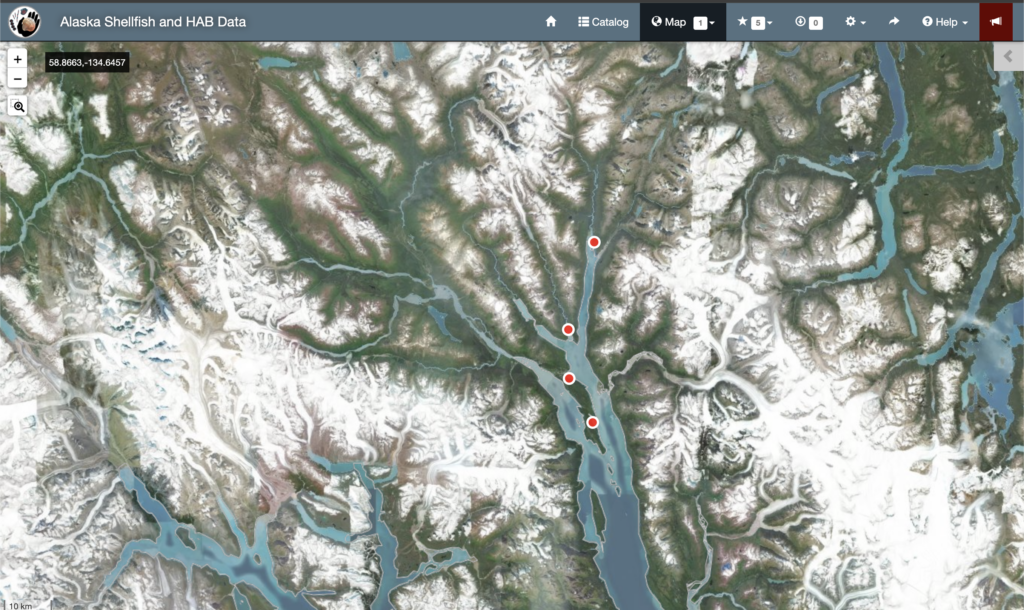
The Alaska Harmful Algal Bloom Network’s map of shellfish and phytoplankton testing in the upper Lynn Canal.
Paralytic shellfish toxins have been found in shellfish collected in water around Haines.
The toxins, which originate from some species of phytoplankton, can pass up the food chain when phytoplankton levels are high, accumulating in shellfish and then affecting humans and animals that eat those shellfish. Consuming affected shellfish can be fatal to humans. The toxin is not destroyed by cooking or freezing.
That means all mollusks are currently unsafe to eat, said Chilkoot Indian Association environmental specialist Liam Cassidy, who collects the samples in Haines and then sends them to a Sitka lab where they’re tested.
The mollusk category refers to shellfish with a hinged shell, like clams, mussels, and geoducks. Finfish, shrimp and crab meat is not known to contain the toxin, Cassidy said, but crab guts, sometimes known as crab butter, may contain high levels of the toxin and should be cleaned out before eating.
Harvesters can send samples to Cassidy to be tested. He can be reached at lcassidy@chilkoot-nsn.gov or at 907-766-2323. The collector does not have to reveal the location where they were harvested.
Fresh or frozen samples can also be sent directly to Southeast Alaska Tribal Ocean Research’s lab in Sitka. The research lab, also known as SEATOR, is a tribal consortium that does environmental data collection.
Results from testing shellfish all over Southeast Alaska are published on SEATOR’s website, to help the public know where toxins are present and avoid eating unsafe shellfish. Currently, the lab has advisories for shellfish from Ketchikan and Skagway in addition to Haines.
Responders examine a dead fin whale that had been found on the bow of a cruise ship that docked in Seward on June 19, 2026. The whale was towed to a nearby beach, where a necropsy was planned. The response has been coordinated by the National Oceanic and Atmospheric Administration and the Alaska SeaLife Center. Royal Caribbean said in a statement that one of its ships struck the whale, a female that appeared to be pregnant. (Photo provided by NOAA Fisheries)
Government regulators and scientists are investigating the death of a fin whale that was carried on the bow of a cruise ship into Seward on Friday.
The dead female whale, measuring 61 feet and apparently pregnant, was moved by local responders to a nearby beach for the investigation into its cause of death, the National Oceanic and Atmospheric Administration said.
NOAA Fisheries and the Seward-based Alaska SeaLife Center are working cooperatively on the necropsy.
While NOAA did not identify the vessel involved, the only cruise ship scheduled to be in Seward on Friday was the Ovation of the Seas, operated by Royal Caribbean Cruise Line.
Royal Caribbean, in a statement, admitted that its ship struck the whale.
“We are saddened to hear that one of our ships struck a whale while on its way to Seward. We take any impact to marine ecosystems very seriously. The ship immediately reported the incident to the proper authorities. We are cooperating fully with NOAA and are awaiting the necropsy results,” a company spokesperson said by email.
Fin whales are listed as endangered under the U.S. Endangered Species Act. They are the world’s second-largest whales, after blue whales, according to NOAA. The agency lists ship strikes among the top threats to their populations.
Ship strikes have killed numerous whales in Alaska in the past. A 2012 NOAA report said there were 108 reported whale-vessel collisions in Alaska from 1978 to 2011, and nearly a quarter of those killed the whales. Those events included strikes by cruise ships, such as a 2010 case involving a Princess Cruises ship.
A 2024 NOAA report on human-caused, nonhunting deaths to Alaska marine mammals tallied 41 probable deaths of humpback whales between 2018 and 2022, along with numerous deaths of other whale species. Data in the report indicated that more than two dozen whales were killed by ship strikes in that period.
For environmentalist Rick Steiner, the Seward case on Friday is further evidence supporting the need for ship speed limits in important whale habitat off Alaska.
Steiner, a retired University of Alaska marine biologist who now heads an organization called Oasis Earth, has been campaigning for speed limits for several years. If not mandatory, as they are on the East Coast to protect endangered Atlantic right whales, he said they could be voluntary, as they are in areas of California.
Those speed limits have been effective, Steiner said.
The problem of ships striking whales is widespread, he said. “The number of times you see a whale deal and pinned on the bow of a ship, either an oil tanker or a cruise ship, is only the tip of the iceberg,” he said.
Steiner and others, including the Prince William Sound Regional Citizens Advisory Council, have been seeking to establish speed limits for a variety of vessels in places like Unimak Pass, Icy Strait, Prince William Sound and Resurrection Bay, where whales congregate but where there is also heavy ship traffic at certain times of the year.
Those limits should be set at 10 knots in daytime and 8 knots when visibility is low, he said. That compares to the normal sailing speeds of up to 20 or 22 knots for cruise ships and 15 to 17 knots for oil tankers, he said.
However, regulators and industry groups have not agreed to any such limits, as voluntary guidelines, he said.
Steiner said he appreciated Royal Caribbean’s statement acknowledging that its ship struck the whale.
“But what are they going to do about it is the question,” he said. “If Royal Caribbean is genuinely contrite and wants to do something about it, we know what that is.”
Bailey Zimmerman is in hot water with New Mexico authorities.
The country music star is facing is a fourth-degree felony for criminal damage to property over $1,000 and a misdemeanor for falsely… E! Online (US) – Top Stories
It seems what happened in Vegas actually stayed in Vegas.
Indeed, Bridesmaids writer Annie Mumolo—who co-wrote the 2011 movie alongside its star Kristen Wiig—spilled the behind-the-scenes process… E! Online (US) – Top Stories
France scored early, played through driving rain in Philadelphia, sat through a long weather delay, and simply controlled its game against Iraq for all 90 minutes. Iraq at times has played well but has now lost its first two games at the tournament as it has made continuous mistakes – first against Norway and now against France. Here are my takeaways: 1. Mbappé Shines In World Cup Of Stars The defining stories of this World Cup have yet to be written, but it would not be a surprise if this will be remembered as an international tournament where many of the sport’s greatest players all shined together. Earlier in the day, Argentina star Lionel Messi became the World Cup’s all-time leading scorer with his 18th goal, but that record might not last for long with the way Kylian Mbappé has been playing. France’s all-time leading scorer opened the scoring against Iraq with a magnificent strike for his 15th career World Cup goal. He is just the fourth player to reach that mark, behind Messi, Germany’s Miroslav Klose, and Brazil’s Ronaldo. Then in the second half, Mbappé took advantage of another Iraqi blunder at the World Cup to score his 16th goal. The caveat is that Mbappé is still only 27 years old and could still have multiple World Cups ahead of him, and he might eventually become the tournament’s greatest ever player. This World Cup has been an incredible gathering of historic talent. Along with Messi and Mbappé, you have also seen multiple goals from Erling Haaland, Mohamed Salah, and Harry Kane. That number will only increase as more teams begin playing multiple games. 2. France’s Other Stars Make A Splash Much of the attention surrounding this French team is on Mbappé as he now chases Messi’s scoring record, with both stars picking up right where they left off after the 2022 final. But Michael Olise’s contributions continue to be first-rate as he shows the world why he is one of the best wingers in the world for both France and Bayern Munich. In his last three appearances for France – going back before the start of the World Cup – Olise has three goals and two assists. Another big story for France out of Monday’s game was that 2025 Ballon d’Or winner Ousmane Dembélé scored his first ever World Cup when he put France up 3-0. That was always a question when that burden would finally be lifted, and now it has finally happened. The potential now is that Dembélé is more relaxed and comfortable at the World Cup. That is bad news for any team hoping to stop Les Bleus. It is far from just Mbappé. His supporting cast, especially Olise and Dembélé, is world-class. They all showed it in this game. 3. No Issue For France After Rain Delay This game featured the first weather delay of the World Cup when a thunderstorm kept players in the locker room for over two hours. It raised the question of how the respective teams would respond. In this game, France responded very well. Iraq was likely content to only be trailing by one goal at halftime, and the first half took a lot of energy from Graham Arnold’s players to get to that point. France, meanwhile, was likely frustrated to have only one goal at that point. The long break saw the game revert towards how it was expected to be. France played very nice soccer in the early parts of the second half while Iraq did not look like the team that was keeping it close in the first half. France’s professionalism was apparent after the delay. France’s players refocused on the original game plan and returned to business as usual. For Iraq, the delay deflated the team’s excitement and momentum. 4. Mistakes Are Ruining Iraq’s Chances For the second straight game against a top team, Iraq committed an error in playing the ball out of the back with a shot goal kick. Against Norway with the score 1-1, Iraqi goalkeeper Jalal Hassan played the ball out wide to defender Zaid Tahseen, who then played the ball back to Hassan with Erling Haaland running down on him. It ended with a goal. Against France, Iraq made a goalkeeper change and went with Ahmed Basil Fadhil. But the same mistake happened as he passed it to Tahseen, who again hit a poor pass back to the keeper. This resulted in a Mbappé goal that put France up 2-0 and squandered any chance of an Iraq comeback. Playing out of the back is a risky strategy, but it becomes almost reckless when a team is not nearly as talented as its opponent. Arnold deserves a lot of blame for having this mistake happen twice on such a big stage. His team should have respected the talent of Norway and France and played it much safer. His teams would have been much better off.Latest Sports News from FOX Sports
Forget the bombshells, as the popularity of Love Island (both the OG UK version and its across-the-pond sibling) grows, a whole new lexicon has entered the villa.
Because while even casual fans… E! Online (US) – Top Stories
Meghan Markle feels as lucky as ever for her life with Prince Harry.
The With Love, Meghan host gave fans a heartwarming glimpse of their children, Prince Archie, 7, and Princess Lilibet, 5, with… E! Online (US) – Top Stories













 Bailey Zimmerman is in hot water with New Mexico authorities.
 It seems what happened in Vegas actually stayed in Vegas.

 Forget the bombshells, as the popularity of Love Island (both the OG UK version and its across-the-pond sibling) grows, a whole new lexicon has entered the villa.
 Meghan Markle feels as lucky as ever for her life with Prince Harry.