The chair of Alaska’s human rights commission has sued a political writer for defamation over his description of her work on a failed attempt to preserve a historic building in Seward.
Dorene Lorenz of Juneau filed the suit on Friday in Juneau Superior Court, seeking damages from Jeff Landfield and the other owners of the Alaska Landmine, a popular Alaska political website that publishes a mixture of news, commentary and parody.
Landfield, who backed Donald Trump in the 2024 presidential election, also publishes the Alaska Political Report, a sobersided news digest priced at $1,299 per year for lobbyists and others interested in activity at the state Capitol.
Lorenz’s suit stems from a social media post in which Landfield ridiculed a recent appearance by Lorenz at a United Nations event in Switzerland.
Landfield went beyond that appearance, which he labeled “bizarre,” and said, “This woman is an absolute nut. Remember when she got in trouble for using … state money for the Jesse Lee Home for herself?”
Lorenz asked for a retraction. Landfield refused, and reiterated his belief in a video posted on Facebook.
Lorenz filed her lawsuit in response, saying Landfield’s claim is false. She asked for financial damages for slander and defamation, a correction and retraction.
Lorenz, who has experience representing herself in court, filed the lawsuit on her own behalf.
“She’s a f***ing lunatic,” Landfield said of the lawsuit on Tuesday.
“Anyone who has themselves as a client is a fool, as the old saying goes,” he said, adding that he looks forward to the discovery process and showing what happened with the Jesse Lee Home.
That building was a former orphanage and the home of Alaska Flag designer Benny Benson in the early 20th century.
During the administration of Gov. Bill Walker, state lawmakers allocated almost $7 million to restore the building, but grants given to a Lorenz-chaired nonprofit called the Friends of the Jesse Lee Home were terminated after a series of “reporting issues and accountability issues.”
Lorenz said by text on Tuesday that most of the grant money was never disbursed to the nonprofit she administered.
In 2018, Fred Parady, then deputy commissioner of the Alaska Department of Commerce, Community and Economic Development, told Alaska Public Media that he didn’t think anyone involved with the project stole money.
In her legal complaint, Lorenz notes that Landfield was aware of that reporting and repeated his claim anyway.
Under Alaska law — which mirrors federal law — a public official filing a defamation claim needs to prove that someone knew what they were saying was a lie or that they willingly ignored evidence that their statement was a lie.
By text message, Lorenz said the 2018 reporting by Alaska Public Media shows that the state believed that the Friends of the Jesse Lee Home were spending too much money on classes within the school and not enough on the building itself.
“Landmine has asserted otherwise, with actual malice, and continues to do so,” she said. “Not cool.”
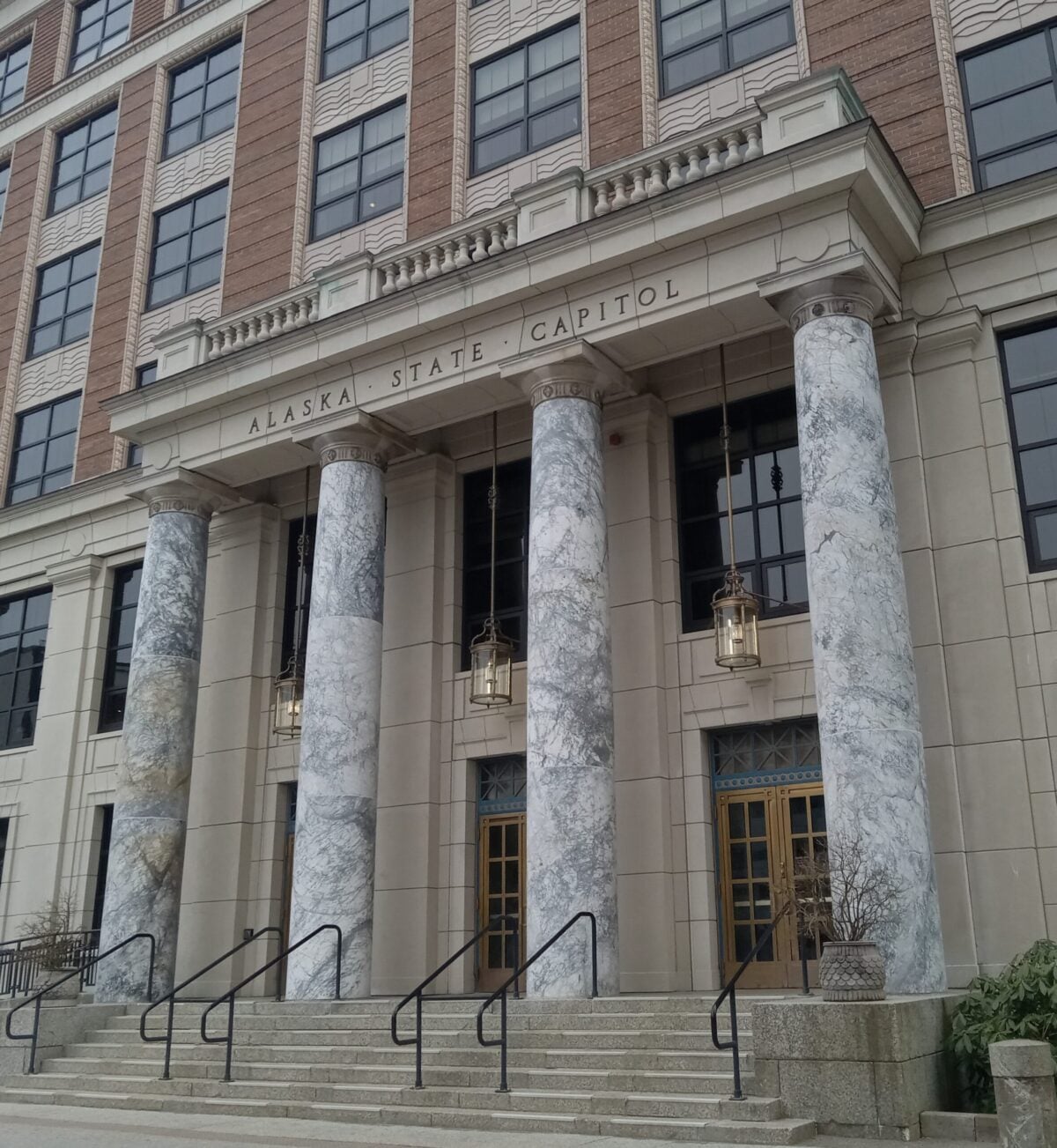
The Alaska State Capitol in downtown Juneau.
(Photo by Greg Knight/News of the North)
By: James Brooks, Alaska Beacon
The Alaska State Capitol in downtown Juneau.
(Photo by Greg Knight/News of the North)
Alaska Gov. Mike Dunleavy is now considering who may fill two legislative seats vacated by state senators seeking higher office.
Sen. Mike Shower, R-Wasilla, resigned Nov. 3 to run for lieutenant governor, and Sen. Shelley Hughes, R-Palmer, resigned Nov. 14 to run for governor.
On Sunday, Republicans in Hughes’ district proposed three local residents to fill her seat: Rep. Cathy Tilton, R-Wasilla, Matanuska-Susitna school board member Tom Bergey, and Gerrie Deal of Palmer.
Under state law, Dunleavy does not have to pick any of the three, but Republican Party rules state that local party officials will propose nominees to the governor in the event of a vacancy.
Dunleavy has until Dec. 14 — 30 days after Hughes’ resignation — to fill the seat.
The deadline to fill Shower’s vacant seat is coming up sooner: Republicans in his district have nominated Reps. Kevin McCabe, R-Big Lake, and George Rauscher, R-Sutton, for the vacancy, as well as Ryan Sheldon, a former aide to Rep. Julie Coulombe, R-Anchorage.
Any person picked for the Senate must be confirmed with a majority vote by the Senate’s Republican members, which includes four remaining members of the all-Republican Senate minority as well as the five Republicans who are in the Senate’s majority caucus.
If Dunleavy picks a current member of the state House for either seat, he will create a vacancy that he must fill within 30 days.
That person — or those people — will almost certainly join the House’s 19-person all-Republican minority caucus, whose leadership is in flux.
On Saturday, House Minority Leader Mia Costello, R-Anchorage, said she would resign immediately as minority leader.
The resignation came after two members of the minority met with her and said there were enough votes to remove her as leader. That meeting was first described by Jeff Landfield of the Alaska Landmine.
Her resignation, which had not been requested, leaves the minority’s position uncertain ahead of the legislative session. The minority leader is traditionally in charge of opposition messaging and is the main negotiator between the House majority and minority caucuses.
This past year, members of the House minority repeatedly diverged on key topics, including a vote on whether or not to override Gov. Mike Dunleavy’s education funding vetoes.
The Alaska House is currently controlled by a 21-person majority that includes Republicans, Democrats and independents.
CBJ- Tlingit & Haida and the City and Borough of Juneau (CBJ) are pleased to announce a new partnership to expand early childhood education and youth development opportunities in Juneau. Through a recently finalized lease agreement, Tlingit & Haida will utilize classroom space at Floyd Dryden to bring three Head Start classrooms, LEARN and youth programs under one roof.
Construction and remodeling of the new space are currently underway and are scheduled for completion by January 2026. Once finished, the updated facility will provide a welcoming, child-centered environment designed to support high-quality education and holistic youth programming for Juneau’s families.
“This partnership represents a shared commitment to Tribal citizen children and their futures,” said Tlingit & Haida President Chalyee Éesh Richard Peterson. “We are grateful to the City and Borough of Juneau for working collaboratively with us to create a unified space for learning and growth. When we invest in our youth, we invest in the strength and resilience of our community. This project brings together education, culture, and care in one place—helping our youngest learners and future leaders thrive.”
Mayor Beth Weldon emphasized the importance of community partnerships in expanding access to education and youth resources. “The City and Borough of Juneau is proud to partner with Tlingit & Haida on this project,” said Weldon. “Providing quality early education and youth programming is a shared goal that benefits the entire community. By working together, we’re ensuring that families have access to the resources and support their children need to succeed.”
The lease agreement ensures that Floyd Dryden Middle School continues to be an active and valuable part of the community. The building is far from sitting empty—it will soon be home to Tlingit & Haida’s early education and youth services while maintaining community access to shared spaces. The gymnasium is not part of the lease and will remain available for scheduled programming and public use through CBJ Parks and Recreation’s regular scheduling process.
A Central Hub for Tlingit & Haida Youth and Family Services The Floyd Dryden site will be the home to a growing number of Tlingit & Haida’s youth services and will serve as a central hub for:
Three Head Start classroomspromoting school readiness at no cost to families for any eligible child age 3 to 5 years (Head Start Pre-School) and 18 months to 3 years (Early Head Start)
Little Eagles and Raven’s Nest, a licensedchildcare center that provides year-round, full day care and early learning for any child age 0 to 6 years.
Haa Yoo X̲’atángi Kúdi, a pre-kindergarten Lingít language immersion nest program that serves tribal citizen children age 3 to 5 years.
The future Native Boys & Girls Club, which will expand after-school, cultural, and family engagement opportunities for youth age 6-18 and the broader Juneau community.
“Wayfinders, Wellness, and the Native Boys & Girls Club all work toward the same goal—helping our youth discover their strengths and lead with confidence,” said Tlingit & Haida Youth Engagement Manager Jasmine James. “We’re investing in the next generation of leaders who will carry forward our values, culture, and community pride.”
Bringing early education and youth programs together under one roof strengthens Tlingit & Haida’s ability to support children and families from early learning through adolescence. The project reflects both partners’ long-term vision of fostering education, wellness, and community connection.
A guided tour of the facilities is scheduled for today, November 18 at 1 PM.
A community open house is planned for early 2026 to celebrate the completion of the space and to recognize the collaboration that made the project possible.
About the City and Borough of Juneau The City and Borough of Juneau (CBJ) is the capital city of Alaska and serves as the hub of government, education, and culture for the region. CBJ is committed to partnerships that support thriving families and strong educational foundations for all residents.
About Tlingit & Haida The Central Council of the Tlingit & Haida Indian Tribes of Alaska is a sovereign tribal government representing over 38,000 citizens worldwide. The Tribe provides a wide range of services and programs to support the well-being of its citizens and strengthen communities across Southeast Alaska.
Salmon returning from the ocean attempt to jump Brooks Falls in Katmai National Park and Preserve’s Brooks River on July 12, 2018. Alaska’s commercial salmon harvest this year was nearly twice as big as last year’s small harvest. (Photo by Russ Taylor/National Park Service)
Alaska commercial fishers caught much more salmon in 2025 than they did last year, but the money they earned was modest, according to the statewide harvest report.
The state commercial salmon haul totaled 194.8 million fish, the 12th largest since 1985, according to the Alaska Department of Fish and Game’s preliminary annual summary, released this month.
Measured in pounds, the 2025 harvest was about average compared to the last 40 years the agency has been keeping an all-species record, the Fish and Game summary said.
But the amount of money paid to harvesters delivering their fish – known as ex-vessel value – was the 13th lowest since 1975, when adjusted for inflation. This year’s total was $541 million, the department said.
Copper River sockeye salmon fillets are displayed at New Sagaya Midtown Market in Anchorage on June 12, 2025. Sockeye salmon is also called red salmon. This year, sockeye salmon accounted for 58% of the value of Alaska’s total commercial salmon harvest, though it reprsented only about a quarter of the fish caught. (Photo by Yereth Rosen/Alaska Beacon)
This year’s totals represent a big improvement from last year, when only 101.2 million salmon were harvested. It was the third lowest haul since 1985 and the ex-vessel value was $304 million, the third lowest since 1975 when adjusted for inflation. In weight, the 2024 harvest totaled 450 million pounds, the lowest on record.
Alaska salmon, particularly Chinook, have been shrinking in size over the past decades, a trend that scientists attribute to a variety of factors, including climate change and ocean conditions.
This year, sockeye salmon accounted for the most value among Alaska’s five salmon species, continuing the long-term pattern in the industry. A little over a quarter of the landed fish were sockeye, but they made up 58% of the value, according to the Department of Fish and Game’s summary.
Pink salmon, the most plentiful and cheapest of the Alaska species, made up 61% of the total fish harvested and 21% of the total ex-value. The pink salmon harvest was about 14% less than expected at the start of the season, the department said.
At the other end of the volume spectrum, the statewide Chinook harvest, which accounted for only 181,892 of the 194.8 million total, was 26% higher than predicted in the preseason forecast, the department said.
Chum salmon accounted for 10% of the harvest and coho accounted for 1%, the department said.
The harvest totals are preliminary and subject to revision as more information is received, the department said.
Right-wing influencer Nick Fuentes, center, speaks in front of flags that say ‘America First’ at a pro-Trump march on Nov. 14, 2020, in Washington. AP Photo/Jacquelyn Martin, File
“We’ve had some great interviews with Tucker Carlson, but you can’t tell him who to interview,” President Donald Trump said on Nov. 17, 2025. “Ultimately, people have to decide.”
This dynamic reveals how fringe ideologies operate differently today compared to the mid-20th century, when institutional gatekeepers – political parties, law enforcement, the media – could more effectively contain extremist movements.
And through their 21st-century methods of communication and operation, Nick Fuentes and his followers – the “Groypers” – have managed to get what their 20th-century predecessors could not: widespread awareness and political influence.
Atlanta, 1940: Brazen but brief fascist group
As a historian of the American far right, I have spent years examining how fascist movements adapted to the conditions of postwar America. The trajectory from the 1940s until today shows a fundamental shift: from defined organizational structures that could be dismantled to diffuse cultural movements that spread through social media.
Let me offer an example.
In 1946, barely a year after Hitler’s defeat, young men in khaki shirts marched through Atlanta, Georgia, performing Nazi salutes and promising racial vengeance.
Led by Homer Loomis Jr. – a Princeton dropout who called Hitler’s manifesto “Mein Kampf” his “bible” – this group, known as the Columbians, offered Atlanta a glimpse of explicit fascism. They conducted armed patrols, held uniformed drills and even drew up blueprints for blowing up City Hall.
Their brazenness, however, was matched by their brevity. Ten months after forming, Atlanta authorities revoked their charter and jailed the ringleaders.
The swift suppression seemed to prove that explicit fascism had no future in postwar America. And for decades that held true. Open Nazi sympathizers remained marginal, their organizations small and easily ostracized.
In the 1970s, when a group of American Nazis planned to march in Skokie, Illinois, a predominantly Jewish suburb of Chicago, the event was most notable for the counterprotests it triggered.
Mainstreaming fascism
But the Columbians’ failure, it turned out, was organizational, not ideological. The government could revoke a charter and convict leaders. They could not repress a mood.
In the digital age, Fuentes represents that mood as a diffuse sensibility rather than a structured organization. Where the Columbians wore uniforms that advertised their fascist allegiance, Fuentes wears suits and frames his worldview in the rhetoric of “America First.”
The difference is strategic. In a 2019 livestream, Fuentes explained his approach openly: “Bit by bit we start to break down these walls … and then one day, we become the mainstream.”
This packaging marks a deliberate shift. Fuentes treats plausible deniability – of fascism, of antisemitism – not as a weakness but as a central feature. The content of his message remains extreme, but the ironic wrapping enables something the Columbians never achieved – cultural saturation.
Fuentes’s followers, Groypers, have in turn mastered this diffusion strategy.
For many conservatives under 40, exposure to Groyper-style content isn’t in meetings. They absorb it through social media feeds, Discord servers and group chats. A tone of grievance and ironic provocation becomes prominent background noise, moving the marginal toward the mainstream. A generation raised on anti-woke content, 4chan and transgressive memes now shapes the neofascist movement’s tone.
At the same time, institutional authority has in many ways effectively collapsed. The Columbians faced united opposition from media, prosecutors and politicians. Those gatekeepers no longer control conservatism or the white nationalists who are adjacent to it.
In late 2022, former President Donald Trump issued this social media post after having dinner with Nick Fuentes. X
Achieving what predecessors could not
The Carlson-Fuentes interview has instead exposed a rift within MAGA circles.
Several board members of the Heritage Foundation, a conservative think tank with deep ties to the Trump administration, have resigned over the controversy, including one this week.
They were angered that Kevin Roberts, the foundation’s president, released a video defending the interview. Roberts has apologized for some of its contents but not retracted it.
Republicans aren’t all in agreement about whether Groypers represent a threat or an important constituency. Members of Congress have given speeches at Fuentes’ conferences; Trump dined with him at Mar-a-Lago in 2022.
Last year, JD Vance, now the vice president, called Fuentes a “total loser.” Fuentes attempted, without success, to mobilize Groypers against Trump in 2024 and called the president a “scam artist” earlier this year for failing to release the files in the Jeffrey Epstein case.
Yet the broader Groyperfication of conservative youth culture proceeds apace. Trump reversed his stance on the Epstein files. In defending Carlson’s interview with Fuentes, Trump said, “I don’t know much about him.”
The old remedies no longer function. Authorities cannot ban an atmosphere or revoke the charter of a meme. Social media platforms designed to maximize engagement often maximize anger. Fuentes and imitators exploit this frustration.
They remain controversial, and the Groypers’ lack of formal institutions could mean they will at some point fade like other far-right youth movements. Trump’s eventual exit from politics may also deprive them of a central reference point.
But they might represent something new: a post-organizational extremism uniquely adapted to digital life.
The Columbians once promised to control Atlanta in six months and America in 10 years. They lasted 10 months. The Groypers have already long outlasted them. That endurance signals a new, far more successful approach.
Alex McPhee-Browne does not work for, consult, own shares in or receive funding from any company or organization that would benefit from this article, and has disclosed no relevant affiliations beyond their academic appointment.
U.S. President John F. Kennedy, right, confers with his brother, Attorney General Robert F. Kennedy, at the White House on Oct. 1, 1962, during the buildup of military tensions that became the Cuban missile crisis later that month. AP Photo
Something’s missing from Robert F. Kennedy Jr.’s accounts of “Operation Northwoods.” Something that explains the origins of this menu of false flag operations – pretexts for war with Cuba – drafted by the Pentagon in March 1962.
Something about his father.
Most people remember Robert F. Kennedy as President John F. Kennedy’s closest confidant, campaign manager and attorney general, the tough but idealistic younger brother who helped him through the Cuban missile crisis and later waged an antiwar campaign for president, before becoming the second Kennedy brother slain by an assassin.
Kennedy Jr. pinned the blame for the pretexts solely on “the highest officials in the U.S. military,” accusing them of “lethal zealotry,” decrying “how badly the American military leadership had lost its moral bearings.”
To illustrate the point, he cited one pretext at length: “A ‘Remember the Maine’ incident could be arranged in several forms: We could blow up a U.S. ship in Guantánamo Bay and blame Cuba.”
In each of these accounts, Kennedy Jr. omitted the most important part of the “Operation Northwoods” story: his father’s role. I learned of that role from documents declassified by the JFK Assassination Records Review Board, in the Kennedy Library and in other archives while researching a book I’m writing, “Clandestine Camelot.”
Robert F. Kennedy aimed to use false flag operations as a pretext to go to war with Cuba and depose its communist leader, Fidel Castro, seen here in 1963. Keystone-France/Gamma-Keystone via Getty Images
Debacle with a chaser of deceit
In the first foreign policy memo he dictated, Attorney General Kennedy broached the idea of fabricating an attack on the U.S. naval base at Guantánamo Bay in Cuba, one of the spoils of the Spanish-American War.
It was April 19, 1961, and the Bay of Pigs invasion was in mid-collapse. Roughly 1,500 CIA-trained and -financed Cuban expatriates were mounting a doomed attempt to overthrow Fidel Castro, the Cuban revolutionary-turned-tyrant. Castro had the invaders pinned down on the beach under fire from Moscow-furnished MiG fighter jets.
It was then that the attorney general asked the president if they could get Central and South American nations “to take some action” to stop the flow of Russian arms to Cuba “if it was reported that one or two of Castro’s MiGs attacked Guantanamo Bay and the United States made noises like this was an act of war and that we might very well have to take armed action ourselves.”
Castro, of course, had not attacked the U.S. naval base. That would have meant war with America and the end of his regime.
President Kennedy didn’t act on his brother’s suggestion, but began including him regularly in foreign policymaking. Newspapers started calling RFK “the second most important man in the Western World.”
Fomenting revolution in Cuba faced an insurmountable obstacle: Castro was already powerful enough to crush any purely internal uprising.
CIA, State Department, and Defense Department officials agreed that the only way to overthrow Castro was a U.S. invasion.
Under Robert Kennedy’s leadership, the “Special Group (Augmented),” the interagency group JFK charged with overseeing Mongoose, proposed to change the covert operation’s goal from orchestrating subversion to justifying U.S. military intervention.
On March 5, 1962, the group asked Deputy Under Secretary of State for Political Affairs U. Alexis Johnson “to have a list prepared of various situations which would serve as a plausible pretext for intervention.” In the minutes of that meeting, someone crossed out “plausible pretext” and wrote “valid basis.”
The minutes of a March 5, 1962, meeting show that Robert F. Kennedy’s group asked a State Department staffer to prepare a list of various situations ‘which would serve as a plausible pretext for intervention’ in Cuba. National Archives
The Joint Chiefs of Staff responded by drafting the document now known as “Operation Northwoods.”
Fun fact: No one called it “Operation Northwoods” at the time.
“Northwoods” was just a code word the Joint Chiefs of Staff used on Mongoose documents. In the 21st century, however, historiansmistook the code word for a code name and gave the pretexts their unhistorical handle. There was no “Operation Northwoods,” but that didn’t stop it from getting its own Wikipedia page.
The Special Group (Augmented) voted on March 13, 1962, to alter the Mongoose guidelines to state “that final success will require decisive U.S. military intervention.”
Three days later, the group briefed the president on the revised guidelines, including secret “plans for creating plausible pretexts to use force, with the pretexts either attacks on U.S. aircraft or a Cuban action in Latin America for which we would retaliate.”
President Kennedy said “bluntly” that they were not then able to make a decision on the use of military force.
But he did tell the group to “go ahead on the guidelines.” Since the revised guidelines said that Cubans “will be used to prepare for and justify this [U.S. military] intervention, and thereafter to facilitate and support it,” the revision transformed Mongoose into a secret program to furnish the president with a pretext to invade Cuba if he so chose.
Fortunately, he didn’t.
Apocalyptic advice
The last recorded time Robert Kennedy urged his brother to consider a false flag operation was on Oct. 16, 1962, the first day of the Cuban missile crisis.
The president’s secret White House recording system captured Robert Kennedy advising him to consider fabricating a pretext for U.S military intervention: “Can I say that one other thing is whether we should also think of whether there is some other way we can get involved in this, through Guantánamo Bay or something. Or whether there’s some ship that … you know, sink the Maine again or something.”
JFK ignored the suggestion. Taking it would have, in all likelihood, started a nuclear war.
This year marks the centennial of Robert Kennedy’s birth, the perfect occasion to stop scapegoating the military for his darkest deeds. In drafting pretexts for war, the Pentagon was complying with instructions it received through the command structure the president established for Operation Mongoose. Generals have little choice but to comply with such instructions unless and until Congress outlaws false flag operations.
Robert F. Kennedy Jr. wrote that the “Operation Northwoods memo should serve as a warning [to] the American people about the dangers of allowing the military to set goals or standards for our country.”
In reality, it reveals the dangers of letting someone like Robert F. Kennedy use the power of the U.S. government to deceive Americans about life-or-death matters.
Ken Hughes is a research specialist with the Presidential Recordings Program of the University of Virginia’s Miller Center, whose work is funded in part by grants from the National Historical Publications and Records Commission.
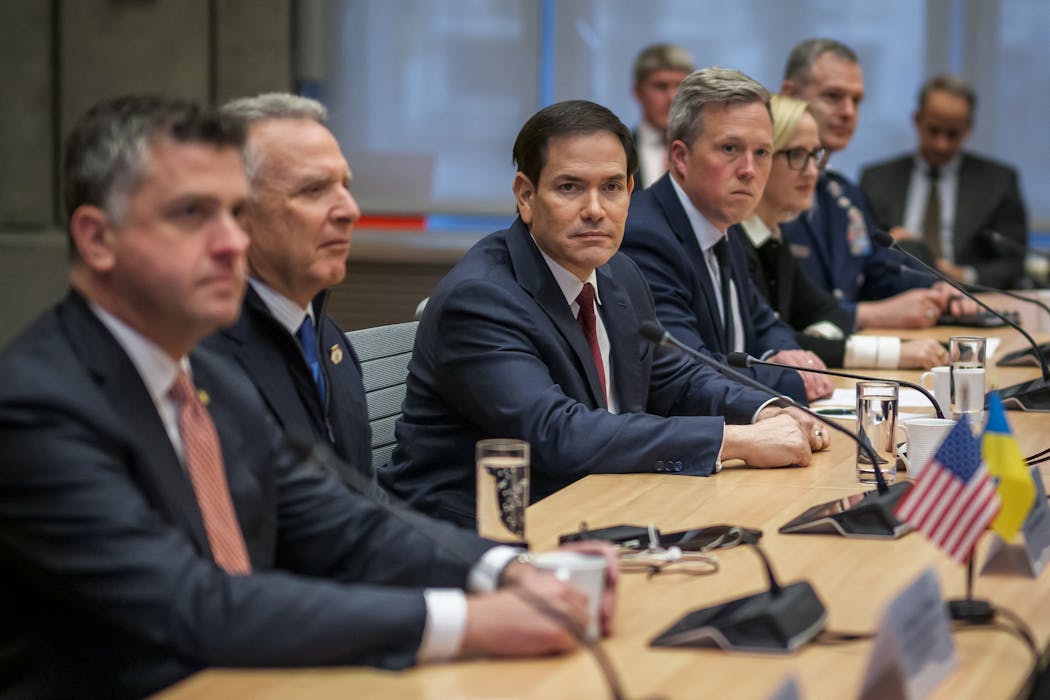
U.S. Secretary of State Marco Rubio, center, with U.S. delegation members faces the Ukrainian delegation during discussions in Geneva on Nov. 23, 2025, on a plan to end the war in Ukraine. Fabrice Coffrini/ AFP via Getty Images
As Russian bombs continued to pound Ukraine, a different conflict has blown up over plans to end that almost four-year-long war. The Trump administration on Nov. 20, 2025, formally presented Ukraine with a 28-point proposal to end the war, and President Donald Trump announced the country had until Thanksgiving to sign it. But Ukraine and its European and U.S. allies said the plan heavily favored Russia, requiring Ukraine to give up territory not even held by Russia, diminish the size of its military and, ultimately, place its long-term sovereignty at risk. The Trump administration was accused by policy experts and some lawmakers of fashioning a plan to serve Russia’s interests, and Secretary of State Marco Rubio got enmeshed in an argument with U.S. senators over whether the U.S. or Russia had authored the document. On Nov. 23, Ukrainian and U.S. officials held talks in Geneva, which Rubio declared were “productive and meaningful,” and those negotiations continue. The Conversation U.S. politics editor Naomi Schalit asked longtime diplomat Donald Heflin, now teaching at Tufts University’s Fletcher School, to help make sense of the chaotic events.
I have a whole list of questions to ask you, but my first question is what on earth is going on?
It’s hard to say. Ever since the Trump administration took power for the second time, it’s alternated between leaning towards Russia in this war or being more neutral, with occasional leaning towards Ukraine. They go back and forth.
This particular peace plan gives Russia a lot at once. It gets the size of the Ukrainian army cut down from 800,000-plus to 600,000, when the country is barely hanging on defending itself with 800,000 troops. Russia gets land, including land that it has conquered. A lot of people expected that might be one of the conditions of a Ukraine-Russia peace deal. But this also gives Russia land that it hasn’t taken yet and may never take.
It bars Ukraine from seeking NATO membership. That’s not a huge surprise. That was probably always going to be part of an eventual deal. Ukraine gets security guarantees from the West. Unfortunately, the U.S. gave ironclad security guarantees in 1994 when Ukraine gave up its nuclear weapons voluntarily. It’s been invaded by Russia twice since then, in 2014 and 2022. So our security guarantees really don’t mean a whole lot in that area of the world.
I think this is the most important part, what Putin is looking for more than anything else. Russia gets released from economic sanctions and it rejoins the group of G7 industrialized countries.
Putin’s economy is under a lot of stress. The cash that would flow in for the sale of Russian goods, particularly energy, would enable him to build a whole new army from scratch, if he needed to. That’s a huge strategic advantage. This would be a major shot in the arm for the Russian economy and for the Russian war economy.
So this is a very pro-Russian deal, unless it’s modified heavily, and there’s argument in Washington now whether the Russians just plain drafted it, or whether our State Department drafted it but for some reason leaned heavily towards Russia.
I’m inclined to think the original draft came from the Russians. It’s just too loaded up with the stuff that they want.
There was a fair amount of confusing back-and-forth on Nov. 23 that Rubio had told some senators that, in fact, the plan wasn’t generated by the United States, that it reflected a Russian wish list. The senators revealed this publicly. Then a State Department spokesman called that claim “blatantly false.” You’re a former diplomat. When you see that kind of thing happening, what do you think?
It’s amateur hour. We’ve seen this before. With this administration, it puts a lot of very amateurish people – Rubio’s not one of them – in place in important offices, like Steve Witkoff, the special envoy for Russia and Ukraine who is also the special envoy for the Middle East. And they’ve gotten rid of all the professionals. They either just fired some or ran some off.
So you know, the problem here is implementation. Politicians can have great thoughts, but they usually then turn to the professionals and say, “Here’s what I’m thinking.” The people they would turn to are gone. And that was their own doing – the left hand doesn’t know what the right hand is doing.
How might that affect the ultimate goal, which is peace?
This is a very delicate situation that calls for delicate peace talks from professional diplomats. There are a couple of things that need to happen and aren’t happening very much. First off, this is a war in Eastern Europe. Europe should be very involved now. They lean against Russia, so they probably can’t be honest brokers, but they need to be involved in every step of this process. If there’s going to be any rebuilding of Ukraine, Europe’s going to have to help with that. If there’s going to be pressure on Russia, Europe buys a lot of its goods, especially energy. They’re just a necessary player, and they haven’t been included.
Ukrainian President Volodymyr Zelenskyy meets with U.S. President Donald Trump at the 80th session of the United Nations General Assembly on Sept. 23, 2025. in New York City. Chip Somodevilla/Getty Images
What else?
The other is that when people have these great ideas, normally they would turn to their professionals. Those professionals would then talk to the professionals on the other side or other sides. Staff work would be done, then your presidents or your prime ministers or your secretaries of state would meet and hammer out the deal.
None of that’s happening in this process. People are having great thoughts and getting on planes, and that’s not a recipe for a permanent peace deal.
Europe is champing at the bit to try to get involved in this, because they’ve got professional diplomats still in place, and it affects them.
Why is this happening now?
The timing of all this is really interesting. Winter’s coming, and Northern Europe, particularly Germany, is very dependent on Russian natural gas to heat their homes. These sanctions against Russia make that difficult. They make it more expensive. Should Russia decide it wanted to play hardball, it could cut off its natural gas in Northern Europe, and people in Germany would be freezing in the dark this winter. This timing is not an accident.
Trump said he wanted an agreement by Thanksgiving. Is that a reasonable requirement of a process to bring peace after a multiyear war?
No, it’s not. I don’t know if they even realize this in the
Trump administration, but that’s another sign – just as we had ahead of the Alaska Summit between Putin and Trump – that this isn’t really about trying to make peace. It’s for show and to get credit. In a war that’s been going on now for almost four years, you don’t say, “OK, within the next week, come up with a very complicated peace deal and sign off on it and it’s going to stick.” That’s just not the way it works.
Donald Heflin does not work for, consult, own shares in or receive funding from any company or organization that would benefit from this article, and has disclosed no relevant affiliations beyond their academic appointment.
Amidst whatever is going on between JD Vance and Erika Kirk, the Vances has been in the conservative hotseat for being an interfaith and interracial couple.
Most recently, photos of Usha without her wedding ring have made the rounds.
Are they headed for a split? Can Usha explain the missing wedding band?
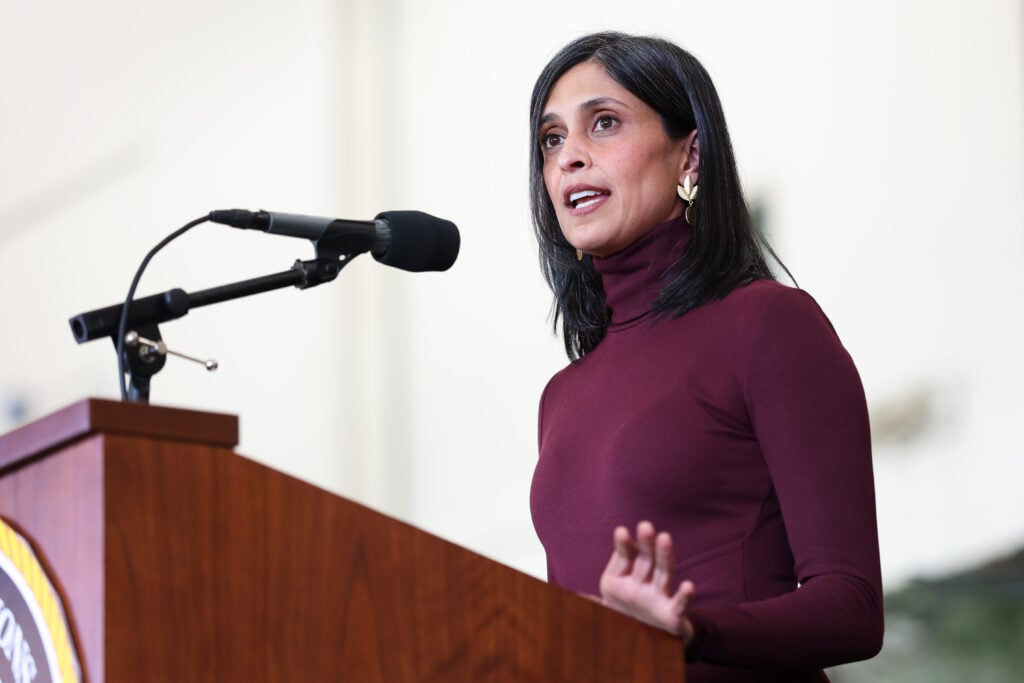
Usha Vance delivers remarks to military personnel and their families during a visit to MV-22 Mega Hangar on Marine Corps Air Station New River on November 19, 2025. (Photo Credit: Anna Moneymaker/Getty Images)
With Usha Vance going without her wedding ring, is she sending a message?
In recent photos — including formal public appearances — Usha Vance has very clearly been going without her wedding ring.
When traveling alongside Melania Trump to Camp Lejeune on November 19 (to talk about the role of technology in warfare, though it’s unclear why), she gave everyone an eyeful of her bare finger.
In real life, it’s normal for people to quickly run an errand without a wedding band. No, not for a cheater who’s on thin ice with a spouse, but for plenty of others.
Public figures live by a different set of rules. One of them is that going ringless in public as the spouse of one of the highest offices in the country generally sends a message.
Considering everything that’s been going on with JD Vance lately, is it really a surprise that Usha has been going without her ring?
I would like to apologize. USA Today has corrected me and Usha Vance stopped wearing her ring a day before I stated. 💀
Through her spokesperson, Usha has now responded to the understandable speculation about the status of her marriage.
According to the statement to People, she went without her ring because she is “a mother of three young children.”
The spokesperson went on to characterize Usha as someone “who does a lot of dishes, gives lots of baths, and forgets her ring sometimes.”
It would be very normal for an everyday person to forget their ring for exactly that sort of reason.
However, it is more remarkable for a millionaire to do so many dishes that she allegedly leaves her wedding ring at home while she flies to North Carolina to speak to troops on camera. At the very least, she could certainly have sent someone to fetch it. She didn’t.
JD Vance stands with his wife Usha Vance as they take part in a tour of the Dachau Concentration Camp memorial site in Dachau, southern Germany, on February 13, 2025. (Photo Credit: TOBIAS SCHWARZ/AFP via Getty Images)
Is JD Vance sleeping on the couch? (Sorry)
(We are not the first to make that joke and we will not be the last)
Recently, DJ Vance has attracted viral attention for some very public weirdness with highly publicized widow Erika Kirk.
As you may recall, far-right podcaster Charlie Kirk died in September. Due to the public nature of his shooting death and the public campaign to punish anyone celebrating or even insufficiently mourning him, there has been a lot of attention on his widow.
With all eyes on her, people could not help but notice how strangely close she seemed with JD.
“No one will ever replace my husband,” Erika herself publicly stated.” But I do see some similarities of my husband in JD — in Vice President JD Vance. I do. And that’s why I am so blessed to be able to introduce him tonight.”
Vance: Do I hope eventually that she is somehow moved in by church. Yeah, I honestly, I do wish that because I believe in the Christian gospel. And I hope eventually my wife comes to see it the same way. If she does not, then god says everybody has free will and so that does not… pic.twitter.com/IVVJfMFhKT
Additionally, there’s this unsettling clip in which JD Vance seemed to throw his wife under the bus to appease conservatives.
JD converted to Catholicism as an adult. His wife, Usha, is a Hindu.
White nationalists who voted for Trump have repeatedly and publicly taken issue with JD being part of an interracial marriage. By the same token, Christian nationalists have pushed even harder over him being in an interfaith marriage.
“Do I hope, eventually, that she is somehow moved by the same thing I was moved by in church? Yes,” JD Vance said of his wife in a public statement.
He continued: “I honestly do wish that, because I believe in the Christian gospel and I hope that eventually my wife comes to see it the same way.”
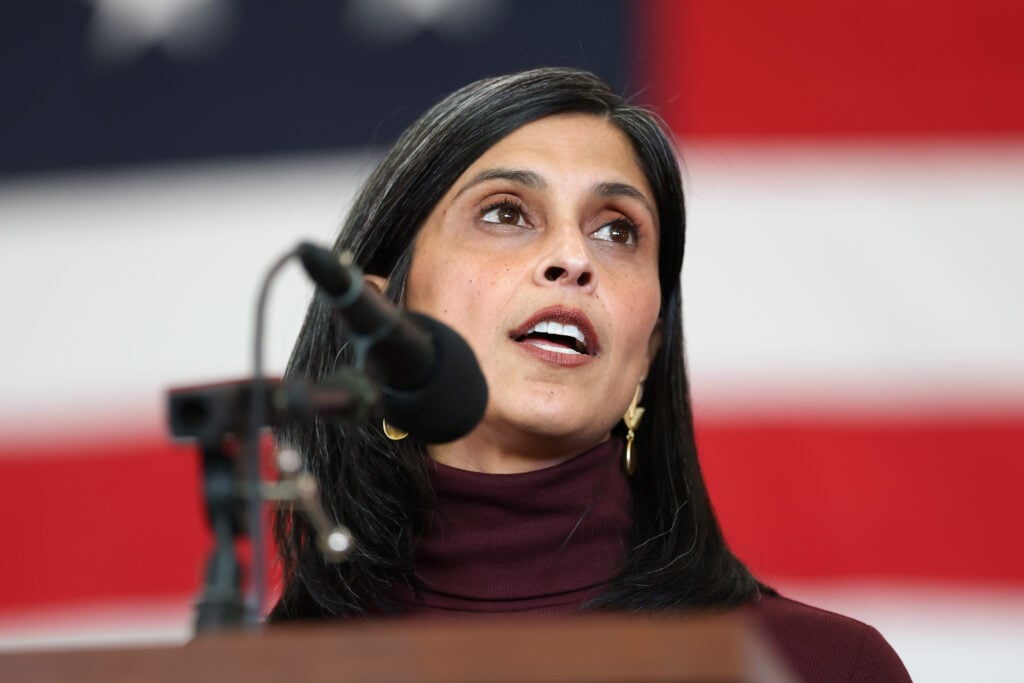
Usha Vance delivers remarks to military personnel and their families during a visit to MV-22 Mega Hangar on Marine Corps Air Station New River on November 19, 2025. (Photo Credit: Anna Moneymaker/Getty Images)
Are they actually going to divorce?
Seemingly overly friendly towards a grieving widow can come across as predatory. Or, at the very least, a little creepy.
Erika Kirk has made it very clear that she’s grateful for JD’s moral support. It doesn’t sound like sparks are flying. (And, not to be rude, but who exactly is going to fall in love with JD Vance?)
Publicly stating that you hope that your wife converts to your religions is on another level of hostility. It’s disrespectful and dismissive, whether your wife has her own religion or is not religious.
Everyone understands why JD spoke that way. It’s a political move to improve his standing in the eyes of the Republican base. And it very callously dismisses his wife’s personhood in the process. For JD, this may be a small price to pay.
But is she actually going to leave him? After everything that he has said and done, it seems unlikely. It’s not like he’s suddenly revealing himself to be a garbage person for the first time. He’s been unlikeable for many years. That’s his whole brand.
Obviously, if JD and Usha Vance divorced, it would be very funny. We could all use some comic relief amidst the horrors. But, for now, it doesn’t seem that likely.
Back in 2014, Morgan Geyser confessed to stabbing her friend 19 times, telling authorities that she sought to appease Slender Man, a fictional character who’s inspired countless memes.
Last week, Geyser removed her ankle monitor and fled the Wisconsin group home where she had been living.
Police were not notified until 12 hours later, and as news of the 23-year-old’s disappearance spread across social media, many began to fear the worst.
‘Slender Man Stabber’ Morgan Geyser has been found after removing her ankle monitor and fleeing the state. (YouTube)
Authorities in Madison say they eventually learned of the disappearance, but only after they were contacted by the corrections officers who were in charge of monitoring Geyser’s device.
They were informed that “she was not at the home and that she had removed her GPS bracelet.
Thankfully, authorities located in Illinois Geyser on Sunday night — nearly 200 miles from where she had disappeared.
To their surprise, Geyser had crossed state lines with the help of a friend.
Police responded to a call about a man and woman loitering near a truck stop, but they were initially unaware that they’d found the subject of a multi-state search party.
“After continued attempts to identify her, she finally stated that she didn’t want to tell officers who she was because she had ‘done something really bad,’ and suggested that officers could ‘just Google’ her name,” police said in a press release (via NPR).
“Once she provided her true identity, officers confirmed she was Morgan Geyser, who was wanted out of Wisconsin for escape after walking away from a group home where she had been placed.”
Many who were close to Geyser publicly urged her to turn herself in to authorities.
One person who attempted to send that message to Geyser was her attorney, Tony Cotton.
“Do not continue to remain on the run like this,” Cotton said in a video posted to Facebook. “It is not in your best interest to handle this matter that way.”
Geyser’s resaons for fleeing the group home remain unclear.
In 2014, she and an accomplice named Anissa E. Weier lured their friend Payton Isabella Leutner into a wooded area of a park in Waukesha, Wisconsin and stabbed her 19 times before leaving her for dead.
Leutner survived after being found by a bicyclist. Geyser and Weier were both found not guilty by mental disease or defect.
We will have further updates on this developing story as new information becomes available.
Tara Reid was rushed to the hospital over the weekend.
To those familiar with the low points of the Sharknado actress’ messed up history, the story and video of her might sound grimly inevitable.
There is a twist, however, because Tara says that she is not the one who put drugs in her system.
According to her, someone drugged her.
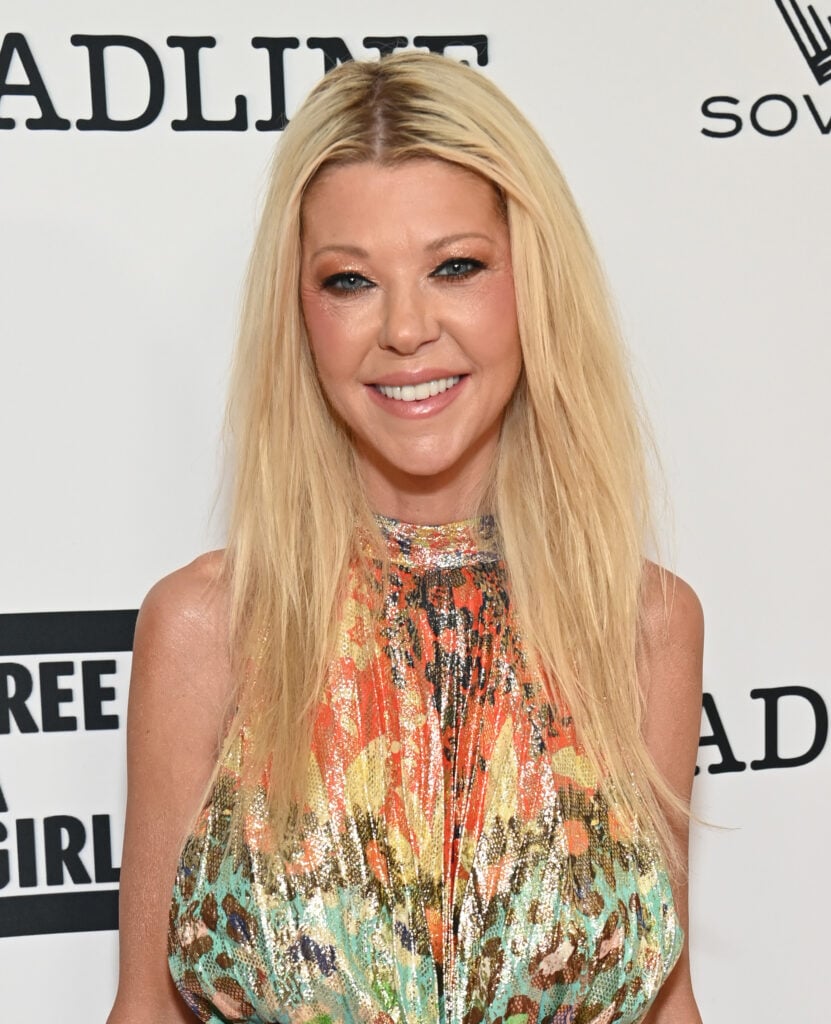
Actress Tara Reid attends Yolanthe Cabau’s “Free A Girl” Screening With DEADLINE at The London Hotel on July 19, 2025. (Photo Credit: Jon Kopaloff/Getty Images for Jane Owen PR / “Free A Girl”)
What happened to Tara Reid?
Early on Sunday, November 23, actress Tara Reid appeared in a harrowing video.
Someone’s camera captured a look at her on a stretcher.
Paramedics were transporting her to a nearby hospital.
According to the person who provided TMZ with the video, Tara made some eyebrow-raising statements prior to the arrival of paramedics.
You don’t know who I am. I am famous,” she allegedly proclaimed. “I’m an actress.”
#EXCLUSIVE 😳 Tara Reid claims she was drugged in a Chicago hotel then hospitalized.
Sometimes, celebrities behave in embarrassing manners in public places. Even more so than the non-famous, they are likely to end up on video.
And, yes, sometimes these moments happen while the person in question is under the influence.
However, before people start asking Tara if this is “going to ruin the tour,” we should keep in mind that not every public incident is the same.
In this case, Tara says that she may have had something to drink the night before — but that didn’t cause this.
Instead, she says, someone drugged her against her will and without her knowledge.
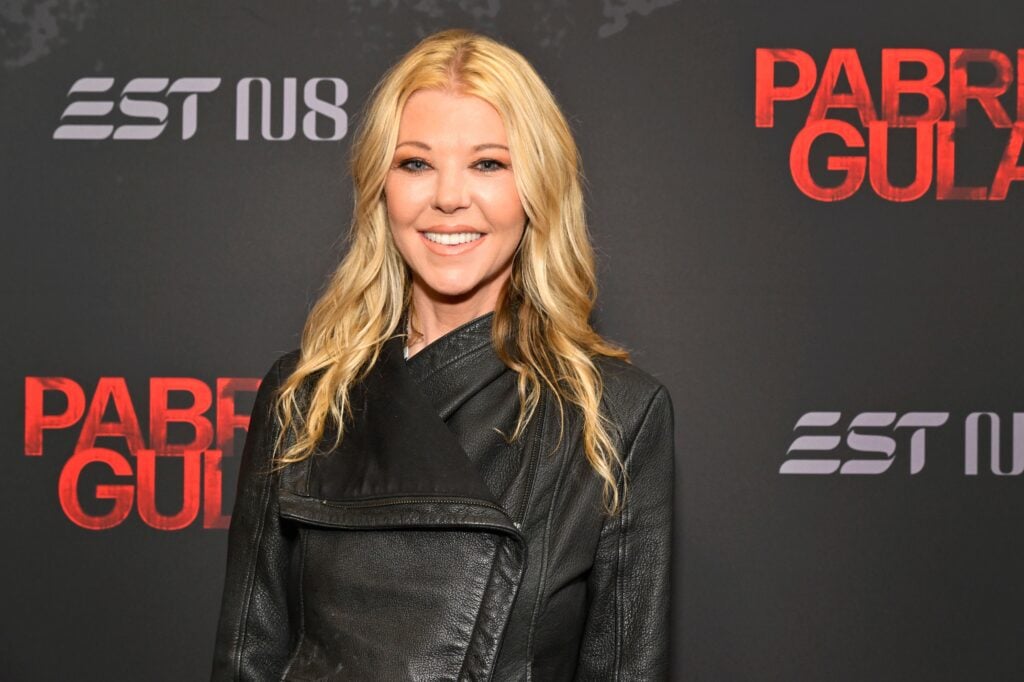
Actress Tara Reid attends the U.S. Premiere of “Pabrik Gula” in Los Angeles at AMC The Grove 14 on March 26, 2025. (Photo Credit: John Sciulli/Getty Images for Jane Owen Public Relations)
Someone DRUGGED Tara Reid?!
Speaking to TMZ, Tara Reid says that what happened was not her doing.
According to the actress, she had checked in to her hotel room late on Saturday, November 22.
She then went downstairs, looking to smoke (cigarettes) and drink.
Tara went to the bar, ordered a drink, and then stepped outside to smoke a cigarette.
She ended up sharing a cigarette with a YouTuber whom she had encountered in the lobby.
Tara Reid attends Vegan Fashion Week at California Market Center on October 09, 2023. (Photo Credit: Frazer Harrison/Getty Images)
Eventually, Tara decided to swap to alcohol, and returned to the bar.
She found her drink with a napkin placed on top of it — emphasizing that she did not place it there.
According to Tara, she removed the napkin and drank from her glass.
That was the last thing that she remembers before waking up in the hospital. We’re talking about hours of missing memory.
Certain drugs that can cause memory loss, like GHB, only remain detectable via urine tests for a matter of hours after ingestion. It is unclear if Tara will get answers.
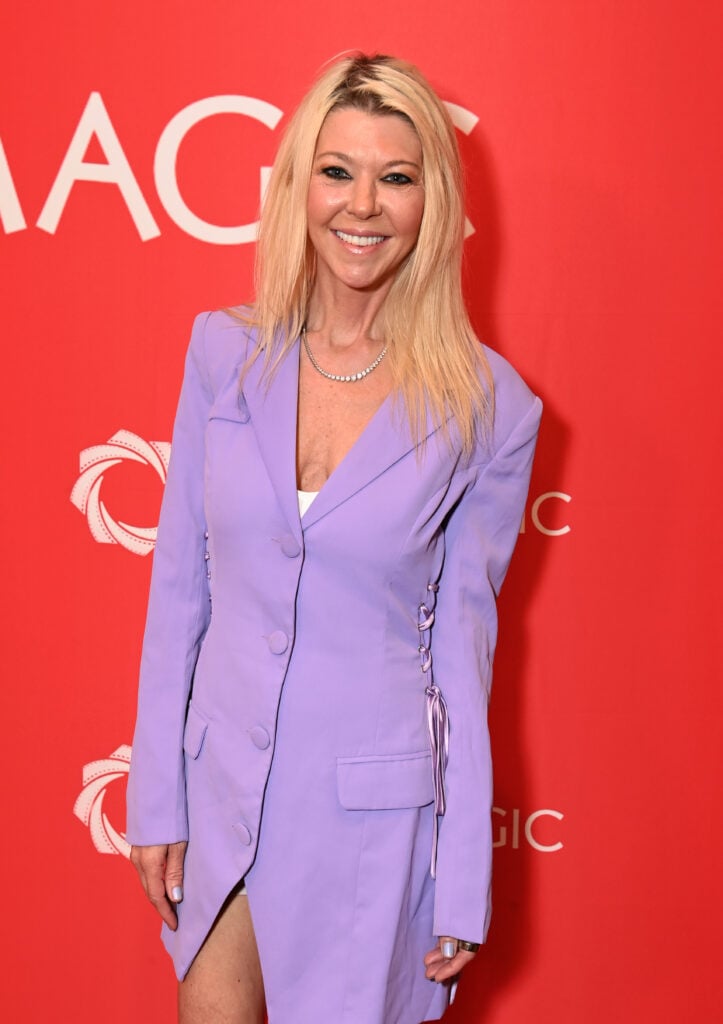
Tara Reid attends Cinemagic Los Angeles Film Showcase 2025 at Fairmont Miramar – Hotel & Bungalows on June 20, 2025. (Photo Credit: Jon Kopaloff/Getty Images for JOPR)
This can happen so quickly, so easily
Obviously, Tara Reid has a documented history with substance abuse struggles. Nearly two decades ago, she claimed the rehab had saved her life.
(She is not exactly sober these days — as her somewhat infamous nicotine dependence and the role of alcohol in this harrowing story highlight)
That does not mean that she cannot be telling the truth. Drugging someone at bars is a danger.
Even if Tara were not famous (she is), had never been a sex symbol (a quarter century ago, she truly was), she could be targeted by someone. Also, random drugging — someone spiking one or more drinks and looking to see who is clearly under the influence — happens.
Tara says that she had only one drink. Hopefully, witnesses or hotel surveillance footage can identify who may have drugged her drink. Such a person would be a danger to society.