NOTN- Sealaska Corp. has appointed Sarah Dybdahl as its new president, making her the first woman to lead the regional Native corporation.
The Sealaska Board of Directors voted unanimously to select Dybdahl after a national recruitment process, the corporation announced Monday. Her appointment comes as Sealaska updates its strategic plan and works to refine its mission and vision.
Dybdahl, Sarah Dybdahl (Aanshawatk’i), Taakw.aaneidi clan, grew up in Klawock, Alaska, and has dedicated her career to advancing cultural heritage, education and the prosperity of Native communities. She holds a Bachelor of Arts degree in Anthropology and currently serves as the Director to the Office of the President for the Central Council of the Tlingit and Haida Indian Tribes of Alaska, She also serves on the boards of the Alaska Federation of Natives and Native Americans in Philanthropy, as well as the Klawock Heenya Corporation.
“The board of directors devoted significant time to selecting the right individual to lead Sealaska. We are at a pivotal moment in our growth — taking the lessons learned from our international businesses and bringing that knowledge home to Southeast Alaska,” said Richard Rinehart, Sealaska board chair. “As we recognize the strengths that Sarah brings to Sealaska, we also honor the deep roots she has established not only with surrounding Tribes but with community partners as well. We look forward to strengthening these relationships as Sealaska grows under her leadership.”
Dybdahl succeeds interim president Joe Nelson, who will continue to serve on Sealaska’s board.
“It is an honor to serve Sealaska and our shareholders,” said Dybdahl. “Growing up in Klawock, I was shaped by the strength of our people and our culture, and I look forward to building on that foundation to create opportunities that uplift our communities for generations to come.”
In the coming months, Sealaska will share more about President Dybdahl and the vision for sustaining Sealaska’s growth.
“I hope our shareholders and Southeast communities can feel the same excitement and confidence we do — that President Dybdahl will carry forward the growth we’ve achieved in recent years and open new doors for working together in ways that truly benefit Sealaska, our people, and our communities,” said Rinehart.
GRUNDY, VIRGINIA – OCTOBER 07: Patients have their blood pressure checked and other vitals taken at a intake triage at a Remote Area Medical (RAM) mobile dental and medical clinic on October 07, 2023 in Grundy, Virginia. More than a thousand people were expected to seek free dental, medical and vision care at the two-day event in the rural and financially struggling area of western Virginia. RAM provides free medical care through mobile clinics in underserved, isolated, or impoverished communities around the country and world. As health care continues to be a contentious issue in America, an estimated 29 million Americans, about one in 10, lack coverage. An estimated 27 million people — or 8.3 percent of the population of America- were uninsured, according to a report from the Census Bureau. This rate is considerably high in rural and poorer parts of the country. (Photo by Spencer Platt/Getty Images)
A combination of Trump administration policies will make health care coverage more expensive for people who purchase plans from health insurance marketplaces — and rural residents will be hit the hardest, according to a new analysis.
Researchers from the Century Foundation say Trump administration policies — especially its refusal to ask Congress to extend Biden-era tax credits that are set to expire at the end of this year — will boost out-of-pocket premiums by 93% in the 32 states that allow the federal government to operate their Affordable Care Act insurance marketplaces. New rules and tariffs will have a smaller impact.
Rural county residents in those states will see an increase of 107%, while residents of urban counties will pay 89% more, according to the analysis by the Century Foundation, a left-leaning research nonprofit.
Insurers participating in the Affordable Care Act marketplaces are proposing a median premium increase of 18% for 2026 — the biggest jump since 2018 and 11 points more than the growth from 2024 to this year. That bump would come on top of the increase resulting from the expiration of the tax credits and the other policy changes.
About 2.8 million people who are enrolled in marketplace plans in the 32 states live in rural counties, including 776,000 adults between the ages of 55 to 64 and more than 223,000 children, according to the Century Foundation.
“Rural residents tend to be older. They may be more likely to have chronic illness at the same time,” said Jeanne Lambrew, director of health care reform at the foundation. “It costs more, both because they have somewhat greater needs and less access to health care.”
The researchers calculated that average annual premiums for rural residents will increase by $760 — 28% more than the expected average increase for urban residents. States where rural enrollees are expected to see the highest cost increases are Wyoming ($1,943), Alaska ($1,835), and Illinois ($1,700).
Many of the states with a large number of rural residents have chosen not to expand Medicaid under the Affordable Care Act, meaning many people who earn between 100% and 138% of the federal poverty level, between $15,650 and $21,597 for an individual, get their coverage from an insurance marketplace, Lambrew said.
Of the seven states where 10% or more of rural residents are enrolled in marketplace plans (Alabama, Mississippi, Nebraska, North Carolina, South Carolina, Texas and Wyoming), only two — Nebraska and North Carolina — have expanded Medicaid.
State officials in Pennsylvania recently advised residents who use the marketplace that they should closely examine the plans that are available.
“This year, even more than previous years, Pennsylvanians should consider shopping around to find the best plans to meet their individual needs, at a price that makes sense for their current financial situation,” Pennsylvania Insurance Commissioner Michael Humphreys said in a statement released at the beginning of this month.
Lambrew said the increases will force many people to forgo insurance altogether.
“It’s harmful for those individuals in terms of their own health and life expectancy. It’s harmful for our providers, because they’re now dealing with people who are sicker and in the wrong settings, and it’s kind of expensive for our society,” Lambrew said.
“We know health insurance matters, so having these large potential increases on uninsured Americans is distressing.”
Stateline is part of States Newsroom, a nonprofit news network supported by grants and a coalition of donors as a 501c(3) public charity. Stateline maintains editorial independence. Contact Editor Scott S. Greenberger for questions: info@stateline.org.
Screenshot of Backloop Bridge Damage, sent to KINY
NOTN- Repairs continue on the Mendenhall River Back Loop Bridge after the record glacier lake outburst flood this month caused severe damage, authorities reported.
The flood scoured an area approximately 16 feet deep, 50 feet long, and 120 feet wide, displacing roughly 3,555 cubic yards of material, equivalent to about 300 dump-truck loads.
Since Saturday, Aug. 16, crews have excavated more than 22 feet to reach stable material and begin rebuilding around the undermined but stable bridge structures. Officials said about 5.7 million pounds of rock have been placed to restore the riverbanks and roadway.
If conditions allow, officials are targeting a reopening of the bridge by tomorrow, Aug. 26, with paving to follow depending on crew availability. Authorities urged motorists to be patient, noting that safety and long-term durability guide the reconstruction effort.
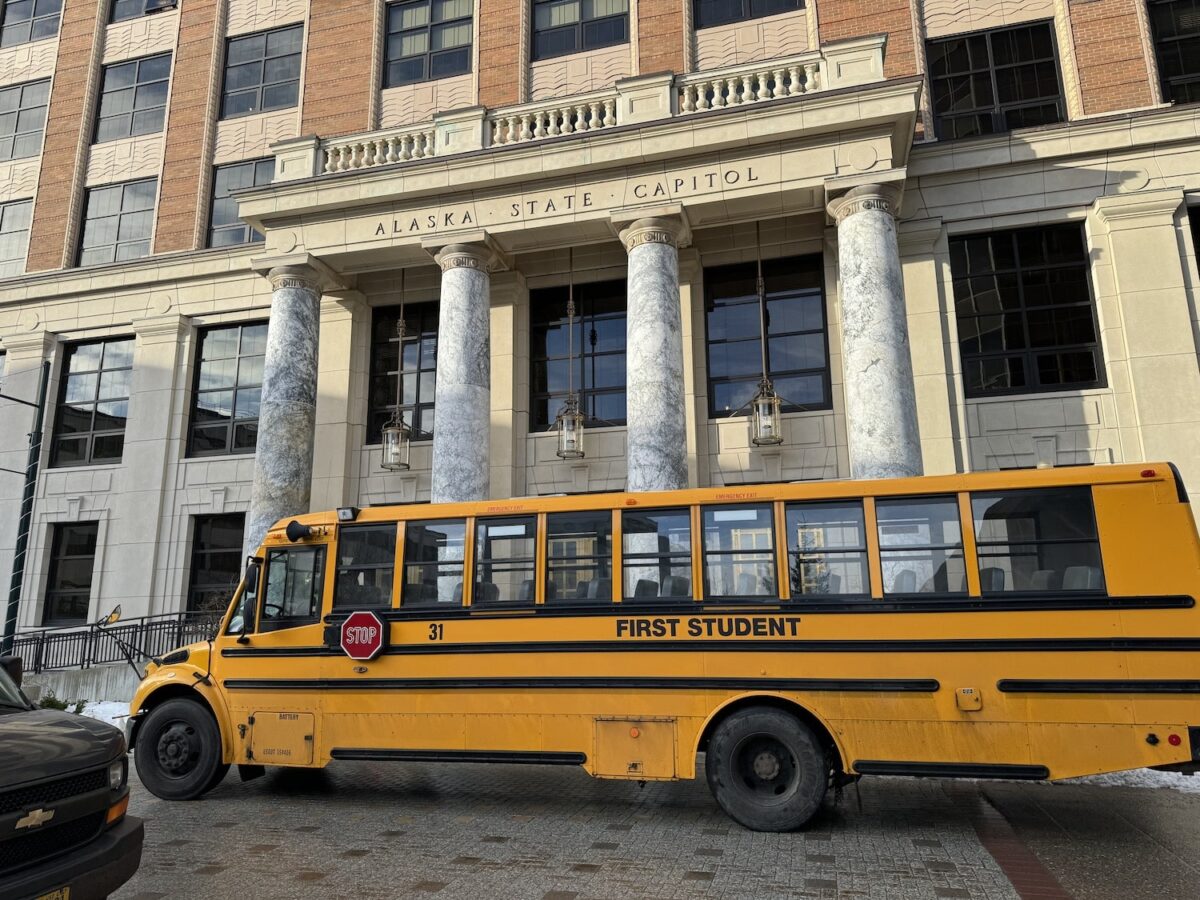
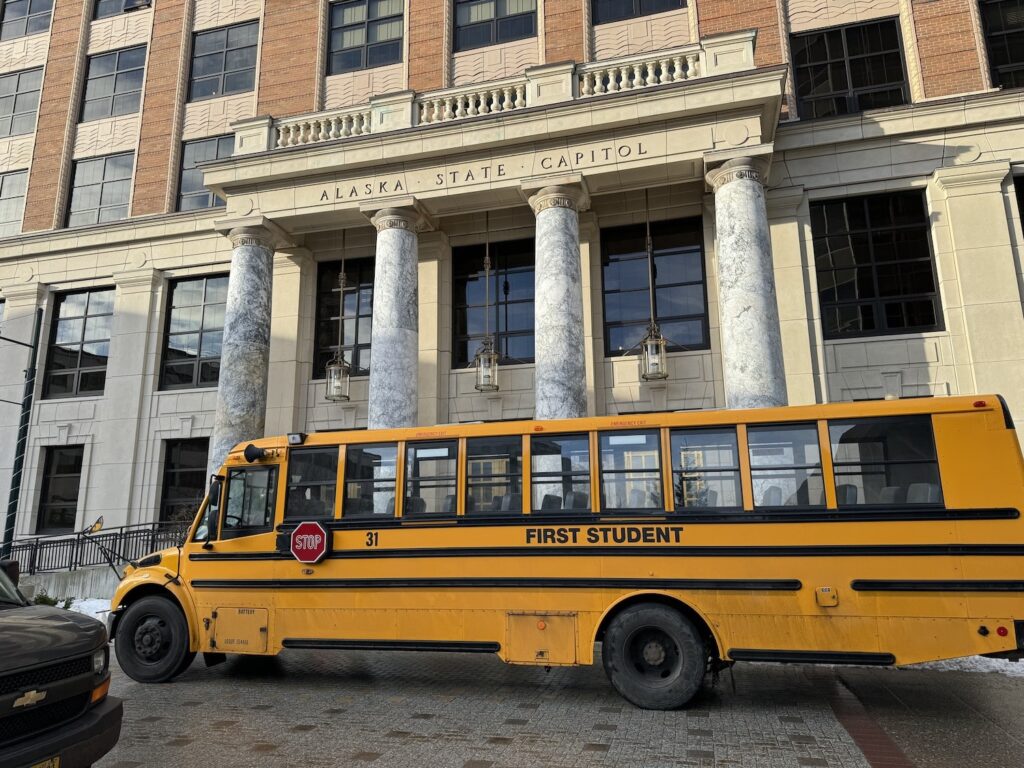
A school bus passes in front of the Alaska Capitol on Tuesday, Feb. 6, 2024. (Photo by James Brooks/Alaska Beacon)
A school bus passes in front of the Alaska Capitol on Tuesday, Feb. 6, 2024. (Photo by James Brooks/Alaska Beacon)
NOTN- Alaska lawmakers will hold the first meeting of the Education Task Force today, beginning a 17-month process to evaluate the state’s approach to school funding and policy.
The task force, is charged with producing a report to the full legislature that will examine education funding formulas as well as policy items championed by the governor and other lawmakers.
“it’s a really broad mandate.” Said Juneau Senator Jessie Kiehl, we’ll look at education funding, look at some policy issues, including several that were on the governor’s wish list, and and really dig in.”
The Education Task force is described as multipartisan, with both democratic and republican leaders starting work this August.
“We’re going to bring in a lot of information, a lot of experts, and see if we can figure out what the state needs to do, to really improve education stability, education funding and outcomes for Alaska kids.” said Kiehl.
The panel’s creation stems from House bill 57, and is part of Alaska’s ongoing political and financial discussions surrounding education.
“This task force was in the bill that the Governor vetoed, that Bill had, of course, most importantly, the funding stabilization, but then it also had a number of education policy things that the governor wanted, some legislators wanted,” Kiehl said,”The governor’s veto, he said, was because he didn’t get all of the policy pieces he wanted. One of the things this task force is going to look into is some of those policy pieces that just did not have support in the legislature.”
Task force members said they will revisit some of those disputed policy proposals while focusing on long-term solutions to strengthen education in Alaska.
Nick Beckage, a graduate researcher, Davin Louangaphay, a research assistant, and Philippe Amstislavski, a professor of health sciences, stand among spruce trees on the University of Alaska Anchorage campus on April 30, 2025, with one of the insulating seafood boxes they created with a cellulose-mycelium blend. (Photo by Yereth Rosen/Alaska Beacon) Philippe Amstislavski, a professor of health sciences, holds a cube of insulating material created with a blend of cellulose from beetle-killed trees and mycelium, the fibers found in fungi. He and his research partners want to use these natural materials as a substitute for plastic foam. (Photo by Yereth Rosen/Alaska Beacon)
Every year, copious amounts of plastic foam boxes are used to ship Alaska seafood.
Instead of using plastics that contribute huge amounts of carbon emissions in their manufacture and huge amounts to pollution after their disposal, could Alaskans use environmentally friendly local materials to ship fish and provide other insulation?
University of Alaska Professor Phillippe Amstislavski, in his lab on June 9, 2025, holds a slab of moist cellulose, derived from spruce pulp, and mycelium, the fibers that cause fungal growth. The combination, once dried and hardened, will form a non-polluting type of insulation intended to be a substitute for Styrofoam and other plastic foam. (Photo by Yereth Rosen/Alaska Beacon)
A team led by a University of Alaska Anchorage professor is tackling that question.
Philippe Amstislavski, a professor of public health at UAA, and his colleagues have created an insulation box from a blend of cellulose and fibers from fungi. To him, it is an appropriate invention for Alaska, where he estimates that more than 1 million plastic foam boxes are used annually to hold fish.
“Our economy is dependent on seafood. And the ability to get fish to markets is really important,” he said. But while Alaskans value sustainable fish harvests, what about sustainable fish shipments? “How do we become materially independent?” he asks.
One solution, he believes, lies in materials that exist in abundance in Alaska’s boreal forest, including the woods on and near UAA’s campus: dead trees and fungi.
The key ingredient is mycelium, the fibrous, vegetative part of fungi. Mycelium creates a strong bond when it is weaved into web-like structures. Amstislavski and his team grow mycelium in their lab in cellulose foam created from wood pulp. The resulting material that, when dried, is durable, insulating and water-repellent. The growth process takes just days.
A beetle-infested spruce tree is seen at Goose Lake Park on July 29, 2025. The park borders the University of Alaska Anchorage campus. (Photo by Yereth Rosen/Alaska Beacon)
For cellulose, they use spruce trees that have been killed by a beetle infestation that has spread over millions of acres in Alaska, including to trees outside the door to the UAA lab building where they work.
The work addresses a global problem with special Alaska significance.
Over its lifetime, Styrofoam and similar plastic insulating foam are carbon intensive.
The product itself is generally made from fossil fuels. Its manufacture uses the energy from more fossil fuels. Though lightweight, it must be transported over long distances to reach Alaska, which also requires fossil fuels. As it ages, plastic foam can release gases known as volatile organic compounds. When it breaks down into debris, the foam crumbles into increasingly small pieces, eventually becoming tiny microplastics swirling in the ecosystem that are difficult to see and nearly impossible to corral but create a big impact.
“It’s this whole, kind of perfect cycle of carbon emissions and pollution that they’re generating every time you use it,” Amstislavski said. “So how do you break it up? How do you challenge it? How do you create alternatives?”
Philippe Amstislavski, a professor at the University of Alaska Anchorage, sits in his biomaterials laboratory on June 9, 2025. Amstislavski, who specializes in environmental health, is leading a project to create a natural, Alaska-grown subtitute for polluting plastic insulation foam. The cellulose-mycelium blend that he and his research partners have created draws on his longtime interest in mushrooms; mycelium is the fiber responsible for fungal growth. (Photo by Yereth Rosen/Alaska Beacon)
Plastic impacts on Alaska
For marine- and fish-dependent Alaska, where disposal or recycling options are limited, plastic pollution is a serious problem, even in remote locations.
Microplastics from distant sources have become concentrated in high latitudes, brought north by ocean and atmospheric currents.
Climate change, which is amplified in the far north, has helped concentrate microplastics in the region because debris previously locked into sea ice or glacier ice is now being released through accelerated melt.
A study by Chinese researchers published earlier this year found microplastics in every single ice sample taken from Elson Lagoon in Utqiagvik, the nation’s northernmost community, and from every sample of Chukchi Sea ice taken nearby off the coast of Point Barrow, the spit of land extending north from town. An earlier study found microplastics in every sample taken from waterways in Anchorage, Alaska’s largest city, and in other waterways in Southcentral Alaska.
Microplastics have been found in the bodies of walruses harvested by Indigenous hunters in the Bering Strait region, in fetuses of spotted seals and in Alaska fish such as pollock.
Polystyrene and other plastics litter a remote beach in Alaska in 2012. (Photo provided by the National Oceanic and Atmospheric Administration)
The abundance of plastic waste that has accumulated in Alaska is striking, said Amstislavski’s research assistants.
“I was driving to Eagle River, and I was looking at the side of the highway, and there was a bunch of plastic trash laying on the side,” said Davin Louangaphay, one of the technicians. “And I was, like, ‘Wow, there’s so much out there.’ And I feel like it’s just been increasing over the years as I’ve grown up.”
Eco-friendly boxes for Alaska seafood
The fish-box project is supported by a grant from the National Oceanic and Atmospheric Administration. The UAA team has partners on the Kenai Peninsula, including the Center for Alaskan Coastal Studies and seafood companies like Kachemak Bay Shellfish Growers Co-Op and Salmon Sisters.
The seafood industry partners are enthusiastic, said Alex Ravelo, a University of Alaska Fairbanks postgraduate researcher working on the project.
“Nobody likes Styrofoam. That’s the reality. Everybody’s well aware of how bad it is for the environment,” she said.
Results from a test conducted over the past winter and spring are promising.
Alex Ravelo, a postgraduate researcher, stands in the University of ALaska Anchorage biomaterial laboratory on June 9, 2025, holding an insulating seafood box made from a cellulose-mycelium mix. The project, led by UAA professor Philippe Amstislavski, aims to develop a natural substitute for plastic foam. The plastic foam used for insulation in Alaska and elsewhere has a big carbon footprint, from its manufacture to its disposal, and it creates widespread pollution that has become embedded in the marine food web. (Photo by Yereth Rosen/Alaska Beacon)
Prototypes of what the team has called “MyghtyBox” were built by Amstislavski, Ravelo and Davin. The Center for Alaskan Coastal Studies put frozen salmon, halibut, shrimp and scallops into them. The filled and sealed boxes were sent from Homer to New York, Kansas and Florida. In addition, a box with live Alaska oysters was sent to Minnesota.
All but one arrived safely and sufficiently chilled, according to federal safety standards. The exception was the shipment to Florida, which was delayed for three days after it was accidentally left on the hot tarmac.
The MyghtyBox project has yet to reach any kind of commercial stage. As of early summer, the number of constructed boxes totaled only about 30, Amstislavski said. Scaling up production is a challenge yet to be cracked.
Home insulation possibilities
The fish-box project is part of a larger mycelium-cellulose vision.
A mobile test lab, set up as a simulated cabin with cellulose-mycelium insulation, is seen on June 5, 2025, at the National Renewable Energy Laboratories site at the Cold Climate Housing Research Center in Fairbanks. (Photo by Yereth Rosen/Alaska Beacon)
A broad goal is to use this all-natural, all-Alaska foam for home insulation, particularly in rural areas. Housing there is notoriously expensive, overcrowded and unsuitable for the environment, especially as the climate continues to change.
Building new homes in rural Alaska is especially difficult because materials must travel over long distances to be used during short summer construction seasons. If materials don’t arrive in time, construction activities can be delayed for a full year.
Mycelium-based board could be a cheaper, faster-delivered, more convenient and higher-quality building material. In partnership with Amstislavski’s team, the National Renewable Energy Laboratory is investigating the possibility.
NREL researchers, operating at their site on the edge of the University of Alaska Fairbanks campus, have been testing different blends of cellulose-mycelium insulation.
There, at the site on the Cold Climate Housing Research Center campus, a mock cabin was set up as a mobile test lab, with panels of mycelium board of varying thicknesses, along with a section of currently used plastic insulation that served as a control. Performance has been measured at each of the panels.
Georgina Davis, a project manager at the National Renewable Energy Laboratory in Fairbanks, holds a sample of cellulose-mycelium insulation on June 5, 2025. Davis is standing in a mobile test lab set up as a mock cabin. It different sets of cellulose-mycelium panels. and instruments are measuring the performance of each. The hope is that the all-natural, all-Alaska materia will be an eco-friendly substitute for plastic insulation foam. (Photo by Yereth Rosen/Alaska Beacon)
The project is about more than eco-friendly building materials, said Georgina Davis, an NREL research project manager working on the experiment.
Mycelium insulation could also address a quality problem that plagues Alaska homes, and particularly those in rural areas, where homes are old and weather-beaten: mold. The materials used widely in the Lower 48 can fare poorly in Alaska’s climate, Davis said.
“If you put two inches of foam around any house in Alaska, you’re going to create prime conditions for mold,” she said. “That’s wrecking a good percentage of homes in rural Alaska.”
Unlike plastic foam, which traps moisture, mycelium insulation can be breathable, she said.
The result of the NREL experiment are now being analyzed.
Interest in mushrooms began in the Russian Arctic
For Amstislavski, the journey to the Alaska cellulose-mycelium project has been something of a circle covering wide geographic and cultural distances.
He grew up in Russia, where his fishery biologist father worked in the Nenets region in theEuropean Arctic. There, as a young boy, he was immersed in Indigenous Nenets culture, which includes mushroom harvesting. There, mushroom harvesting is not just a pastime, but an important subsistence activity, especially in Soviet times, when other foods were scarce.
“I was lucky enough to be in a place with people who understood the landscape and the world, in a deeper, introspective way,” he said.
A mushroom clings to a tree in Anchorage’s Goose Lake Park on July 29, 2025. This type of mushroom, sometimes called a hoof fungus, has been traditionally used by Indigenous tribes for medicinal purposes. (Photo by Yereth Rosen/Alaska Beacon)
After the Iron Curtain fell, he moved with his family to Israel, where he pursued a nursing career. He became interested in architecture, which led him to move to New York. Before he completed his architecture degree, he served as a first responder tending to victims of the Sept. 11 attack on the World Trade Center. That experience gave him first-hand knowledge of respiratory ailments and lung-damaging chemicals. It also further stimulated his interest in environmental health and its relationship to the built environment.
Amstislavski then earned a master’s degree from the Yale School of Forestry and Environmental Studies, where one of his mentors was Tom Siccama, an expert in fungi. “He knew everything about North American mushrooms,” he said.
He then got a Ph.D. in environmental sciences from the City University of New York and taught for a while at the State University of New York before being lured to Alaska. That happened when he presented his research at a circumpolar conference in Fairbanks in 2012, which led to a job as a state public health manager, a position involving travel to rural villages. He came to UAA in 2014, a position that enabled him to study in Finland in 2021 on a Fulbright scholarship.
Amstislavski and his team members are not the only researchers looking at fungus as a solution to plastic problems.
Oyster farmers in Maine, for example, have experimented with buoys made of mycelium. British fashion designer Stella McCartney in 2021 unveiled some faux-leather products crafted from mycelium. A Seattle company is developing a variety of products, from foods to construction materials, out of mycelium.
University of Alaska Professor Philippe checks on June 9, 2025, on the growth in a sample of mycelium-embedded cellulose blocks in a petri dish held by Alex Ravelo, a postgraduate researcher. Ravelo was testing a particular combination of cellulose and mycelium, the fibers that form the root structure of fungi. Mycelium, once dried, forms a strong bond. (Photo by Yereth Rosen/Alaska Beacon)
Alaska challenges
While mycelium development proceeds elsewhere, Alaska projects have some obstacles.
The University of Alaska does not have the type of well-connected business incubators that exist at universities like Harvard, though UAF’s Center for Innovation, Commercialization, and Entrepreneurship has supported the mycelium research.
Alaska, with its remote location and high shipping costs, lacks the type of well-developed manufacturing capacity that exists in most states. Manufacturing in Alaska is dominated by seafood processing, which provides about two-thirds of the sector’s employment, according to the state Department of Labor and Workforce Development.
A new challenge comes from Trump administration decisions to axe funding for environmental research and climate change work.
The $2.5 million U.S. Department of Energy grant awarded in 2023 for the building-insulation project at NREL will not be renewed, the team recently learned.
Funding for NOAA has been drastically cut, though impacts to its marine debris programs and services are yet to be determined.
The Trump administration has resisted attempts to curb plastic pollution, most recently putting up roadblocks that led to the collapse of negotiations on an international plastics treaty.
Amstislavski hopes that entities beyond the federal government, including the private sector, will step in to support mycelium product development.
Aside from its environmental benefits, mycelium could help build Alaska’s workforce, a subject of concern for state officials, he said.
“It’s an opportunity for interesting jobs that are meaningful to people that have positive impacts in the world,” he said.
Mushrooms growing on a trees stump at Anchorage’s Goose Lake are seen on July 29, 2025. In the background are birch and beetle-infested spruce trees. A University of Alaska Anchorage-led project is creating an eco-friendly insulation material from pulped beetle-killed spruce and mycelium, the strong fibers contained in mushrooms. The materials are widely available; Goose Lake Park borders the UAA campus. (Photo byYereth Rosen/Alaska Beacon)
Jillian Michaels is back in the figurative crosshairs.
As you may know by now, one of the most popular current programs on Netflix is titled Fit for TV: The Reality of the Biggest Loser.
It features past contestants from that reality show making allegations about the dangerous weight loss practices they were forced to take part in — almost always, in their view, at the behest of Michaels.
“She’s horrible. She’s just a horrible person,” Jackie Warner stated on the August 22 episode of the Hot Take & Deep Dives podcast, adding of one instance in which this description proved to be true:
“Jill was ready to punch, ready to spit, ready to curse in a beautiful restaurant surrounded by dressy, classy people.”
Warner — also a fitness guru who said she dated Jillian for seven years — recalled her former girlfriend “screaming and cursing so much at the table with me and her mom that we were asked to leave” during this same interview.
The 57-year-old continued of Michaels: “I used to call her Tasmanian Devil. She used to get herself worked up.”
HIIT class with personal trainer Jillian Michaels from the Biggest Loser at the first day of the Wellness Your Way Festival at the Colorado Convention Center on August 16, 2019 in Denver, Colorado. (Photo by Tom Cooper/Getty Images for Wellness Your Way Festival)
Warner said that the trainer’s behavior was so “embarrassing” that she ultimately “fell out of love with her completely.” That certainly seems to be clear at this point, doesn’t it?
Last week, Michaels pushed back against allegations that she sharply restricted the calorie intake of Biggest Loser contestants and that she ignored medical advice from the show’s doctor.
“I have an example of a direct written correspondence with a contestant, while she was home for the holidays during filming,” Michaels wrote on Instagram, “in which I explicitly instructed her to consume 1,600 calories per day.”
Michaels shared two more alleged screenshots at the time with The Biggest Loser staffers that emphasized her “ongoing priority of ensuring contestants were adequately nourished and the need to provide a steady supply of fresh food in the BL house to guarantee ready access to calories.”
NEW YORK, NEW YORK – Jillian Michaels visits SiriusXM Studios on January 6, 2020 in New York City. (Photo by Dia Dipasupil/Getty Images)
We don’t know anything about all of this.
Earlier this month, however, Biggest Loser co-star Bob Harper chided Jillian for NOT reaching out to him after his 2017 heart attack.
“We weren’t besties, but we were partners on a television show for a very long time,” he told The Guardian, explaining that such behavior “spoke volumes.”
To be clear, Harper — who was a trainer on The Biggest Loser from 2004 until the show’s finale in 2020 — added that he would never expect Jillian “to do anything other than what she wants to do.”
For her part, meanwhile, Michaels has said that she was “shocked and disappointed” by Harper’s insults.
“I’m not here to get into catty, b–chy, nasty name-calling,” the 51-year-old emphasized on the Hot Mics with Billy Bush podcast following his interview. “I actually do hope that Bob is happy and well.”
Over a year after tying the knot to Bleachers frontman Jack Antonoff, Margaret Qualley also starred in The Substance, one of the most critically acclaimed movies in 2024. With her romance with the rockstar producer, some fans have been wondering: is Margaret Qualley pregnant?
Margaret has appeared in plenty of hit movies and TV shows, after making her debut in 2013’s Palo Alto. That same year, she starred in in the HBO series The Leftovers.
Since then, Margaret has plenty of other major films and shows, like Once Upon a Time in Hollywood, Fosse/Verdon, and Maid. Most recently, fans have been flocking to her after The Substance became an Oscar-nominated hit.
Margaret Qualley attends the 30th Annual Critics Choice Awards at Barker Hangar on February 07, 2025 in Santa Monica, California. (Photo by Frazer Harrison/Getty Images)
In August 2023, she married Jack, and the pair seem head over heels for each other.
Naturally, fans are curious if the couple plans to have a family of their own. Keep reading to find out more about their family plans.
Is Margaret Qualley Pregnant?
In short, Margaret is not pregnant. There is currently no evidence to suggest that she may be expecting a child. With just over a year of marriage under their belt, it seems like the actress and her husband are enjoying time to themselves.
While they don’t currently have any children, Margaret has been open about wanting kids!
Even though she’s not pregnant now, there may be some Bleachers babies in the future.
Margaret Qualley & Jack Antonoff’s Family Plans
Jack Antonoff and Margaret Qualley attend the 64th Annual GRAMMY Awards at MGM Grand Garden Arena on April 03, 2022 in Las Vegas, Nevada. (Photo by Emma McIntyre/Getty Images for The Recording Academy)
Shortly after getting hitched, Margaret opened up about her future family plans in a Harper’s Bazaarinterview, published in September 2023. “Qualley has always wanted to get married and have kids,” the profile noted.
In the interview, The Substance star opened up about visiting a friend who recently had a child shortly after she and Jack started dating. She admitted that she snapped photos of herself in a wedding dress, while holding a baby.
Margaret said she sent the producer a photo and wrote, “What do you think?”
She confessed that she was excited to have many milestones with the “Modern Girl” singer, but she wants to take her time.
“I just want to do everything with Jack,” she told the outlet. “One day I want kids, and I’m not there yet, and I want to keep doing movies. And that’s about all I know.”
Her Past Romances
Margaret Qualley attends the “Kinds Of Kindness” Photocall at the 77th annual Cannes Film Festival at Palais des Festivals on May 18, 2024 in Cannes, France. (Photo by Andreas Rentz/Getty Images)
Before Margaret connected with the Strange Desire singer, she had a string of relationships with other celebrities.
The actress’s first public romance was with fellow actor Nat Wolff. They first connected while filming Palo Alto, but they split up by August 2017, according toUs Weekly.
Margaret was tied to comedian Pete Davidson back in late 2019. The pair’s romance came after the funny man broke off his engagement with Ariana Grande. He also had a brief fling with Kate Beckinsale before linking up with Margaret.
It was reported that The Leftovers star and the SNL alum had been dating for a few months in August 2019, per Cosmopolitan. They were spotted together a few times that fall.
Margaret Qualley attends the 82nd Annual Golden Globe Awards at The Beverly Hilton on January 05, 2025 in Beverly Hills, California. (Photo by Amy Sussman/Getty Images)
Margaret’s mom actually spilled some details about their love. Andie MacDowell gushed about the young couple in a September 2019 interview with People.
“She has a beautiful relationship with him but I don’t want to step on her relationship too much,” she told the outlet. Thanks, Mom! Unfortunately, a few weeks later, the pair called it quits.
In 2020, Margaret started dating Shia LeBeouf after appearing in her sister Rainey’s music video alongside him. In 2021, the pair split up after indie singer FKA Twigs filed a lawsuit for assault and sexual battery against Shia.
Shia has denied the allegations. The actress has shown support for FKA Twigs on social media and in interviews. “It was important to me for her to know that I believe her. It’s as simple as that,” she told Harper’s Bazaar in 2021.
On Saturday afternoon, Britney Spears bared basically everything for the camera on Instagram, posing online with her arms stretched out over her head and her gaze set upon something outside of a glass door in her home.
As you can see below, the singer was wearing black boots in this photo.
Black boots, and only black boots.
(Instagram)
There’s no caption nor are there any Comments because the artist turned that section of her account off for this post.
Within 14 hours of the sexy snapshot going live, however, it had garnered over 200,000 Likes.
This is FAR from the first time Spears has shared a scantily-clad picture of herself.
The mother of two has been posting a number of photos and videos of herself on the social media platform of late, uploading footage of herself singing, dancing and modeling outfits.
In this same previous clip, dogs could also seen running behind the 43-year old, and one fan even pointed out what appeared to be feces on the floor in the background… while other items (including a folded rug) were scattered all around.
She also made a very weird comment about having adopted a baby girl, despite evidence to the contrary and no mention of this child ever since.
Britney Spears arrives for the 2016 MTV Video Music Awards August 28, 2016. (Photo Credit: ANGELA WEISS/AFP via Getty Images)
Spears has two sons and has been married three times.
She exchanged vows with childhood friend Jason Allen Alexander in Las Vegas in January 2004 and then had the union annulled 55 hours after they wed.
The musician then married Kevin Federline in June 2004 after meeting three months earlier, with whom she shares kids Sean Preston and Jayden. Spears filed for divorce in November 2006, citing irreconcilable differences as the cause of the split.
From there, Spears became the wife of Sam Asghari in June 2022; the marriage ended just over a year later.
“After 6 years of love and commitment to each other, my wife and I have decided to end our journey together,” Asghari announced via Instagram at the time.
“We will hold onto the love and respect we have for each other and I wish her the best always. S*** happens. Asking for privacy seems ridiculous so I will just ask for everyone including media to be kind and thoughtful.”
Britney Spears attends the 29th Annual GLAAD Media Awards at The Beverly Hilton Hotel on April 12, 2018. (Photo Credit: Alberto E. Rodriguez/Getty Images)
For well over a decade, meanwhile, Spears was also at the mercy of her seemingly awful dad.
He held a conservatorship over his daughter after a series of meltdowns around the height of Britney’s music career prompted her to be placed in a psychiatric hold.
This meant that Jamie Spears controlled his child’s finances, career and, in general, her life.
While there’s relief in knowing that the 30-year-old killer will remain behind bars for the rest of his life, some of the victims’ loved ones were upset by the plea deal offered by prosecutors.
Not only was Kohberger able to avoid the death penalty by accepting the deal, the families were denied a trial that might have provided closure by offering answers to lingering questions.
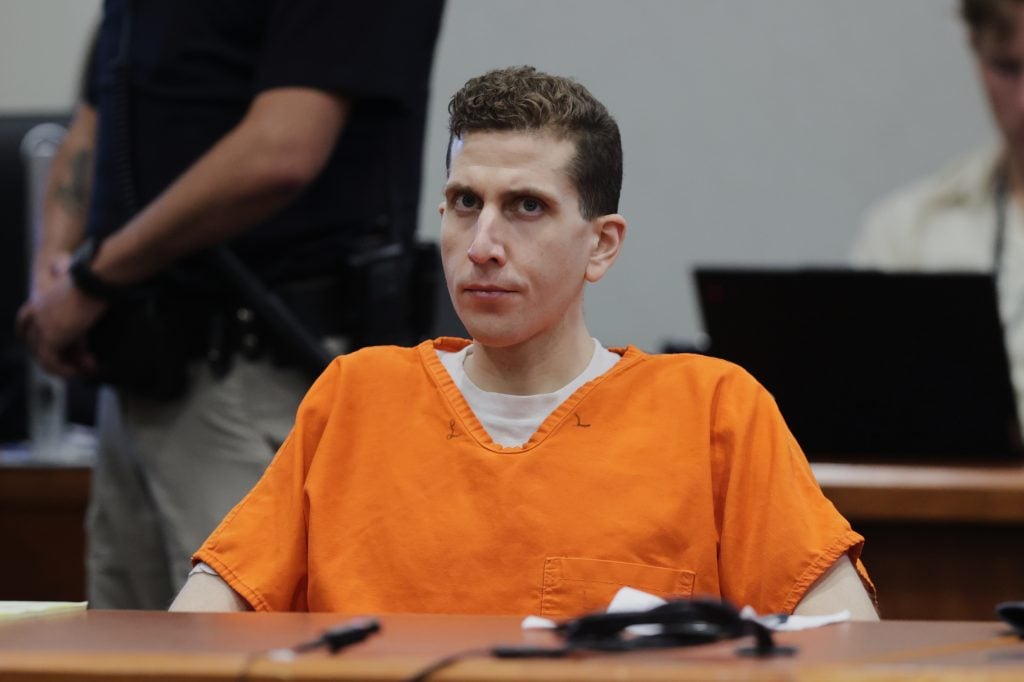
Bryan Kohberger appears at the Ada County Courthouse for his sentencing hearing on July 23, 2025 in Boise, Idaho. (Photo by Kyle Green-Pool/Getty Images)
But while we might never know exactly what happened in Moscow, Idaho in the early morning hours of November 13, 2022, experts and investigators have been able to piece together some of the events.
And now, a retired FBI agent and expert on the case is theorizing that the sequence of the events helps to expose Kohberger’s motives.
Former FBI agent believes Kohberger planned to commit sexual assault
Bryan Kohberger enters the courtroom for a hearing at the Latah County Courthouse on June 27, 2023 in Moscow, Idaho. (Photo by August Frank-Pool/Getty Images)
Former FBI agent Jennifer Coffindaffer has emerged as one of the foremost experts on the case, and she now believes Kohberger entered the house that night with the intention of raping Maddie Mogen.
In a new interview with TMZ, Coffindaffer notes that Kohberger went straight to Mogen’s bedroom on the third floor.
When he got there, she theorizes, he was dismayed to find Kaylee Goncalves sleeping in her housemate’s bed beside her.
According to Coffindaffer, Goncalves was subjected to more violent treatment than the other victims because she unknowingly interfered with Kohberger’s plans.
Bryan Kohberger, charged in the murders of four University of Idaho students in 2022, appears for a hearing at the Ada County Courthouse on July 2, 2025, in Boise, Idaho. (Photo by Kyle Green-Pool/Getty Images)
“Kaylee ruined his plans on how the night would go, that’s why her face was completely disfigured,” Coffindaffer explained.
In a previous interview, Coffindaffer described Kohberger as an “incel” whose violent tendencies were a product of his sexual frustrations.
“I’m convinced that he was what I term as an ‘incel’ — an individual who is involuntarily celibate because they cannot attract the persons that they hope to attract,” she told the Mirror.
“Inside of them is a certain maniacal anger.”
The fact is, we might never know what motivated Kohberger to take four innocent lives that night.
But hopefully the victims’ families can find some comfort in the fact that he’ll never be able to commit such a horrific act again.
The shingles vaccine can help you avoid an outbreak of shingles, but research says it may also be able to protect you against a common age-related illness.
Health Digest – Health News, Wellness, Expert Insights