The Palestinian ambassador to the United Nations has condemned Israel’s attack on Nasser Hospital as “a premeditated strike on medics and journalists”.The Latest News from the UK and Around the World | Sky News










The Palestinian ambassador to the United Nations has condemned Israel’s attack on Nasser Hospital as “a premeditated strike on medics and journalists”.The Latest News from the UK and Around the World | Sky News

Two children have been killed and 17 other people injured after a shooter opened fire at a school in Minneapolis.The Latest News from the UK and Around the World | Sky News

For people with attention-deficit hyperactivity disorder, also known as ADHD, the traditional workplace can be a challenging world to navigate. The Latest News from the UK and Around the World | Sky News

The headlines these past few weeks have focused on the National Guard deployed by the American president to the streets of Washington DC.The Latest News from the UK and Around the World | Sky News
By: James Brooks, Alaska Beacon

Ten members of the U.S. House of Representatives’ Committee on Natural Resources are making an unusual visit to Alaska this week during a break from business on Capitol Hill.
The 45-person committee deals with a variety of issues pertaining to public lands in the United States, and the visit is giving eight Republicans and two Democrats a chance to put their literal hands on the topics they cover.
On Monday, the lawmakers visited Hecla Greens Creek Mine, which produces silver, gold, zinc and lead from a site west of Juneau. They overflew parts of the Tongass National Forest, the nation’s largest, and observed Suicide Basin in the Mendenhall Glacier, the origin point for glacial floods that have inundated parts of Alaska’s capital city in recent summers.
Outside the hangars of Ward Air in Juneau, several House representatives talked with reporters.
“Obviously, Alaska is a big natural resources state, so we’re here seeing things on the ground, so that when we’re talking about (them) in Washington, DC, it’s not just an academic exercise for us,” said Rep. Celeste Maloy, R-Utah and a member of the committee.
Among the group was the committee’s chairman, Rep. Bruce Westerman, R-Arkansas, as well as the home-state Republican Rep. Nick Begich.

Begich called the visit “historic for Alaska,” citing the number of visiting Representatives.
Also attending were Reps. Harriet Hageman, R-Wyoming; Tom Tiffany, R-Wisconsin; Pete Stauber, R-Minnesota; Rob Wittman, R-Virginia; Val Hoyle, D-Oregon; Paul Gosar, R-Arizona; and Sarah Elfreth, D-Maryland.
“It is imperative that we visit these places, so that we have a better understanding when they come before us and ask for relief, whether it is in permitting reform or in ways to better manage the resources that we have,” Hageman said.
The legislators are expected to spend several days in southcentral Alaska, where they will address the annual meeting of the Alaska Oil and Gas Association in Anchorage on Wednesday.
Members are planning to meet with Gov. Mike Dunleavy and expecting to hold a news conference with reporters in Anchorage as well.

For many of the national lawmakers, fresh from a mine tour, minerals were on their minds. President Donald Trump and his administration have been talking at length about the need to increase American production of so-called “critical minerals” used in electronics and high-tech equipment.
Stauber, of Minnesota, said he saw Alaska’s potential to contribute to that effort.
“Alaska can drive that. They can lead the nation into both oil and gas and mineral exploration, if we’d allow them to do that. What we saw at that mine was spectacular,” he said, referring to the Greens Creek mine.
Westerman said he believes additional mining and refining are needed in the United States and Alaska.
“With the big demand on critical minerals and rare earth (minerals) that we have in the country right now, the dependence we have on China for that, I think it’s imperative that Congress work with everyone who’s in the business to help figure out how to get more mining done here in the US — and not just mining, but also the refining of the metals, which is a huge issue,” he said.
Neither of the two Democrats on the trip spoke publicly during their stop in Juneau.
Several of the Republican lawmakers said they believe there is room to increase logging in the Tongass in order to meet the demand for lumber to build housing, particularly locally.
“You ought to at least be able to cut enough timber to sustain your needs here at home, and that will make the forest healthier,” Westerman said.
Speaking nationally, Gosar of Arizona said he believes that selectively thinning national forests could reduce wildfire danger as well.
“You can’t let a lightning fire start where the undergrowth hasn’t been taken care of,” he said. “That’s how we lost the 19 firefighters in Yarnell. … I think there needs to be common sense in that aspect. Get people out on the timber, get the timber, use it for something like building homes. This place needs a lot of homes.”

NOTN- The Juneau School District Board of Education will hold a special meeting today, at noon via Zoom to consider a series of action items, from playground improvements to budget changes and contract approvals.
One of the key items up for a final vote is the acceptance of playground equipment donated by Juneau Rotary Clubs for the Dzantik’i Heeni campus. Rotary has secured $30,000 in funding to provide musical play elements for students at Montessori Borealis and the Juneau Community Charter School.
Volunteers have committed to installing the equipment this fall.
Also on the agenda is a first reading of a budget revision that would add universal free breakfast for all JSD students. The revision comes after an increase in state education funding, after the Base Student Allocation was restored to $700 per student.
The adjustment would provide an additional $1.5 million in revenue, allowing the district to potentially expand student meal programs.
The public can view the meeting online, and final adoption of the FY 2026 Budget Revision is expected at a subsequent board meeting.


NOTN- The National Indian Gaming Commission has approved and amended a proposal submitted by the Central Council of the Tlingit and Haida Indian Tribes of Alaska, authorizing gaming on a 20-acre parcel of restricted Native allotment land on Douglas Island, close to Eaglecrest ski area.
The land, leased by Tlingit & Haida for 25 years with an option for renewal, is restricted against alienation and taxation and falls under both tribal and federal jurisdiction.
The lease allows for the development of a lodge with a restaurant and gift shop, and bingo and entertainment facilities.
While the site is currently undeveloped, the approval clears a regulatory hurdle for potential future projects.
By: James Brooks, Alaska Beacon

The Alaska Legislature opened an 18-month study of the state’s troubled public education system on Tuesday as lawmakers convened the first meeting of their Task Force on Education Funding, established by law this spring.
Alaska’s public schools rank among the worst in the country according to national standardized testing data, and members of the bipartisan, bicameral task force have been charged with identifying ways to improve performance by changing the way schools are funded and manage their students.
Legislative leaders have said the task force will also have the opportunity to examine funding for schools and ways to address rising costs of transportation, utilities, insurance and maintenance.
Members of the task force will hold a series of hearings and discussions before drafting recommendations for new laws that legislators might implement. Those recommendations must be delivered before lawmakers arrive at the Alaska Capitol in January 2027.
Gov. Mike Dunleavy called legislators into a special session to address education issues, but lawmakers have ignored that call and are not planning to hold formal meetings before the special session ends at the end of the month. Legislative leaders have said they prefer to work through the task force instead.
Dunleavy is term-limited and will be out of office by the time the task force’s recommendations are complete.
“The current state of Alaska’s education is not where we’d like it to be, but I know that we can get to a better place if we all work together, we find common ground, and we build upon what we agree upon,” said Sen. Löki Tobin, D-Anchorage and co-chair of the task force.
But on Monday, it appeared that finding that common ground could be difficult, as task force participants identified different areas they prefer to focus upon.
“John Muir said that when we try to pick out anything by itself, we find it hitched to everything else in the universe. The same is true in education,” said Rep. Rebecca Himschoot, I-Sitka. If we take steps to improve teacher quality, that has an impact on the classroom. If we take steps to make sure kids are fed, that has an impact. If we take steps to make sure that we have the right ratios of teachers with students. All of these things have impacts.”
Rep. Justin Ruffridge, R-Soldotna, said he would like the task force to consider how it measures results. What standardized tests, if any, should be used to consider performance?
“I think accountability broadly is a place that I hope to go, and I hope that the (Alaska Department of Education and Early Development) can have some input on that,” he said.
Sen. Jesse Kiehl, D-Juneau, suggested that the task force should be “looking at how we empower local government” to deal with education decisions, while Sen. Mike Cronk, R-Tok, said he wants to make sure the task force is “focusing on policies like the READS Act,” which was a bipartisan bill intended to improve reading performance among younger students.
“We are seeing success in that, and those are the kind of policies we need,” he said.
This year, lawmakers voted to increase the base student allocation, core of the state’s per-pupil funding formula, but Ruffridge suggested that lawmakers need to examine other aspects of the formula to see whether they are delivering the intended results.
Alaska, for example, multiplies the base student allocation for students with “intensive needs” and those in rural Alaska.
“It’s a scary proposition to open up the foundation formula, but I think it’s something that we are really tasked with doing in this group,” he said, adding that the state has failed to properly maintain school facilities, particularly in rural Alaska.
Cronk, in prior comments, said he also is concerned about school maintenance. In most of Alaska, proper maintenance depends on funding from the state government.
“If we want to continue to have (stable) education funding, us as a collective group need to create a fiscal plan for this state,” he said.
“I’m hoping that if we’re talking about funding, that should be our goal as part of this, to make sure that we can come up with something so we do have a level funding for all the government services,” Cronk said.
A legislative task force in 2021 did draft a long-term state plan to bring expenses and revenue into balance, but lawmakers have not adopted any legislation suggested by that task force.
The next meeting of the education task force is scheduled for Oct. 30 in Juneau.

Mike Evans knew something had to change.
As the lead instructor for American Government 1101 at Georgia State University in 2021, Evans had watched his students over the years show up with fewer facts and more conspiracy theories. Gone were the days when students arrived on campus with dim memories of high school civics. Now they came armed with bold, often misleading beliefs shaped by hours spent each day on TikTok, YouTube and Instagram.
One example of misinformation making the rounds back then was an anonymously posted video that more than half of teens in a national survey said provided “strong evidence” of U.S. voter fraud. The video was actually shot in Russia, crucial context that could be gleaned by entering a few choice keywords into a browser.
Ignoring the problem of online gullibility felt irresponsible – even negligent. How could the course deliver on its aim of helping students become “effective and responsible participants in American democracy” if it turned a blind eye to digital misinformation? At the same time, a major overhaul of a course that enrolls more than 4,000 students each year – with 15 instructors teaching 42 sections in person, online and in a hybrid format – would create a logistical nightmare.
That’s when Evans, a political scientist, came across the Civic Online Reasoning curriculum, developed by the research group I used to lead at Stanford University. The curriculum, which is freely available to anyone, teaches a set of strategies based on how professional fact-checkers evaluate online information.
In fall 2021, he reached out with a question: Could aspects of the curriculum be incorporated into American Government 1101 without turning the whole course on its head?
My team and I thought so.
Evans’ challenge was hardly unique to his campus.
For Generation Z, born between 1997 and 2012, social media – especially YouTube, TikTok, Instagram and Snapchat – has become their source of information about the world, eclipsing traditional news outlets. In a survey of more than 1,000 young people ages 13 to 18, 8 in 10 said they encounter conspiracy theories in their social media feeds each week, yet only 39% reported receiving instruction in evaluating the claims they saw there.
We built our Civic Online Reasoning program to address this gap.
When we launched the program in 2018, digital literacy was a catchall that included everything from editing and uploading videos to cyberbullying and sexting. “Checking the credibility of sources” was just one criterion among many buried in a list of desired outcomes.
We narrowed the focus of our program to skills essential to being an informed citizen, such as “lateral reading” − that is, using the full context of the internet to judge the quality of a claim, identify the people or organizations behind it and assess their credibility. Rather than fixate solely on the message, we taught students to vet the messenger: What organizations stand behind the claim? Does the source of the claim have a conflict of interest? What are the source’s credentials or expertise?
We tested our approach in an experiment in 12th grade classrooms teaching government in Lincoln, Nebraska, public schools.
Across six hours of instruction – two hours less than the average teen spends online each day – students nearly doubled in their ability to locate quality information compared to a control group. We thought it wouldn’t be a huge leap to extend our approach to college classrooms.
In a version of this program modified for Evans’ course, we designed six short modules that could be used asynchronously, meaning that students could complete them on their own time, regardless of course format. Unlike information literacy lessons that soar above the particulars of any one discipline, our modules were closely tied to course content.
In a unit on the executive branch, for instance, students examined an Instagram video that falsely claimed President Joe Biden wanted Americans to pay more at the gas pump. In a module on the judiciary, they watched a video on TikTok about Ketanji Brown Jackson’s Supreme Court confirmation, posted by a partisan, left-leaning organization.
We created videos that pulled back the curtain by deconstructing tactics common in political campaigns – quotes ripped from context, videos spliced and selectively edited, and corporate-funded websites that masquerade as grassroots efforts.
We also taught students how to check facts like the pros. The main strategy was lateral reading – searching across the internet to see what other, more credible sources say about an organization or influencer. We challenged common assumptions too, such as that Wikipedia is always unreliable. Not true, especially for “protected pages,” indicated by a padlock icon at the top of an article, which prevent editorial changes except those made by established Wikipedians. Another is the belief that a dot-org website has passed rigorous tests that qualify it as a charity, which is never true. Dot-org has always been an “open” domain that anyone can register, no questions asked.
These lessons took just 150 minutes in total over the semester, and instructors didn’t need to change a thing; they just listed the lessons on the course schedule.
Did this approach work for Evans and his American Government 1101 students?
Across two semesters in one academic year, 3,488 students took a test at the beginning of the course and again at the end. It included items such as one in which students evaluated a website that claimed it “does not represent any industry or political group” but is actually backed by fossil fuel interests.
In June, Evans, two co-authors and I uploaded a preprint of a journal article, which hasn’t yet been peer reviewed, that documents the experiment and its results. We found that from the beginning to the end of the semester, students became a lot smarter at identifying shady sources and more confident in evaluating where information comes from. Students’ scores showing how well they were able to do this improved by 18%. Even better, 80% said they “learned important things” from the modules.
Not bad for an easily adopted addition to the course.
These results add to other studies we’ve conducted, such as one in a college nutrition class and one in a rhetoric and writing intro course, that similarly showed how educators can improve students’ digital literacy – and their awareness of misinformation – without causing a major disruption to the curriculum.
And I believe it’s needed. A chasm separates the approved content that appears on students’ reading lists and the massive amount of unregulated, unverified and unreliable content they consume online.
The good news? This intervention could work in any subject where misinformation runs wild: history, nutrition, economics, biology and politics. Findings similar to ours from other college campuses buoy our confidence in the approach.
These changes don’t require waiting for a big revolution. Small steps can go a long way. And in a world flooded with misinformation, helping students learn to sort fact from fiction might be the most civic thing we can do.

Sam Wineburg received funding from the William & Flora Hewlett Foundation for this research. He is a board member of the not-for-profit Digital Inquiry Group (inquirygroup.org), which now operates the Civic Online Reasoning curriculum.
Politics + Society – The Conversation
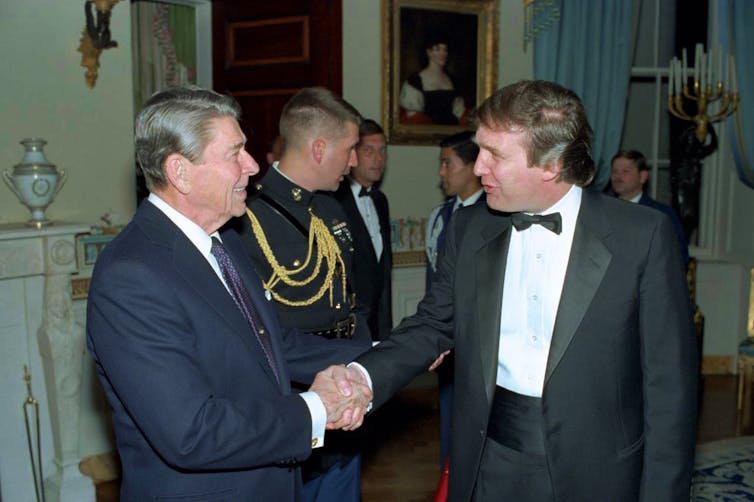
When the Trump administration announced it was moving to eliminate dozens of U.S. climate policies, Environmental Protection Agency Administrator Lee Zeldin said he was sending “a dagger straight into the heart of the climate change religion.”
That drive – to both repeal environmental regulations and cast doubt on science – reflects the Trump administration’s approach to environment policy.
Deregulation has long been a key theme in Republican environmental policy. The conflict between the obligation to protect public health and the desire to boost markets traces back to Ronald Reagan’s presidential administration. Reagan’s perspective that government is not a solution to problems, but is the problem instead, set the stage for Republican administrations that followed.

Reagan argued that the growth of government spending and business regulation had stymied economic prosperity. Environmental regulations were a prime target.
Forty years later, America is seeing many of the same concepts in the Trump administration. However, its strategy could have a greater effect than Reagan ever envisioned.
There are many ways to kneecap government agencies: Instituting massive budget cuts, cutting staff with critical functions and appointing leadership whose goal is limiting the reach and effectiveness of the very agencies they direct are just a few.
In these efforts, Reagan and Trump had similar approaches to the EPA, although with different levels of intensity.
Trump’s EPA budget plan for 2026 includes a draconian 50% cut from the previous year and the lowest budget proposal, when adjusted for inflation, since Reagan. Staff cuts in just the first six months of the second Trump administration put the agency’s total employment at 12,448, down from 16,155 in January.
Reagan dissolved the EPA Office of Enforcement to limit “unnecessary regulation,” which resulted in a 80% decline in actions to enforce environmental regulations. Trump is also stopping enforcement actions, dismantling the EPA’s Science and Research Office and politicizing the agency’s science by putting political appointees in charge, moves that undermine EPA’s independence and expertise.
Both cut EPA’s budget, but that alone does not reduce an agency’s effectiveness.
When the EPA was founded in 1970 during the Nixon administration, it represented a bipartisan consensus: After decades of auto exhaust, polluted waterways and smog-filled air, environmental protection had become a national policy priority.
But industries that EPA regulated argued that the costs of implementing the agency’s mandates were too high. That created tension between economics and science and enforcement.
As part of his “government is not the solution” approach, Reagan issued an executive order shortly after taking office in 1981 requiring federal agencies to submit all proposed rules to the White House Office of Management and Budget before making them public. In Reagan’s eyes, this approach centralized power in the White House and was a way to eliminate burdensome regulations before the agencies announced them to the public.
He also appointed an EPA administrator who shared his anti-government perspective. Anne Gorsuch Burford was a lawyer and state legislator from Colorado, where she routinely voted against toxic waste cleanup and auto pollution controls.

Once in Washington, she appointed several people to the EPA’s leadership team with direct ties to industries the EPA regulated. An example was Rita Lavelle, head of the EPA’s toxic waste programs, who was later convicted of perjury for lying to Congress about when she knew her former employer, a defense contractor, was disposing of toxic waste at a now notorious dump site.
These appointments were an example of regulatory capture by the industries EPA was in charge of overseeing. Anne Gorsuch Burford was held in contempt of Congress for not turning over records related to the Superfund cleanup of the same hazardous waste site, which led to her resignation. The Superfund program to clean up toxic waste dumps was new and one of EPA’s largest programs at the time.
The scandals, broken staff morale, stripped budgets and fights over policy discredited the agency.
Anne Gorsuch Burford’s deregulation efforts weren’t fully successful, in part because EPA staff experts rallied to preserve science and regulatory functions. They leaked materials about delays in the Superfund site cleanup to sympathetic congressional staff, who in turn found support from Republican and Democratic senators.
That history may have influenced the Trump administration’s strategy toward the federal bureaucracy’s staff experts, who Trump calls “the Deep State.”
The Department of Government Efficiency, an unofficial group Trump set up in early 2025 headed by Elon Musk, directed the firing of tens of thousands of government scientists and other staff with expertise that government agencies rely on. Thousands more have resigned amid intimidation tactics such as surveillance.

Trump’s head of the Office of Management and Budget, Russell Vought, has been clear about targeting bureaucrats. He said in 2023: “We want their funding to be shut down so that the EPA can’t do all of the rules against our energy industry because they have no bandwidth financially to do so. We want to put them in trauma.”
There is a clear focus today on EPA programs that don’t align with the administration’s views. Programs related to environmental justice for low-income communities are in the line of fire. The appointment of people from the chemical, fossil fuel and corporate industries to high-level regulatory and legal positions raises questions about regulatory capture – whether their focus will be more on the health of the industries they oversee than on the health of the public.
The first Trump administration had a focus on reforming permitting and bureaucracy. While appearing radical at the time, the revamping of scientific boards to include more industry representatives, the undoing of power plant rules and the lessening of enforcement hobbled but did not completely undo the agency.
The second Trump administration, in actively supporting fossil fuel “energy dominance,” is taking steps to not just eliminate regulations but to ensure future administrations can’t bring the regulations back, by using a complex set of legal arguments related to the regulation of greenhouse gases.
At the same time, the administration is trying to discredit scientific research to downplay the risks of a warming planet.
The Reagan administration, while it also pushed for deregulation and expanded permitting of oil, gas and coal leases, embraced some elements of environmental protection. Reagan designated more than 10 million acres as protected wilderness and signed the Coastal Barriers Resources Act, which helped protect 3.5 million acres of shoreline from development. When Reagan signed the Montreal Protocol in 1988 to help protect the ozone layer, he cited scientific data showing the growing risks of ozone-depleting substances.
There is another critical difference between the first and second Trump administrations: The current Republican-controlled Congress is consenting to almost every request the president makes.
Congress has a constitutional responsibility to be a check on the executive branch, and a bipartisan Congress has long taken an active role in oversight and investigation involving environmental issues.
In 2025, however, Congress has approved most of Trump’s demands, including voting to repeal much of the Inflation Reduction Act, a package of pro-environment spending it had just passed two years earlier and that included many projects in Republican districts.
The administration’s effort to eliminate U.S. climate policies will take time and face lawsuits.
In an irony of history, Anne Gorsuch Burford’s son Neil Gorsuch now sits on the Supreme Court. His vote when those cases come before the court may be the ultimate Reagan legacy on the Trump EPA.

Barbara Kates-Garnick does not work for, consult, own shares in or receive funding from any company or organization that would benefit from this article, and has disclosed no relevant affiliations beyond their academic appointment.
Politics + Society – The Conversation
