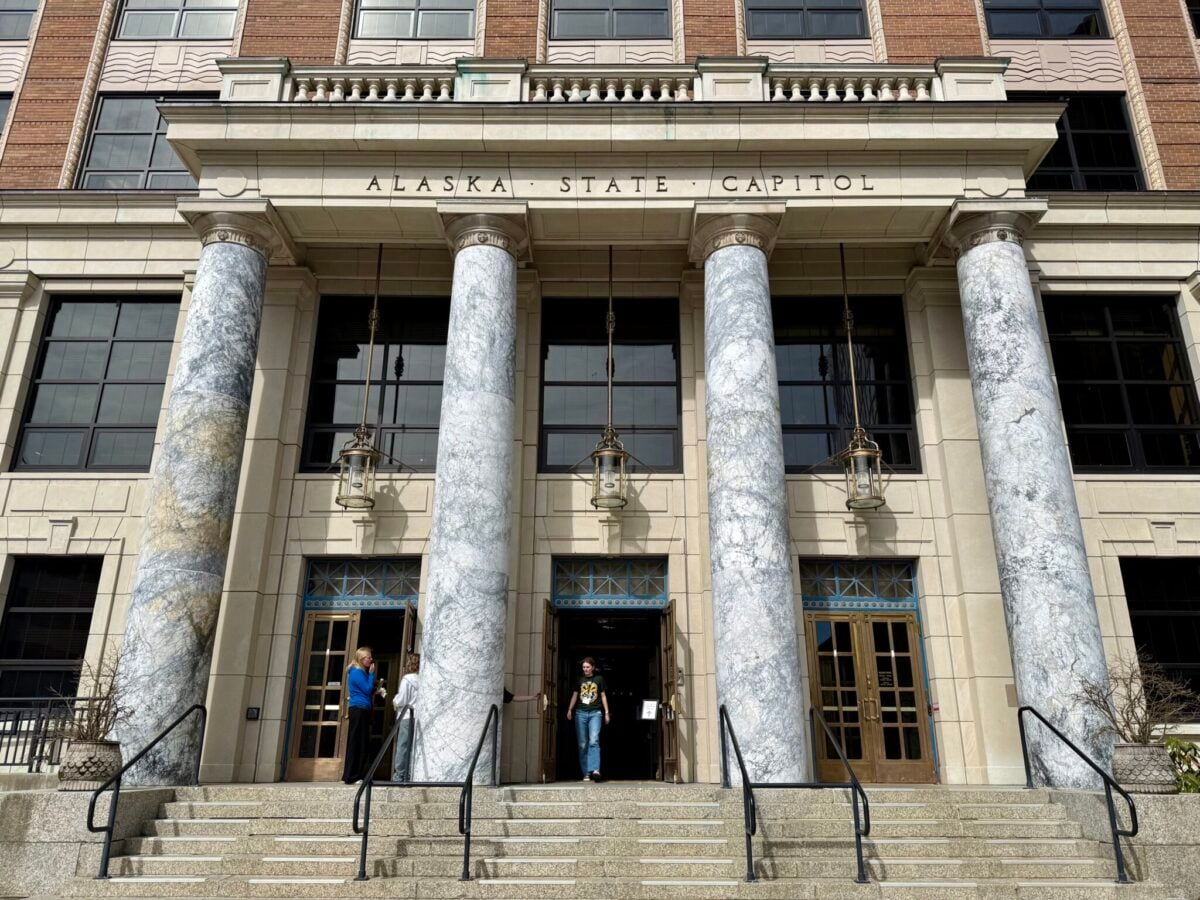
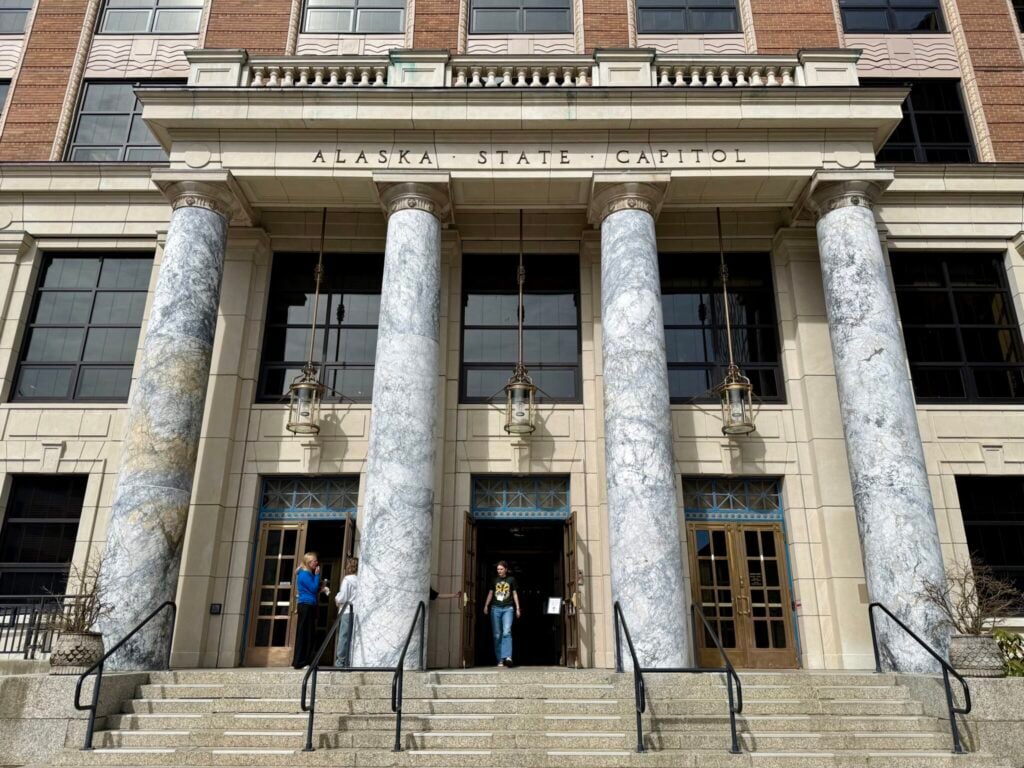
The Alaska State Capitol in Juneau is seen on Apr. 24, 2026. (Photo by Claire Stremple/Alaska Beacon)
There are five competitive races for the Alaska House and Senate in this year’s primary election, where candidates are vying for the top four places in order to advance to the ranked choice general election in November.
Early voting has begun across Alaska, and ends on Tuesday with polls closing at 8 p.m. Mail-in ballots must be postmarked by Tuesday, Aug. 18.
All 40 members of the Alaska House are up for election; 10 of the 20 Senate seats are up for election.2026 Voter Guide
The candidates, the ballot measures, and the tools you need to cast your vote.
In those races with four or fewer candidates, all are expected to advance to the general election unless they decide to drop out by an Aug. 31 deadline.
Those competitive primary races include one of the largest Senate districts that extends from Western Alaska to the Aleutian Islands, as well as House districts in Southwest Alaska, Eagle River and in the eastern and western districts of the Matanuska-Susitna Borough.
In the Western Alaska Senate District S, longtime incumbent Bethel Democrat Sen. Lyman Hoffman is retiring. The district extends from Western Alaska to Lake Clark and south across the Aleutian Islands, and the Senate seat represents approximately 36,800 Alaskans.
The candidates are current House Speaker Independent Rep. Bryce Edgmon of Dillingham, Republican Darren Deacon of Aniak, Democrat Wassilie Guy of Napaskiak and Independents Wayne Morgan of Aniak and Rick Robb of Bethel.
The winner of the Senate race in November will serve a four-year term.
Alaska House seats represent approximately 18,335 Alaskans each, and representatives serve two-year terms.
Edgmon is vacating a seat representing House District 37, which includes Southwest Alaska communities from Bristol Bay to the Aleutian Islands.
Seven candidates are running for the top four spots this race: Independents Peter Angasan of King Salmon, Kimberly Johnson of Dillingham, Mark Smith of Aleknagik and Cade Woods of Dillingham; Democrats Dennis Robinson of Unalaska and Evelynn Trefon of Newhalen; and Republican Brenda Wilson of King Cove.
Five candidates are running for House District 23, which encompasses Eagle River, a northern suburb of Anchorage near the Joint Base Elmendorf-Richardson. Incumbent Republican Rep. Jamie Allard is running for re-election, challenged by Republicans Nick Capozzi and Ruby Jones, and Democrats Jim Arlington and Lee Hammermeister.
In the eastern district of the Manatuska-Susitna Borough, House District 29 covers communities in the Palmer-Fishook area eastward to Valdez. Incumbent Republican Rep. Garret Nelson is running for the seat for the first time. He was appointed by Gov. Mike Dunleavy to the seat last year, after former Rep. George Rauscher, R-Sutton, was appointed to the Alaska Senate to fill a seat vacated by Shelley Hughes who is running for governor.
Challenging Nelson are Independents Amber Hansen of Wasilla and Jessica Kusner-Kalarchik of Palmer, Republican Steve Menard of Palmer, Democrat Kimberly Slone of Wasilla and Libertarian Candice Frisby of Palmer.
In House District 30, in the western region of the Mat-Su Borough from Big Lake to Talkeetna, four candidates are challenging incumbent Republican Rep. Kevin McCabe. He was first elected to the seat in 2020. McCabe will face Democrat Sandra Loomis of Talkeetna and Republicans Mike Alexander of Big Lake, Doyle Holmes of Willow and Doug Massie of Wasilla.
In the House, 36 races are expected to be competitive in the general election. Four incumbents are running unopposed: Rep. Sara Hannan, D-Juneau, in District 4; Rep. Chuck Kopp, R-Anchorage in District 10, Rep. Genevieve Mina, D-Anchorage in District 19; Chuck Kopp, R-Anchorage in District 10, and Rep. Will Stapp, R-Fairbanks in District 32.
In the Senate, seven races are expected to be competitive in the general election. Three Senate incumbents are running unopposed, including Sitka Republican Sen. Bert Stedman, and Anchorage Democrats Bill Wielochowski, and Löki Tobin.
The Alaska State Capitol in Juneau is seen on Apr. 24, 2026. (Photo by Claire Stremple/Alaska Beacon)
There are five competitive races for the Alaska House and Senate in this year’s primary election, where candidates are vying for the top four places in order to advance to the ranked choice general election in November.
Early voting has begun across Alaska, and ends on Tuesday with polls closing at 8 p.m. Mail-in ballots must be postmarked by Tuesday, Aug. 18.
All 40 members of the Alaska House are up for election; 10 of the 20 Senate seats are up for election.
In those races with four or fewer candidates, all are expected to advance to the general election unless they decide to drop out by an Aug. 31 deadline.
Those competitive primary races include one of the largest Senate districts that extends from Western Alaska to the Aleutian Islands, as well as House districts in Southwest Alaska, Eagle River and in the eastern and western districts of the Matanuska-Susitna Borough.
In the Western Alaska Senate District S, longtime incumbent Bethel Democrat Sen. Lyman Hoffman is retiring. The district extends from Western Alaska to Lake Clark and south across the Aleutian Islands, and the Senate seat represents approximately 36,800 Alaskans.
The candidates are current House Speaker Independent Rep. Bryce Edgmon of Dillingham, Republican Darren Deacon of Aniak, Democrat Wassilie Guy of Napaskiak and Independents Wayne Morgan of Aniak and Rick Robb of Bethel.
The winner of the Senate race in November will serve a four-year term.
Alaska House seats represent approximately 18,335 Alaskans each, and representatives serve two-year terms.
Edgmon is vacating a seat representing House District 37, which includes Southwest Alaska communities from Bristol Bay to the Aleutian Islands.
Seven candidates are running for the top four spots this race: Independents Peter Angasan of King Salmon, Kimberly Johnson of Dillingham, Mark Smith of Aleknagik and Cade Woods of Dillingham; Democrats Dennis Robinson of Unalaska and Evelynn Trefon of Newhalen; and Republican Brenda Wilson of King Cove.
Five candidates are running for House District 23, which encompasses Eagle River, a northern suburb of Anchorage near the Joint Base Elmendorf-Richardson. Incumbent Republican Rep. Jamie Allard is running for re-election, challenged by Republicans Nick Capozzi and Ruby Jones, and Democrats Jim Arlington and Lee Hammermeister.
In the eastern district of the Manatuska-Susitna Borough, House District 29 covers communities in the Palmer-Fishook area eastward to Valdez. Incumbent Republican Rep. Garret Nelson is running for the seat for the first time. He was appointed by Gov. Mike Dunleavy to the seat last year, after former Rep. George Rauscher, R-Sutton, was appointed to the Alaska Senate to fill a seat vacated by Shelley Hughes who is running for governor.
Challenging Nelson are Independents Amber Hansen of Wasilla and Jessica Kusner-Kalarchik of Palmer, Republican Steve Menard of Palmer, Democrat Kimberly Slone of Wasilla and Libertarian Candice Frisby of Palmer.
In House District 30, in the western region of the Mat-Su Borough from Big Lake to Talkeetna, four candidates are challenging incumbent Republican Rep. Kevin McCabe. He was first elected to the seat in 2020. McCabe will face Democrat Sandra Loomis of Talkeetna and Republicans Mike Alexander of Big Lake, Doyle Holmes of Willow and Doug Massie of Wasilla.
In the House, 36 races are expected to be competitive in the general election. Four incumbents are running unopposed: Rep. Sara Hannan, D-Juneau, in District 4; Rep. Chuck Kopp, R-Anchorage in District 10, Rep. Genevieve Mina, D-Anchorage in District 19; Chuck Kopp, R-Anchorage in District 10, and Rep. Will Stapp, R-Fairbanks in District 32.
In the Senate, seven races are expected to be competitive in the general election. Three Senate incumbents are running unopposed, including Sitka Republican Sen. Bert Stedman, and Anchorage Democrats Bill Wielochowski, and Löki Tobin.
The Alaska State Capitol is seen on May 18, 2026. (Photo by Claire Stremple/Alaska Beacon)
I was aimlessly scrolling through Instagram when I learned that Jonathan Kreiss-Tomkins, or JKT, had entered the governor’s race.
My interest was piqued — not so much by the announcement as the photo attached to it. Framed by a majestic Sitka mountainscape, JKT sports a blue flannel button up — classic Alaska campaign-wear. I took a screenshot, zoomed in, and squinted. Did he always have that beard?
I’d be hard pressed to believe JKT didn’t grow it for the campaign. The timing is at least suspicious. Since entering the race, the long clean-shaven policy nerd has transformed into a robustly-bearded powerlifter. In a campaign video, he’s seen deadlifting a huge rack of weights to “save schools” and “protect our fisheries.”
It’s not enough that JKT was born and raised in Sitka and has spent much of his adult life serving in the state Legislature. In order to be truly worthy of a shot at governor, he must now audition for the title of “Real Alaskan.”
Jonathan Kreiss-Tomkins, a Democratic candidate for Alaska governor, poses for a photo in Nome. (Diane Haecker/The Nome Nugget)
He’s far from the only one.
Every campaign season, like clockwork, candidates across the political spectrum jockey to position themselves as “Real Alaskans.” (Or, in the case of U.S. House hopeful Bill Hill, “the Real Alaska.”)
Over a banjo-string track, a man’s warm, bassy voice booms through my Instagram feed, declaring that incumbent U.S. Sen. Dan Sullivan will “fight for Alaskans.”
Meanwhile, the senator’s detractors take shots at his Alaskan bona fides with the derisive nickname “Ohio Dan.”
My mailbox is stuffed with images of congressional hopefuls in Copper River Fleecevests and frontier-esque flannel.
Every candidate wants to prove they’re the most “Real Alaskan,” and therefore most fit for your vote.
But what does it mean to be a “Real Alaskan?” While that’s a hot topic of debate, a 2008 journal article argues that the term is “deeply coded” as white, rural and masculine.
In this paradigm — the one that often dominates public discourse — Real Alaskans hunt, fish and work blue collar jobs. They fight, shoot and defend us from Washington, D.C. lobbyists. They forgo suits for Grundens, bolo ties and of course, flannel. They’re tough, hardy, no-nonsense and raring to stand up to the Washington bureaucrats who think they’re better than us.
Here’s where it gets absurd: The tropes that make up the Real Alaskan ethos didn’t originate here at all. Their forerunner is a much older archetype that dates back over 200 years, to when Kentucky was America’s far-West frontier.
In my podcast The Alaska Myth, I argue that the Real Alaskan is cheap repackaging of what historian Richard Slotkin refers to as hunter-heroes — think Davy Crockett and Daniel Boone. As the frontier moved west, so did the stereotype, eventually donning Carhartts and Xtratuffs to birth the modern image of the “Real Alaskan.”
What’s interesting about those memorable images of Western “heroes”, with their guns and coonskin caps, is that they were always political in nature. Boone and Crockett weren’t just frontier icons. They were also politicians who sought to woo rural constituents with their sharpshooting frontier cred.
This 19th Century political innovation remains deeply embedded here in Alaska, in the politics of the “Last Frontier.” Regardless of your party affiliation or identity, performing Real Alaskan-ness has become a prerequisite for entering any high profile race in this state. This is how our feeds become clogged with videos using folksy language about “Alaskans being whipsawed from one generation to the next” or how “in Alaska, we’ve always done things our own way.”
Real talk: I want to know what runs through the mind of a campaign communications staffer when their candidate’s lead in the polls starts to narrow. And whether it’s some version of “Well, we can always make a video about that time the senator took out a Kodiak bear.”
Regardless of political affiliation or personal background, no candidate is immune to this posturing.
Solely by virtue of their identity, any Alaska Native candidate is arguably far more of a “Real Alaskan” than their self-styled settler competitors. And yet they too tend to earnestly perform the tropes associated with the white, rural and masculine-coded “Real Alaskan.”
Bill Hill’s website reminds voters he’s not just Dena’ina Athabaskan but also a lifelong Alaskan, with a resume that includes commercial fishing and chopping wood. Whether these credentials — the basis of an aligned super PAC’s claim that Hill is the “real Alaska” — will translate into votes is more dubious.
On her campaign website, Mary Peltola’s “my story” page puzzlingly makes no mention of her Yup’ik identity — though it does feature images of her in a smokehouse and wearing a traditional kuspuk. It is, however, permeated with colorful, frontier-coded language, from quoting Ted Stevens’ “to hell with politics” to expressing her vision of a congressional delegation that’s “strong and tough.”
Mary Peltola is running as a Democrat for U.S. Senate in Alaska. (Nathaniel Herz/Anchorage Press)
It’s not just this year’s campaigns, either. The impulse to prove that one is indeed a “Real Alaskan” has produced some of the cringiest campaigning in recent memory.
If you want to make any Alaskan shudder with secondhand embarrassment, you need only utter two words: Bear Doctor. Despite the backlash the now-infamous videoreceived, former U.S. Senate hopeful Dr. Al Gross was simply drawing from the same toolkit candidates use every campaign season.
To be fair, these representations are often true to the lifestyles that many of these candidates lead. This year’s field is full of contenders who represent various shades of the distinct lifestyles that make up this state: fisherman, mushers and pilots, to name a few.
But I can’t help but be cynical about the requirement to campaign as a Real Alaskan, knowing that it’s rooted in the idea of the frontier.
At the end of the 19th Century, the concept was thought so close to death that historians were eulogizing it. And it’s very much a product of its time. Frontier logic posits that there are endless resources to be exploited, and a glittering economic future awaits those who exploit the right ones. When frontier imagery and frontier logic alike have a chokehold on our politics, they endlessly offer the same tired 19th Century solutions — like developing any resource we can think of — to our 21st Century ills. Just ask the state legislators who are currently debating the gas pipeline that elected leaders have been propping up for the better part of the last 50 years.
I know my view is a minority one. I was reminded of that when I casually ribbed JKT’s frontier glow up at a recent dinner party. A friend of mine — an outdoorsy transplant who leans progressive — said he’d noticed, and he was a fan. “I’m more likely to vote for a man who’s put some work into himself,” he said approvingly.
Ultimately, candidates lean on this tried and true formula because when candidates can pull it off, it works. Don Young, the longtime bolo-tie wearing Alaska Congressman originally from California, so successfully channeled the frontier spirit that candidates across the political spectrum tout him as an aspirational figure.
As to which candidates’ Real Alaskan antics will win over the electorate this time?
Only the primaries will tell.
This story was originally published in the Anchorage Press. Subscribe here.
Boats pictured along the bank of the Yukon River in Grayling, Alaska. (Max Graham)
For the past few years, smokehouses in the Yukon River village of Anvik have sat empty.
After salmon populations crashed, dozens of Alaska Native communities along the river faced a stark new reality, one without the fish that fed families and sustained Yup’ik and Athabascan traditions for generations.
This summer, though, smoke once again wafted through Anvik, on the middle Yukon some 350 miles west of Anchorage.
The river’s two main species, chinook and chum, have recorded a surprising uptick in numbers. And in spite of state regulations that bar fishing for chinook, Anvik’s fishermen have caught dozens of the fish this year, plus even more salmon of other species — meaning that there are enough to share with elders, hang in smokehouses and store in freezers.
“It’s the first time I’ve seen the smokehouses smoking in five years,” said Robert Walker, former chief of the Anvik Tribal Council. “I was just amazed. People are so happy.”
The returning fish could represent a remarkable rebound for one of Alaska’s most iconic and culturally important salmon runs, though scientists caution that numbers are still relatively low and that more data are needed before they can be confident about a meaningful turnaround.
The harvest in Anvik, announced by Walker on a public teleconference with fishery managers and local leaders in July, also has inflamed a long-running political debate over fishery closures and government policies aimed at rebuilding the runs.
In 2024, Alaska state officials agreed with the Canadian government to a seven-year ban on harvesting chinook along the Yukon, which flows from northwest Canada more than 2,000 miles through Alaska to the Bering Sea.
Even though many Alaska Native leaders generally agreed about the need to limit fishing, they also criticized Alaska’s government for not formally including tribal governments in the decision-making process.
The recent chinook harvest in Anvik came in spite of the official moratorium.
Walker, in a recent phone interview, described the state’s implementation of the ban without input from tribal leaders as a form of “dictatorship.”
Alaska’s fish and game commissioner, Doug Vincent-Lang, said state officials wouldn’t have been able to reach a timely agreement with Canada if they had formally consulted with every tribe along the river.
But he pushed back against the idea that they didn’t get input from local leaders before agreeing to the ban.
“We talked to a lot of people downriver,” Vincent-Lang said in a brief phone interview.
“I think it’s working,” he added, referring to the agreement. He also noted that the ban includes certain exceptions, such as allowing fishing on tributaries when local spawning goals are met.
During the July teleconference, Walker described a scene of joy in Anvik. People in the village are “eating fish like they never ate fish before,” he said.
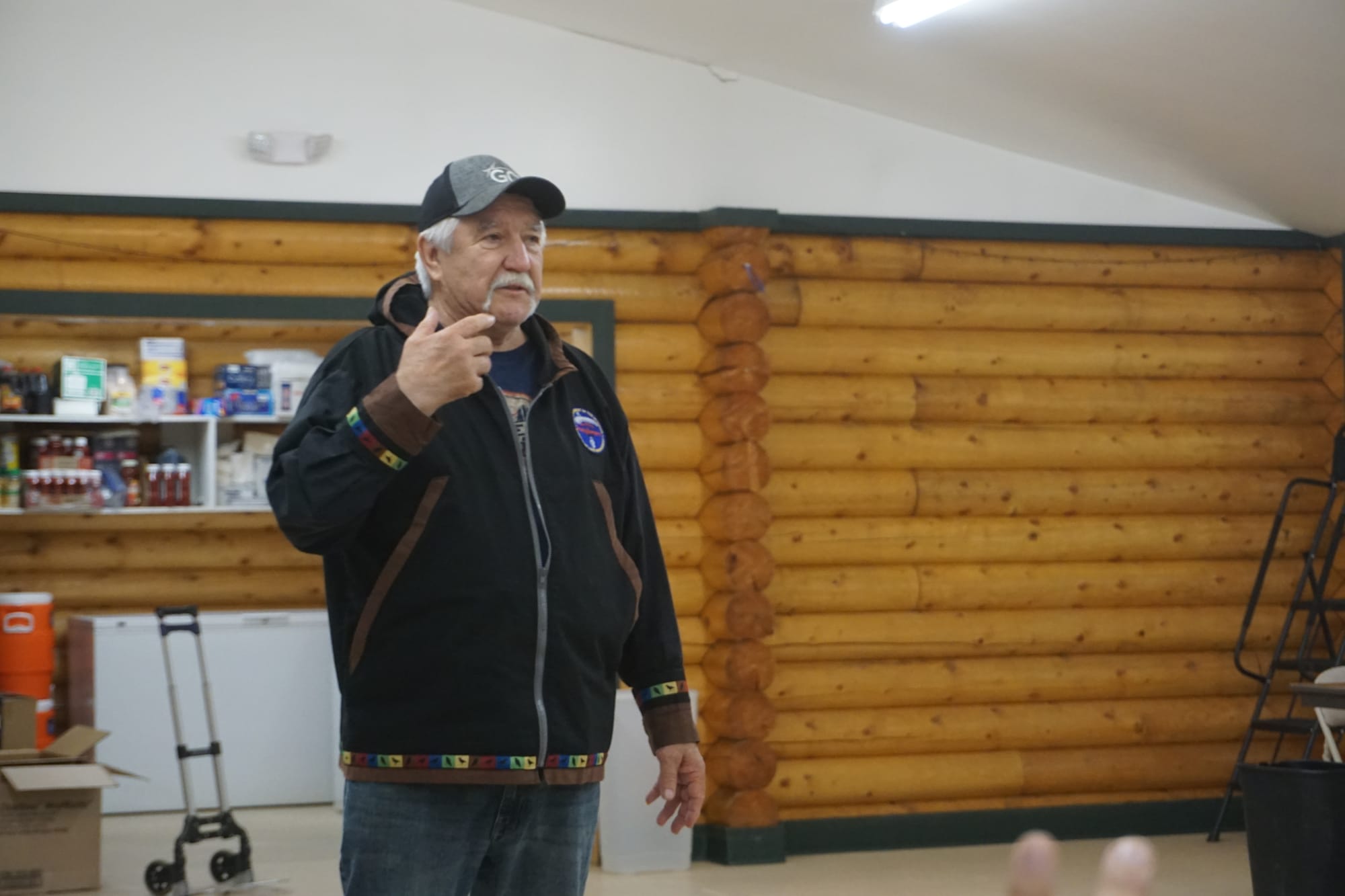
Robert Walker, former chief of the Anvik Tribal Council, speaks in the village’s tribal building in 2023. (Max Graham)
Some salmon advocates and fisheries biologist say the chinook run isn’t yet strong enough to warrant fishing. The numbers are still well below targets set by fisheries managers.
Roughly 32,000 chinook have been counted so far this season at a sonar station in Eagle, Alaska, near the Canadian border. That’s more than the state had tallied by now in recent years. But it’s still below average, and the final count is expected to be substantially lower than the goal of 71,000 set by Alaska and Canadian fisheries managers two years ago.
“While it is a little bit more encouraging, the runs are still well below average,” said Deena Jallen, a Yukon area fisheries biologist for the Alaska Department of Fish and Game. “We’re still not meeting any goals in Alaska and Canada.”
In a statement posted on social media last week, a leading Alaska Native advocate described the painful decision not to fish during closures that she and many others along the Yukon have made, and she called on fishermen to continue cooperating with government agencies with the shared goal of restoring the salmon runs.
“I understand the importance of passing on our way of life, our traditional knowledge and our culture to our children and grandchildren,” said Serena Alstrom, the longtime executive director of Yukon River Drainage Fisheries Association, a conservation-focused advocacy group with board members from communities along the river.
“Because of that, I have made the difficult decision not to fish when regulations require it. I don’t do it because it is easy or because I always agree with management. I do it because I believe those sacrifices give our salmon the best chance to recover for future generations.”
In a phone interview, Alstrom said she has heard about more instances of illegal fishing this summer than usual — not only in Anvik but on other stretches of river, too.
“It’s upsetting,” she said.
Later, Alstrom released another statement, saying the boost in salmon numbers this year reflects the “diligence of those who have chosen to allow these salmon to continue their journey to the spawning grounds.”
Most families along the river are continuing to make that sacrifice, she said in the interview. They’re doing that not merely for the sake of following rules but because they “understand that we need to have salmon at the spawning grounds,” Alstrom said.
In Anvik, the fishermen used a traditional fishwheel to catch chinook and chum, according to Walker.
They released most of the fish, but kept a few dozen chinook and more than 100 salmon of other species, he said.
The fishermen took only what the village needed, he added. The fish “went in people’s freezers, and people are jarring them, too,” Walker said.
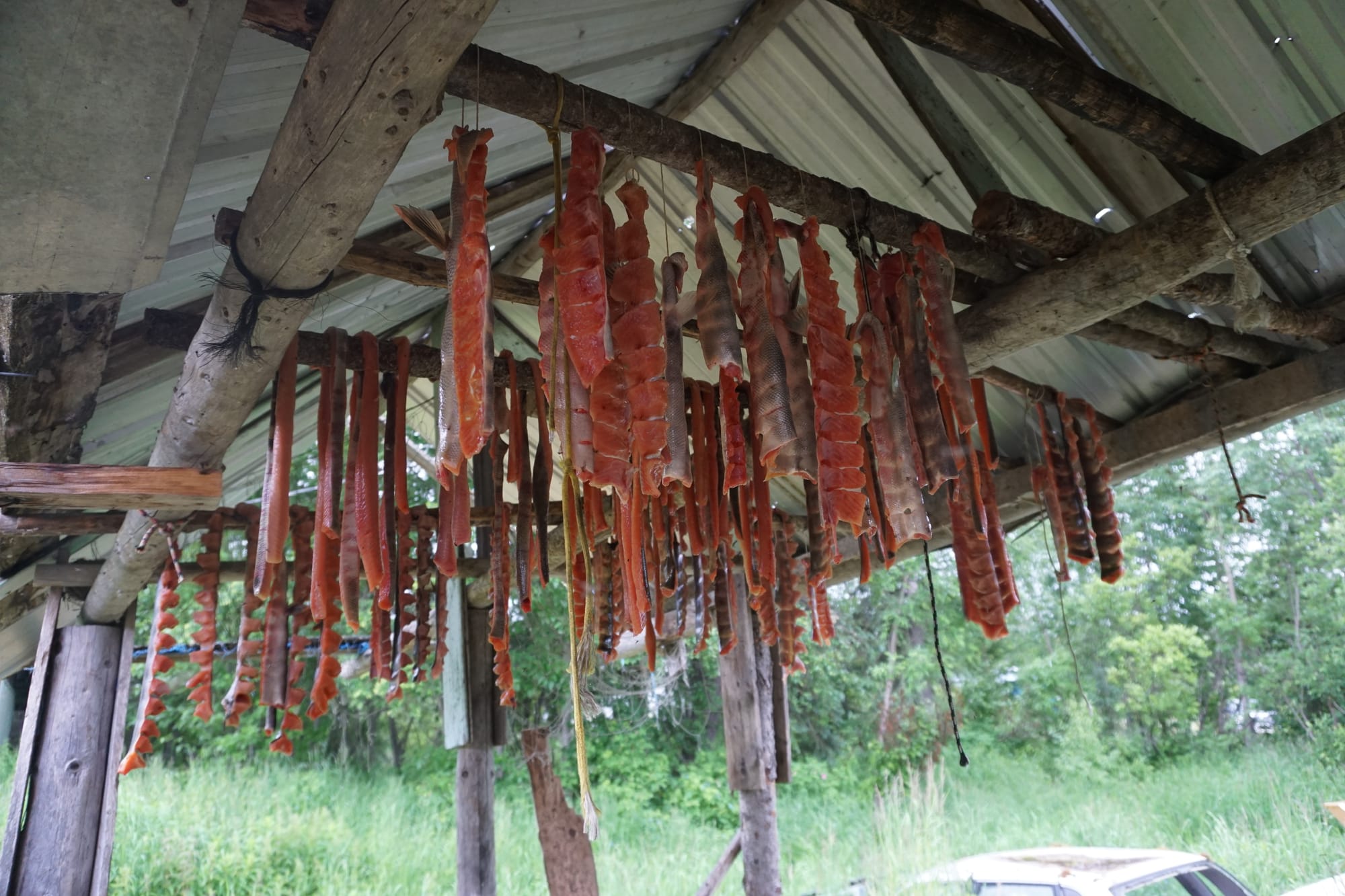
Salmon strips hang to dry in Anvik in 2023. (Max Graham)
The Alaska State Troopers, which enforces state fisheries closures, have not observed an increase in illegal salmon harvests this season, according to spokesperson Austin McDaniel.
The agency issued five citations for illegal fishing along the lower Yukon during a salmon closure, including one for unlawfully possessing chinook, McDaniel said.
State wildlife troopers “are aware of reports of potential improper fishing practices near Anvik,” he said. “However, we have been unable to substantiate those claims at this time.”
But, McDaniel added, “our patrols indicate that compliance with Yukon River subsistence fishing restrictions remains high and has improved in many areas.”
On another river in Western Alaska, the Kuskokwim, fishing during state-imposed closures more than a decade ago led to prosecutions of Yup’ik fishermen, who unsuccessfully argued that harvesting was an expression of their constitutionally protected religious beliefs.
Chinook numbers in the Yukon initially plummeted more than two decades ago, and harvests have largely been limited since then. The run dropped to a record low of about 50,000 fish in 2022, down from closer to 300,000 decades ago.
This year’s run is now estimated at 103,000 fish, far exceeding pre-season forecasts.
Managers also counted nearly 1 million summer chum, which was more than forecasted and enough for limited fishing opportunities in Western Alaska communities, like Anvik, along the lower and middle river.
In a recent interview with KYUK, the regional public broadcaster, a Yup’ik elder in Russian Mission, 70 miles downstream of Anvik, described a sense of elation around the summer chum harvest.
“When I ate my fish,” said the elder, Alexandra Quak-aq Kozevnikoff, “I could feel that tingling from my stomach come out like [a] little quiver all the way around my body, even to the top of my head, and a big sigh of relief.”
This story was originally published in the Anchorage Press. Subscribe here.
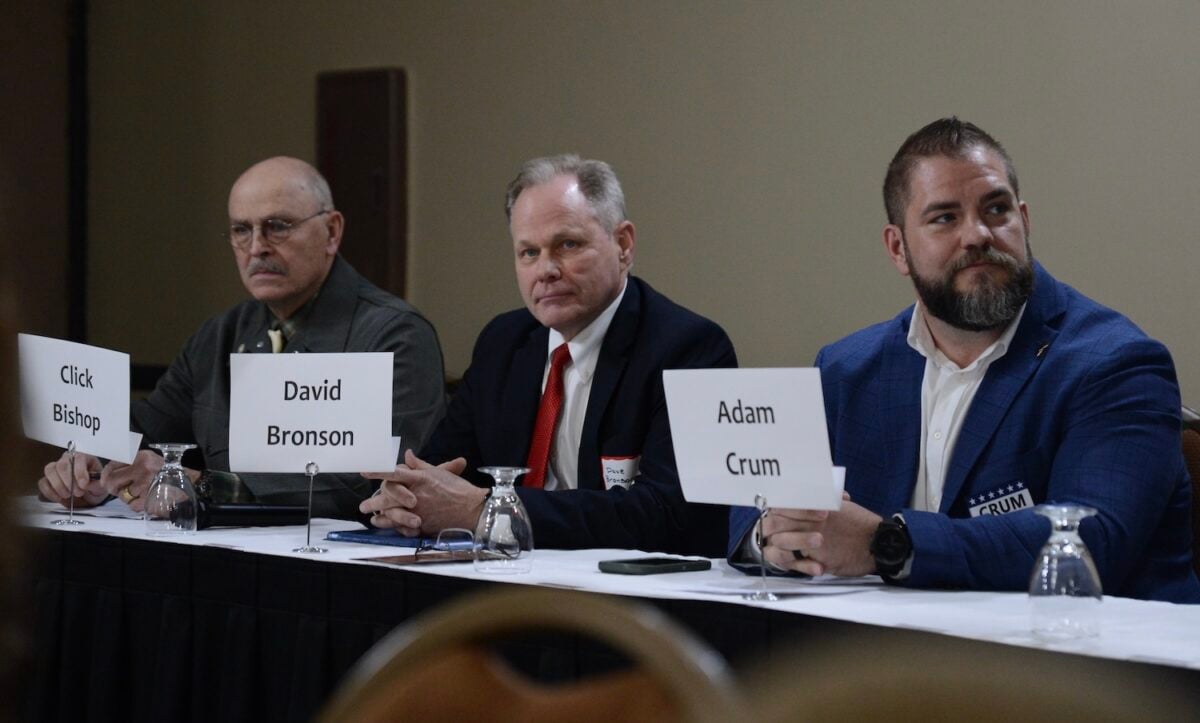
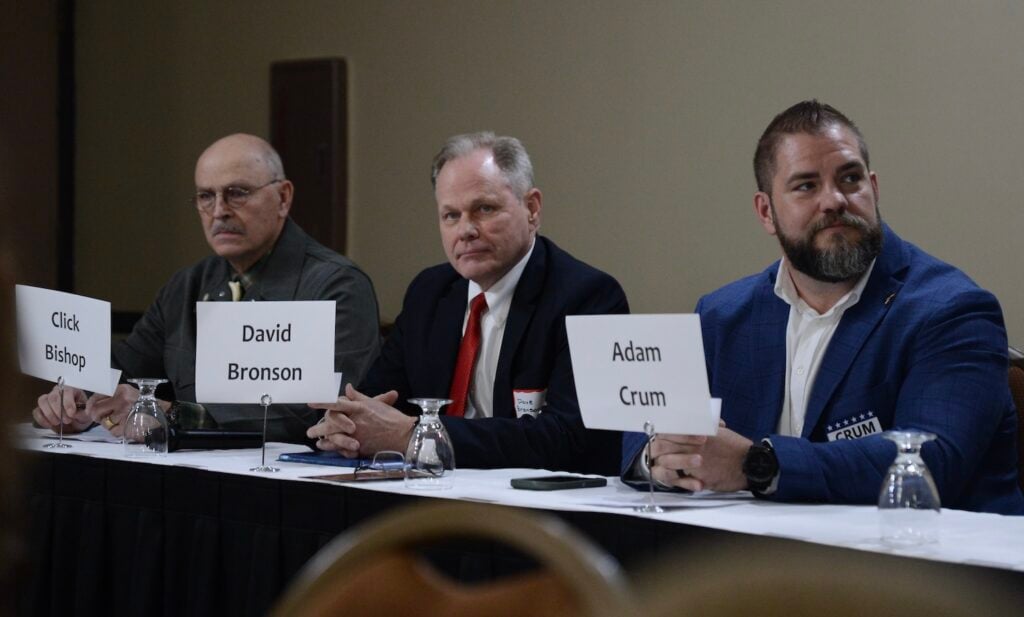
From left to right, Click Bishop, Dave Bronson and Adam Crum, three of the 10 candidates at the Capital City Republican governor candidate forum, are seen on Wednesday, Feb. 11, 2026, at the Baranof Hotel in Juneau. (James Brooks photo/Alaska Beacon)
By: James Brooks, Alaska Beacon
From left to right, Click Bishop, Dave Bronson and Adam Crum, three of the 10 candidates at the Capital City Republican governor candidate forum, are seen on Wednesday, Feb. 11, 2026, at the Baranof Hotel in Juneau. (James Brooks photo/Alaska Beacon)
Alaska’s two leading Democratic candidates for governor have quietly been discussing whether one of them should quit the race if both are among the top four vote-getters in Tuesday’s primary election.
Jonathan Kreiss-Tomkins and Tom Begich each said by phone on Thursday that they’ve been discussing different scenarios about what could happen when the final votes are counted.
Republicans have been talking about similar maneuvers for months, with one prominent Republican group going so far as to run ads urging lower-finishing candidates to withdraw in order to consolidate the vote in November.
“Both sides are trying to figure out: What does the top four look like? And how are we best positioned for success?” said Bernadette Wilson, one of the leading Republican candidates for governor in Alaska’s 17-person race.
Under Alaska’s election system, the top four vote-getters — regardless of political party — advance to the November general election. That may mean multiple Republicans or Democrats on the same ballot, competing for the same votes.
In November, voters in the general election will be asked to rank those four candidates in order of preference.
After all the votes are in, the candidate with the fewest number of first-choice preferences is eliminated. Any voters who ranked that candidate first will have their votes go to their second choice.
The process repeats until only two candidates are left.
In theory, that means no vote splitting. Anyone whose favorite candidate is eliminated can instead vote for someone else.
In practice, some Alaska voters ranked only one or two candidates in the 2022 and 2024 statewide elections, leading to an unusual number of “exhausted” ballots whose votes went to neither of the final two candidates.
That November, Hafner was eliminated first, and fewer than half his votes transferred to the other Democrat, then-incumbent Rep. Mary Peltola.
That was less than Peltola’s margin of defeat — Peltola was defeated by current Rep. Nick Begich III, R-Alaska — but in a closer race, it could have been decisive.
Now, as Peltola runs for U.S. Senate against incumbent Sen. Dan Sullivan, R-Alaska, a similar strategy is playing out.
National groups have spent more than $2 million in an attempt to boost lesser-known candidates into the final four and potentially split the field.
Dan J. Sullivan, unrelated to the incumbent senator, is on the ballot but told the Chicago Tribune that he’s uncertain whether he will remain in the race if he makes the top four.
In the 17-person race to replace Gov. Mike Dunleavy — who is term-limited and unable to run this year — candidates have been talking for over a year about whether or not they will be willing to bow out after the primary.
Wilson entered the race in May 2025 and promptly pledged to withdraw after the primary if she finished behind another Republican. It’s a pledge she’s renewed since then.
“I don’t think that it’s smart to carry on. … I don’t think that we need any more division as we head into November. I don’t think that it’s smart to split up the voting base, the volunteers that help, I don’t think it’s smart to split up the finances,” she said.
Wilson also said that having multiple candidates from the same party risks denying the eventual winner a mandate — a margin of victory so large that it gives the winner political backing to implement their platform.
“I think it’s important that a governor win by a strong strongest margin as possible, because I think that it’s important for the stability and the unity of the state past November,” she said.
Wilson has also been campaigning hard to repeal Alaska’s current elections system with Ballot Measure 2, which will come in front of voters in November.
Post-primary juggling is evidence that ranked choice voting doesn’t work, she said.
“I think it’s just made it worse,” Wilson said. “I think it’s handed more power to backroom conversations, and I just don’t think the public’s gonna like it.”
Jenny-Marie Stryker, executive director of the Alaska Democratic Party, was traveling on Friday and unavailable for an interview, a spokesman said. Carmela Warfield, chair of the Alaska Republican Party, did not respond to an email.
The Valley Republican Women, an influential group based in the Matanuska-Susitna Borough, has an ongoing ad campaign that urges Republicans to “vote the primary, consolidate the vote” and “don’t split the field.”
Julia Anastos, campaign manager for the group opposing Ballot Measure 2, said by email that gamesmanship isn’t new in Alaska.
“Parties and political insiders will always strategize about who should run and who should drop out. These kinds of maneuvers happen under a partisan primary as well, like in the 2014 and 2018 gubernatorial races, when would-be spoiler candidates dropped out to clear the lane for a stronger candidate,” she said. “Under our system now, ranked choice voting addresses that spoiler effect and ensures the winning candidate has earned majority support.”
The issue of what to do after the primary was a key issue at a forum earlier this month in Soldotna, when five candidates were directly asked about the issue.
“I would stay in,” nonpartisan candidate Meda DeWitt told forum attendees.
As a nonpartisan, she sees herself able to attract second-choice votes from both Republicans and Democrats.
“I actually appreciate ranked choice voting because your vote is not lost if your top pick doesn’t get in,” she said.
Adam Crum, a Republican candidate and former Dunleavy cabinet official, said he thinks there’s an advantage to having multiple Republicans in the general election.
“It actually does make more sense for more conservatives to stay in it, because you actually work together,” he said.
In the 2022 special election to replace Rep. Don Young, R-Alaska, Republican candidates Sarah Palin and Nick Begich III frequently fought each other on the campaign trail. That turned off Republican voters, Crum noted.
During the current primary election campaign, he said, “We have actually done a very good job … of actually working together and pushing forward ideas.”
A cordial campaign keeps voters involved and going to the polls, he said.
“You actually increase the ceiling, and the math actually works out. I’m a numbers guy. Over time, it does work,” Crum said.
Matt Heilala, a podiatrist and Republican who has put more than $1.5 million of his own money into a campaign for governor, said that last year, “I had the thought that I would immediately withdraw because we saw what happened with Sarah and Nick.”
Now, he’s not as sure. What if there’s “an indictment, an October surprise, some kind of a shenanigan that the opposing party is going to play on the person that is 10 votes ahead of me, and they’re just waiting for me to leave?” he asked.
In that case, having another Republican would be helpful, he suggested.
Dave Bronson, the former Anchorage mayor and Republican candidate for governor, said he intends to reserve his options until he sees what happens in the primary.
“The notion that I would stand up and say at this point in time I’ll absolutely get out if I’m No. 2 on the Republican side — that’s foolishness,” he said.
NOTN- Ferry service to Skagway has been suspended indefinitely after officials discovered major structural damage to the state-owned ferry dock.
The Alaska Department of Transportation and Public Facilities announced Saturday that there would be no service to Skagway for the “foreseeable future” while crews assess the damage.
Below is a portion of the notice issued by DOT;
“Due to major structural damage at the Alaska Marine Highway System (AMHS) docking facility in Skagway, the Skagway port is closed until further notice. All ferry service to and from Skagway is suspended for the foreseeable future.
The safety of our passengers and crew is always our highest priority, and operations will only resume once the facility is fully secure.
AMHS terminal agents are actively reaching out to passengers with existing reservations to assist with refunds, alternative travel plans, and rerouting options.
DOT is working with Hamilton Construction on a temporary repair, but there is no timeline yet for when ferry service will resume.
The Alaska governor’s mansion in Juneau is seen on Aug 14, 2026. (Photo by Corinne Smith/Alaska Beacon)
Nine of 17 candidates for Alaska governor weighed in on plans for communicating with the media and the public. They touched on a variety of topics, including town halls, news conferences, public records, use of artificial intelligence and the role of their communications teams.
The candidates are vying for the top four spots to advance to the ranked choice general election in November. The primary election is on Tuesday, August 18.
The Anchorage-based public relations firm Thompson & Co. conducted a survey of 12 candidates on communications with the public “whose campaigns have demonstrated significant organizational capacity, fundraising, and public support,” according to a statement announcing the survey results.
The candidates that chose to participate answered an 18 question survey. The respondents were Democrats Tom Begich and Jonathan Kreiss-Tomkins; Independent Bill Walker; and Republicans Adam Crum, Lesil McGuire, Click Bishop, Edna DeVries, Shelley Hughes and Matt Heilala.
Republicans Dave Bronson, Treg Taylor and Bernadette Wilson received the survey but did not respond.
“Candidates answered the same questions on press access, crisis communications, social media, rural and language accessibility, public records requests and staffing for the governor’s communications office,” the statement said.
Transparency and public access
All nine candidates that responded agreed that a free press providing information to the public is critical to democratic government. Several candidates committed to an open and transparent relationship with the press, including Kreiss-Tomkins.
“If I find myself annoyed as Governor by seemingly pesky questions from the media, I think that is a good thing for Alaskans, for transparency, and for a healthy democracy,” he said.
Hughes and Heilala noted the press also should be held to a standard of fairness. Hughes said she would be more responsive to “those who are fair.”
“I want journalists to report in a balanced fashion and strive to be unbiased – the way they should be in a healthy democracy (in our case, constitutional republic) – but that rarely is the case,” Hughes said. “I will give more time to those who are fair. I will be more apt to provide written comments to those who aren’t.”
Candidates varied on how often they would hold open press conferences and public town halls.
Bishop, McGuire and Hughes said they would hold weekly press conferences, with some flexibility due to scheduling Hughes added. Crum and Walker committed to two press conferences a month.
DeVries and Heilala said they would hold conferences as events warranted; Begich and Kreiss-Tomkins were unsure.
Seven candidates promised to hold regular town halls and public events across the state, with DeVries and Crum saying they were unsure of frequency.
“I intend to hold regular town halls and community visits across Alaska, including remote communities,” Bishop said. “My goal is to maintain a visible statewide presence through in-person visits and virtual options so Alaskans know their governor is accessible and engaged.”
Candidates split on their willingness to publish a public-facing calendar of the governor’s official schedule.
Currently Dunleavy’s calendar isn’t officially published publically, but has been available through a public records request.
Bishop, Walker, McGuire, and Heleila said they would publish a public-facing calendar. Kreiss-Tomkins said he would publish a schedule of public events.
Begich and DeVries said they were unsure, and Crum and Hughes said it would depend on security considerations.
Limiting media access and non-traditional media
Candidates were asked under what circumstances they would refuse to take press questions or limit media access to them personally.
McGuire and DeVries said “None.”
Kreiss-Tomkins, Crum, Bishop and Heilela said the default would be to answer questions.
Begich noted the line between personal and professional life should be respected.
“However, when the personal veers into the professional, it is fair for the press to question those actions, and it is essential that a Governor respond to them in the interest of public integrity and the truth,” Begich said.
Several candidates noted access may be limited on issues related to ongoing law enforcement investigations, active litigation, personnel issues or public safety.
Hughes said media access would be limited: “Would limit if information is confidential, uncertain, or would jeopardize a positive outcome. Would limit access if a safety issue,” she said.
Candidates agreed that their media distribution lists would be broad and inclusive, and they would host virtual online press conferences. They agreed their administrations would be available to rural reporters and give them access equivalent to that of reporters in urban areas.
The majority of candidates agreed they would grant access to “non-traditional” media organizations, including podcasters, bloggers, independent journalists and online-only outlets.
Begich said he would evaluate such interview requests on a case-by-case basis depending on his availability. He said in the past he’s done interviews for outlets that were “inherently biased,” but said “as long as they and I acknowledged that, it was fine.”
Social media and artificial intelligence use
All candidates said they plan to maintain active social media accounts across major platforms, including Facebook, Instagram, X (formerly Twitter), YouTube and others.
Candidates varied on whether they plan to use artificial intelligence-generated content on their social pages.
McGuire and Heilala said yes.
Hughes said she would on occasion. “It would be the exception rather than the rule,” she said.
Begich and Bishop said no.
Kreiss-Tomkins, Crum, Walker, and DeVries answered “unsure at this time.”
Candidates were also asked under what circumstances they would mute or block members of the public from government social media accounts.
DeVries answered she would not block anyone. The majority of candidates said they would keep social media pages open and welcome criticism or differing opinions, but would consider blocking accounts for hate speech, threats, intimidation or spam.
Heilala said his administration would monitor such blocked accounts. “Any blocks will be documented, applied consistently, and reviewed periodically. Viewpoint discrimination will never be tolerated. Alaskans have a right to speak to their government, even critically. I expect robust debate, not an echo chamber,” he said.
Public records
All the candidates said their administrations would comply with public records law, under the Alaska Public Records Act.
Kreiss-Tomkins and McGuire said they would not charge any fees.
Currently the law allows public agencies to charge after the first 5 hours of work on filling public records requests for personnel time based on their salary.
Walker said he would “like to avoid fees if at all possible” and would assess once in office. Bishop noted that fees should reflect actual costs and not be a barrier to accessing public records. Hughes said a small fee would be necessary for large projects.
Language access and communication with non-English speaking communities
Alaska is home to 21 official languages including Inupiaq, Yup’ik, Alutiiq, Tlingit and others.
Candidates were asked how their potential administrations would communicate with non-English speaking communities, and what resources would be committed to making official information available across languages.
Begich, Kreiss-Tomkins, Walker and Bishop said they would work with tribal and community organizations to translate government communications and make translation services available, particularly for emergencies.
Kreiss-Tomkins pointed to his legislative record officially recognizing Native languages. “I’ll prioritize it in emergencies, when a delay in someone’s own language can cost lives. I’ve worked on this issue dating back to my service as a Representative, when I sponsored the bill that made Alaska’s 20 Native languages official languages of our state alongside English,” he wrote.
Crum said his administration would follow current law which “requires broad availability of public material.”
Hughes and Helaila said they would use AI translation tools and refer the public to AI translation services— “While always having human review for important documents,” Heilala added.
McGuire said she would build on the Division of Elections translation model, and also seek bilingual team members in her administration. “I would also consider sight and hearing impaired Alaskans,” she said.
Staffing communications teams
Bishop, Heleila and McGuire provided some details on their potential communications offices, which would include a communications director, press secretary, digital communications and outreach coordinators.
Walker pointed to his previous term as Alaska governor, from 2014 to 2018, with staff including a communication director, deputy communication director and several assistants to the director.
Hughes said she would have a minimum of two communications staff, and possibly task others with communications duties.
Several candidates responded that plans on staffing their communications teams are premature, and would be determined if elected to office. That included Begich, Kreiss-Tomkins, Crum and DeVries.
“We are focused on campaigning, listening to Alaskans, and getting our message out,” Kreiss-Tomkins said. “If we win the election, that is when we will make decisions on staffing the administration.”
(The Center Square) – Top teachers union leaders make more than $500,000 a year in pay and benefits, leaving critics to say that taxpayer-funded membership dues allow for the high compensation, an investigation by The Center Square found.
Moldy dishes left behind at checkout can turn into a real problem for an Airbnb guest, not just an eyesore for whoever cleans next. Airbnb’s … Read moreThe post Leaving dishes in the sink could cost an Airbnb guest more…