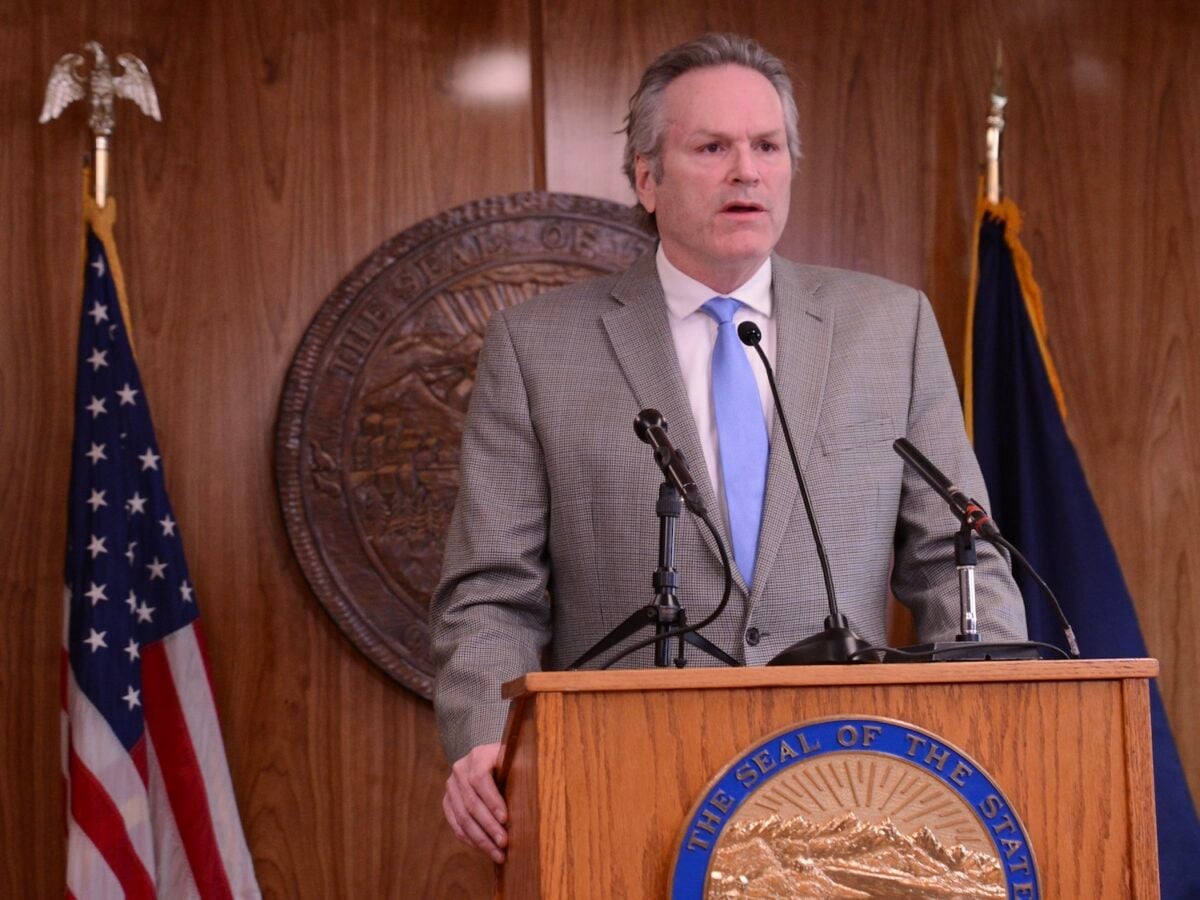
Alaska Gov. Mike Dunleavy speaks to reporters on Thursday, April 17, 2025, with Deena Bishop, commissioner of the Alaska Department of Education and Early Development, looking on in the background. (Photo by James Brooks/Alaska Beacon)
By: Corinne Smith, Alaska Beacon
Alaska Gov. Mike Dunleavy speaks to reporters on Thursday, April 17, 2025. (Photo by James Brooks/Alaska Beacon)
Gov. Mike Dunleavy signed off on a supplemental budget bill that authorizes nearly $450 million in additional state spending this year.
The budget bill covers additional costs incurred by the state this fiscal year ending in June, including funds for disaster relief, education, corrections and transportation.
The bill was approved by the Alaska State Legislature two weeks ago. Dunleavy signed the budget on Apr. 2, and transmitted it back to the Legislature on Thursday.
“I appreciate the Legislature’s support of these proposals,” Dunleavy said in a letter announcing his signature on the bill. “The supplemental budget I have signed into law today enables the State to meet current fiscal year responsibilities and represents prudent and fiscally responsible investments in emergency and fire response, public safety and statewide transportation needs.”
The budget includes $75 million for disaster relief to address the response to the Western Alaska storms last fall, and nearly $100 million for fire suppression, particularly in Interior Alaska. It includes $20 million for the Alaska Department of Corrections overtime expenses, as well as $70 million in time-sensitive funding for transportation — sought by the construction industry to unlock a federal match of $630 million for state construction projects.
It also includes $130 million for the Alaska Higher Education Fund which provides grants and scholarships for students, as well as $34.4 million for Medicaid and $12.8 million for other public assistance programs through the Alaska Department of Health.
The governor’s office submitted an additional $11.6 million request, but it was submitted too late to include in the budget bill, and will be rolled into the proposal for next year’s budget.
Additionally, the state is waiting on an appeal decision after failing a federal disparity test for education funding, and could potentially be liable for $72 million in K-12 funding for next year, according to officials with the Legislative Finance Division.
Oil revenues still uncertain
In the Legislature, the bill was delayed this year amid ongoing debate in the House of Representatives on whether to pay for the larger than usual budget bill out of state savings — an act that requires the approval of three-quarters of legislators.
Members of the House Republican minority caucus objected to spending from a state savings account, the Constitutional Budget Reserve. After the Alaska Department of Revenue projected the state would see an additional $500 million in oil revenue due to a surge in oil prices driven by the Iran war, they argued the state would not need to pull from savings to pay its bills.
Members of the multipartisan House majority caucus objected to the uncertainty of revenue forecasts and future oil prices, and argued for a draw from state savings to fund the budget bill immediately.
If oil-driven state revenues from now until the end of the fiscal year are not sufficient to cover the $450 million supplemental budget, then lawmakers agreed to draw from state savings. That means oil prices must average approximately $82 per barrel of oil through June for state revenue to cover spending, according to officials with the Legislative Finance Division.
House Speaker Rep. Bryce Edgmon, I-Dillingham, was among legislators who supported the draw from savings several weeks ago, instead of banking on uncertain future oil revenues. On Friday, he said it seems revenues will cover the budget bill.
“As appears now, oil prices are continuing to move in an upward trajectory, which means that the bill at the very end could be fully funded,” Edgmon said. “But there’s still a fair amount of time in front of us for oil prices to, you know, continue to be volatile.”
Edgmon said barring a dive in oil prices, he doesn’t expect another vote on drawing from the state savings this session.
“That’s pending a dramatic drop in oil prices, of course, which doesn’t seem to be on the horizon.”
A subadult fur seal is hauled out on St. Paul Island in 2007. About two-thirds of the world’s northern fur seal population uses the Pribilofs for breeding. (Photo by Carla Stanley/U.S. Fish and Wildlife Service)
A conservation group sued federal fisheries managers over catch limits in the pollock trawl fishery, arguing that their regulations do not adequately protect northern fur seals in the Bering Sea.
The lawsuit, filed in the U.S. District Court of Alaska on Wednesday, centers on the fur seal population on St. Paul Island, home to nursing females that rely on pollock to feed their pups.
The Center for Biological Diversity, an Arizona-based conservation group, alleges that NOAA Fisheries violated federal conservation laws by not including stronger protections for fur seals in its annual harvest limits for pollock by trawlers.
The group cites data that northern fur seals have declined by 70% on St. Paul Island since the 1970s.
“The federal government is legally required to make sure industrial fishing doesn’t devastate this vulnerable population of seals, but it’s failed to act for decades,” said Cooper Freeman, Alaska director at the Center for Biological Diversity, through a prepared statement.
NOAA Fisheries, also called the National Marine Fisheries Service, is responsible for ensuring fish stocks are sustainable and conserving marine life. The agency wrote in March that there is “not sufficient information” to determine if the pollock trawl fishery is disrupting fur seal populations on St. Paul Island in violation of federal law.
Similar long-running legal battles have been fought over trawl fishing and its impacts on Steller sea lion populations in Western Alaska.
Trawl fishing for pollock in the Bering Sea is divisive in Alaska. Supporters point to billions of dollars in economic activity and thousands of jobs created by the fishery. Opponents argue that trawling for pollock is leading to environmental damage and salmon bycatch.
The fur seal challenge has been assigned to Judge H. Russell Holland, a senior U.S. District court judge.
Gov. Mike Dunleavy signed off on a supplemental budget bill that authorizes nearly $450 million in additional state spending this year.
The budget bill covers additional costs incurred by the state this fiscal year ending in June, including funds for disaster relief, education, corrections and transportation.
The bill was approved by the Alaska State Legislature two weeks ago. Dunleavy signed the budget on Apr. 2, and transmitted it back to the Legislature on Thursday.
“I appreciate the Legislature’s support of these proposals,” Dunleavy said in a letter announcing his signature on the bill. “The supplemental budget I have signed into law today enables the State to meet current fiscal year responsibilities and represents prudent and fiscally responsible investments in emergency and fire response, public safety and statewide transportation needs.”
The budget includes $75 million for disaster relief to address the response to the Western Alaska storms last fall, and nearly $100 million for fire suppression, particularly in Interior Alaska. It includes $20 million for the Alaska Department of Corrections overtime expenses, as well as $70 million in time-sensitive funding for transportation — sought by the construction industry to unlock a federal match of $630 million for state construction projects.
It also includes $130 million for the Alaska Higher Education Fund which provides grants and scholarships for students, as well as $34.4 million for Medicaid and $12.8 million for other public assistance programs through the Alaska Department of Health.
The governor’s office submitted an additional $11.6 million request, but it was submitted too late to include in the budget bill, and will be rolled into the proposal for next year’s budget.
Additionally, the state is waiting on an appeal decision after failing a federal disparity test for education funding, and could potentially be liable for $72 million in K-12 funding for next year, according to officials with the Legislative Finance Division.
Oil revenues still uncertain
In the Legislature, the bill was delayed this year amid ongoing debate in the House of Representatives on whether to pay for the larger than usual budget bill out of state savings — an act that requires the approval of three-quarters of legislators.
Members of the House Republican minority caucus objected to spending from a state savings account, the Constitutional Budget Reserve. After the Alaska Department of Revenue projected the state would see an additional $500 million in oil revenue due to a surge in oil prices driven by the Iran war, they argued the state would not need to pull from savings to pay its bills.
Members of the multipartisan House majority caucus objected to the uncertainty of revenue forecasts and future oil prices, and argued for a draw from state savings to fund the budget bill immediately.
If oil-driven state revenues from now until the end of the fiscal year are not sufficient to cover the $450 million supplemental budget, then lawmakers agreed to draw from state savings. That means oil prices must average approximately $82 per barrel of oil through June for state revenue to cover spending, according to officials with the Legislative Finance Division.
House Speaker Rep. Bryce Edgmon, I-Dillingham, was among legislators who supported the draw from savings several weeks ago, instead of banking on uncertain future oil revenues. On Friday, he said it seems revenues will cover the budget bill.
“As appears now, oil prices are continuing to move in an upward trajectory, which means that the bill at the very end could be fully funded,” Edgmon said. “But there’s still a fair amount of time in front of us for oil prices to, you know, continue to be volatile.”
Edgmon said barring a dive in oil prices, he doesn’t expect another vote on drawing from the state savings this session.
“That’s pending a dramatic drop in oil prices, of course, which doesn’t seem to be on the horizon.”
President Donald Trump on Friday called on Alaska voters to repeal ranked choice voting at the November election.
“The Wonderful People of Alaska desperately want to restore Free, Fair, and Honest Elections in their Great State, and get rid of their disastrous, and very fraudulent, “Ranked-Choice Voting,” Trump said on Truth Social.
An effort to repeal ranked choice voting in 2024 failed by just 737 votes. A separate repeal initiative, sponsored by figures aligned with the Alaska Republican Party, is set to appear on the 2026 general election ballot.
Trump gave his “complete and total support” to supporters of the repeal effort, including U.S. Sen. Dan Sullivan and Congressman Nick Begich, both Alaska Republicans running for reelection in November.
The president’s post was seized on by Republican candidates for Alaska statewide office who echoed his calls to strike down the voting system.
Alaska voters narrowly approved a ballot measure in 2020 that implemented ranked choice voting for state and congressional elections, alongside open primary elections and tougher campaign finance disclosure requirements.
Ranked-choice voting in Alaska lets voters pick candidates in order of preference rather than choosing just one. If no candidate wins a majority of first-choice votes, the lowest-ranked candidate is eliminated and those votes are redistributed until someone surpasses 50% of votes.
However, the new election system has been controversial. Opponents argue that ranked choice voting is unnecessarily complicated, while supporters say it has led to more moderate and consensus candidates elected.
Ranked voting, open primaries and the tougher campaign finance disclosure requirements would all be struck down if the 2026 ballot measure is approved by a majority of voters.
Alaska for Better Elections is a group running voter education campaigns in support of retaining ranked choice voting and open primaries. Executive Director Juli Lucky said Alaska’s election system has allowed policymakers across the political spectrum to work together without fear of challengers in partisan primaries.
“I think Alaskans will reflect on the results we’ve seen to decide whether our system of open primaries, ranked choice voting, and the strictest campaign finance laws in the country works for them,” Lucky said by text message after Trump’s post. “Ultimately, Alaskans created and enacted this system, and Alaskans will decide whether we keep it.”
If you’ve ever wanted to subsidize a sneaky stowaway’s blended drink habit, you’re in luck. The Alaska Zoo is seeking symbolic adoptive parents for Meatball, a juvenile opossum found and captured in a Juneau machine shop near the airport late last month.
“We’ve made him these smoothies he really likes out of his vegetables,” said Sam Levin, curator at the Alaska Zoo. “He’s pretty much eating anything we give him right now.”
His bottomless appetite inspired zookeepers to name him Meatball. Levin said he’s currently on the lighter side with some parasites he’s overcoming, so the zoo is hoping his appearance will match his namesake soon.
“We kind of threw a couple names around, and Meatball seemed like it fit him, what we were seeing of his personality so far,” Levin said. “We are hoping to put some weight on him and some muscle.”
Animal Control Officer Jordan Bales holds up Chester/Meatball the opossum. (Juneau Animal Rescue photo)
Tim Travis, who originally discovered the opossum at Juneau’s N C Machinery and aided in his capture, was happy to hear Meatball had found a home. Travis and his coworkers originally dubbed him Chester.
“The name Chester just popped up in my co-worker Chad’s head, and we all agreed it seemed like a fitting name for a grungy little lost opossum,” he explained in a message. “I have been following the story with the zoo and we are glad they were able to take him in but were disappointed to hear about the name change.”
Levin said the zoo named Meatball before seeing Travis’s post with the original name.
According to Levin, Meatball likely followed in the footsteps of Grubby, a legendary opossum who hitchhiked to Homer in a shipping container. After evading capture for a month and inspiring an online #FreeGrubby movement, she was finally taken into custody by the Homer Police Department in 2023–but not without a fight. She bit an officer on the hand during the course of her “arrest.”
“Officer Crowder, without any fear or hesitation, attempted to apprehend the suspect, who then let out a little hiss and growl and bit our officer in the hand,” a 2023 Facebook post from the Homer Police Department read. “After some very effective de-escalation, the suspect was contained and taken into custody without further incident. It was transported to the Homer Jail via a very comfortable Rubbermaid trash can.”
Like Meatball, she found a home at the zoo, where her notoriety continued. Last year, she passed away due to natural complications of age. Grubby was estimated to be 3.5 years old at the time of her death, much longer than opossums usually survive in the wild.
Grubby’s last moments of freedom. (Homer Police Department photo)
“The way that she had gotten here was by stowaway and she’s an invasive species, and so she didn’t have a lot of options here in Alaska, and it just happened that it happened again in Juneau,” Levin said. “It was brought to animal control, they picked him up and asked if we would like another one. They knew that we had lost Grubby and we liked her very much and she was very popular at the zoo, so we had the space and the timing was fortuitous.”
In Meatball’s case, the opossum arrest was a little smoother. Animal control and Travis’s coworkers wrangled him into a cat trap with cardboard flaps and a broom, and no injuries were reported.
“While Juneau Animal Rescue’s Animal Control team typically responds to domestic animals, this unusual situation called for extra coordination and we were glad to assist,” a newsletter from Juneau Animal Rescue read.
Meatball was shipped north to Anchorage on Alaska Air Cargo and Levin picked him up from the airport. She said that it’s possible he came from Washington state where they’re also considered invasive, but it’s hard to say for sure.
“They’re actually really good at spreading. Since they’re really good at adapting to where people live, they tend to just follow the people,” she said. “Even though we don’t see that a lot in Alaska, you can certainly apply those same principles to things like coyotes. They’re also really good at following where people go and thriving in areas where people are. So, it’s the same lesson, and you can see what they’ve done in the ecosystem, and how important it is to kind of just be good stewards of the land and watch for things like invasive species.”
While he definitely has some iconic shoes to fill, Meatball’s origin story is a little different than his spunkier predecessor.
“Grubby I think was maybe a little bit older than he was and she had been on the lam for a while, so she was very wary of humans,” Levin said. “She was, unfortunately, doing fine out in the wild in Homer, whereas Meatball, I think, is a little hungrier. He wasn’t really thriving the way she was. But he went through, I think, a lot less stress.”
That puts him in a better spot to help with the zoo’s goal of educating the public about invasive species while being in a safe haven for animals that find themselves where they’re not supposed to be. He’s still in quarantine recovering from parasites and some superficial injuries, but is on display and already a popular critter.
People can help with the zoo’s goal by charitably adopting Meatball. Different donation levels fund equipment and food for the adopted animal, like the new food processor required for Meatball’s specialized diet, and correspond to benefits like photos, plush toys, stickers, or even private tours. Details about adoption can be found on the Alaska Zoo’s website.
“We hear all sides of the spectrum of people with opossums,” Levin said. “They either love them or hate them. We’re hoping to turn some more haters into lovers.”
The Alaska State Capitol seen on the first day of the second session of the 34th Alaska State Legislature on Jan. 20, 2025 (Photo by Corinne Smith/Alaska Beacon)
At the Alaska Beacon, we’re constantly trying to figure out where we should put our attention. There’s always more news than there are people to report it.
Every Thursday, the Alaska Legislature publishes its committee schedule for the coming week. Public notices alert us to meetings and events. The governor’s office occasionally lets us know ahead of time that something’s coming down the pike, too.
Here’s what we know about for the coming week. If you know of something that’s coming up that you should think we should pay attention to, email us at info@alaskabeacon.com.
We can’t cover everything on this list, but we’re interested in them and we think you should know about them in case you’re interested in them, too.
This list is ripped from our notebooks, and it is likely to change over the course of the week. We’ll update it when we can.
Are you trying to keep track of when to testify on a bill? The Legislature has a website for that.
Monday, April 13
*The House continues debating the operating budget for next year, so House committee meetings are contingent on that schedule
8 a.m. – House Education hears a that would mandate civics education
9 a.m. – Senate Finance hears a bill related to an occupational therapy licensure compact
12 p.m. – Lunch & Learn with Alaska Youth for Environmental Action
1 p.m. – House Judiciary hears bills related to consumer data privacy, to maintain sibling relationships for youth in foster care, and a bill to increase criminal penalties for selling fraudulent airbags
1 p.m. – House Resources hears the governor’s bill to provide tax breaks for the proposed Alaska LNG gas line
1:30 p.m. – House Finance hears a bill to establish criminal penalties for mail theft, and a bill to authorize pharmacists to prescribe certain medications
1:30 p.m. – Senate Judiciary considers the governor’s appointees for the Alaska Parole Board and the Human Rights Commission, and a bill to increase criminal penalties for hit-and-runs
1:30 p.m. – Senate Labor and Commerce hears a bill related to the right to repair digital devices, and a bill related to allowable charges by health insurers
1:30 p.m. – House Labor and Commerce hears bills related to benefits for emergency dispatchers, telehealth reimbursement rates, damages limits for personal injuries or wrongful death, and to close a tax loopholes for C-corporations
3:30 p.m. – Senate Education hears a presentation on the history of the state’s Regional Education Attendance Areas
3:30 p.m. – Senate Resources hears a bill proposed by the governor to provide property tax breaks for the proposed 739-mile Alaska LNG gas line project
Tuesday, April 14
8 a.m. – House Community and Regional Affairs considers “right to repair” legislation and hears bills that would make it easier for unhoused youth to get birth certificates and regulate autonomous vehicles
9 a.m. – Senate Finance hears a bill that would increase access to retirement benefits for disabled veterans and a bill that would support the civil legal services fund
9 a.m. – Senate Resources continues considering the governor’s bill to provide property tax breaks for the proposed Alaska LNG gas line
12 p.m. – Lunch and Learn presentation on delivering health care to Southeast Alaska
1 p.m. – House Energy hears a presentation on geothermal energy
1:30 p.m. – House Finance hears a a resolution to put a constitutional amendment on the November ballot to establish an education fund
3:15 p.m. – House Health and Social Services hears a bill that would expand early education services, and a bill to establish an opioid litigation settlement fund for the state to record and better manage opioid settlement proceeds
3:15 p.m. – House State Affairs hears a presentation about how other states regulate artificial intelligence
3:30 p.m. – House Health and Social Services hears a resolution in support of the Rural Health Transformation Fund
3:30 – Senate State Affairs hears a presentation on disaster management
Wednesday, April 15
Arctic Encounter Summit takes place in Anchorage
8 a.m. – House Education hears a bill to require CPR training in schools and a bill to fund free school breakfast and lunch
9 a.m. – House Finance hears a bill related to expand funding for the special education services agency
9 a.m. – Senate Finance hears a bill to allow the transfer of inmates serving long sentences to out-of-state facilities and another to allow the Alaska Industrial Development and Export Authority to provide loans to build workforce housing
12 p.m. – Documentary film screening: “Talking to the Tundra: How a Yup’ik Village Heals Together” by Indie Alaska
12 p.m. – Lunch and Learn presentation on the Alaska Fentanyl Response Project
1 p.m. – House Judiciary hears a bill that would allow the surrender of infants in so-called infant safety devices, a bill that would lower the legal blood alcohol limit for driving to 0.04 from 0.08, and a resolution to put a constitutional amendment on the ballot to define that corporations do not have the same rights as people to donate to political campaigns
1 p.m. – House Resources hears a companion bill proposed by the governor to provide property tax breaks for the proposed Alaska LNG gas line
1:30 p.m. – Senate Finance hears a bill related to regulating cryptocurrency
1:30 p.m. – Senate Judiciary considers governors nominees for the Commission on Judicial Conduct — Aldean Kilbourn, Donald McClintock III and Jane Moore — and a bill related to AI-generated child sexual abuse material
1:30 p.m. – Senate Labor and Commerce hears a bill that would allow municipalities to set local property tax caps
3:15 p.m. – House Labor and Commerce considers a bill that would regulate LNG gas import facilities3:30 p.m. – Senate Resources hears a bill related to state policy and oversight of the proposed Alaska LNG gas line project
3:30 p.m. – Task Force on Education Funding hears a presentation on national assessments, and holds a demonstration for lawmakers to take a state standardized test
Thursday, April 16
Arctic Encounter Summit continues in Anchorage
Native Youth Olympic Games begin at the University of Alaska Anchorage Alaska Airlines Center and run through Saturday.
8 a.m. – House Community and Regional Affairs continues consideration of “right to repair” legislation
9 a.m. – House Finance considers a bill that would establish paid parental leave program for parental leave up to 26 weeks and increases unemployment insurance maximum weekly benefit amount through the Alaska Department of Labor, and create a new parental leave fund
9 a.m. – Senate Resources continues considering a governor’s bill to provide property tax breaks for the proposed Alaska LNG gas line, and a bill to establish state policy for regulating and oversight of gas line construction
10 a.m. – House Fisheries considers a bill that would cap annual fees, streamline the permitting process and create exemptions from certain health and sanitary requirements for small commercial fishing vessels
10:15 p.m. – House Military and Veteran Affairs considers a bill that would create options for veterans who are exposed to service-related trauma and commit crimes to be able to access therapeutic services and avoid incarceration
12 p.m. – Lunch and Learn presentation on the science of child development
1 p.m. – House Energy hears a presentation on Alaska’s Sustainable Energy Corporation
1:30 p.m. Senate Community and Regional Affairs considers a bill that would require contracts for new data centers account for energy needs, prioritize renewable energy, and ensure other energy customers’ costs do not increase, and another bill that would expand the number of seats on the Board of Fisheries
3:30 p.m. House Health and Social Services considers governors’ appointees to several boards
3:30 p.m. – Senate State Affairs reviews the voter initiatives that have been certified to appear on the state ballot in November
Friday, April 17
Arctic Encounter Summit closes in Anchorage
1 p.m. House Resources continues hearing a companion bill proposed by the governor to provide property tax breaks for the proposed Alaska LNG gas line
3:15 p.m. House Labor and Commerce considers a bill that would require insurance to cover evaluations and treatment for certain pediatric neuropsychiatric disorders, and another bill to reclassify emergency dispatchers to be included in “protective services occupations” and eligible for the state’s public employees’ defined benefit retirement system
3:30 p.m. Senate Resources continues considering a governor’s bill to provide property tax breaks for the proposed Alaska LNG gas line
President Donald Trump speaks to the media in the Oval Office at the White House on Sept. 2, 2025 in Washington, D.C. (Photo by Alex Wong/Getty Images)
President Donald Trump on Friday called on Alaska voters to repeal ranked choice voting at the November election.
“The Wonderful People of Alaska desperately want to restore Free, Fair, and Honest Elections in their Great State, and get rid of their disastrous, and very fraudulent, “Ranked-Choice Voting,” Trump said on Truth Social.
An effort to repeal ranked choice voting in 2024 failed by just 737 votes. A separate repeal initiative, sponsored by figures aligned with the Alaska Republican Party, is set to appear on the 2026 general election ballot.
Trump gave his “complete and total support” to supporters of the repeal effort, including U.S. Sen. Dan Sullivan and Congressman Nick Begich, both Alaska Republicans running for reelection in November.
The president’s post was seized on by Republican candidates for Alaska statewide office who echoed his calls to strike down the voting system.
Alaska voters narrowly approved a ballot measure in 2020 that implemented ranked choice voting for state and congressional elections, alongside open primary elections and tougher campaign finance disclosure requirements.
Ranked-choice voting in Alaska lets voters pick candidates in order of preference rather than choosing just one. If no candidate wins a majority of first-choice votes, the lowest-ranked candidate is eliminated and those votes are redistributed until someone surpasses 50% of votes.
However, the new election system has been controversial. Opponents argue that ranked choice voting is unnecessarily complicated, while supporters say it has led to more moderate and consensus candidates elected.
Ranked voting, open primaries and the tougher campaign finance disclosure requirements would all be struck down if the 2026 ballot measure is approved by a majority of voters.
Alaska for Better Elections is a group running voter education campaigns in support of retaining ranked choice voting and open primaries. Executive Director Juli Lucky said Alaska’s election system has allowed policymakers across the political spectrum to work together without fear of challengers in partisan primaries.
“I think Alaskans will reflect on the results we’ve seen to decide whether our system of open primaries, ranked choice voting, and the strictest campaign finance laws in the country works for them,” Lucky said by text message after Trump’s post. “Ultimately, Alaskans created and enacted this system, and Alaskans will decide whether we keep it.”
The borough manager has proposed a budget for the upcoming year that would hold big-ticket spending roughly steady, but would pay for it, at least in part, with significant spending from savings.
In one of few larger spending changes, the manager has proposed a roughly 4% bump in school funding, on top of the increase approved by the assembly last year.
The increase, which comes out to an additional $101,000 over last year, would bring the borough’s spending on the school to $2,668,000.
That’s still short of a 12%, or $295,000, increase requested this year by superintendent Lilly Boron, said borough manager Alekka Fullerton.
The increase in borough school spending comes as a response to shrinking state funding.
In recent weeks, Boron told state lawmakers that the district is in dire financial straits, warning of potential “insolvency” if state funding levels continue to stagnate.
District officials in the last two years have said their top priority with new funds is to increase teacher salaries. Under a newly-negotiated collective bargaining agreement, teachers in the district will see a 5% pay bump this year, followed by a 4% and 3% increase in the two years following.
The district’s issues, of inflation-fueled cost increases and declining state-funding, have been problems for the borough as well, Fullerton said. “We have a very lean budget already and have battled inflation in every department over the last few years,” Fullerton wrote in a letter accompanying the budget.
For a number of reasons, it has not been easy for the borough to pull in new revenue to match increasing costs.
Property taxes are just about tied with sales tax as the largest sources of borough revenue. Raising property tax rates, however, is politically unpopular and capped by borough code.
This year, Fullerton’s budget would actually drop property tax rates. As written, the rate in the townsite would drop 8% from last year and the borough-wide rate would drop 11%.
Property tax rates are often expressed in mills — the dollars taxed per $1000 of assessed value. Haines’ rates in the proposed budget, 10.09 mills in the townsite and 5.74 boroughwide, come in below the 2025 state average of 10.58 mills, according to the Office of the State Tax Assessor.
In recent months, borough leadership has sought to increase revenues outside of direct taxation of locals.
New revenue streams approved by the assembly include a cruise ship head-tax and zero-balance ambulance billing, each projected to bring in low-to-mid six-figure sums annually. The revenue generating effort also included the seasonal sales tax, which voters approved last year, but which remains controversial, and a potential new severance tax on exported raw materials.
Even with these new funding sources, revenue in the proposed budget falls about $2.7 million short of spending. To close the gap, Fullerton proposes dipping into borough savings.
That would come from a number of different savings accounts, all of which are restricted to specific types of spending except for the unrestricted areawide general fund. That general fund, the largest of the accounts, funds items like the school, library, pool, and borough administration.
The proposed savings draw would pull $1.1 million from the areawide general fund, which is expected to have $4.3 million in savings by the end of June 2026.
The rest of the savings draw would largely come from the townsite-services fund and the economic development and tourism fund, each of which currently contain more than $1 million.
The manager’s proposal is headed to the assembly, which controls final decisions on the annual tax-and-spend plan.
Last year, the assembly approved additional spending beyond the manager’s plan for services like the school and the pool, which it could once again do this year.
Assembly members will likely also comb through the budget to find cuts, like last year’s cancellation of a handful of new borough vehicle purchases.
The manager has also left what she says are more political decisions to the assembly. For instance, there’s no money in her budget for non-profits or for the Freeride World Tour, which has asked to be paid $150,000 to return next year.
The assembly’s deliberations will include three committee-of-the-whole meetings dedicated to the budget on April 21, April 28, and May 14. Then the assembly will hold public hearings on the budget on May 12 and May 26. If the budget is not passed at the May 26 meeting, the assembly will hold a third public hearing on June 9.
According to borough charter, the assembly must pass the final budget by June 15.
What do you want to know about the Haines Borough budget?
Help us report on the the borough’s budget by telling us how borough spending impacts you.
Please enable JavaScript in your browser to complete this form.
Please enable JavaScript in your browser to complete this form.
Alaska Gov. Mike Dunleavy speaks to reporters on Thursday, April 17, 2025. (Photo by James Brooks/Alaska Beacon)
Gov. Mike Dunleavy signed off on a supplemental budget bill that authorizes nearly $450 million in additional state spending this year.
The budget bill covers additional costs incurred by the state this fiscal year ending in June, including funds for disaster relief, education, corrections and transportation.
The bill was approved by the Alaska State Legislature two weeks ago. Dunleavy signed the budget on Apr. 2, and transmitted it back to the Legislature on Thursday.
“I appreciate the Legislature’s support of these proposals,” Dunleavy said in a letter announcing his signature on the bill. “The supplemental budget I have signed into law today enables the State to meet current fiscal year responsibilities and represents prudent and fiscally responsible investments in emergency and fire response, public safety and statewide transportation needs.”
The budget includes$75 million for disaster relief to address the response to the Western Alaska storms last fall, and nearly $100 million for fire suppression, particularly in Interior Alaska. It includes $20 million for the Alaska Department of Corrections overtime expenses, as well as $70 million in time-sensitive funding for transportation — sought by the construction industry to unlock a federal match of $630 million for state construction projects.
It also includes $130 million for the Alaska Higher Education Fund which provides grants and scholarships for students, as well as $34.4 million for Medicaid and $12.8 million for other public assistance programs through the Alaska Department of Health.
The governor’s office submitted an additional $11.6 million request, but it was submitted too late to include in the budget bill, and will be rolled into the proposal for next year’s budget.
Additionally, the state is waiting on an appeal decision after failing a federal disparity test for education funding, and could potentially be liable for $72 million in K-12 funding for next year, according to officials with the Legislative Finance Division.
Oil revenues still uncertain
In the Legislature, the bill was delayed this year amid ongoing debate in the House of Representatives on whether to pay for the larger than usual budget bill out of state savings — an act that requires the approval of three-quarters of legislators.
Members of the House Republican minority caucus objected to spending from a state savings account, the Constitutional Budget Reserve. After the Alaska Department of Revenue projected the state would see an additional $500 million in oil revenue due to a surge in oil prices driven by the Iran war, they argued the state would not need to pull from savings to pay its bills.
Members of the multipartisan House majority caucus objected to the uncertainty of revenue forecasts and future oil prices, and argued for a draw from state savings to fund the budget bill immediately.
If oil-driven state revenues from now until the end of the fiscal year are not sufficient to cover the $450 million supplemental budget, then lawmakers agreed to draw from state savings. That means oil prices must average approximately $82 per barrel of oil through June for state revenue to cover spending, according to officials with the Legislative Finance Division.
House Speaker Rep. Bryce Edgmon, I-Dillingham, was among legislators who supported the draw from savings several weeks ago, instead of banking on uncertain future oil revenues. On Friday, he said it seems revenues will cover the budget bill.
“As appears now, oil prices are continuing to move in an upward trajectory, which means that the bill at the very end could be fully funded,” Edgmon said. “But there’s still a fair amount of time in front of us for oil prices to, you know, continue to be volatile.”
Edgmon said barring a dive in oil prices, he doesn’t expect another vote on drawing from the state savings this session.
“That’s pending a dramatic drop in oil prices, of course, which doesn’t seem to be on the horizon.”
Patrick Ford flies a Cessna 208 Caravan through the clouds over Juneau on Thursday, April 9, 2026. (Courtesy/ Clarise Larson, KTOO)
On Thursday morning, Patrick Ford descended through clouds shrouding Juneau in a brand new Cessna 208 Caravan. The plane emerged from whiteout conditions at around 1600 feet above the Mendenhall Wetlands and glided gently onto the runway at Juneau International Airport.
Ford is a pilot and the director of operations at Alaska Seaplanes, the largest commuter airline in Southeast Alaska. For much of the test flight, he operated on autopilot using an approach that automatically followed fixed waypoints in the sky.
“Every one of these little star-looking guys is a different fix. It’s just a three-dimensional point in space that you have to hit at a specific spot at a specific altitude,” Ford said. “It’s basically just like driving down the highway, and you’re driving the highway in the sky, following the markers.”
The Federal Aviation Administration approved Alaska Seaplanes’ new departure and arrival paths in Juneau, Haines, Kake, Sitka, Hoonah, Klawock, Wrangell and Petersburg. Those paths are available to the company’s wheeled fleet, but not float planes. The goal of these new, proprietary approaches and departures is to improve flight safety and reliability for Southeast communities when pilots can’t see anything but clouds.
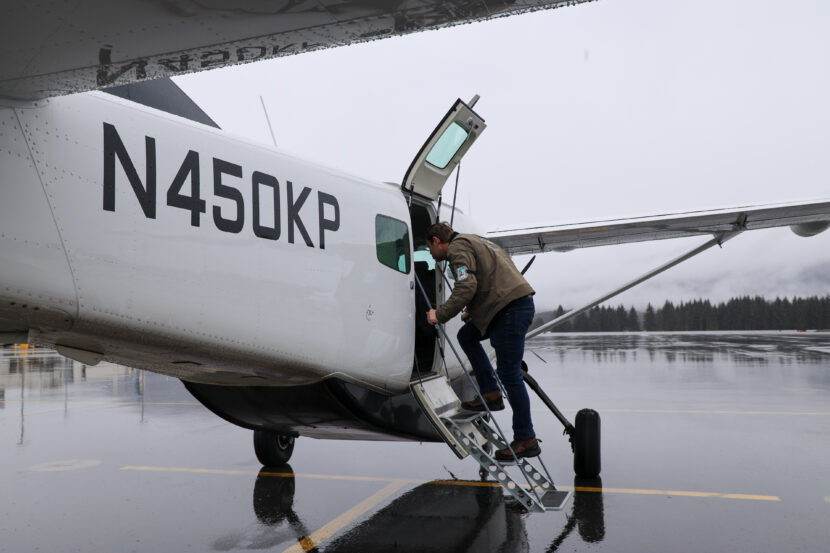
Patrick Ford, a pilot and the director of operations at Alaska Seaplanes, prepares for takeoff in Cessna 208 Caravan on Thursday, April 9, 2026. (Photo by Clarise Larson/KTOO)
Andy Kline, marketing manager at Alaska Seaplanes, said the company spent millions to design and get authorization for the new paths. Since the expense was planned years in advance, he said passengers won’t see fare spikes from this.
The company’s new path in and out of Juneau International Airport goes through the south end of Gastineau Channel. Ford said it allows pilots to drop out of a cloud ceiling that’s as low as 580 feet above sea level, increasing a plane’s chances of landing in poor visibility instead of turning around.
“I’m sure you guys have been on a flight where you get halfway up to Haines and, you know, it’s shut down at Eldred Rock, and you have to turn around and come all the way back,” Ford said.
Those new flight paths are paired with advanced GPS technology called synthetic vision, made by Garmin. A screen in the cockpit displays a computer-generated 3-D view of the terrain, allowing pilots to ‘see’ their surroundings when there’s zero visibility.
A screen in the cockpit displays a computer-generated 3-D view of the terrain, called synthetic vision. (Photo by Clarise Larson/KTOO)
Ford said that’s an advancement on what’s called instrument flight rules, or IFR, a set of FAA regulations that control the conditions for pilots relying on instruments to navigate rather than sight.
“It’s a huge, huge improvement in safety,” Ford said. “I sleep better at night knowing that that’s an option.”
Kline said it brings the commuter airline closer to the capabilities of Alaska Airlines, which has had the technology for decades.
That matters to residents of Southeast, a notoriously cloudy and mountainous region. Large jets don’t land in many small towns in the region, so residents rely on small, commuter flights for air travel.
Sean Kveum, co-owner and chief operating officer of Alaska Seaplanes, said that flights were frequently cancelled decades ago, before commuter aircraft could fly in low visibility
“We just had to stay low below the clouds and wait for good weather, and you could go when it was good enough,” Kveum said.
He said the new flight paths and synthetic vision will improve flights for outlying communities like Hoonah, where he grew up.
“It really allows us to be providing a more reliable service to the communities throughout Southeast,” he said.