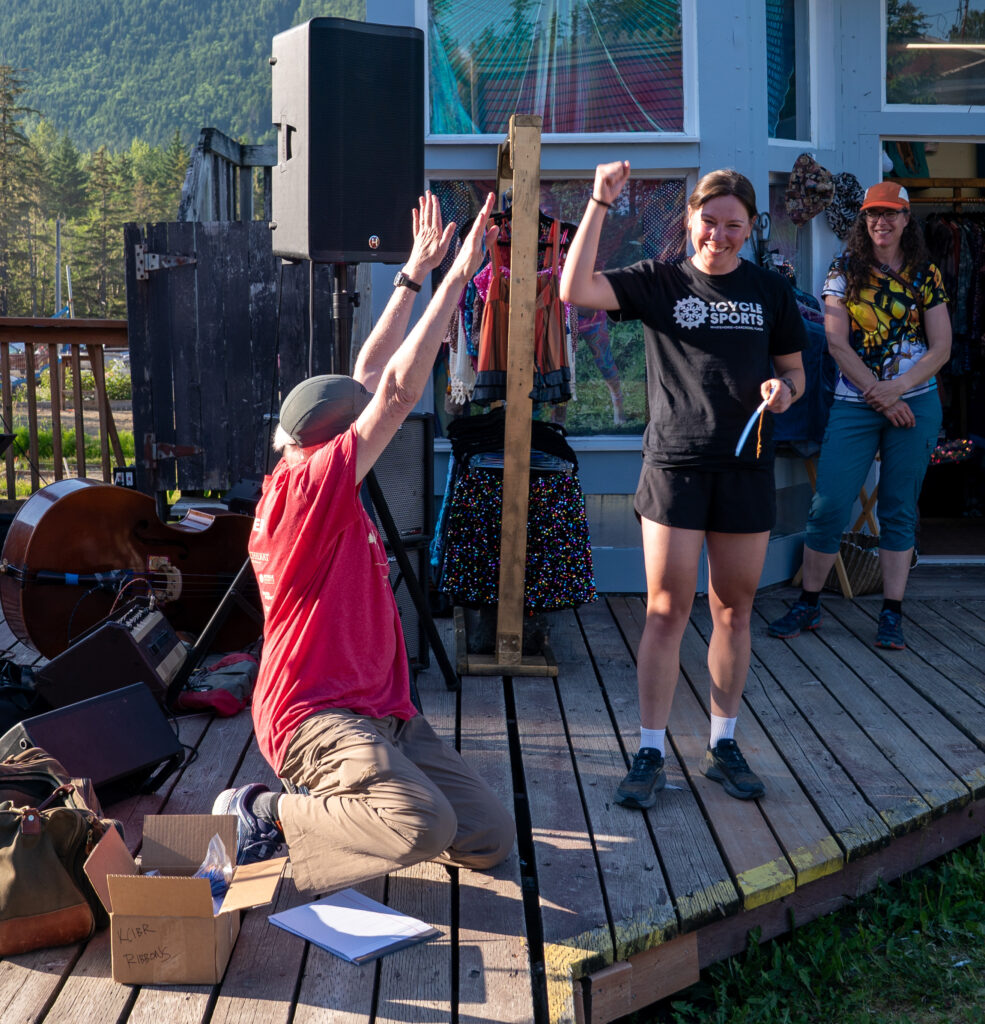
A free workshop led by Dan Henry July 7-9 aims at helping residents develop skits for September’s Historic Hysterics Skit Festival.
The festival, Sept. 9-10, celebrates the 90th anniversary of the Chilkat Center and will serve as the annual fundraiser for the Chilkat Center.
The festival aims to feature a series of 10-15 minute skits equivalent to a mini theater festival, with adjudication and awards, said Annette Smith, secretary of Lynn Canal Community Players.
A collaboration between the foundation and the theater troupe, the festival seeks theatrical pieces with a humorous and historical bent, based on an event or item from Haines or Alaska history.
Anyone interested in creating a skit is invited to attend the workshop. “You don’t have to be a writer. You can just be a person who has fun developing something like that,” Smith said.
20 Years Ago
Haines residents are being warned to be on the lookout for phishing attacks that target First National Bank Alaska customers.
The phishing is done by counterfeit E-mails designed to look like official bank correspondence and include urgent requests for personal information.
Banker Dick Flegel, president of the Haines Branch, said “calls started coming in about a week ago. The three of four calls so far have been from local businesses.”
The scam could last a few days up to a month or longer, a bank warning advised residents. “Anyone receiving an E-mail that could be phishing, should not respond to the solicitations nor click on any links within the E-mail,” the announcement said.
30 Years Ago
A cellular telephone was used to summon rescuers to Sullivan River Monday afternoon, after an injury on a three-thinning operation.
A Fairbanks man called Haines police with a report of a man being struck by a tree, said chief Charlie Fannon. The man with the phone apparently was part of a crew working on a Native allotment for Tlingit-Haida, Fannon said.
The dispatcher alerted the U.S. Coast Guard and the Alaska State Troopers in Juneau, and in turn a two-person medical emergency team from Glacier Valley Fire Department was deployed on a Temsco helicopter under a standing arrangement between the department and the company.
The injured man, 24 years old, was struck in the hip by the butt end of a tree as it fell after being cut, said Jeff Newkirk, a supervisor at the fire department.
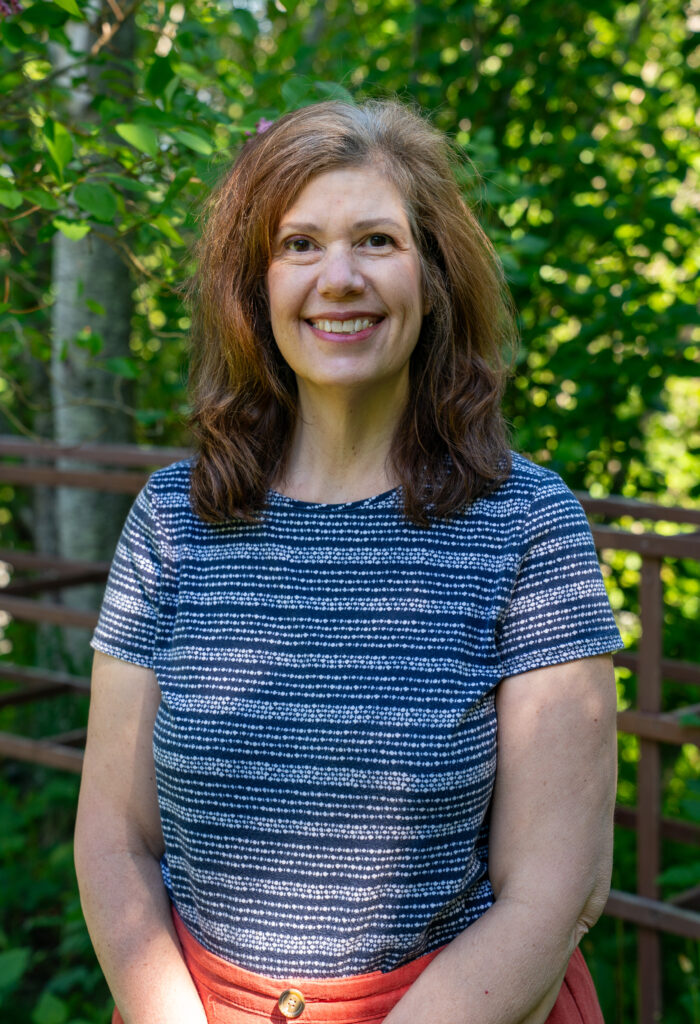
Lisa Andriesen, Haines middle school language arts and social studies teacher, retired in May after being a teacher in Haines for 35 years, seen on June 19, 2026 in Haines, Alaska. (Lizzy Hahn/ Chilkat Valley News)
As teachers closed down their classrooms in preparation for next year, some longtime teachers like Lisa Andriesen packed up their rooms for good.
Andriesen’s route to the Chilkat Valley started with a grandmother who always talked about wanting to come to Alaska. That motivated Andriesen to attend a job fair in Anchorage where she met the Haines Borough School District superintendent at the time, who later reached out and encouraged her to apply.
Andriesen said she didn’t know where Haines was when she applied to be a middle school teacher, but she still got the job and took the ferry up to Haines 35 years ago, fresh out of the University of Michigan in Ann Arbor with her teaching certificates in hand. She was 21 years old. She said she figured she could do anything for one to two years.
Thirty-five years later, most if not all, Haines middle school students had Andriesen as their language arts and social studies teacher.
Andriesen was not only a middle school teacher, but also the homeschool correspondence coordinator for almost 15 years. Andriesen said there were two language arts and social studies teachers in the middle school when she first started. Now, with fewer students, there is only one.
She said one of the reasons she stuck with the job for so long is that the staff she worked with were driven and motivated.
“So many people that they [school district] hired have been so dedicated, wanting to do the best for the kids, and just great, fun people to work with and teach with,” Andriesen said.
Haines Borough School District superintendent Lilly Boron said over the five years that she was the principal, the school lost a lot of core teachers.
“We’ve had about 40% turnover rate,” Boron said. Boron mentioned that because of the current state funding environment in Alaska, teachers are having to do more with less. She said Andriesen is one of the core teachers in the middle school and for the homeschool program that the school depends on for their institutional knowledge.
She also blamed, and thanked, Andriesen for pushing her into leadership positions. Boron said Andriesen recommended that Boron attend a principal program, which ultimately led to her stepping into an administrative role in the district. Not only was Boron a colleague of Andriesen’s, but her twin daughters were also students of Andriesen.
Looking to the future, Andriesen said she thinks artificial intelligence will drive a big change for education.
“We’re just starting to learn how to deal with it, what to incorporate, what to ask from the kids.” Andriesen said.. She encouraged her students to use the Quizlet AI tools, which allowe concepts to be explained in new ways and give new examples.
But, she said, it’s an adjustment for teachers. She gave the example of teaching students for three years in middle school, so she becomes familiar with their writing styles.
A few of her students have tried to use AI for their writing but she could tell it wasn’t their style of writing. Andriesen anticipates that this may become more common.
As the coordinator for the homeschool program, Andriesen oversaw the curriculum, checking work samples and plans that parents would send in. Andriesen said that there are currently around 25 students enrolled in the Haines Borough’s homeschool program, which spans K-12. During the COVID-19 pandemic, the program had 80 students enrolled.
Andriesen said that a challenge in education is the never-ending new techniques. It’s a balancing act of knowing what works for the students and incorporating new methods. Andriesen said she changed a lot in her teaching over 35 years.
Other challenges arose with new administrators who were not familiar with Haines and trying to acclimatize them as well as maintaining programs through reduced staffing. Andriesen said that with staff reductions, teachers took on more responsibilities and got more creative with their schedules to be able to fit in the additional programming.
“I’ve really been proud that we’ve been able to keep our art, music, P.E., … industrial arts and everything.” Andriesen mentioned that it would be easier to move to a smaller schedule, but then the students wouldn’t have access to the vast amount of programs.
“We want them to get everything that they can have,” Andriesen said.
As the social studies and language arts teacher, Andriesen said she would find ways to connect history, civics, novels and readings with public speaking and research. She especially enjoyed working on hands-on projects and simulations to simulate various real-world situations.
Jeanine Ward was a student of Andriesen’s around 21 years ago. She said she still remembers a stock market activity that students participated in. Ward said they learned how to trade stocks and all created something that had never been created before. She created edible glue to put cakes back together. Students recreated the rise of the stock market and eventually saw its fall – something the students never saw coming, according to Andriesen.
Andriesen worked with grades six through eight for two hours a day.
“You get to know them [students] pretty well,” Andriesen said. Sixth graders have a lot of energy and are easier to cause to laugh compared to the more serious eighth graders, who would finish her sentences. Andriesen said that a middle schooler’s mind changes more than a two-year-old’s mind. “Middle schoolers are fun. You never know what to say, they’re super funny.”
The middle schoolers, she said, kept her on her toes. “They’re so silly and goofy… they don’t really care. That’s like their personality, that’s the fun part.”
Although she was teaching in the same position for 35 years, Andriesen said that every year felt different. While she was teaching similar things, the students are what made each year unique, with each class having their own group personality. A few of her students this year were the children of students Andriesen had during her first two years teaching.
When the elementary and middle school moved to join the high school building, Andriesen picked her classroom when it was still cement. She has been the only teacher in that room since it was built. Over the past school year, Andriesen was able to “slowly kind of say goodbye to things.”
Now that she has retired, Andriesen said that she is looking forward to not having to pack a lunch anymore. She will be traveling to go see the location of the Battle of Verdun in France. After teaching about World War I for years, Andriesen said that while it is a sad site, she is looking forward to being part of and near to something that she has taught for so long.
Replacing Andriesen to teach middle school social studies and language arts is Shannon Jeter. Jeter is moving to Haines from Maryland and has experience teaching middle school. Jeter will be one of the two new middle school teachers, in addition to the science teacher. There are still three positions waiting to be filled: two special education instructors and a kindergarten teacher.
“Ultimately, the students that pass through her classroom door were stronger and better for her instruction,” Boron said.
Nearly 300 teams participated in the 30th Kluane Chilkat International Bike Relay on Saturday. They biked the nearly 150 mile race as solo riders, or as part of two-, four- or five-to-eight member teams.
One big change this year was the number of solo riders, which skyrocketed. A record 73 total registered, of which 48 men, 24 women and 1 solo open competitor finished.
Here’s more from racers and teams about their experience went this year:
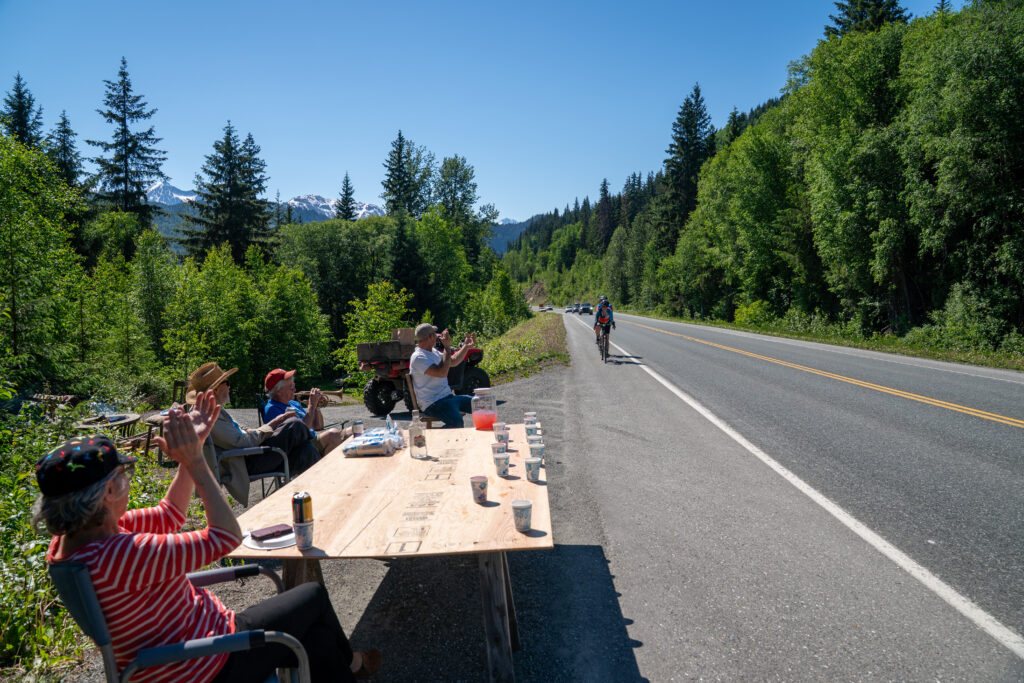
Debra Schnabel, Tom Binder, Tom Morphet and Nicholas Bishop cheer on cyclists at their hydration station during the Kluane Chilkat International Bike Relay on June 20, 2026 in Haines, Alaska. (Lizzy Hahn/ Chilkat Valley News)
Tom Binder’s driveway acted as a lemonade stand for cyclists going by on Saturday. He along with Nicholas Bishop, mayor Tom Morphet and Debra Schnabel got their camping chairs out and sat along the highway with a plywood table filled with paper cups of lemonade. They offered those who stopped canned vodka lemonade. There was also a bottle of vodka sitting on the table next to the lemonade cups, in case riders wanted an added kick to their drink.
Whitehorse local Vincent Menard said that he, his sister, Orlina Menard, and the rest of their family have been doing the race since he was in 2nd grade. The first time they did it, the siblings rode tandem bikes with their parents. They have since moved on to being a part of an eight person team and tested out a four person team this year. “We’re getting older and wanted to try a little harder.” Menard said his parents came along to view the team, named “Dodging Potholes,” but decided to turn around before the border, while the siblings kept going to the finish line in Haines. “We’re just supporting the bike environment and the culture, not the country.”
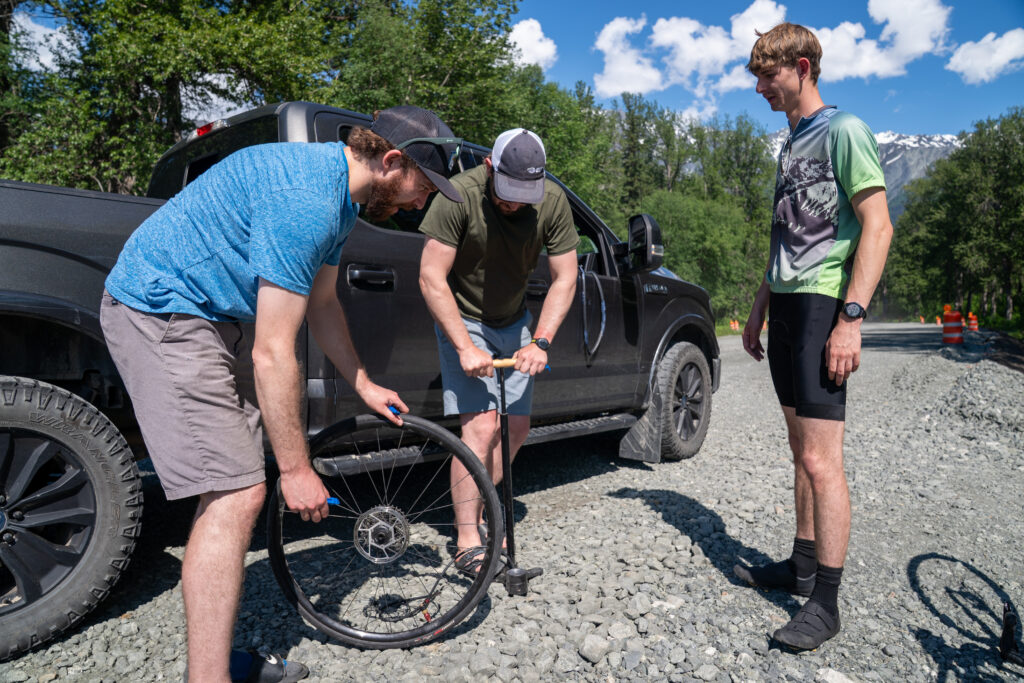
Four person relay members from Whitehorse, Craig Flaherty, left, and Jonathan Lowey help Darin Tingey of Juneau fix his flat during the Kluane Chilkat International Bike Relay on June 20, 2026 in Haines, Alaska. (Lizzy Hahn/ Chilkat Valley News)
Whitehorse cyclists Craig Flaherty and Jonathan Lowey were driving their team’s support car when they came across Juneau cyclist Darin Tingey stuck on the side of the Haines Highway. Tingey got a flat tire about a half a mile after the construction zone started. Road cycling tires are not built to handle the amount of gravel that cyclists faced towards the end of their race. The duo from Whitehorse had a spare tube that they helped put into Tingey’s tire. Tingey was competing in the two person men’s category with his father Brent Tingey.
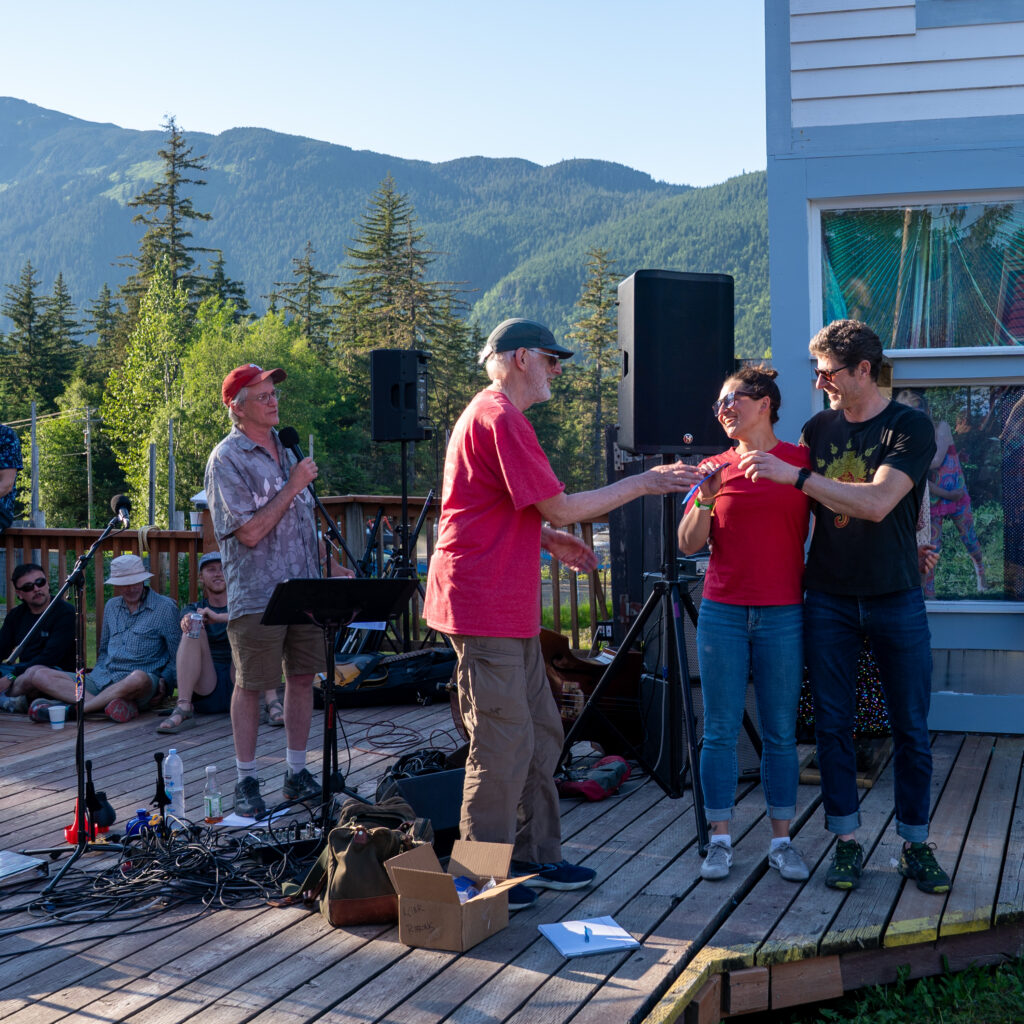
Alisha Falberg and Adam Moser recieve their first place ribbon in the two person mixed cateogry of the Kluane Chilkat International Bike Relay on June 20, 2026 in Haines, Alaska. (Lizzy Hahn/ Chilkat Valley News)
Winners of the two person mixed relay, Alisha Falberg and husband Adam Moser averaged 20.1 miles per hour. The duo from Juneau has completed the race five times. “On a day like today, it [KCIBR] is the place to be. There is no other place in the world we’d rather be,” Moser said. He and Falberg are avid cyclists in Juneau and train rain or shine. Moser rode the first four legs from Haines Junction to Mansfield Creek, with Falberg riding the last four legs from there until Haines. Moser said he did not feel much of a headwind this year, which was an advantage speedwise. The duo received second and third place in this category in years prior but say this race felt a bit easier because of the “impeccable conditions.” Falberg said the conditions one year were so bad that she had two layers on her upper body, a headband, full tights, shoe covers and full finger gloves. Falberg and Moser hope to be back to race again sometime in the near future.
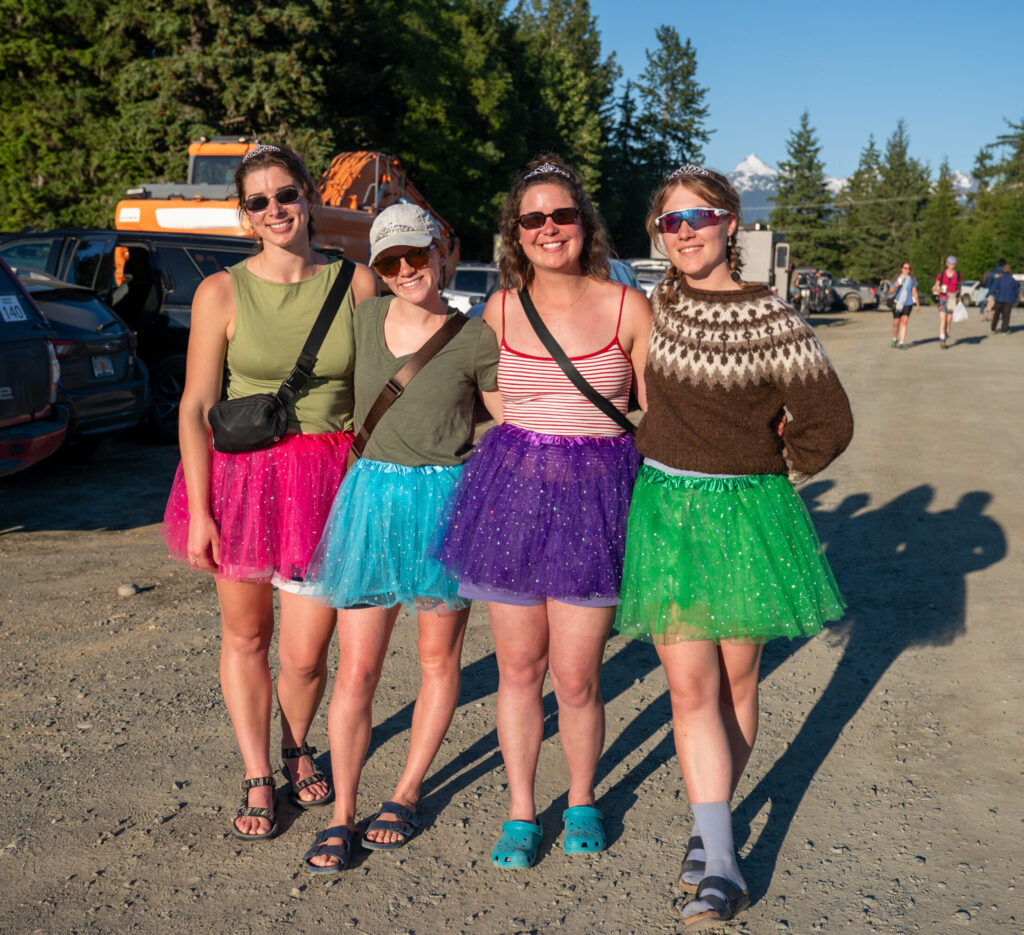
Teammates Lauren Keryluke, Alanna Stobbe, Erica Friesen and Tyra Bretten donned tutus and tiaras for their four person women’s relay team in the Kluane Chilkat International Bike Relay on June 20, 2026 in Haines, Alaska. (Lizzy Hahn/ Chilkat Valley News)
Dressed to the nines in tutus with tiaras on their helmets, the Canadian four person women’s relay team “Islanders” said they hope to make this race a yearly occurrence. Lauren Keryluke, from Whitehorse, organized the group’s costume, allowing each member to be decked out in a sparkly tutu while they rode. Alanna Stobbe, Erica Friesen and Tyra Bretten said they were leisurely racing. Bretten said she hopes to dress up in a tutu in future races. Keryluke rode the leg through the construction on the Haines Highway, an area where she said she “ate a lot of gravel, lot of dust,” but ended up passing a lot of people because she was on a gravel bike. The entire team rode gravel bikes over road bikes because of the road conditions in Canada, where all the members live. Earlier in the race, the team came across a rider with a flat tire and assisted him, “the rescuers with the tutus,” as Friesen explained.
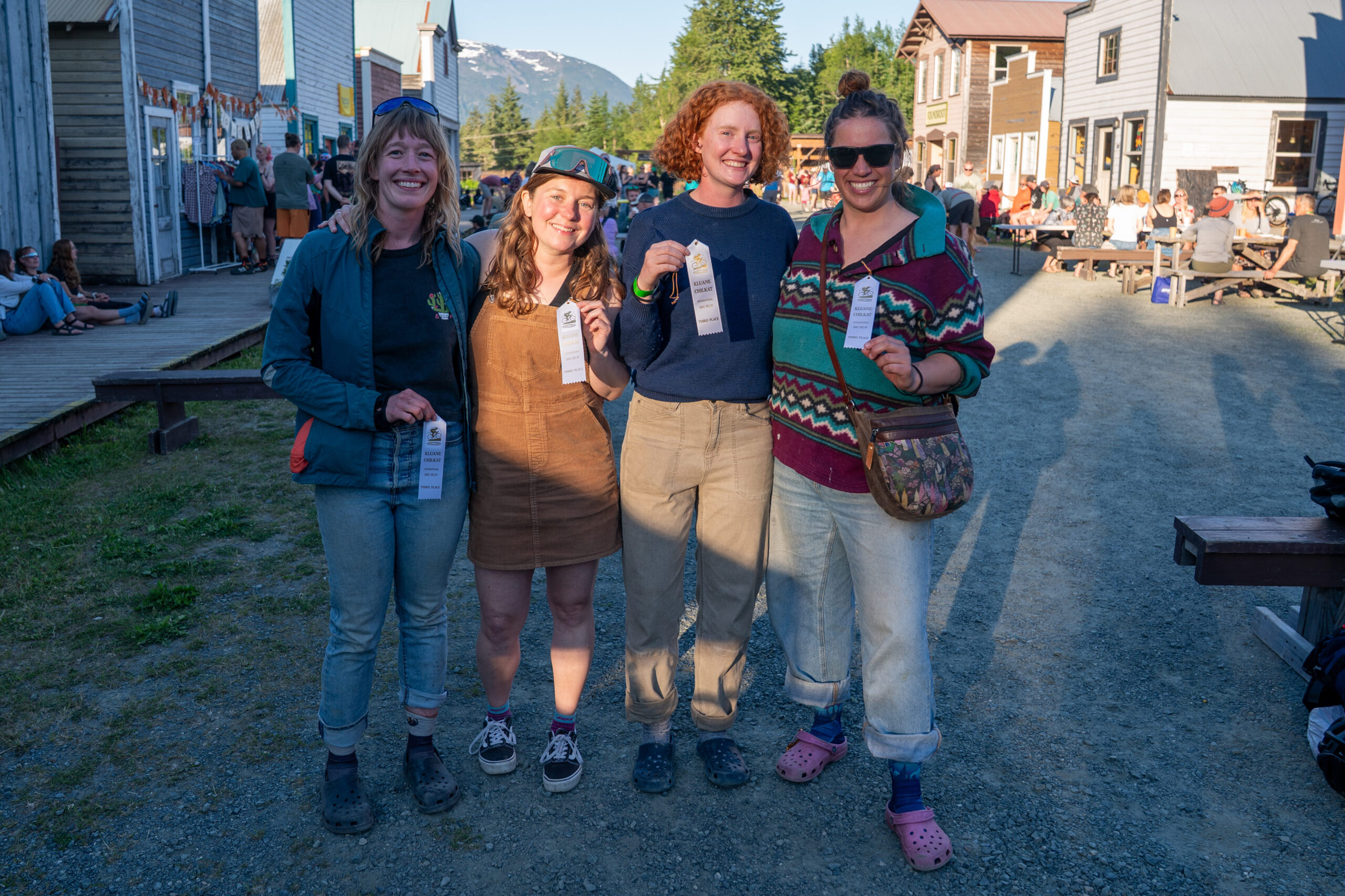
Hilary Lefort, Jennifer Gibson, Harriet Stanford and Aly Miller hold their ribbons after finishing third in the four person women’s relay of the Kluane Chilkat International Bike Relay on June 20, 2026 in Haines, Alaska. (Lizzy Hahn/ Chilkat Valley News)
Team captain Jennifer Gibson gave the team a mission before the race started: have fun. The group said they not only completed their mission but also exceeded expectations. The team, all from Whitehorse, was named “Ghost Riders” and received third place in the four person women’s relay. This was Harriet Stanford and Jennifer Gibson’s second time competing in the race. Hilary Lefort and Aly Miller joined the duo for their first ever KCIBR race. “A lot of training happened today,” said Lefort after completing her longest ride. Miller is new to road biking, having just completed her second month of road biking. Now that the race is over, the group talked about all riding the race solo, but riding together as a group.
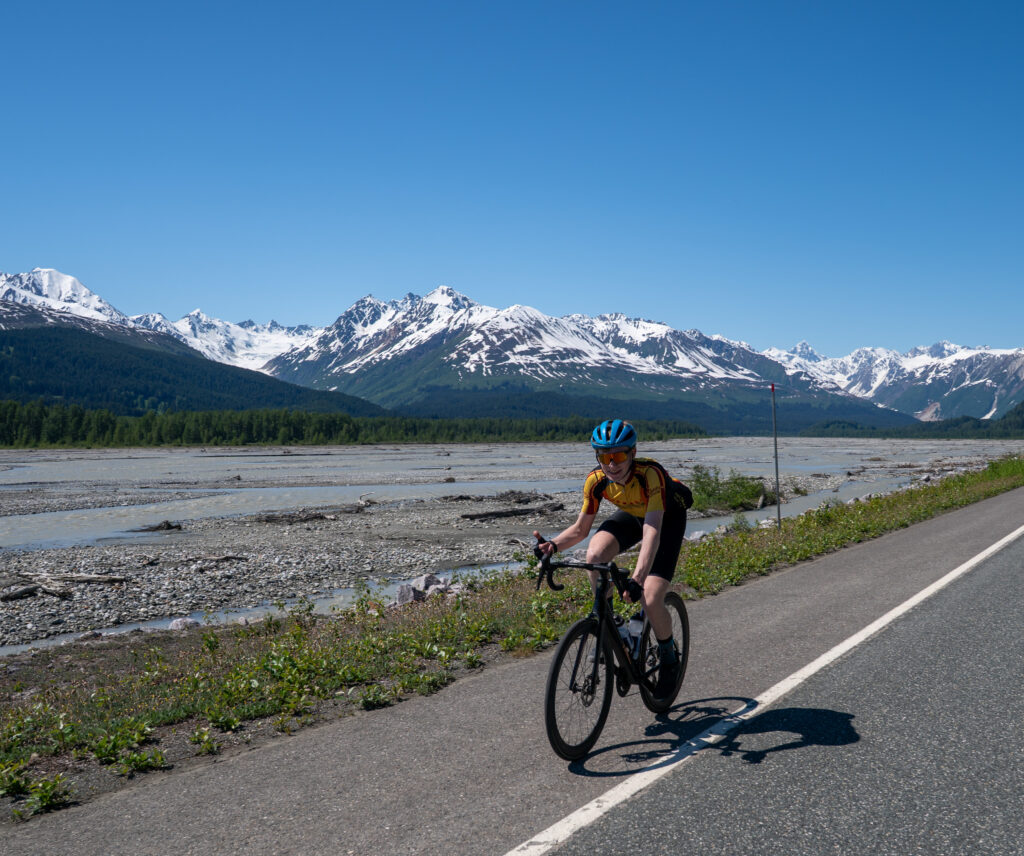
Third place solo finisher Matteo Kuizenga bikes along the Klehini River during the Kluane Chilkat International Bike Relay on June 20, 2026 in Haines, Alaska. (Lizzy Hahn/ Chilkat Valley News)
Third place finisher in the men’s solo category was 21-year-old Matteo Kuizenga. This was the Fairbanks rider’s first time racing the KCIBR as well as his first time being in Canada. Kuizenga first got the race on his radar in April while looking at races to compete in this summer. He learned about the race from fellow Fairbanks biker, Tyson Flaharty, who has won the race multiple times. Fires in the Interior of Alaska impact cyclists ability to train. Kuizenga said that this race is great timing because he was able to train consistently before the fires and smoke start. Kuizenga works 30 hours a week at the Alaska Center for Energy and Power, and tries to bike around 10 to 14 hours a week. While he does not have a coach, he gets advice from fellow cyclists. To train for the race, Kuizenga focused on duration and getting a lot of time in the bike saddle. His longest ride before the KCIBR was a 115 mile ride from Fairbanks to Nenana and back. He said he is still figuring out the best training methods. Kuizenga has done other long races, like the White Mountains 100 and the Triple Dome Classic which consists of 15 hours straight of biking, but this was his longest race distance wise. This was the first road race that Kuizenga has ever done, with most of his experience being in fat bike races. Second place finisher Tyson Flaharty and Kuizenga bike together in Fairbanks and stuck together for most of this year’s race. After Hudson Lucier’s attack at Million Dollar Falls, Kuizenga said he and Flaharty followed cruising down the descent at around 50 miles per hour. The three cyclists split on the Haines Summit descent, which led to what Kuizenga described as “basically what my worst nightmare was going in,” – a two hour solo time trial. For the rest of his race, Kuizenga worked on holding out his lead ahead of Whitehorse racers Simon Connell and Jonah McConnell. He said this was tricky because of the headwind. The duo behind him had the advantage of drafting off of each other. The night after he finished the race, Kuizenga said he spent around two hours going through the Strava data of everyone who he raced with. He wanted to figure out what the gaps were and where he gained or lost time during the race. The physically hardest part of the race for Kuizenga occurred on the Million Dollar Falls climb, but the hardest part mentally came with the last two hours of the race, while he was “leaving it all on the table.” However, he said he still felt strong, seven hours in going up the finish climb.
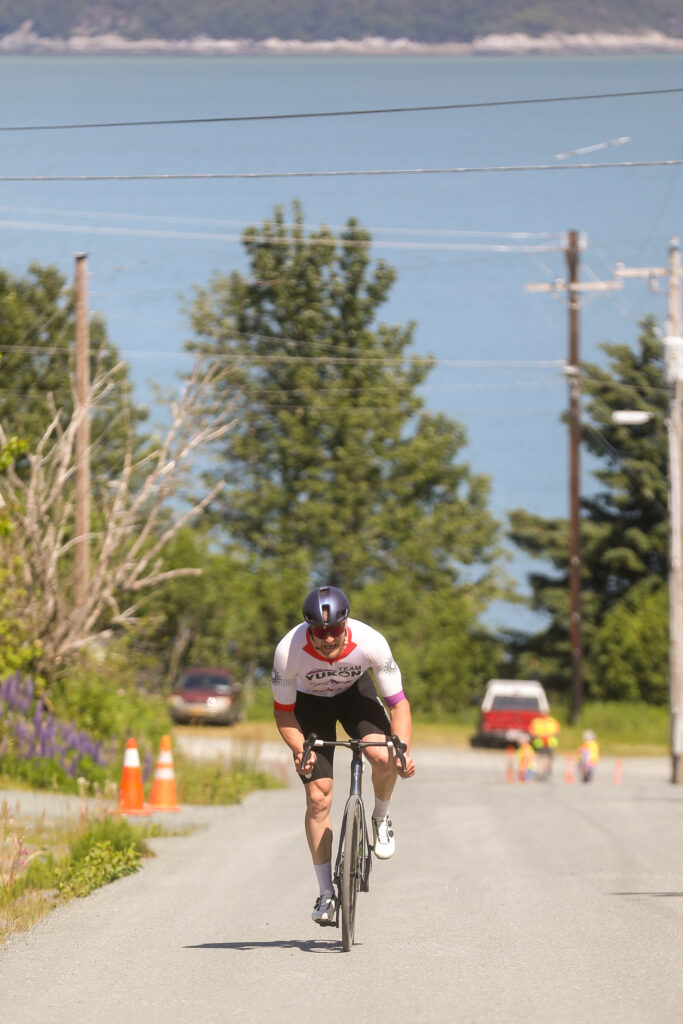
Hudson Lucier, the fastest solo racer in the Kluane Chilkat International Bike Relay makes his way up the final hill toward the finish line on Saturday, June 20, 2026, in Haines, Alaska. Lucier, of Whitehorse, was the first to cross the finish line and completed the nearly 150 mile race in 6 hours 34 minutes and 31 seconds.
In the week leading up to the race, Hudson Lucier was worried that the race would be quite rainy after it was raining every day in Whitehorse. This year’s men’s solo race winner did not see any rain on his ride, however did face some wind around 25 to 20 kilometers from the finish line. Lucier won solo last year, making this his second solo win. Lucier said that his race was faster by about 10 minutes over last year’s race, even with the gravel section that had larger rocks compared to last year’s gravel. “There was some extra body degradation that happened because it’s just so rough,” Lucier said. However, he was able to get through the construction zone without getting a flat. Lucier explained that the race typically plays out the same year after year, with racers starting out hard going up the Haines Junction hill and then sticking together until the Million Dollar Falls climb. On this climb, the peloton broke down into five solo riders and three two person riders. Lucier made his move and attacked on the Guardsmen climb and was able to get a two minute lead to the border. “This year it was all just about building/ maintaining the lead.” He said that this is not his preferred strategy, however with the finish on the climb, he did not want to gamble with coming up to the finish line with other people. Breaking away from Tyson Flaharty and Matteo Kuizenga simplified the finish for Lucier. Lucier is the head coach of the Cycling Association of Yukon. Last year’s Canada summer games led to an uptick in people interested in racing. Lucier said that their program saw an increase in participants with 24 people under 19 signing up for the race program. He said this was more than the Yukon ever had in a cycling program. Lucier’s athletes will be going to Saint George, Quebec after the KCIBR for Canadian Road Championships which goes from June 25 to 28. For many Yukoners like himself, Lucier said that the KCIBR is the goal race for the year. For athletes going to nationals, the race acts as their last big training ride that they do. Coming from the Yukon, Lucier said that they don’t have a ton of practice riding in the heat. This year’s heat impacted his last 40 kilometers, with his feet starting to hurt quite badly. “Ensuring that you’re eating and drinking enough is super key,” Lucier said about biking in the heat. Lucier estimated that around nine of his racers from the under 19 and under 17 categories raced the KCIBR solo. He said it won’t take long until those racers start fighting for the win as well. “Theres been a huge surge in the last two years of people interested in racing their bike,” Lucier said about the Yukon cycling environment.
Winner of the Kluane Chilkat International Bike Relay solo women’s category Heather Clarke celebrates her win on June 20, 2026 in Haines, Alaska. (Lizzy Hahn/ Chilkat Valley News)
Growing up in Whitehorse, Heather Clarke participated in the eight, four and two person race relays. For the past four years, Clarke has won the KCIBR solo women’s race. Clarke was not sure how many times she has completed the KCIBR total over the years. “It’s just one of my favorite events, I love it,” Clarke said after completing her fifth solo race. Clarke said the weather the past few years has been amazing, with “pretty good” winds during this year’s race. She said that the first three legs had a huge group of strong riders. Throughout the ride, Clarke was managing both the heat, swiping salt off her face after the finish, as well as her nutrition. Looking at her strategy over the past few years, Clarke said she tries to stay at the front of the group and hang on as long as she can. This year, her chain dropped right when the first move occurred, which resulted in her being dropped from the first group. With around 40 kilometers to go before the finish, Clarke got into a good group. This was when her dad came up and said that they were on track for the record. “So I looked at her and said, ‘Let’s go.’” Before the race started, Clarke explained how the border crossing worked to another solo women’s rider, Rachel Canning, who was racing the KCIBR for the first time. “People wait [at the border] because there’s always a headwind coming into Haines and you just want people to ride with,” Clarke said. Biking through the construction on the Haines Highway, Clarke said they saw a lot of casualties with some people getting flat tires on their front and rear tires. Clarke, however, made it through with no flat tires, but was waiting for them to go while biking through the five mile section. She explained that this is one of her favorite races, because of the community, amazing scenery and how hard it is. “I love the challenge of it. It is a truly hard race and you’re really out there.”
“I also think there’s a huge uptaking, like the solo women, which I’ve been trying to build and bring people.” She said that when she did the race four years ago, she was fully on her own with the solo men’s racers. This year, she said the turnout for the women’s solo race increased greatly. “It makes me so excited that all these strong women are taking on this really challenging event,” Clarke said. “It takes a village for sure, and everyone lives it.”
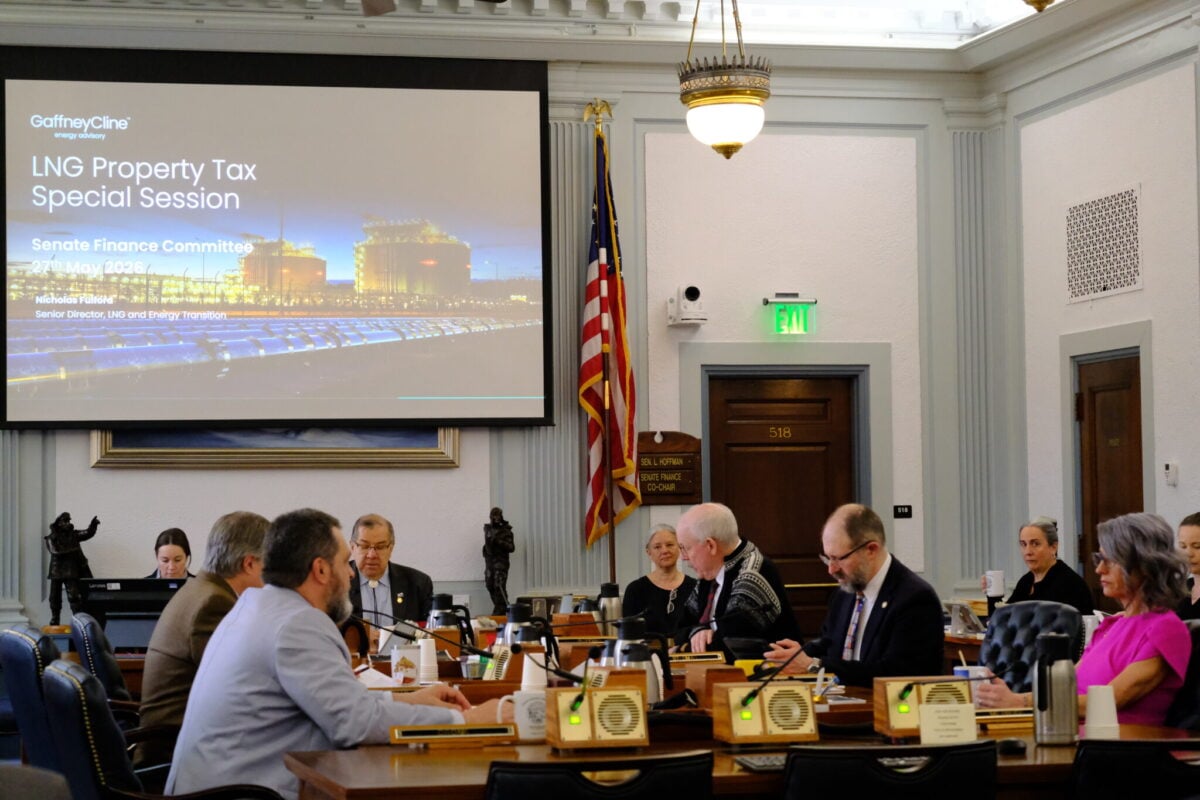
Members of the Senate Finance Committee convene on the first day of a special legislative session on the proposed LNG gas line project on May 27, 2026. (Photo by Corinne Smith/Alaska Beacon)
Now, a newly revealed draft of the agreement between the state-owned Alaska Gasline Development Corp. and Glenfarne, the private developer, shows that if the project fails to go forward under certain conditions, the state could be required to pay in order to retake control of the project.
The contract between AGDC and Glenfarne has never been published and remains confidential, but a handful of state senators obtained a leaked draft copy during debates over the size and scope of a $16 billion tax break intended to benefit the pipeline project.
The draft offers the best glimpse to date about the relationship between the state-owned AGDC and Glenfarne, which together are pursuing a multibillion-dollar effort to sell natural gas from the North Slope.
“It’s a significant document. It should be taken seriously,” said Sen. Bert Stedman, R-Sitka.
As legislators debated the bill containing the tax break this month, the leaked document inspired some members of the Senate to amend the legislation. Meanwhile, the document stayed secret from other senators, members of the House and Alaskans overall.
Gov. Mike Dunleavy and members of the House criticized the Senate’s version of the tax-break bill, calling it unacceptable. The governor and House lawmakers said they prefer a separate version passed by the House.
“I don’t know how the document got out to people that it got out to, but somehow it did, and quite frankly, thank God it did,” said Sen. Bill Wielechowski, D-Anchorage.
When the Beacon asked AGDC and Glenfarne about the document and its contents, each said they are bound by a confidentiality rule and cannot discuss them.
“We believe Glenfarne can deliver something enormously important for the state: reliable and affordable energy, thousands of jobs, and the opportunity to finally unlock the value of North Slope natural gas for future generations of Alaskans,” said Tim Fitzpatrick, a spokesman for Glenfarne, by email. “Business documents are protected as a matter of ethical and good faith principles. For that reason, rather than any document specifics, the inappropriate distribution of draft AGDC materials is very disappointing.”
With the House and Senate having passed different versions of the tax-break legislation, lawmakers are negotiating a compromise that could come as early as the first week of July and as late as never.
If the bill advances, the protections inspired by the leaked document could be preserved, diluted or removed entirely.
“The structure of the state’s agreements that could leave Alaskans paying for something is something Alaskans should know,” said Sen. Jesse Kiehl, D-Juneau.
“I’m worried, and I don’t have full information, so we’re doing the best we possibly can,” he said.
Details of the confidential document
The document obtained by the senators dates from a key point in the pipeline project’s history.
That timing indicates the draft obtained by lawmakers and the Beacon was written relatively late in the process and may be close to the final version.
“My impression is that it is a highly refined draft,” Stedman said.
By email, AGDC president Frank Richards said it was written by an AGDC staff member for the corporation’s board of directors.
“The document you reference is a confidential memorandum meant for use by the AGDC Board to make an informed decision on a significant business partnership to move the Alaska LNG Project forward. Alaska LNG has made historic progress in the past fourteen months and development momentum continues,” he wrote.
Glenfarne officials have testified that they will allow legislators who sign non-disclosure agreements to examine financial documents. Members of the Senate Finance Committee have said in hearings that they are unwilling to accept that precondition.
“AGDC has identified that Alaska’s oil and gas property taxes are very high compared to other jurisdictions where LNG facilities are built and need to be lowered to help the Alaska LNG Project be competitive to attract capital investment and achieve (final investment decision),” he wrote.
With an officially estimated construction price of between $44.5 billion and $54.5 billion, the project — formally named Alaska LNG or AKLNG — would be one of the largest natural gas projects on Earth.
Under current law, Alaska would levy a 2% property tax on that project when it finishes construction. Legislators are considering whether to replace that tax with a tax on natural gas pumped through the pipeline. The resulting tax break would be worth about $16 billion over the project’s first 30 years of operation.
Alaska would still receive royalties and production taxes from natural gas sold through the pipeline, and it would receive assorted other fees as well, such as the proceeds of carbon dioxide sequestration.
Altogether, the state treasury stands to earn as much as $800 million per year for 30 years. That’s on top of the economic benefits caused by having thousands of extra workers in the state to build the pipeline, and potentially cheaper natural gas for residents and local industries.
As explained in public and in the confidential document, AKLNG would be built in two phases. The first phase would include a “764-mile, 42-inch-diameter pipeline” from the North Slope “into the Southcentral Alaska gas pipeline system.”
Coupled with a small gas treatment facility on the North Slope, that first phase would provide gas for in-state use by Alaskans.
Because the pipeline will not be built before Southcentral Alaska begins running out of gas, the confidential agreement also calls for AGDC and Glenfarne to build a gas import facility together.
Once the pipeline is operating, the partnership would use that equipment for exports.
The second phase would involve connecting the pipeline to the Prudhoe Bay and Point Thomson oil and gas fields, plus construction of a larger gas treatment facility and a liquefied natural gas export facility on the Kenai Peninsula “capable of (exporting) up to 20 million tons per annum.”
The pipeline, North Slope facility and Kenai Peninsula facility are each considered “sub projects” under the agreement between AGDC and Glenfarne.
“Glenfarne will negotiate contracts for construction, equipment, materials, and gas supply,” the document states. “No projects can create an obligation for AGDC or the State of Alaska without prior approval by AGDC or the State of Alaska, respectively.”
Currently, lawmakers are considering whether to restrict AGDC’s ability to borrow money without input from the Legislature. The House version of the tax-break bill would allow AGDC to borrow without permission, but lawmakers could halt the borrowing. The Senate version would require AGDC to ask permission first.
When AGDC and Glenfarne reach a final investment decision — a last decision on whether to build at all — there will be new development agreements that determine the ownership of each subproject.
Ownership would be split among any investors, AGDC and Glenfarne.
In presentations to the Legislature, AGDC officials explained that while the state currently owns 25% of the project, that share will be diluted on each subproject as investors are brought on board. The state will only keep its 25% share if it invests more money.
The confidential draft agreement says Glenfarne must reach “clawback milestones” to continually prove that it is operating in good faith.
If AGDC decides Glenfarne hasn’t met a milestone — such as signing a binding agreement to sell natural gas to a particular customer — it could seek to retake the project. That may require AGDC to pay.
The structure of the state’s agreements that could leave Alaskans paying for something is something Alaskans should know.
– Sen. Jesse Kiehl, D-Juneau
If Glenfarne disputes AGDC’s assessment, the two parties would consult a third party.
AGDC isn’t required to repurchase Glenfarne’s part of the project, but if it does, Glenfarne would be the one proposing the price, “based on the value Glenfarne has added to the company.”
AGDC could dispute that price, and if it does, an “independent investment bank” would determine the final amount.
Senators familiar with the confidential draft said this language was new to them, and they see it as a potential financial liability.
Under the draft agreement, confidentiality is required
“We are trying to craft legislation to protect the state’s interests, and we’ve been put in a position where we have had to guess what is in the contract or not in the contract in order to protect our interests. That is an awful place to be as a state and as a legislature,” Wielechowski said.
Secrecy between Alaska’s state-owned corporations and their investment partners isn’t unprecedented, nor are controversies over that secrecy.
When it comes to the gas pipeline, Glenfarne released an updated estimate for the project’s cost earlier this month, but state lawmakers still don’t have all the financial information they’ve been seeking, including estimates about the project’s profitability.
The confidential draft states that AGDC would share profits with Glenfarne and other partners, but lawmakers don’t know what that share would be or how the project’s economics would change under the tax break being discussed by legislators.
The Alaska Department of Revenue has provided public estimates, but Glenfarne and AGDC have not.
“On the whole, it gets down to the level of information that we need to make good decisions, and we have a little bit more than we had when the bill came out of the House, but we are still pretty short,” said Sen. Jesse Kiehl, D-Juneau and one of the lawmakers who had access to the document.
How we reported this article
The Beacon obtained the draft agreement discussed in this article on Friday from a source who does not work for the Legislature and was able to compare it with a separate paper copy the following day.
The text of the copies was identical, though the paper copy — used by a senator — had its control number and other identifying information clipped out. The senator said they would be shredding their copy after the examination.
We do not know who originally leaked the document, whether there were multiple leakers, or why they shared the document.
After verifying the document, the Beacon called and emailed Glenfarne on Monday about its contents and sent a list of questions by email when asked to do so.
AGDC’s Frank Richards responded by email. Glenfarne officials spoke on the phone but were not willing to be quoted directly, and provided a written statement.
Richards asked for a copy of the “document or documents” the Beacon had. The Beacon declined to send that document — and we are declining to post it in this article — because even with control numbers and other identifying information redacted, it could still contain language that would allow the source to be identified.
The Beacon did not receive answers to all of its questions, including details about how much has been spent on the project to date and possible partnerships with companies mentioned in the draft agreement.
Lawmakers have concerns over the clawback
Senators familiar with the confidential agreement said they don’t recall when they first received it, in part because they initially overlooked its importance.
Sen. Cathy Giessel, R-Anchorage, said she became aware of the draft when her aide, Paige Brown, read through it.
“It wasn’t actually until the last couple weeks that … I found it in a pile of my desk and said, “‘Paige, look this over, I think there might be some stuff in here,’ and she started flagging sections, and we started looking at it more closely,” Giessel said.
Stedman said that when he first saw the document, “I was struggling, quite frankly, on how to handle it.”
He briefly considered releasing it to the general public.
“I actually thought about putting it on the table, and I didn’t do it … because it’s marked confidential. It’s highly sensitive,” he said.
The clawback section drew senators’ attention. Members of the Senate majority have been openly concerned about the risks to the state if the project doesn’t go forward or is only partially built.
In a Senate Finance hearing on June 16, members of the Senate Finance Committee grilled AGDC consultant Matt Kissinger and Glenfarne Alaska president Adam Prestidge with questions drawn from the draft.
“There is no scenario where we will ask the state for money,” Prestidge said under questioning.
The state will be given a chance to invest money in the project, he said, but “even the state investment option is an option to the state that doesn’t come with a formal request or pressure from Glenfarne.”
Prestidge didn’t mention the clawback, so Stedman went a different direction: “Was there preliminary discussions when all this came together, about any exit strategies and purchases, buybacks, any of that stuff?” he asked.
“There is a different provision around making the developer leave, which would require a payment, but as far as the developer quitting themselves and no longer pursuing diligent development efforts, no, there was never even a discussion of a payment in regards to that,” Kissinger said, alluding to the clawback but not explicitly stating it.
Afterward, Stedman said he wasn’t pleased with the answers.
“It’s hard sitting at the table when you knew some of the answers weren’t as direct and accurate as they should be,” he said.
Days later, the Senate rewrote the tax break bill. One of its amendments — adopted by a 14-6 vote, with all members of the majority voting yes — states that if the project does not go forward, the developer must transfer all of the project’s assets back to AGDC within six months “at no cost to the corporation or the state.”
Another amendment, adopted by an identical 14-6 vote, requires AGDC and Glenfarne to report any relationships with foreign companies.
One section of the confidential agreement states that Glenfarne will work with Canadian natural gas firm Enbridge on the proposed import terminal. Another section says Glenfarne will talk with South Korean conglomerate Hanwha Group and Japan’s Inpex about the export terminal.
The document also provided senators with a definition of “final investment decision” as determined by AGDC and Glenfarne.
That mattered, Stedman said, because if legislators used a different definition for that term than AGDC and Glenfarne did, any law covering the term might be ineffective.
Dismay from AGDC’s president
Before the Senate voted on the pipeline tax break, some members of the Senate Majority invited AGDC president Richards into the office of Senate President Gary Stevens, R-Kodiak, and told him what they had.
None of the participants in that meeting were willing to discuss it in depth.
Richards said by email that he was “dismayed” when senators told him last week.
“I think you’ll find AGDC is very concerned about this document,” Stedman said this week, “and potential liability exposure between them and Glenfarne.”
Richards said AGDC’s board is considering an investigation.
“The protection of confidential information is specifically and purposefully allowed in AGDC’s statutes to fulfill the corporation’s mission to deliver North Slope natural gas for the benefit of Alaskans,” he said by email.
While the Capitol has a reputation for information leaks, the text of the document stayed closely held, even as rumors about its existence spread.
I have not liked this process where we are working in the dark and we are not getting information that we need to protect the state’s interests. We are being forced to just guess where the landmines are, guess where the pitfalls are. I don’t like being in that situation at all, and every Alaskan should be concerned about that.
– Sen. Bill Wielechowski, D-Anchorage
Each of the three co-chairs of the House Finance Committee said they had not seen the document. Rep. Neal Foster, D-Nome, said he had heard about it, though.
“I just know there’s something out there, and everybody was kind of getting excited,” he said.
Foster said the document was never discussed in deliberations within the House Finance Committee nor was it discussed among members of the House’s majority coalition.
Sen. James Kaufman, R-Anchorage, and Senate Minority Leader Mike Cronk, R-Tok, are on the Senate Finance Committee and said they had not seen the draft.
Even some Senate majority members said they had not seen it.
“Is that the secret document everyone’s talking about?” said Sen. Kelly Merrick, R-Eagle River, when asked.
“I have not seen that, and I don’t care to see it. I don’t want to be responsible for confidential information,” she said.
Members of the state House and Senate are scheduled to meet July 1 and may consider a compromise tax break on that day.
A preliminary meeting is scheduled for 2 p.m. Friday.
Even if the confidential Glenfarne-AGDC agreement becomes more widely known, senators said lawmakers will be crafting a compromise with incomplete information.
“I have not liked this process where we are working in the dark and we are not getting information that we need to protect the state’s interests,” Wielechowski said. “We are being forced to just guess where the landmines are, guess where the pitfalls are. I don’t like being in that situation at all, and every Alaskan should be concerned about that.”
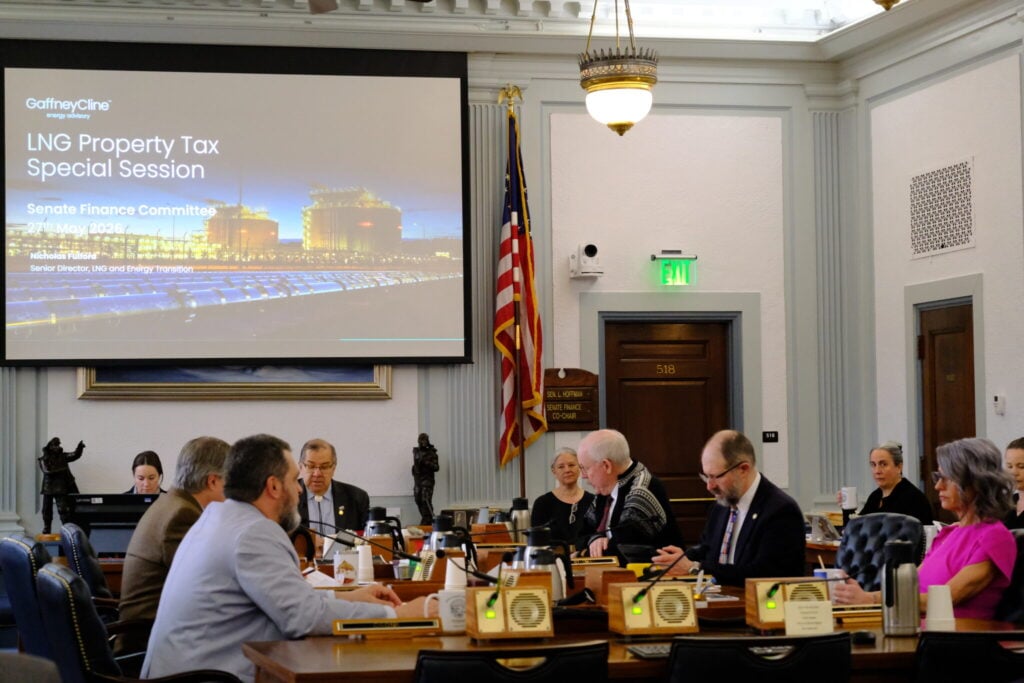
Members of the Senate Finance Committee convene on the first day of a special legislative session on the proposed LNG gas line project on May 27, 2026. (Photo by Corinne Smith/Alaska Beacon)
Now, a newly revealed draft of the agreement between the state-owned Alaska Gasline Development Corp. and Glenfarne, the private developer, shows that if the project fails to go forward under certain conditions, the state could be required to pay in order to retake control of the project.
The contract between AGDC and Glenfarne has never been published and remains confidential, but a handful of state senators obtained a leaked draft copy during debates over the size and scope of a $16 billion tax break intended to benefit the pipeline project.
The draft offers the best glimpse to date about the relationship between the state-owned AGDC and Glenfarne, which together are pursuing a multibillion-dollar effort to sell natural gas from the North Slope.
“It’s a significant document. It should be taken seriously,” said Sen. Bert Stedman, R-Sitka.
As legislators debated the bill containing the tax break this month, the leaked document inspired some members of the Senate to amend the legislation. Meanwhile, the document stayed secret from other senators, members of the House and Alaskans overall.
Gov. Mike Dunleavy and members of the House criticized the Senate’s version of the tax-break bill, calling it unacceptable. The governor and House lawmakers said they prefer a separate version passed by the House.
“I don’t know how the document got out to people that it got out to, but somehow it did, and quite frankly, thank God it did,” said Sen. Bill Wielechowski, D-Anchorage.
When the Beacon asked AGDC and Glenfarne about the document and its contents, each said they are bound by a confidentiality rule and cannot discuss them.
“We believe Glenfarne can deliver something enormously important for the state: reliable and affordable energy, thousands of jobs, and the opportunity to finally unlock the value of North Slope natural gas for future generations of Alaskans,” said Tim Fitzpatrick, a spokesman for Glenfarne, by email. “Business documents are protected as a matter of ethical and good faith principles. For that reason, rather than any document specifics, the inappropriate distribution of draft AGDC materials is very disappointing.”
With the House and Senate having passed different versions of the tax-break legislation, lawmakers are negotiating a compromise that could come as early as the first week of July and as late as never.
If the bill advances, the protections inspired by the leaked document could be preserved, diluted or removed entirely.
“The structure of the state’s agreements that could leave Alaskans paying for something is something Alaskans should know,” said Sen. Jesse Kiehl, D-Juneau.
“I’m worried, and I don’t have full information, so we’re doing the best we possibly can,” he said.
Details of the confidential document
The document obtained by the senators dates from a key point in the pipeline project’s history.
That timing indicates the draft obtained by lawmakers and the Beacon was written relatively late in the process and may be close to the final version.
“My impression is that it is a highly refined draft,” Stedman said.
By email, AGDC president Frank Richards said it was written by an AGDC staff member for the corporation’s board of directors.
“The document you reference is a confidential memorandum meant for use by the AGDC Board to make an informed decision on a significant business partnership to move the Alaska LNG Project forward. Alaska LNG has made historic progress in the past fourteen months and development momentum continues,” he wrote.
Glenfarne officials have testified that they will allow legislators who sign non-disclosure agreements to examine financial documents. Members of the Senate Finance Committee have said in hearings that they are unwilling to accept that precondition.
“AGDC has identified that Alaska’s oil and gas property taxes are very high compared to other jurisdictions where LNG facilities are built and need to be lowered to help the Alaska LNG Project be competitive to attract capital investment and achieve (final investment decision),” he wrote.
With an officially estimated construction price of between $44.5 billion and $54.5 billion, the project — formally named Alaska LNG or AKLNG — would be one of the largest natural gas projects on Earth.
Under current law, Alaska would levy a 2% property tax on that project when it finishes construction. Legislators are considering whether to replace that tax with a tax on natural gas pumped through the pipeline. The resulting tax break would be worth about $16 billion over the project’s first 30 years of operation.
Alaska would still receive royalties and production taxes from natural gas sold through the pipeline, and it would receive assorted other fees as well, such as the proceeds of carbon dioxide sequestration.
Altogether, the state treasury stands to earn as much as $800 million per year for 30 years. That’s on top of the economic benefits caused by having thousands of extra workers in the state to build the pipeline, and potentially cheaper natural gas for residents and local industries.
As explained in public and in the confidential document, AKLNG would be built in two phases. The first phase would include a “764-mile, 42-inch-diameter pipeline” from the North Slope “into the Southcentral Alaska gas pipeline system.”
Coupled with a small gas treatment facility on the North Slope, that first phase would provide gas for in-state use by Alaskans.
Because the pipeline will not be built before Southcentral Alaska begins running out of gas, the confidential agreement also calls for AGDC and Glenfarne to build a gas import facility together.
Once the pipeline is operating, the partnership would use that equipment for exports.
The second phase would involve connecting the pipeline to the Prudhoe Bay and Point Thomson oil and gas fields, plus construction of a larger gas treatment facility and a liquefied natural gas export facility on the Kenai Peninsula “capable of (exporting) up to 20 million tons per annum.”
The pipeline, North Slope facility and Kenai Peninsula facility are each considered “sub projects” under the agreement between AGDC and Glenfarne.
“Glenfarne will negotiate contracts for construction, equipment, materials, and gas supply,” the document states. “No projects can create an obligation for AGDC or the State of Alaska without prior approval by AGDC or the State of Alaska, respectively.”
Currently, lawmakers are considering whether to restrict AGDC’s ability to borrow money without input from the Legislature. The House version of the tax-break bill would allow AGDC to borrow without permission, but lawmakers could halt the borrowing. The Senate version would require AGDC to ask permission first.
When AGDC and Glenfarne reach a final investment decision — a last decision on whether to build at all — there will be new development agreements that determine the ownership of each subproject.
Ownership would be split among any investors, AGDC and Glenfarne.
In presentations to the Legislature, AGDC officials explained that while the state currently owns 25% of the project, that share will be diluted on each subproject as investors are brought on board. The state will only keep its 25% share if it invests more money.
The confidential draft agreement says Glenfarne must reach “clawback milestones” to continually prove that it is operating in good faith.
If AGDC decides Glenfarne hasn’t met a milestone — such as signing a binding agreement to sell natural gas to a particular customer — it could seek to retake the project. That may require AGDC to pay.
Quotation
The structure of the state’s agreements that could leave Alaskans paying for something is something Alaskans should know.
– Sen. Jesse Kiehl, D-Juneau
If Glenfarne disputes AGDC’s assessment, the two parties would consult a third party.
AGDC isn’t required to repurchase Glenfarne’s part of the project, but if it does, Glenfarne would be the one proposing the price, “based on the value Glenfarne has added to the company.”
AGDC could dispute that price, and if it does, an “independent investment bank” would determine the final amount.
Senators familiar with the confidential draft said this language was new to them, and they see it as a potential financial liability.
Under the draft agreement, confidentiality is required
“We are trying to craft legislation to protect the state’s interests, and we’ve been put in a position where we have had to guess what is in the contract or not in the contract in order to protect our interests. That is an awful place to be as a state and as a legislature,” Wielechowski said.
Secrecy between Alaska’s state-owned corporations and their investment partners isn’t unprecedented, nor are controversies over that secrecy.
When it comes to the gas pipeline, Glenfarne released an updated estimate for the project’s cost earlier this month, but state lawmakers still don’t have all the financial information they’ve been seeking, including estimates about the project’s profitability.
The confidential draft states that AGDC would share profits with Glenfarne and other partners, but lawmakers don’t know what that share would be or how the project’s economics would change under the tax break being discussed by legislators.
The Alaska Department of Revenue has provided public estimates, but Glenfarne and AGDC have not.
“On the whole, it gets down to the level of information that we need to make good decisions, and we have a little bit more than we had when the bill came out of the House, but we are still pretty short,” said Sen. Jesse Kiehl, D-Juneau and one of the lawmakers who had access to the document.
How we reported this article
The Beacon obtained the draft agreement discussed in this article on Friday from a source who does not work for the Legislature and was able to compare it with a separate paper copy the following day.
The text of the copies was identical, though the paper copy — used by a senator — had its control number and other identifying information clipped out. The senator said they would be shredding their copy after the examination.
We do not know who originally leaked the document, whether there were multiple leakers, or why they shared the document.
After verifying the document, the Beacon called and emailed Glenfarne on Monday about its contents and sent a list of questions by email when asked to do so.
AGDC’s Frank Richards responded by email. Glenfarne officials spoke on the phone but were not willing to be quoted directly, and provided a written statement.
Richards asked for a copy of the “document or documents” the Beacon had. The Beacon declined to send that document — and we are declining to post it in this article — because even with control numbers and other identifying information redacted, it could still contain language that would allow the source to be identified.
The Beacon did not receive answers to all of its questions, including details about how much has been spent on the project to date and possible partnerships with companies mentioned in the draft agreement.
Lawmakers have concerns over the clawback
Senators familiar with the confidential agreement said they don’t recall when they first received it, in part because they initially overlooked its importance.
Sen. Cathy Giessel, R-Anchorage, said she became aware of the draft when her aide, Paige Brown, read through it.
“It wasn’t actually until the last couple weeks that … I found it in a pile of my desk and said, “‘Paige, look this over, I think there might be some stuff in here,’ and she started flagging sections, and we started looking at it more closely,” Giessel said.
Stedman said that when he first saw the document, “I was struggling, quite frankly, on how to handle it.”
He briefly considered releasing it to the general public.
“I actually thought about putting it on the table, and I didn’t do it … because it’s marked confidential. It’s highly sensitive,” he said.
The clawback section drew senators’ attention. Members of the Senate majority have been openly concerned about the risks to the state if the project doesn’t go forward or is only partially built.
In a Senate Finance hearing on June 16, members of the Senate Finance Committee grilled AGDC consultant Matt Kissinger and Glenfarne Alaska president Adam Prestidge with questions drawn from the draft.
“There is no scenario where we will ask the state for money,” Prestidge said under questioning.
The state will be given a chance to invest money in the project, he said, but “even the state investment option is an option to the state that doesn’t come with a formal request or pressure from Glenfarne.”
Prestidge didn’t mention the clawback, so Stedman went a different direction: “Was there preliminary discussions when all this came together, about any exit strategies and purchases, buybacks, any of that stuff?” he asked.
“There is a different provision around making the developer leave, which would require a payment, but as far as the developer quitting themselves and no longer pursuing diligent development efforts, no, there was never even a discussion of a payment in regards to that,” Kissinger said, alluding to the clawback but not explicitly stating it.
Afterward, Stedman said he wasn’t pleased with the answers.
“It’s hard sitting at the table when you knew some of the answers weren’t as direct and accurate as they should be,” he said.
Days later, the Senate rewrote the tax break bill. One of its amendments — adopted by a 14-6 vote, with all members of the majority voting yes — states that if the project does not go forward, the developer must transfer all of the project’s assets back to AGDC within six months “at no cost to the corporation or the state.”
Another amendment, adopted by an identical 14-6 vote, requires AGDC and Glenfarne to report any relationships with foreign companies.
One section of the confidential agreement states that Glenfarne will work with Canadian natural gas firm Enbridge on the proposed import terminal. Another section says Glenfarne will talk with South Korean conglomerate Hanwha Group and Japan’s Inpex about the export terminal.
The document also provided senators with a definition of “final investment decision” as determined by AGDC and Glenfarne.
That mattered, Stedman said, because if legislators used a different definition for that term than AGDC and Glenfarne did, any law covering the term might be ineffective.
Dismay from AGDC’s president
Before the Senate voted on the pipeline tax break, some members of the Senate Majority invited AGDC president Richards into the office of Senate President Gary Stevens, R-Kodiak, and told him what they had.
None of the participants in that meeting were willing to discuss it in depth.
Richards said by email that he was “dismayed” when senators told him last week.
“I think you’ll find AGDC is very concerned about this document,” Stedman said this week, “and potential liability exposure between them and Glenfarne.”
Richards said AGDC’s board is considering an investigation.
“The protection of confidential information is specifically and purposefully allowed in AGDC’s statutes to fulfill the corporation’s mission to deliver North Slope natural gas for the benefit of Alaskans,” he said by email.
While the Capitol has a reputation for information leaks, the text of the document stayed closely held, even as rumors about its existence spread.
Quotation
I have not liked this process where we are working in the dark and we are not getting information that we need to protect the state’s interests. We are being forced to just guess where the landmines are, guess where the pitfalls are. I don’t like being in that situation at all, and every Alaskan should be concerned about that.
– Sen. Bill Wielechowski, D-Anchorage
Each of the three co-chairs of the House Finance Committee said they had not seen the document. Rep. Neal Foster, D-Nome, said he had heard about it, though.
“I just know there’s something out there, and everybody was kind of getting excited,” he said.
Foster said the document was never discussed in deliberations within the House Finance Committee nor was it discussed among members of the House’s majority coalition.
Sen. James Kaufman, R-Anchorage, and Senate Minority Leader Mike Cronk, R-Tok, are on the Senate Finance Committee and said they had not seen the draft.
Even some Senate majority members said they had not seen it.
“Is that the secret document everyone’s talking about?” said Sen. Kelly Merrick, R-Eagle River, when asked.
“I have not seen that, and I don’t care to see it. I don’t want to be responsible for confidential information,” she said.
Members of the state House and Senate are scheduled to meet July 1 and may consider a compromise tax break on that day.
A preliminary meeting is scheduled for 2 p.m. Friday.
Even if the confidential Glenfarne-AGDC agreement becomes more widely known, senators said lawmakers will be crafting a compromise with incomplete information.
“I have not liked this process where we are working in the dark and we are not getting information that we need to protect the state’s interests,” Wielechowski said. “We are being forced to just guess where the landmines are, guess where the pitfalls are. I don’t like being in that situation at all, and every Alaskan should be concerned about that.”
Thank you to all who made our ninth annual Studio Incamminati portrait painting workshop a great success and a huge asset to our arts community.
Instructor Natalie Italiano traveled from Philadelphia to provide excellent teaching of classical skills. Thank you to the models who sat so very still for us. The Alaska Native Brotherhood Hall was again the perfect venue. Participants traveled from New York, Juneau, and up the highway. A big thank you to all who signed up. Without you, there would be no workshops.
If you are one of those who meant to “take one of those classes one day,” well, you might have missed your chance. As I get older, the amount of time and effort it takes to host this event and all the folks involved becomes harder. There will be no 10th workshop next year. You can still work on your portrait skills at the live model artist gatherings Saturdays at the museum in the winter months. Watch for postings or call me.
(The Center Square) – The grandson of the man who oversaw the invention of the atomic bomb spoke out Wednesday morning in support of nuclear energy development in California.
A new Alaska law expands Snow Classic fundraising opportunities to nonprofits across the state, allowing more organizations to raise money through contests that challenge participants to guess how much snow will fall at a designated location and time. Supporters say…
Officials say aviation limitations played a role in the response, but agencies involved say available aircraft were either unable or unsuitable to perform the rescue