(The Center Square) – Illinois Gov. J.B. Pritzker was joined by state lawmakers and other officials Thursday to sign a four-bill package of legislation aimed at targeting deceptive and fraudulent business practices Thursday.









(The Center Square) – Illinois Gov. J.B. Pritzker was joined by state lawmakers and other officials Thursday to sign a four-bill package of legislation aimed at targeting deceptive and fraudulent business practices Thursday.
(The Center Square) – A new report shines a light on local governments that have burdensome and costly regulations for short-term rentals. They’re in states varying from California and Nevada to Illinois and New York.
(The Center Square) – The IRS processed nearly 139 million returns in 2026, but millions of taxpayers still faced refund delays, identity theft backlogs and phone lines they couldn’t reach, National Taxpayer Advocate Erin Collins said.

Alaska athletes win medals at the Special Olympics USA Games, Mat-Su seeks animal shelter volunteers, Fairbanks updates multiple parks, and Juneau celebrates K-9 Dax’s birthday.

Gov. Mike Dunleavy speaks to reporters at a news conference in Juneau on June 19, 2026. (Photo by Claire Stremple/Alaska Beacon)
Alaska Gov. Mike Dunleavy canceled funding increases for a variety of state health and education programs on Wednesday, vetoing a combined $57.8 million in general-purpose money from state budget bills passed by the Legislature.
Under the Alaska Constitution, the governor has the ability to eliminate or reduce individual line items from the budget. Dunleavy struck $20 million in extra funding for cities and boroughs, $11.25 million to increase Medicaid payments to health care providers, $6.4 million to help child care centers find workers, $2 million for the state’s seafood marketing program, $3 million for tourism marketing, and more.
The governor did not veto most of a $300 million one-time bonus that lawmakers approved for Alaska’s public schools. He did cancel $3.7 million for Head Start grants, not quite a fifth of the proposed grant budget, and funding for a proposed public education spending adequacy study.
The governor’s vetoes were spread across the state’s operating budget, capital budget and mental health budget, the three bills that determine funding for state services in the fiscal year that starts July 1 and ends June 30, 2027.
It is the lowest amount of vetoes of any year in Dunleavy’s tenure. Last year, the governor initially vetoed a higher amount, but it was reduced after a successful veto override by lawmakers.
Altogether, Alaska will spend about $6.6 billion in general-purpose money during FY27, a figure that’s up by almost $600 million from the budget approved in spring 2025, according to figures published Wednesday by the Office of Management and Budget.
While high oil prices brought in more revenue than anticipated, they also burdened state agencies, local government and school districts with extra costs.
In response, Dunleavy said, the approved budget includes some extra funding for school districts around the state that are coping with high energy costs.
“While the state realized additional revenue, those same price pressures placed a real burden on school districts, particularly in rural Alaska. This budget makes targeted, responsible use of a temporary revenue increase to stabilize school facilities and address energy costs,” he said in a statement.
Earlier this year, legislators and the governor enacted a supplemental budget bill that added hundreds of millions in general-purpose spending to the FY26 budget; the FY27 supplemental will not be decided until next spring.
When federal funding and fee-funded programs are included, the FY27 budget totals about $16.4 billion, including $782 million earmarked for the Permanent Fund dividend. Overall spending is up by about $1.2 billion from last spring.
Entering the year, Dunleavy proposed to spend more than $1.5 billion from state savings accounts in order to pay a Permanent Fund dividend estimated at about $3,800 per recipient.
Legislators turned down that proposal, ultimately deciding on a $1,200 payment that includes a $1,000 dividend and a $200 one-time bonus.
Lawmakers avoided spending from savings altogether because the Iran War increased North Slope oil prices in March.
Those high prices caused Alaskans to pay more individually, but they also generated hundreds of millions of dollars in extra revenue for the state treasury.
Yereth Rosen and Claire Stremple contributed to this report.

Sunday, June 14
A caller at 27 Mile Haines Highway reported a brush fire. HVFD, KVVFD, and AST responded. The fire was extinguished.
An officer on Mud Bay Road conducted a vehicle stop. A driver received a verbal warning for speeding.
The Haines Volunteer Fire Department and Haines Borough Police Department police responded to a wood stove fire in the 300 block of Dalton Street. The fire was extinguished.
Monday, June 15
A caller in the 200 block of Third Avenue reported there may be someone in a family member’s property.
A caller in the 1000 block of Haines Highway reported that a neighbor was in their yard.
An officer on Lower Mud Bay Road conducted a vehicle stop. A driver received a verbal warning for speeding.
Haines Borough Police Department officers observed an unsecured building in the 20 block of Oslund Drive. The building was secured.
Haines Borough Police Department officers responded to a disturbance call in the 500 block of Chilkoot Street.
Tuesday, June 16
OCS called to speak with an officer in the 300 block of Haines Highway. An officer took the call.
A Haines Borough Police Department officer in the 200 block of Main Street performed an accident report for a vehicle accident without injury.
A caller in the 1600 block of Mud Bay Road reported a juvenile brown bear in the area.
A caller in the 1200 block of Lutak Road reported a possible scam call and wanted to file a report for information.
An officer on Mud Bay Road conducted a vehicle stop. A driver received a verbal warning for speeding.
A Haines Borough Police Department officer served a trespass order in the 100 block of Glacier View Road.
A Haines Borough Police Department officer in the 300 block of Haines Highway assisted another agency.
A Haines Borough Police Department officer in Haines performed a routine traffic stop.
A caller in the 100 block of Bear Trail Lane reported seeing a person running from their property with stolen property.
A citizen on Front Street turned in an ID they found. A cruise ship agent was contacted.
Wednesday, June 17
A caller on Front Street reported a subject forced entry into their house. One subject was taken into custody.
A caller in the 400 block of Main Street reported a cow and calf crossing the roadway and on the side of the road. A Nixle alert was sent out.
An officer on Mud Bay Road conducted a vehicle stop. A driver received a verbal warning for speeding.
An officer on Mud Bay Road conducted a vehicle stop. A driver received a verbal warning for speeding.
A caller in the 300 block of Lynnview Drive reported a juvenile had left home. Haines Borough Police located the juvenile and returned her to the residence.
Thursday, June 18
A caller in the 600 block of Haines Highway reported finding a purse and gift cards. The item’s description was logged.
A caller on Haines Highway reported a possible DWI with a driver swerving over road lines.
A caller at 2.5 Mile Lutak Road reported a possible issue with a bear attractant.
A ship agent in the 300 block of Haines Highway turned in found items. An officer took custody of the items.
A caller at 2 Mile Haines Highway reported gravel had fallen out of a truck and into the roadway. Haines Borough Police Department and DOT personnel responded. The roadway was cleared.
Friday, June 19
A Haines Borough Police Department officer at 4 Mile Lutak Road stopped to check an abandoned vehicle. It was off the road and not a traffic hazard.
Saturday, June 20
A caller at 1 Mile Lutak Road reported a bear in the area.
An officer on Lower Mud Bay Road conducted a vehicle stop. A driver received a verbal warning for speeding.
A caller on Third Avenue reported a suspicious person in the area.
A Haines Borough Police Department officer in the 400 block of Main Street performed a traffic stop.
HVFD performed support for the Kluane Bike Relay at Fort Seward.
A citizen at Tlingit Park reported the theft of several items.
A caller on Haines Highway reported losing a cell phone. Item description and contact information were obtained.
There were six 911 hang-up calls, one canine call, 11 EMS calls and 33 burn permits issued during this reporting period.
The post Blotter: June 14 – June 20 appeared first on Chilkat Valley News.

What was once commonly called the “bear monitoring” program is being revived along the Chilkoot Corridor in Haines. The new Alaska Department of Fish and Game hire is meant to keep bears, and people, safer.
Fish and Game has hired a technician to monitor the behavior of bears and people where they collide the most in Haines: the Chilkoot River Fish Weir, which attracts bears and the tourists that watch them.
The position is called the Chilkoot River Corridor Human Bear Education position. Approximately 300 brown bears live in Game Management Unit 1D, which includes Haines and Skagway.
Hannah Manninen is a state biologist based out of Juneau. She said the new position has been filled and is in the process of starting.
“It is a position that has a variety of duties,” she said. “So they will be doing things like discussing bear awareness with visitors that come into the Chilkoot River Corridor. They also will be talking with anglers. They’ll be talking with people about camping in bear country, how to store human food and secure angler trash.”
Manninen said the technician will be conducting walk-throughs and collecting data. What they won’t do is enforcement.
“They are not able to actively enforce things,” she said. “They can inform people, they can help educate people. But they don’t actually have that enforcement authority. But they are going to have a strong working relationship with the state trooper that’s on the ground up there, the wildlife trooper that’s up there, and then also the park ranger that is up there.”
Manninen has been a part of the Chilkoot Corridor Working Group, which pressed for the new hire. The original Chilkoot Corridor Group started 26 years ago. But that group fell apart during the pandemic.
While the working group had hoped for two technicians, there was funding for only one. The position is just for this season and is being described as a pilot program.
The new hire comes with a reframe.
“We are trying to get away from calling it a bear monitor, because they’re not only out there monitoring the bears,” Manninen said. “Right? This is the bears’ natural habitat … Really it’s about educating people, and what we’re doing, and what people need to actively be doing to safely recreate around bears.”
Researchers estimate that about 20% of the brown bear population in Haines and Skagway was killed through legal hunting, shot in defense of life or property or hit by cars in 2020.
The post Haines to get bear education position, funded by ADFG appeared first on Chilkat Valley News.

In the first week of June, three men flew into Haines to meet with borough manager Alekka Fullerton. They were executives she hadn’t met from a company she hadn’t heard of. As she learned at the meeting, they manage much of the operations at the borough’s cruise ship dock.
Their visit makes three large corporations that have started circling Haines’ cruise infrastructure in the span of just a few weeks this spring.
It started with an offer in April from international port management company Global Ports Holding. A few weeks after news of the interest broke, a Miami-based executive from the company touched down in Haines to pitch the public, proposing the company take over management of the dock, many of its costs, and much of its revenue.
For many in Haines, the question that accompanied the Global Ports offer was one of public versus private control: continue having the borough operate the public dock, or let Global Ports take a crack at it.
But the visit from the three executives — from Ketchikan-based Survey Point Holdings — has made the question more complicated. Under the current status quo, the small facility is already part of a privately-held management network.
Amid the wave of interest, it now appears where the borough decides to cast its lot may have implications not just for the two-thousand some residents of the Chilkat Valley, but also for a system of interconnected cruise infrastructure across the state. Specifically, some say, for who makes money from that system, and how.
The system, as it stands, is centered around Survey Point, with Global Ports — despite touting itself the largest cruise terminal management company in the world — on the outside looking in.
Currently in Haines, Survey Point and its subsidiaries schedule cruise ships, tie them up when they arrive, deliver ship supplies, and coordinate medical services. The gangways at the dock are owned by the company, as are the Yokohama fenders that floated the F/V Pavlof after it sank in the Small Boat Harbor this winter. One Survey Point executive provided input into design concepts, completed two years ago, for a major Port Chilkoot Dock upgrade.
“In the past all the stuff just happens and no one knows what’s happening behind the scenes,” said Survey Point president Ethan Berto in an interview two weeks ago. “It goes smoothly and no one thinks to ask.”
Fullerton acknowledges she didn’t know much about the system, attributing it at least in part to the fact that it was never in writing. For all of Survey Point’s work at the municipal dock, there has never been a contract or memorandum of understanding between the company and the borough.
In addition to learning more about the company’s operations in Haines, Fullerton and other staff had a second key takeaway from the meeting. Berto, they said, had come to remind the borough of his work specifically because of the Global Ports overture.
Global Ports has described itself as providing “core port services,” including “handling ships and their passengers and crew through terminal and marine services.” The company’s potential landing in Haines could disrupt what Survey Point does, though neither company will say exactly how.
“I don’t know enough about what Global Ports is proposing to know if any of these relationships would change,” Berto said, of Survey Point’s operations in Haines. “It could drastically change or potentially might not change at all.”
On top of current operations, Berto said that knowing now the borough is entertaining management offers for its dock, Survey Point would be interested in a role closer to what Global Ports is offering.
That puts the two companies in a position of vying for the same infrastructure — a pattern that has played out before.
In recent years, Global Ports has rapidly expanded, particularly outside its center of operations in Europe and Asia. From 2022 to 2025, it increased one revenue metric in the Americas from $14.7 million to $106 million, largely through ventures in the Caribbean.
Before Haines, Global Ports had tried unsuccessfully to enter the Alaska market at least twice, bidding on a port management deal in Ketchikan six years ago and on the White Pass railroad and dock in Skagway before that. Both times the company was bidding against Survey Point.
Whereas Global Ports has been trying to gain a first operation in the state, Survey Point has been bidding from a position at the heart of Alaska’s cruise ship industry.
In the recent meeting between Survey Point’s executives and borough staff, “a lot of the conversation revolved around all the companies (Berto) owns,” Fullerton said.
That list of companies connected to Survey Point is long and includes most of the services needed to bring a cruise ship to port — particularly a large foreign-flagged cruise ship subject to more stringent federal regulations.
Ownership of Survey Point itself includes the Berto Family, with Ethan Berto and father Bob Berto, and a 50% stake held by a marine-terminal subsidiary of Blackstone, the private equity firm.
Under the Survey Point umbrella is Southeast Stevedoring, which ties up ships at port. Subsidiaries Temsco, Coastal, and Northstar Helicopters fly passengers on high-cost shore excursions. Other subsidiaries run port security, emergency response, and tugboat services. Survey Point owns docks in Skagway, Juneau, and Ketchikan — the state’s big three cruise ports — as well as its controlling stake in White Pass.
Perhaps most significantly, under the Survey Point umbrella is Cruise Line Agencies of Alaska, or CLAA. CLAA is responsible for scheduling ship itineraries in every public cruise port in the state, not just Haines, as well as some privately-owned cruise terminals.
They’re contracted to provide that scheduling service by the cruise lines. The details of the contracts are not known by any port communities in the state, said borough tourism director Rebecca Hylton, and, like in Haines, the company doesn’t have any written agreements with municipalities.
The scheduling service is a powerful lever to control in a place where, industry experts say, demand for cruise berths far outstrips supply — where cruise towns have miles on end of berthing infrastructure, and still the ports are full.
“Overall there’s a very limited amount of berthing capacity in Southeast,” said former Holland America senior vice president Joseph Slattery. “The port of Juneau is locked down. For a new entry, a cruise line adding capacity, you can’t just come up with an ideal itinerary and expect to be able to operate that.”
Such high demand for berthing space could theoretically give the owners of the berths a lot of leverage in the market. For instance, in 2019 the City of Ketchikan solicited bids for a so-called preferential berthing agreement. With that model, cruise lines would offer the city cash in exchange for guaranteed space at a public dock. The city at the time asked for a minimum bid of $16.7 million per berth.
But the city never moved forward with any berthing deals. And putting those kinds of deals on the table is an outlier, because municipalities don’t directly control scheduling at their docks — CLAA does.
And CLAA’s scheduling system doesn’t center around a kind of free market, space for the highest bidder, model. Instead, it operates according to a principle that goes by a number of names, including the “historic berthing model,” and “historic priority scheduling.” Under the historic berthing model, once you get dock space in a certain place at a certain time, you keep it, theoretically, for good.
In a 2021 letter to the Skagway assembly, longtime CLAA Skagway port manager Steward Stephens explained the system as following core principles: for instance, when multiple cruise lines want a slip, “priority is given to the cruise line company that has historically called on that day of the week… historic priority for each port is determined on the length of time a cruise company has been berthing at a particular port,” Stephens wrote.
That ensures a large number of slots for the largest cruise lines, specifically Carnival Cruise Line, which has been at the top of a food chain of consolidation. In 1989 and 2002, Carnival, now by far the largest cruise line in the world, acquired Holland America and Princess Cruises, who had dominated the early decades of the modern Alaska cruise industry during the last century. By the time those two former big fish were acquired by Carnival, they had already folded in Sitmar, which had been a large competitor in the Alaska market, and Westours, which was the original modern Alaska cruise operator, running passengers from ships to the White Pass railroad and to motorcoaches out of the Halsingland Hotel in Haines.
Today, in large ports like Juneau and Ketchikan, berthing rights are “locked up by the big operators,” Slattery said.
Carnival and CLAA also have formalized business ties outside of the historic berthing rights system. Carnival is the other major party in the White Pass ownership group, with a 45% stake. Together, they purchased the railroad and its associated infrastructure for just under $300 million. The ownership of Survey Point’s dock in Ketchikan gives Survey Point a 55% stake, Carnival (through its subsidiaries) a 30% stake, and Royal Caribbean — the second largest cruise line in the world — a 15% stake.
Currently, there aren’t a lot of ways to work outside the CLAA system. Alternative models to carve out dock space include what American Cruise Lines does, when it offered Haines financing for a dock in exchange for guaranteed berthing access. Other lines have vessels small enough, and domestically flagged, so as to have fewer infrastructure needs, able to come to shore where other ships can’t, said one small cruise line owner, Dan Blanchard, of Uncruise.
But by and large, fitting into the big-ship schedule in Alaska means going through CLAA.
Enter Global Ports, which some say could be an opening in that status quo.
Survey Point seems to think as much. At the meeting between the company and Borough officials, Fullerton said she specifically wrote down one of Berto’s questions that raised the outside company by name: “the question was, if Global Ports Holding were to take over, what would the rest of their itinerary be. If they’re planning to have boats come to Haines, where else would they go,” Fullerton said.
Slattery, while not speaking directly to the Global Ports versus Survey Point question, did say ports like Haines could pitch themselves as a way in for new operators.
“In big ports you can’t break in and get 20 straight weeks of a Tuesday berth. Ports like Haines are trying to break in and offer an alternative — Prince Rupert is another one in that category,” Slattery said. Prince Rupert’s facility, in British Columbia, is managed by Global Ports. “It’s an avenue for a new entry to construct a quality itinerary.”
Others more explicitly say that moving outside the current system with Global Ports would benefit Haines.
One of those advocates is former Skagway mayor Andrew Cremata, who is a paid advisor for Global Ports through his personal consulting firm. He doesn’t speak for the company, he said, but insists he does genuinely believe it’s the best option for the Lynn Canal, which is why he agreed to contract with them.
“(Survey Point) is a private company that has a vested interest in the status quo,” Cremata said. “In my opinion, I think it’s wise for a town like Haines to look outside the existing business model for someone that will come in and get you top dollar.”
As Skagway mayor, Cremata said, he advocated for his borough to put berthing space at the public docks out for bid, like Ketchikan did, rather than follow CLAA’s system for assigning berth space. Skagway should be getting three to four times (the amount they currently get),” he said. “MSC, Viking, whoever isn’t included in the historic berthing model would be bidding and they would probably bid a lot more money.”
Berto, however, argues that kind of community-to-community bidding system could introduce “huge inefficiencies” and destabilize the industry.
“It wouldn’t be fair to kick out a ship that’s been coming for years and years just because another company bid a dollar more,” Berto said.
Plus, he said, municipalities already have the power to charge fees. Haines, for instance, charges cruise ships $9 per passenger each time they dock. “(Cruise lines) are all paying the posted tariff,” Berto said. “They’re all paying what Haines is asking them to pay.” Still, that’s a payment for use of the facility after scheduling is done, different from a payment for guaranteed use of the facility at a specific time or volume.
Global Ports themselves haven’t made any public mention of putting dock space out for bid. And if it did successfully do so, it doesn’t appear that higher berthing fees would translate directly to borough revenue.
The company hasn’t submitted an official term sheet yet, but has said it expects in a deal all the fees the borough currently charges cruise ships to dock it would instead collect.
When asked if his company would use CLAA to schedule ships when managing the Haines facility, Colin Murphy, the Global Ports executive who visited Haines, noted that the company doesn’t have “vested interests,” but said it would “work with whatever booking method our cruise customers prefer.”
Rather, the conversation in the Chilkat Valley in favor of bucking the current system has centered around increasing passenger count. Supporters of a Global Ports deal say doubling, tripling, or even quadrupling the town’s annual cruise ship visitation could be an essential economic lifeline.
“We used to have 25 to 30 employees,” Pioneer Bar and Bamboo Room owner Christy Tengs-Fowler said to Murphy in May. “We have a building that could serve hundreds of people a day but it’s just sitting there. It’s not sustainable, and businesses are going to close… I feel lucky you came here and I hope we listen and learn and try to work with you. To me it’s like a godsend.”
Many people — including industry experts, executives from the competing companies, and borough leaders — say those are the questions Haines has to settle first and foremost, of how many passengers the community really wants, and what it hopes development will look like.
Answers to those questions will shape what kinds of deals the borough assembly is open to. But even if the community can reach some kind of consensus there, it might not lead to a clear answer about which company to go with.
Survey Point, Global Ports, and a third interested company, Huna Totem Corporation, have all said Haines’ “local character” is a selling point for the town — something they’d work to maintain. All say they can get boats into port, too. Global Ports has explicitly cited that as a main goal, potentially increasing traffic from roughly 67,000 passengers to eventually 300,000.
Berto as well said he saw traffic to Haines as decreasing congestion at larger ports, and not competing with them. But he added that he would be “skeptical of any terminal operator that said they could guarantee growth.”
“Ultimately cruise lines are ones that make decisions about where they’re going. Terminal operators don’t own ships or control where they go.”
Amid all the different pitches, one point of differentiation is that Survey Point is the only company with something to take away.
Coordinating cruise ships in the region requires weaving together a whole host of considerations: “an orchestration of port availability, logistics, navigation, fuel consumption, speeds, everything that makes the itinerary work,” as Slattery put it. That’s work Survey Point and CLAA are already doing.
Former Haines tourism director Steven Auch used the word orchestration as well. “CLAA looks at the entire orchestration of everything that’s happening,” he said. “If I had a dock, I’d rather somebody was able to look at the larger picture and slide things around according to that… of course you can look at it as someone holding that and using it as leverage. Sure, welcome to negotiations 101.”
Ethan Berto himself was yet a third to use the word orchestration. When he talked about what his companies do, he said he didn’t think many understood how complex it was. Shifting the system, he said, could have consequences.
“As things get busier they have to be even more orchestrated, and they get very complex,” he said. “Every time you change something in a complex system it creates problems somewhere else.”
There’s no final decision on how the borough government will weigh all these considerations.
As of Monday, Fullerton said the borough and Global Ports are getting closer to finalizing a term sheet. Fullerton also said she has now been officially notified of interest from Huna Totem Corporation, and is not ruling out officially soliciting offers from all interested companies.
The post Behind the battle for Haines’ cruise ship dock appeared first on Chilkat Valley News.
Mayor joining MARAD meeting over Lutak dock
During this week’s report from borough manager Alekka Fullerton, she said the Lutak Dock Liaison committee will be meeting with the Maritime Administration on Wednesday. Committee members are borough staff: clerk Mike Denker, Fullerton, facilities director Brad Jensen, planner Chen Wu, and harbormaster Henry Pollan. Fullerton told assembly members on Tuesday that this meeting was to understand the timeline of where the borough is currently with the Lutak Dock project.
Mayor Tom Morphet spoke up, first asking if any elected officials were joining the meeting, then requesting to sit in on the meeting. Assembly member Mark Smith said he was concerned about having an elected official join the meeting. Morphet said that he wanted to sit in on the meeting “unless somebody blocks me.” He said he wanted to ensure that the borough did not “drop a $25 million grant.”
After much back and forth between assembly members, the decision to allow the mayor to attend the meeting ended in a vote that came down to a 3-3 tie with Eben Sargent, Kevin Forester and Craig Loomis voting to allow Morphet to join the meeting, while Cheryl Stickler, Mark Smith and Gabe Thomas voted against it.
That tied vote meant Mayor Morphet got to vote to break the tie, and ultimately allow himself to attend Wednesday’s meeting.
H-1B Visa
Following the lengthy discussion about the upcoming meeting with MARAD, assembly member Smith brought up the question of vital employee borough planner Chen Wu’s H-1B visa status. For his visa, Wu needs an employer to sponsor the visa request. Smith questioned if it was the “tax payers responsibility” to pursue this.
Fullerton said that the borough wants to retain Wu, who has been the borough’s planner since August 2025.
Last September, the Trump administration raised H-1B visa costs from $5,000 to $100,000. That led to the Haines Borough School District losing its special education teacher, Stacey Spencer, earlier this year after her visa expired in December and the school district was unable to obtain alternate legal status that would have allowed her to remain.
The increase in fees impacted school districts across the state which have turned increasingly toward hiring foreign teachers due to staffing shortages and shrinking budgets.
In April, superintendent Lilly Boron said that nearly all of the district’s applicants for the upcoming school year would be required to have an H-1B or J-1 visa.
But on June 6, U.S. District Court Judge Leo Sorokin ruled that the $100,000 fee was unlawful.
At the borough level, Wu’s job is at stake if the borough does not end up sponsoring his request.
Fullerton estimated that the cost for the whole process will be approximately $2,000, a fee she said Wu is prepared to pay.
Episcopal Church discussion
During public comments at the start of the assembly meeting, Sarah Chapell, Cindy Jones, Barbara Nettleton and Jim Stanford aired their frustrations over the borough’s appeal to remove the tax exemption from the parcel of land owned by St. Michael & All Angels’ Episcopal Church.
Nettleton and Stanford are both on the Board of Equalization. The borough is asking the superior court to overturn a decision the BOE made which allowed the property to be exempt from taxes. The disputed parcel is located at Mile 1 on the Haines Highway, and was purchased by the church in 2000. After the four voiced their concerns, borough finance director Jila Stuart clarified that the assessor was “not singling out the Episcopal Church.” She explained that assessor Martins Onskulis looked at all the exempt churches. Stuart said that while this one was appealed, it is not a unique situation.
The post Assembly Briefs: Mayor joins MARAD meeting, H-1B visa and Episcopal Church’s land appeared first on Chilkat Valley News.
David Svenson is in town visiting his older brother, John Svenson. David has been visiting Haines since the 1960s — he celebrated his 16th birthday here. This year he brought his 16-year-old son Shion Svenson on the trip from their home in California. David Svenson has been sculpting, carving and making art in the Chilkat Valley with local artists for years and has been inspired by Leo Jacobs Sr. , Nathan Jackson and Ed Kasko. Highlights of this trip included going halibut fishing with Ken Gross. David Svenson and his son both caught their very first halibut together on this trip.
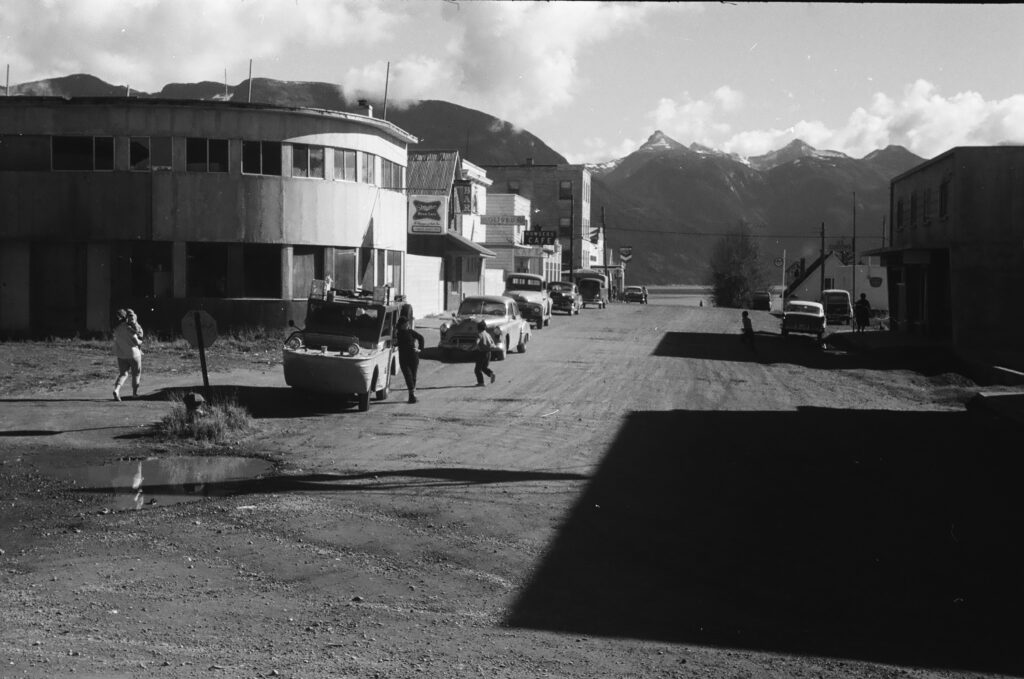
Christiane Leitinger recently visited Haines from Colorado with her family and a stack of pictures from 1961. They set out to match up the photos from her parents’ epic trip that started in Prince Rupert, British Columbia to Haines in 1961, aboard the only vehicle to drive the Lynn Canal. As a boat it averaged four knots. Her parents were Ilse Abshagen and Hans Leitinger; they were traveling in The Ugly Duckling. The Ugly Duckling was a Ford GPA, an amphibious jeep. About 1,200 Ford GPAs were produced during World War II and Abshagen and Leitinger were the first people to drive the Inside Passage in theirs, as documented by plenty of photos. Christiane Leitinger has an amazing collection of pictures from the trip and notes that her parents made on the voyage. She and the family are off to Anchorage next. Leitinger has a solid lead on what could be the current location of the vessel. While the family was in town they compared 1961 photos with areas along Mud Bay road to discover the final landing of the Ugly Duckling before it made the road trip to Anchorage.
Bryce Norton, “Little” Will Tuttle , Lizzy Hahn, Lilly Franck, Katherine Perry, Joseph Rossman and Koa Doddridge went water skiing on the Lynn Canal this week. Norton was the skipper for the adventure in rather chilly waters. Hahn said that 57 degrees was an acceptable temperature. She’s from Nome, maybe that explains things. The chilly waters did not stop Tuttle from skiing in the wake of the Hubbard and a cruise ship, much to the delight of passengers aboard.
Tyler Scovill has been working at The Parts Place for 40 years. His dog, George, has only been on the payroll for a few. His sister, Tomi Scovill, can be credited with inspiring him to move to Haines. He was living in Pentwater, Michigan when she bought the store and pitched the idea to him. His milestone was celebrated with coworkers and friends. Cupcakes and pinwheel appetizers were shared; Scovill enjoyed homemade lasagna and there were several cases of his favorite beverage to enjoy. He said that while working at the Parts Place, the price of oil has changed dramatically, and no people have come in looking for blinker fluid.
The post Duly Noted: Water skiing, ugly ducklings, birthdays and more appeared first on Chilkat Valley News.