A piece of construction equipment drives in front of the Alaska State Capitol on Thursday, June 11, 2026. (James Brooks photo/Alaska Beacon)
Before Gov. Mike Dunleavy’s administration leaves office in December, it’s planning to put its stamp on Alaska’s roads, bridges and infrastructure one last time.
DOT is taking public comments on the draft through Oct. 29, and an online public comment meeting is scheduled for 4 p.m. Oct. 6.
In a meeting of the Senate Transportation Committee last week, DOT Deputy Commissioner Catherine Keith said the agency’s “goal is, if we can stay on schedule, to have an approved ’27 to 2030 STIP by December, mid-December.”
Alaska’s new governor will be sworn into office in the first week of December.
DOT Commissioner Ryan Anderson said the STIP includes more than $1 billion in projects for the Alaska Marine Highway System, including new ferries and terminals.
Next year, construction companies are expected to bid on $847 million in contracting opportunities of all kinds, he said.
Sen. Jesse Kiehl, D-Juneau, asked why the department is issuing a draft STIP now, instead of in the spring, as is traditional.
The draft document is missing components from local planning organizations that haven’t yet finished their work, he noted.
“We were actually hoping to get this STIP out last spring,” Anderson said, but other priorities got in the way. DOT has previously struggled to meet deadlines for transportation planning.
There isn’t a designated time of year for the STIP, he said, “and we want to be ahead of the deadlines … from our previous four-year STIP.”
Some of the projects in the STIP involve road maintenance and pothole patching. Sen. George Rauscher, R-Sutton, noted that some people in his district are getting fed up with the condition of some roads.
“Can a community member go out on that highway and dump a bag of that junk that you can get at Home Depot and just solve the problem in a minute?” he asked.
“Yeah, we would prefer that people didn’t do that,” Anderson said.
There are legal liability issues, he said, and the best thing to do when the road gets bad is to contact DOT’s maintenance and operations section.
An Anchorage Superior Court judge may rule by mid-October on whether or not Lt. Gov. Nancy Dahlstrom acted correctly when she restored Republican state House candidate Jose Tagle to November’s general election ballot.
In an order signed Tuesday, Judge Josie Garton declined to promptly overturn Dahlstrom’s decision but left the door open for subsequent action on a legal challenge filed by the Alaska Democratic Party against Dahlstrom and the Division of Elections.
The delay means absentee voters in House District 22 — where Tagle is running against Democratic incumbent Rep. Ted Eischeid — are receiving ballots with Tagle’s name.
If Tagle is ruled ineligible, any votes for him will be thrown out.
Dahlstrom disqualified Tagle on Aug. 31 for failing to submit an accurate Public Officer Financial Disclosure form on time. She also disqualified Republican gubernatorial candidate Treg Taylor at the same time, for the same reason.
The Alaska Democratic Party has not challenged the decision that restored Taylor to the ballot, but it has continued to fight Tagle’s eligibility.
The party filed its initial lawsuit in July, arguing that the division should have disqualified Tagle when he submitted a blank form. The division regularly disqualifies candidates who file no form.
The Division of Elections opposed the party’s position, saying the Alaska Public Offices Commission is in charge of certifying whether a form is complete or not, and the time to disqualify Tagle would be after the primary.
Garton agreed, ruling on Aug. 14 that Tagle had 30 days to amend his form and thus the Division of Elections acted correctly by keeping Tagle on the primary ballot.
But Tagle didn’t fix his form until after the 30-day deadline, and Garton’s August ruling didn’t address what would happen if the Division of Elections approved his general-election candidacy.
The Alaska Democratic Party asked in September for Garton to issue an order enforcing Tagle’s removal from the general election ballot, but in last week’s order, Garton deferred.
She said the party’s post-primary filing raises different issues than the lawsuit it filed before the primary, and therefore, both the party and the Division of Elections need to exchange new written arguments and possibly hold new oral arguments as well.
The Democratic Party and the Division of Elections have asked Garton to rule no later than Oct. 16; she has not yet approved that request.
Garton’s ruling may not be the final word — in an early-September news conference, Gov. Mike Dunleavy said that any decision on candidacy may have to be decided by the Alaska Supreme Court.
Early, in-person voting begins Oct. 19. Election Day is Nov. 3.
A flier seen Sept. 2, 2026, on a bulletin board at the University of Alaska Anchorage campus gives information about the 988 suicide-prevention hotline established in 2022. (Photo by Yereth Rosen/Alaska Beacon)
I remember the feeling of panic that set in years ago when my daughter told me and my husband she had been feeling incredibly sad for an extended period of time and that a friend of hers had been self-harming recently. Even with years of EMS training and experience working directly with young people with mental health needs, I felt temporarily paralyzed when it came to my own teen and her close friend.
It’s never easy to acknowledge that a child needs help. But the fact that she felt comfortable opening up to us was the first step. It gave us an opportunity to listen, take her concerns seriously, connect her with support and keep checking in. It reminded me that suicide prevention isn’t only about knowing what to do when a crisis happens. It’s also about creating the relationships and trust that allows young people to speak up when something is wrong.
For families across Alaska, moments like these can carry enormous weight. And the data show just how many young people may be struggling.
In late August, the Alaska Department of Health released new data on youth suicide. Between 2016 and 2025, we lost 174 Alaska children and teens ages 10 to 18 to suicide. Suicides in 2025 were the highest on record over the previous ten years. Alaska’s youth suicide rate runs nearly six times the national average.
The struggle reaches much further than even these losses. In the most recent Youth Risk Behavior Survey data compiled in KIDS COUNT Alaska, nearly 1 in 4 high school students said they had seriously considered attempting suicide in the past year.
Many of Alaska’s kids are struggling, and it’s critical we help before a child or teen reaches the tipping point. Preventing suicide takes work throughout the year, but there’s never been a better time to start helping than during Suicide Prevention Month, which is September.
The science says that young people who feel connected to their school and family report suicidal thoughts at far lower rates. An additional caring adult in a child’s life like an afterschool provider, coach or educator can be an important source of support. So can a welcoming school, strong friendships and access to mental health care.
So, what does prevention look like in everyday life?
It looks like showing up. Eat dinner together. Learn the name of your child’s new friend. Make it to the game, the recital, the fish camp. And, you don’t have to be a parent. Teachers, coaches, neighbors and afterschool professionals send the same message when they take a vested interest in a child: you matter and belong.
It looks like asking. If you’re worried about a young person, ask directly: “Are you thinking about suicide?” Asking does not increase suicidal thoughts or behavior. Listen without judgment, help them connect with support and keep checking in.
It looks like taking a training and finding community.Alaska-based organizations like National Alliance on Mental Illness Alaska and the American Foundation for Suicide Prevention’s Alaska chapters host trainings and family support groups to help Alaskan families and educators.
It looks like knowing where to turn. Call or text 988 anytime, whether you’re struggling or worried about someone else. Support is free, confidential, and available 24 hours a day. Save the number in your phone and in your kid’s phone. Talk to your child about how asking for help is a sign of strength — and live that message by showing them that you know how to ask for help from others, too.
Preventing child abuse and neglect means supporting families before problems become crises. That’s the focus of Alaska Children’s Trust’s work, and it matters for suicide prevention, too. The supports that keep families strong also protect a young person’s mental health: welcoming afterschool programs, time with caring adults, connection to culture and mental health care families can reach.
For our family, it meant spending more time together, enrolling in therapy and participation in a Mental Health Advocacy Through Storytelling program. Those interventions helped us — but it’s important that each child’s needs are addressed in a way that works for them.
Suicide Prevention Month is a good time to take a first step and check in with a young person in your life. Make time to listen and keep checking in after September ends.
If you or someone you know is struggling, call or text 988. Help is free, confidential and available 24 hours a day.
A Wilson’s Snipe is seen in an undated photo published by the U.S. Fish and Wildlife Service. (Larry Pace photo/U.S. Fish and Wildlife Service)
Incorrect information provided by a Google AI overview caused a Kodiak woman to hunt snipe illegally on Sept. 5, according to a citation filed this week at the Kodiak district court.
Writing in an affidavit attached to the citation, Alaska Wildlife Trooper Alex Wick said Weaver called troopers to self-report the violation.
“Christina stated that she Googled ‘Snipe season’ on her phone and that, according to Google, snipe season began on September 1st,” he wrote.
Based on that information, she hunted three snipe but became suspicious after learning that duck season didn’t open until Oct. 8.
Snipe are small game birds common in Alaska, Canada and the northern Lower 48.
“After conducting her own research, she learned that snipes are not legal to take under the general season until October 8th. Christina then contacted dispatch to turn herself in,” Wick wrote.
He said he performed a Google search identical to Weaver’s and received identical incorrect information.
Google did not respond to an email seeking comment on the incorrect information provided by its software. The platform provides an immediate artificial intelligence generated summary of search findings.
“I feel terrible, and I have a lot of shame with it. Obviously, that’s why I immediately self-reported once I got home and dived into the regs,” she said by phone on Friday. “It’s incredibly embarrassing.”
Austin McDaniel, a spokesman for the Alaska Department of Public Safety, said the agency doesn’t keep track of cases involving false information provided by AI software.
“This is the first time that I think we have seen AI cited,” he said.
“I expect we’ll see more of this type of thing in the future,” he said of AI being at fault.
McDaniel said Weaver acted completely correctly once she learned about the AI-caused mistake. Self-reported hunting violations are punished much less severely than ones uncovered by troopers.
“The potential consequences for self-turning in versus being caught can be pretty dramatic,” he said.
Weaver pleaded no contest to the citation on Friday and was fined $150.
Like many parents, Arielle Roth has concerns about her children’s screen time at school. But unlike her peers, she’s in a position to influence the issue at nearly every school in America.
Roth heads an obscure federal agency within the Commerce Department that serves as the president’s top policy adviser on telecommunications issues. In that role, she’s called for more scrutiny of federal policies that support technology in the classroom, convened listening sessions with screen-skeptic parents, and coordinated between federal agencies. She calls the struggle “deeply personal.”
Now the Federal Communications Commission — citing Roth’s work and riding a broader backlash to education technology — is conducting a wide-ranging review of federal school internet subsidies that could lead to their elimination, or new requirements for schools to restrict screen time or allow parents to opt out in order to receive the money.
The changes under consideration could be financially devastating and deeply disruptive to classrooms and daily school operations, district leaders and education advocates say.
FCC Chair Brendan Carr asked whether E-Rate has served its purpose. He said the FCC’s review will consider “educational opportunity,” as well as whether “additional safeguards, refinements, or updates are needed to better protect kids online.”
In an interview, Roth, administrator of the National Telecommunications and Information Administration, said it’s time to ask “what E-Rate has meaningfully accomplished and how it has affected behavior.”
“Subsidies are not neutral,” she said. “Subsidies can encourage greater consumption. Understanding how the program has changed educational practice is really important.”
But E-Rate first and foremost supports schools’ access to a modern utility, said Noelle Ellerson Ng, chief advocacy and governance officer at the School Superintendents Association.
“Screen time is a curriculum and a content question,” she said. “The FCC is not the body to regulate those things.”
Schools use E-Rate for security, finances, and instruction
When Congress approved E-rate in 1996, just 14% of U.S. schools had internet access. Then-FCC chair Reed Hundt hailed the program as “the biggest single national effort to change education in classrooms K-12 in the history of our country.”
Still, school district leaders say that access really has been transformative.
Thanks to E-Rate, high school students in the Alaska Gateway School District, where many schools can’t be reached by road for most of the school year, can take virtual career-technical courses to prepare for apprenticeships, Superintendent Patrick Mayer said. The internet also allows Indigenous language teachers to tap online Athabaskan language resources.
“Connectivity is very important for us because it is our lifeline to the outside world,” he said.
It’s not just instruction. Schools use the internet for everything from school security and HVAC systems to attendance and payroll.
“Facilitating screen time is effectively the choice to harm our kids,” said Peter Ryan, a parent activist and co-founder of the Center for Responsible Technology. “To do so is to give them a digital drug.”
That same week, the Education Department hosted a convening called “From Screentime to Screen Value,” put on by an educator group that supports tech in the classroom. The Education Department and the FCC did not respond to questions about its role in the E-Rate review.
Among the more vocal critics is U.S. Sen. Ted Cruz, a Texas Republican who chairs the Senate Commerce Committee, where Roth previously worked on telecommunications policy. Cruz sponsored legislation that would have conditioned E-Rate on screen-time policies, but it stalled in Congress.
“Good policy occasionally takes the scenic route,” Cruz wrote in a post on the social media site X praising the FCC E-Rate review.
FCC puts parental opt-out policies on the table
The FCC’s E-Rate review sets the stage for commissioners to vote on major changes to the program. Without published draft rules, advocates are left reading between the lines as to what those might be.
The issues that concern school districts the most are the FCC’s views on whether E-Rate should end, whether E-Rate should be limited to rural communities, and whether schools should have to adopt technology limits and opt-out policies to participate.
Ending E-Rate — a possibility the FCC downplayed this summer and which many advocates don’t believe is within the FCC’s authority — would be catastrophic, district leaders said.
E-Rate provides more than $700,000 a year for Alaska Gateway, about 7% of the district’s budget, Mayer said. In larger districts, it can be worth many millions. Because schools can’t go without internet, they’d have to find that money elsewhere in their budgets.
“The school districts that are more affluent would continue to have modern schools, and those that serve less affluent areas would be the ones making the toughest choices,” said LaTonya Goffney, president of the School Superintendents Association and superintendent of the Aldine Independent School District, a high-poverty district in Houston.
But mandatory opt-out policies would also be disruptive, district leaders said, because they would require teachers to develop alternative lesson plans and potentially single out students with disabilities who rely on technology for accommodations.
Parents know what’s best for their own child, Ellerson Ng said, but “superintendents are responsible for every child in their district and all of their diverse needs.”
Roth, though, said robust opt-out provisions could encourage a bigger conversation about school internet use and would be consistent with the Trump administration’s focus on parental rights.
“The same conditions that give parents an escape valve could also serve as a check on the subsidy to make sure school districts aren’t using more than they need,” she said.
But with E-Rate on the line, even some advocates for stricter screen time limits are nervous.
“All of these questions they’re asking about screen time and the education efficacy of technology and family’s input on what happens in schools are the right questions,” said Haley Hinkle, policy counsel at Fairplay, a group that fights the influence of tech in children’s lives. “We’re concerned about tying these questions to the provision of internet.
“In the modern world, schools need internet, and kids need internet.”
Erica Meltzer is Chalkbeat’s national editor based in Colorado. Contact Erica at emeltzer@chalkbeat.org.
Chalkbeat is a nonprofit news site covering educational change in public schools.
NOTN- Ballots for Juneau’s municipal election have been mailed to voters, if you haven’t already received them.
Voters can return ballots by mail or use one of five drop boxes: at the Statter Harbor boat launch parking lot, outside the Mendenhall Valley Public Library, outside AEL&P in Lemon Creek, outside the Douglas Public Library and outside City Hall.
Mail-in ballots must be postmarked by Oct. 6. Deputy Municipal Clerk Andy Hirsch said, and she recommended that voters mailing ballots close to the deadline ask the post office to date-stamp them in person.
Voters who did not receive a ballot, or who prefer to vote in person, can do so at vote centers at the Mendenhall Valley Public Library or City Hall. The library is open Monday through Thursday from 10 a.m. to 6 p.m. and Friday and Saturday from noon to 5 p.m. City Hall is open weekdays from 8 a.m. to 4:30 p.m. Both locations will be open from 7 a.m. to 8 p.m. on Election Day.
“If for any reason you didn’t receive a ballot, you can go vote in person. In fact, you can vote in person for any reason at all, even if you did receive your ballot.” Hirsch said.
In-person voters will also use a by-mail ballot, Hirsch said, allowing election officials to process ballots consistently and help ensure each person votes only once.
This year’s ballot includes up to three Assembly seats, an area-wide seat and seats for districts one and two, as well as two school board seats and three propositions. Juneau’s voter turnout has generally been around 30%, Hirsch said.
“Every year I’m like pie in the sky, we’re gonna have the biggest voter turnout ever because that’s what I want to happen. Historically, we’re generally in the 30 percent. Voter turnout…There’s a couple of different things going on, but one is how interesting the ballot is, and we have a really interesting ballot this year.”
Want to know more about what’s on the ballot? Here is CBJ’s voter info collected for ease;
Preschoolers play in the snowmelt at Hillcrest Children’s Center in Anchorage on April 18, 2024. (Photo by Claire Stremple/Alaska Beacon)
Alaska childcare providers, families and employers are under intense strain with the lack of childcare availability and funding, according to advocates. They are calling for major state investment in the childcare industry and seeking policy changes under the next governor and Alaska State Legislature.
Leaders with several non-profit groups held an online webinar Wednesday focused on barriers and potential solutions to what they called “Alaska’s childcare desert,” which included advocates with the Alaska Children’s Trust, Southeast Childhood Collective and thread, a statewide resource and referral organization.
Advocates described a patchwork funding system of federal, state and some local municipal grants for childcare providers, which has resulted in a lack of childcare spaces to meet demand, long waitlists, high costs for families and a lack of qualified childcare providers, who also work for low pay.
“It’s a battle right now,” said Candice Vialpando, marketing and communications director with thread. “But every little bit helps, and every bucket of money that we are getting, we’re just putting out into the field to try and help, and keep programs open.”
Alaska has seen a wave of childcare centers close in recent years. Last year, one of Anchorage’s largest childcare facilities, Bright Beginnings Learning Center, closed due to rising costs and a shortage of workers, displacing 125 children and 35 staff. Since 2019, 25% of childcare facilities have closed, according to thread.
The organization estimates 50% of Alaskan families cannot fully participate in the workforce because they lack access to childcare. They estimate the average cost Alaska parents pay is nearly $14,000 per year per child.
Advocates are pushing legislators and state political candidates to make childcare a priority in this election.
“Alaska is a childcare desert,” said Blue Shibler, executive director of the Southeast Childhood Collective, which provides resource, funding and workforce development support throughout Southeast Alaska. “The good news is, advocates like us on here have been working for years on this issue, and there is quite a bit of framework systems development that could turn all of that around pretty quickly.”
She said that the state could make big changes quickly if a new executive branch and motivated legislators were open to their policy and funding ideas.
Shibler said childcare providers are struggling to recruit childcare workers and pay liveable wages, which can result in long wait lists for care.
“Childcare providers cannot charge families enough money to pay competitive wages in this labor market, and so they’re limited at how many kids they can take based on that,” she said. “So we’re working to improve that.”
This year, the Legislature approved $6.4 million to help boost pay and retain childcare workers, but Gov. Mike Dunleavy vetoed it.
“That really hurt us,” Vialpando said.
Dunleavy also vetoed Legislature-approved increases of $355,000 to the family support program Parents as Teachers, a $3.7 million increase for Head Start programs and a $3 million increase for infant learning programs to support children with developmental delays or disabilities.
A spokesperson for the Dunleavy administration, Jeff Turner, said by email Thursday that “substantial funding was provided,” for childcare. He pointed to the governor’s approvals in this year’s budget for $13 million in Head Start grants, $475,000 for Parents as Teachers and $12.3 million for early intervention and infant learning programs.
“Governor Dunleavy also proposed legislation for funding and opportunities to expand workforce training, unfortunately the legislature chose not to pass his legislation,” Turner said, referring to a bill that would have expanded the unemployment insurance trust fund.
State assistance grants, licensing and economic impacts
For state childcare assistance grants that are paid out to providers and families, Vialpando described issues with delayed payments, which can cause children to lose their spots.
Vialpando said one issue is if families miss renewal dates, they have to reapply for assistance all over again. “It’s not just a quick renewal. It’s like a whole new application period, which takes a very long time,” she said.
“And during that application period, they’re not getting assistance, so their childcare provider is not getting paid, so they don’t have care for their child during that time. And it’s like, does this person care for the kid without getting paid? Does the child stay home?” she said. “It’s a really bad effect that is happening, so I think that needs to be addressed: prompt payment.”
Officials with the Alaska Department of Health did not respond to a request for comment on state assistance delays on Thursday.
Nonprofit groups are working to boost childcare worker support and professional development opportunities, including apprenticeship programs, and helping new providers with licensing and regulatory standards for new childcare programs.
Shibler and others said providers continue to struggle with licensing issues and regulatory hurdles, and the Department of Health could do more to ease the strain.
“A lot of the licensing regulations are just really old and outdated. They just need a review,” she said. “To figure out how many of these are really important to maintain health, safety, and quality, and which ones are just sort of extra that we don’t need to be dealing with and putting on providers.”
With support from an Anchorage initiative directing marijuana tax revenue to the Anchorage Child Care and Early Education Fund, Vialpando said thread is able to provide grants to childcare providers for supplies, equipment upgrades, rent and other operational costs. The organization is also using a mix of state and federal grants to provide health care benefits to childcare workers statewide. “Which is huge in a sector where people do not have healthcare,” she said.
Teresa Wrobel, director of policy and advocacy, Alaska Children’s Trust noted childcare is becoming a priority issue for employers, as there’s a loss of hours as employees need to tend to childcare needs. She and others acknowledged lack of childcare is a major factor in some families leaving Alaska.
Wrobel emphasized the Alaska Children’s Trust – which is focused on reducing child abuse and neglect — is advocating to address childcare issues to help alleviate stress on families. “Neglect happens with families when there is stress in the family, and we just know that childcare is one of those methods that can reduce stress on the family,” she said.
Shibler and others expressed hope that future state leaders will address the state’s growing childcare gap.
“So there’s all these little band-aids out there, you know, trying to fix the problem because nobody wants to take off the big bite, which is we really need to invest $50 million into a compensation system in Alaska,” Shibler said.
“Childcare is a public good: it needs a public subsidy,” she said. “We subsidize public goods all the time. We’re just not doing it for childcare for some reason.”
Correction: This story has been updated to clarify thread is a statewide resource and referral organization, and to clarify state and federal funding, not ACCE funding, is supporting childcare workers’ healthcare benefits.
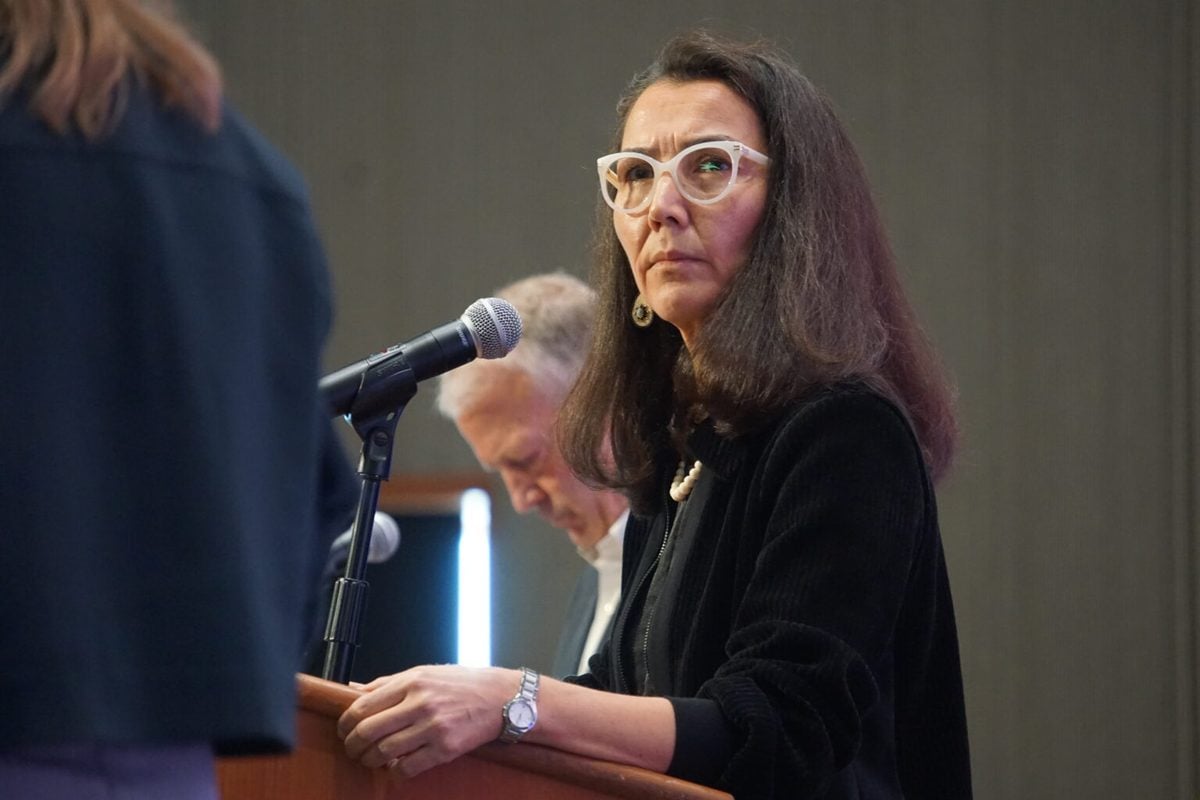
Mary Peltola listens to a question posed by moderator Michelle Egan at a candidate forum held by the Alaska Oii and Gas Association on Aug. 27, 2026. Next to Peltola is i Sen. Dan Sullivan. Peltola, a Democrat and former U.S. House member, is challenging Sullivan. (Photo by Yereth Rosen/Alaska Beacon)
Alaska observers say it is too early to say how reports of bad behavior by Democratic U.S. Senate candidate Mary Peltola might affect the state’s closely watched election, and some supporters suggested this week that she may be subject to a double standard because of her gender.
“While it’s surprising news, I think there’s a very hefty proportion of people who go, ‘It’s a hit job. It’s typical politics,’ and kind of brush it off,” said Ivan Moore of Alaska Survey Research, a political polling firm active in the race.
“It takes a lot to swing someone over from being a Peltola voter to all of a sudden going, ‘Oh, OK, I’ll vote for Sullivan.’ So we’ll see,” Moore said.
On Wednesday, the New York Times published an anonymously sourced article documenting abusive behavior by the former Alaska congresswoman, now a leading candidate for Senate. The article said she was hostile to her staff and used slurs and profanity to privately criticize others.
The article detailed accounts from former staff members who said she required aides to feed her family’s pet chameleon and said that in 2024, she wrote that she hoped a local Planned Parenthood board member would “die of a botched abortion.”
That comment came after the group was slow to endorse Peltola in that year’s election. This year, she does not appear on the group’s endorsement list.
“Planned Parenthood has been called worse and withstood more in its 100+ years; we’ll talk with her about what was reported when she’s Senator-elect,” said Morgan Lim, Alaska state director for Planned Parenthood Alliance Advocates. “Nothing has changed in the stakes of this race and we remain laser-focused on ousting Sullivan from the Senate — making sure Alaska voters know that Dan Sullivan is an anti-abortion, anti-LGBTQ fanatic who will continue to rubber stamp Trump’s judicial nominees.”
Peltola was elected in 2022 to fill the remainder of Congressman Don Young’s term after his death that spring. She subsequently won the general election in November and served a two-year term of her own.
Her time in office coincided with a period of personal loss. Five months after she began her full term, her mother died. Three months after that, her husband died in a plane crash. She sued his employer a year and a half later, and a trial is set to begin in March.
Harry Child, a spokesman for Peltola’s campaign, said by text that the Times article is exaggerated.
“Like any person who has gone through multiple personal tragedies in the span of a few months, Mary sometimes struggled to deal with her grief. But she treats her staff with respect and care, and she maintains close positive relationships with her staff spanning her nearly 30 years in public service,” he said. “Exaggerating and outright lying about moments from the hardest period of her life, and falsely presenting them as a pattern of behavior, is wrong.”
A double standard for judging Peltola?
Polling indicates Peltola, a Democrat, is in a close race against Republican incumbent Dan S. Sullivan for one of Alaska’s two U.S. Senate seats. The winner of that election may decide whether Democrats or Republicans hold a majority of the Senate.
Moore said he doesn’t know whether the Times article will affect the eventual result.
Readers of the Anchorage Press said they don’t think it will, with some labeling the Times article a “nothingburger.”
The Times found something similar in a followup article of its own. A spokesperson for the Alaska Democratic Party called the initial article “a hit piece.”
“Mary grew up working on a fishing boat and was made in the mold of great Alaskan leaders that came before her. She’s the only candidate in this race who will actually fight to lower costs and put Alaska first, and Alaskans will send her to the Senate this fall because she will deliver,” the spokesperson said.
Nate Adams, a spokesperson for the Sullivan campaign, said by email, “Nearly 30 people close to Mary Peltola were interviewed and more than 100 screenshots informed this reporting. What the Times printed is only a fraction of it, so imagine what was left out, and what else Mary Peltola is hiding from Alaskans.”
Jim Lottsfeldt, a veteran political campaigner who is working on pro-Peltola efforts this year, said he sees somewhat of a double standard in the way she’s being treated.
“Stevens blew his stack, and we were all like, ‘That’s great, because he blew his stack for our benefit.’ And then you had Don Young saying the most outrageous things occasionally, but got like tons of things passed,” Lottsfeldt said. “So when all this stuff happens with the guys, nobody really clutches their pearls, and now we have little Mary Sunshine, Mary Peltola, who may have said the word f**k when she was mad, and now we’re acting like it’s a major political story, and I don’t think it is.”
Some former staffers back Times reporting, others dispute it
After the Times published its initial article, the Beacon contacted more than a dozen former Peltola aides in an attempt to verify its contents. Some, speaking anonymously, said they could not confirm all the incidents described by the Times but said the article matched the tone and mood of their time in her Congressional office or with her campaign.
They asked to not be named in order to offer frank opinions and because their current jobs may require them to work with Peltola in the future.
But at least some defended their former boss.
Kate Consenstein worked for Peltola in the Alaska Legislature and now runs a communications firm in Anchorage. The Peltola campaign suggested her as someone whose experience doesn’t match the Times article.
“I wouldn’t want to engage in denying the veracity or the accuracy of those people’s accounts, especially because I don’t know who they are,” she said, “but I would just say the person that I worked for, and the person that I still know, is kind, generous, and not an abusive boss.”
Current U.S. Sen. Lisa Murkowski is a Republican who endorsed Peltola’s 2024 U.S. House run but is backing Sullivan this year. She told reporters in Washington, D.C. on Thursday, “I do acknowledge that while she was here in her first term, she was not only thrown into a very challenging situation immediately running for campaign, but then to lose her husband in that airplane crash and to deal with all of that. That’s pressure that is hard for anybody to bear.”
Sullivan, also interviewed by D.C. reporters on Thursday, said, “I think it’s very sad, very disturbing that so many Alaskans had to get put through that kind of severe abuse, which is very disturbing, but not surprising.”
Tyson Fick, a fisherman from Juneau who worked as a special assistant in Peltola’s congressional office, said there’s no doubt that Peltola would want a “mulligan” for some of the things she said, and he feels she was frequently second-guessed by East Coast staff.
“She never, I thought, was abusive, but also she often got some inadequate staff work,” he said.
“Having been around some operations where they were a little more, you know, systematic and organized, it was hard for me. I had to get out of there. I love Mary. I’ll be with Mary till I die, but I knew I couldn’t sign up for them again,” he said.
Fick and other Alaskans interviewed for this article were particularly critical of Anton McParland, who replaced Alex Ortiz as Peltola’s chief of staff. Ortiz, who declined to comment for this article, had previously worked for Young. When Peltola was elected, McParland did not live in Alaska; he has since registered as an Alaska voter.
In addition to the personal losses that Peltola suffered, there was also a conflict between the people Peltola brought from Alaska and the people she hired from the East Coast.
Peltola and Fick are fishermen and accustomed to salty language, he said. Someone with a trust fund may not understand it, he said.
“Sometimes you say some salty stuff just for effect, and it doesn’t reflect a cultural bias … I get that words mean things, and words hurt, and people get their feelings hurt, and maybe it’s not right, but there’s also times when you’re under super stress, and you’re grieving, that stuff comes out like in inopportune moments, and it’s like, yeah, we could communicate better, we could do better, but also we could have — I could have done better for her,” Fick said.
Use of GLP-1 weight-loss drugs has surged in just two years, and medical groups have said most people taking them aren’t getting enough nutrition and … Read moreThe post Taking a GLP-1 and feeling alone? You’re not; a South Carolina…
All-inclusive resorts have sold travelers on the same basic unit for decades: one room, one bed configuration, one small balcony. A growing share of vacationers … Read moreThe post Multigenerational travel is booming, and this resort has smarter options than…