Economists talk about “new money” and “old money,” but not always in the sense of old, like long-time rich families, or new, like tech startup multi-millionaires. Old money can refer to dollars earned in a state that stay and circulate in that state, like plumbers who provide services to people in town and then spend their earnings at stores in town, while new money refers to dollars brought into the state.
If you want a pair of smartglasses that will record every burp, blemish and blush of whoever is sitting across from you — while it also remembers their names — Chief Executive Mark Zuckerberg and his techies at Meta see the world the same as you. They see privacy to be dismissed and eating habits to be recorded.
Maybe it will improve table manners, though probably not. They see money to be made, which is…
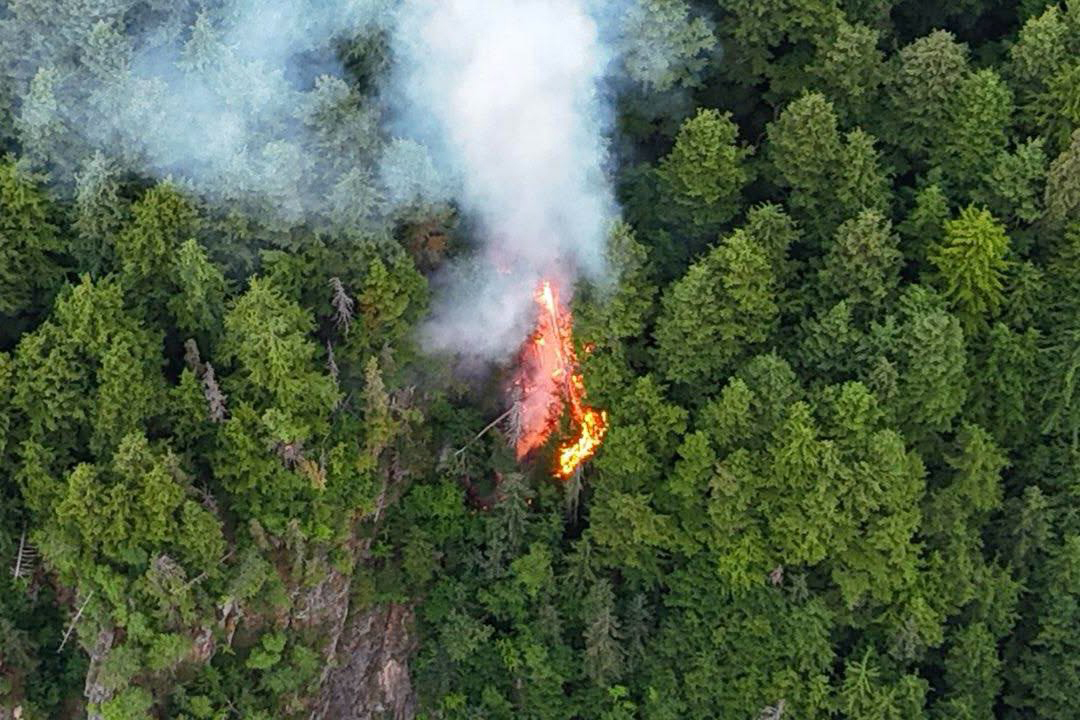
Just as a burn permit ban came into effect on Wednesday morning, firefighters got a call about a wildfire near Chilkat Lake.
Fire Chief Zak Overmyer said four people from the Haines volunteer fire department, one from the Klehini Valley volunteer fire department and the state wildlife trooper responded to a fire that was about ⅕ of an acre Wednesday morning.
“Crews are working on securing the edge of the containment line, chainsaw work and…
Marilyn Jo (Ross) Huitger passed away July 20, 2026. She is survived by her husband, Tom Huitger; sister, Mary (Greg) Shipley-Smith; stepchildren, Carrie and Collins Huitger; and cherished grandchildren, Amelia and Vincent Huitger. Marilyn and Tom proudly called Haines their home for many years, where they built and lived in a rustic cabin filled with comfort, love and lasting memories. She served as Manager of the Haines Chamber and was a founding organizer…
Glenfarne CEO Brendan Duval speaks on May 21, 2026, at the Alaska Sustainable Energy Conference in Anchorage, while Gov. Mike Dunleavy listens. Glenfarne is the company now proposing to build a liquefied natural gas project to commercialize North Slope’s stranded reserves. Dunleavy on Wednesday introduced a new bill proposing tax concessions to encourage construction of the LNG project. (Photo by Yereth Rosen/Alaska Beacon)
Gov. Mike Dunleavy on Wednesday introduced a new natural gas pipeline bill that he characterized as a compromise between conflicting philosophies on oil and gas taxes that he wants lawmakers to pass during the ongoing special session.
The new bill would nearly eliminate property taxes that would be charged on the operator of a yet-to-be-built gas pipeline. Dunleavy and Glenfarne, the Texas-based investment company that is now the main sponsor of the gas pipeline project, have argued in recent months that such concessions are a major requirement for the project to be built.
The special session is due to end in less than two weeks. Lawmakers are still evaluating the proposal, but on Monday members of the Senate’s bipartisan majority expressed reticence to make quick decisions on a gasline bill.
Dunleavy’s new bill contains a concession to a tax previously sought by the Senate majority. It would also impose a small corporate income tax on certain private oil- and gas-producing corporations. Those companies, also known as S corporations or pass-through corporations, are currently exempted from such taxes in Alaska law. For now, the main corporation that would be affected is Hilcorp, a privately held Texas-based company that operated the Prudhoe Bay field and other North Slope assets that used to be owned by BP. Several legislators view Hilcorp’s exemption from corporate income taxes as a loophole that should be closed.
The governor said legislators should pass his bill in what is now the third special session he has called on the subject.
“I have never been in favor of new taxes on Alaska’s producers, and I still am not,” Dunleavy said in a statement. “This bill is a compromise that removes a significant barrier to moving the gas line forward. Given the robust discussion and work that has already gone into this bill, I am hopeful the legislature can swiftly pass a bill that will help the AK LNG project get the financing it needs to start construction as soon as possible.”
The 2% tax rate Dunleavy proposed on petroleum-producing S corporations is significantly lower than the lower than tax rates legislative leaders have previously proposed, which went up as high as 9.4%.
Doug Fletcher, a Glenfarne employee, prepares to close down the company’s “Build The Line” booth at the Fairbanks Golden Days street fair on June 25, 2026. The campaign aims to convince state lawmakers to pass tax concessions that Glenfarne argues are needed to make the LNG project a reality. (Photo by Yereth Rosen/Alaska Beacon)
Officials and energy companies in Alaska and elsewhere have been pushing since the 1970s — even before oil began flowing through the Trans Alaska Pipeline System — for a second pipeline to deliver the North Slope’s vast but stranded natural gas resources to markets. None of the plans has been economically feasible, even though politicians at various points over the past decades declared that construction was imminent.
The current iteration of the gas commercialization plan calls for a pipeline to run about 800 miles from Prudhoe Bay to tidewater at Cook Inlet, where the product would be liquefied for shipment by tanker to markets. The estimated price tag is $65 billion to $70 billion, according to legislators.
A bill considered during an earlier special session, House Bill 381, proposed to grant the property tax concession, but it also included several conditions for any LNG sponsor to meet, such as timeline assurances, labor protections, alternative sources of state revenue and required financial support of local school districts.
The bill also included a bracketed income tax with rates up to 9.4% on petroleum-producing S corporations such as Hilcorp — significantly higher than the 2% that Dunleavy is now proposing.
One lawmaker on Wednesday said Dunleavy’s new bill, just like any oil tax legislation, should not be rushed.
“It would be wildly irresponsible to pass complex oil and gas legislation without due diligence to understand the consequences,” said Rep. Zack Fields, D-Anchorage.
Leaders of the state Senate majority caucus, in a statement on Monday, expressed skepticism about the need for any further concessions to help Glenfarne’s plan.
“For more than fifty years, Alaskans have worked to bring our gas to market, and every member who has served in this building shares that goal. The Senate has done its part in good faith, passing two bills that would let this project move forward while protecting the people we answer to,” Senate President Gary Stevens, R-Kodiak, said in the statement. “A decision of this scale will outlast all of us, and it deserves to be made with care rather than in haste. We are ready to evaluate the project further once the producer, Glenfarne, and the Administration bring us the numbers this year. These are Alaska’s resources, and they must work first and foremost for Alaskans.”
The special session is scheduled to end on Aug. 25.
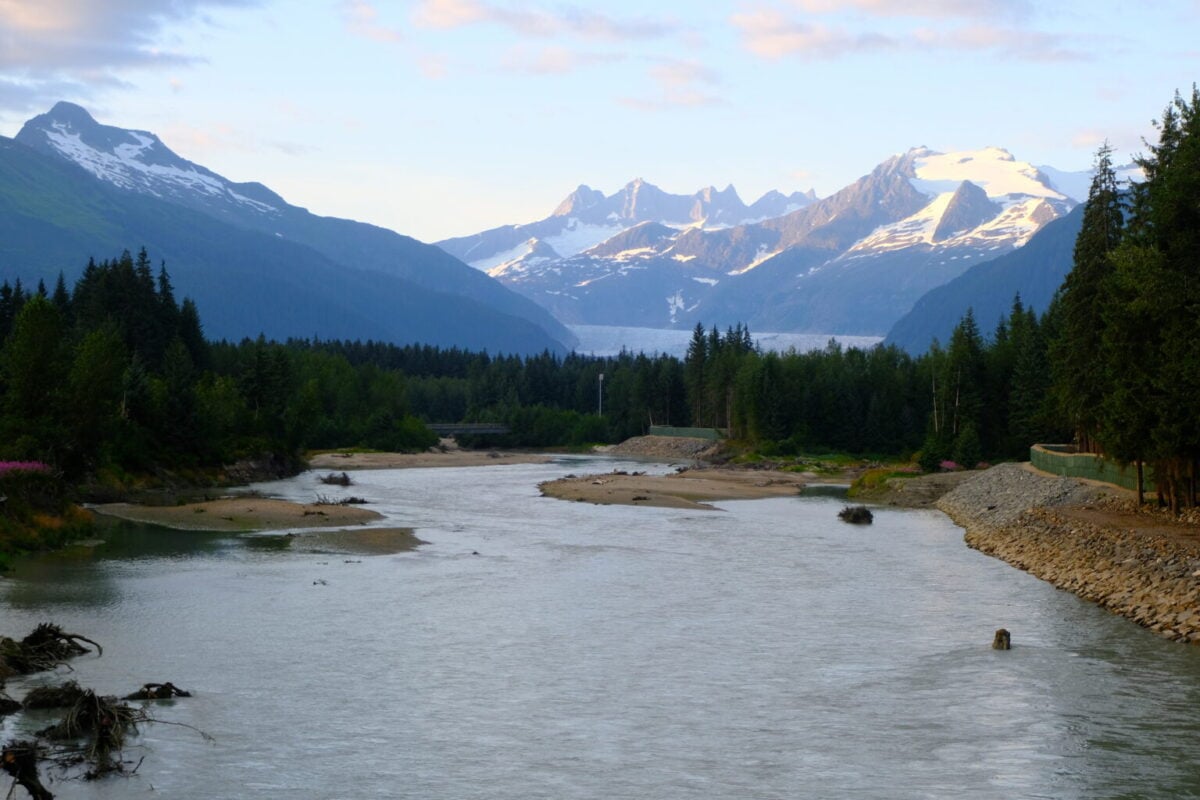
Glacial lake outburst flooding begins on the Mendenhall River below the Mendenhall Glacier on Aug 11, 2026. Officials issued an evacuation advisory for roughly 5,000 residents in the area. (Photo by Corinne Smith/Alaska Beacon)
For questions and resources, call the local 24/7 flood hotline at 907-500-0890.
Alaska’s capital city has issued an evacuation advisory for the densely-populated Mendenhall Valley area on Wednesday as glacial outburst flooding begins.
Officials and the public are closely watching the Mendenhall Glacier, where climate-change driven melting results in water filling an ice-dammed lake called Suicide Basin each year. That lake eventually bursts and billions of gallons of water are released down the Mendenhall River, threatening suburban neighborhoods nearby.
The National Weather Service forecasts the flooding in the Mendenhall River will peak on Thursday morning between 8 a.m. and 12 p.m.
“Evacuating is absolutely the best way to keep yourselves, your neighbors, and first responders safe as we respond to this flood,” said Ryan O’Shaughnessy, emergency manager for the City and Borough of Juneau at a news conference on Wednesday.
Ryan O’Shaughnessy, emergency manager for the City and Borough of Juneau, Ginny Nadolny, commander of US Coast Guard Southeast Sector (center) and Sabrina Grubitz, public safety manager for Central Council of Tlingit and Haida Indian Tribes of Alaska (left) speak at a news conference ahead of the glacial outburst flood in Juneau on Aug 12, 2026. (Photo by Corinne Smith/Alaska Beacon)
Scientists with the National Weather Service estimate the flooding to peak between 16.1 to 16.6 feet. That’s similar to last year’s flood where the river peaked at a record-breaking 16.65 feet.
The scale of flooding is uncertain, and depends largely on whether sand bag barriers erected along the Mendenhall River hold.
In the event that water bursts through the barriers, CBJ will issue an emergency flash-flood alert to all local cell phones, similar to an Amber alert.
Last year, local, state and federal agencies erected the new barriers along the river, where they largely prevented major flood damage. Thirty-five homes were affected by the flood, with six sustaining major flood damage. Some homes had up to five feet of flooding water in living spaces, according to city reports. In 2024, there were no barriers and flooding damaged nearly 300 homes.
This year, the U.S. Army Corps of Engineers and local partners worked to fortify those sand bag barriers along the Mendenhall River. In some areas, the barriers were constructed higher, up to 16 feet. They were extended in other areas across 1.8 miles of additional riverbank, said U.S. Army Corps Brigadier General Joseph Goetz at a news conference on Tuesday. The Army Corps has also installed roughly 40 industrial pumps to control seepage, and distributed an estimated 225,000 sandbags.
But this year officials issued an evacuation advisory for an area nearly double the size of last year’s — including roughly 1,900 homes — in case the barriers fail. Officials are calling that a worst case scenario.
Ryan O’Shaughnessy said census data shows the evacuation area includes an estimated 5,000 residents.
“I know this community has experienced this flood before, but we can’t be complacent,” said Ken Murphy, a safety officer with the Alaska Department of Transportation and Public Facilities, on Tuesday. “What happened last year may or may not happen this year.”
Residents are asked to evacuate the area by 3 p.m. on Wednesday.
Sand bag barriers newly constructed this year in the lower part of the Mendenhall River below Brotherhood Bridge are seen from Meadow Lane in Juneau on Aug 8, 2026. (Photo by Corinne Smith/Alaska Beacon)
Officials said there is a risk of tree-strikes damaging the barriers and causing major flooding, and urged the public to take extra precautions, evacuate and avoid the river area entirely.
“The risk is real,” Murphy said. “Debris, erosion, unstable banks, changing water levels, and hidden hazards make the river dangerous. If you’re near the river or within the flood zone, you’re in danger. There is no safe reason to approach the water during this event. This is not a normal event, even though it reoccurs.”
Officials said they will be monitoring the river and barriers by livestream cameras and by drone throughout the flood, with emergency crews staged nearby ready to respond.
Residents can monitor Suicide Basin through a National Weather Service monitoring page. Officials recommend signing up for emergency alerts and reviewing Mendenhall River inundation maps. KTOO Public Media has set up several livestreams to monitor the flooding event. There is an emergency shelter at the former Floyd Dryden Middle School staffed by the American Red Cross.
The Mendenhall Glacier Recreation Area, Alaska’s most-visited tourist destination, surrounding the Mendenhall Glacier and Mendenhall Lake below is closing on Wednesday afternoon.
A joint emergency incident command has been established to monitor and respond to the flood. That includes the National Weather Service, City and Borough of Juneau, Central Council of Tlingit and Haida Indian Tribes of Alaska, the Alaska Department of Transportation and Public Facilities, the U.S. Coast Guard, the U.S. Army Corps of Engineers and the Alaska Division of Homeland Security and Emergency Management.
The City and Borough of Juneau are planning to issue a larger evacuation advisory for the 2026 glacial outburst flooding event. (Screenshot of CBJ evacuation advisory map)
Glacial lake outburst flooding begins on the Mendenhall River below the Mendenhall Glacier on Aug 11, 2026. Officials issued an evacuation advisory for roughly 5,000 residents in the area. (Photo by Corinne Smith/Alaska Beacon)
Alaska’s capital city has issued an evacuation advisory for the densely-populated Mendenhall Valley area on Wednesday as glacial outburst flooding begins.
Officials and the public are closely watching the Mendenhall Glacier, where climate-change driven melting results in water filling an ice-dammed lake called Suicide Basin each year. That lake eventually bursts and billions of gallons of water are released down the Mendenhall River, threatening suburban neighborhoods nearby.
The National Weather Service forecasts the flooding in the Mendenhall River will peak on Thursday morning between 8 a.m. and 12 p.m.
“Evacuating is absolutely the best way to keep yourselves, your neighbors, and first responders safe as we respond to this flood,” said Ryan O’Shaughnessy, emergency manager for the City and Borough of Juneau at a news conference on Wednesday.
Ryan O’Shaughnessy, emergency manager for the City and Borough of Juneau, Ginny Nadolny, commander of US Coast Guard Southeast Sector (center) and Sabrina Grubitz, public safety manager for Central Council of Tlingit and Haida Indian Tribes of Alaska (left) speak at a news conference ahead of the glacial outburst flood in Juneau on Aug 12, 2026. (Photo by Corinne Smith/Alaska Beacon)
Scientists with the National Weather Service estimate the flooding to peak between 16.1 to 16.6 feet. That’s similar to last year’s flood where the river peaked at a record-breaking 16.65 feet.
The scale of flooding is uncertain, and depends largely on whether sand bag barriers erected along the Mendenhall River hold.
In the event that water bursts through the barriers, CBJ will issue an emergency flash-flood alert to all local cell phones, similar to an Amber alert.
Last year, local, state and federal agencies erected the new barriers along the river, where they largely prevented major flood damage. Thirty-five homes were affected by the flood, with six sustaining major flood damage. Some homes had up to five feet of flooding water in living spaces, according to city reports. In 2024, there were no barriers and flooding damaged nearly 300 homes.
This year, the U.S. Army Corps of Engineers and local partners worked to fortify those sand bag barriers along the Mendenhall River. In some areas, the barriers were constructed higher, up to 16 feet. They were extended in other areas across 1.8 miles of additional riverbank, said U.S. Army Corps Brigadier General Joseph Goetz at a news conference on Tuesday. The Army Corps has also installed roughly 40 industrial pumps to control seepage, and distributed an estimated 225,000 sandbags.
But this year officials issued an evacuation advisory for an area nearly double the size of last year’s — including roughly 1,900 homes — in case the barriers fail. Officials are calling that a worst case scenario.
Ryan O’Shaughnessy said census data shows the evacuation area includes an estimated 5,000 residents.
“I know this community has experienced this flood before, but we can’t be complacent,” said Ken Murphy, a safety officer with the Alaska Department of Transportation and Public Facilities, on Tuesday. “What happened last year may or may not happen this year.”
Residents are asked to evacuate the area by 3 p.m. on Wednesday.
Sand bag barriers newly constructed this year in the lower part of the Mendenhall River below Brotherhood Bridge are seen from Meadow Lane in Juneau on Aug 8, 2026. (Photo by Corinne Smith/Alaska Beacon)
Officials said there is a risk of tree-strikes damaging the barriers and causing major flooding, and urged the public to take extra precautions, evacuate and avoid the river area entirely.
“The risk is real,” Murphy said. “Debris, erosion, unstable banks, changing water levels, and hidden hazards make the river dangerous. If you’re near the river or within the flood zone, you’re in danger. There is no safe reason to approach the water during this event. This is not a normal event, even though it reoccurs.”
Officials said they will be monitoring the river and barriers by livestream cameras and by drone throughout the flood, with emergency crews staged nearby ready to respond.
Residents can monitor Suicide Basin through a National Weather Service monitoring page. Officials recommend signing up for emergency alerts and reviewing Mendenhall River inundation maps. KTOO Public Media has set up several livestreams to monitor the flooding event. There is an emergency shelter at the former Floyd Dryden Middle School staffed by the American Red Cross.
The Mendenhall Glacier Recreation Area, Alaska’s most-visited tourist destination, surrounding the Mendenhall Glacier and Mendenhall Lake below is closing on Wednesday afternoon.
A joint emergency incident command has been established to monitor and respond to the flood. That includes the National Weather Service, City and Borough of Juneau, Central Council of Tlingit and Haida Indian Tribes of Alaska, the Alaska Department of Transportation and Public Facilities, the U.S. Coast Guard, the U.S. Army Corps of Engineers and the Alaska Division of Homeland Security and Emergency Management.
The City and Borough of Juneau are planning to issue a larger evacuation advisory for the 2026 glacial outburst flooding event. (Screenshot of CBJ evacuation advisory map)
In the days leading up to Alaska’s primary election, two super PACs have poured nearly $2 million into the U.S. Senate race.
The twist: Alaska’s unusual election format is likely to negate the spending campaigns’ efforts to tear support away from the front-runners.
With Republican incumbent Dan Sullivan and Democratic former Rep. Mary Peltola comfortably leading in both fundraising and polls ahead of the Aug. 18 primary, outside groups are directing much of their cash toward secondary candidates in an apparent attempt to manipulate Alaska’s top-four ranked-choice system before the general election in November.
“People are kind of trying to pull the wool over their eyes,” said Deb Otis, the senior director of research and policy at FairVote, a nonprofit that advocates for ranked-choice voting and proportional representation.
Outside groups have become “pretty sophisticated” in the level of “gamesmanship” they deploy, she said. While those tactics often work in states with conventional election formats, Alaska’s system is built differently and may be harder to exploit.
“In most elections around the country, it really is effective,” Otis told OpenSecrets. “If you can prop up a lesser known candidate, they really can take away votes and deny the election to a front-runner. But with ranked-choice voting, when voters get a backup choice, the possibility to alter the outcomes is much narrower, so I think they’ll be disappointed with the impact here.”
All of the spending by the two super PACs took place in July and August, after the Federal Election Commission’s pre-primary reporting cutoff. And because Alaska’s anti-dark-money law doesn’t apply to federal races, voters won’t learn the original sources of most of that money until well after ballots are cast – if ever.
Fair Deal Alaska formed July 28 and within days began spending, dumping more than $768,000 into the race through Aug. 8. Most was spent in support of two frequent candidates from out of state: the Green Party’s Richard Grayson – who told OpenSecrets that running for public office is merely a “hobby” – and Democrat Carol Hafner.
Another super PAC, Right For Alaska, poured $1.2 million into the race between July 30 and Aug. 7, with much of it backing two other minor candidates.
“I think it’s a waste of money,” said Grayson, the beneficiary of more than $300,000 in outside spending by Fair Deal Alaska. Citing rules that prevent super PACs and candidates from coordinating, he added, “I can’t call them and tell them to stop it.”
In a clear sign of their broader strategic motives, Fair Deal Alaska also spent nearly $152,000 on negative ads opposing Peltola while Right For Alaska spent nearly $574,000 to oppose Sullivan. The race, which Democrats view as central to their aim of claiming control of the Senate, is rated as a toss-up by the Cook Political Report.
“I wonder if these tactics are just being carried over from organizations that have worked in other states, where this is a more well-established tactic,” Otis said.
None of the candidates supported by those super PACs reported any significant fundraising activity to the FEC. That leaves the money race dominated by the two heavyweights: Peltola raised $18.5 million and held $4.6 million in cash on hand, while Sullivan took in $11.7 million with a war chest of nearly $7.3 million, according to pre-primary filings through July 29.
How top-four voting complicates super PAC strategy
Alaska operates under a nonpartisan top-four system, placing all primary candidates on a single ballot regardless of party affiliation. The top four advance to the general election, which uses ranked-choice voting. In that system, voters rank candidates by preference. If no candidate earns an immediate majority, the lowest-performing candidate is eliminated and that person’s votes are redistributed to the voters’ next choice until a candidate clears the majority threshold.
The super PAC surge is intended to foster strategic vote-splitting. The more candidates on the ballot who appeal to the same ideological base, the greater the potential to dilute a front-runner’s support.
“The Republicans – I don’t guess, I know – they would like to see Sen. Sullivan on the ballot with Mary Peltola and two Democrats or two liberals,” Grayson said.
Such a maneuver typically doesn’t work as well in a ranked-choice system, Otis said.
“If one of these lesser-known candidates makes it into the top-four candidates and goes on to the general election, it looks like the hope here is that those lesser-known candidates will siphon votes away from one of the front-runners,” she said.
But, Otis continued, voters who place an underdog No. 1 on their ballots tend to favor a more prominent candidate as a second or third choice.
“Even if you do get your candidate into the general election, and you get some substantial share of voters to vote for them, most of those voters will rank a front-runner as a backup choice,” she added. “You’re not taking votes away in the same way that gamers can do in other states.”
Late spending keeps donors hidden
That hasn’t stopped the super PACs from pouring in big bucks in a relatively short period of time: During the 10-day window between July 30 and Aug. 8, Fair Deal Alaska and Right For Alaska combined to spend nearly $2 million.
Fair Deal Alaska began its spending spree two days after it formed as a quarterly filer with the Federal Election Commission. That timeline matters. Under FEC rules, quarterly filers must submit a pre-primary report covering spending through the 20th day before the primary that wasn’t included in the previous quarterly report.
For the Aug. 18 Alaska primary, the 20-day cutoff was July 29 – the day before the group’s first expenditure. While the super PAC must file 24-hour reports for its independent expenditures that aggregate $1,000 or more after that day, it will not have to identify its funders until well after the election.
And while state law requires disclosure of the “true source” of contributions greater than $2,000 within 24 hours, that requirement does not apply to federal races, which operate under FEC rules.
“It certainly is [timed] so they don’t have to release their donors ahead of the election,” Otis said.
Fair Deal Alaska is headquartered in a Wasilla office building that also houses a gun shop and two medical training facilities. A sign in a window visible on Google Street View advertises virtual office and mail services. OpenSecrets reached out to the super PAC’s treasurer and custodian of records, Sam Praytor, but did not immediately receive a response.
A bit more information exists about the money behind the other super PAC spending heavily on the race’s underdogs: Right For Alaska formed March 23 and is based in Hudson, Wisconsin. Its only disclosed contribution so far is a $100,000 donation on March 30 from William Harris, a retiree in Lexington, Mass. The address Harris listed in FEC records matches one used by the William H. Harris Foundation, a 501(c)(3) nonprofit that supports higher education and medical research and disbursed $3.6 million in 2024, IRS filings show. OpenSecrets reached out to the super PAC’s treasurer, Thomas Datwyler, and to the email address listed in the foundation’s IRS filing for comment but did not immediately receive responses from either. Datwyler has served in a similar role for numerous other political entities, has been finedthousands of dollars for breaking FEC rules and was accused of being the “shadow treasurer” for the re-election bid for former Rep. George Santos (R-N.Y.). FEC records also show a Thomas Datwyler of Hudson, Wisconsin, as a frequent donor to Republican-aligned groups.
Of Right For Alaska’s $1.2 million in spending through Aug. 7, nearly $574,000 went to oppose Sullivan with $410,000 backing Republican Gerald Heikes and nearly $219,000 to support Earl “Skip” Southworth of the Alaskan Party – the successor to the right-leaning Alaskan Independence Party. An Earl Southworth of Dutch Harbor, Alaska, donated to Democratic nominee Kamala Harris’ presidential campaign in 2024 and to Democratic state Sen. Forrest Dunbar a decade earlier, FEC records show. OpenSecrets reached out to Heikes and Southworth but did not immediately receive responses from either.
Fair Deal Alaska started spending on July 30, pouring roughly $17,000 into mailers supporting Grayson and Hafner along with $34,000 into those opposing Peltola. Its largest expenditures came the next day: a $275,000 investment in media placement and production that consisted of $137,500 to back both Grayson and Hafner. In a statement to OpenSecrets, Hafner said she was “totally unaware” of any super PAC interest in her candidacy prior to the spending, adding that she has no involvement in its messaging, which she hypothesized was taken from her website without her knowledge.
Grayson said he has fielded calls from residents blaming him for mailers sent by Fair Deal Alaska, with one leaving a voicemail demanding removal from his mailing list “because my postcard has lies in it.”
He also shared a video ad to YouTube produced by the group that includes an image of him with Reps. Alexandria Ocasio-Cortez (D-N.Y.) and Bernie Sanders (I-Vt.) alongside text saying he “will stand with Bernie and AOC” followed by an image of a red X covering President Donald Trump’s face. He characterized it as a “bizarre AI video ad” from a “mysterious” super PAC.
“There’s no false claims in it,” Grayson said. “The ad was not false advertising. I guess it’s the kind of advertising I would put if I were a serious candidate and had money.”
This article was originally published by OpenSecrets, a nonpartisan, nonprofit organization that tracks money in politics. View the original article.
Mailers from Fair Deal Alaska, a PAC that is spending to promote U.S. Senate candidate Carol Hafner over former congresswoman Mary Peltola, are showing up in Alaskans’ mailboxes in August 2026. (Photo by Claire Stremple/Alaska Beacon)
In the days leading up to Alaska’s primary election, two super PACs have poured nearly $2 million into the U.S. Senate race.
The twist: Alaska’s unusual election format is likely to negate the spending campaigns’ efforts to tear support away from the front-runners.
With Republican incumbent Dan Sullivan and Democratic former Rep. Mary Peltola comfortably leading in both fundraising and polls ahead of the Aug. 18 primary, outside groups are directing much of their cash toward secondary candidates in an apparent attempt to manipulate Alaska’s top-four ranked-choice system before the general election in November.
“People are kind of trying to pull the wool over their eyes,” said Deb Otis, the senior director of research and policy at FairVote, a nonprofit that advocates for ranked-choice voting and proportional representation.
Outside groups have become “pretty sophisticated” in the level of “gamesmanship” they deploy, she said. While those tactics often work in states with conventional election formats, Alaska’s system is built differently and may be harder to exploit.
“In most elections around the country, it really is effective,” Otis told OpenSecrets. “If you can prop up a lesser known candidate, they really can take away votes and deny the election to a front-runner. But with ranked-choice voting, when voters get a backup choice, the possibility to alter the outcomes is much narrower, so I think they’ll be disappointed with the impact here.”
All of the spending by the two super PACs took place in July and August, after the Federal Election Commission’s pre-primary reporting cutoff. And because Alaska’s anti-dark-money law doesn’t apply to federal races, voters won’t learn the original sources of most of that money until well after ballots are cast – if ever.
Fair Deal Alaska formed July 28 and within days began spending, dumping more than $768,000 into the race through Aug. 8. Most was spent in support of two frequent candidates from out of state: the Green Party’s Richard Grayson – who told OpenSecrets that running for public office is merely a “hobby” – and Democrat Carol Hafner.
Another super PAC, Right For Alaska, poured $1.2 million into the race between July 30 and Aug. 7, with much of it backing two other minor candidates.
“I think it’s a waste of money,” said Grayson, the beneficiary of more than $300,000 in outside spending by Fair Deal Alaska. Citing rules that prevent super PACs and candidates from coordinating, he added, “I can’t call them and tell them to stop it.”
In a clear sign of their broader strategic motives, Fair Deal Alaska also spent nearly $152,000 on negative ads opposing Peltola while Right For Alaska spent nearly $574,000 to oppose Sullivan. The race, which Democrats view as central to their aim of claiming control of the Senate, is rated as a toss-up by the Cook Political Report.
“I wonder if these tactics are just being carried over from organizations that have worked in other states, where this is a more well-established tactic,” Otis said.
None of the candidates supported by those super PACs reported any significant fundraising activity to the FEC. That leaves the money race dominated by the two heavyweights: Peltola raised $18.5 million and held $4.6 million in cash on hand, while Sullivan took in $11.7 million with a war chest of nearly $7.3 million, according to pre-primary filings through July 29.
How top-four voting complicates super PAC strategy
Alaska operates under a nonpartisan top-four system, placing all primary candidates on a single ballot regardless of party affiliation. The top four advance to the general election, which uses ranked-choice voting. In that system, voters rank candidates by preference. If no candidate earns an immediate majority, the lowest-performing candidate is eliminated and that person’s votes are redistributed to the voters’ next choice until a candidate clears the majority threshold.
The super PAC surge is intended to foster strategic vote-splitting. The more candidates on the ballot who appeal to the same ideological base, the greater the potential to dilute a front-runner’s support.
“The Republicans – I don’t guess, I know – they would like to see Sen. Sullivan on the ballot with Mary Peltola and two Democrats or two liberals,” Grayson said.
Such a maneuver typically doesn’t work as well in a ranked-choice system, Otis said.
“If one of these lesser-known candidates makes it into the top-four candidates and goes on to the general election, it looks like the hope here is that those lesser-known candidates will siphon votes away from one of the front-runners,” she said.
But, Otis continued, voters who place an underdog No. 1 on their ballots tend to favor a more prominent candidate as a second or third choice.
“Even if you do get your candidate into the general election, and you get some substantial share of voters to vote for them, most of those voters will rank a front-runner as a backup choice,” she added. “You’re not taking votes away in the same way that gamers can do in other states.”
Late spending keeps donors hidden
That hasn’t stopped the super PACs from pouring in big bucks in a relatively short period of time: During the 10-day window between July 30 and Aug. 8, Fair Deal Alaska and Right For Alaska combined to spend nearly $2 million.
Fair Deal Alaska began its spending spree two days after it formed as a quarterly filer with the Federal Election Commission. That timeline matters. Under FEC rules, quarterly filers must submit a pre-primary report covering spending through the 20th day before the primary that wasn’t included in the previous quarterly report.
For the Aug. 18 Alaska primary, the 20-day cutoff was July 29 – the day before the group’s first expenditure. While the super PAC must file 24-hour reports for its independent expenditures that aggregate $1,000 or more after that day, it will not have to identify its funders until well after the election.
And while state law requires disclosure of the “true source” of contributions greater than $2,000 within 24 hours, that requirement does not apply to federal races, which operate under FEC rules.
“It certainly is [timed] so they don’t have to release their donors ahead of the election,” Otis said.
Fair Deal Alaska is headquartered in a Wasilla office building that also houses a gun shop and two medical training facilities. A sign in a window visible on Google Street View advertises virtual office and mail services. OpenSecrets reached out to the super PAC’s treasurer and custodian of records, Sam Praytor, but did not immediately receive a response.
A bit more information exists about the money behind the other super PAC spending heavily on the race’s underdogs: Right For Alaska formed March 23 and is based in Hudson, Wisconsin. Its only disclosed contribution so far is a $100,000 donation on March 30 from William Harris, a retiree in Lexington, Mass. The address Harris listed in FEC records matches one used by the William H. Harris Foundation, a 501(c)(3) nonprofit that supports higher education and medical research and disbursed $3.6 million in 2024, IRS filings show. OpenSecrets reached out to the super PAC’s treasurer, Thomas Datwyler, and to the email address listed in the foundation’s IRS filing for comment but did not immediately receive responses from either. Datwyler has served in a similar role for numerous other political entities, has been finedthousands of dollars for breaking FEC rules and was accused of being the “shadow treasurer” for the re-election bid for former Rep. George Santos (R-N.Y.). FEC records also show a Thomas Datwyler of Hudson, Wisconsin, as a frequent donor to Republican-aligned groups.
Of Right For Alaska’s $1.2 million in spending through Aug. 7, nearly $574,000 went to oppose Sullivan with $410,000 backing Republican Gerald Heikes and nearly $219,000 to support Earl “Skip” Southworth of the Alaskan Party – the successor to the right-leaning Alaskan Independence Party. An Earl Southworth of Dutch Harbor, Alaska, donated to Democratic nominee Kamala Harris’ presidential campaign in 2024 and to Democratic state Sen. Forrest Dunbar a decade earlier, FEC records show. OpenSecrets reached out to Heikes and Southworth but did not immediately receive responses from either.
Fair Deal Alaska started spending on July 30, pouring roughly $17,000 into mailers supporting Grayson and Hafner along with $34,000 into those opposing Peltola. Its largest expenditures came the next day: a $275,000 investment in media placement and production that consisted of $137,500 to back both Grayson and Hafner. In a statement to OpenSecrets, Hafner said she was “totally unaware” of any super PAC interest in her candidacy prior to the spending, adding that she has no involvement in its messaging, which she hypothesized was taken from her website without her knowledge.
Grayson said he has fielded calls from residents blaming him for mailers sent by Fair Deal Alaska, with one leaving a voicemail demanding removal from his mailing list “because my postcard has lies in it.”
He also shared a video ad to YouTube produced by the group that includes an image of him with Reps. Alexandria Ocasio-Cortez (D-N.Y.) and Bernie Sanders (I-Vt.) alongside text saying he “will stand with Bernie and AOC” followed by an image of a red X covering President Donald Trump’s face. He characterized it as a “bizarre AI video ad” from a “mysterious” super PAC.
“There’s no false claims in it,” Grayson said. “The ad was not false advertising. I guess it’s the kind of advertising I would put if I were a serious candidate and had money.”
The Alaska State Capitol is seen on the last day of the legislative session on May 20, 2026. (Photo by Claire Stremple/Alaska Beacon)
Alaska Gov. Mike Dunleavy allowed two bills to become law without his signature and vetoed two more on Monday, extending the record for the most vetoes in a two-year session of the Alaska Legislature.
Dunleavy permitted an omnibus agriculture bill that names the giant cabbage the Alaska state vegetable. He also permitted a local-government bill that mandates local school boards undergo budget and ethics training, and allows small communities to have smaller city councils.
In the 34th Legislature, Dunleavy has vetoed 31 of the 115 bills passed by lawmakers. Of those 115, only two have not yet been considered by the governor.
Dunleavy’s actions this week extend the record for the most vetoes by an Alaska governor during a single Legislature. The previous record, 25 vetoes, was set by Gov. Tony Knowles in the 19th Alaska State Legislature, which ran from 1995 to 1996.
Gov. Jay Hammond has the career vetoes record, with 74 in his eight years as governor. Knowles is second with 69. Gov. Bill Egan, who had 12 years in office, vetoed 56. Dunleavy’s career tally stands at 46.
Veto cancels university fee notice mandate
House Bill 176, from Rep. Ashley Carrick, D-Fairbanks, and Sen. Robb Myers, R-North Pole, would have required the University of Alaska to give students notice of any fee increases and to provide students with itemized billing statements.
The university system testified that it viewed the bill as unnecessary because it could provide itemized statements under existing powers. The sponsors of the bill, however, said the university’s current actions do not provide sufficient information and do not give students enough advance notice.
In his veto message, the governor appeared to side with the university, saying that “while transparency for students is an important objective, the university should retain the discretion to determine the most effective and efficient methods for providing notices and billing information.”
No tougher requirements for resident hunting licenses
Dunleavy’s other veto negated House Bill 93, from Rep. Rebecca Himschoot, I-Sitka. Had that bill been enacted, it would have required people to live in the state for one year, with absences allowed for military service, college and medical treatment among other exemptions, before receiving a resident hunting, fishing or trapping license.
The exemptions are those listed in the Permanent Fund dividend eligibility law.
Current law permits someone to obtain a resident license if they have a home in Alaska and do not establish residency in another state. They do not need to physically live in the state but do need to declare their intent to return.
The change was intended to limit the abuse of resident hunting and fishing rights, but it drew opposition from pilots and snowbird residents who live in Alaska only seasonally.
In his veto message, Dunleavy said the PFD law was written for a “different purpose and may exclude otherwise bona fide Alaska residents such as military members, students, pilots, and seniors.”
Agriculture bill becomes law without governor’s signature
Under the Alaska Constitution, a bill becomes law if the governor takes no action on it after lawmakers send it to him.
That happened with Senate Bill 208, from Sen. Jesse Bjorkman, R-Nikiski. That bill reduces the preconditions for the Alaska Department of Natural Resources to sell or lease state land for agricultural uses.
Legislature, governor approve smaller city councils
The governor also allowed Senate Bill 143, from Sen. Robert Yundt, R-Wasilla, to become law without his signature.
As written by Yundt, the bill reduces the minimum size of city councils to three members in towns and villages with fewer than 1,000 residents. The previous limit was seven members.
In addition, the bill allows boroughs and cities to elect school board members to terms longer or shorter than three years. Prior law limited school board terms to three years only.
The state House amended Yundt’s bill to add additional requirements. Newly elected school board members must take ethics and budget training provided by the Alaska Department of Education and Early Development.