On Friday, Paolo Paiva waited in a hotel near Caracas airport, nervous but giddy with excitement to be reunited with her brother, finally.The Latest News from the UK and Around the World | Sky News












On Friday, Paolo Paiva waited in a hotel near Caracas airport, nervous but giddy with excitement to be reunited with her brother, finally.The Latest News from the UK and Around the World | Sky News

An expert in financial regulation at one of the big four accountancy firms is in talks to become the inaugural boss of English football’s powerful new watchdog.The Latest News from the UK and Around the World | Sky News

A US tech company has placed its boss on leave and is investigating after a video appearing to show two senior staff members embracing at a Coldplay concert went viral.The Latest News from the UK and Around the World | Sky News

A man who had his leg amputated after a hit-and-run has criticised the “appalling” sentence given to the motorist – as he backed a campaign to increase the “shoddy” penalties for uninsured drivers.The Latest News from the UK and Around the World | Sky News

What started as a missing person case led to the capture of an “evil” serial killer who “got sadistic sexual pleasure” from murdering women.The Latest News from the UK and Around the World | Sky News

Donald Trump has filed a lawsuit against Rupert Murdoch, two Wall Street Journal reporters and the publication’s owner, News Corp.The Latest News from the UK and Around the World | Sky News

The Syrian presidency has announced it’s assembling a special taskforce to try to stop nearly a week of sectarian clashes in the southern Druze city of Sweida.The Latest News from the UK and Around the World | Sky News

By: Yereth Rosen, Alaska Beacon

Health insurers must provide speedier responses to prior authorization requests for certain medical treatments and services, under a bill that went into law on Monday without Gov. Mike Dunleavy’s signature.
The measure, Senate Bill 133, requires insurers to notify patients within 72 hours whether the requested services are authorized in cases when requests are sent by fax or by other routine means. In cases of expedited requests, the insurer must provide answers within 24 hours, under the bill.
The bill, which passed unanimously in both the Senate and House, is intended to prevent delays in patient treatment, said the main sponsor, Sen. Jesse Bjorkman, R-Nikiski.
“Alaskans should not have to fight with their insurance company to get the care they need,” Bjorkman said in a statement. “This bill makes the process quicker, clearer, and fairer for everyone.”
The bill was officially sponsored by the Senate Labor and Commerce Committee, which Bjorkman chairs.
It was supported by medical organizations, including the Alaska Hospital and Healthcare Association, the Alaska State Medical Association and the Alaska Native Health Board.
It also got some qualified support from Premera Blue Cross Blue Shield of Alaska, the state’s largest health insurer.
In a March 25 letter to Bjorkman and members of the Senate Labor and Commerce Committee, Premera said that the version that emerged through the committee process had “some reasonable sideboards as well as incentives that will help plans modernize and improve their prior authorization systems so that these systems optimally serve providers, patients and plans alike.”
Premera said in its letter that it requires prior authorizations for care in only about 2% of cases, unlike insurers that “have been exceedingly aggressive in this space,” requiring prior authorization for up to 20% of all claims.
The bill has some exceptions, caveats and special provisions. For example, it does not prevent insurers from requiring generic versions of medicines prescribed by providers. It also has a section giving guidelines for insurers to grant exceptions for cancer patients who are covered by “step therapy” protocols. Those protocols provide patients with the least expensive medications first before advancing to more expensive medications.
Additionally, the bill gives insurers up to 14 working days to obtain more information from providers if they determine that there is a lack of sufficient information for decisions on prior authorization requests.
The new law goes into effect on Jan. 1, except for a portion that directs the state Division of Insurance to start drafting regulations. That portion went into effect immediately.


NOTN- Governor Mike Dunleavy has vetoed a bipartisan bill that aimed to expand loan access for small commercial fishing businesses in Alaska, legislation that passed the Legislature by a vote of 59–1.
Senate Bill 156, sponsored by Senator Jesse Kiehl , would have enabled the Alaska Commercial Fishing and Agriculture Bank (CFAB) to offer low-interest loans for permit holders in the state’s fishing industry. It also authorized the Department of Commerce, Community, and Economic Development to invest in CFAB through the purchase of nonvoting, preferred shares, using funds left over from a now-defunct aviation loan program.
“That’s a weird move. First because it built on work I helped him do last year,” Sen. Kiehl said in a Facebook post Thursday. “I was glad to help Alaskans, and even took pains to share credit with the governor.”
The veto halts what advocates called a targeted solution to help permit-holding fishers refinance debt under more stable terms, a tool supporters say could have strengthened Alaska’s seafood economy and reduced the risk of permit loss in the face of rising interest rates.
“With our fisheries being dominated by outside special interests, this bill was designed to help struggling AK fishermen by providing competitive loans to help them buy permits, vessels and gear.” Senator Bill Wielechowski said in a post on X.
Kiehl expressed disappointment at the veto, noting the bill’s near-unanimous support across party lines. “Strange way to run a state,” he said.
The bill posed little to no costs to the state, according to legislative analysis.
The governor’s office has not yet released a public explanation for the veto.
By Corinne Smith, Alaska Beacon

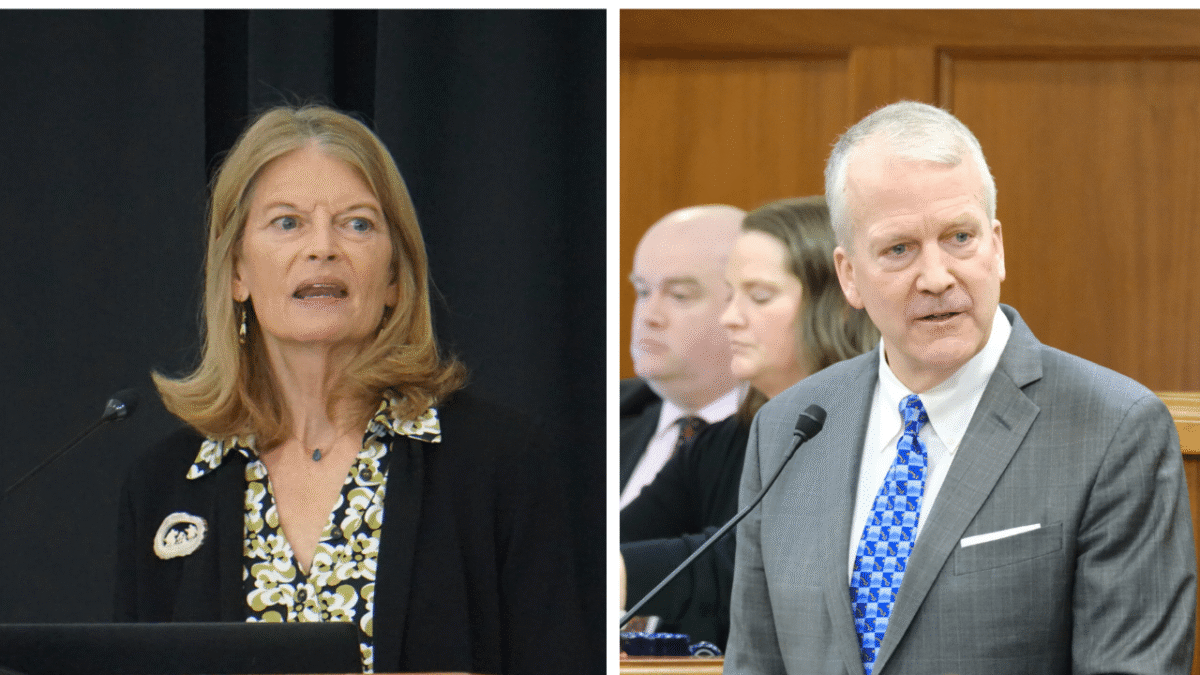
Alaska’s two U.S. senators voted differently on a bill requested by President Donald Trump to block federal funding for foreign aid and public broadcasting.
The cuts include $1.1 billion for public broadcasting over two years, with more than $20 million in funding for Alaska’s 27 public radio and television stations. The measure is known as a rescission package, because it claws back funding that Congress had already approved earlier this year.
The overall bill includes $9 billion in cuts, with most in foreign aid.
The bill passed 51 to 48, with Alaska’s Republican senators voted differently: U.S. Sen. Dan Sullivan voted for the rescission, and U.S. Sen. Lisa Murkowski voted against.
Sullivan spokesperson Amanda Coyne sent a statement by email on Thursday repeating the senator’s position that he had warned public media, NPR and the Corporation for Public Broadcasting for years about their “biased reporting” that “would eventually jeopardize federal support for both national and local radio stations,” she said.
However, Coyne added, Sullivan has advocated for rural stations and has been working with other senators and White House officials on alternative sources of funding to keep rural stations on the air, particularly Native stations in Alaska.
“Currently, there is approximately $10 million available for tribal and Native stations in the country. Alaska has 11 Native stations. Going forward, Senator Sullivan will continue working to provide resources to support as many Alaska rural radio stations as possible. He was discussing this funding issue with a senior administration official this morning,” Coyne said.
Coyne did not respond to questions on how much would be available for Alaska stations, when, or what stations would be eligible.
Murkowski was outspoken and critical of the rescission bill, voting no.
In a statement on Thursday, she first cited a lack of clarity by the Trump administration for what programs and amounts would be rescinded, especially for global health programs. “We still lack necessary details, including which ones will be zeroed out. There is no way to determine the implications for lifesaving care and vital resources for women and children abroad,” she said.
“I also strongly oppose the rescission of funding for the Corporation for Public Broadcasting. My colleagues are targeting NPR but will wind up hurting – and, over time, closing down – local radio stations that provide essential news, alerts, and educational programming in Alaska and across the country,” she said.
Murkowski introduced an amendment on the Senate floor late Wednesday night to protect CPB funding, and it was voted down 51 to 47.
Murkowski told reporters on Thursday afternoon in an audio recording shared with the Alaska Beacon, when asked about the fate of rural stations in Alaska, that her office was also looking into funding for stations from federal tribal grants.
“Some of them, about a dozen, will be able to access these tribal grants,” she told the reporters.
“But that’s less than half of the Alaska stations. So what happens to KUCB going forward?” she said, referring to the public radio station in Unalaska that broadcast a tsunami warning and emergency evacuation order for remote Aleutian Island communities following a magnitude 7.3 earthquake the day before.
“So what we’re trying to do is kind of identify how perilously close are many of these small stations to being in a shut down mode. How much do they have to carry them forward?” she said.
In her statement, Murkowski emphasized her opposition to the rescission process, driven by the White House Office of Management and Budget, as undermining Congress’ authority.
“Finally, and most importantly, approving this package in this manner further shifts the balance of power over the federal budget to the executive branch. Congress, not OMB, holds the power of the purse under the Constitution. To the extent that certain appropriations are not necessary to comply with the laws passed by Congress, we can best address that through the annual budgeting process, where we routinely rescind funds every year.”
The rescission bill now advances back to the U.S. House, which passed an earlier version of the measure. As of Thursday evening it had not been taken up for a vote.