Former Bayern Munich star Jerome Boateng is facing a backlash against a planned coaching internship after he was found guilty of physically abusing a former partner.The Latest News from the UK and Around the World | Sky News











Former Bayern Munich star Jerome Boateng is facing a backlash against a planned coaching internship after he was found guilty of physically abusing a former partner.The Latest News from the UK and Around the World | Sky News

A BBC Gaza documentary breached the broadcasting code, an Ofcom investigation has found.The Latest News from the UK and Around the World | Sky News

A Post Office Capture victim says delays in the justice system have left him fearing he may never live to see his name cleared.The Latest News from the UK and Around the World | Sky News

Three neo-Nazis who plotted terrorist attacks on mosques and synagogues have been jailed for a total of 29 years.The Latest News from the UK and Around the World | Sky News

Stopping Israeli football fans from attending a match in Birmingham has raised fresh concerns about Britain’s ability to protect the Jewish community – two weeks after the deadly terror attack on a Manchester synagogue.The Latest News from the UK and Around the World | Sky News

AP- One of the most significant airlifts in Alaska history was underway Wednesday to move hundreds of people from coastal villages ravaged by high surf and strong winds from the remnants of Typhoon Halong last weekend, officials said.
The storm brought record water levels to two low-lying communities and washed away homes — some with people inside. At least one person was killed and two are missing. Makeshift shelters were quickly established and swelled to about 1,500 people, an extraordinary number in a sparsely populated region where communities are reachable by air or water.
The remoteness and the scale of the destruction created challenges for getting resources in place. Damage assessments have been trickling in as responders have shifted from initial search-and-rescue operations to trying to stabilize or restore basic services.
The communities of Kipnuk and Kwigillingok near the Bering Sea saw water levels more than 6 feet (1.8 meters) above the highest normal tide line. Leaders asked the state to evacuate the more than 1,000 residents in those villages, said Jeremy Zidek, a spokesperson with the state emergency management office.
Some homes cannot be reoccupied, even with emergency repairs, and others may not be livable by winter, said emergency management officials. Forecasters say rain and snow is possible in the region this weekend, with average temperatures soon below freezing.
Mark Roberts, the incident commander with the state emergency management agency, said the immediate focus was on “making sure people are safe, warm and cared for while we work with our partners to restore essential services.”
Meantime, restrooms were again working at the school in Kwigillingok, where about 350 people had sheltered overnight Tuesday, according to a state emergency management statement. “Damage to many homes is severe, and the community leadership is instructing residents not to reenter homes due to safety concerns,” it said.
About 300 evacuees were being brought to Anchorage on Wednesday, about 500 miles (805 kilometers) east of the battered coastline villages, according to the state Department of Military and Veterans Affairs. They were going to the Alaska Airlines Center, a sports and events complex with capacity for about 400, Zidek said.
Shelter space closer to home — in the southwest Alaska regional hub of Bethel — had been reaching capacity, officials said.
Zidek did not know how long the evacuation process would take and said authorities were looking for additional sheltering locations. The aim is to get people from congregate shelters into hotel rooms or dormitories, he said.
The crisis unfolding in southwest Alaska has drawn attention to Trump administration cuts to grants aimed at helping small, mostly Indigenous villages prepare for storms or mitigate disaster risks.
For example, a $20 million U.S. Environmental Protection Agency grant to Kipnuk, which was inundated by floodwaters, was terminated by the Trump administration, a move challenged by environmental groups. The grant was intended to protect to protect the boardwalk residents use to get around the community as well as 1,400 feet (430 meters) of river from erosion, according to a federal website that tracks government spending.
There was limited work on the project before the grant was ended. The village had purchased a bulldozer for shipment and briefly hired a bookkeeper, according to Public Rights Project, which represents Kipnuk.
The group said no single project was likely to prevent the recent flood. But work to remove abandoned fuel tanks and other material to prevent it from falling into the river might have been feasible during the 2025 construction season.
“What’s happening in Kipnuk shows the real cost of pulling back support that was already promised to front line communities,” said Jill Habig, CEO of Public Rights Project. “These grants were designed to help local governments prepare for and adapt to the growing effects of climate change. When that commitment is broken, it puts people’s safety, homes and futures at risk.”
By: Corinne Smith, Alaska Beacon

Residents of Kipnuk and Kwigillingok began evacuating en masse on Wednesday, flying in military aircraft from their western Alaska communities which were devastated by ex-Typhoon Halong.
On Wednesday evening, the first 300 evacuees embarked on a C-17 military transport plane from Bethel to make the one-hour journey to Anchorage and emergency shelter there.
“Just devastated, feeling heartbroken, displaced,” said Jody Agimuk of Kipnuk, standing with his wife Kristin, and their five young children, waiting in line to board in the Alaska Army National Guard hangar.

“I hope we find a place,” he said of arriving in Anchorage. “It’s hard to explain, I hope we won’t have a hard time finding a place.”
He said since the storm hit Sunday, they sheltered at their grandmother’s and one night at the local school, and evacuated on Wednesday. “It’s just hard — leaving families at home, separating with families that we were close to. People we’ve seen, people we knew, people we used to talk to, all the close relatives, it’s heartbreaking seeing people separating.”
The rest of the village of Kipnuk is scheduled to be evacuated on Thursday, and Kwigillingok by Friday, said Lieutenant Colonel Brendan Holbrook, commander of the 207th Aviation Troop Command with the Alaska Army National Guard.
He said roughly 500 people had been evacuated to Bethel so far out of those two villages by members of the Alaska Army National Guard and Alaska Air National Guard. The C-17 plane can only transport 300 people, so the rest would shelter in Bethel overnight and more flights would be available out to Anchorage on Thursday morning.
“I have five aircraft, four UH-60s and CH-47 in support operations, doing evac. And we’ve been running basically 12 to 14-hour operations every day getting these people to safety,” he said.

In the Alaska Army National Guard Readiness Center in Bethel, evacuees waited, some resting on cots, as officers read lists of names and groups of 30 people at a time boarded the plane.
Holbrook said evacuation was self-organized by community members, with families with children and elders prioritized.
“So it was primarily Kipnuk today, if the call comes back, we can do Kwig (Kwigillingok) tomorrow,” he said “But prioritization was just who was available and ready to go. So we would go to both and whoever got on got on. Kipnuk just happened to be, they had already established a marshaling plan, so as soon as we landed, they were ready with people to just start loading.”
Those who did not get on the Wednesday evening flight were sheltering in Bethel, some in an emergency shelter across the road from the Readiness Center hanger, administered by the Yukon-Kuskokwim Health Corporation with the support from the American Red Cross. Cots, showers and meals were provided there.
Holbrook added that there is a misconception that evacuees must go to Anchorage. He said once in Bethel, regional tribal organizations like the Yukon-Kuskokwim Health Corporation are providing support for people to travel wherever they like. “If you have a place to go, another village, family, somewhere else, Y-K will help you get to where you need to go,” he said.
Evacuees board from Kipnuk and Kwigillingok board a C17 military transport plane in Bethel on Oct. 15, 2025 (Photo by Corinne Smith/Alaska Beacon)
Members of the Alaska Army National Guard and Alaska Air National Guard are assisting with the evacuation of residents, seen in Bethel on Oct. 15, 2025 (Photo by Corinne Smith/Alaska Beacon)
Members of the Members of the Alaska Army National Guard read a list of names of evacuees to board the first flight from Bethel to Anchorage on Oct. 15, 2025 (Photo by Corinne Smith/Alaska Beacon)
Jody and Kristin Agimuk and their five young children evacuated from the community of Kipnuk after ex-Typhoon Halong. They landed in Bethel on Wednesday and were on the first large evacuation flight to Anchorage on Oct. 15, 2025 (Photo by Corinne Smith/Alaska Beacon)
Cots set up at the shelter at the Alaska Army National Guard Readiness Center in Bethel for evacuees of ex-Typhoon Halong provided by the American Red Cross on Oct. 15, 2025 (Photo by Corinne Smith/Alaska Beacon)
Evacuees from Kipnuk and Kwigillingok rest and eat dinner on Oct. 15, 2025 at an emergency shelter at the Alaska National Guard Readiness Center in Bethel (Photo by Corinne Smith/Alaska Beacon)
Evacuees wait in line to board the first evacuation flight from Bethel to Anchorage at the Alaska Army National Guard Readiness Center in Bethel, on Oct. 15, 2025 (Photo by Corinne Smith/Alaska Beacon)
A family is seen stepping out on to the runway in Bethel to board the first evacuation flight to Anchorage on Oct. 15, 2025 (Photo by Corinne Smith/Alaska Beacon)
Evacuees from Kipnuk and Kwigillingok were allowed to bring one bag of personal items to evacuate after ex-Typhoon Halong, seen stacked in the Alaska Army National Guard Readiness Center in Bethel, awaiting transport to Anchorage on Oct. 15, 2025 (Photo by Corinne Smith/Alaska Beacon)
Evacuees wait for their name to be called by members of the Alaska National Guard, for a flight from Bethel to Anchorage on Oct. 15, 2025 (Photo by Corinne Smith/Alaska Beacon)
A Blackhawk helicopter used to evacuate residents from storm devastated communities of Kipnuk and Kwigillingok fuels up in Bethel on Oct. 15, 2025 (Photo by Corinne Smith/Alaska Beacon)
Alaska Army National Guard Readiness Center in Bethel hosted an evacuation shelter for ex-Typhoon Halong storm evacuees on Oct. 15, 2025 (Photo by Corinne Smith/Alaska Beacon)
Residents who evacuated from Kipnuk and Kwigillingok wait to board an evacuation flight in Bethel on Oct. 15, 2025 (Photo by Corinne Smith/Alaska Beacon)

Why do some people endorse claims that can easily be disproved? It’s one thing to believe false information, but another to actively stick with something that’s obviously wrong.
Our new research, published in the Journal of Social Psychology, suggests that some people consider it a “win” to lean in to known falsehoods.
We are social psychologists who study political psychology and how people reason about reality. During the pandemic, we surveyed 5,535 people across eight countries to investigate why people believed COVID-19 misinformation, like false claims that 5G networks cause the virus.
The strongest predictor of whether someone believed in COVID-19-related misinformation and risks related to the vaccine was whether they viewed COVID-19 prevention efforts in terms of symbolic strength and weakness. In other words, this group focused on whether an action would make them appear to fend off or “give in” to untoward influence.
This factor outweighed how people felt about COVID-19 in general, their thinking style and even their political beliefs.
Our survey measured it on a scale of how much people agreed with sentences including “Following coronavirus prevention guidelines means you have backed down” and “Continuous coronavirus coverage in the media is a sign we are losing.” Our interpretation is that people who responded positively to these statements would feel they “win” by endorsing misinformation – doing so can show “the enemy” that it will not gain any ground over people’s views.
Rather than consider issues in light of actual facts, we suggest people with this mindset prioritize being independent from outside influence. It means you can justify espousing pretty much anything – the easier a statement is to disprove, the more of a power move it is to say it, as it symbolizes how far you’re willing to go.
When people think symbolically this way, the literal issue – here, fighting COVID-19 – is secondary to a psychological war over people’s minds. In the minds of those who think they’re engaged in them, psychological wars are waged over opinions and attitudes, and are won via control of belief and messaging. The U.S. government at various times has used the concept of psychological war to try to limit the influence of foreign powers, pushing people to think that literal battles are less important than psychological independence.
By that same token, vaccination, masking or other COVID-19 prevention efforts could be seen as a symbolic risk that could “weaken” one psychologically even if they provide literal physical benefits. If this seems like an extreme stance, it is – the majority of participants in our studies did not hold this mindset. But those who did were especially likely to also believe in misinformation.
In an additional study we ran that focused on attitudes around cryptocurrency, we measured whether people saw crypto investment in terms of signaling independence from traditional finance. These participants, who, like those in our COVID-19 study, prioritized a symbolic show of strength, were more likely to believe in other kinds of misinformation and conspiracies, too, such as that the government is concealing evidence of alien contact.
In all of our studies, this mindset was also strongly associated with authoritarian attitudes, including beliefs that some groups should dominate others and support for autocratic government. These links help explain why strongman leaders often use misinformation symbolically to impress and control a population.

Our findings highlight the limits of countering misinformation directly, because for some people, literal truth is not the point.
For example, President Donald Trump incorrectly claimed in August 2025 that crime in Washington D.C. was at an all-time high, generating countless fact-checks of his premise and think pieces about his dissociation from reality.
But we believe that to someone with a symbolic mindset, debunkers merely demonstrate that they’re the ones reacting, and are therefore weak. The correct information is easily available, but is irrelevant to someone who prioritizes a symbolic show of strength. What matters is signaling one isn’t listening and won’t be swayed.
In fact, for symbolic thinkers, nearly any statement should be justifiable. The more outlandish or easily disproved something is, the more powerful one might seem when standing by it. Being an edgelord – a contrarian online provocateur – or outright lying can, in their own odd way, appear “authentic.”
Some people may also view their favorite dissembler’s claims as provocative trolling, but, given the link between this mindset and authoritarianism, they want those far-fetched claims acted on anyway. The deployment of National Guard troops to Washington, for example, can be the desired end goal, even if the offered justification is a transparent farce.
It is possible that symbolic, but not exactly true, beliefs have some downstream benefit, such as serving as negotiation tactics, loyalty tests, or a fake-it-till-you-make-it long game that somehow, eventually, becomes a reality. Political theorist Murray Edelman, known for his work on political symbolism, noted that politicians often prefer scoring symbolic points over delivering results – it’s easier. Leaders can offer symbolism when they have little tangible to provide.

The authors do not work for, consult, own shares in or receive funding from any company or organization that would benefit from this article, and have disclosed no relevant affiliations beyond their academic appointment.
Politics + Society – The Conversation

For decades, federal shutdowns have mostly been budget fights. The 2025 one has become bigger than that: It’s turned into a messaging war.
Official government communications, including website banners, out-of-office email replies and autogenerated responses that denounce “Senate Democrats,” “the Radical Left” or “Democrats’ $1.5 trillion wishlist” for closing the government, mark a sharp break from past practice.
These messages are more than rhetorical escalation. Many may violate the Hatch Act, the 1939 statute that limits partisan political activity by federal employees and agencies. They also represent new tests for how far a White House can push the bounds of campaign-style messaging while also claiming to govern.
In any democracy, power lies not only in who writes the laws or signs the budgets but in who shapes the story. Communication is not an afterthought or byproduct of governance. It is one of its essential instruments. Political narrative helps citizens understand who’s responsible, who’s acting in good faith and who’s to blame.
The 2025 shutdown has turned that truth into strategy. Federal communication systems – agency websites, automated emails and public information portals – are being used to persuade rather than inform. It’s a move that is both politically risky and legally perilous.
The Hatch Act was passed during the Great Depression, after years of concern that federal agencies were being used improperly as political machines. Its goal was simple: to ensure that public servants worked for the American people, not for the party in power.
At its core, the Hatch Act prohibits executive branch federal employees – except for the president and vice president – from engaging in partisan political activity as part of their official duties or under their official authority. Government workers may not use their positions or public resources to influence elections, coerce individual behavior or engage in political advocacy.
The law requires federal agencies to avoid the partisan fray and focus on serving the public rather than political agendas.
The Office of Special Counsel, which enforces the law, has been clear on this point. “The purpose of the Act,” says an Office of Special Counsel guide written for federal employees, “is to maintain a federal workforce that is free from partisan political influence or coersion.” Government communication can inform, but it cannot campaign.

Yet the shutdown has already produced multiple potential violations:
• The Department of Education, according to a lawsuit, altered employees’ email auto-responses – without consent – to say things like “the Democrats have shut the government down.” Such changes do more than convey impartial information. They compel employees to align themselves with institutionally imposed scripts.
• Likewise, agencies including Health and Human Services and the Small Business Administration reportedly distributed or directed staff to adopt partisan out-of-office auto-replies assigning blame to Democrats.
• The Department of Housing and Urban Development posted a banner on its official website stating that the “Radical Left are going to shut down the government.”
Taken individually, each incident might provoke a Hatch Act complaint. Collectively, they amount to a systematic campaign to transform nonpartisan federal agencies into partisan political messengers.

What sets the 2025 messaging apart isn’t just its volume – it’s the scale, the coordination and the brazenness of its political targeting.
In past shutdowns, partisan spin lived mostly in press conferences and campaign talking points. Agencies themselves, even under pressure, stayed neutral.
This time, the administration is using the machinery of government to deliver partisan blame.
The timing and similarity of messages across departments seems coordinated. Housing and Urban Development posted a banner blaming Democrats the day before the shutdown began. Within hours, other agencies followed using nearly identical language.
More troubling are the reported changes to federal employees’ auto-replies without their consent.
These missives forced career civil servants, many of them furloughed, to become unwilling messengers for partisan ends. Federal agencies and their workers are supposed to serve everyone, not only those who support the party in power.
And because the watchdogs who could enforce the legal boundary are also sidelined – the Office of Special Counsel is furloughed – complaints have nowhere to go, at least for now. They simply land in unattended email inboxes.
Whether shutdown communications truly violate the Hatch Act – or related laws – is not yet clear. The administration could argue that it’s not campaigning but merely explaining why services are suspended. As a scholar of political communication and American democracy, I believe that defense weakens when official messages explicitly assign partisan blame or name a political party.
And not every political statement is a Hatch Act violation. The law allows employees to express views off duty or in private contexts, so long as they use their own phones and computers.
Even if the Office of Special Counsel later finds violations, harm will likely persist. Once messages are posted or auto-replies sent, their effects can’t always be undone. And because ethics officials are furloughed, too, accountability will be delayed, if it comes at all.
Some employees are likely to claim their speech rights were violated by being forced to send partisan messages. This is an argument already at the heart of the lawsuit filed by the American Federation of Government Employees against the Education Department.
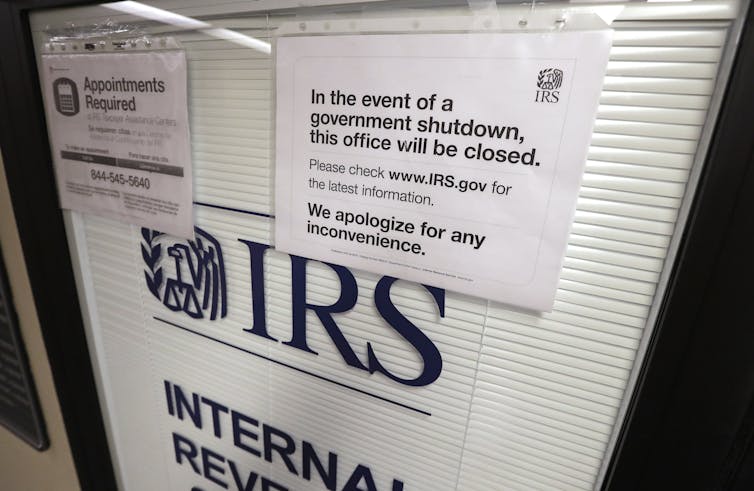
Federal agencies exist to administer laws impartially and to do so on behalf of the people.
When the government uses its own infrastructure for partisan messaging, the very neutrality on which democratic governance depends erodes. It dilutes public trust in the idea of a neutral state.
The damage also extends into the future. If the current administration succeeds in turning its administrative machinery into a political weapon, without consequence, a precedent will be created. Future presidents may be tempted to follow suit, making acceptable the use of taxpayer-funded systems as campaign tools.
And because enforcement bodies such as the Office of Special Counsel also are sidelined during a shutdown, accountability has to wait. That creates an asymmetry of power: One side gets to amplify its message through government channels in real time, while its opponents must wait for the system to restart just to file a complaint. By the time they can, the moment will have passed and the political narrative is likely to have already hardened.
Crises demand explanation, even blame. Citizens expect their leaders to tell them what went wrong. But they also expect honesty and fairness in how that story is told. The administration’s messaging strategy during this shutdown tests whether government communication remains a public service or becomes another instrument of political power.

Stephanie A. (Sam) Martin does not work for, consult, own shares in or receive funding from any company or organization that would benefit from this article, and has disclosed no relevant affiliations beyond their academic appointment.
Politics + Society – The Conversation

Reading Time: 3 minutes
Are Amy Robach and T.J. Holmes really planning to have a child together?
Just a couple of years ago, they went from reading headlines to making them after their alleged workplace affair became public knowledge.
Since then, they lost their jobs at ABC. Their exes are now dating each other.
The sensational couple are now engaged. And they themselves are sharing their baby plans with the world.
In January 2023, Good Morning America ousted co-hosts Amy Robach and T.J. Holmes.
While their alleged adultery is a person wrong involving only the two and their spouses, a workplace affair adds numerous complications.
Alongside the end of their careers, Robach’s marriage to Andrew Shue came to an end
So, too, ended Holmes’ marriage to Marilee Fiebig.
Just recently, Robach and Holmes announced their engagement. And that was not the end of their October surprises.

Though they use their Amy & T.J. podcast to do actual journalism, the couple also open up about their personal lives.
“I don’t know what’s going on, but we have talked more lately about having kids,” Holmes admitted.
“We have talked more lately about the idea of even adopting a child,” he added.
“And,” Holmes pointed out to Robach, “usually it’s me bringing it up to you.”
Robach chimed in, noting that doctors told her that she was “out of the baby-making business” in 2013, after her breast cancer diagnosis. She has been in remission for 11 years, and knows that conceiving on her own is not the only way to grow their family.

According to a report from RadarOnline, Amy Robach and T.J. Holmes are serious about having a kid together.
But is it for the right reasons?
“They do want a child together,” the alleged inside source confirmed.
“The most logical way would be to adopt,” the insider noted. “Although they’re exploring surrogacy, too.”
The source then claimed: “But make no mistake, everything they do is orchestrated to revamp their image.”

“She would love to have a little girl because she enjoys being a mother figure to T.J.’s daughter Sabine,” the insider then added.
Notably, Robach is already the mother of 20-year-old Ava and 19-year-old Annalise, both with ex-husband Tim McIntosh.
She has also publicly gushed about Sabine, who is 12.
It’s not that she doesn’t adore her own daughters.
But Robach has explained that she has enjoyed having Sabine in her life. That makes sense!

Still, the alleged inside source says: “It burns them that so many people see them as fame-hungry love rats who broke up two marriages.”
The insider explained: “As far as they’re concerned, their marriages were already over.” Many people say things like this.
“Now they swear their intention to expand the family is honorable,” the source admitted.
“But people know T.J. and Amy think a baby would not only improve their image,” the insider claimed, “but be great publicity as well.”
There is no proof whatsoever that Robach and Holmes are discussing having an actual child as a PR move. But it’s definitely an interesting narrative.
Amy Robach & T.J. Holmes: Baby Plans Revealed! was originally published on The Hollywood Gossip.
The Hollywood Gossip


