Categories
Alaska News Featured Juneau News juneau Juneau Local Juneau Local Ketchikan Local News Feeds Sitka Local

Oil markets are second most uncertain on record, economist tells Alaska legislators

By: James Brooks, Alaska Beacon
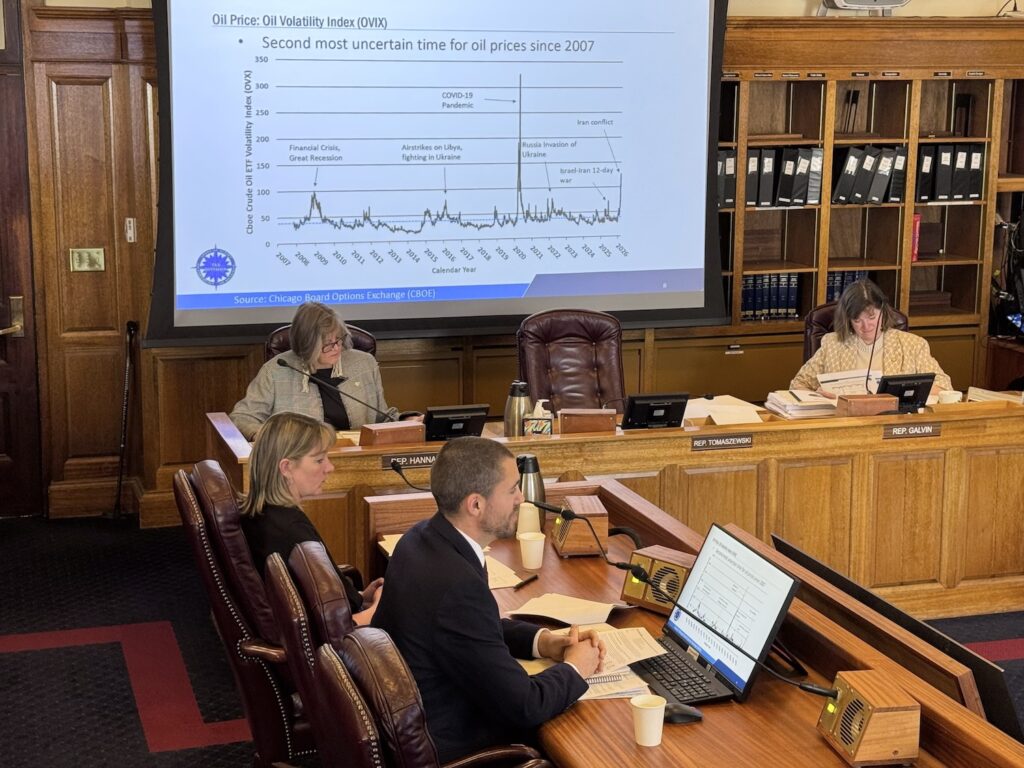
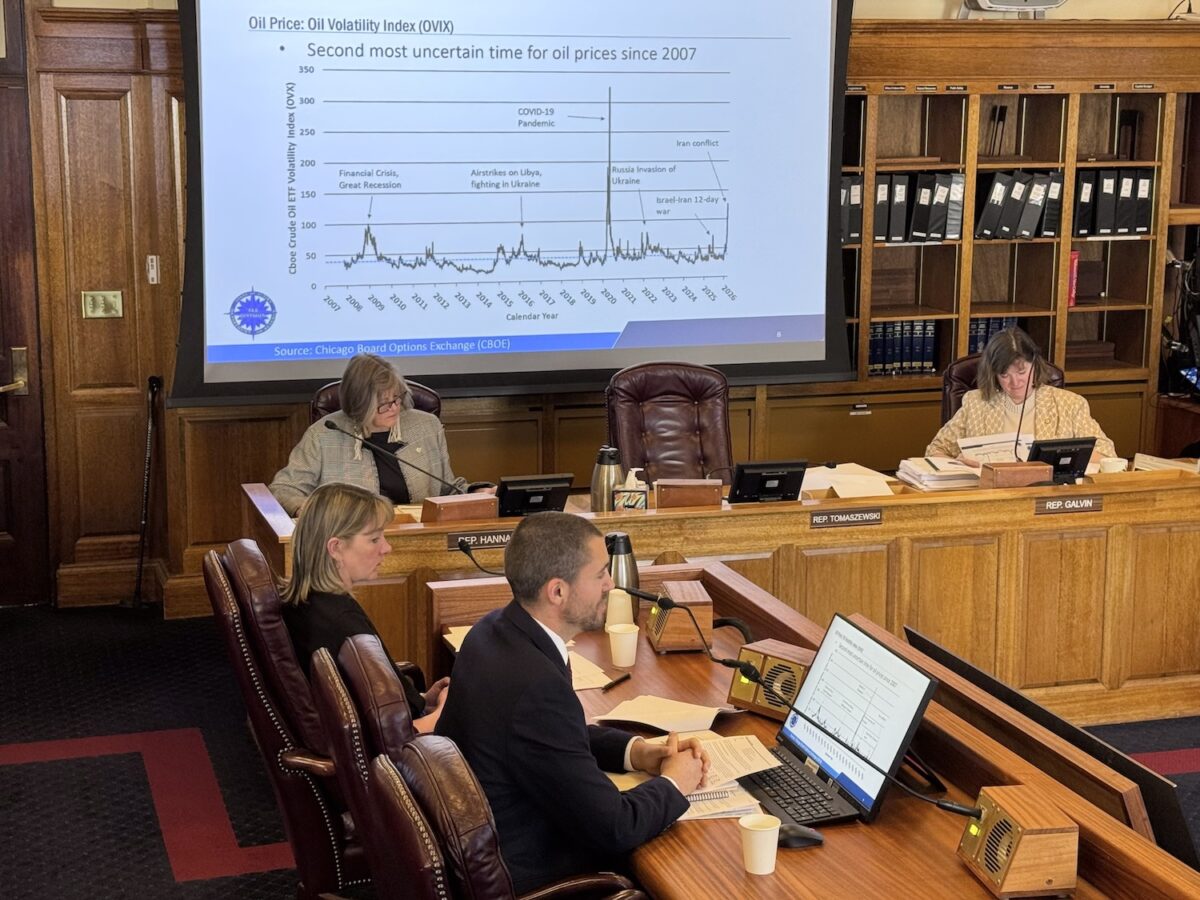
Economist Dan Stickel talks to the Alaska House Finance Committee on Monday, March 16, 2026. (James Brooks photo/Alaska Beacon)

The U.S.-Israeli war against Iran has left oil markets more uncertain than they were during the Great Recession, a state expert told the Alaska Legislature on Monday.

In a pair of hearings, Alaska Department of Revenue economist Dan Stickel told state legislators that the volatility of global oil markets is the second-highest on record, leaving future forecasts particularly unreliable.

“The level of uncertainty around future prices in the oil markets now is higher than during the peaks of the Great Recession in 2008-2009 and it’s higher than the Russian invasion of Ukraine, and it’s higher than any of the COVID spikes other than the initial April 2020 spike,” he said during a Monday morning hearing of the Senate Finance Committee.

“The message here is to plan for the possibility that revenue doesn’t come in exactly at what we forecast for the next couple of years,” Stickel said. 

Oil is the second-largest source of general-purpose revenue for the Alaska state budget, and Stickel’s testimony came days after the department released a new Alaska revenue forecast showing $545 million more in current-year revenue than projected in the fall. Most of that higher prediction is due to the price of oil.

That forecast has snarled relations in the Alaska House of Representatives, which has repeatedly postponed discussion of a bill that would fund a variety of amendments to the fiscal year 2026 budget passed by lawmakers and Gov. Mike Dunleavy last spring. 

On Monday, after more than two hours of acrimonious debate, House legislators again declined to take up the bill.

Soon after the House adjourned its floor session, Stickel testified in front of the House Finance Committee, and told lawmakers that “the level of certainty that we will hit our exact forecast is low.”

As he spoke, on the other end of the Capitol’s fifth floor, the Senate Finance Committee was simultaneously hearing from Office of Management and Budget director Lacey Sanders, who said the governor’s office was requesting another $18 million in spending for the current fiscal year.

Altogether, the governor has requested almost $427 million in additions to the budget. Add in additional spending proposed by lawmakers, and there’s only about a $30 million difference between the new revenue forecast and the additions proposed by the governor and legislators.

At the latest forecast prices, said Rep. Calvin Schrage, I-Anchorage, a $2 change in the average price of a barrel of North Slope oil is worth $30 million.

He asked Stickel what the odds were that the forecast misses low by more than $2.

“Roughly a slightly less than 50% chance that we come in more than $2 below the forecast,” Stickel said, then alluded to the fact that there’s a similar chance of coming in above the forecast.

“The level of certainty that we will hit our exact forecast is low in either direction,” he said.

Currently, members of the House majority are advocating that legislators unlock the state’s principal savings account to provide surety for some of those budget additions.

Doing so would avoid problems if oil prices turn out to be lower than forecast.

But spending from the Constitutional Budget Reserve, the state’s principal savings account, requires 30 votes in the House and 15 votes in the Senate. 

The House’s multipartisan coalition majority has 21 members, which means they need support from the all-Republican House minority caucus.

Members of that group have been arguing against unlocking the budget reserve right now, saying that the new forecast and the current balance of the state’s general-purpose accounts demonstrate it isn’t needed.

In addition, as currently written, the supplemental budget bill in the House would allow spending from savings regardless of the price of oil. That could allow the majority to dictate extra spending even if prices stay high. 

The Senate has already approved spending from the Constitutional Budget Reserve, and on Monday morning, Sen. Bert Stedman, R-Sitka and co-chair of the Senate Finance Committee, said a draw from the reserve would act as a “safety net.” 

Sen. Lyman Hoffman, D-Bethel, said senators don’t intend to spend dollars from savings unless it is needed. 

“If they are not needed, they will stay in the CBR,” he said, adding that without permission to spend from savings, there’s a chance that lawmakers would need to return in August to fix budget problems in a special session.

Categories
Sports Fox

4 Takeaways from Broncos’ Trade for WR Jaylen Waddle from Dolphins

The blockbuster deal the NFL world has been waiting for is the Philadelphia Eagles inevitably moving mercurial receiver A.J. Brown. But instead, the Denver Broncos got ahead of that market, acquiring productive receiver Jaylen Waddle from the rebuilding Miami Dolphins on Tuesday. According to multiple reports, the Broncos gave up the team’s first-round selection in this year’s draft, No. 30 overall, along with third- and fourth-round picks in exchange for Waddle and a fourth-round selection. So, what does that mean for the Broncos, who finished a game away from the Super Bowl last season? And what is happening in the receiver market, given that salaries are rapidly rising at this premium position? Here are my four takeaways from Denver’s big move. 1. Broncos HC Sean Payton secures a No. 1 WR for QB Bo Nix Courtland Sutton, Denver’s top receiver last season, is a big, physical target who can make contested catches on third down and near the red zone. Sutton is Nix’s security blanket. And Marvin Mims Jr.  does a nice job of stretching the field for the Broncos. But the addition of Waddle gives the Broncos a pass-catcher with No. 1 receiver traits. He can consistently win against man coverage and can score from anywhere on the field. Waddle had 1,000-yard seasons his first three years in the league and averaged 14.2 yards per reception in a bad offense for the Dolphins last season. Acquiring the 27-year-old Waddle allows the Broncos to take advantage of third-year quarterback Nix still playing on his rookie contract. And Waddle also reunites with former Alabama teammate and Denver lockdown cornerback Pat Surtain II. 2. Waddle escapes the dysfunction in South Beach Waddle was set to play for his third head coach, Jeff Hafley, and a new quarterback in Malik Willis. The Dolphins are in the middle of an organizational restructuring, with former Green Bay Packers personnel executive Jon-Eric Sullivan taking over as Miami’s general manager. Talk around the league has centered on the dysfunction that existed during the coaching tenures of Brian Flores and Mike McDaniel, with no clear plan or alignment between the front office and the on-field product. Owner Stephen Ross is focused on creating that clarity this offseason. The Dolphins are now one of five teams with two first-round selections — and six picks in the top 94 selections. Miami is in full rebuilding mode. With Tyreek Hill and Waddle gone, free-agent addition Tutu Atwell is the most dynamic receiver currently on Miami’s roster. Meanwhile, in Denver, there is clear alignment between Payton and GM George Paton, and Waddle will take the field for a team ready to make another deep playoff run. 3. Denver’s trade for Waddle highlights shift in WR market The franchise tag for receivers of $27.3 million is the second-most in the NFL, behind only quarterbacks at $43.4 million. Alec Pierce, who finished with just 47 catches a year ago, recently re-signed with the Indianapolis Colts for $29 million a year. Waddle is set to make $41.2 million in total compensation over the next two seasons. That’s a good deal for the Broncos, considering skyrocketing salaries for receivers and how much it costs to secure them on the open market. The Eagles have been unwilling so far to part ways with Brown, but he’s sure to fetch more than what the Broncos gave up for Waddle, based on his past production. And the price is only going to get higher to secure top-notch receivers in the future, with young stars such as Jaxon Smith-Njigba and Puka Nacua eligible to sign new lucrative deals. Five years ago, the franchise tag for receivers was $18.4 million. 4. Broncos are clearly in win-now mode With Nix out with a leg injury, Denver lost the AFC Championship Game to the Patriots 10-7 with backup Jarrett Stidham under center. Chiefs QB Patrick Mahomes is working his way back from an ACL injury. The Chargers can’t seem to protect Justin Herbert and squandered another postseason opportunity last season. Star QBs Joe Burrow (Bengals), Lamar Jackson (Ravens) and Mahomes all missed the playoffs in 2025, while Buffalo’s Josh Allen has a new head coach in Joe Brady. Denver is built to compete with New England for AFC supremacy. Grabbing Waddle shows that Payton and the Broncos believe they can make a strong run at the Lombardi Trophy this season.​Latest Sports News from FOX Sports

Categories
Alaska News

Oil markets are second most uncertain on record, economist tells Alaska legislators

Economist Dan Stickel talks to the Alaska House Finance Committee on Monday, March 16, 2026. (James Brooks photo/Alaska Beacon)

The U.S.-Israeli war against Iran has left oil markets more uncertain than they were during the Great Recession, a state expert told the Alaska Legislature on Monday.

In a pair of hearings, Alaska Department of Revenue economist Dan Stickel told state legislators that the volatility of global oil markets is the second-highest on record, leaving future forecasts particularly unreliable.

“The level of uncertainty around future prices in the oil markets now is higher than during the peaks of the Great Recession in 2008-2009 and it’s higher than the Russian invasion of Ukraine, and it’s higher than any of the COVID spikes other than the initial April 2020 spike,” he said during a Monday morning hearing of the Senate Finance Committee.

“The message here is to plan for the possibility that revenue doesn’t come in exactly at what we forecast for the next couple of years,” Stickel said. 

Oil is the second-largest source of general-purpose revenue for the Alaska state budget, and Stickel’s testimony came days after the department released a new Alaska revenue forecast showing $545 million more in current-year revenue than projected in the fall. Most of that higher prediction is due to the price of oil.

That forecast has snarled relations in the Alaska House of Representatives, which has repeatedly postponed discussion of a bill that would fund a variety of amendments to the fiscal year 2026 budget passed by lawmakers and Gov. Mike Dunleavy last spring. 

On Monday, after more than two hours of acrimonious debate, House legislators again declined to take up the bill.

Soon after the House adjourned its floor session, Stickel testified in front of the House Finance Committee, and told lawmakers that “the level of certainty that we will hit our exact forecast is low.”

As he spoke, on the other end of the Capitol’s fifth floor, the Senate Finance Committee was simultaneously hearing from Office of Management and Budget director Lacey Sanders, who said the governor’s office was requesting another $18 million in spending for the current fiscal year.

Altogether, the governor has requested almost $427 million in additions to the budget. Add in additional spending proposed by lawmakers, and there’s only about a $30 million difference between the new revenue forecast and the additions proposed by the governor and legislators.

At the latest forecast prices, said Rep. Calvin Schrage, I-Anchorage, a $2 change in the average price of a barrel of North Slope oil is worth $30 million.

He asked Stickel what the odds were that the forecast misses low by more than $2.

“Roughly a slightly less than 50% chance that we come in more than $2 below the forecast,” Stickel said, then alluded to the fact that there’s a similar chance of coming in above the forecast.

“The level of certainty that we will hit our exact forecast is low in either direction,” he said.

Currently, members of the House majority are advocating that legislators unlock the state’s principal savings account to provide surety for some of those budget additions.

Doing so would avoid problems if oil prices turn out to be lower than forecast.

But spending from the Constitutional Budget Reserve, the state’s principal savings account, requires 30 votes in the House and 15 votes in the Senate. 

The House’s multipartisan coalition majority has 21 members, which means they need support from the all-Republican House minority caucus.

Members of that group have been arguing against unlocking the budget reserve right now, saying that the new forecast and the current balance of the state’s general-purpose accounts demonstrate it isn’t needed.

In addition, as currently written, the supplemental budget bill in the House would allow spending from savings regardless of the price of oil. That could allow the majority to dictate extra spending even if prices stay high. 

The Senate has already approved spending from the Constitutional Budget Reserve, and on Monday morning, Sen. Bert Stedman, R-Sitka and co-chair of the Senate Finance Committee, said a draw from the reserve would act as a “safety net.” 

Sen. Lyman Hoffman, D-Bethel, said senators don’t intend to spend dollars from savings unless it is needed. 

“If they are not needed, they will stay in the CBR,” he said, adding that without permission to spend from savings, there’s a chance that lawmakers would need to return in August to fix budget problems in a special session.

SUPPORT: YOU MAKE OUR WORK POSSIBLE

Categories
Food

The McDonald’s Restaurant Where You Can Eat Inside A Real Airplane

One unique McDonald’s location takes dining to new heights, featuring a retired aircraft where guests can enjoy their meals inside the actual plane.

​Food Republic – Restaurants, Reviews, Recipes, Cooking Tips

Categories
Entertainment

Why Doesn’t McDonald’s Center The Cheese On Its Filet-O-Fish?

The half-slice of cheese on McDonald’s Filet-O-Fish may induce eye rolls from customers, especially when it’s crookedly placed on the bun. This might be why.

​Mashed – Fast Food, Celebrity Chefs, Grocery, Reviews

Categories
Alaska News

Support for education funding bill comes as Alaska districts grapple with ongoing deficits

Emily Brubaker, age 15 and a 9th grader at West Anchorage High School and a member of Alaska Youth for Environmental Action testified in support of a bill to increase per student funding, the base student allocation, before members of the House Education Committee on Mar. 12, 2026. (Photo by Corinne Smith/Alaska Beacon)

Emily Brubaker, age 15 and a 9th grader at West Anchorage High School and a member of Alaska Youth for Environmental Action testified in support of a bill to increase per student funding, the base student allocation, before members of the House Education Committee on Mar. 12, 2026. (Photo by Corinne Smith/Alaska Beacon)

Lawmakers are considering new legislation to increase state funding for Alaska schools, and heard public comment on Wednesday evening that showed overwhelming support for more funding for public education. 

The legislation comes on the heels of a historic increase to per pupil student funding last year — after political debate between lawmakers and Gov. Mike Dunleavy resulted in three governor’s vetoes and two override votes by the Legislature.

House Bill 374 would increase per student funding, known as the base student allocation, by $630 per student. The bill would take per student funding from $6,660 to $7,290 — totalling $158.6 million additional dollars for schools next year.

Sponsors of the legislation said they calculated that increase by assessing the current budget deficits of the state’s five largest school districts by student population — Anchorage, Matanuska-Susitna Borough, Kenai Peninsula Borough, Fairbanks North Star Borough and Juneau School Districts are all facing millions in budget shortfalls, and looking at cutting teachers and programs, increasing class sizes and potentially closing schools.

Members of the House Education Committee hear public testimony on HB 347, a bill to increase per student funding, on Mar 11, 2026. (Photo by Corinne Smith/Alaska Beacon)

Dozens of Alaska students, parents, grandparents, teachers, nurses and superintendents from across the state called in and spoke in-person at the Capitol to the House Education Committee for two hours on Mar. 11, urging support for the legislation. There were no testifiers against the bill. 

Sixteen-year-old Claire Tallis testified in person on behalf of her hometown school in Tok, and as a current student at the state-run boarding school, Mt. Edgecumbe High School.

“My personal experience with the education system has been challenging. When I was attending Tok school, it was blatantly apparent that I would not gain the level of education I wanted. There were constant funding issues, inconsistent hiring of teachers and lowered expectations based on the background of students. This forced me to choose between the best of two bad options,” she said. 

Tallis said she ultimately chose to move 680 miles away from family to Sitka to attend Mt. Edgecumbe, which is also experiencing funding and management issues. She said the BSA needs to keep up with inflation.

“When the BSA stays frozen while the cost keeps rising, it feels like my generation is being asked to carry the burden. It feels like our future is being cut at the knees before we even had the chance to stand. Mt. Edgecumbe is my home away from home, and my last option for a fruitful education,” she said. “Please consider this when you make the decision whether or not to fund Alaskan futures.” 

Emily Brubaker, a ninth grader at West High School in Anchorage, testified that her district is facing a $90 million budget shortfall, which could mean deeper cuts to student programs and opportunities. 

“Countless extracurriculars in ASD, like sports and clubs, are getting completely cut, opportunities that the youth of today will never get to experience. On top of this, educational classes like art and music are being eliminated, as well as the educators who teach them,” Brubaker said. “School districts are doing all of this cutting. They are trying their best, and it isn’t enough.” 

Several students and parents spoke about how budget cuts and school closures result in unmanageable class sizes. 

“Right now, my school will lose four teachers,” said Audrey Brower, a fourth grader at W. L. Bowman Elementary School in Anchorage. “Which means classrooms will start at 40 to 45 students per class with combos of two to three grade levels. It’s not okay for me and my friends. We can’t even fit that many kids in one classroom.” 

Several testifiers expressed frustration — some to the point of tears — that school funding is up for debate in the Legislature each year, rather than considered a state mandate.

Nancy Bale, a school nurse in the Anchorage School District, testifies in support of a school funding increase and HB 374. She says the district is proposing cutting nurses next year, to address a budget shortfall, which will negatively impact students. (Photo by Corinne Smith/Alaska Beacon)

Fairbanks resident Sarah Lewis said she’s frustrated at watching agencies like the Alaska Department of Corrections overspend by millions, while the level of school funding is debated each year. 

“Schools are community hubs. They are evacuation points. They are a place where many kids can depend on breakfast and lunch, and they’re even hostels, whether for a single visitor in remote areas, or for several dozen students from everywhere in the state,” she said. 

“Our schools and the people who fill them are doing remarkable, important work that keeps Alaskan kids secure, sheltered, fed and informed. They’re the front lines in the system that keeps our kids safe,” she said. “But somehow we support them so poorly that buildings are literally crumbling around them and resources are few and far between.”

Superintendents called in from around the state to share their support for increased funding. They described continually having to make difficult cuts to staff and programs to offset increasing operational costs. 

Cyndy Mika, superintendent of the Kodiak Borough School District, said her district is considering how to make at least $1 million in budget reductions ahead of next year —  including potential cuts to counseling, nursing, special education and gifted support, instructional coaching and classroom aides.

“Last year, we closed an elementary school, and if our fiscal outlook does not improve, our community is already preparing for the possibility of closing another school in the 2027-2028 school year,” she said. “Stable and adequate funding through the BSA is essential.”

Lily Boron is superintendent of the Haines Borough School District, which serves an elementary, middle and high school, plus a homeschool program. She said the district could not afford a new bus contract this year, continues to struggle with hiring teachers and had to cut its library program. She said she worries about the district’s future solvency. 

“We’ve cut, we’ve consolidated, we’ve deferred maintenance, and at this point, there simply is no more breathing room without a BSA increase. Without adequate funding for student transportation, major maintenance and mandated programs like the Alaska Reads Act, our school will not be able to remain solvent,” she sai. 

Lon Garrison, executive director of the Association of Alaska School Boards, was one of several school officials who pointed out that last year’s increase was only $20 per student more than the one-time funding schools got the year prior. He said last year’s BSA increase did not fill the inflation gap, where the cost of goods and services is rising faster than state funding. 

Garrison said state investment in students is well worth it.

“Ultimately, those student opportunities translate directly into community opportunity and strong schools help communities, large and small, attract families, develop workforces and sustain healthy economies,” he said. 

The House Education Committee is now considering the bill. Members of the House majority caucus have discussed spending more on schools since the Alaska Department of Revenue is forecasting that the Iran war will prompt a surge in oil prices and state revenues, but that will be up for debate in the Legislature in the coming weeks and months.

SUBSCRIBE: GET THE MORNING HEADLINES DELIVERED TO YOUR INBOX

Categories
Music

Costco Pulls Ready-to-Eat Meals Over Possible Salmonella Risk

A recent recall at Costco has everyone checking their freezers. Those meatloaf meals might be more trouble than they’re worth right now. Let’s break it down. Continue reading…​The Boot – Country Music News, Music Videos and Songs

Categories
Entertainment

Rex Culpepper Cause of Death: Syracuse QB, Son of ‘Survivor’ Stars Was 28

Reading Time: 3 minutes

We have tragic news to report from the world of sports today.

Rex Culpepper — the former Syracuse University quarterback whose parents competed on the reality show Survivor — has passed away.

He was just 28 years old.

Rex Culpepper #17 of the Syracuse Orange warms up before the game against the Holy Cross Crusaders at the Carrier Dome on September 28, 2019 in Syracuse, New York.
Rex Culpepper #17 of the Syracuse Orange warms up before the game against the Holy Cross Crusaders at the Carrier Dome on September 28, 2019 in Syracuse, New York. (Photo by Brett Carlsen/Getty Images)

Culpepper proposed to girlfriend just weeks before death

News of Culpepper’s death comes courtesy of an announcement from the Syracuse football program.

“Rex lived his life with endless passion, having overcome cancer at the age of 20 while playing for the Orange. Appearing in 30 games, Rex played football as fierce as he lived life,” the team said in a statement (per People).

“Our hearts are with the Culpepper family & all those who loved him.”

Culpepper passed away just weeks after he proposed to longtime girlfriend Savanna Morgan.

“No one expects to meet the love of your life and lose them in only 6 short years after meeting,” Morgan wrote on Instagram this week.

Rex Culpepper #15 of the Syracuse Orange moves in the pocket during the second half against the Central Connecticut State Blue Devils on September 1, 2017 at The Carrier Dome in Syracuse, New York.
Rex Culpepper #15 of the Syracuse Orange moves in the pocket during the second half against the Central Connecticut State Blue Devils on September 1, 2017 at The Carrier Dome in Syracuse, New York. (Photo by Brett Carlsen/Getty Images)

“Rex didnt always believe in soulmates but towards the end he told me that he didnt realize what having a soulmate felt like until we felt like extensions of each other,” she continued, adding:

“And one thing about us is that we lived every single day like it was our last.

“We did every little thing that we set our minds to, between learning new skills and hobbies, and traveling to new places, there was never any free time with us and not a moment spent apart. I dont regret a single day in our 6 years.”

Rex Culpepper’s loved ones confirm surprising cause of death

Culpepper battled testicular cancer in 2018, and heshocked his treatment team by still starting under center for SU the following season.

The feat earned him the school’s Jim DaRin Courage Award.

Rex Culpepper #15 of the Syracuse Orange passes the ball during the first quarter against the Boston College Eagles at the Carrier Dome on November 25, 2017 in Syracuse, New York.
Rex Culpepper #15 of the Syracuse Orange passes the ball during the first quarter against the Boston College Eagles at the Carrier Dome on November 25, 2017 in Syracuse, New York. (Photo by Brett Carlsen/Getty Images)

Rex’s death, however, had nothing to do with his previous health issues.

Culpepper’s family has confirmed that he was killed in a dirt bike accident in Florida.

The Culpeppers are well known in the world of football, as Rex’s dad, Brad, was a defensive tackle who played in the NFL for the Minnesota Vikings, Tampa Bay Buccaneers, and Chicago Bears.

He later appeared on Survivor: Blood vs Water and Survivor: Game Changers.

Rex’s mother, Monica Culpepper, also competed on Survivor: Blood vs. Water, and she later appeard on Survivor: One World.

Our thoughts go out to Rex Culpepper’s loved ones during this incredibly difficult time.

Rex Culpepper Cause of Death: Syracuse QB, Son of ‘Survivor’ Stars Was 28 was originally published on The Hollywood Gossip.

​The Hollywood Gossip

Categories
Entertainment

Zach Braff Dating an ‘AI’ Chatbot? The Rumor & The Truth

Reading Time: 3 minutes

Not too long ago, a group of comedians spoke about an unnamed “TV famous” actor.

The actor allegedly believed himself to be in a “relationship” with a genAI slopbot, though clearly he would phrase it more romantically.

Rumors have circulated, with TikTok cybersleuths naming their suspect: Zach Braff.

He’s addressing it now — and he’s in a state of disbelief.

Zach Braff chats with Dax Shepard.
Reflecting upon his career, Zach Braff speaks on a podcast. (Image Credit: YouTube)

Which actor is ‘dating’ a genAI chatbot?

Let’s start at the beginning, which is actually a December 16, 2025 episode of the I Need You Guys podcast.

Comedian hosts Max Silvestri, Jenny Slate, and Gabe Liedman had the incomparable Kumail Nanjiani as a guest.

“There’s a well-known actor who is currently in a romantic relationship with his AI chatbot,” Silvestri dished.

He claimed that the actor “brings the chatbot with him places and talks to the chatbot. I think on the phone or computer or whatever.”

When Nanjiani asked how well-known the actor was, Silvestri replied: “Very. As near A-list as TV can get you. This person’s also done films.”

“Is he self-aware about how f–king weird it is, or he thinks it’s okay?” Nanjiani asked.

“From my understanding, the little bit I’ve heard, is that there is a self-awareness, but in kind of like a, ‘Yeah, sorry you’re not on board with the future’ [way],” Silvestri replied.

(That is a common dismissal from people who buy into genAI slop machines — they believe that they are on the cutting edge of technology and that they have not been hoodwinked by a colossal scam.)

Nanjiani was curious, so Silvestri messaged him the name. “Perfect! I will say, good description, not A-list,” Nanjiani replied.

Jenny Slate asked to move on, noting: “We can’t put this on our podcast. It’s not nice.”

Zach Braff on Seth Meyers.
‘Scrubs’ star Zach Braff discusses his early career. (Image Credit: NBC)

‘I can’t believe I have to type these words’

Three months after that podcast episode aired, actor Zach Braff — a man best known for his television work but who has also appeared in film — took to his Instagram Stories to debunk a rumor.

“I’m not dating a chatbot,” he began his message. “I can’t believe I have to type these words.”

Braff added: “It is a storyline in an upcoming ep of Scrubs. Maybe it came from that? Not sure.”

The actor then reiterated: “But not me. Love, The guy not dating his chatbot.”

Braff asked: “Please update all gossip sites.”

Zach Braff Instagram Story screenshot.
On his Instagram Story, Zach Braff used as YouTube screenshot while debunking a rumor. Notably, the people from the screenshot never mentioned him. (Image Credit: Instagram/YouTube)

Braff then shared screenshots of the podcast episode.

“Also I had no idea until tonight (because I’m not on TikTok) that these folks were the origin of this?” he continued.

“I feel like now is a good time to be kind to people,” the actor suggested.

Just for the record, none of the people in that podcast episode mentioned his name at all. We have no idea what name they typed in private.

However, Braff is right about kindness.

Zach Braff speaks with Dax Shepard.
Gesturing, Zach Braff chats on a podcast. (Image Credit: YouTube)

Which actor IS ‘dating’ a slop engine?

Considering that genAI slop propaganda often targets the vulnerable among us, kindness is an especially relevant plea.

Whoever this actor is (if the rumor is even true), this is probably someone who was feeling isolated and vulnerable.

All cons are most effective against people who feel like they are alone. And sycophantic predictive-text programs make these unfortunate individuals feel that they are understood and loved.

It’s an illusion. It’s a lie. These slop engines cannot know people, let alone love them. But they can immitate text messages that can more or less make someone feel loved.

Someone who believes that they are “dating” genAI slop is a victim. They will need care, patience, and understanding to come back to reality.

Zach Braff Dating an ‘AI’ Chatbot? The Rumor & The Truth was originally published on The Hollywood Gossip.

​The Hollywood Gossip

Categories
Food

Elizabeth Taylor’s Favorite Retro Champagne Label Is Now Worth A Small Fortune

Elizabeth Taylor had a keen appreciation for vintage Champagne. It’s an expensive habit, though; if you hope to drink like her, you’ll need deep pockets.

​Food Republic – Restaurants, Reviews, Recipes, Cooking Tips