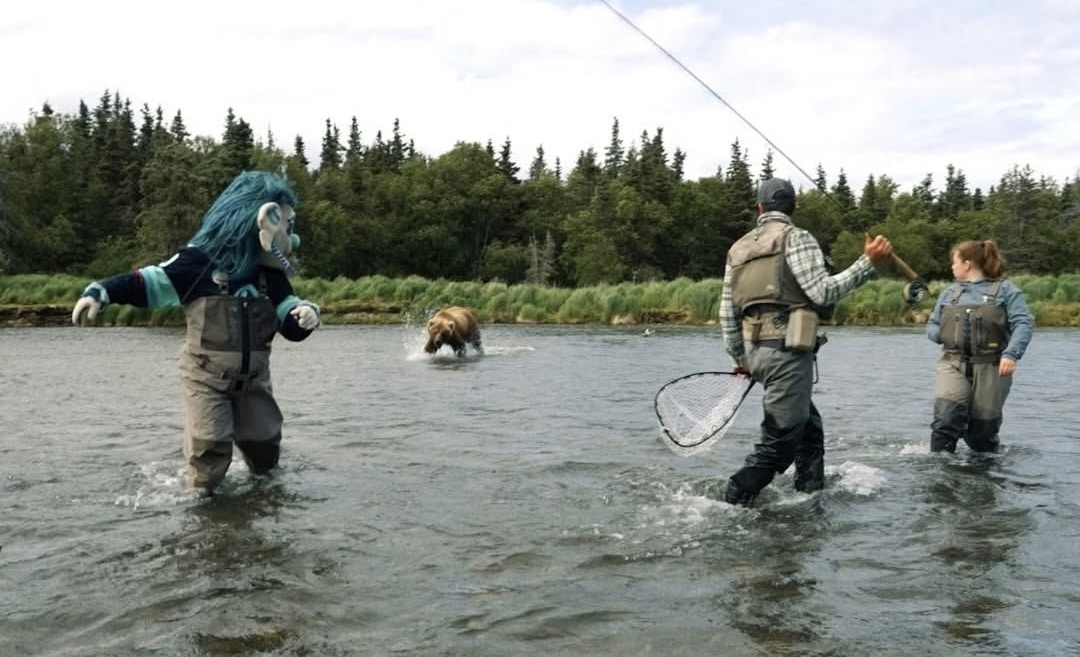
AP- Seattle Kraken forward John Hayden and the team’s blue-haired troll mascot had a close call with a brown bear during a promotional video shoot in Alaska.
Hayden and the mascot named Buoy were on a fly-fishing outing in Katmai National Park as part of a trip promoting youth hockey when the bear approached, video released by the team shows.
Knee-deep in a shallow river, they wore waders and other fly-fishing gear. Hayden had been fishing, but a guide quickly took the rod from him.
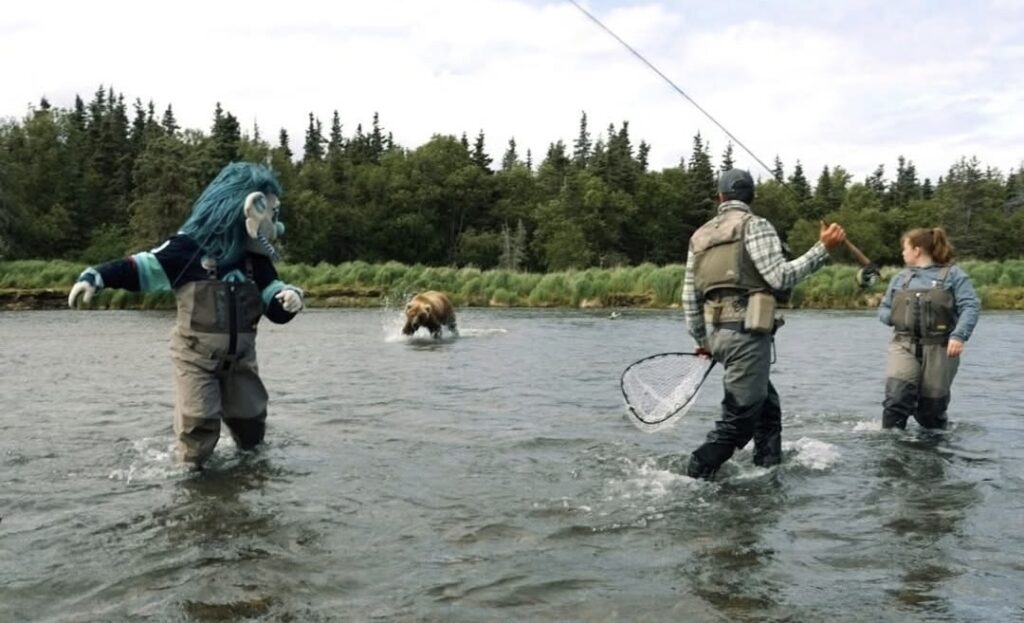
The bear charged toward the mascot, splashing water, but turned away before making contact as Hayden, Buoy and the film crew waded back to shore through a gentle current.
Brown bears commonly feast on salmon in the Brooks River in Katmai National Park, gobbling them as they leap upstream over Brooks Falls to spawn. The park, nearly 300 miles (485 km) southwest of Anchorage and inaccessible by road, is home to the annual “Fat Bear Week” contest celebrating the bears as they fatten up for the winter.
The NHL team said it didn’t intend to involve the bear in filming, but included it in a video posted to social media. Organizers had hired guides for safety.
“Bears are everywhere at Brooks Falls and, like, this is their territory,” said Kraken Partnership Marketing Director Melissa O’Brochta, who also recorded the encounter from shore. “They’re also super used to seeing humans. So I wasn’t scared.”
A troll might have been a different story.
“I want to blame it on Buoy,” Hayden said on the video afterward. “They were pretty interested in his look.”
The run-in happened on June 25 as part of an annual trip organized by the Bristol Bay Native Corporation in Anchorage, Alaska, with events that promote youth ice hockey. Alaska does not have its own NHL team; the closest teams are in Seattle and Vancouver, Canada.
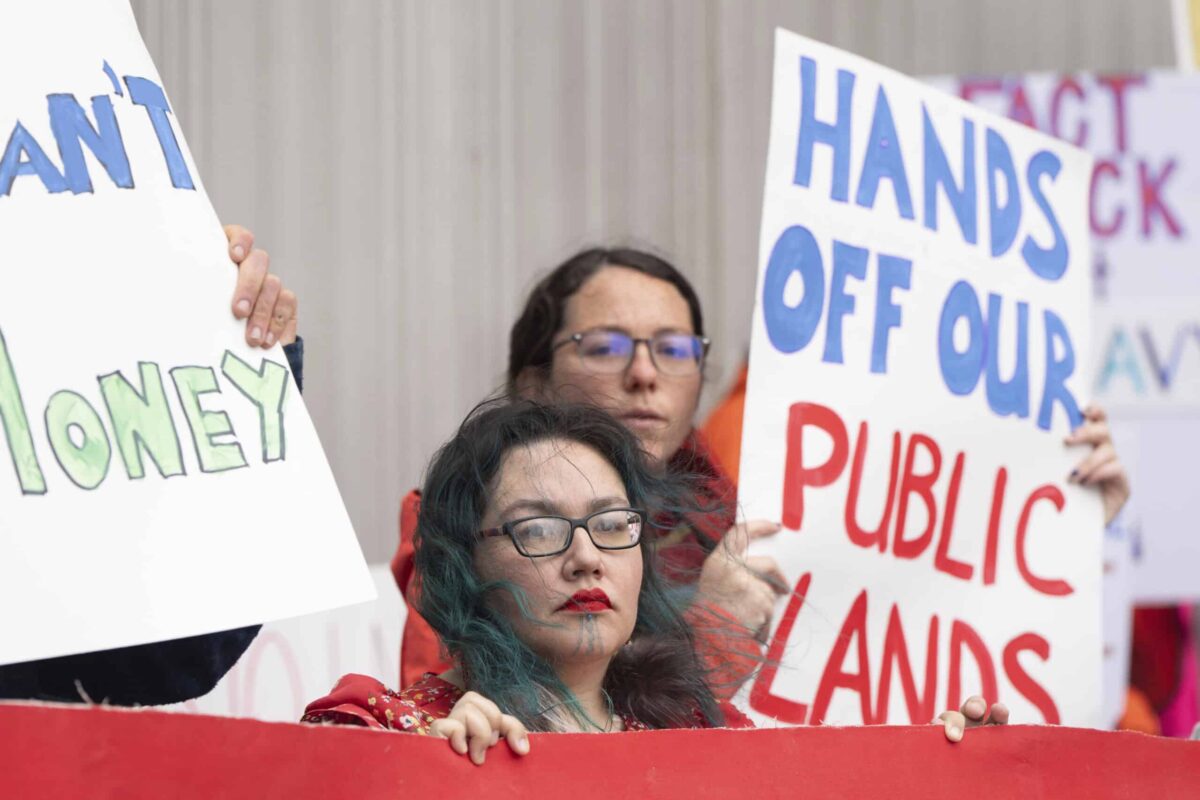
FILE - Demonstrators hold signs during a protest outside the annual Alaska Sustainable Energy Conference on Tuesday, June 3, 2025, in Anchorage, Alaska. (AP Photo/Jenny Kane, File)
Demonstrators hold signs during a protest outside the annual Alaska Sustainable Energy Conference on Tuesday, June 3, 2025, in Anchorage, Alaska. (AP Photo/Jenny Kane, File)
AP- Fish camps still dot the banks of the broad Kuskokwim River in southwestern Alaska. Wooden huts and tarped shelters stand beside drying racks draped with bright red strips of salmon, which Alaska Native families have harvested for generations and preserved for the bitter winters ahead.
But the once-abundant salmon populations have declined so sharply in recent years that authorities have severely restricted subsistence fishing on Alaska’s second-longest river. They’ve imposed even tighter restrictions on the longer Yukon River to the north.
Various factors are blamed for the salmon collapse, from climate change to commercial fishing practices. What’s clear is the impact is not just on food but on long-standing rituals — fish camps where elders transmit skills and stories to younger generations while bonding over a sacred connection to the land.
“Our families are together for that single-minded purpose of providing for our survival,” said Gloria Simeon, a Yup’ik resident of Bethel. “It’s the college of fish camp.”
So when Alaska Natives debate proposals to drill, mine or otherwise develop the landscape of the nation’s largest state, it involves more than an environmental or economic question. It’s also a spiritual and cultural one.
“We have a special spiritual, religious relationship to our river and our land,” said Simeon, standing outside her backyard smokehouse where she uses birch-bark kindling and cottonwood logs to preserve this year’s salmon catch. “Our people have been stewards of this land for millennia, and we’ve taken that relationship seriously.”
Trump policies intensify the debates
Such debates are simmering across the state’s vast tundra, broad rivers, sprawling wetlands and towering mountain ranges. Put a pin just about anywhere on the map of Alaska, and you’re likely to hit an area debating a proposed mine, a new wilderness road, a logging site, an oil well, a natural gas pipeline.
Such debates have intensified during President Donald Trump’s second term. His administration and allies have pushed aggressively for drilling, mining and developing on Alaska’s public lands.
More than 1 in 5 Alaskans identify as Alaska Native or American Indian alone or in combination with another racial group, the highest ratio of any state, according to 2020 U.S. Census figures. Alaska Natives include Aleut, Athabascan, Iñupiat, Tlingit, Yup’ik and other groups. For all their diversity, they share a history in the region dating back thousands of years, as well as cultural and spiritual traditions, including those closely associated with subsistence hunting and gathering.
Native leaders and activists are divided about extraction projects. Supporters say they bring jobs and pay for infrastructure. Opponents say they imperil the environment and their traditions.
Tribal members sometimes even find themselves on opposite sides of the same proposal. Native-run corporations — formed to benefit Alaska Native shareholders — are supporting a mine in southwestern Alaska that a regional tribal coalition opposes, a scenario similar to an oil exploration project underway in Interior Alaska.
Trump singled out Alaska as a priority for extraction projects in an executive order signed on his first day in office.
“Unlocking this bounty of natural wealth will raise the prosperity of our citizens while helping to enhance our Nation’s economic and national security,” the order said.
Increasingly, words are turning to action.
Congress, in passing Trump’s budget bill in July, authorized an unprecedented four new sales of oil and gas leases in the coastal plain of the Arctic National Wildlife Refuge, and still more in other locations.
Trump cabinet officials made a high-profile visit in June to Prudhoe Bay in Alaska’s far north — an aging oil field that is one of the largest in North America. They touted goals of doubling the oil coursing through Alaska’s existing pipeline system and building a massive natural gas pipeline as its “big, beautiful twin.”
Trump’s policy shifts came even as he removed one of the most prominent Alaska Native names from the official map. He returned the federal name of “Mount McKinley” to the largest mountain in Alaska and North America. For all their disputes over extraction, Native and Alaska political leaders were largely united in wanting to keep its traditional Athabascan name of Denali, which translates to “the high one.”
‘We need jobs … to stand on our own two feet’
It takes years for proposed extraction projects to unfold, if they ever do. The extent of oil reserves in the Arctic refuge remains uncertain. Limited infrastructure and harsh weather raise costs. No major oil company bid during the only two lease sales offered to date in the Arctic refuge.
But the measures pushed by the new administration and Congress amount to the latest pendulum swing between Republican and Democratic presidents, between policies prioritizing extraction and environmental protections.
The budget bill calls for additional lease sales in the National Petroleum Reserve-Alaska, west of the Arctic refuge, and opening more areas to potential leasing than authorized under recent Democratic administrations.
Alaska’s political leaders generally have cheered on the push for more extraction, including its Republican congressional delegation and its governor, who has called his state “America’s natural resource warehouse.”
So have some Native leaders, who say their communities stand to benefit from jobs and revenues. They say such projects are critical to their economic prospects and self-determination, providing jobs and helping their communities pay for schools, streets and snow removal. They’ve accused the previous administration of President Joe Biden of ignoring their voices.
“We need jobs. Our people need training, to stand on our own two feet. Our kids need a future,” said PJ Simon, first chief of the Allakaket Tribal Council. He said communities can maintain their traditions while benefiting from economic development — but that it’s crucial that public officials and businesses include them in the planning. “Native people want to be heard, not pushed aside,” Simon said.
Mayor Nathan Gordon Jr. of Kaktovik, the only community within the Arctic refuge, applauded the budget bill. It enables Kaktovik “to strengthen our community, preserve our cultural traditions, and ensure that we can remain in our homelands for years to come,” he said in a statement issued by Voice of the Arctic Iñupiat, a group advocating for oil exploration.
A ‘lack of respect’ for Native subsistence traditions
But Native opponents of such projects say short-term economic gains come at the risk of long-term environmental impacts that will reverberate widely.
“We’re kind of viewed as the last frontier, like we have unlimited resources,” said Sophie Swope, executive director of the environmental advocacy group Mother Kuskokwim Tribal Coalition.
She said Alaska’s most renewable resources — such as salmon, deer and other migratory wildlife — are threatened both by overly aggressive ocean fishing and by extractive industries.
“There’s that lack of respect for our traditional subsistence lifestyles,” she said.
Opponents of oil drilling in the Arctic refuge fear it will permanently disrupt the long-range migration of caribou, which Native people have hunted for millennia. The Tanana Chiefs Conference, a coalition representing dozens of tribes in Alaska’s interior south of the refuge, has long opposed the drilling.
A massive caribou herd goes to the refuge’s coastal plain to calve in the spring before fanning out across a wider area, providing a crucial food source for Native hunters in Alaska and Canada.
If the herd’s migration is disrupted, opponents fear an impact similar to the salmon collapse — a loss not just of food but of a focal point of culture and spirituality.
While the source of the salmon crisis is uncertain, researchers say possible causes include the impacts of commercial fishing, disease, warming waters, other environmental changes and competition between wild and hatchery-reared fish. In a June policy brief, Indigenous leaders, scientists and policy experts called for further study and for easing the disproportionate impact of the crisis on subsistence fishermen.
But if the salmon collapse’s cause isn’t clear, its impact is.
It has meant “no fish camps, no traditional knowledge that’s been passed down to our younger generation,” said Kristen Moreland, executive director of the Fairbanks-based advocacy group Gwich’in Steering Committee.
Moreland said she regularly takes her children to her home village in the north to reconnect with traditional festivals and activities, including those centered around the caribou hunt: “They learn all our traditional knowledge that way. What if the caribou doesn’t migrate up there anymore?”
The yearslong battle over the refuge takes its toll, she said. “How long do we have to advocate for our land and our people?”
Chief Brian Ridley of the Tanana Chiefs Conference said he sympathizes with those tribal leaders supporting development, given the shortage of well-paying jobs in many villages.
But concern over potential long-term environmental damage has prompted the conference to oppose projects such as oil drilling in the Arctic refuge and the nearer Yukon Flats, as well as construction of the so-called Ambler Road, which could open access to mining in more remote areas.
Ridley said he recently attended a national conference with other tribal leaders who echoed a common theme — opposing “development projects on our land or near our land that come in and promise jobs and whatnot, and they come and go and then we get stuck with the long-term negative aspects of cleanup and restoration.”
Empty smokehouses, broken spirits
In southwestern Alaska, a proposed major mine, the Donlin Gold project, has long been debated.
The project, planned by private investors in cooperation with Native corporations owning the land and mineral rights, would require a massive dam to hold back millions of tons of mineral and chemical waste in a valley.
Project proponents say the dam will involve state-of-the-art design, with its wide base anchored to bedrock and the surrounding mountain walls incorporated into containing the debris. Proponents tout benefits including jobs, shareholder payments and funds for such things as village services and education.
“This kind of project, since it’s on our lands, is different than most other resource projects,” said Thomas Leonard, vice president of corporate affairs for Calista Corp., a regional Alaska Native corporation involved. “We literally have a seat at the table, have a voice in the project.”
But opponents, such as Mother Kuskokwim and some area tribes, aren’t convinced and say the risk of a failure on the Kuskokwim watershed is too great.
“Protecting the river and the land and the Earth is part of the partnership and the relationship that we have as caregivers,” Simeon said.
That relationship isn’t abstract, Simeon said. She said the disruption of communal hunting and fishing activities leads to a spiritual rootlessness that she believes contributes to alarming rates of addictions and suicide among Alaska Native people.
“What does it do to your heart and soul when you have to look at an empty smokehouse year after year after year, and you can’t provide for your family?” Simeon said.
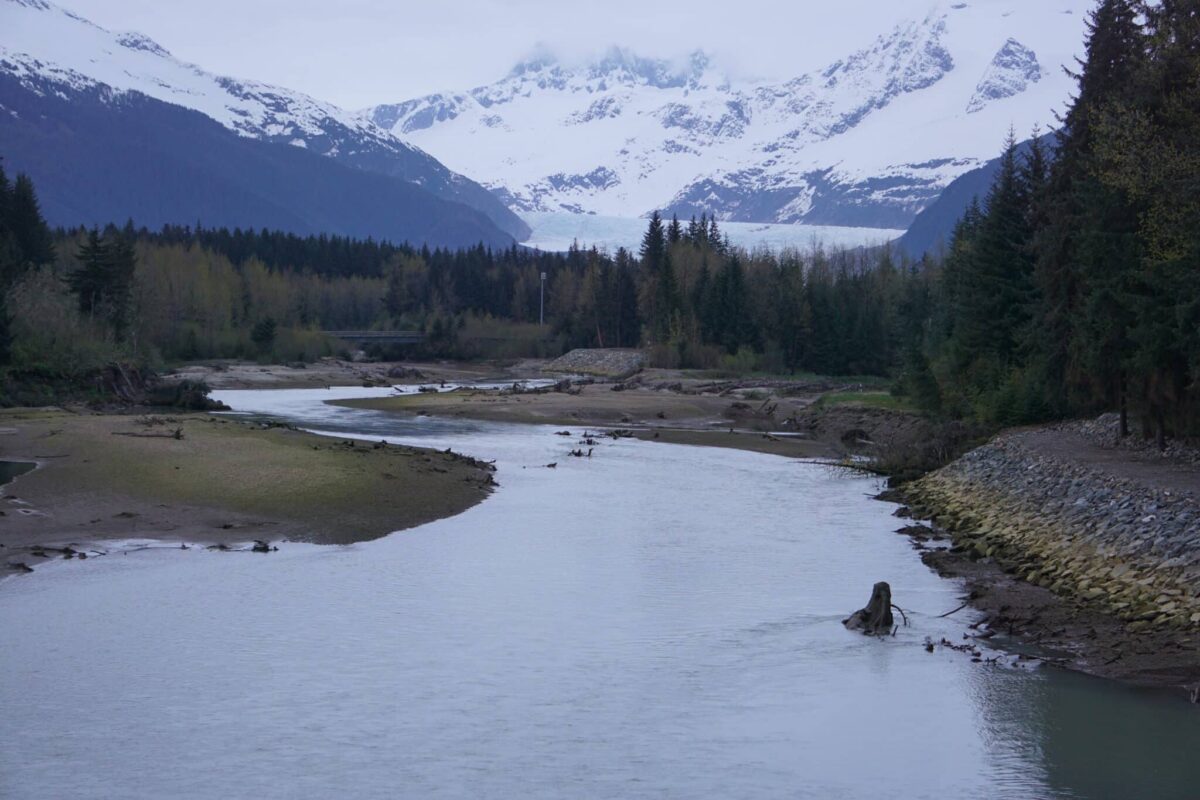
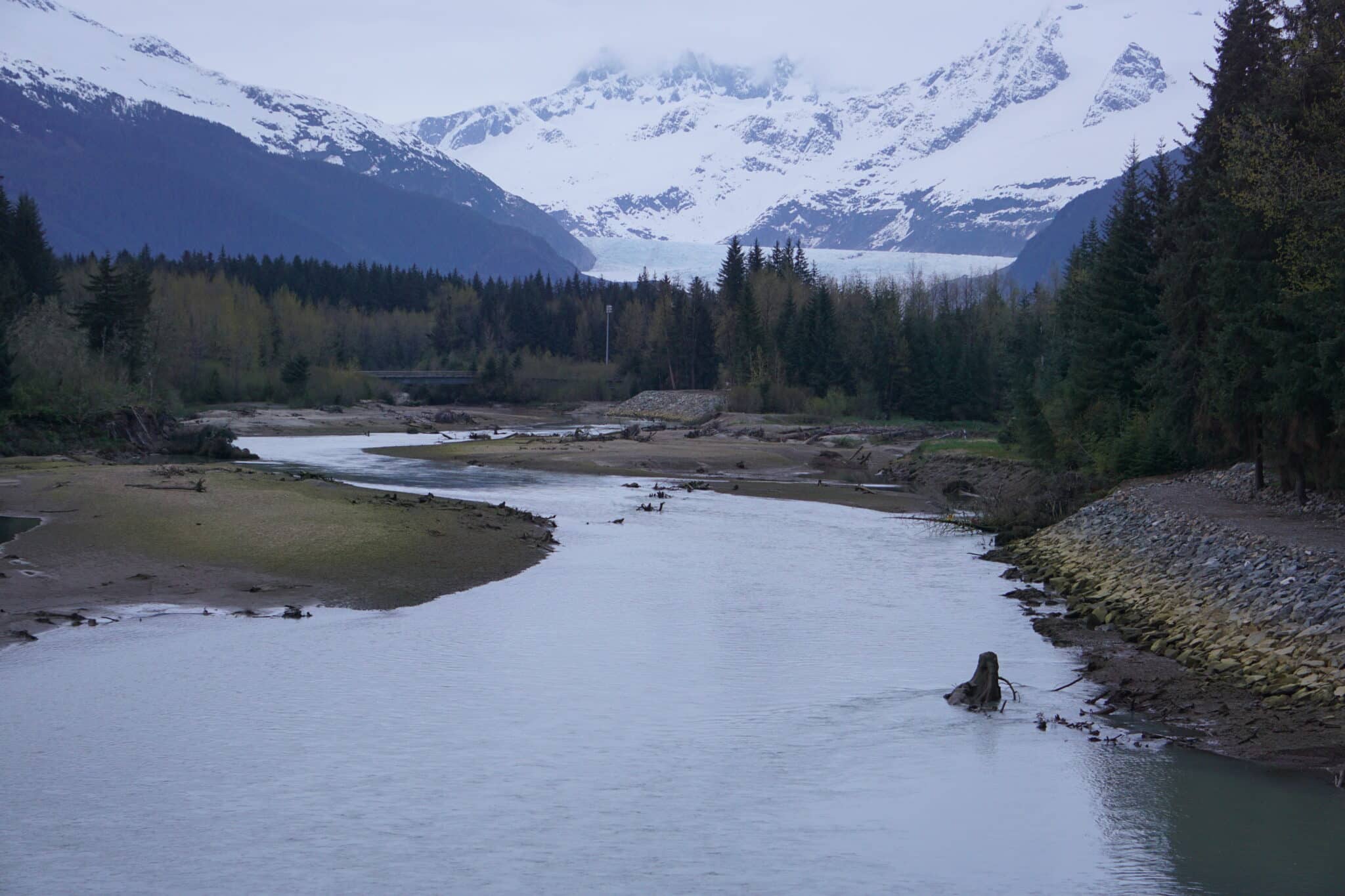
The Mendenhall River, which flows out of Mendenhall Glacier, is seen on May 14, 2025. (Photo by Yereth Rosen/Alaska Beacon)
Suicide Basin, the glacier-dammed side basin above the Mendenhall Glacier, may reach capacity around August 12 according to the National Weather Service.
The basin, which has released annual floods into Mendenhall Lake and River since 2011, has risen 20 feet in the past week and currently sits at 1,350 feet, according to a status update released Wednesday.
The most damaging flood occurred one year ago yesterday, August 6, 2024, causing record damage in Juneau.
Once the basin reaches its estimated capacity of 1,368 feet, it typically takes 4 to 6 days before an outburst begins, according to officials.
Officials are urging residents to stay informed and monitor updates from the National Weather Service and local emergency management.
The City and Borough of Juneau has plentiful resources, including emergency alerts, vehicle registration and Mendenhall inundation maps.
The most recent flood event from the basin occurred on October 20, 2024.
More information and updates will be shared as conditions change.
Earlier this week, Fox News personality Jeanine Pirro was confirmed as US attorney for Washington, D.C.
Now, Donald Trump’s controversial appointee may be granted unprecedented authority, thanks to the president’s new push to federalize the nation’s capital.
The move comes in the wake of an alleged attack on Edward Coristine, an employee of the controversial DOGE agency, who’s best known by the nickname “Big Balls.”
U.S. President Donald Trump talks to the media as he meets with British Prime Minister Keir Starmer (not pictured) at Trump Turnberry golf club on July 28, 2025 in Turnberry, Scotland. (Photo by Christopher Furlong/Getty Images)
According to a police report obtained by Politico, Coristine, 19, was assaulted by a group of teenage assailants.
Two suspects, a 15-year-old female and a 15-year-old male, have been taken into custody.
Trump lashes out at D.C. authorities following attack on DOGE worker
“Crime in Washington, D.C., is totally out of control. Local ‘youths’ and gang members, some only 14, 15, and 16-years-old, are randomly attacking, mugging, maiming, and shooting innocent Citizens, at the same time knowing that they will be almost immediately released,” Trump wrote on his Truth Social platform, seemingly in response to the attack.
“The Law in D.C. must be changed to prosecute these ‘minors’ as adults, and lock them up for a long time, starting at age 14. The most recent victim was beaten mercilessly by local thugs.”
From there, Trump expounded on plans for the federal government to take over operation of the city.
Republican presidential nominee, former U.S. President Donald Trump looks on during a roundtable with faith leaders at Christ Chapel on October 23, 2024 in Zebulon, Georgia. (Photo by Anna Moneymaker/Getty Images)
“If D.C. doesn’t get its act together, and quickly, we will have no choice but to take Federal control of the City, and run this City how it should be run, and put criminals on notice that they’re not going to get away with it anymore,” he wrote, adding:
“Perhaps it should have been done a long time ago, then this incredible young man, and so many others, would not have had to go through the horrors of Violent Crime. If this continues, I am going to exert my powers, and FEDERALIZE this City. MAKE AMERICA GREAT AGAIN!”
Trump says was Coristine was attacked by ‘bunch of thugs’
Trump doubled-down on his threat to federalize the city while speaking with reporters on Tuesday:
U.S. President Donald Trump stops and talks to the media before he boards Marine One on the South Lawn at the White House on June 15, 2025 in Washington, DC. (Photo by Tasos Katopodis/Getty Images)
“I have to say that somebody from DOGE was very badly hurt,” the president remarked, according to CNN.
“A young man who was beat up by a bunch of thugs in DC, and either they’re gonna straighten their act out in the terms of government and in terms of protection or we’re gonna have to federalize and run it the way it’s supposed to be run.”
“It’s time we start taking crime more seriously irrespective of the age of the criminal,” Pirro echoed in a statement issued today.
“No longer can we coddle criminals while innocent victims are being assaulted and maimed as young, violent criminals avoid consequences. It’s time for this to end.”
We’ll have further updates on this developing story as new information becomes available.
Heidi Klum is working to rid herself of worms and parasites.
It’s … not clear if she actually has any.
According to the supermodel, she and her husband are going to deworm and de-parasite “for the first time.”
She has no idea “what the heck is going to come out.” Is this … medically advisable?
Heidi Klum attends Heidi Klum’s 21st Annual Halloween Party presented by Now Screaming x Prime Video and Baileys Irish Cream Liqueur at Sake No Hana at Moxy Lower East Side on October 31, 2022. (Photo Credit: Noam Galai/Getty Images for Heidi Klum)
Apparently, Heidi Klum would NOT still love you if you were a worm
This week, Heidi Klum spoke to the Wall Street Journal about plans that she and husband Tom Kaulitz have for their health.
During the chat, the WSJ asked the legendary supermodel whether she adheres to a specific diet.
“I don’t,” Klum replied. Then, she announced:
“I’m going to deworm and de-parasite for the first time.”
Supermodel Heidi Klum arrives for the 51st American Music Awards at the Fontainebleau in Las Vegas, Nevada on May 26, 2025. (Photo Credit: MICHAEL TRAN/AFP via Getty Images)
To hear Klum tell it, she got the idea from things that her social media algorithm fed to her.
(Please do not take advice from Meta ads!)
“Everything I’m getting on my Instagram feed at the moment is about worms and parasites,” she stated.
“So,” Klum continued, as if this were an explanation, “I’m doing a worm cleanse and parasite cleanse with my husband.”
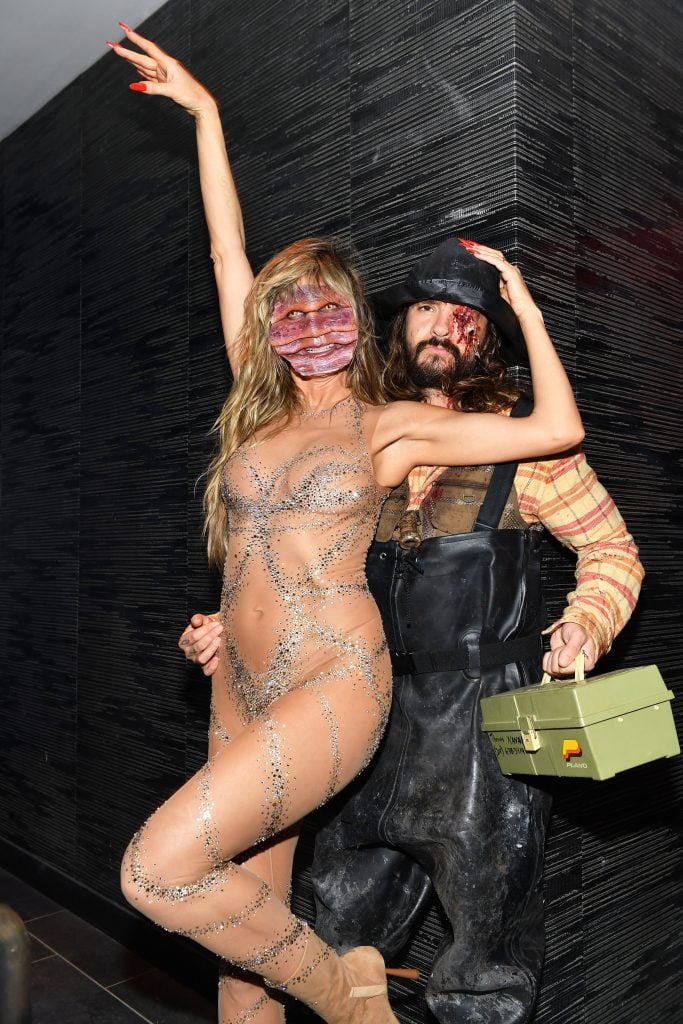
Heidi Klum and Tom Kaulitz attend Heidi Klum’s 21st Annual Halloween Party presented by Now Screaming x Prime Video and Baileys Irish Cream Liqueur at Sake No Hana at Moxy Lower East Side on October 31, 2022. (Photo Credit: Noam Galai/Getty Images for Heidi Klum)
It doesn’t sound like this is coming from, like, her doctor
According to Heidi Klum, she has “heard” that people are “supposed to do this once a year.” (Oh no!)
Klum admitted that she has “never done it.” Most people do not, unless they actually have a parasite.
And, instead of making her question what she’s seeing in random Instagram posts, it makes her feel “really behind.”
Heidi Klum attends the Calzedonia billboard presentation at Friesenwall on June 16, 2025. (Photo Credit: Andreas Rentz/Getty Images)
She added: “I don’t know what the heck is going to come out.” (Oh dear)
“Apparently, we all have parasites and worms,” Klum claimed outlandishly.
“If you are someone who eats raw things every now and then, like, for example, sushi.”
Generally, sushi undergoes sub-zero freezing in order to kill parasites.
We cannot, however, guarantee that the world-famous supermodel has never been fed sushi that was not adequately prepared.
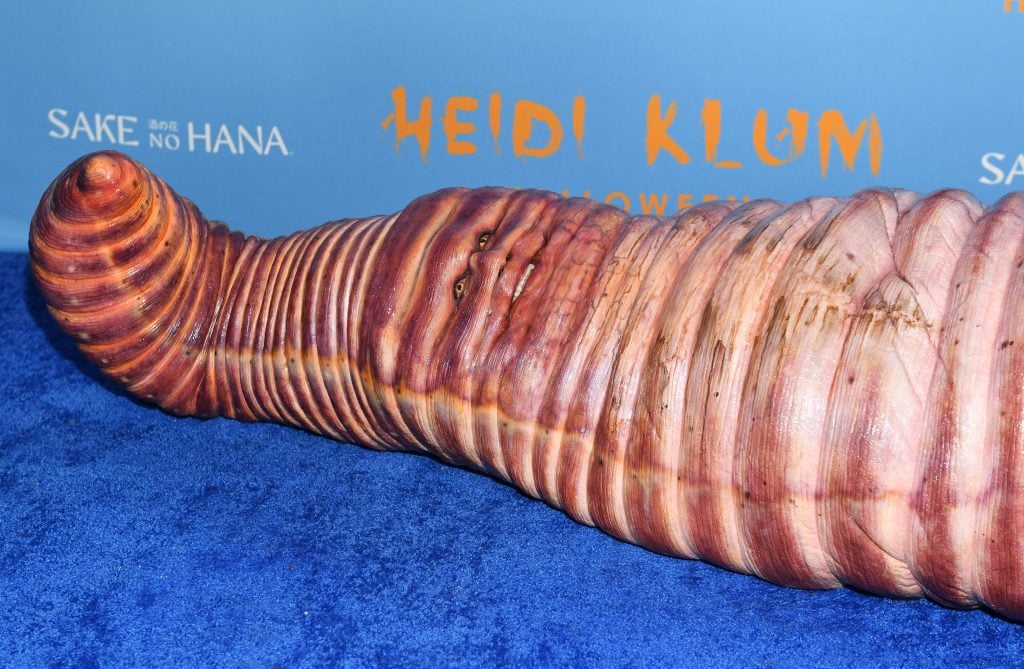
Heidi Klum attends Heidi Klum’s 21st Annual Halloween Party presented by Now Screaming x Prime Video and Baileys Irish Cream Liqueur at Sake No Hana at Moxy Lower East Side on October 31, 2022. (Photo Credit: Noam Galai/Getty Images for Heidi Klum)
Please consult a doctor before attempting a fad cleanse of any kind
Heidi Klum noted that “there are pills [to get rid of them].”
It sounds like she’s speaking of antiparasitic medications. (Ivermectin does treat certain parasites! Don’t let the lunatics who started treating it like a magic paste in 2020 drive you away if you get an actual parasite)
However, she described pills that “have all of these herbs. There’s a lot of clove in there. The parasite hates clove. They also hate the seeds from a papaya.”
If you believe that you have a parasitic infection, please consult with a doctor.
Very few doctors are likely to recommend that your average person go on a once-per-year “cleanse” of worms and parasites.
It really sounds like some TikTok nonsense migrated to become Instagram nonsense, and wriggled its way into Klum.
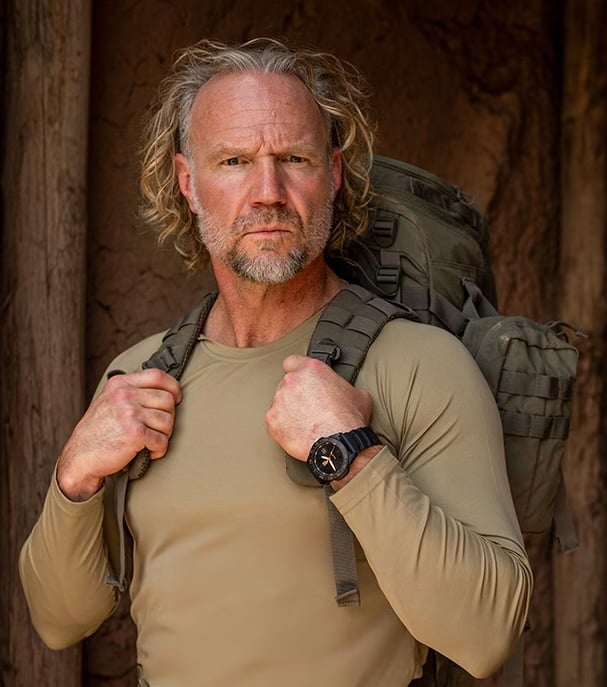
Kody Brown has been training for this his whole adult life.
The Sister Wives patriarch, who managed to juggle four wives for well over a decade, has agreed to face his biggest challenge yet by leading the cast of Special Forces Season 4.
On Wednesday, Fox announced the lineup for reality stars, podcasters and athletes who will put their physical and mental capabilities to the test in front of a television audience.
(FOX)
As you may already know, Special Forces: World’s Toughest Test features celebrities from all genres going through exercises led by an elite team of ex-Special Forces operatives.
Viewers watch in awe and fear as the so-called recruits face harsh environments that simulate the highly classified selection process… pushing themselves in ways they never thought possible.
Or deciding to drop out of things get too challenging for them.
Ready to find out who will be joining Brown on the series, which premieres with new episodes on September? Scroll down now!
(FOX)
EVA MARCILLE: Real Housewives of Atlanta alum, model and actress.
TERESA GIUDICE: Real Housewives of New Jersey veteran who served years in prison on charges of financial fraud.
GIA GIUDICE: The daughter of Teresa, who has appeared on Bravo plenty of times herself.
JUSSIE SMOLLETT: Yes, that Jussie Smollett! An actor who made a name for himself on Empire — and then made an even bigger name for himself by fabricating an attack on the streets of Chicago and then spending time in jail for falsifying a police report.
(FOX)
JESSIE JAMES DECKER: County music artist who, as far as we know, never filed a false police report.
ERIC DECKER: Former NFL wide receiver and, yes, the husband of Jessie James.
Amidst her divorce, she has accused ex Aaron Phypers of physical abuse.
Over the weekend, some sort of alleged confrontation played out, possibly including her ex’s brother.
Now, Richards’ face is showing signs of injury in a public appearance. Fans fear the worst. What really happened?
On ‘Denise Richards & Her Wild Things,’ the titular actress speaks about the complex realities of parenting teen girls (and one young adult). (Image Credit: Bravo)
What happened to Denise Richards?
On Tuesday, August 5, photographers snapped pics of Denise Richards out and about in Calabasas, California.
The actress and reality TV personality wore a baseball cap while apparently running errands around town.
What worries fans is Richards’ face.
She appeared to have a bruise under an eye and a cut on her chin. What happened?
On The Real Housewives of Beverly Hills Season 13, Episode 9, Denise Richards returned. (Image Credit: Bravo)
In addition to the photos themselves, TMZ also shared what sources close to Richards had to say.
Allegedly, the look of her face is merely lighting and shadow … on top of some actual, intentional injuries.
Richards apparently underwent beauty treatments, including micro-needling and a PRP injection.
These procedures (and so many others) can cause bruising and other signs of injury.
On her very own reality show, Denise Richards flashes a fake smile at a former castmate. (Image Credit: Bravo)
Does this have anything to do with the incident on Sunday?
On Sunday, August 3, Denise Richards allegedly showed up to the place where Aaron Phypers is residing without warning or invitation.
That sounds unthinkable for an ex who only recently filed for a restraining order. However, the reason explained it.
Richards alleged that Phypers had “put down” one of her dogs without her knowledge.
That is a situation that, if true, would drive just about anyone to do just about anything.
During this explosive RHOBH Reunion special, Denise Richards came ready to fight. (Image Credit: Bravo)
As far as we know, Richards was not the victim of a violent attack on her face on Sunday, August 3 of this year.
With that in mind, perhaps her beauty treatments — combined with not wearing TV makeup — are simply leading fans to imagine the worst.
That said, fans are remembering numerous signs that something wasn’t right from her time on reality TV.
Speaking to the cameras, Denise Richards gives Bravo fans a taste of what’s to come. (Image Credit: Bravo)
This divorce is so ugly, and it has scarcely begun
In addition to the alleged dog-murder, Denise Richards has also accused Aaron Phypers of stealing her electronics and leaking her private messages and photos following their split.
Some divorces, celebrity and otherwise, can take months before they turn bitter.
This one appears to be doing a speedrun of the stages of hostility.
Remember, the filing came from barely one month ago.
We hope that any and all future incidents can be avoided. This scary situation could escalate far too easily.
Very sad news today out of the world of reality television and social media:
Yanin Campos — who appeared on season four of the cooking competition series MasterChef — was killed on on August 4 following a fatal car crash, her brother Raúl confirmed this afternoon via Facebook.
She was 38 years old.
(Instagram)
“To family and friends,” Raúl wrote in the August 6 post, translated from Spanish. “We inform and mourn the death of my sister Yanin Campos.”
According to this same post, Yanin’s family held a wake on August 4 at Hernández Funeral “for those who like to say goodbye” to the late content creator.
Campos was driving in her home city of Chihuahua, Mexico, when she collided with a parked vehicle at around 6:30 a.m. this past Saturday, as told by the Mexican Secretariat of Public Security to local newspaper El Financiero.
This outlet went on to say that Campos was rushed to a local hospital and passed away two days later.
The newspaper also reported that local authorities are investigating whether excessive speed or distracted driving played a role in the collision. No determination has been made either way as of this writing.
(Instagram)
Campos rose small screen popularity when she appeared on season four of MasterChef in 2018.
She came in sixth place, yet was invited back the following year to compete in MasterChef México: La Revancha.
Following her successful run on reality TV, Campos — who actually trained as a nurse before pursuing her talents as a chef — created a name for herself on social media, garnering nearly 100,000 followers on TikTok, where she shared funny and relatable lifestyle content.
Underneath her most recent TikTok post, which was shared a mere two days before her death, fans took to the comments to express their sorrow and shock.
“It will never cease to amaze me how ridiculously fragile life is,” one user wrote in a translated remark. “Right now it’s just a normal day, but in a few seconds everything will change forever, and you won’t even realize it. You’ll just know it’s the end, or sometimes not even that.”
This profound comment concluded:
“Laugh, love, enjoy, hug, and remind your loved ones of the love you have for them. Life is amazing and cares about absolutely nothing. RIP. I wish you a safe journey.”
CHICAGO — The Texas Democrats staying in a Chicago suburb to protest a controversial redistricting map in their state said Wednesday that they are facing threats against their group.
The St. Charles Police Department, which oversees the jurisdiction where they are staying, confirmed a potential bomb threat was made.
“This morning, a threat was made against the safety of the members of the Texas House Democratic Caucus. We are safe, we are secure, and we are undeterred. We are grateful for Governor [JB] Pritzker, local, and state law enforcement for their quick action to ensure our safety,” caucus leadership said in a statement.
The St. Charles Police Department said the threat came in at about 7:15 a.m. Central time.
“St. Charles Police Department responded to a report of a potential bomb threat at the Q-Center hotel and convention complex” in St. Charles, the city’s police department said in a statement, and local police and the Kane County Sheriff’s Office bomb squad “conducted a thorough search and no device was found.”
“In response to the threat, 400 people were immediately evacuated and the area was secured as bomb squad units conducted their investigation,” police said.
The guests and staff were allowed to return after police gave clearance to do so.
The Texas statehouse Democrats are in Illinois after leaving their state en masse Sunday in an attempt to prevent a quorum in the Texas state Legislature — and thus stop a vote on a controversial Republican-drawn congressional map that would give as many as five more U.S. House seats to the GOP in the 2026 midterms.
The group postponed a planned press conference with Sen. Dick Durbin (D-Ill.) after reports of the threat.
🚨 🚨 — “Trump Weighs Getting Involved in New York City Mayor Race,” by NYT’s Nicholas Fandos, Jeremy W. Peters, Maggie Haberman and Katherine Rosman: “President Trump may have moved out of New York City, but he has privately discussed whether to intercede in its fractious race for mayor to try to stop Zohran Mamdani, the Democratic nominee, according to eight people briefed on the discussions.” (More below)
CRY ME A RIVER: Even as Gov. Kathy Hochul doubles down on her Democratic gerrymandering plan, she said she’s feeling overcome with despondency for New York Republicans who could lose their seats when she tries to redraw New York’s maps to boost her party.
“I feel really sad,” Hochul said today, when asked if she had a message for any GOP reps who might see their seat erased if she pushes through a full-fledged gerrymander.
Hochul and California Gov. Gavin Newsom sprinted to the front lines of the mucky redistricting war and have vowed to redraw their own maps to add more Democratic seats ever since President Donald Trump called on Texas to abruptly redraw its Congressional maps to add 5 more GOP seats.
Luckily, Hochul noted, there’s a way out.
His name is Republican Rep. Mike Lawler, and, she said, he has the political power and sway in Washington to end partisan gerrymandering with his forthcoming federal bill that would ban the practice nationwide.
“He has so much enormous power in Washington,” Hochul said of Lawler.
Sike! She was kidding. She doesn’t feel sad. She doesn’t think Lawler has any juice in D.C. and she definitely doesn’t seem to be slowing down her push to gerrymander the hell out of New York in what she says is a response to Texas’ efforts.
As the redistricting war looks to be going nuclear, Hochul is daring Republicans like Lawler to loudly call for an end to their party’s redistricting effort in Texas.
“Tell them to call the president of their own party and say, ‘Stand down in the war with New York and California and other Democratic states,’” Hochul said. “If you want to stop what you’re doing in Texas, I’ll stand down. You started it. You end it.”
“This is a guy who’s now saying, ‘I’m going to introduce a bill to get it changed,’” she said. “The same guy who promised a full restoration of the state and local tax deduction comes back far short from that and spins it as a win that everybody’s buying. He has no power. He won’t get it done. And I’m not sympathetic because he was silent.”
Lawler’s office noted that the increases in state and local tax deductions he fought with Trump for during the creation of the One Big Beautiful Bill Act provides relief for most of his district, with only the top 10 percent of taxpayers not getting a tax cut.
“Kathy Hochul is not just the worst Governor in America, she’s also the dumbest,” Lawler said in a statement. “After years of calling for the SALT cap to be fixed, she’s now attacking the solution because Democrats weren’t the ones to get it done, my New York GOP colleagues and I were. No one believes a word she says. Her own colleagues in the State Legislature mock her at every turn. What a pathetic excuse for a leader of New York State.” — Jason Beeferman
TRUMP EYES NYC MAYOR’S RACE: Trump is “very interested” in the New York City mayoral race, said Republican billionaire John Catsimatidis, who is friendly with both Andrew Cuomo and Mayor Eric Adams. Catsimatidis said he dined Friday with Trump.
“He’s a New York guy, he grew up in New York,” Catsimatidis told Playbook. “He loves New York. He wants to make sure there’s proper accounting in New York, that the quality of life goes on in New York and that we don’t lose any more population.”
Trump hasn’t committed to a role in the race, though, and Catsimatidis said he wants the president to hold off — for now.
“I asked him to put off decisions on anything until September,” Catsimatidis said.
The Times also reported that during a closed-door meeting with Lawler last month in the White House, Trump discussed the mayor’s race with the Hudson Valley congressman.
A person familiar with the meeting told Playbook that Trump did not express a specific preference for any of the mayoral candidates, but rather was interested in who has the best shot at winning.
Trump’s involvement would come as Cuomo’s pushing for the field to coalesce around the strongest challenger to Mamdani by mid-September — a dynamic that currently favors the former governor, according to most polls.
“The president runs the country and what is said to him at the dinner party is, ‘We saved America, we saved the free world, now it’s time to save New York,” Catsimatidis said. “I’m pretty sure he agreed with it.” —Nick Reisman and Jason Beeferman
ANDREW CUOMO, THE REPLY GUY: If you haven’t been on X in the last 24 hours (lucky you) you’ve missed Cuomo’s furious — and curious — barrage of posts and replies.
Since Monday, Cuomo has expressed gratitude to someone with the username “Andrew Cuomo is a Sex Pest.” He called on Democratic nominee Zohran Mamdani to “Boycott, Divest, and Sanction” his property in Uganda — a country, he noted, “that murders LGBTQIA+ people.” And the former governor even responded earnestly to someone else who told him to “Give it up grandpa.”
“No grandkids yet- but I’ve got the experience and the ability to get things done,” Cuomo wrote.
The mayoral hopeful and failed primary candidate has posted over 35 times on X over the past two days, mostly with a new, direct tone that would’ve been unbecoming of the highly-coordinated primary campaign he was running just two months ago.
It’s a new social media approach from the 67-year-old and his campaign after his millennial foe Mamdani successfully utilized the medium to handily beat him in the Democratic primary and surge the under-30 turnout.
So is Andrew himself behind the account?
“We hired this really smart kid named A.J. Parkinson,” Rich Azzopardi told Playbook, an apparent tongue-in-cheek reference to a fictitious character Cuomo’s father first brought to life and quoted frequently in the early ‘80s.
Coincidentally, Parkinson emerged around the same time Cuomo took his last nap — a fact we now know because he told us so in one of his many replies on X this afternoon.
MAGA influencer Laura Loomer loves it.
“W,” she wrote in response to Cuomo’s call for a Uganda-centric BDS movement.
Mamdani’s campaign did not comment on Cuomo’s new online approach. — Jason Beeferman
NO MATCHING FUNDS FOR ADAMS: The New York City Campaign Finance Board denied Adams millions of dollars in matching funds for the tenth time this morning — and suggested in a strongly worded statement that Adams will not be getting a penny anytime soon, POLITICO reported today.
The regulatory body denied Adams the public funding he’s seeking for his general election bid on two grounds: His campaign has not submitted required paperwork, and the board has reason to believe the campaign violated the law.
The board’s decision escalates a long-simmering standoff with the incumbent and hobbles Adams’ ability to compete at a time when he is already at a severe disadvantage. The mayor dropped out of the Democratic primary after the controversial dismissal of a federal bribery case against him. He is now running in the crowded general election as an independent.
Fellow independents Cuomo and Jim Walden are hoping to take down Mamdani, a democratic socialist who has solidly staked out the left lane in the general election. So is GOP nominee Curtis Sliwa.
Cuomo’s base overlaps with Adams’, as does Sliwa’s, although to a lesser degree. Should the multimillion-dollar hole in his war chest persist, the mayor will be forced to continue the time-consuming process of fundraising long after his opponents, placing yet another obstacle in the way of his longshot comeback bid.
Adams’ campaign did not immediately comment on the board’s latest decision. —Joe Anuta
— PAC CASH: The pro-Adams PAC, Empower NYC, has raised $1 million in support of the mayor’s long-shot reelection bid, including from crypto industry donors. (City and State)
— NUCLEAR OPTION: Hochul’s administration wants to continue subsidizing New York’s aging nuclear facilities until 2050. (POLITICO Pro)
— RYDER’S LAW: The death of a New York City carriage horse has renewed calls for City Hall to phase-out horse-drawn carriages. (CBS News)
Missed this morning’s New York Playbook? We forgive you. Read it here.