Three men have been arrested in Essex after violence erupted at the latest protest over housing asylum seekers at the Bell Hotel in Epping.The Latest News from the UK and Around the World | Sky News









Three men have been arrested in Essex after violence erupted at the latest protest over housing asylum seekers at the Bell Hotel in Epping.The Latest News from the UK and Around the World | Sky News

Palestinian President Mahmoud Abbas and 80 other officials have been blocked from attending September’s annual meeting of the United Nations General Assembly in New York.The Latest News from the UK and Around the World | Sky News

In the hospital which was supposed to help her, the last moments of 14-year-old Ruth Szymankiewicz’s life were recorded on CCTV.The Latest News from the UK and Around the World | Sky News

This is a copy of an information release by the City and Borough of Juneau
Today, the City and Borough of Juneau released body-worn camera footage and related materials from the July 30, 2025 incident in which a Juneau Police Department (JPD) officer used force during an arrest that resulted in a serious head injury to the arrested individual. The officer, who was in his probationary period, resigned on August 28, 2025.
This release is part of the City’s ongoing commitment to transparency and accountability and in accordance with CBJ Code (Ordinance 2025-05(c)(am)). In addition to the body-worn video, the City has published dashboard camera footage and applicable JPD policies. All materials are available online at bit.ly/jpd-incident-july30.
City Manager Katie Koester stated, “This has been a painful event for our community. The officer’s resignation reflects the seriousness of what occurred, and our obligation to uphold the standards of conduct our community expects. Accountability means not only reviewing the facts but acting on them. I want to be clear: the Juneau Police Department is full of good and hardworking people who serve with professionalism, empathy and integrity. One incident does not define the department. We’re committed to using this moment to strengthen relationships and to listen and learn from all impacted voices.”
She added, “Chief Bos has been in contact with the family of the individual who was injured, and we are keeping them in our thoughts. Out of respect for their privacy, we will defer any questions regarding his condition or legal matters to the family.”
The officer was placed on administrative leave following the incident. JPD immediately requested an investigation of the incident by an independent third party. That investigation is ongoing.
JPD Chief of Police Derek Bos stated, “What happened on July 30 was not consistent with department policy, values or the conduct we expect from our officers. As Chief, I take responsibility for ensuring our department earns and maintains the public’s trust. We have already begun reviewing JPD directives, implementing policy clarifications as well as additional training focused on de-escalation, proportionality in use-of-force, and medical response protocols.”
As part of the City’s commitment to long-term healing and improved relationships, the Juneau Police Department will also participate in cultural sensitivity training. This training is designed to deepen officers’ understanding of Indigenous history, values, and lived experiences in Juneau, and to reinforce the department’s role as a respectful and responsive community partner.
“This training is not a checkbox. It’s a step toward meaningful connection,” said City Manager Katie Koester.
In addition, Tlingit & Haida has offered to co-host a community dialogue with the City to create space for open and respectful conversations about the community’s relationship with law enforcement. The event will be designed to elevate voices, share perspectives, and chart a path forward rooted in trust, accountability, and shared values.
“We need to approach the dialogue in a thoughtful manner and recognize that it will be difficult for many in our community who have experienced trauma. We’re grateful to Tlingit & Haida for their leadership and willingness to engage with us on this important work,” said Manager Koester. Details about the training and dialogue event will be shared in the coming weeks.
All referenced videos and materials are accessible at: bit.ly/jpd-incident-july30.

NOTN – Governor Mike Dunleavy is criticizing the Alaska Legislature for failing to take action on education reform, pointing out that the state remains last in the nation for student outcomes.
In a letter to legislators Friday, he emphasized that increasing funding won’t improve results without meaningful policy changes, and called on lawmakers to act immediately.
According to lawmakers who spoke with News of the North, Dunleavy has declined to call a second special session this year.
Dunleavy warned that if the legislature does not pass education reforms during the next regular session, he is prepared to call additional special sessions in 2026 until changes are made, stressing that each year of inaction affects an entire cohort of students.

Los Angeles Rams general manager Les Snead hasn’t been shy about making big trades, but he might have made his biggest move yet on Monday. After minimal buzz, the Rams landed two-time Defensive Player of the Year Myles Garrett from the Cleveland Browns for two-time Pro Bowler Jared Verse, a 2027 first-round pick, a 2028 second-round pick and a 2029 third-round pick. It’s a historic trade in multiple regards. Garrett is the first reigning Defensive Player of the Year winner to be traded. Also, the Rams will become the first team in NFL history to have both the reigning MVP (QB Matthew Stafford) and Defensive Player of the Year recipients in the season after they won the awards (excluding when the same player took both honors). But where does the Rams’ trade for Garrett stack up against the most eye-opening deals in NFL history? Here’s our full top 10. After Randy Moss was moved to the New England Patriots in April 2007, his career found a second wind. He developed a special connection with quarterback Tom Brady and surpassed the 1,000-receiving yards mark each season from 2007 to 2009. In 2007, Moss posted a career-high 1,493 yards and 23 touchdowns, the most by a receiver in a single season. Despite his individual success, Moss wasn’t a part of New England’s Super Bowl-winning teams. A historical theory was tested with this trade: Can a team be successful with a high-powered, high-paid running back? The Carolina Panthers must not have thought so, and in 2022, during their fourth straight losing season, they traded Christian McCaffrey to the San Francisco 49ers. Since then, the 49ers have proved the opposite. In McCaffrey’s first season, San Francisco went to the NFC Championship Game. The following year, he led the NFL with 1,459 yards and 14 touchdowns and the 49ers reached the Super Bowl. The Tampa Bay Buccaneers traded Steve Young to the 49ers in April 1987 for a second-round pick, a fourth-round pick and $1 million. In San Francisco, the struggling young quarterback resurrected his career. After backing up Joe Montana for four seasons, Young became the 49ers’ starter and led them to a Super Bowl victory in 1995. He also won the MVP in 1992 and 1994. Just one season after selecting Brett Favre in the second round of the NFL Draft, the Atlanta Falcons shipped him to the Green Bay Packers. Atlanta would come to regret that decision as Favre went on to lead Green Bay to a Super Bowl victory in 1997. He also won the league MVP award in 1995, 1996 and 1997, the only player in league history to win three straight years. Many view the Matthew Stafford for Jared Goff QB swap as a win-win. With Goff, the Rams lost the Super Bowl in 2018 before missing the playoffs the next season and losing in the divisional round the following year. So, in order to capitalize on a win-now window, they traded the younger Goff to the Detroit Lions for the wily veteran Stafford in January 2021. In his first season with Los Angeles, Stafford led the team to a Super Bowl title. While the deal instantly paid off for the Rams, it took a few seasons for the Lions. Detroit rebuilt around Goff as the city fell in love with the culture-setting quarterback. In 2025, the Lions put it all together, going 15-2 as Goff threw for a career-high 4,629 yards and 37 touchdowns. The Rams are still reaping the rewards of the trade as well, with Stafford winning MVP in 2025. While there were rumors about the Dallas Cowboys sending Parsons to the Packers, it was shocking when it actually happened. After failed contract negotiations, the Cowboys opted to trade Parsons a week before the start of the 2025 regular season, significantly diminishing their defense for two first-round picks. The Packers got an instant boost, with Parsons posting 12.5 sacks in 14 games before tearing his ACL in mid-December. Dallas, meanwhile, used one of the first-round picks on UCF edge rusher Malachi Lawrence in the 2026 draft. The other pick the Cowboys acquired from the Packers allowed them to trade for New York Jets star defensive tackle Quinnen Williams in the middle of the 2025 season. The second overall pick in the 1983 draft, running back Eric Dickerson was wildly successful in his first four seasons with the Rams. In 1984, he set the NFL’s single-season rushing record with 2,105 yards. After winning Offensive Player of the Year in 1986 and a prolonged contract dispute, Dickerson was traded to the Indianapolis Colts on Halloween 1987 for several draft picks and players, including three first-round picks. Was it a trick or treat? Dickerson ran for 1,011 yards in nine games after joining Indianapolis in 1987 before rushing for 1,659 yards and 14 touchdowns in 1988. But after that, his career started to trickle off as he made only one more Pro Bowl. The Colts were unwilling to pay Marshall Faulk, so they shipped him to the St. Louis Rams for a pair of draft picks in April 1999. It was a huge win for the Rams, who won the Super Bowl in Faulk’s first season as he rushed for 1,381 yards at a career-high 5.5 yards per attempt. The following season (2000), he won the NFL’s Most Valuable Player Award. The Rams’ blockbuster deal on June 1 earned them yet another spot on this list. They acquired Garrett from Cleveland for not only three draft picks (including a first-round selection), but also two-time Pro Bowl edge rusher Jared Verse. That’s the price of acquiring a two-time Defensive Player of the Year in his prime, though, as Garrett also set the single-season record for sacks (23) in 2025. In addition to the deal for Garrett, this marked the Rams’ second trade this offseason in which they swapped a first-round pick for a star player. In March, they gave up four picks, including a 2026 first-rounder, to acquire two-time All-Pro cornerback Trent McDuffie from the Kansas City Chiefs. In 1989, 36 years before the Micah Parsons deal, the Cowboys made a trade that still stands as the most significant in NFL history. In this instance, Dallas traded Pro Bowl running back Herschel Walker and four draft picks to Minnesota for a haul of five players and five draft picks that ultimately set them up to win the Super Bowl in 1992, 1993 and 1995. The Cowboys turned those five Vikings players into even more draft picks by cutting or trading them. Dallas’ best draft addition was running back Emmitt Smith, whom the Cowboys selected in the first round in 1990. He went on to become the NFL’s all-time leading rusher. Meanwhile, in Minnesota, Walker didn’t surpass the 1,000-yard rushing mark in any of his seasons there, and the Vikings released him in 1992. Check out all of our Daily Rankers.Latest Sports News from FOX Sports
By: Corinne Smith, Alaska Beacon

A trial underway in Anchorage this week is challenging the Alaska Office of Children’s Services and the foster care system, with plaintiffs claiming the system is failing Alaskan children and violating their rights.
“We hope that this trial will lead to significant reforms in Alaska’s foster care system. Alaska’s foster children deserve far better childhoods. It can be done,” Marcia Lowry, an attorney for the plaintiffs and with the nonprofit A Better Childhood, said in a written statement ahead of the trial.
There are about 2,500 children in Alaska foster care, a system that aims to provide a temporary placement environment after a child has been determined to be unsafe or at risk of maltreatment in their family home. Some placements are temporary, and families can seek reunification. If not possible or unsafe, OCS staff are tasked with finding other forms of permanent, safe placement for the child.
Alaska Native children make up a disproportionately high number of those in state custody – in July, the number was two thirds, or 68% of all children in custody, or 1,712 children.
The plaintiffs, who include five foster youths, are representing a class-action case that seeks wide-ranging changes to the system. The lawsuit, first filed in 2022, was brought on behalf of all Alaska children whom OCS has or will have in state custody.
The suit names Alaska’s Department of Family and Community Services (DFCS) and Office of Children’s Services (OCS) as defendants, as well as agency directors including OCS Director Kim Guay and DFCS Commissioner Kim Kovol.
The lawsuit, Mary B. et al. v. Kim Kovol, et al., alleges OCS is chronically understaffed and overburdens caseworkers, which poses a risk of harm to children. They argue the agency’s systemic failures include high vacancies and staff turnover, infrequent or poor quality caseworker visits, insufficient caseworker planning, and lack of adequate placements.
“Defendents knew and were aware of the serious harm to children, and ignored that harm,” said Julia Tebor, an attorney for the plaintiffs, during opening arguments on Monday, according to court transcripts. “Defendants have a policy and a practice of maintaining overburdened caseworkers. These caseworkers have 51 to 100 children, sometimes. They cannot do their job. They cannot keep children safe.”
Child welfare advocates, lawmakers, and foster youth themselves have raised alarm at inappropriate placements, including unnecessarily long stays at psychiatric facilities, homeless shelters, hotels with hired security guards and even overnights at OCS offices.
“Defendents fail to recruit and retain placements. They fail to connect children with services. And this places children at unnecessary risk of institutionalization,” Tebor said.
In defense of OCS, lawyers with the Alaska Department of Law are arguing that the child welfare system in Alaska is a complex network of government agencies and private partners, including Alaska Native tribes, working on children’s behalf — not just OCS.
They argue that superior court judges are routinely reviewing children’s cases and whether families are getting visitation, services and case planning, as required by law.
They say OCS is not ignoring the challenges presented by a shortage of caseworkers, caseplanning and access to services. But there are difficult logistics related to delivering services in Alaska, due to the vast geography, remote communities off the road system, and weather complications that can delay or complicate OCS staff’s work.
The lawsuit also alleges OCS overlooks or fails to seek out placements within an Alaska Native child’s family or community, instead placing them in non-Native households, violating their rights under the federal Indian Child Welfare Act.
Lawyers for the plaintiffs are arguing that “deliberate indifference” within OCS poses a substantial risk of harm to all foster children across the state.
The state rejects the claim, saying there is no deliberate indifference by OCS staff, and they are not violating children’s rights under federal child welfare laws, the Indian Child Welfare Act or the Americans with Disabilities Act.
Foster youth testify in court
A foster youth named Matthew was the first to take the stand on Monday. He entered OCS custody at 15 years old. In three years, he said, he was moved between 13 and 14 placements, including staying at an OCS office.
“Mentally, it took a toll on me because I couldn’t get schoolwork done,” he said. “There was a lot that I could have got done, that I never got done because I was moving around so much, and mentally took a toll on me.”
He described a placement called the “Ramen House” where kids only got two packs of ramen to eat for the entire day. “And if you ate the two ramen packs in the morning, then you’d have no food for the rest of the day,” he said. When he reported it to OCS, there was little response. “I told them multiple times, and they didn’t move me until I sat in the office and was like, I’m not moving until you guys put me in a new foster home, because I couldn’t do it anymore.”
Matthew said during his time in foster care he attended four or five schools in the Anchorage and Matanuska-Susitna Borough areas, and did not have regular access to medical care, like for a potential broken bone or to see a dentist. Now at 20, he’s still working on finishing high school.
In court on Monday, he recounted sleeping in OCS offices in Wasilla multiple times, where he was sometimes locked in. In one instance, he said “there was no couch — or there were no pillows or blankets or anything like that. They never gave me a pillow or blanket or anything like that.”
He said he had three or four caseworkers, some he never met in person.
Asked why he chose to testify, he said “so another kid doesn’t have to go through what I went through.”
Social workers’ caseload burden
OCS has five regional offices — Anchorage, Wasilla, Fairbanks, Bethel and Juneau — and 22 regional offices across the state.
Between January 2018 and January 2024, an average of 45% of OCS caseworkers had caseloads with more than 30 children, and an average of 25% of caseworkers had between 51 to 100 children, according to the lawsuit. At one point in 2023, the OCS Western Region had three caseworkers for the 309 out-of-home foster children in the region.
Kim Guay, director of OCS, took the stand on Monday and argued the state is working to make improvements to the system. She said caseworkers often work with partners, including tribal organizations and village public safety officers to make visits in remote locations. She said high caseload data requires context.
“They’re good things to look at, but it doesn’t tell the whole story. More needs to be looked into, what’s going on with the case, that office, the staff. There’s a whole context besides just the data and the numbers,” she said.
Guay herself began at OCS in 2000 as a caseworker.
“A one-kid case may sound easy, although that child may be extremely medically complex or have behavioral health problems or actively suicidal, and they will spend an enormous amount of time on a one-kid case as compared to maybe a family of six that are in a relative’s home,” Kovol said.
When asked if a caseworker having more than 100 children poses a “risk of substantial harm,” Kovol replied it depends on the situation. “Would I like to see caseloads lower than that? Sure. I think everyone would. But it, the cases are — you know I don’t like to use the words ‘it depends,’ but it does depend on the situation.”
Kovol also pointed to ongoing challenges with recruiting and hiring OCS caseworkers. “We need more workers,” she said.
Attorneys with the Department of Law and the plaintiffs were not immediately available to comment on Thursday.
“Defendents will try to argue that there are factors outside their control that affects the child welfare system,” Tebor said on Monday. “But that is not an excuse for failing children and failing to ensure their substantive due process rights and their statutory rights.”
NOTN- Body Camera footage of the July 30 use-of-force arrest that left a man hospitalized will become available today.
The incident began after police responded to reports of a disturbance outside the Douglas Library, where a woman allegedly threw water in a man’s face while making racial remarks. Officers said when they attempted to arrest her, she asked Williams to intervene and it led to a confrontation. Police say he resisted arrest before being forced to the ground.
49-year-old Chris Williams, Jr. was medevaced to Anchorage after his arrest.
Awareness of the incident has grown since video of the arrest surfaced online and sparked a protest, the witness video prompted both city and tribal leaders to weigh in.
Officer Brandon LeBlanc is a 17-year law enforcement veteran hired by the Juneau Police Department in August 2024 after serving in Louisiana.
The department said an outside law enforcement agency is leading the investigation into the use-of force incident, which remains ongoing.
When it concludes, the Alaska Office of Special Prosecutions will review the case to determine whether the force used was consistent with state law.
LeBlanc is on administrative leave during the investigation. In line with city code, body-worn camera footage from the incident will be released today on the department’s website.
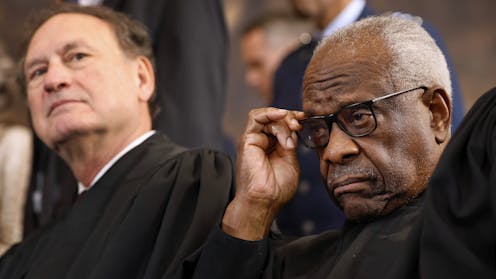
During the 2016 presidential election campaign, candidate Donald Trump took the unprecedented move of releasing a list of his potential Supreme Court nominees.
But Trump didn’t assemble this list himself. Instead, he outsourced the selection of his judicial appointments to leaders of the Federalist Society, an organization in the conservative legal movement.
As Trump explained in a 2016 interview, “We’re going to have great judges, conservative, all picked by the Federalist Society.”
This was a strategic decision by Trump. By turning to the Federalist Society, he was able to court conservative and evangelical voters who may have been otherwise uneasy with supporting the former New York City real estate mogul.
In his first presidential term, Trump appointed three justices affiliated with the Federalist Society – Neil Gorsuch, Brett Kavanaugh, and Amy Coney Barrett – in addition to hundreds of lower federal court judges. Federalist Society affiliates are current or former members of the organization, as well as individuals who interact with the group, such as by attending Federalist Society events, but who may not claim membership.
We are political science scholars who recently published research in a peer-reviewed journal showing that Supreme Court justices affiliated with the Federalist Society are more conservative and more consistently conservative than other justices, meaning they seldom deviate from their conservative voting behavior.
Our research suggests that, despite Trump’s recent criticism of the organization and its leadership, justices affiliated with the Federalist Society will advance the conservative legal agenda decades into the future. But this won’t always involve supporting Trump’s agenda.
Here’s what you should know, and why it matters.
The Federalist Society for Law and Public Policy Studies was founded in 1982 with the goal of providing intellectual spaces for conservative law students who felt their views were dismissed by the legal field. It has grown tremendously over the past 40 years. Today, it boasts more than 200 chapters and over 70,000 members.
Unlike other conservative public interest groups, it does not advocate for specific issue positions. Instead, it promotes its goals primarily through education and networking.
The Federalist Society’s educational mission is pursued chiefly in law schools. That’s where it trains the next generation of lawyers in the approaches and goals of the conservative legal movement. This includes promoting the judicial philosophy of originalism – the idea that the best way to interpret the U.S. Constitution is according to how it was understood at the time of its adoption.
Originalism is often used to justify conservative outcomes.
For example, Justice Clarence Thomas, a prominent member of the Federalist Society, has called for using originalism to reconsider Supreme Court precedents involving the right to contraception, same-sex marriage and same-sex consensual relations.

The Federalist Society network also connects junior members with more senior members, helping young lawyers obtain prestigious clerkships and positions in government and the legal profession. These lawyers tend to associate with the Federalist Society throughout their careers.
Federalist Society affiliates learn that promoting the group’s interest is also a way of promoting their self-interests as they move up in the legal world.
For Supreme Court justices, this networking has tangible benefits. For instance, Justice Samuel Alito accepted a luxury fishing vacation in 2008 organized by Leonard Leo, the former executive vice president and current co-chair of the Federalist Society. The estimated cost of the fishing trip was more than $100,000.
And Thomas was treated to decades of high-end vacations and private school tuition for his grandnephew – whom he raised as a son – by billionaire businessman Harlan Crow, a Federalist Society donor.
In short, the Federalist Society is a network of lawyers and judges who share a conservative outlook on the world and aspire to etch the conservative agenda into law through judicial decisions.
Our research sought to answer two interrelated questions. Are justices affiliated with the Federalist Society more conservative than nonaffiliated justices, and are they more consistently conservative?
To illustrate this, consider former Justice David Souter, whom President George H.W. Bush appointed in 1990 and who had no connections to the Federalist Society. Despite being a Republican appointee, Souter often voted with the court’s liberal members, such as upholding abortion rights in 1992. In 2005, he wrote the majority opinion in a ruling that prevented the Ten Commandments from being displayed in courthouses and public schools.

To determine whether justices affiliated with the Federalist Society are different from even other judges appointed by Republican presidents, we examined almost 25,000 votes cast by Supreme Court justices between 1986 and 2023. We started with 1986 because that’s when the first justice affiliated with the Federalist Society – Antonin Scalia – joined the high court.
We classified votes as conservative or liberal according to a well-established methodology. For example, conservative votes support the restriction of reproductive freedom, are anti-business regulation and generally disfavor policies that promote the rights of vulnerable populations, such as the LGBTQ+ community. Liberal votes do the opposite.
We found that justices connected to the Federalist Society are about 10 percentage points more likely to cast a conservative vote than other justices, even other justices appointed by Republican presidents. And they are more consistent in their voting behavior, seldom casting votes that go against their conservative values.
These findings have important implications. Justices on the modern Supreme Court serve for about a quarter century on average. And every current Republican-appointed member of the court is affiliated with the Federalist Society.
This means that Americans are likely to see justices affiliated with the Federalist Society advance the agenda of the conservative legal movement for decades to come. This has already happened in recent decisions that curtailed reproductive freedom, eliminated affirmative action in college admissions and expanded the powers of the president, including immunizing the president from criminal prosecution.
President Trump has recently had a high-profile breakup with the Federalist Society, calling Leo a “sleazebag” and expressing his disappointment with the organization.
Trump’s outburst followed a ruling by the U.S. Court of International Trade that blocked his sweeping tariff program against China and other nations. This happened despite one of Trump’s first-term judicial appointees sitting on the panel.
Notwithstanding this acrimony, this term will give justices affiliated with the Federalist Society the opportunity to further solidify the conservative agenda. Cases involving LGBTQ+ rights and federal elections are on the docket. And the court will be adding other important issue areas as it fills out its caseload for the 2025-26 term, which starts on the first Monday in October.

The authors do not work for, consult, own shares in or receive funding from any company or organization that would benefit from this article, and have disclosed no relevant affiliations beyond their academic appointment.
Politics + Society – The Conversation

Reading Time: 3 minutes
Kristin Cavallari is stirring up quite the discussion about co-sleeping.
The reality TV personality and conspiracy theorist isn’t debating the risks of an infant sleeping in an adult bed.
She’s talking about frequent sleepovers with her two preteens. (Not her teenage son)
Is this inappropriate? Is it stunting emotional development? Could Cavallari be onto something here? People’s takes are all over the place.
On Tuesday, August 26, Kristin Cavallari discussed co-sleeping with her kids on her Let’s Be Honest podcast.
The reality TV personality revealed that 11-year-old son Jaxon and 9-year-old daughter Saylor have these sleepovers with her “one night a week.”
It was not always such a rare occurrence.
Previously, Cavallari shared, the two would join her in bed “every other night … for a while.”
Cavallari explained that this cannot continue because she “can’t do” that now that the school year has started.
She affirmed that she does “enjoy” the company of her kids, she’s glad to “finally have time” for herself in the morning.
Alluding to her custody arrangement with ex-husband Jay Cutler, Cavallari acknowledged:
“Yes, I have every other weekend, but I also need a minute to myself!”

Additionally, Kristin Cavallari admitted that she has “a problem” because she wakes up before her children, and has to sneak around her own bedroom.
“I have to be so quiet in my bathroom, like, brushing my teeth, washing my face and getting dressed,” she described.
“I want to be able to have the freedom to move about my room and get dressed in the morning,” Cavallari expressed, “without worrying about waking someone up.”
According to Cavallari, Jaxon began crawling into her bad as a toddler and did so “every single night for four years” until finally moving into a room with his older brother, Camden.
Camden is now 13 and, understandably, does not appear to be a participant. She says that Jaxon has “always had FOMO.”
Those of us who would not have wanted to co-sleep with a parent at 9 or 11 might not relate to any of this.
Surely, even those who do would agree that most 11-year-olds would prefer that their mothers not broadcast this information.

Responses on social media are mixed, with some Reddit denizens praising Kristin Cavallari for “normalizing” this.
Obviously, not everyone agrees.
From people concerned about their social development to people who just prefer to sleep alone whenever possible, this is clearly not for everyone.
Our big takeaway? Jaxon turned 11 last spring and probably just started middle school.
This podcast episode is likely to haunt him.
Kristin Cavallari Admits to Frequently Co-Sleeping With Preteen Kids was originally published on The Hollywood Gossip.
The Hollywood Gossip