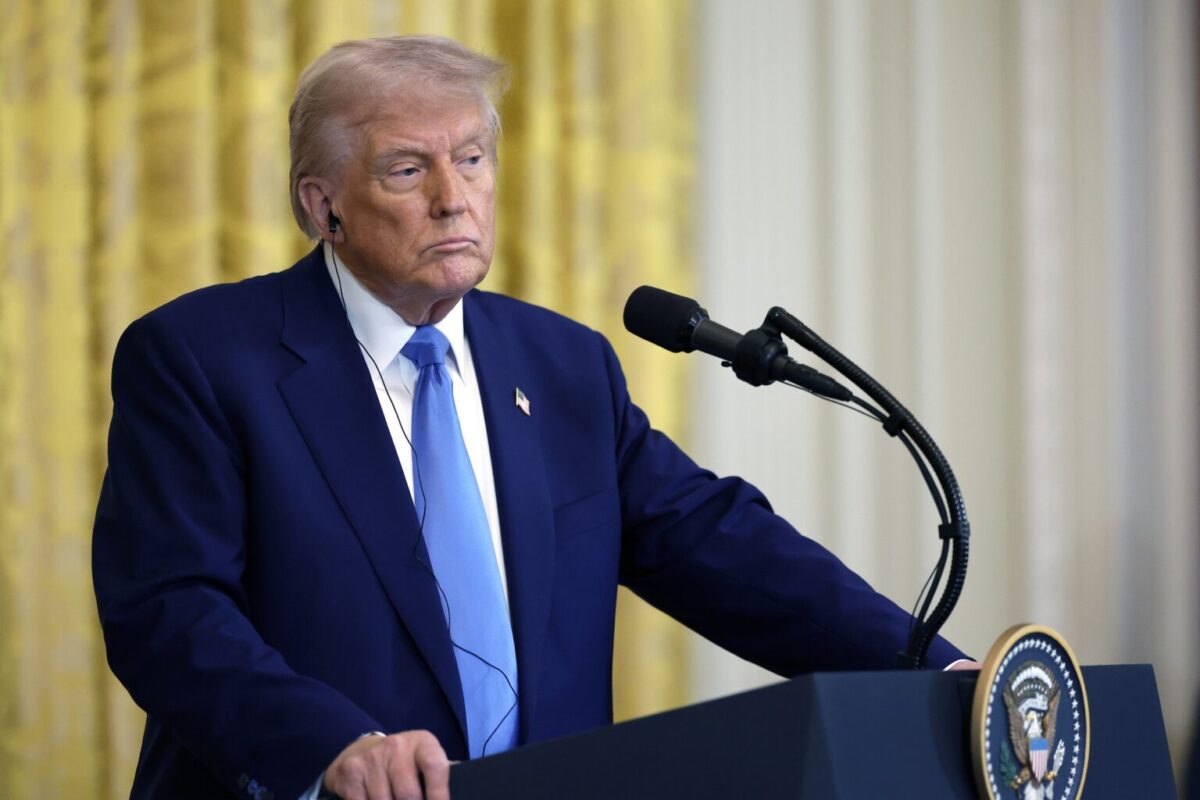
President Donald Trump delivers remarks during a joint press conference with French President Emmanuel Macron in the East Room at the White House on Feb. 24, 2025, in Washington, D.C. (Photo by Chip Somodevilla/Getty Images)
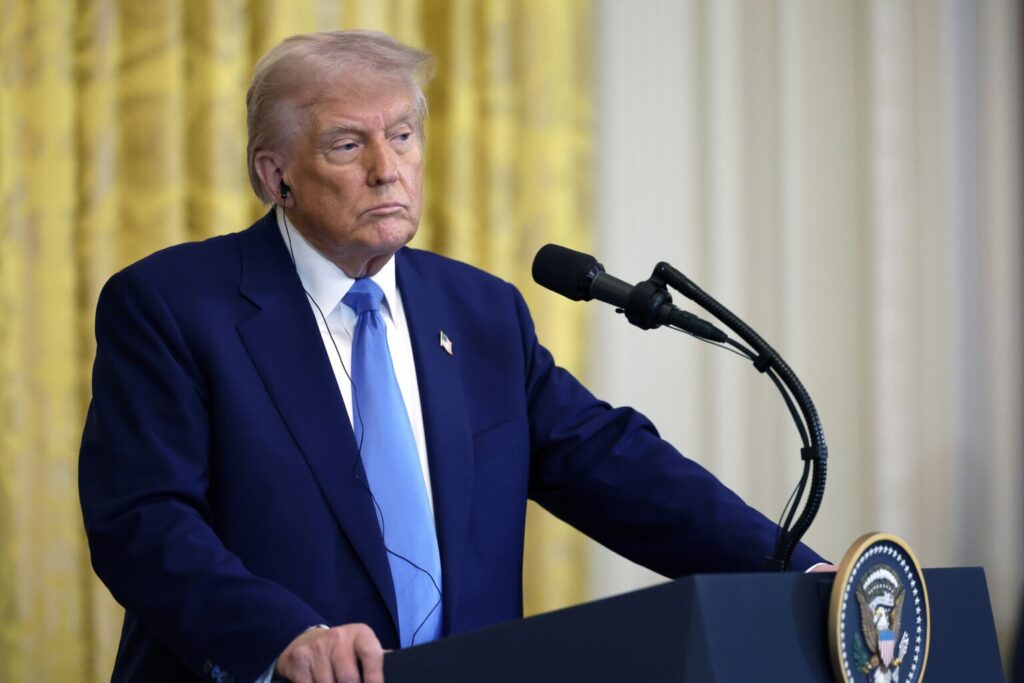
President Donald Trump delivers remarks during a joint press conference with French President Emmanuel Macron in the East Room at the White House on Feb. 24, 2025, in Washington, D.C. (Photo by Chip Somodevilla/Getty Images)
By James Brooks, Alaska Beacon
President Donald Trump will meet with Russian President Vladimir Putin on Aug. 15 in Alaska, Trump said in a social media post Friday.
The location, timing and other details were not immediately available. Staff for all three members of Alaska’s congressional delegation said they were unaware of the announcement ahead of time.
“The highly anticipated meeting between myself, as President of the United States of America, and President Vladimir Putin, of Russia, will take place next Friday, August 15, 2025, in the Great State of Alaska,” Trump wrote on Truth Social.
Trump has repeatedly said on social media that he is interested in negotiating with Putin in order to bring an end to the Russian invasion of Ukraine.
A drone image shows widespread flooding in the Mendenhall Valley. (Image courtesy of Rich Ross)
A drone image shows widespread flooding in the Mendenhall Valley. (Image courtesy of Rich Ross)
JUNEAU – The City and Borough of Juneau and the Central Council of the Tlingit & Haida Tribes of Alaska have issued coordinated emergency disaster declarations ahead of a potentially historic glacial lake outburst flood from Suicide Basin near the Mendenhall Glacier.
Hydrologic data shows the water level could exceed past records, prompting proactive action to protect lives, property, and infrastructure. Officials say while flood barriers are in place, no risks will be taken.
Tlingit & Haida Vice President Jackie Pata says this step ensures “every tool is in place before the water rises,” following last year’s devastating flood.
The declarations allow emergency teams to mobilize now, activate equipment, establish permitting, and to provide public alerts. City Manager Katie Koester says this year, “We’re not just responding, we’re ready.”
Residents are urged to stay informed and prepared for possible evacuation. Visit JuneauFlood.com or the CBJ website for updates and resources.
JUNEAU – Governor Mike Dunleavy has appointed Janelle Earls as acting commissioner of the Alaska Department of Revenue, effective immediately.
Earls steps in following the resignation of Commissioner Adam Crum, announced two weeks ago.
She currently serves as the department’s administrative services director, overseeing the agency’s budget, and brings over 20 years of state government experience.
Earls spent 13 years in leadership roles at the Department of Health and Social Services and joined Revenue in May 2024.
Earls will lead the department during the transition period until a permanent commissioner is named.
NOTN- The U.S. Coast Guard cutter Storis, the Coast Guard’s first polar icebreaker acquired in more than 25 years, will depart Auke Bay on Saturday for its scheduled transit to downtown Juneau, where it will be permanently berthed.
The Storis hosted free public tours Thursday and Friday and will host a media ride-along Saturday.
The Coast Guard will commission this first new icebreaker in 25 years during a ceremony in Juneau on Sunday.
The Coast Guard Cutter Storis will be officially commissioned at 9:30 a.m. at Peratrovich Plaza, 292 Marine Way, the service said. The event will also be streamed online.
Adm. Kevin Lunday, acting commandant of the Coast Guard, is scheduled to attend and take part in a media availability.
The vessel expands America’s operational presence in the Arctic and will support Coast Guard missions while the service awaits the delivery of the Polar Security Cutter class of ships.
It’s the second vessel in Coast Guard history to bear the name Storis. The vessel is manned with a hybrid crew consisting of military and civilian mariners.
The acquisition of the Storis was made possible through the Don Young Coast Guard Authorization Act of 2022 and fiscal year 2024 Congressional appropriations.
The Coast Guard operates more than 250 cutters, 200 aircraft and 1,600 boats to safeguard U.S. ports, waterways and maritime borders.
This undated image, provided by the National Oceanic and Atmospheric Administration, shows a mockup of the Surveyor, an ocean-floor-mapping ship under construction and scheduled to be homeported in Ketchikan. (NOAA image)
Next week, the National Oceanic and Atmospheric Administration is planning to host a ceremony in Louisiana to mark the start of construction on the NOAA ship the Surveyor, a new charting and mapping ship scheduled to be homeported in Ketchikan.
NOAA announced the keel-laying ceremony, scheduled for Aug. 14, by email.
The Surveyor is expected to be finished in 2027, and its sister ship, the Navigator, is expected to be finished in 2028.
NOAA operates a fleet of 15 charting, mapping and fisheries ships using an unarmed officer corps like a scientific version of the U.S. military. The Surveyor and Navigator will be used primarily for ocean mapping and nautical charting.
Two other deep-sea ships, the Oceanographer and Discoverer, are also under construction and are expected to be complete in 2026.
All four ships are part of an ongoing effort to keep the NOAA fleet afloat; as of 2023, the fleet’s average age was 30 years old, and six of the fleet’s current ships are expected to reach the end of their service life by 2030.
The ships will be built by Thoma-Sea Marine Constructors in Houma, Louisiana, under a $624.6 million contract that would allow NOAA to construct two more ships if funding is available.
A July 2025 CBS/YouGov poll asked Americans, “Do you approve or disapprove of the Trump administration’s program to find and deport immigrants who are in the U.S. illegally?”
The respondents were divided, with 49% of Americans approving and 51% disapproving.
But, as I’ll explain, that survey question addresses only part of the administration’s immigration enforcement agenda.
I’m a lawyer and former adviser to senior state officials in Florida, and to the Clinton and George W. Bush administrations. I also teach human rights and national security courses at Florida State University, including an interdisciplinary seminar called Refugees, Asylees & Migrants.
Immigration issues are complex. Discussing them is challenging, since key terms are often conflated and confused.
Clarifying these terms and their legal implications can help ensure people are talking about the same things – regardless of whether they agree about who should be in the country.
Some key immigration-related terms
Let’s start with terms describing different aspects of immigration.
Immigrant is a common term meaning a foreign national who intends to remain in the U.S. or another country where they weren’t born.
Migrant is a generic term that doesn’t have any specific legal meaning and is often used incorrectly as a synonym for immigrant.
Immigrants are considered documented if they’ve been issued an immigrant visa or a green card, thereby achieving lawful permanent resident status. Green cards and visas can be revoked – typically a consequence of certain criminal convictions. Visas allow foreign nationals to travel to a U.S. port of entry and request permission to enter but do not guarantee entry.
A lawful permanent resident generally can apply for U.S. citizenship after five years. This process is known as naturalization. In fiscal year 2024, 818,500 people were naturalized.
Once naturalized, revocation of U.S. citizenship – or denaturalization – is rare, traditionally resulting from fraud, omission during the application process or other extraordinary causes. Between 1990 and 2017, about 11 people annually had their naturalized citizenship revoked.
The Trump administration is reportedly expanding the scope of denaturalization and is being called out for allegedly weaponizing it against current political adversaries such as Elon Musk. However, denaturalization numbers remain low. The first Trump administration filed 102 denaturalization cases, and his current administration has filed five so far, according to NBC News.
Apart from immigrant visas, a variety of nonimmigrant or temporary visas are available.
For instance, there are visas for international students, although the Trump administration has expressed its intention to significantly restrict availability.
Attracting more politicalattention are foreign nationals who cross U.S. borders outside of an authorized checkpoint without asserting a credible claims for asylum. The Border Patrol recorded an historic high of 249,741 encounters with such migrants in December 2023. That figure dropped 77% by August 2024, according to a Pew Research Center analysis.
Being undocumented doesn’t necessarily mean a foreign national is in the U.S. illegally.
Some foreign nationals are admitted into the country without documentation. Asylum-seekers, also known as asylees, are people fleeing persecution in their home countries. They generally must present themselves to federal immigration authorities at a port of entry, or after entering the country by other lawful means, and eventually substantiate their claims.
Migrants escaping desperate economic circumstances are not eligible for asylum.
Refugees, like asylum-seekers, are fleeing a well-founded fear of persecution in their home countries and are protected under the 1951 Refugee Convention as amended by its 1967 Protocol. This identifies five forms of persecution for relief – race, religion, nationality, membership in a particular social group, or political opinion. In 1980, Congress passed and President Jimmy Carter signed the Refugee Act, which incorporated these international standards into U.S. law.
Unlike asylum-seekers, refugees apply for relief and substantiate their claims through the United Nations. They generally don’t get to choose whether or where they may be resettled.
Refugees and people granted asylum may seek lawful permanent resident status and eventually apply for U.S. citizenship.
Foreign nationals admitted into the U.S. as humanitarian parolees are undocumented initially, but their presence is authorized.
The federal government has historically used humanitarian parole to facilitate the admission of people from countries confronting significant violence or other compelling humanitarian crises when other processes are unavailable, overwhelmed or simply too slow.
For example, the U.S. launched a new humanitarian parole initiative in late 2022 to admit foreign nationals from Cuba, Haiti, Nicaragua and Venezuela.
Those granted temporary protected status, or TPS, by the federal executive branch are also believed to face extraordinary dangers if they return to their home countries. However, TPS can be granted only to foreign nationals who are already present in the U.S.
DACA recipients, or Dreamers, who arrived in the country without authorization as children, represent another protected category of undocumented foreign nationals legally living in the U.S. However, their status is uncertain due to ongoing litigation.
Mark Schlakman is Of Counsel to Rambana & Ricci, P.L.L.C., Immigration Attorneys, in Tallahassee, Florida.
Since World War II, the United States has repeatedly supported governments that have been committing mass atrocities, which are defined by genocide scholar Scott Straus as “large-scale, systematic violence against civilian populations.”
This includes U.S. support for Israel, which has remained consistent despite President Donald Trump’s recent disagreement with Prime Minister Benjamin Netanyahu over whether Palestinians are being starved in Gaza.
We are scholars of genocideand other mass atrocities, as well as international security. In our research for a forthcoming article in the Journal of Genocide Research, we analyzed official statements, declassified documents and media reports across four cases that involve U.S. support for governments as they were committing atrocities: Indonesia in East Timor from 1975 to 1999, Guatemala from 1981 to 1983, the Saudi-led coalition – known as the “Coalition” – in Yemen since 2015, and Israel in Gaza since October 2023.
We identified six rhetorical strategies, which are ways of talking about something, used by U.S. officials to publicly distance the U.S. from atrocities committed by those who receive its support.
This is significant because when Americans, as well as others around the world, accept such rhetoric at face value, the U.S. can maintain impunity for its role in global violence.
Feigned ignorance
When U.S. officials deny any knowledge of atrocities perpetrated by parties receiving U.S. support, we call that feigned ignorance.
For example, after the Coalition bombed a school bus in Yemen, killing dozens of children, U.S. Sen. Elizabeth Warren asked Gen. Joseph Votel whether the U.S. Central Command tracks the purpose of the missions it is refueling.
His response: “Senator, we do not.”
This proclaimed ignorance stands in stark contrast with well-documented Coalition war crimes since 2015. As Yemen expert Scott Paul put it, “No one can feign surprise when lots of civilians are killed anymore.”
Obfuscation
When evidence of atrocities can no longer be ignored, obfuscation is used by U.S. officials, who muddle the facts.
When Indonesian forces carried out massacres in 1983, killing hundreds of civilians, the U.S. Embassy in Jakarta sent a telegram to the secretary of state and multiple U.S. embassies, consulates and missions questioning the reports because they had “not received substantiation from other sources.”
‘I know that President Ríos Montt is a man of great personal integrity and commitment,’ said U.S. President Ronald Reagan after meeting with the Guatemalan president in 1982.
In its 1982 report on human rights in Guatemala, for example, the State Department claimed, “Where it has been possible to assign responsibility [for killings in Guatemala] it appears more likely that in the majority of cases the insurgents … have been guilty.”
Reports of state atrocities and abuses in Guatemala can be found in U.S. intelligence documents from the 1960s onward. One 1992 CIA cable explicitly noted that “several villages have been burned to the ground” and that the “army can be expected to give no quarter to combatants and noncombatants alike.”
Negation
As evidence of atrocities continue to mount, as well as evidence of who is responsible, U.S. officials have often turned to negation. They don’t deny that U.S. aid is being provided, but rather argue that it was not directly used in the commission of atrocities.
For example, during Indonesia’s atrocities in East Timor, the U.S. was actively training members of Indonesia’s officer corps. When Indonesian security forces massacred as many as 100 people at a cemetery in Dili in 1991, the George H.W. Bush administration’s reaction was simply to say that “none of the Indonesian military officers present at Santa Cruz had received U.S. training.”
Diversion
When public scrutiny of U.S. support reaches levels no longer easily dismissed, U.S. officials may turn to diversion.
These are highly publicized policy adjustments that rarely involve significant changes. They often include a form of bait-and-switch. This is because the aim of diversion is not to change the behavior of the recipient of U.S. aid; it is merely a political tactic used to placate critics.
More recently, responding to both congressional and public criticism, the Biden administration paused the delivery of 2,000-pound and 500-pound bombs to Israel in May 2024 – but only briefly. All its other extensive weapons transfers remained unchanged.
When atrocities committed by recipients of U.S. support are highly visible, U.S. officials also use aggrandizement to praise their leaders and paint them as worthy of assistance.
Similarly, Guatemala’s leader Ríos Montt was portrayed by Reagan in the early 1980s as “a man of great personal integrity and commitment,” being forced to confront “a brutal challenge from guerrillas armed and supported by others outside Guatemala.”
These leaders are thus presented as using force either for a just cause or only because they are faced with an existential threat. This was the case for Israel, with the Biden administration stating Israel was “in the throes of an existential battle.”
This aggrandizement not only morally elevates leaders but also justifies the violence they commit.
Indonesian President Suharto, left, visiting President Bill Clinton in 1993, was praised by Clinton administration officials as ‘our kind of guy’ despite being responsible for the deaths of more than 700,000 people in his country. Kazuhiro Nogi/AFP via Getty Images
Quiet diplomacy
Finally, U.S. officials also often claim to be engaging in a form of quiet diplomacy, working behind the scenes to rein in recipients of U.S. support.
Importantly, according to U.S. officials, for quiet diplomacy to succeed, continued U.S. support remains necessary. Therefore, continued support for those committing atrocities becomes legitimized precisely because it is this relationship that allows the U.S. to influence their behavior.
In East Timor, the Pentagon argued that training increased “Indonesian troops’ respect for human rights.” When a U.S.-trained Indonesian military unit massacred about 1,200 people in 1998, the Defense Department said that “even if American-trained soldiers had committed some of the murders,” the U.S. should continue training to “maintain influence over what happens next.”
U.S. officials also implied in 2020 that Yemenis under attack from the Coalition, led by Saudi Arabia, are advantaged by U.S. arms support to the Coalition because the support gave the U.S. influence over how the arms are used.
In the case of Gaza, U.S. officials have repeatedly referenced quiet diplomacy as promoting restraint, while seeking to block other systems of accountability.
For example, the United States has vetoed six United Nations Security Council resolutions on Gaza since October 2023 and has imposed sanctions on five International Criminal Court judges and prosecutors because of arrest warrants issued against Netanyahu and former Israeli Defense Minister Yoav Gallant.
Distancing and minimizing
U.S. officials have long used a variety of rhetorical strategies to distance the country from, and minimize its contributions to, atrocities committed by others with U.S. support.
With these strategies in mind, Trump’s acknowledgment of “real starvation” in Gaza can be viewed as a diversion from unchanged U.S. support for Israel as famine conditions in Gaza worsen and Palestinians are killed while waiting for food.
From feigning ignorance to minimizing violence and praising its perpetrators, U.S. governments and presidents have long used deceptive rhetoric to legitimize the violence of leaders and countries the U.S. supports.
But there are two necessary elements that allow this framing to continue to work: One is the language of the U.S. government; the other is the credulity and apathy of the public.
The authors do not work for, consult, own shares in or receive funding from any company or organization that would benefit from this article, and have disclosed no relevant affiliations beyond their academic appointment.
Surveys consistently show that millions of American voters feel they lack real choices. They believe the two major parties don’t reflect their values, and they are exhausted by the constant polarization.
The bigger question isn’t whether Musk succeeds. As a public policy scholar, I think it’s why the U.S. political system is so hostile to new voices and ideas in the first place.
Why third parties rarely succeed
If he follows through on his idea, can Musk’s America Party actually take off? Probably not. History isn’t on his side.
That’s because the U.S. political system is structurally rigged against third parties, with deeply entrenched legal and procedural barriers that make it nearly impossible for new parties to gain traction.
In most states, getting a new party on the ballot is a formidable task. It involves gathering thousands of signatures, meeting stringent deadlines and complying with obscure filing requirements.
Even if a party gets on the ballot in one state, replicating that effort nationally is extremely hard. Each state has different laws, deadlines, signature requirements and legal demands.
Ballot access, campaign finance, media coverage and election rules overwhelmingly favor the existing Republican and Democratic parties. Even the Federal Election Commission is designed for partisan deadlock with an even number of members from each of the two major parties.
In a 2025 article on election administration in America, my colleagues and I analyzed all 50 state election codes. We found widespread legal and administrative barriers that systematically exclude independents and minor parties.
In 45 states, only major party members can serve on election boards, local or state bodies responsible for overseeing the administration of elections. In 27 states, judges must be registered with a major party. Campaign finance laws, access to voter data and registration rules also tilt the field to the major parties.
These structural barriers exist in both red and blue states. We found no statistical correlation between partisan leanings and these restrictions. That’s telling. It suggests that both parties, regardless of their ideological differences, are united in protecting their duopoly.
This entrenched two-party control runs contrary to the vision of the U.S. Constitution’s framers, who intentionally excluded political parties from the founding document.
George Washington in 1796 warned that parties would inflame animosity and that the nation could not do enough to protect itself from this. John Adams worried that “a division of the republic into two great parties … is to be dreaded as the great political evil.” Likewise, Alexander Hamilton feared parties as “the most fatal disease” of government and hoped America could dispense of such groups.
An appetite for alternatives
Enter Elon Musk. His suggestion to create the America Party taps directly into a growing national frustration with the two-party entrenchment.
Public trust in major political parties is at historic lows, particularly among young voters and independents, who do not identify with any major party and may register as “no party preference,” “unaffiliated” or “independent” depending on state laws.
Even if Musk never follows through, the idea of a new party highlights how undemocratic U.S. elections have become. It opens the door to conversations about reforms that give independents and third parties a fair shot and reflects the growing demand for alternatives to the two-party system.
Voters are frustrated by limited choices that fail to capture their full range of political views.
There are models to learn from. Most democracies use a nonpartisan election administration and don’t let political parties control the rules.
In the U.S., partisans referee contests in which members of their party directly compete. That conflict of interest would be unacceptable in business or sports. So why is it tolerated in elections?
Structural reforms and designs have been implemented to varying degrees in the U.S. with a goal of making democracy more responsive, fair, transparent and representative.
So, too, have ranked-choice voting and fusion voting. In ranked-choice voting, voters rank candidates by preference. If no one gets a majority, the lowest-ranked candidates are eliminated and votes are redistributed until someone wins. In fusion voting, multiple political parties can endorse the same candidate, who then appears on the ballot under each endorsing party’s line.
However, implementation of such reforms has been limited. Opposition to these reforms by the Democratic and Republican parties has, in many cases, been fierce.
It’s the system
The two-party system has insulated itself from competition.
The consequence is that today America has an impenetrable two-party system, the very scenario the framers and reformers feared most. Rather than focusing solely on Musk’s ambitions, the more pressing question is how to build an electoral system that reflects a modern, diverse democracy.
If Americans want more choices, and polling suggests they do, then they may want to examine the legal and procedural barriers that lock in the current system, which fails to address and accommodate their political preferences.
Thom Reilly does not work for, consult, own shares in or receive funding from any company or organization that would benefit from this article, and has disclosed no relevant affiliations beyond their academic appointment.
First came love, then came marriage, but a pregnant Gwen Stefani? Is that really a possibility?
Ever since Gwen and Blake Shelton got together, fans have been eager for them to start a family of their own.
Rumors have been flying for years, with “sources” suggesting everything from medical miracles to secret pregnancies and beyond.
On the flip side, there have also been reports that the pair are headed for a split, but we choose to ignore that noise.
So, is Gwen Stefani, who turns 55 in October, pregnant? Let’s discuss what we know.
Blake Shelton, his wife Gwen Stefani and her children pose during his Hollywood Walk of Fame Star ceremony, in 2023. ((Photo by FREDERIC J. BROWN/AFP via Getty Images))
Gwen Stefani & Blake Shelton Love Being Parents
Gwen Stefani and Blake Shelton started dating in late 2015, shortly after both of them divorced their respective spouses.
While they seemingly had nothing in common, it was clear from the start that they were perfectly aligned when it came to the importance of family.
Gwen gave birth to three children with her ex, Gavin Rossdale: Kingston, Zuma and Apollo.
Meanwhile, Blake had no children of his own with his ex-wife, Miranda Lambert. In fact, some insiders suggested that the lack of kids was the reason for their split.
From the moment Blake joined the family, it was clear he was eager to be a role model for Gwen’s boys and took to being a “stepdad” even before it was official.
In fact, he’s become such a mentor to the boys, he’s even started helping them launch their own musical careers! How about that!
Gwen Stefani pregnant in 2006 with her then husband Gavin Rossdale at the Grammys ((Photo by Stephen Shugerman/Getty Images))
Is Gwen Stefani Pregnant with Blake Shelton’s Child?
Cards on the table: no, Gwen isn’t pregnant. At least, not that she has announced.
But it’s not completely out of the question that these two will still have a kid together – especially since they have been trying for over 7 years!
Gwen and Blake did not get married until 2021, but for years before that, it was reported that the pair were “hyper-focused on getting pregnant.”
Insiders close to the couple told outlets like Us Weekly that their bond was so strong, Blake and Gwen put having a kid ahead of getting married for many years.
Blake Shelton and Gwen Stefani attend the 48th Annual AFI Life Achievement Award Honoring Julie Andrews at Dolby Theatre on June 09, 2022 in Hollywood, California. (Photo by Emma McIntyre/Getty Images for TNT))
“They believe there is still a chance for Gwen,” said an Shelton insider. “They are incredibly hopeful.”
Despite having 3 successful pregnancies, Gwen was in her late 40’s when she started dating Blake.
While celebs like Janet Jackson welcomed children into their 50’s, insiders explained that Gwen needed some help if she was going to conceive.
“Gwen would love to get pregnant, things with Blake are so perfect, having a baby with him would be the icing on the cake.,” a Gwen insider told HollywoodLife.com.
“She’s a big believer in alternative medicine so she wants to do it in the most natural way possible. She’s been getting acupuncture and working with a Chinese herbalist to increase her fertility.”
Gwen Stefani and Blake Shelton attend the 62nd Annual GRAMMY Awards at STAPLES Center on January 26, 2020 in Los Angeles, California. ( (Photo by Emma McIntyre/Getty Images for The Recording Academy))
However, as we know, as of 2024, any attempts to have a baby have not proven fruitful yet.
Still, there is always adoption and surrogacy. And ,with them both off The Voice now, there would be no real time to focus on a family.
Gwen Stefani Loves Being A Mother
“I waited my whole life to be a mom. That’s all I wanted, my entire life”
The rock star mom appeared on a 2024 episode of The Skinny Confidential Him & Her Show‘s podcast, and she discussed how hard it was to juggle her kids while working, even though she loved being a mom.
From working on her solo album to touring with No Doubt, Kingston was always by her side.
“It just felt so real and right. I got so ripped off on that tour because I was so sick. I ended up taking the baby when he was 9 months and going and doing a world tour, like 120 shows … We’re in a hotel one day and I thought that I had to stop nursing because I was like, ‘How am I going to nurse and be on stage?’”
Blake Shelton and Gwen Stefani attend the 2023 CMT Music Awards at Moody Center on April 02, 2023 in Austin, Texas. (Photo by Jason Kempin/Getty Images)
With all that said, Gwen had thought, once upon a time, that she was too old to have another child. Then her oldest, Kingston started asking her to have another sibling.
“I was like, ‘I’m too old. I’m not having any more babies. I’m sorry, love,’ ” she said. “He just wanted a baby, so he would start praying every night for this baby. Four weeks later, praying every night like, ‘Please, let my mom have a baby,’ and I’m pregnant with Apollo.”
Gwen calls that pregnancy a miracle. She also admits she’s been lucky enough to have 3 miracles happen in her lifetime.
“[Hosting The Voice] was the second miracle. The first miracle was getting pregnant. The second was The Voice. And then the third was, obviously, meeting Blake.”
Perhaps a fourth miracle is due? Fourth baby, fourth miracle – stranger things have happened!
Sometimes, rumors about Zendaya and Tom Holland are just wishful thinking. Or thirst. Or both.
That said, sometimes these claims about the talented actress turn out to be true. It happens!
So what about this time? Is Zendaya pregnant?
Zendaya attends the Louis Vuitton Paris Womenswear Spring-Summer 2025 show as part of Paris Fashion Week on October 01, 2024. (Photo Credit: Pascal Le Segretain/Getty Images)
Is Zendaya pregnant?
In early August of 2025, Zendaya appeared in an advertisement.
She and Law Roach are part of a new ad campaign for On!
It is good to remember that, though most of us know her first and foremost as an immensely talented actress, Zendaya is also a fashion icon.
As you can see in this clip, however, which circulated around social media, Zendaya is wearing a puffy jacket.
Now, there are plenty of reasons to wear a puffy jacket. They can be stylish. They can let you carry things in pockets. And some people, for whatever reason, feel “cold” in air conditioned buildings — even in the height of summer.
Across social media, people have (once again) begun to speculate that Zendaya is pregnant and hiding a baby bump. Fans are jumping with presumptuous joy. And some thirsty individuals are lamenting that they missed a “chance” that they never had with her in the first place.
Zendaya attends the 2024 Rock & Roll Hall Of Fame Induction Ceremony streaming on Disney+ at Rocket Mortgage Fieldhouse on October 19, 2024. (Photo Credit: Arturo Holmes/Getty Images for The Rock and Roll Hall of Fame)
Wasn’t there similar speculation back in 2022?
In June of 2022, a fan of Zendaya’s took to TikTok to spread pregnancy rumors about her. This claim soon spread to Twitter (this was before the platform’s cringe renaming).
Just like now, many fans were excited for her and for hunky boyfriend Tom Holland. And many thirsty individuals wailed to the heavens that they’d missed out.
It was a rare moment when Zendaya spoke up to quash the pregnancy rumor.
In June 2022, Zendaya took to her Instagram Story to debunk a wild claim that she was pregnant. She blamed Twitter, though the rumor originated on TikTok. (Image Credit: Instagram)
“See now, this is why I stay off Twitter,” Zendaya wrote on her Instagram Story at the time, erroneously blaming the wrong platform. “Just making stuff up for no reason … weekly”
She is not entirely wrong. Many people do simply fabricate wild claims, or circulate dubious ones because it’s more exciting than waiting for the truth.
People will also say things to sort of parody this trend. One common one? People declaring that Zendaya has impregnated Tom Holland. Sometimes, social media is a beautiful place.
As we all know, Zendaya is many things. But there is no evidence at this time that she is pregnant.
Furthermore, the video above — part of the exact same campaign as the earlier video with Law Roach — shows her wearing a body suit. If she has a baby bump, where exactly is she hiding it?
If Zendaya — or, perhaps less likely, her fiance Tom Holland — were to become pregnant, we don’t know if or when she’d share the news. But she probably wouldn’t soft launch it in a fashion campaign in the middle of filming a new movie.