Juneau’s proposed new Civic Center, photo from capitalciviccenter.org
Juneau is actively planning and moving forward with the construction of a new Capital Civic Center, according to the project’s executive director Bob Banghart the Civic Center’s purpose is to provide Alaska’s Capital City with an essential and vibrant community cultural and conference center located within the Áak’w Village Arts and Culture District.
“‘I’ll take us back to the early 80s, when Centennial Hall was first being designed and built.” Said Banghart, “Centennial Hall was built as it is, with an idea that there would be an addition later that would support performing arts and the arts itself. So about 10 years ago, a group of people got together to say, we need to do this.”
According to Banghart, the process of designing the new Civic Center started with an independent standalone building in the vicinity of Centennial Hall, but the group kept running into opposition, “We started listening to the different, diverse voices in the community, and then pandemic hit us.” Said Banghart, “during that process, the city approached us and said, what if we were to join the two buildings together and see about looking for some synergy that could be generated there. So the city put up some money, and we did just that, we designed a facility that conjoined what we had programmatically in the standalone building with Centennial Hall.”
The project has overcome significant challenges in recent years, including high construction costs and community opposition.
“In August last year, we came up with an idea, and we shopped it around. Took a lot of evaluation of it. People were saying, we like this, we don’t like that.” Said Banghart, “predominantly, we were looking at just joining the two buildings together with a large common space that proved to be, again, non-viable because it completely eradicated all the local parking in the area, and the cost to operate was looking like it might be outside the boundaries that we were able to afford.”
The proposed facility, an addition to the existing Centennial Hall, will feature a 299-seat professional theater, expanded lobby space, a gallery, and a flexible “black box” performance area.
Banghart described the project as a strategic response to community needs. “We’ve designed a facility that not only meets current event management challenges but creates new opportunities for community gatherings,” Banghart explained.
The $60 million project has already secured significant community support, with over 140 local donors contributing more than $10,000.
In terms of timeline, Banghart says he’d love to see the Civic Center break ground in 2027, “That’s funding pending right? the city is not on the hook to do any of that, other than what they’ve already contributed, contrary to some people’s beliefs, we are on a full court press to raise the money. We’ve been having some very strong successes.” Banghart said “So we’d love to see it happen in 27, we’ll see the documents completed next year.”
Though Banghart says there’s uncertainty on the federal end of things, he’s optimistic about contributions from the Coast Guard, “they’ve been very positive. They see a lot of application for the building’s use. We’re right across the street from them.”
The City and Project, the founding nonprofit, are jointly managing the Civic Center project, sharing design phase costs.
Interested community members can follow the project’s progress at capitalciviccenter.org.
Linda Churchill carefully works on July 10 to finish painting the Bear up the mountain Totem
For the first time in 38 years, the Wrangell Native community has raised new totem poles in town, with four days of events planned Thursday through Sunday, July 17-20.
Unveiling the five new poles marks a significant revival of a centuries-old Tlingit tradition. The event honors the carvers and apprentices who transformed logs into cultural masterpieces, continuing a legacy nearly lost to time.
By the early 1900s, most of the town’s 30 to 40 totem poles had decayed or fallen, and the art of pole carving faded. The last totem pole raised in Wrangell was the Sun House Totem in 1987, carved by Steve Brown and Wayne Price, according to organizers of this week’s events.
Last week’s celebration symbolized a broader cultural resurgence that began with the 2013 rededication of Chief Shakes House and the 2015 completion of the WCA’s Carving Shed on Front Street, the organizers explained.
Each pole tells a story rooted in Tlingit and Haida traditions:
Bear Up The Mountain Pole: A Naanya.aayí X’atgu Hít narrative of survival during a great flood.
Gunakaadeit Pole: A Naanya.aayí X’atgu Naasí Hít tale of a man using a sea monster’s skin to feed his community.
Underwater Sea Bear Pole: A Sik’nax.ádi legend of a mythical good-luck creature.
Killer Whale Grave Marker: A Kayaashkeiditaan tribute to Shx’atoo, who died during the U.S. Army’s 1869 bombardment of the Native village at Wrangell.
Kadashan Pole: A replica of a 1940 pole, originally gifted by Haida relatives to honor intermarriage with Tlingit women in the 1830s.
Master carvers and apprentices
Leading the project are master carvers:
Joe Young (Haida, Yahgw’laanaas clan), who learned from his grandfather Claude Morrison and carved the Bear Up The Mountain and Gunakaadeit poles.
Tommy Joseph (Tlingit, Kaagwaantaan clan), a renowned woodcarver behind the Underwater Sea Bear Pole.
TJ Young (Haida, Yahgw’láanaas clan), lead carver for the Kadashan pole.
Apprentice carvers, including Mike Hoyt, Tony Harding, Linda Churchill and Susie Beebee, also contributed, ensuring the tradition’s future.
“What an incredible experience to witness the community, literally pulling together to stand Kadashan pole in Totem Park.” Tlingit &Haida said in a Facebook post.
“This is more than art – it’s healing,” said Joe Young. “We’re reclaiming our history.”
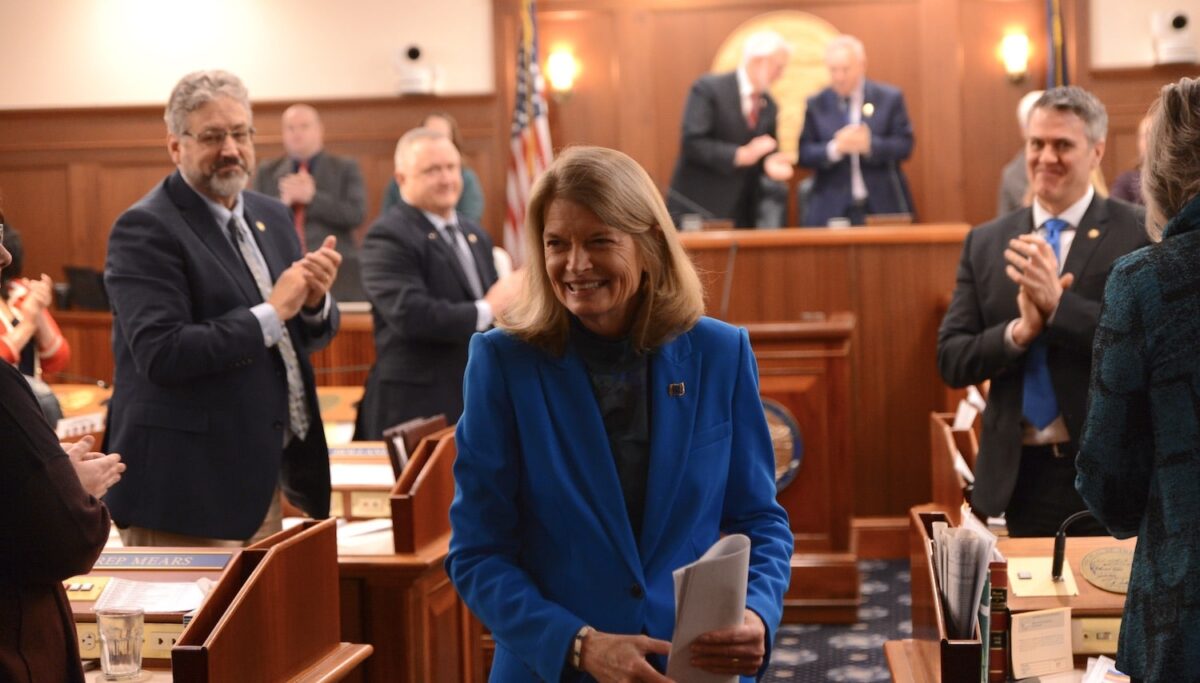
Sen. Lisa Murkowski, R-Alaska, smiles on Tuesday, March 18, 2025, as she exits the Alaska House of Representatives following her annual address to the Alaska Legislature. (Photo by James Brooks/Alaska Beacon)
By: James Brooks, Alaska Beacon
Sen. Lisa Murkowski, R-Alaska, smiles on Tuesday, March 18, 2025, as she exits the Alaska House of Representatives following her annual address to the Alaska Legislature. (Photo by James Brooks/Alaska Beacon)
Speaking in an interview on Friday, Alaska Sen. Lisa Murkowski said President Donald Trump’s health care-cutting budget plan was destined to pass Congress, and her decisive vote on the package last month represented the best of a bad pair of options.
In a new analysis published Monday by the nonpartisan Congressional Budget Office, Republicans’ “big, beautiful” law is estimated to add almost $3.4 trillion to the federal debt over the next decade and cause 10 million Americans to lose access to health insurance.
Murkowski said she believes that had she opposed the law, Republican senators would instead have sought a 50th vote from Kentucky Republican Sen. Rand Paul, and the result would have been deeper cuts to the federal budget, including to health care.
“What he was looking for was dramatically more cuts to Medicaid, dramatically greater reductions in spending,” Murkowski said. “And so it was no secret that the bill was going to pass. It was just a question of whether or not it was going to pass with Senator Paul’s vote, or with Senator Murkowski’s vote.”
In a column published July 3 by the Louisville Courier-Journal, Paul wrote, “They could have had my vote and saved money but instead chose more spending and tax and welfare changes targeted at Alaska at the cost of the fiscal sanity of our country.”
Murkowski, echoing comments made previously by Alaska Sen. Dan Sullivan, who also voted for the proposal, said she was disappointed that several provisions benefiting Alaska were stricken by the Senate parliamentarian after objections from Senate Democrats.
Those included large subsidies for the state’s Medicaid program and a new split of oil revenue from federal land on the North Slope, with 90% going to the state and 10% to the federal government.
Voting on the budget package began before the parliamentarian ruled on all aspects of it.
“And so we didn’t know what was in and we didn’t know what was not in,” Murkowski said.
During the process, the 90-10 split dropped to 70-30, and state-specific benefits for Alaska disappeared.
Afterward, one provision that survived — a concession for wind and solar projects — was quashed by executive orders issued by President Trump.
Speaking to the Anchorage Daily News on Friday, Murkowski said she feels “cheated” by the maneuver.
Speaking to the Alaska Beacon, she said, “I have been criticized. I have been hung out to dry. But you know what? At the end of the day, I fought for my constituents as best I knew how, and I should never, and I will never, apologize for doing the best that I can by them.”
In her last three Alaska U.S. Senate elections, Murkowski defeated more socially conservative candidates with the support of Democrats and independents.
On social media, after her vote in favor of the Republican budget plan, many of those voters voiced their disapproval.
Asked about that disappointment, Murkowski said she understands and hears that criticism.
“I get the fact that they want me to be principled on this. But if it costs Alaskans — which it would have — then how is that doing my job for them? … At the end of the day, I couldn’t kill it, and I understand that people might not believe that, but again, what I set out to do was try to make improvements to a measure that started out in a place that would have … made it very challenging for too many Alaskans.”
Murkowski said she expects the Trump administration to propose more retroactive budget cuts akin to the one that passed last week involving foreign aid and the Corporation for Public Broadcasting.
Sullivan voted in favor of the cut; Murkowski opposed it.
Afterward, Trump budget director Russ Vought said he wants congressional Republicans to get more partisan in the budget process and that lawmakers should expect more “rescission” votes like last week’s.
Murkowski said she hopes other Republicans will join her in rejecting that call.
“I would like to think that it’s comments like that, that would galvanize us as appropriators, galvanize us as Republicans and Democrats in the United States Senate,” she said. “Our oath is to the Constitution. We would say we’ve got our job to do here, and we know that in order to do it and have it be enduring, it takes 60 votes, and so we need to be more bipartisan and not more partisan. To me, it was absolutely offensive, his statement, and so arrogant.”
U.S. Immigration and Customs Enforcement officers gather for a briefing before an enforcement operation on Jan. 27, 2025, in Silver Spring, Md. Associated Press
“They’re in unmarked vans, wearing masks, being shipped off to foreign torture dungeons, no chance to mount a defense, not even a chance to kiss a loved one goodbye, just grabbed up by masked agents, shoved into those vans, and disappeared,” Walz added.
ICE, tasked with enforcing immigration policies, has dramatically increased the number of nationwide arrests of immigrants since President Donald Trump returned to office in January 2025. ICE’s arrests of immigrants have more than doubled in 38 states since then.
The Gestapo arrests a group of Jewish men hiding in a cellar in Poland in 1939, in what was possibly a staged German propaganda photo. Keystone/Hulton Archive/Getty Images
Understanding the Gestapo
The Nazi regime established the Gestapo, short for the German phrase Geheime Staatspolizei, meaning secret state police, soon after Hitler became chancellor of Germany in January 1933. Among other responsibilities, the Gestapo was tasked with investigating political crimes and monitoring opposition activity. It later enforced racial laws in Germany and across occupied Europe.
As part of its daily work, the Gestapo identified and monitored the regime’s political enemies. It arrested, interrogated, detained and tortured suspects and sent others to concentration camps. To identify suspects, it often relied on anonymous denunciations that came not only from zealous Nazis, but also from disgruntled neighbors or business competitors who tipped off the Gestapo to Jews and other people.
While the Gestapo was relatively small in terms of personnel, it projected an image of being, as one scholar wrote, “omniscient, omnipotent, and omnipresent.”
It enforced the regime’s will and suppressed dissent not through sheer manpower but by creating a pervasive sense of fear. This aura of menace and terror has long outlived the Nazi regime itself.
ICE is set to expand its work in the next few years with an additional US$75 billion in funding that Congress appropriated in July as part of Trump’s tax and spending bill.
And while ICE focuses on immigration, the Gestapo had a more expansive role. It was responsible for suppressing all forms of political dissent, not just violations of immigration law.
There is technically more transparency around ICE’s work than the Gestapo’s, since ICE is a federal agency that is subject to its work and information being reviewed by politicians and the public alike. But in June 2020, the first Trump administration reclassified ICE, which is part of the Department of Homeland Security, as a “security/sensitive agency.” This designation makes it harder for people to request and receive information about ICE’s work through Freedom of Information Act records requests.
Since World War II and the fall of the Nazi regime, the term Gestapo has become shorthand in the United States to describe police repression.
Using the word Gestapo to describe the worst possible authoritarian oppression has been popularized in popular movies in everything from the 1943 film “Casablanca” and “The Black Gestapo” in 1975 to “Inglourious Basterds” in 2009 and “Jojo Rabbit” in 2019.
Walz’s remarks in May, though provocative, were also far from isolated in politics. Politicians from both sides of the aisle, as well as political observers, regularly use Gestapo and Nazi metaphors to attack their opponents.
In 2022, Rep. Marjorie Taylor Greene of Georgia famously confused the term Gestapo with gazpacho soup in a gaffe that went viral. “Now we have Nancy Pelosi’s gazpacho police spying on members of Congress,” she said.
In 2024, Trump accused President Joe Biden of running a “Gestapo administration” as the Justice Department prosecuted Trump for attempting to overturn the 2020 election.
Overall, mentions of the word Gestapo in social media increased by 184% between 2017 and 2024, according to the nonprofit group Foundation to Combat Antisemitism.
The U.S. Holocaust Memorial Museum is among the organizations that have condemned making comparisons to the Holocaust and the Nazis for many reasons, including their historical inaccuracy and because they are insulting to people whose families remain scarred by the Holocaust.
A Paraguayan woman whose relative was detained by ICE agents scuffles with officers in the halls of an immigration court in New York City on July 16, 2025. Spencer Platt/Getty Images
What historical comparisons really say
Analogies can be useful for clarifying complex ideas. But especially when they stretch across decades and vastly different political contexts, they risk oversimplifying and trivializing history.
I believe that comparing ICE to the Gestapo is less a historical judgment than a reflection of modern anxiety – a fear that the U.S. is veering toward authoritarianism reminiscent of 1930s Germany.
If politicians and other public figures are looking for historical comparisons to modern law enforcement agencies that use severe tactics, there is, unfortunately, no shortage of options: the Soviet Union’s secret police agencies NKVDand KGB, Iran’s former secret police and intelligence agency SAVAK or East Germany’s Stasi, to name just a few.
All of those organizations denied suspects due process and grossly violated human rights in order to protect political regimes – but they don’t necessarily easily compare to ICE, either.
Still, politicians and political observers alike most often turn to the Gestapo and other Nazi references instead.
Ultimately, the Gestapo, Nazi Germany and the Holocaust serve as a powerful, shared cultural reference point. The catastrophes of World War II epitomize the worst possible outcomes of evil left unchecked.
They have become the master moral paradigm and an ethical compass for the world today. In an age of polarization, World War II and the Holocaust remain the mirror in which Americans examine their present.
Daniel H. Magilow received funding from the National Endowment for the Humanities (although DOGE cancelled the grant in April 2025).
He serves as Co-Editor-in-Chief of Holocaust and Genocide Studies, the journal of the United States Holocaust Memorial Museum’s Jack, Joseph and Morton Mandel Center for Advanced Holocaust Studies
Congress’ cuts to public broadcasting will diminish the range and volume of the free press and the independent reporting it provides.MicroStockHub-iStock/Getty Images Plus
Champions of the almost entirely party-line vote in the U.S. Senate to erase US$1.1 billion in already approved funds for the Corporation for Public Broadcasting called their action a refusal to subsidize liberal media.
“Public broadcasting has long been overtaken by partisan activists,” said U.S. Sen. Ted Cruz of Texas, insisting there is no need for government to fund what he regards as biased media. “If you want to watch the left-wing propaganda, turn on MSNBC,” Cruz said.
Accusing the media of liberal bias has been a consistent conservative complaint since the civil rights era, when white Southerners insisted news outlets were slanting their stories against segregation. During his presidential campaign in 1964, U.S. Sen. Barry Goldwater of Arizona complained that the media was against him, an accusation that has been repeated by every Republican presidential candidate since.
But those charges of bias rarely survive empirical scrutiny.
That independence in the United States – enshrined in the press freedom clause of the First Amendment – gives journalists the ability to hold government accountable, expose abuses of power and thereby support democracy.
GOP Sen. Ted Cruz speaks to reporters as Senate Republicans vote on President Donald Trump’s request to cancel about $9 billion in foreign aid and public broadcasting spending on July 16, 2025. AP Photo/J. Scott Applewhite
Trusting independence
Ad Fontes Media, a self-described “public benefit company” whose mission is to rate media for credibility and bias, have placed the reporting of “PBS NewsHour” under 10 points left of the ideological center. They label it as both “reliable” and based in “analysis/fact.” “Fox and Friends,” by contrast, the popular morning show on Fox News, is nearly 20 points to the right. The scale starts at zero and runs 42 points to the left to measure progressive bias and 42 points to the right to measure conservative bias. Ratings are provided by three-person panels comprising left-, right- and center-leaning reviewers.
A similar 2016 study published in Public Opinion Quarterly said that media are more similar than dissimilar and, excepting political scandals, “major
news organizations present topics in a largely nonpartisan manner,
casting neither Democrats nor Republicans in a particularly favorable
or unfavorable light.”
Surveys show public media’s audiences do not see it as biased. A national poll of likely voters released July 14, 2025, found that 53% of respondents trust public media to report news “fully, accurately and fairly,” while only 35% extend that trust to “the media in general.” A majority also opposed eliminating federal support.
Contrast these numbers with attitudes about public broadcasters such as MTVA in Hungary or the TVP in Poland, where the state controls most content. Protests in Budapest October 2024 drew thousands demanding an end to “propaganda.” Oxford’s Reuters Institute for the Study of Journalism reports that TVP is the least trusted news outlet in the country.
While critics sometimes conflate American public broadcasting with state-run outlets, the structures are very different.
Safeguards for editorial freedom
In state-run media systems, a government agency hires editors, dictates coverage and provides full funding from the treasury. Public officials determine – or make up – what is newsworthy. Individual media operations survive only so long as the party in power is happy.
Public broadcasting in the U.S. works in almost exactly the opposite way: The Corporation for Public Broadcasting is a private nonprofit with a statutory “firewall” that forbids political interference.
Stations survive by combining this modest federal grant money with listener donations, underwriting and foundation support. That creates a diversified revenue mix that further safeguards their editorial freedom.
As a public-private partnership, individual communities mostly own the public broadcasting system and its affiliate stations. Congress allocates funds, while community nonprofits, university boards, state authorities or other local license holders actually own and run the stations. Individual monthly donors are often called “members” and sometimes have voting rights in station-governance matters. Membership contributions make up the largest share of revenue for most stations, providing another safeguard for editorial independence.
A host and guest in July 2024 sit inside a recording studio at KMXT, the public radio station on Kodiak Island in Alaska. Nathaniel Herz/Northern Journal
A 2021 report from the European Broadcasting Union links public broadcasting with higher voter turnout, better factual knowledge and lower susceptibility to extremist rhetoric.
Experts warn that even small cuts will exacerbate an already pernicious problem with political disinformation in the U.S., as citizens lose access to free information that fosters media literacy and encourages trust across demographics.
In many ways, public media remains the last broadly shared civic commons. It is both commercial-free and independently edited.
Another study, by the University of Pennsylvania’s Annenberg School in 2022, affirmed that “countries with independent and well-funded public broadcasting systems also consistently have stronger democracies.”
Such attention to nuance provides a critical counterweight to the fragmented, often hyperpartisan news bubbles that pervade cable news and social media. And this skillful, more balanced treatment helps to ameliorate political polarization and misinformation.
In all, public media’s unique structure and mission make democracy healthier in the U.S. and across the world. Public media prioritizes education and civic enlightenment. It gives citizens important tools for navigating complex issues to make informed decisions – whether those decisions are about whom to vote for or about public policy itself. Maintaining and strengthening public broadcasting preserves media diversity and advances important principles of self-government.
Congress’ cuts to public broadcasting will diminish the range and volume of the free press and the independent reporting it provides. Ronald Reagan once described a free press as vital for the United States to succeed in its “noble experiment in self-government.” From that perspective, more independent reporting – not less – will prove the best remedy for any worry about partisan spin.
Stephanie A. (Sam) Martin does not work for, consult, own shares in or receive funding from any company or organization that would benefit from this article, and has disclosed no relevant affiliations beyond their academic appointment.
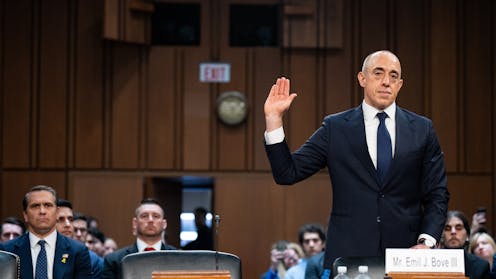
Emil Bove, Donald Trump’s nominee to serve as a federal appeals judge for the 3rd Circuit, is sworn in during a confirmation hearing in Washington, D.C., on June 25, 2025. Bill Clark/CQ-Roll Call, Inc, via Getty Images
On June 24, 2025, Erez Reuveni, a former Department of Justice attorney who worked with Bove, released an extensive, 27-page whistleblower report. Reuveni claimed that Bove, as the Trump administration’s acting deputy attorney general, said “that it might become necessary to tell a court ‘fuck you’” and ignore court orders related to the administration’s immigration policies. Bove’s acting role ended on March 6 when he resumed his current position of principal associate deputy attorney general.
When asked about this statement at his June 25 Senate confirmation hearing, Bove said, “I don’t recall.”
And on July 15, 80 former federal and state judges signed a letter opposing Bove’s nomination. The letter argued that “Mr. Bove’s egregious record of mistreating law enforcement officers, abusing power, and disregarding the law itself disqualifies him for this position.”
A day later, more than 900 former Department of Justice attorneys submitted their own letter opposing Bove’s confirmation. The attorneys argued that “Few actions could undermine the rule of law more than a senior executive branch official flouting another branch’s authority. But that is exactly what Mr. Bove allegedly did through his involvement in DOJ’s defiance of court orders.”
On July 17, Democrats walked out of the Senate Judiciary Committee vote, in protest of the refusal by Chairman Chuck Grassley, a Republican from Iowa, to allow further investigation and debate on the nomination. Republicans on the committee then unanimously voted to move the nomination forward for a full Senate vote.
As a scholar of the courts, I know that most federal court appointments are not as controversial as Bove’s nomination. But highly contentious nominations do arise from time to time.
Here’s how three controversial nominations turned out – and how Bove’s nomination is different in a crucial way.
Robert Bork testifies before the Senate Judiciary Committee for his confirmation as associate justice of the Supreme Court in September 1987. Mark Reinstein/Corbis via Getty Images
Robert Bork
Bork is the only federal court nominee whose name became a verb.
“Borking” is “to attack or defeat (a nominee or candidate for public office) unfairly through an organized campaign of harsh public criticism or vilification,” according to Merriam-Webster.
In opposing the Bork nomination, Sen. Ted Kennedy of Massachusetts took the Senate floor and gave a fiery speech: “Robert Bork’s America is a land in which women would be forced into back-alley abortions, blacks would sit at segregated lunch counters, rogue police could break down citizens’ doors in midnight raids, schoolchildren could not be taught about evolution, writers and artists could be censored at the whim of government, and the doors of the federal courts would be shut on the fingers of millions of citizens for whom the judiciary is often the only protector of the individual rights that are the heart of our democracy.”
Ultimately, Bork’s nomination failed by a 58-42 vote in the Senate, with 52 Democrats and six Republicans rejecting the nomination.
Republican Sen. John Ashcroft, from White’s home state of Missouri, led the fight against the nomination. Ashcroft alleged that White’s confirmation would “push the law in a pro-criminal direction.” Ashcroft based this claim on White’s comparatively liberal record in death penalty cases as a judge on the Missouri Supreme Court.
However, there was limited evidence to support this assertion. This led someto believe that Ashcroft’s attack on the nomination was motivated by stereotypes that African Americans, like White, are soft on crime.
Even Clinton implied that race may be a factor in the attacks on White: “By voting down the first African-American judge to serve on the Missouri Supreme Court, the Republicans have deprived both the judiciary and the people of Missouri of an excellent, fair, and impartial Federal judge.”
White’s nomination was defeated in the Senate by a 54-45 party-line vote. In 2014, White was renominated to the same judgeship by President Barack Obama and confirmed by largely party-line 53-44 vote, garnering the support of a single Republican, Susan Collins of Maine.
Ronnie White, a former justice for the Missouri Supreme Court, testifies during an attorney general confirmation hearing in Washington in January 2001. Alex Wong/Newsmakers
Estrada, who had earned a unanimous “well-qualified” rating from the American Bar Association, faced deep opposition from Senate Democrats, who believed he was a conservative ideologue. They also worried that, if confirmed, he would later be appointed to the Supreme Court.
Miguel Estrada, President George Bush’s nominee to the U.S. Court of Appeals for the District of Columbia, is sworn in during his hearing before Senate Judiciary on Sept. 26, 2002. Scott J. Ferrell/Congressional Quarterly/Getty Images
However, unlike Bork – who had an extensive paper trail as an academic and judge – Estrada’s written record was very thin.
Democrats sought to use his confirmation hearing to probe his beliefs. But they didn’t get very far, as Estrada dodged many of the senators’ questions, including ones about Supreme Court cases he disagreed with and judges he admired.
Democrats were particularly troubled by allegations that Estrada, when he was screening candidates for Justice Anthony Kennedy, disqualified applicants for Supreme Court clerkships based on their ideology.
According to one attorney: “Miguel told me his job was to prevent liberal clerks from being hired. He told me he was screening out liberals because a liberal clerk had influenced Justice Kennedy to side with the majority and write a pro-gay-rights decision in a case known as Romer v. Evans, which struck down a Colorado statute that discriminated against gays and lesbians.”
When asked about this at his confirmation hearing, Estrada initially denied it but later backpedaled. Estrada said, “There is a set of circumstances in which I would consider ideology if I think that the person has some extreme view that he would not be willing to set aside in service to Justice Kennedy.”
Unlike the Bork nomination, Democrats didn’t have the numbers to vote Estrada’s nomination down. Instead, they successfully filibustered the nomination, knowing that Republicans couldn’t muster the required 60 votes to end the filibuster. This marked the first time in Senate history that a court of appeals nomination was filibustered. Estrada would never serve as a judge.
Bove stands out
As the examples of Bork, Estrada and White make clear, contentious nominations to the federal courts often involve ideological concerns.
This is also true for Bove, who is opposed in part because of the perception that he is a conservativeideologue.
This makes Bove stand out among contentious federal court nominations.
Paul M. Collins Jr. does not work for, consult, own shares in or receive funding from any company or organization that would benefit from this article, and has disclosed no relevant affiliations beyond their academic appointment.
Long before anyone understood the nature of their cult, the now-infamous family’s size was their claim to fame.
In March, Jinger welcomed baby Finnegan. This addition led to a key piece of information about the broader brood.
How many grandbabies do Jim Bob and Michelle have to their name? The number is in the dozens.
A wide-eyed Michelle Duggar makes a memorable expression on YouTube. (Image Credit: YouTube)
Not all Duggar births have been public announcements
Early in the summer of 2021, TLC finally canceled Counting On, putting an end to the stream of TLC paychecks flowing into Jim Bob Duggar’s pockets.
Since then, many of the Duggar family have returned to social media — despite Josh’s crimes and the complicity of some family members in downplaying, defending, and straight-up covering for him over the years.
As such, some members of the infamous family just don’t announce marriages and milestones like they used to.
That means that some grandbaby births slip through the cracks, and we only find out about them later.
After welcoming their third child, Jinger Duggar spoke about the experience on the podcast that she shares with her husband. (Image Credit: YouTube)
In April 2025, Jinger gave viewers a number of grandkids
Early in the spring of 2025, Jinger Duggar spoke on an episode of her podcast about
“I think that she’s only missed two,” Jinger said while praising her mother’s attendance of grandbaby births. “But each of ours she’s been there. Finn is grandbaby number 37 for my parents — and that is insane to think about.”
Yes it is insane to think about 37 grandchildren from the same two grandparents.
That is what happens when you have 19 kids and raise them within the same fundamentalist fertility cult.
Who’s had the most Duggar grandbabies?
As we know, John David, Joy-Anna, Joseph, Josiah, Jed, and Jeremiah Duggar have all married and started their own families.
Jinger and Jeremy Vuolo have three kids. Jill and Derick Dillard have three kids.
And Josh and Anna Duggar have an alarming seven children. Alarming, we say, because it’s always a little scary when Josh is linked to any child.
Jim Bob Duggar is one seriously messed-up dude. (Photo Credit: TLC)
Where are Jim Bob and Michelle living now?
Jim Bob and Michelle Duggar continue to live on the compound in Arkansas. It is a piece of property with which many former viewers are familiar.
This means that they remain very close to many of their adult children and grandchildren.
Notably, Jim Bob “gifts” houses to some adult children — meaning that he has a say in where they start their adult, married lives.
Some Duggar adults, like Jinger and Jill and now Jana, have moved farther away. Inevitably, they all make the pilgrimage back to Jim Bob’s domain from time to time. Even if they end up regretting it.
There are just so many Duggars. And here so many of them are, all in one majestic photograph. (Image Credit: TLC)
37 is so many grandkids!
Prior to Jinger’s statement in spring 2025, the official count of grandbabies was “at least 32.”
It seems grimly inevitable that the final count of Jim Bob and Michelle’s grandkids will be considerably higher than 37.
We say “grimly” not because babies aren’t adorable (they are!), but because we would not wish being related to Jim Bob and Michelle upon our worst enemies.
Are you ready to believe again, television viewers?
As previously announced, Apply TV is bringing back Ted Lasso for a fourth season.
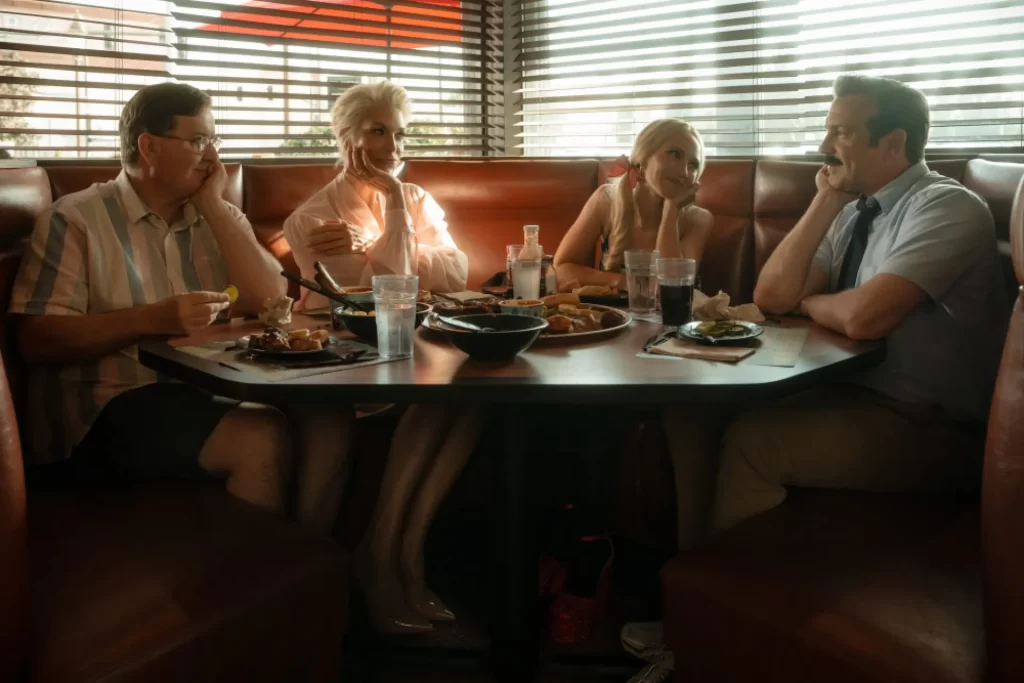
Now, meanwhile, the platform has given viewers our first look at said new season, releasing a photo on July 21 of Jason Sudeikis in the title role.
He isn’t alone, however.
(Apple TV)
The photo (below) features Sudeikis, along with Juno Temple as Keeley Jones, Hannah Waddingham as Rebecca Welton and Jeremy Swift as Leslie Higgins.
From what we can gather, Brendan Hunt and Brett Goldstein have also closed their deals to return to the program.
It’s believed they’ve even signed three-year pacts, corroborating the speculation that Sudeikis has a new three-season arc in mind for Ted Lasso‘s new chapter.
Amazing, no?!?
(Apple TV)
In addition, new cast members for the series include Tanya Reynolds, Jude Mack, Faye Marsay, Rex Hayes, Aisling Sharkey, Abbie Hern, and Grant Feely.
Exact character details for the newcomers are being kept under wraps, although it is known that Feely will take over the role of Henry Lasso, Ted’s son.
According to Season 4’s official logline, Ted (Sudeikis) returns to Richmond, taking on his biggest challenge yet: coaching a second division women’s football team.
Throughout the course of the season, Ted and the team learn to leap before they look, taking chances they never thought they would.
A poster for one of the funniest shows of all-time. (Apple)
As reported in March, principal photography on Season 4 has now gotten underway in Kansas City … before the show heads back to London.
During its first three seasons, Ted Lasso sky-rocketed a massive ratings hit and a pop culture phenomenon –while also garnering critical acclaim, including back-to-back Outstanding Comedy Series Emmys.
Apple TV has not yet announced a premiere date for Season 4.
Amidst all of the conversation and controversy of Todd and Julie’s release from prison, one member of the infamous family has not been part of the conversation.
Lindsie is the family’s eldest daughter. She has an understandably complex relationship — or lack thereof — with her notorious parents and some of her siblings.
Earlier this month, she debuted a new last name. Is she married?
TV personality Lindsie Chrisley speaks onstage during the ‘Chrisley Knows Best’ panel at the 2016 NBCUniversal Summer Press Day at Four Seasons Hotel Westlake Village on April 1, 2016. (Photo Credit: Frederick M. Brown/Getty Images)
Yes, Lindsie Chrisley changed her name
Previously, 35-year-old Lindsie Chrisley was married to Will Campbell.
She and her ex-husband share a child, Jackson. Jackson is her only child.
Following their divorce, Lindsie adopted her maiden name, despite the stigma of any association with her parents.
However, earlier this month, Lindsie changed her last name.
As we reported, the eldest Chrisley daughter started going by “Lindsie Landsman” on social media.
Fans may already know that she is dating David Landsman.
What’s the story behind the name change? Did they get married?
TV personalities Julie Chrisley, Savannah Chrisley, producer/TV personality Todd Chrisley, and TV personalities Chase Chrisley, and Lindsie Chrisley speak onstage during the ‘Chrisley Knows Best’ panel at the 2016 NBCUniversal Summer Press Day at Four Seasons Hotel Westlake Village on April 1, 2016. (Photo Credit: Frederick M. Brown/Getty Images)
Is Lindsie Chrisley married?
Lindsie Chrisley — well, Lindsie Landsman, now — took to the July 16 episode of her The Southern Tea podcast to address the change.
She admitted that she had felt that she’d “quietly” made this name change.
However, she’d known that people would notice.
What caught her off guard, however, was “how quickly” fans had picked up on what seems like such a tiny little detail.
First and foremost, Lindsie confirmed that she has not married David Landsman. They have been dating for less than a year, and they are not even engaged.
She explained that the Chrisley surname “did not create income or opportunity” for her. Rather, it was detrimental to her opportunities and personal brand.
“In fact, it became very problematic with me being associated in any capacity in business,” Lindsie admitted.
“And has been problematic for projects that I have done post ‘Chrisley Knows Best’ and have been asked to go by another name altogether.”
TV personality Lindsie Chrisley attends the 2016 NBCUniversal Summer Press Day at Four Seasons Hotel Westlake Village on April 1, 2016. (Photo Credit: Jason Kempin/Getty Images)
That does make a lot of sense
Having parents who are notorious criminals has a certain degree of deeply unfair stigma.
Certainly, no one gets to choose the circumstances of their birth. If they could, Todd and Julie Chrisley would be childfree — and so would Jim Bob and Michelle Duggar.
Lindsie praised the “safe and loving relationship” taht she and David share. When it comes to borrowing his surname for social media, she shared that she “felt like it was the right thing to do.”
Good for her. Everyone deserves peace, free from the burdens and stigma of toxic influences.
But things worked out quite differently for a lesser-known rapper who faced a similar slate of charges.
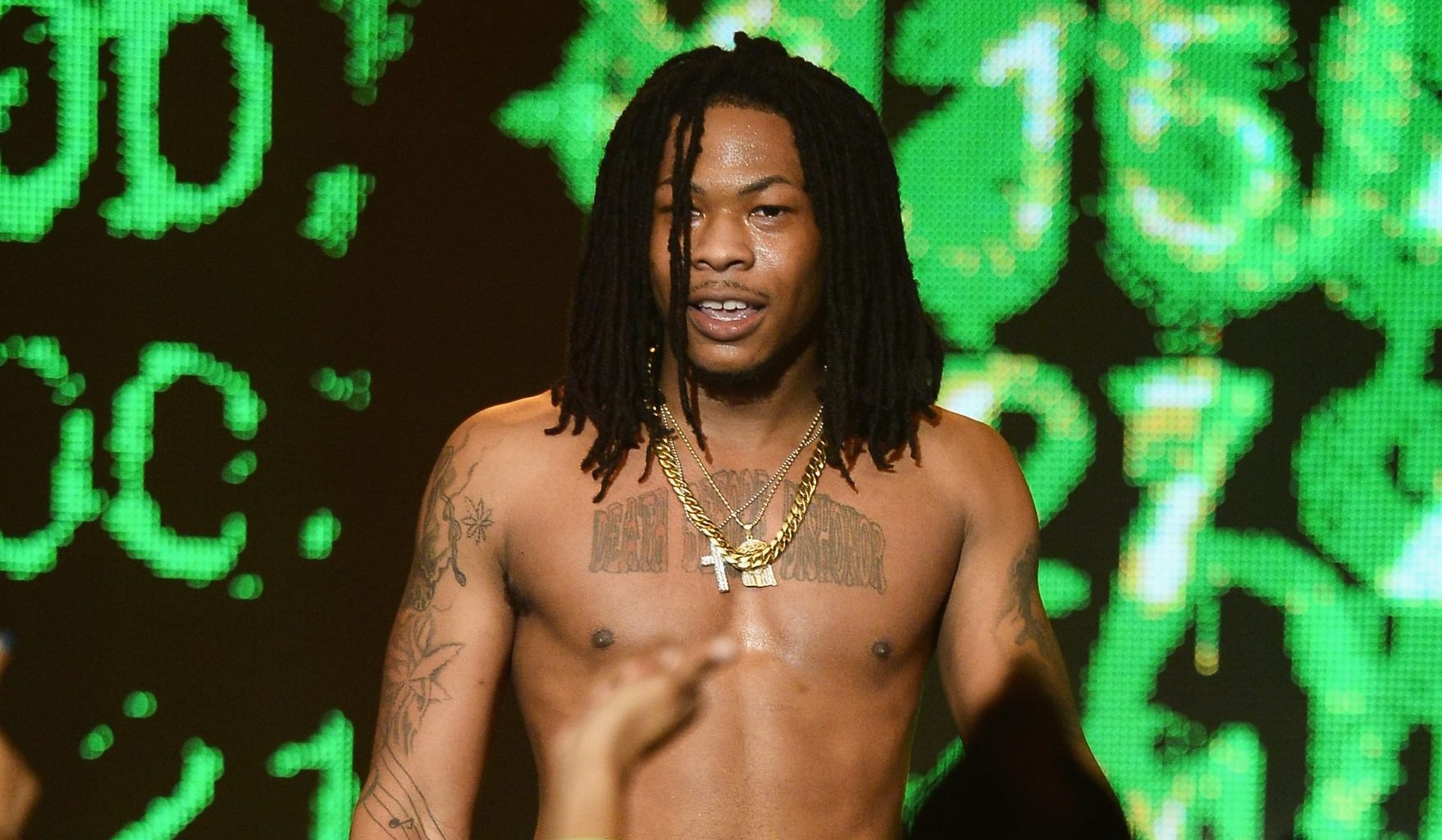
Atlanta-based emcee Cash Out was sentenced to life in prison plus 70 years today after being convicted on rape and sex trafficking charges last week.
Rapper Ca$h Out performs during BET’s 106 And Park 2013 New Years Eve Party at BET Studios on December 17, 2012 in New York City. (Photo by Michael Loccisano/Getty Images)
Cash Out will spend the rest of his life behind bars
The rapper, whose real name is John Michael Hakeem Gibson was arrested back in June of 2023 along with five alleged accomplices.
He was indicted on 13 charges — including rape and sex trafficking — and held without bail.
His mother, Linda Smith, and his cousin, Tyrone Taylor, were also found guilty of RICO charges.
On Friday, June 18, the jury concluded that Gibson and his accomplices used their record label, Pyrez Music Group LLC as a front for their sex trafficking activities.
Rapper Ca$h Out performs during BET’s 106 And Park 2013 New Years Eve Party at BET Studios on December 17, 2012 in New York City. (Photo by Michael Loccisano/Getty Images)
He asserted his innocence and claimed that all sexual activity described during the trial was consensual. He then compared himself to Jesus Christ.
Unmoved by this impassioned argument, the judge threw the book at Cash Out, denying his lawyers’ request for a more lenient sentence of 30 years behind bars.
Gibson was sentenced to life imprisonment for rape, as well as 70 years for racketeering, sex trafficking, and firearm possession.
According to TMZ, the judge excoriated Gibson, accusing him of “the very worst of human behavior” and noting that several of his victims now suffer from PTSD.
A promising career ends in scandal
Though never exactly a household name, Cash Out showed major promise in the late 2010s.
His single “Cashin’ Out” went platinum, while the follow-up “She Twerkin” was certified gold.
Cash Out even played himself in a brief cameo in the acclaimed 2019 Adam Sandler film Uncut Gems.
But according to the case presented by prosecutors, even as his music and film career was taking off, Gibson and his accomplices were engaged in a “reign of terror,” in which they would ensnare women and force them into life in prison.
Cash Out will now almost certainly spend the rest of his life behind bars.