Public Service Commissioner Brad Molnar is challenging Gov. Greg Gianforte’s suspension of him from the commission. At the same time, a lawsuit was filed asking that all consideration of a major NorthWestern Energy merger be paused until the Molnar case…
From left to right, Click Bishop, Dave Bronson and Adam Crum, three of the 10 candidates at the Capital City Republican governor candidate forum, are seen on Wednesday, Feb. 11, 2026, at the Baranof Hotel in Juneau. (James Brooks photo/Alaska Beacon)
Alaska’s two leading Democratic candidates for governor have quietly been discussing whether one of them should quit the race if both are among the top four vote-getters in Tuesday’s primary election.
Jonathan Kreiss-Tomkins and Tom Begich each said by phone on Thursday that they’ve been discussing different scenarios about what could happen when the final votes are counted.
Republicans have been talking about similar maneuvers for months, with one prominent Republican group going so far as to run ads urging lower-finishing candidates to withdraw in order to consolidate the vote in November.
“Both sides are trying to figure out: What does the top four look like? And how are we best positioned for success?” said Bernadette Wilson, one of the leading Republican candidates for governor in Alaska’s 17-person race.
Under Alaska’s election system, the top four vote-getters — regardless of political party — advance to the November general election. That may mean multiple Republicans or Democrats on the same ballot, competing for the same votes.
In November, voters in the general election will be asked to rank those four candidates in order of preference.
After all the votes are in, the candidate with the fewest number of first-choice preferences is eliminated. Any voters who ranked that candidate first will have their votes go to their second choice.
The process repeats until only two candidates are left.
In theory, that means no vote splitting. Anyone whose favorite candidate is eliminated can instead vote for someone else.
In practice, some Alaska voters ranked only one or two candidates in the 2022 and 2024 statewide elections, leading to an unusual number of “exhausted” ballots whose votes went to neither of the final two candidates.
That November, Hafner was eliminated first, and fewer than half his votes transferred to the other Democrat, then-incumbent Rep. Mary Peltola.
That was less than Peltola’s margin of defeat — Peltola was defeated by current Rep. Nick Begich III, R-Alaska — but in a closer race, it could have been decisive.
Now, as Peltola runs for U.S. Senate against incumbent Sen. Dan Sullivan, R-Alaska, a similar strategy is playing out.
National groups have spent more than $2 million in an attempt to boost lesser-known candidates into the final four and potentially split the field.
Dan J. Sullivan, unrelated to the incumbent senator, is on the ballot but told the Chicago Tribune that he’s uncertain whether he will remain in the race if he makes the top four.
In the 17-person race to replace Gov. Mike Dunleavy — who is term-limited and unable to run this year — candidates have been talking for over a year about whether or not they will be willing to bow out after the primary.
Wilson entered the race in May 2025 and promptly pledged to withdraw after the primary if she finished behind another Republican. It’s a pledge she’s renewed since then.
“I don’t think that it’s smart to carry on. … I don’t think that we need any more division as we head into November. I don’t think that it’s smart to split up the voting base, the volunteers that help, I don’t think it’s smart to split up the finances,” she said.
Wilson also said that having multiple candidates from the same party risks denying the eventual winner a mandate — a margin of victory so large that it gives the winner political backing to implement their platform.
“I think it’s important that a governor win by a strong strongest margin as possible, because I think that it’s important for the stability and the unity of the state past November,” she said.
Wilson has also been campaigning hard to repeal Alaska’s current elections system with Ballot Measure 2, which will come in front of voters in November.
Post-primary juggling is evidence that ranked choice voting doesn’t work, she said.
“I think it’s just made it worse,” Wilson said. “I think it’s handed more power to backroom conversations, and I just don’t think the public’s gonna like it.”
Jenny-Marie Stryker, executive director of the Alaska Democratic Party, was traveling on Friday and unavailable for an interview, a spokesman said. Carmela Warfield, chair of the Alaska Republican Party, did not respond to an email.
The Valley Republican Women, an influential group based in the Matanuska-Susitna Borough, has an ongoing ad campaign that urges Republicans to “vote the primary, consolidate the vote” and “don’t split the field.”
Julia Anastos, campaign manager for the group opposing Ballot Measure 2, said by email that gamesmanship isn’t new in Alaska.
“Parties and political insiders will always strategize about who should run and who should drop out. These kinds of maneuvers happen under a partisan primary as well, like in the 2014 and 2018 gubernatorial races, when would-be spoiler candidates dropped out to clear the lane for a stronger candidate,” she said. “Under our system now, ranked choice voting addresses that spoiler effect and ensures the winning candidate has earned majority support.”
The issue of what to do after the primary was a key issue at a forum earlier this month in Soldotna, when five candidates were directly asked about the issue.
“I would stay in,” nonpartisan candidate Meda DeWitt told forum attendees.
As a nonpartisan, she sees herself able to attract second-choice votes from both Republicans and Democrats.
“I actually appreciate ranked choice voting because your vote is not lost if your top pick doesn’t get in,” she said.
Adam Crum, a Republican candidate and former Dunleavy cabinet official, said he thinks there’s an advantage to having multiple Republicans in the general election.
“It actually does make more sense for more conservatives to stay in it, because you actually work together,” he said.
In the 2022 special election to replace Rep. Don Young, R-Alaska, Republican candidates Sarah Palin and Nick Begich III frequently fought each other on the campaign trail. That turned off Republican voters, Crum noted.
During the current primary election campaign, he said, “We have actually done a very good job … of actually working together and pushing forward ideas.”
A cordial campaign keeps voters involved and going to the polls, he said.
“You actually increase the ceiling, and the math actually works out. I’m a numbers guy. Over time, it does work,” Crum said.
Matt Heilala, a podiatrist and Republican who has put more than $1.5 million of his own money into a campaign for governor, said that last year, “I had the thought that I would immediately withdraw because we saw what happened with Sarah and Nick.”
Now, he’s not as sure. What if there’s “an indictment, an October surprise, some kind of a shenanigan that the opposing party is going to play on the person that is 10 votes ahead of me, and they’re just waiting for me to leave?” he asked.
In that case, having another Republican would be helpful, he suggested.
Dave Bronson, the former Anchorage mayor and Republican candidate for governor, said he intends to reserve his options until he sees what happens in the primary.
“The notion that I would stand up and say at this point in time I’ll absolutely get out if I’m No. 2 on the Republican side — that’s foolishness,” he said.
Alaska Attorney General Treg Taylor speaks at a news conference on Thursday, Dec. 15, 2022, at the Alaska State Capitol in Juneau. (Photo by James Brooks/Alaska Beacon)
Former Alaska Attorney General Treg Taylor, a Republican candidate for governor, violated state campaign finance laws by donating more than 60 times the maximum amount of money to his own campaign, according to disclosure documents filed this week.
Those documents show his lieutenant governor candidate, Candice English, also violating the same limit.
Under state law, primary election candidates cannot give or loan their campaigns more than $5,000 after July 17.
In a campaign finance disclosure report due Tuesday, Taylor says he donated $260,000 to his campaign on Aug. 3. He also reported buying plane tickets worth more than $3,400 with his own money.
English and her husband, Stanley, reported donating $100,000 to the campaign on July 28, according to the same report.
Evan Lee, Taylor’s campaign manager, did not return emails on Thursday or Friday asking if the report was accurate and whether Taylor intended to return the contribution. Lee also did not return a text message or a call to his cellphone on Friday.
A separate disclosure report showed Taylor donated another $40,000 to his own campaign on Monday, for a total of $300,000 in cash contributions past the deadline in state law.
Heather Hebdon is the executive director of the Alaska Public Offices Commission, which regulates campaign financial disclosures. She said on Friday that she was unaware of any complaints against the Taylor-English campaign and had not reviewed their filing herself.
By email Friday, Lee reiterated the statement he gave the Daily News.
“The Ninth Circuit struck down Alaska’s unconstitutional contribution limits years ago. This overlooked relic in our statutes is no different, and no less unconstitutional,” he said.
Neither state nor federal court records show any lawsuit by Taylor challenging the law in question.
This week’s report by Taylor shows he has raised more than $1.58 million during his campaign to become one of the four finalists in the race to replace incumbent Gov. Mike Dunleavy.
Dunleavy is term-limited and cannot run again this year.
Among the 17 candidates vying to replace Dunleavy, Taylor’s campaign is one of the best-funded. Among Republicans, only Matt Heilala has raised more — $1.59 million, according to this week’s filings. Most of Heilala’s campaign has been self-funded.
Among Democrats, former state Rep. Jonathan Kreiss-Tomkins has raised almost $2.3 million and former state Sen. Tom Begich has raised more than $1.2 million.
Under Alaska’s current elections system, the top four vote-getters for a particular office — regardless of political party — advance from the primary to the general election.
Alaska’s primary election is Aug. 18, and final results are expected Aug. 28. The deadline for any of the top finishers to withdraw is Aug. 31.
The community of St. Paul is seen from the island’s beach. The Pribilof Island community has managed to fend off rat infestations. Residents are now allowed to enlist rat-hunting dogs to help with the efforts. Dogs have long been banned from the islands, but a new rule makes an exception for rat-prevention purposes. (Photo by Jamie Musbach/National Oceanic and Atmospheric Administration)
For decades, dogs have been verboten on the Pribilof Islands under a rule imposed by the federal government to protect the world’s largest concentration of northern fur seals.
Now, dogs are welcome — with important caveats.
Under a new interim rule enacted by the National Oceanic and Atmospheric Administration, dogs may be brought to the islands, but only for the specific purpose of hunting for rats. Dogs allowed on St. Paul Island or any other part of the five-island archipelago must be trained and certified as rat-detectors and catchers, and their stays are limited to 180 days. The general ban on dogs, in place since the 1980s, remains intact, but the new rule creates an exception for dogs enlisted in the anti-rat work.
The Pribilofs have managed to stay rat-free even as other Alaska islands and coastal areas have become infested with the non-native rodents.
Murres congregate on a cliff on St. Paul Island in the Pribilofs in 2008. The isolated volcanic islands are used by millions of seabirds, including common and thick-billed murres. Invasive rats on other Alaska islands have ravaged bird populations there. (Photo by Dean Kildaw/U.S. Fish and Wildlife Service)
Rat-sniffing dogs would help keep things that way, according to the residents of St. Paul Island, site of the main community in the archipelago.
“We work very, very hard to keep this a rat-free island. And we also recognize that shipping lanes are opening up right in the Arctic and there’s just potentially, if not already, going to be more vessel traffic in this part of the world,” said Chelsea Campbell, marine mammal programs manager for the Aleut Community of St. Paul Island, the local tribal government.
Allowing dogs to help is a bit of “forward thinking,” she said. The idea is that “maybe we should have some ability to get a rat sniffing dog out here, just in case,” she said.
Rats are not native to any part of Alaska. But, introduced by ships, they have infested several coastal regions and become one of the most destructive invasive species in the state.
Once established, they can devastate natural ecosystems, especially on islands where bird populations have evolved without exposure to or defenses against any land-based predators. It is a longstanding problem for islands around the world. Invasive rats are even believed to be partly to blame for the extinction of the Dodo.
On St. Paul, there have been a few isolated cases of rats escaping ships, but almost all of those were caught immediately in traps set up at the harbor. One rat escaped that gauntlet in 2018; it was found dead 10 months later.
A reported but unconfirmed rat sighting in 2024 was the main impetus for the new rule, said Mike Williams, NOAA’s Pribilof Islands program manager. No rat was ever found, so if there had been one that escaped from a ship, it apparently died, he said.
Another impetus, Campbell said, was a visit in recent years by a cruise ship that underreported its rat-infestation problem.
Rat tracks are seen on a beach on Kiska Island. in the Aleutians (Photo by Lora Haller/U.S. Fish and Wildlife Service)
Compared to other vulnerable Alaska islands, the Pribilofs have some advantages in their fight against rats.
Community members have been vigilant in the anti-rat program, in coordination with the U.S. Fish and Wildlife Service, the Alaska Department of Fish and Game and other entities and organizations.
Additionally, ship traffic through the Pribilofs is not quite as heavy as that through the Aleutians, Wiliams said. And a “saving grace” for the archipelago, he said, is the native population of Arctic foxes.
The Pribilof foxes make up a genetically distinct population known for the blue tint that shows up in the animals’ fur. Williams said they do not bother the fur seals.
They have a varied diet that includes birds, eggs, marine resources and berries. And they are on hand to hunt and eat rats, Williams said.
One of the first rats ever seen on St. Paul, an event in the 1990s, was actually in the mouth of a passing fox, he said.
The new rule went into effect on Aug. 6. For now, Williams and Campbell said, there is no particular dog or dog trainer yet identified as a candidate for Pribilof work.
Williams said that if a rat-catching dog is sent to St. Paul, it might make the most sense to have it there in the winter, when any rats on the island would be concentrated in town rather than across a wider area where they may not be able to find food.
“You want a small, focused area to search rather than the whole entire island,” he said.
On the other hand, having a rat-sniffing dog on duty during the summer might be useful to ensure that ships that come to the island are safe, Campbell said.
Rat eradication
Although it is difficult to eject rats once they are established, it is not impossible.
Rat eradication has been successful at some islands, and possibly most famously at an Alaska site formerly called Rat Island. It got the name because it was the first place in Alaska to be invaded by rats; it is believed that the rodents swam ashore from a wrecked Japanese sailing ship in the late 1700s.
A cooperative effort between the U.S. Fish and Wildlife Service and two nonprofits, Island Conservation and the Nature Conservancy.
By 2012, the bird populations there had recovered, and the island was officially bestowed with its Unangan name: Hawadax.
The Fish and Wildlife Service is now planning for similar rat eradications on four other Aleutian islands: Kiska, Attu, Amchitka and Great Sitkin. Like Hawadax, all four islands are part of the Alaska Maritime National Wildlife Refuge. Different types of rat poison are being considered, along with genetic biocontrol technology, which is a process that uses genetic engineering to limit reproduction.
Dead auklets found in a rat cache on Kiska Island are displayed. (Photo provided by the U.S. Fish and Wildlife Service)
Kiska and Attu were occupied by the Japanese during World War II, and a brutal battle occurred on Attu in 1943. The rats there are war legacies. The threat is particularly ominous in Kiska because that rugged volcanic island is home to what is considered a “superflock” of seabirds, particularly auklets, but also an ever-expanding population of rats using the same rocky crevices to kill and stash their prey. Since Kiska is much bigger than the island now called Hawadax, rat eradication there would be more challenging, the Fish and Wildlife Service notes.
The rat eradication proposals for the four Aleutian sites are moving forward, though gradually.
Scoping, the initial phase that leads to an environmental impact statement, was conducted in 2024. A draft environmental impact statement is expected to be released later this year. A draft environmental impact statement is expected this fall, to be followed by a final EIS and a decision on action next year, according to the Fish and Wildlife Service.
Dawson City will host the Tenth Annual Great Klondike International outhouse race during Labor Day weekend.
Dawson City Mayor Peter Jenkins, on behalf of the Outhouse Race Committee, has challenged all Alaskans to participate. “We are eager to show our neighbors in Alaska, as well as the world, that when it comes to running outhouses, Yukoners are the best,” the mayor said.
The 1 ½ mile race through Dawson City begins at 3 p.m. Aug.…
A brown bear wades through river water in Katmai National Park and Preserve on Aug. 12, 2023. (Photo by F. Jimenez/National Park Service)
Earlier this summer, I was jogging on a local trail with my 7-year-old black lab mutt, Camas, when she suddenly froze. The fur along her spine bristled. Then she let out a single, sharp bark — a timbre I’d never before heard.
I caught the unmistakable musk of an animal and my hand shot to the bear spray on my chest. Halfway up a tree less than 20 yards away, a beautiful, small cinnamon black bear stared back at us.
The bear scampered off as Camas growled, standing her ground in front of me on the trail. “Good girl,” I told her, my heart rate slowing to a normal pace. My dog, I assumed, warned me early of a potential threat. I was proud.
In bear country, common wisdom holds that dogs serve as early bear alarms, or even deterrents. That belief, however, has long rested mostly on anecdote. Until recently, almost no one had tested whether it was actually true.
Credit: Journal of Wildlife Management
A new study in the Journal of Wildlife Management analyzed bear-dog conflicts involving black, polar and brown bears from Alaska to Florida. The results challenge the idea that dogs make people safer in bear country and they have me rethinking my relationship with Camas in the woods.
“If you think a house pet is likely going to be your bear, not only detector but deterrent, you might want to think twice about that,” lead author of the paper Tom Smith told me over Zoom, one of his dogs begging for attention in the background while mine snoozed next to me.
Smith, a research wildlife biologist at Brigham Young University in Utah, analyzed 326 bear-dog encounters spanning more than a century, drawing from newspaper articles, federal and state government reports, books, records compiled by other bear specialists, and internet searches.
Smith began working with bears more than 30 years ago in Alaska’s Katmai National Park. He’s published influential research on bear spray and guns as bear deterrents, and has become one of the world’s leading experts on human-bear interaction. “As soon as you become the bear guy, then everybody comes running to you for advice on how to be safe,” he said. “So I thought, ‘I’m going to have to get to the heart of this.”
Smith has long been interested in the way dogs impact humans’ odds of an encounter in bear country. But the issue became urgent and tangible to him following a 2023 attack that left two people and their dog dead in a tent in Canada’s Banff National Park. The issue hasn’t gone away. This summer alone, a jogger and his dog were mauled near Island Park, Idaho, while recordings of separate encounters involving dogs in Banff and Alberta went viral online.
The findings
The data show people are largely unprepared for bear encounters and naive to their possible consequences. Dogs ran away, fought with bears, provoked confrontations, drew owners in to fight off bears barehanded, and even boomeranged bears back to people.
The first surprise in the data was how few people carried any deterrent at all. That might be because people thought, erroneously, Smith says, that dogs would be sufficient to keep bears away. Recreators wielded bear spray in only about a tenth of cases and a firearm in roughly a third. All told, five people and 56 dogs died in the encounters Smith analyzed.
Contrary to some common wisdom, dogs also weren’t effective warning systems for bears. In fact, they alerted their owners early of a bear in only 1 in 11 of the encounters the study analyzed. Dogs provoked the bear, instigating the encounter, in more than half the cases. After the bear conflict began, things didn’t look much better: Dogs tangled with bears about 40 percent of the time, ran away in 20 percent of encounters, and didn’t engage at all in about 17 percent of cases. So much for dogs being excellent protectors.
Credit: Journal of Wildlife Management
Other findings were less surprising. Leashes were a major decider in the severity of the interaction. Unleashed dogs were involved in six times as many incidents as leashed pets. Smith said dogs without a leash can dart ahead of owners or crash through brush and spook a bear. Canines can also act as bear boomerangs. In 27 of the encounters, dogs brought a bear back to their owners. In 70 percent of these instances, the dog owner was injured. Worse yet, many owners in the data came to rescue their pet when it got in a scuffle with a bear, often with no deterrent. The result: 85 percent of the time, those owners were injured.
Additionally, the data reinforced something bear experts have known for years: the larger the group of people, the less likely the encounter. However, the presence of a dog dramatically shifts that risk. Dogs roughly doubled the odds of a conflict compared to the same-sized groups with no canine companions.
Taken as a whole, the data paint a portrait in which bears and domestic dogs don’t get along. Smith suspects it’s part of the long evolutionary relationship between bears and wolves. For thousands of years, wolves competed with bears for food, killed cubs and even kicked bruins off carcasses. Some of this behavior is on public display in places like Yellowstone National Park, where populations of both species flourish. Modern dogs may still trigger those ancient instincts.
Smith recognizes limitations and nuance in his data, too. For one, it’s important to note that the dogs in the analysis were domestic companions, not highly-trained guardian dogs meant to fend off predators — which data show can reduce bear presence at ranches and farms. Also, data on human-bear conflict inherently shows a bias, depicting only the encounters that went majorly wrong rather than the majority of experiences when people venture into the places bruins live and the species coexist without incident. “For the most part, people and their dogs pass through bear country without incident,” Smith wrote in the paper.
Should your pup join the hike?
“The takeaway isn’t to keep dogs out of bear country,” Smith said. “The takeaway is there are things you can do that greatly improve your odds.”
Best practices, backed by Smith’s data, say to travel in groups, eliminate smells if you’re camping and make noise. Bear bells, he says, don’t work. Above almost all else? “You have no business being in bear country without a deterrent,” Smith said.
Dogs just don’t cut it on that front. According to Smith, bear spray has the highest likelihood of fending off an aggressive bear for the vast majority of recreationists in bear country. But firearms can work too for experienced users. Carry your spray (or gun) where you can reach it in a split second. No matter what deterrent you choose, practice with it. Bear encounters can happen in seconds.
The author’s companion, Camas, in bear country.(Photo by Nick Mott)
If you do take your dog, consider a leash. “It’s not just dogs and bears,” Smith said. “It’s also dogs and everything else.” Smith’s own dog had been sprayed by a skunk twice in the last month. Mine finds few greater joys in life than chasing ground squirrels, marmots and grouse. So, we’re both faced with navigating how to behave in wild places with these family members that, if they see a deer or elk or bear, may not be able to hold themselves back.
Since talking with Smith, I’ve thought about the role Camas plays in bear country in a more nuanced way. She’s warned me about bears — even since that encounter on my jog. But she’s also ignored bears less than 30 yards away, chased wildlife she shouldn’t and, even in her younger days, treed a black bear.
The lesson isn’t that dogs don’t belong in bear country writ large. It’s that they’re dogs. If recreating in bear country is an odds game, they’re not doing you any favors. As much as we love and trust them, they’re unpredictable. And they can make things worse as often as they make things better.
“It’s a personal thing, it really is,” Smith said. “We work in statistics with a pool of instances. But you are not a pool of instances. You’re you.”
This story was originally published by Mountain Journal at mountainjournal.org.
A spawning male sockeye salmon is seen in July 2010 in the Wood River, part of the Bristol Bay watershed. Bristol Bay is the site of the world’s largest sockeye salmon runs. (Photo by Thomas Quinn/University of Washington, provided by the Environmental Protection Agency)
With the 2026 commercial salmon harvests winding down in Alaska, the seafood industry is already calculating how to navigate at a profit in 2027, given dynamic biological, economic, climate and market conditions.
Their forecast has a far-reaching socio-economic impact across the state — Bristol Bay’s commercial fishery had about $2 billion in economic impact and supported 15,000 jobs in 2019 according to research from the McKinley Research Group.
Preliminary forecasts from the University of Washington for the celebrated Bristol Bay wild sockeye fishery are looking at a run of 45 million fish next year, up from the 2026 forecast of 41.5 million. But run size is just one of many factors under consideration.
Fish size is one of those factors: 45 million big fish have more meat — and a bigger economic effect — than 45 million smaller fish. The size of the fish also helps determine which products the processors will produce.
“When we get really big returns the fish are smaller for their age, because they are competing for their food,” said salmon researcher Daniel Schindler of the University of Washington School of Aquatic and Fishery Sciences. “We estimate how many fish of each age class are coming back.”
For 2027 that preliminary estimate is 20 million fish that have spent three years in the ocean — known as three ocean fish — and 30 million fish that have spent two years in the ocean in 2027. Because there are more fish that have spent less time in the ocean, the overall catch will be smaller.
But the climate can affect how much of that forecast becomes a reality.
“The climate factor is baked into the number of fish we see,” Schindler said. “The fish tell us how well they survived, so if it was a bad climate year we see it early in the numbers of young fish.”
The University of Washington and Alaska Department of Fish & Game both compile data on the Bristol Bay fishery. ADF&G compiles data on Bristol Bay using counting towers. Researchers at the University of Washington go to the spawning grounds and count the fish there. The two methods help inform a more accurate forecast.
The industry would like to increase the amount of domestically-caught fish that Americans consume. According to NOAA Fisheries, the national average consumption of domestically-caught seafood remains relatively flat at 19 pounds per person, with 80% of that seafood coming from foreign imports.
An ongoing campaign of the Alaska Seafood Marketing Institute focuses on boosting retail consumption of the Alaska catch, including an abundance of salmon, with an eye to how the economy, climate and marketing conditions are evolving. Planning for domestic and overseas markets for the coming year gets underway annually on July 1, with a concentration on harvest information, consumer trends and preferences and numerous other factors, said Greg Smith, communications director for ASMI.
Smith said the organization’s emphasis is on the wild-caught harvest, the people who catch and process the harvest and the health,nutrition and sustainability of well managed fisheries. ASMI focuses on helping consumers overcome barriers to seafood purchases such as a lack of confidence in preparing seafood, uncertainty on sourcing and sustainability of fisheries, cost of product and convenience, he said. ASMI also focuses on ensuring younger generations become strong seafood consumers.
Harvest forecasts for Alaska’s 2026 salmon fisheries of 125.5 million fish were about 36% lower than a year earlier, resulting in prices per pound in retail shops being higher overall than in 2025. But with fewer fish for sale fewer are likely to be left in inventory for 2027, said fisheries economist Gunner Knapp. Such conditions could keep prices stable in the coming season.
Long term growth in seafood production is dependent on consumer demand as well as selling fish in product forms that meet consumer demand. Both are important, Knapp said.
As of late July average prices of wild Alaska salmon fillets in the Anchorage area were $13.99 to $26.99 a pound, with sockeye and coho on the lower end and king salmon on the higher end. At Seattle’s Pike Place Fish Market the price of fresh wild Alaska sockeye fillets was holding steady at $29.99 a pound.
The bulk of seafood produced in the U.S. is consumed internationally, so the industry continues to turn its eyes to home — but there is competition from low prices from foreign markets. That fish may not be sustainably sourced with ethical labor practices. “U.S. domestic markets are increasingly important, so in many parts of the U.S. at higher end retail outlets you can find wild Alaska sockeye salmon for sale,” he said.
Knapp characterizes commercial fisheries as a risky business.
“Lots of opportunity and lots of risk, but the resources are so big and so valuable that there will always be a seafood industry in Alaska,” he said. “Only aquaculture has potential to grow.”
Aquaculture is when the fish are not wild caught but cultivated or raised in hatcheries.
“The reason I’ve observed so much more innovation in aquaculture than in wild stocks is that aquaculture is far more able to take advantage of technological innovation than wild fisheries because aquaculture has so much greater control of production,” Knapp said.
“Still because wild fisheries are much older they have stronger cultural traditions, with more dependent communities less receptive to innovation, although they may have more political power,” he said.
Meanwhile, NOAA Fisheries is working to calculate many climate factors affecting the state’s commercial fisheries, from winds and ocean currents to ocean temperatures and precipitation. For salmon, the varying and changing climate impacts winter snowpack, ice cover, growing season lengths and streamflow, said Nate Mantua, a physical scientist at NOAA’s Southwest Fisheries Science Center in La Jolla, California.
“Right now there is a great deal of media attention on the developing El Nino event in the tropical Pacific,” Mantua said. “This is likely to impact Alaska’s winter and spring climate in 2027.”
El Nino is a climate pattern defined by unusually warming of surface waters in the central and eastern tropical Pacific Ocean, weakening trade winds and global weather disruptions.
The current forecast for Alaska’s winter includes increased odds for a warmer than average winter, and increased odds for above average precipitation in Southcentral Alaska and below average precipitation around Norton Sound.
“Another large factor in seasonal forecasts relates back to climate change and the fact that most every winter in the past decade has been warmer than winters before the 2000s,” Mantua said.
“Our ability to predict future climate is limited to about one year in advance and NOAA has an operational forecasting effort provided by the Climate Prediction Center.”
The rise in greenhouse gas concentrations have caused ocean warming and increased acidification, which is bad for salmon.
University of Washington fisheries researchers have started producing a preliminary report to come out the third week of August on the 2027 salmon fishery. Its formal preseason river by river forecast will come out in November, after ADF&G finishes collating its data on a river by river forecast.
The bill, said Speaker of the House Bryce Edgmon and Senate President Gary Stevens, lacks the support to advance in either body.
“The caucus is really not at this point, really not interested in having to rush a bill,” Stevens said.
“The votes just aren’t there,” Edgmon said. “The Senate made it very clear that they need more time than what could be allotted.”
Glenfarne, the firm acting as the project’s lead developer, has said that a tax break is necessary to finance the pipeline. Glenfarne had said that it was planning to reach a final investment decision on the first phase of the project by the end of this year.
It has already missed several self-imposed deadlines, and it isn’t clear whether it will again change its plans. The company did not respond to a request for comment on Thursday.
As proposed, the pipeline project would be built in two phases, with the first completed no sooner than 2029. The first phase would deliver gas from the North Slope to Southcentral Alaska for in-state use. The second phase would allow international exports.
Official estimates state that the total project will cost as much as $54.5 billion, making it one of the largest natural gas projects in the world. Unofficial estimates are significantly higher.
The governor released his proposal 17 days into a 30-day special session about pipeline taxes. This is the third special session of 2026 devoted to the issue; the second special session ended in July after the state House voted down a compromise bill.
The governor’s new bill appears similar to that failed compromise. It would replace the state’s petroleum property tax with a tax on gas shipped through the pipeline, a change that would help the project pencil out financially, and it would cap the cost of gas for in-state use and shield the state from cost overruns.
It also includes a 2% corporate income tax on certain privately owned oil and gas companies that don’t pay the state’s existing corporate income tax. That’s a little over a fifth of the size of a similar tax proposed by the Senate.
The so-called “pass-through entities” tax was a key condition of skeptical state Senators and helped last month’s compromise bill pass the Senate.
But business-friendly trade groups and legislators opposed the tax increase, causing it to fail in the House, and Dunleavy said before the House vote that he would veto the Senate’s version if it reached his desk.
“This bill is a compromise that removes a significant barrier to moving the gas line forward,” he said in a written statement.
But the compromise appears to have satisfied no one.
A coalition of trade groups and the Alaska Chamber of Commerce issued a letter opposing it, and Stevens said by phone on Thursday that lawmakers will need to review the governor’s changes.
In a Tuesday news conference with reporters, Stevens said 2% is “not very much. … We need to do a careful analysis of that. I think the intention of the Senate was a higher tax than that.”
The 35th Alaska State Legislature is scheduled to convene in January, after this fall’s election. Incumbent Gov. Mike Dunleavy is term-limited and will leave office in January. The Legislature will have new leaders, too. Stevens is retiring and Edgmon is running for Senate.
“I think we’ve reached the point, honestly, where we need to turn it over to the new governor, whoever that would be, and a new legislature,” Stevens said.
Glenfarne, the development firm that owns 75% of the pipeline project, did not respond to a request for comment on Thursday about the governor’s latest proposal and did not answer a question asking what it thinks about the potential for there to be no bill this year.
Earlier this year, Glenfarne officials said the tax break is necessary for the project to obtain financing.
Some state legislators say Glenfarne supported a prior compromise bill but subsequently withdrew its support under pressure from the oil and gas company Hilcorp.
In response to a request for comment about the latest bill, Hilcorp spokesman Matt Shuckerow said the company doesn’t support the governor’s proposal.
“The underlying issues with this structurally incomplete and insufficiently developed income tax language remain unchanged and unresolved,” he said by email. “Hilcorp supports the Alaska LNG Project, but legislation intended to improve the project’s commercial viability should not impose a new tax that increases the cost of producing its gas, further complicates long-term investment and commercial negotiations, and challenges Cook Inlet development at a time when continued investment is critical to maintaining reliable natural gas supplies.”
Late Wednesday, the leaders of the 21-person coalition in charge of the state House issued a statement declaring that “intractable differences have emerged on the Governor’s bill relating to property tax relief for the gas line. The proposed HB 4001 does not appear to have the support needed to pass the Alaska House, with opposition being expressed by both Majority and Minority members.”
The 19-person, all-Republican House minority caucus responded with a letter asking the Majority to call the House back to Juneau anyway in order to continue talking about the gas pipeline.
House Minority Leader DeLena Johnson, R-Palmer, said the letter doesn’t mean that all members of the minority support the governor’s bill, just that they want to continue talking about the issue and trying to find a path forward.
But Edgmon said that doesn’t make sense.
“It costs a lot of money to reconvene the Legislature,” he said. “It doesn’t make fiscal sense to just go down and talk about something with no resolution at hand, or no means to achieving a resolution, and so here we are.”
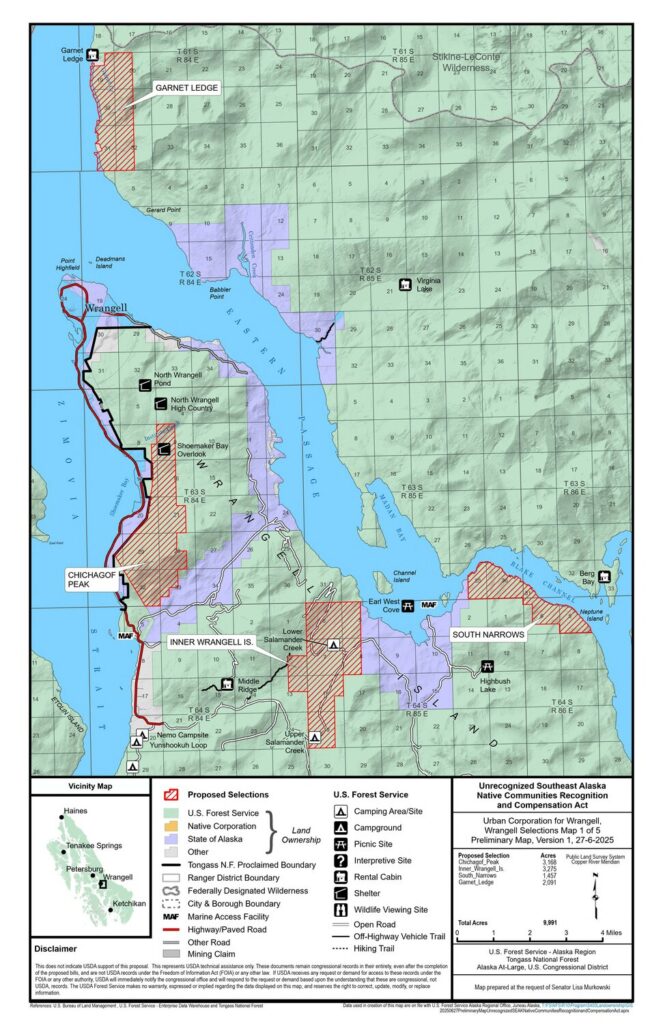
If Congress approves legislation to create Native corporations for Wrangell and four other Southeast communities, the new corporation would receive title to almost 10,000 acres on Wrangell Island, in addition to 13,000 additional acres in the area.
For the second time in three years, federal legislation to create a land-owning Native corporation in Wrangell and four other Southeast communities has passed out a Senate committee.
But the bill still has a ways to go before it could become law.
It would have to win passage in the full Senate and concurrence in the House. Though the House approved an identical version of the legislation in June, sending it to the Senate, the same actual bill needs to win passage in both the House and Senate before it can go to the president for signature into law.
And though the current congressional makeup will remain in place until a new Congress is sworn into office in January, after the fall elections are certified, the congressional calendar shows members in session for less than a total of nine weeks before the end of the year as members take breaks for campaigns and holidays.
The five communities, under the banner of Landless Natives, have been advocating for the congressional land-grant legislation since the 1990s, following on the 1971 Alaska Native Claims Settlement Act which created more than 200 urban and village corporations.
The act also created a dozen regional corporations, including Sealaska.
It has long been debated — but never resolved — why Native corporations were not created for the five Southeast communities under the 1971 legislation.
If the Senate — or the House — amendment to the land claims act makes it into law, the Native residents of Wrangell, Haines, Ketchikan, Petersburg and Tenakee would be allowed to organize as an urban corporation under ANCSA. Each corporation would receive $2.5 million in startup planning money and each would receive about 23,000 acres of federal land.
The Senate bill, which was introduced a year ago, is sponsored by Alaska Sen. Lisa Murkowski and co-sponsored by Alaska Sen. Dan Sullivan. The House bill, which was introduced in January 2025, is sponsored by Alaska U.S. Rep. Nick Begich III.
“I think really it is about a measure being ripe for passage,” Murkowski said in an interview with the Juneau Independent in June.
“It has taken us many years to negotiate the maps in terms of identifying parcels,” she said. “As we know, when it comes to the Tongass, every acre is precious to someone. And so when you’re trying to identify areas that are perhaps outside of your immediate community, it’s challenging.”
The senator’s bill advanced out of the Senate Energy and Natural Resources Committee on July 16. It would go next to the floor for a vote by the full chamber, if Senate leadership makes that decision.
The bill also allows each urban corporation to establish a settlement trust to promote the health, education and welfare of the trust beneficiaries, and preserve the Alaska Native heritage and culture of their communities.
“Is it a perfect bill?” Murkowski said. “No. Is it one that we have agreement amongst everybody as to the maps? Probably not. But is it a work product that I think we and the communities can stand behind? Absolutely,” she said. “We’re finally to that place where all of that legwork has been done.”
The legislation’s proposed land selections for a Wrangell corporation include 2,091 acres on the mainland near the Garnet Ledge, 3,168 acres on the north end of Wrangell Island around the Shoemaker Bay overlook and Chichagof Peak, 3,275 acres around Lower and Upper Salamander Creek, about 2,000 acres near Turn Island Beach on the southern end of Wrangell Island, almost 5,000 acres on the east side of Zarembo Island near Round Point, almost 1,500 acres at Anita Bay on Etolin Island, and several other blocks in the area.
Murkowski pointed to support from environmental groups including The Nature Conservancy and The Wilderness Society, who previously opposed the legislation.
“While our defense of the Tongass continues, we must correct the injustices faced by certain Native communities in Southeast Alaska,” a March letter from The Wilderness Society states in support of the House bill.
However, there is opposition, the senator said.
“I will share that there are some on the other side of the aisle who have reservations about the landless bill because they philosophically disagree that land should go from the federal estate into private hands because they are looking at these areas in the Tongass and saying, ‘All of these need to be preserved, and the best way to preserve that is to keep them in — again — in the federal estate,’” Murkowski said.
An Anchorage Superior Court judge ruled Thursday that the Alaska Division of Elections was correct to keep Anchorage Republican Jose Tagle on the primary election ballot for state House even though he filed a blank form when asked to disclose his personal finances.
State law requires candidates for public office to complete a Public Official Financial Disclosure form that lists their income and personal finances when they register as a candidate, but Tagle filed a blank form when he filed to challenge incumbent Rep. Ted Eischeid, D-Anchorage.
The Alaska Democratic Party challenged Tagle’s eligibility, but the division dismissed the party’s challenge, saying that the Alaska Public Offices Commission, not the division, is in charge of verifying a form’s accuracy.
The party sued the division, challenging that dismissal and arguing that a blank form is the same as filing no disclosure at all.
In a 23-page decision, Judge Josie Garton agreed with elections officials, saying the Division of Elections does not have to ensure that the information in the disclosure form is accurate.
“While the Division enforces the physical, simultaneous filing of the statement at the deadline,
Determining whether the statement’s contents are substantively compliant with (state law) is the express statutory responsibility of APOC,” she wrote.
Candidates have 30 days after the filing deadline to amend their personal financial disclosure forms, Garton said, and if they remain inaccurate at that deadline, only then may the director of the Division of Elections “not certify a person’s nomination or election to office.”
It isn’t yet clear what that will mean for Tagle’s election. Tagle filed an amended financial disclosure form on Aug. 8, more than a month after the 30-day period allowed by law.
Sam Curtis, a spokesman for the Alaska Department of Law, said by email that “APOC can now consider his amended financial disclosure, the complaint filed against him, and whether he is eligible to advance out of the primary election and appear in the general election.”
The department represented the division and the lieutenant governor’s office in the case.
Of Garton’s decision, he wrote, “the court’s decision confirms the Division’s practice: the Division makes sure candidates file financial disclosures on time, while the Alaska Public Offices Commission investigates whether their disclosures are accurate. This is the process set out in law. Mr. Tagle filed on time and is on the primary election ballot.”
Tagle and Eischeid are the only registered candidates for House District 22, and if Tagle is disqualified from advancing to the general election, Eischeid would be unopposed for re-election.
Garton’s decision appears to open the door for future candidates to delay disclosing their personal finances until the primary election is well underway.
Alaska’s candidate filing deadline is June 1, and if candidates are permitted to file blank forms until the 30-day period ends, that would halve the amount of time that primary election voters have to inspect candidates’ personal finances.
Garton asked about the issue during oral arguments last week, and her ruling on Thursday adopts the state’s position.
“A person who files a POFD that fails to accurately report the required information does not forfeit (their candidacy) upon the initial, non-compliant filing,” she wrote.
The Alaska Democratic Party had suggested in preliminary written arguments that it could appeal Garton’s decision to the Alaska Supreme Court, but in a statement on Thursday, the party implied that it would not do so.
“The Division of Elections has decided it wants to keep its head in the sand, and the court concluded that it is up to APOC to clean this mess up,” said Jenny-Marie Stryker, executive director of the Alaska Democratic Party, in a written statement. “Now that the decision sits squarely with APOC, we expect the commission to take a hard look at the facts and the law. Mr. Tagle’s blank disclosure left voters in the dark for months — and even if his recent amended filing is accurate, which is not at all clear, it does not change the fact that it was submitted well after the deadline to come into compliance.”