Categories
Alaska News

In speech, Murkowski calls for strong partnerships to meet challenges, opportunities for Alaska

Alaska U.S. Sen. Lisa Murkowski addresses a joint session of the Alaska State Legislature on Mar. 31, 2026. (Photo by Corinne Smith/Alaska Beacon)

Alaska U.S. Sen. Lisa Murkowski addresses a joint session of the Alaska State Legislature on Mar. 31, 2026. (Photo by Corinne Smith/Alaska Beacon)

U.S. Sen. Lisa Murkowski, R-Alaska, shared a message of tempered optimism and hope for the opportunities before Alaskans at her annual speech to the Alaska Legislature on Tuesday, yet called for collaboration to address a wide range of challenges and uncertainty under the Trump administration. 

“Alaska has big needs that demand strong leadership. We’ve got a lot going for us,” she said. “But we have to be clear eyed about our challenges. We need to tackle them head on, and we need to remember we are in this together.”

Alaska U.S. Sen. Lisa Murkowski addresses a joint session of the Alaska State Legislature on Mar. 31, 2026. (Photo by Corinne Smith/Alaska Beacon)
Eric Antrim was the sole demonstrator in the Alaska State Capitol for the Alaska U.S. Sen. Lisa Murkowski's annual legislative address. As a union member of NFFE Local 251 with the U.S. Forest Service, he said he wanted to thank the senator for supporting federal unions. (Photo by Corinne Smith/Alaska Beacon)
Eric Antrim was the sole demonstrator in the Alaska State Capitol for U.S. Sen. Lisa Murkowski’s annual legislative address. As a union member of NFFE Local 251 with the U.S. Forest Service, he said he wanted to thank the senator for supporting federal unions. (Photo by Corinne Smith/Alaska Beacon)

In her annual legislative address, Murkowski highlighted federal accomplishments in Congress, in step with Alaska’s other federal representatives, Republicans U.S. Sen. Dan Sullivan and Rep. Nick Begich III in speeches to the Legislature in recent weeks. That included investments in infrastructure, the U.S. military, Arctic defense, and extended tax credits. 

“We have kept federal income taxes low. We made the child tax credit permanent. We provided tax relief for everyone from waitresses to whaling captains,” she said. “We made historic, absolutely historic, investments in aviation safety, and, of course, for our Coast Guard.”

She praised the Trump administration’s focus on opening federal lands in Alaska and pushing for expanded oil and gas development, citing companies’ renewed investment and expanded future production in the National Petroleum Reserve in the North Slope.  

“Nothing is going better for Alaska than resource development,” she said. “Our state is no longer the special on the menu, but we are the heart of the plan.”

However, Murkowski said while it’s a moment of optimism for Alaska, the time demands realism. 

“Part of my purpose this morning is to help perhaps translate some of what is happening outside our state and the implications for us here in Alaska,” she said. 

“We can start with the crises around the world that are impacting Alaskans now from military service members who are deployed abroad, to rural residents who are already feeling the echoes of war through higher fuel prices, shipping surcharges, and certainly more expensive groceries,” she said. 

Murkwoski said people should prepare to confront volatility and economic hardships caused by a prolonged war in Iran and regional conflict in the Middle East. 

“I’m worried about the impact of higher fuel prices, but I’m also worried about shortages, shortages of our ability to get refined products,” she said. “This is something we all need to be paying attention to.”

In a news conference after her speech, Murkowski defended her vote against a war powers resolution aimed at limiting President Donald Trump’s military authority, citing the need to support actively deployed troops in the region.

Alaska U.S. Sen. Lisa Murkowski answers questions from news reporters following her annual address the Alaska State Legislature on Mar. 31, 2026. (Photo by Corinne Smith/Alaska Beacon)

“Those who are now in this fight need to know that they are supported by their country,” she said. 

But she said she is pushing for a vote in Congress on the Authorization for Military Use of Force, in part to compel a more clear military mission. 

“We’re no longer seeing a targeted approach to the conflict in Iran,” she said. “So an authorization of use of military force would put some guardrails, (and) allow the President to execute his war plan, but would also require a level of reporting to the Congress. And I don’t think that that’s asking too much.”

Murkowski said that Alaska may see a continued surge in oil prices and state revenues resulting from the regional conflict in the Middle East, but cautioned lawmakers against banking on the boom and bust of oil prices. 

“The windfall will only go so far and last so long, and I think it’s much better to get revenue from volume than it is from price,” she said. “We can’t count on anyone or anything to bail us out of our fiscal woes, only a long term plan will truly end the cycle of a boom and bust.”

‘Political football’

Murkowski criticized more frequent government shutdowns amid deep divides with Congress and the Trump administration as adding to the uncertainty.

“Shutdowns are becoming far too routine and too many policy makers are just becoming numb to their impacts,” she said. “These are real and they are harmful, and we cannot use a shutdown as a form of a political football.”

“It’s not great there in Congress right now,” she added. 

She also criticized the Trump administration’s immigration crackdown. She said she supports securing the southern border, but not at the expense of working people, citing a recent arrest and immediate deportation of a family in Soldotna. 

“It’s important for our security. But when the extension of these policies results in a mother in Soldotna and her three children being taken into custody with the mother deported and the oldest put in jail, I think it’s time for serious reflection and reform of our legal immigration immigration policies in this country,” she said. 

Similarly, Murkowski said she agrees only citizens should be able to vote, but she opposes a measure currently being debated in the Senate, the SAVE America Act, which would require proof of citizenship in-person to register to vote. 

“The premise is strong. It was not intended to disenfranchise Alaskans who can rightly vote, but I fear that that could be its effect,” she said. 

Murkowski urges state action to capture federal dollars

Murkowski also urged Alaska lawmakers to do their part, and said there are areas where the state is “not meeting expectations,” particularly for federal match programs for transportation and the Alaska Marine Highway ferry system.

“The fact of the matter is federal funding for AMHS is a lifeline. It’s not an entitlement. We’re going to try but there’s no guarantee that we’re going to be able to renew it at any level. And so it’s not a good strategy to rely on a temporary, competitive federal grant program to cover 45% of our state’s operating costs, all of which used to be paid for by the state,”

Murkowski urged timely action from Alaska leaders to secure health care funding through the Rural Health Transformation Fund, a $50 billion fund created by Congress last year as part of the negotiations that cut $1 trillion from Medicare and health care subsidies. 

“Alaska will receive the second most dollars of any state and the most per capita, about $1.3 billion in all, but the state needs to do dramatically better on this five-year effort than we did on ferries, just putting it out there,” she said. “Because If we don’t, Alaska’s funds can be redirected elsewhere, and we will miss a generational opportunity to improve care.”

Focus on partnerships

Murkowski urged state lawmakers to continue to support fisheries, which continue to be “in crisis” with some salmon runs collapsing, disputes in the industry around bycatch laws, and uncontrollable factors like climate change. 

“We need to have sound science, that’s the foundation of sound management,” she said. “And we need constructive dialogue that respects the needs of communities upriver, while also recognizing the benefits of industry.”

Murkowski called for more state investments in public education, citing visits to schools in “appalling” conditions with deferred maintenance needs. She called for increased pay, local investment in housing, and competitive retirement benefits to recruit and hire teachers in Alaska, as well as families wanting to stay in the state. 

Murkowski highlighted her efforts to secure federal dollars, called earmark spending for specific regions and local projects, like hydropower, drinking water infrastructure, child care, substance abuse recovery services and housing. 

“Over the past five years, my team and I have secured just over $2 billion for the state of Alaska,” she said.  

She touted her role as chair of the Senate Indian Affairs Committee, and work focused on Alaska Native communities. 

“We’ve got a big measure that we’re working on to convert the recommendations from the Commission on Native Children into legislation that addresses child welfare, behavioral health, nutrition, education, housing and more,” she said. “So we’re going to be introducing this in the next month or so.”

Murkowski said she’s committed to her role serving Alaska, and urged lawmakers to work across political and regional divides to address the significant challenges ahead.

“We are blessed to live in this great state and even more blessed to be able to represent this great state,” she said. “Let’s set aside the politics, and the regionalism. Let’s focus on partnerships for all of Alaska to achieve as much as we can for every part of our state and for every person in it.”

Alaska U.S. Sen. Lisa Murkowski poses for a photo with the women members of the Alaska House and Senate following her address to a joint session of the Alaska State Legislature on Mar. 31, 2026. (Photo by Corinne Smith/Alaska Beacon)

SUPPORT: YOU MAKE OUR WORK POSSIBLE

Categories
Alaska News

U.S. Forest Service overhaul sows confusion, concern

The setting sun casts pink hues in the Craig District of the Tongass National Forest on June 15, 2020. (Photo by Amy Li/U.S. Forest Service)

The setting sun casts pink hues in the Craig District of the Tongass National Forest on June 15, 2020. (Photo by Amy Li/U.S. Forest Service)

On March 31, the U.S. Forest Service announced plans to move its headquarters from Washington, D.C., to Salt Lake City, Utah. It will also close or repurpose all nine of its regional offices, create 15 state offices, and shutter research and development facilities in more than 30 states. According to a news release, the plan is intended to make the agency more “nimble, efficient [and] effective.” Forest Service leaders told staff on a call after the announcement that no changes will be made to fire and aviation management programs or field-based operational firefighters.

Since first announcing its intent to reorganize the agency last July, the Trump administration has marketed the plan as a way to streamline Forest Service operations, with a focus on boosting timber production and communicating more closely with local communities. But during a congressional hearing and public comment period on the subject last summer, more than 80% of the 14,000 public comments submitted were negative, with many tribal representatives, conservation groups and former Forest Service staffers opposing the move. A U.S. Department of Agriculture summary of public comments included concerns that relocating Forest Service staff and further cuts to its budgets “could compromise ecological management, public access, and employee morale.” The current plan incorporates many elements of the original proposal, including the move to Salt Lake City and the closure of regional offices.

“Nobody is asking for this,” said Robert Bonnie, who oversaw the Forest Service as a Department of Agriculture undersecretary during the Obama administration. “None of the farm groups want this. No one in conservation wants this. Nobody.” To Bonnie and other former Forest Service staff, the plan, which will uproot thousands of employees, looks like it will only make the agency’s existing troubles worse, especially given the past year of deep cuts and chaos.

“This is not going to strengthen the Forest Service, it is going to weaken it,” Bonnie said. “It’s not about solving problems, it’s about blowing things up.”

None of the farm groups want this. No one in conservation wants this. Nobody.

– Robert Bonnie, former Department of Agriculture undersecretary who oversaw the Forest Service during the Obama administration

MARY ERICKSON, a retired Custer Gallatin National Forest supervisor, had more questions than answers after the announcement. “I’m not going to say if it’s good or bad at this point,” she said. “It’s just such a sweeping change with no real analysis about if there would be cost savings.”

Under the new proposal, some states will have their own offices and others will be lumped together, similar to the organization of the Bureau of Land Management. This will be a new approach for the country’s 154 national forests, which have long been managed by the nine regional offices that will be shuttered or repurposed. Now, forests in Washington, Oregon, Montana, Alaska and Idaho will each be managed by their own state office. Forests in Nevada and Utah, however, will be managed together, as will forests in Colorado and Kansas.

Some Forest Service research facilities, including the Rocky Mountain Research Station in Fort Collins, Colorado, will stay open. Others, including the research station in Portland, Oregon, which is responsible for critical work on species like spotted owls, will be closed. Losing local leadership “is not going to improve the programs,” said former Forest Service wildlife biologist Eric Forsman. Forsman, who retired in 2016, studied spotted owls and red tree voles at the agency’s Forestry Sciences Laboratory in Corvallis, Oregon, which will remain in operation. “It may help budgets,” he added, “but it won’t improve the quality of the research or the amount of research that gets done.”

Erickson and others were also concerned about the plan to move high-level bureaucrats out of D.C., where the nation’s law- and policymakers reside. “I would push back on this idea that moving out of D.C. is moving closer to the people you serve. That’s not the role of the national office,” Erickson said. The national office, she added, is supposed to coordinate and create guidance based on national policy. “Forests and districts have always been the heart of local communities and local delivery.”

I would push back on this idea that moving out of D.C. is moving closer to the people you serve. That’s not the role of the national office.

– Mary Erickson, retired Custer Gallatin National Forest supervisor

After talking with current and former Forest Service staffers following Tuesday’s announcement, she also worries that, at least in the short term, disarray created by the reorganization will hamstring the agency’s ability to address the complex and worsening challenges that modern forests face. Those include tree disease outbreaks, the growing wildland-urban interface and climate change-induced drought. The Forest Service is already reeling from the loss of thousands of employees during the last year, through the terminations and deferred resignations effected by the now-defunct Department of Government Efficiency, or DOGE.

The reorganization may also lead to states playing an even bigger role in forest management, said Kevin Hood, executive director of Forest Service Employees for Environmental Ethics, who retired in 2025 after decades working in the Forest Service throughout the West. While local coordination isn’t bad in theory, he said, he’s concerned the new structure will be a step toward ceding the management of national forests and other public lands to states.

Tribal representatives, several of whom declined to comment for this story, voiced concerns during the July public comment process that the reorganization would lead to losses of expertise and fractured relationships. Mass staff relocations, one representative wrote, would “destroy irreplaceable knowledge about Treaty rights, forest conditions, and working relationships built over decades, and new staff unfamiliar with the land will make mistakes.”

FOR MANY PEOPLE in conservation, the Forest Service reorganization feels like déjà vu, or even a recurring nightmare.

In 2019, during Trump’s first term, his administration announced a plan to move nearly all Bureau of Land Management staff out of the agency’s D.C. headquarters to Grand Junction, Colorado — then a 66,000-person city located hundreds of miles from a major airport. As with the March 31 Forest Service announcement, the administration said the change would put high-level staff closer to the mostly-Western lands they manage. Instead, many of those staff left the agency altogether, said Tracy Stone-Manning, who directed the BLM under President Joe Biden and is now president of The Wilderness Society.

In fact, by the time the Grand Junction office opened in 2020, only 41 of the 328 BLM employees expected to move West chose to do so, according to a High Country News investigation. For many, moving meant uprooting their entire family, and required a spouse to find a new job in a much smaller market.

The reorganization cost taxpayers $28 million. And the Biden administration ended up moving many high-level positions back to D.C., though it did keep some agency leaders in the Grand Junction office, which it renamed the agency’s “Western Headquarters.” John Gale, who headed the office for two years under Biden, sees merit in searching for ways to improve public-lands management. But restructuring and relocation need to be done thoughtfully and carefully to be effective, he said.

That’s because agencies lose irreplaceable institutional knowledge when people with decades of experience are forced out the door, said Stone-Manning. And while that may not have been the first Trump administration’s intention, it was indeed the outcome of the BLM reorganization. She and others expect the Forest Service to suffer the same fate, with even more dire results for the public.

“Our public lands are not being cared for the way they need to be,” she said. “And what that means is ultimately people will throw up their hands and say the federal government can’t manage them, let’s sell them off.”

We welcome reader letters. Email High Country News at editor@hcn.org or submit a letter to the editor. See our letters to the editor policy.

This story is part of High Country News’ Conservation Beyond Boundaries project, which is supported by the BAND Foundation and the Mighty Arrow Family Foundation.

This article first appeared on High Country News and is republished here under a Creative Commons Attribution-NonCommercial-NoDerivatives 4.0 International License.

Categories
Alaska News Featured Juneau News juneau Juneau Local Juneau Local Ketchikan Local News Feeds Sitka Local

Alaska lawmakers push for continued ban on Russian seafood imports

By: Yereth Rosen, Alaska Beacon

Fishing vessels are seen in Homer’s harbor on Oct. 22, 2025. A resolution passed by state lawmakers urges federal officials to extend the ban on Russian seafood imports. Russian fish competes for market share with Alaska’s fish. (Photo by Yereth Rosen/Alaska Beacon)

A legislative resolution urging a continued and better-enforced ban on Russian seafood in the United States is headed to Gov. Mike Dunleavy.

Part of a series of actions by Alaska lawmakers to try to shore up the state’s ailing seafood industry, House Joint Resolution 29 won final passage last week and was transferred to the governor on Monday.

The resolution calls for continuation of the ban on Russian seafood imports imposed in 2022, after that country’s invasion of Ukraine. The ban was expanded in 2023 to cover imports of Russian seafood to the U.S. through a third-party country, usually China, where fish are processed.

The import ban is set to expire later this year. That makes the resolution timely, supporters aid.

Among the supporters is Jeremy Woodrow, executive director of the Alaska Seafood Marketing Institute.

Woodrow, in testimony to the Senate Resources Committee on Feb. 27, said a stockpile of Russian fish that was in the U.S. before the ban went into full effect is just now being depleted.

“We need more time to really capture the U.S. marketplace. Our industry has not recovered yet,” Woodrow said. Even though last year’s fishing season was better, it was still one of the worst years in the last 20 years, he said.

“This is one measure that will help our fishermen. We’re starting to see the fruits of this ban coming into play, but we need more time to provide stability to our industry. We need more time to see it come to fruition,” he told the committee.

In addition to seeking an extension of the import ban, the resolution calls for stronger monitoring and enforcement to “ensure fair trade, protect the state’s seafood industry, and promote sustainable and ethical seafood production.”

Legislative resolutions do not have the power of law, but they can influence actions by Congress, the federal executive branch or other institutions.

The Russian seafood import ban resolution was not among the measures introduced by the Joint Legislative Task Force Evaluating Alaska’s Seafood Industry, formed in 2024. However, it addresses an aspect of international trade, one of the issues raised by the task force. The task force’s report recommended an update to a Russia-focused resolution passed by the legislature in 2022, Senate Joint Resolution 16.

Russian king crab is displayed at a Costco in Anchorage on Nov. 14, 2022. The crab, from the Barent Sea, was distributed by Arctic Seafoods of San Francisco, and was part of inventory stockpiled before the U.S. government banned fish imports from Russia. (Photo by Yereth Rosen/Alaska Beacon)

The eight-member task force, comprising Senate and House members from fishery-dependent districts, issued its recommendation report in January 2025, at the start of last year’s session. Recommendations for action resulted in the introduction of a series of bills intended to help the industry, which has struggled with low fish prices, glutted international markets, high costs and other challenges.

Other bills focus on tax credits and revenues

One of the task force’s bills, aimed at encouraging seafood product development and diversification, is headed for a vote in the Senate this week.

That measure, Senate Bill 130, concerns the state’s fisheries product development tax credit system. Currently, seafood companies are allowed to deduct the cost of new equipment used to develop value-added products from salmon, herring, pollock, sablefish and Pacific cod. The bill would expand that to all fish species, including shellfish. That is in line with the recommendation in the task force report, which identifies arrowtooth flounder, fish meal and crab shells as examples of some underused or discarded products that could be processed into something marketable.

The bill, in the amended form before the Senate, also seeks to expand the range of technology for which investment would qualify for credits, and it would extend the sunset date for the credit to 2037. Currently, the tax credit is due to expire next year.

The revenue impact of the bill, if it wins final passage, is difficult to determine because there are several unknown variables, said the fiscal note prepared by the state Alaska Department of Revenue. Estimated annual revenues losses to the state would range from $1 million to nearly $4 million, according to the fiscal note.

Another task force bill, aimed at helping fishery-dependent local governments, had not moved out of the Senate Finance Committee as of Tuesday. That measure, Senate Bill 135, would allow municipalities to increase their share of fisheries business tax and fishery resource landing tax revenues. Currently, the state and local governments split those tax revenues equally. The bill would allow local governments to get up to 75% of the tax revenues.

The legislature passed two seafood task force bills last year, each of which had wide support. However, Dunleavy vetoed one of the bills.

The bill that escaped the governor’s veto, House Bill 116, allows for the formation and operation of member-owned commercial fishing insurance cooperatives. Such cooperativesexist in other states and were used by some Alaska fishers. The bill passed unanimously.

The vetoed bill, Senate Bill 156, would have transferred $3.69 million from a defunct state loan fund to the Alaska Commercial Fishing and Agriculture Bank. The state-owned bank needed the boost to keep serving the seafood industry, bill supporters argued. But Dunleavy argued that the cost of the action was too great for the state budget to bear.

Categories
Alaska News Featured Juneau News juneau Juneau Local Juneau Local Ketchikan Local News Feeds Sitka Local

Alaska Senate advances constitutional amendment to lower override threshold for spending vetoes

By: Sean Maguire, Alaska Beacon

 Members of the House and Senate voted to sustain Gov. Mike Dunleavy’s veto of SB 113, a corporate income tax bill tied to education funding by a vote of 45 to 16. 46 votes were needed to override the veto on Jan. 22, 2026 (Photo by Corinne Smith/Alaska Beacon)

The Alaska Senate on Tuesday advanced a constitutional amendment that would lower the threshold for veto overrides of spending decisions.

The Alaska Constitution currently has two thresholds to override a governor’s vetoes: it takes two-thirds of legislators to override a veto of a policy bill and three-quarters of lawmakers to override a budget veto or a veto of legislation that spends money.  

Anchorage Democratic Sen. Matt Claman’s proposed the constitutional amendment that would reduce vetoes of spending decisions to the same two-thirds threshold.

Sen. Matt Claman, D-Anchorage, speaks at a March 19, 2024, news conference held by the Senate majority caucus. (Photo by Yereth Rosen/Alaska Beacon)

Claman’s resolution passed the Senate along caucus lines on a 14-6 vote. All 14 members of the bipartisan Senate majority voted for the resolution while each member of the all-Republican Senate minority voted no. 

At least 14 of Alaska’s 20 Senators are needed to reach the two-thirds threshold to advance a constitutional amendment. Twenty-seven of the 40 House members would need to approve Claman’s resolution for the proposed amendment to appear on November’s ballot.

The last time the Alaska Constitution was amended was in 2004.

Claman, a Democratic candidate for governor, said the drafters of the Alaska Constitution intended to create a strong executive branch. But the high hurdle to override a veto on spending decisions had “undermined the balance of power between the Legislature and the executive,” he said.

Alaska is the only state with a three-quarter veto override threshold for spending decisions.

In a statement following the vote on Tuesday, minority Senate Republicans said the governor’s veto power was one of few tools to curb the Legislature’s wide-reaching power. Members of the caucus stated that Gov. Mike Dunleavy had used that authority to veto tax bills, among other measures.

“The framers of our Constitution saw the wisdom in giving the governor considerable power to reduce state spending,” said Tok Republican Sen. Mike Cronk, the Senate minority leader. “The fiscal override threshold is high for a reason.”

While the Legislature has voted to override a governor on 40 occasions for policy bills since statehood, veto overrides for spending decisions have only occurred five times, Claman said.

The most recent override of a spending veto occurred last August in a special session Lawmakers voted to reject Dunleavy’s veto of more than $50 million in public school funding. The vote was 45-14, the minimum number of lawmakers needed to override a budget veto.

If approved by the House, the constitutional amendment would appear on the ballot at the Nov. 3 election. If approved by a majority of voters, the constitutional threshold for budget vetoes would then be lowered starting in 2027, also the beginning of a new governor’s term.

Unlike legislation, an Alaska governor cannot veto a constitutional amendment.

Categories
Alaska News

A giant lease sale could launch a new era of oil on Alaska’s North Slope

HOUSTON — Global energy leaders have convened here this week, spiffed up in dark suits and polished shoes, to discuss the industry’s most pressing issues: war in the Middle East, Venezuela, artificial intelligence.

But behind the scenes at this annual conference of industry executives — known formally as CERAWeek by S&P Global but nicknamed the “Super Bowl of energy” — a big story about Alaska oil is unfolding.

It involves a massive lease sale in the Arctic, a remarkable show of interest from global oil giants that had faded from Alaska’s frontlines and an emerging race to find deposits potentially worth billions of dollars. Industry proponents say a flood of crude from the largely undeveloped western Arctic, if companies can locate and produce it, could open a new era for the state’s industry.

In what was by far the highest-value federal lease sale in the vast National Petroleum Reserve–Alaska in more than two decades, oil companies last week snatched up more than 1 million acres across the western Arctic.

The scale of interest, with 11 companies participating and a record $163 million spent on bids, was itself notable. But so were the identities of some of the bidders. Two, in particular, surprised even industry insiders: ExxonMobil and Shell. 

Both supermajors have a history in Alaska. 

ExxonMobil still owns shares of existing Arctic oil fields and the trans-Alaska pipeline. But Shell no longer operates in the state and hasn’t drilled a well in Alaska since its failed offshore exploration campaign more than a decade ago. And ExxonMobil hadn’t bid on leases in years.

Energy historian Dan Yergin, left, speaks with Wael Sawan, chief executive of Shell, at the CERAWeek oil industry conference in Houston this week. (Grant Miller Photography/CERAWeek by S&P Global)

Their renewed interest — along with continued investment from established players like ConocoPhillips and Colorado-based wildcatter Bill Armstrong — accelerates an industry revival that was already playing out on the North Slope. 

Just a few years ago, new production and investment in the region lagged as some companies struggled to raise money and even pulled out of Alaska amid successful advocacy campaigns against Arctic drilling. 

But major geologic discoveries by Armstrong — and a pair of big new oil fields now under construction — have made the North Slope a more attractive investment. And the industry also has political tailwinds coming from a Trump administration keen to boost resource extraction in Alaska. 

“This sale absolutely shows the world the potential for Alaska,” Armstrong, one of the primary bidders, said in an interview at CERAWeek. “This could be a game-changer for the state.”

Bill Armstrong (Max Graham/Northern Journal)

The region still faces obstacles to development, like high costs and competition from other basins where drilling is cheaper. 

And the lease sale is just a preliminary step, far from an assurance of future production: No new wells have been drilled yet, and companies often spend years doing exploratory work before deciding whether to start pumping oil. 

Conservation groups, meanwhile, continue to fight the industry’s expansion in the reserve — where, they note, federal law instructs policymakers to not only to oversee oil development but also to protect the environment and cultural values. Multiple lawsuits are challenging the Trump administration’s oil-friendly policies in the Arctic, and advocates have asked a judge to invalidate leases set to be awarded after last week’s sale. 

Four small lakes sit on the northwestern side of Teshekpuk Lake, a key wildlife habitat within the National Petroleum Reserve – Alaska that’s also seen interest from oil companies. (Craig McCaa/U.S. Bureau of Land Management)

“What we saw last week were companies pushing into some of the most sensitive areas of the reserve,” said Suzanne Bostrom, an attorney with a conservation-focused Anchorage law firm, Trustees for Alaska, that represents some of the organizations suing the administration. “We and the groups that we work with are going to continue to fight for this area, and fight for the protections that it deserves,” Bostrom added. 

But even amid the pending legal questions, the sale’s results are still a step toward new development; further investment and competition in the petroleum reserve are likely to follow, conference participants told Northern Journal in Houston this week.   

A surprising sale

Leading up to the sale, there were signs that oil companies could show up in force. 

It was the first auction in NPR-A in seven years, and more acreage was up for grabs than in many previous sales. The offerings included large swaths of tundra and wetlands that Democratic administrations had designated off-limits to drilling. 

And after years of comparatively tepid industry interest, recent oil discoveries have expanded the known resources on the North Slope, said Bob Fryklund, a top oil and gas analyst at S&P Global Energy, a research firm.

“It’s kind of been a sleeper basin,” he said. 

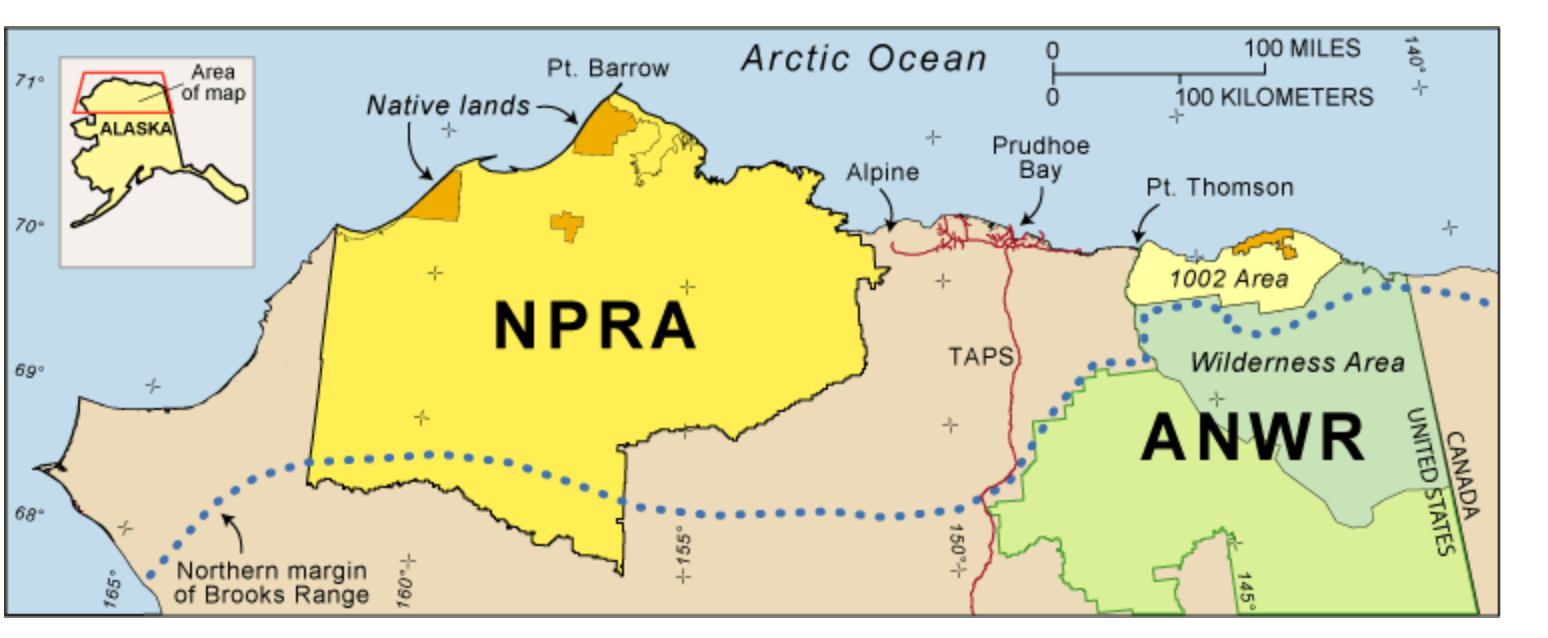
This map of Alaska’s North Slope shows the National Petroleum Reserve – Alaska and the Arctic National Wildlife Refuge. Two oil companies are building large developments near the reserve’s eastern edge, and a major lease sale recently auctioned off land deeper into the reserve. Prudhoe Bay is the hub of existing North Slope development.

A decade ago, the petroleum reserve was beyond the western edge of the North Slope’s oil infrastructure, making it more expensive to bring in equipment and drill. 

But the industry has been moving in its direction: Construction is now underway at two big new oil fields in the area — ConocoPhillips’ Willow project and Santos’ Pikka project. Both will tap into a long-overlooked oil-rich geologic formation, known as the Nanushuk, that Armstrong initially discovered near the reserve’s eastern boundary. 

It was no surprise, then, that ConocoPhillips, Santos and Armstrong all showed up at the recent auction, analysts said.

An exploration rig drills for oil at ConocoPhillips’ Willow prospect in the National Petroleum Reserve – Alaska. (ConocoPhillips)

Few people, however, predicted that so many other companies would put in bids, or that major corporations like ExxonMobil and Shell would participate. 

ExxonMobil, committing more than $7 million on some 138,000 acres, came as a particularly big surprise.

That company, headquartered in Houston, owns shares in the existing Point Thomson and Prudhoe Bay oil fields on the North Slope. But it doesn’t manage either field, and the company has not been active in exploration and new development in the state: Until last week, ExxonMobil had not bid on a federal or state oil and gas lease in Alaska in more than a decade, according to data provided by Welligence, an industry research firm. 

Meanwhile, Shell, in a partnership with a Spanish company, Repsol, submitted some of the highest bids. The two companies offered more than $2 million on many individual tracts, and committed more than $90 million in total.

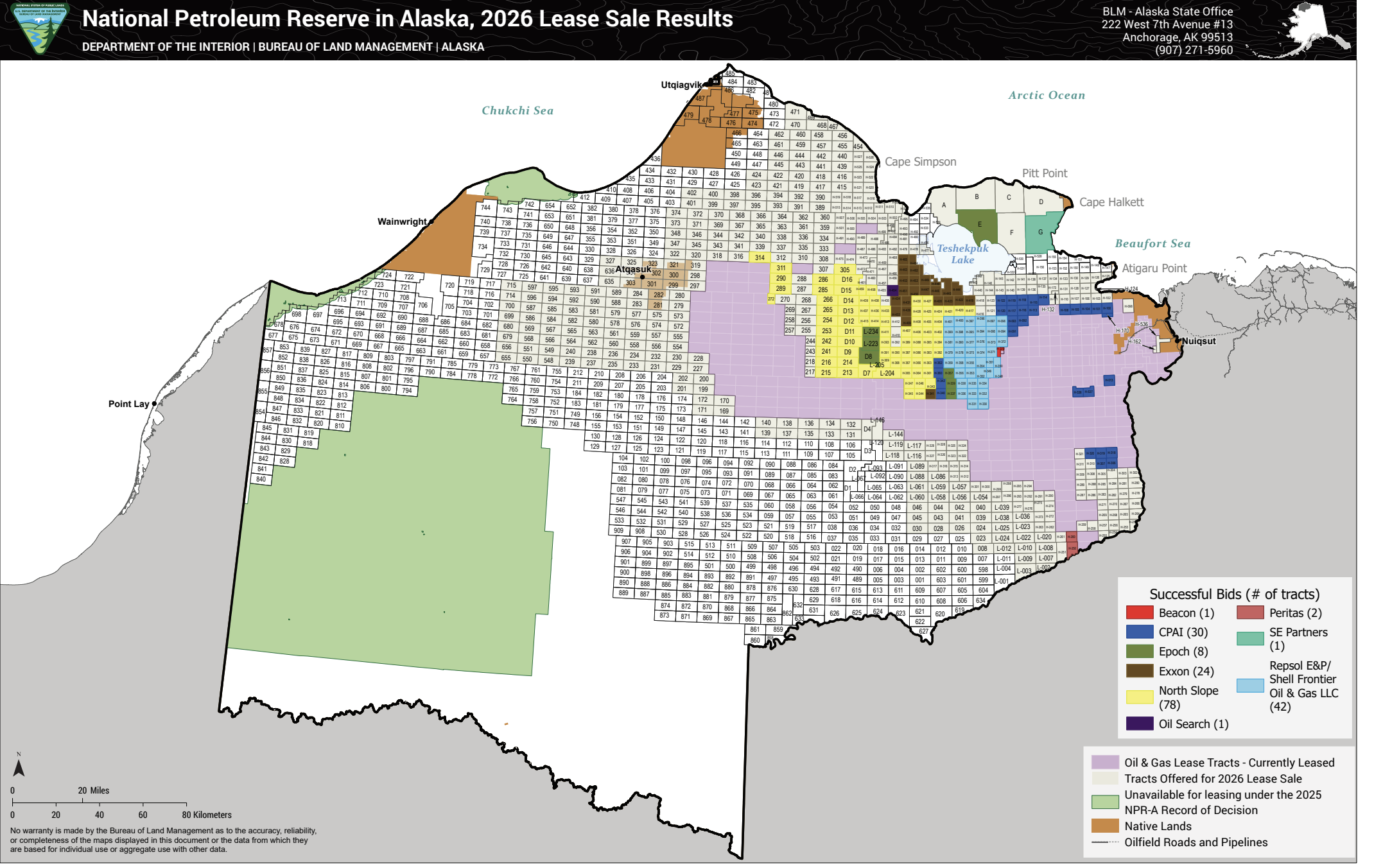
A map produced by the U.S. Bureau of Land Management shows winning bids from last week’s lease sale.

Experts said the return of those players was likely influenced by the ongoing development in the area.

Although neither the Willow nor Pikka project is producing yet, the multibillion-dollar investments by ConocoPhillips and Santos may have given other companies more faith in the surrounding geology and the ability to pump oil in the area, analysts said. 

“What you saw Shell do, and even Exxon, was validation of the work done by other players on the North Slope in recent years,” an oil company executive said in Houston, speaking on the condition of anonymity because he was not authorized to speak publicly. 

Industry headwinds subside

Shell’s interest represents a reversal from its announcement a decade ago that it was pulling out of Alaska. The company had spent some $7 billion on its failed effort to drill for oil offshore in the Chukchi Sea, citing Obama administration policies and high costs when it departed the state. 

In 2020, another major, BP, also pulled out of Alaska, selling its assets to Hilcorp, a privately owned Texas business. 

Those decisions both seemed like signals of the industry’s decline in the state, as the daily flow through the trans-Alaska pipeline shrank to 500,000 barrels from a high of 2 million decades earlier. An era of oil giants spending freely on big new projects was giving way to one of smaller companies wringing the last drops of crude out of aging fields.

An oil and gas rig drills at a Hilcorp development in the Cook Inlet basin in Southcentral Alaska. (Nathaniel Herz/Northern Journal)

At the time, companies were contending not only with the usual impediments to drilling in Alaska, like high costs and opposition from environmental groups, but also with growing political pressure from climate-minded shareholders and activists opposed to expanding fossil fuel production. Even oil executives acknowledged that advocacy against the oil industry, which is a major driver of climate change, was deterring investment in Alaska. 

But even as the burning of fossil fuels continues to warm the planet, global demand for oil remains high — and industry confidence in the North Slope’s potential appears only to be growing. 

The newly discovered oil deposits there “have proven that Alaska is not over,” Fryklund said.

ConocoPhillips, ExxonMobil and Santos declined to make officials available for on-record interviews. Shell did not respond to a request for comment. 

“This marks an important step in our continued commitment to responsible energy development in Alaska and the U.S.,” an Exxon spokesperson said in an emailed statement. 

Once the company’s leases are finalized, ExxonMobil will work with the state and local communities as it evaluates “potential next steps for the area,” the statement said. 

“I wish I were 30 years younger” 

For those who work in the oil industry, the central plank of Alaska’s economy, the sale stirred excitement, and some relief: New activity in the federal reserve could bring more gigs for contractors that have long wondered if there would be enough development on the North Slope to sustain their businesses.   

“We’ve all had this little worry of, ‘Well, what’s next?’” said Greg Miller, vice president of operations at Cruz Construction, a Palmer-based company with oil-related contracts on the Slope. “Now, there’s a little bit of reason to be a little bit more hopeful and positive about the next 10, 20 years.”

The sale won’t lead to immediate growth for Miller’s business, he said. But new exploration activity, if and when it happens, will create jobs: A single project can provide a year’s worth of wages for as many as 100 employees at Cruz, Miller added. 

For the president of another Alaska oil services company, Kevin Durling, the hype around the petroleum reserve is reminiscent of the boom days when oil started flowing through the trans-Alaska pipeline, in the 1970s and 1980s.

The trans-Alaska oil pipeline pumps some 500,000 barrels a day. (Nathaniel Herz/Northern Journal)

“I wish I was 30 years younger,” he said. 

The state’s conservation community, meanwhile, has reacted with disappointment, and concern for the western Arctic ecosystem. 

The vast, largely undeveloped region contains important habitat for migratory birds, and it sustains tens of thousands of caribou, some of which calve around Teshekpuk Lake, a major water body in the northern part of the petroleum reserve. 

“I’ve had better weeks at work. No question about that,” said Andy Moderow, senior policy director at Alaska Wilderness League, one of the environmental groups suing the Trump administration. But, he added: “The war is still well in front of us.”

One potential hurdle for development is a legally disputed conservation area around Teshekpuk Lake. The protections, across about 1 million acres, were set aside by the Biden administration for the nearby Iñupiaq village of Nuiqsut, where many people still depend on caribou and other wildlife for food. 

The Trump administration canceled the protections late last year, touting the area’s oil and gas potential and aiming to authorize leasing there. Nuiqsut’s leaders then sued, saying the move violated a prior agreement and threatened the village’s subsistence traditions. 

Two days before the lease sale results were announced, a federal judge restored the Teshekpuk protections while the lawsuit played out. 

But the area still attracted bids from a few companies — including ExxonMobil. 

The administration has not said whether it plans to award leases in the disputed area to high bidders — or how, exactly, it intends to navigate the apparent conflict between the sale results and the court ruling.

Nathaniel Herz contributed reporting from Anchorage.

The post A giant lease sale could launch a new era of oil on Alaska’s North Slope appeared first on Chilkat Valley News.

Categories
Alaska News

Alaska Senate votes to clarify state authority for imported natural gas prices

The downtown Anchorage skyline is seen from the Tony Knowles Coastal Trial on June 3, 2022. Although Anchorage is Alaska's largest city, it and the surrounding Southcentral region are considered small and isolated natural-gas markets. (Photo by Yereth Rosen/Alaska Beacon)

The downtown Anchorage skyline is seen from the Tony Knowles Coastal Trial on June 3, 2022. Although Anchorage is Alaska’s largest city, it and the surrounding Southcentral region are considered small and isolated natural-gas markets. (Photo by Yereth Rosen/Alaska Beacon)

The Alaska Senate on Tuesday unanimously advanced a bill that would clarify state regulators’ authority to oversee pricing for imported natural gas. 

The Federal Energy Regulatory Commission oversees the construction and location of gas import facilities. Senate Bill 180 clarifies that authority to regulate pricing for imported gas rests with the Regulatory Committee of Alaska, which is tasked with ensuring utilities pay “just and reasonable rates” for energy.

A looming shortfall of Cook Inlet gas has sparked calls for imports and to build a pipeline for Southcentral Alaska’s energy needs. At least two separate gas import terminal proposals have been advancing, which has caused anxiety among regulators and the public about the potential for higher utility bills. 

The Anchorage Daily News reported in February that one facility could import roughly a third of Southcentral Alaska’s annual gas needs; the other could import around 155% of the region’s needs, allowing for the potential growth of demand.

The import facilities are slated to deliver gas in 2027 and 2029, the ADN reported.

Anchorage Republican Sen. Cathy Giessel, chair of the Senate Resources Committee and lead sponsor of SB 180, said the bill would help guarantee the lowest power and heating bills for ratepayers. She said a recent legislative change had caused “significant confusion.”

In 2024, the Legislature approved House Bill 50, an omnibus energy bill that combined provisions to regulate carbon storage, an expansion of the state’s geothermal energy program, among other changes.

One sentence on page 39 of the bill has been problematic for state regulators, Giessel said. The provision states a LNG import facility under the jurisdiction of federal regulators is exempt from state regulatory oversight.

Giessel cited several cases where state regulators have been uncertain about their power to oversee rates for imported gas.

“It needs to be clarified that the RCA has the authority over the cost of the product purchased by one of our utilities,” she said in support of SB 180 before Tuesday’s vote.

The bill now advances to the Alaska House of Representatives for its consideration.

Categories
Alaska News

Alaska Senate advances constitutional amendment to lower override threshold for spending vetoes

Members of the House and Senate voted to sustain Gov. Mike Dunleavy's veto of SB 113, a corporate income tax bill tied to education funding by a vote of 45 to 16. 46 votes were needed to override the veto on Jan. 22, 2026 (Photo by Corinne Smith/Alaska Beacon)

Members of the House and Senate voted to sustain Gov. Mike Dunleavy’s veto of SB 113, a corporate income tax bill tied to education funding by a vote of 45 to 16. 46 votes were needed to override the veto on Jan. 22, 2026 (Photo by Corinne Smith/Alaska Beacon)

The Alaska Senate on Tuesday advanced a constitutional amendment that would lower the threshold for veto overrides of spending decisions.

The Alaska Constitution currently has two thresholds to override a governor’s vetoes: it takes two-thirds of legislators to override a veto of a policy bill and three-quarters of lawmakers to override a budget veto or a veto of legislation that spends money.  

Anchorage Democratic Sen. Matt Claman’s proposed the constitutional amendment that would reduce vetoes of spending decisions to the same two-thirds threshold.

Sen. Matt Claman, D-Anchorage, speaks at a March 19, 2024, news conference held by the Senate majority caucus. (Photo by Yereth Rosen/Alaska Beacon)

Claman’s resolution passed the Senate along caucus lines on a 14-6 vote. All 14 members of the bipartisan Senate majority voted for the resolution while each member of the all-Republican Senate minority voted no. 

At least 14 of Alaska’s 20 Senators are needed to reach the two-thirds threshold to advance a constitutional amendment. Twenty-seven of the 40 House members would need to approve Claman’s resolution for the proposed amendment to appear on November’s ballot.

The last time the Alaska Constitution was amended was in 2004.

Claman, a Democratic candidate for governor, said the drafters of the Alaska Constitution intended to create a strong executive branch. But the high hurdle to override a veto on spending decisions had “undermined the balance of power between the Legislature and the executive,” he said.

Alaska is the only state with a three-quarter veto override threshold for spending decisions.

In a statement following the vote on Tuesday, minority Senate Republicans said the governor’s veto power was one of few tools to curb the Legislature’s wide-reaching power. Members of the caucus stated that Gov. Mike Dunleavy had used that authority to veto tax bills, among other measures.

“The framers of our Constitution saw the wisdom in giving the governor considerable power to reduce state spending,” said Tok Republican Sen. Mike Cronk, the Senate minority leader. “The fiscal override threshold is high for a reason.”

While the Legislature has voted to override a governor on 40 occasions for policy bills since statehood, veto overrides for spending decisions have only occurred five times, Claman said.

The most recent override of a spending veto occurred last August in a special session Lawmakers voted to reject Dunleavy’s veto of more than $50 million in public school funding. The vote was 45-14, the minimum number of lawmakers needed to override a budget veto.

If approved by the House, the constitutional amendment would appear on the ballot at the Nov. 3 election. If approved by a majority of voters, the constitutional threshold for budget vetoes would then be lowered starting in 2027, also the beginning of a new governor’s term.

Unlike legislation, an Alaska governor cannot veto a constitutional amendment.

Editor’s note: this story has been updated with comment from the Senate Minority caucus.

SUPPORT: YOU MAKE OUR WORK POSSIBLE

Categories
Alaska News

Alaska mayors say governor’s proposed tax break for $46B gas line ‘needs a lot of work’

Five Alaska mayors voiced concerns about how a proposed tax break for the Alaska LNG gas line project would impact their communities.

Republican Alaska Gov. Mike Dunleavy has proposed eliminating property taxes and other local taxes for the $46 billion megaproject. Instead, his bill would impose a volume-based tax when substantial quantities of gas are delivered from the North Slope. 

The Alaska Department of Revenue estimated Dunleavy’s bill would equate to a roughly 90% reduction in property tax revenue, once the pipeline is at full capacity. The state agency has said the pipeline will not move forward without cutting property taxes for Glenfarne, the New York-based developer of the proposed pipeline and export facilities. 

Five Alaska mayors on Friday testified to the Senate Resources Committee in support of the 800-mile pipeline, which is set to run from the North Slope to Cook Inlet. But the municipal leaders also expressed concerns about the potential loss of revenue from the governor’s tax break and the impacts on municipal services. 

‘Bottom offer’

Peter Micciche is mayor of the Kenai Peninsula Borough, one of Alaska’s largest with roughly 62,000 residents. He said a liquefaction facility, equating to 43.5% of the total project, is set to be located in the coastal region.

Micciche said the project would have tens of millions of dollars of impact annually for the Kenai Peninsula, with costs set to be borne by local communities under Dunleavy’s bill. He said the proposed elimination of all local taxes for Alaska LNG is “cutting deep into the fabric of how our communities work. And that worries me.”

He cited concerns about Dunleavy’s proposed tax rate rising by 1% annually. He said the borough’s budget increases on average by 2.5% each year, meaning that would leave the Kenai Peninsula “underwater.”

“Costs have shifted from the state to the municipalities. But we simply cannot afford additional costs,” he said to lawmakers Friday.

Micciche, a former long-time oil and gas executive, emphasized that he is excited by the project, but he considers the governor’s tax break to be “a bottom offer.”

Adam Prestidge, president of Glenfarne Alaska LNG, on Monday told the Senate Resources Committee that the company recognizes there will be impacts to municipalities from the project. He said discussions are ongoing with municipal leaders about how the company will cover some costs to ensure communities feel comfortable they “will be taken care of.”

Senate President Peter Micciche, R-Soldotna, listens to questions from senators during a break in Alaska Senate proceedings on Tuesday, May 3, 2022 at the Alaska State Capitol in Juneau. (James Brooks / Alaska Beacon)

Micciche, a former Republican Alaska Senate president, framed the scale of the challenge of negotiating acceptable legislation for communities and Glenfarne with less than half of the legislative session left until adjournment. “This bill needs a lot of work,” he said. 

“We’re ready to sit down and pen a deal that works for everyone — the developers, our community, Alaskans — and I hope to God that comes along with affordable gas,” Micciche said.

‘Once-in-a-lifetime project’

Supporters remain bullish on the gas line’s potential to be an economic boon for Alaska. Former Democratic U.S. Sen. Mark Begich has been hired by the Dunleavy administration to boost the pipeline. He told the Senate Resource Committee on Monday that it was “a once-in-a-lifetime project.”

Glenfarne owns 75% of the project while the Alaska Gasline Development Corp., a state agency, owns the remaining 25%.

Begich and Prestidge declined to answer some questions in detail about the proposed tax break and whether it was at an appropriate rate, citing the need for confidentiality in commercial agreements. Begich implored lawmakers to hold a session behind closed doors to discuss revenue questions with Glenfarne.

Under Dunleavy’s bill, the long-sought gas pipeline is expected to raise over $22.5 billion in new revenue for the state of Alaska. But over the next 36 years, it would also cost roughly $13 billion for local communities compared to current law, according to state projections.

Instead of property taxes, the governor’s bill would impose a volume-based tax of 6 cents on every thousand cubic feet of gas, which would increase by 1% annually. The tax would only be imposed once the pipeline delivers an average of 1 billion cubic feet of gas per day or 10 years after gas starts being produced. 

Edna DeVries is mayor of the Matanuska-Susitna Borough, home to around 117,000 people. She said the Mat-Su Assembly believes those thresholds are “far too high” and that they should be lowered so the borough could collect revenue sooner.  

DeVries cited a concern common to all five mayors along the proposed corridor for Alaska LNG: the impacts of constructing the pipeline on municipal budgets. 

Mayor Chris Noel of Denali Borough, home to 1,600 residents, said that construction would see added costs for waste management, fire and rescue and housing, which would likely be borne by the local community. Denali Borough does not currently collect property tax. But it would get “limited benefits” from the pipeline with no local offtake planned for the borough, Noel said. 

“The bottom-line is we cannot subsidize increased costs. We need certainty via an impact payment program during construction that actual costs will be covered by the project,” he said.

Another potential concern: education funding. Alaska’s complicated education funding formula means that as a local community’s total assessed property tax value increases, state contribution for schools is reduced. 

Concerned at the ‘precedent’

Mayor Josiah Patkotak of the North Slope Borough said he was concerned at the “precedent” set by eliminating property taxes for oil and gas projects before a final investment decision is reached. Patkotak, also a former member of the Alaska House of Representatives, cited a recent record North Slope lease sale and said oil developers could seek similar tax relief.

Rep. Louise Stutes, R-Kodiak, talks with Rep. Josiah Patkotak, I-Utqiagvik, on Tuesday, Jan. 17, 2023, as the Alaska House of Representatives convenes at the state Capitol in Juneau. (Photo by James Brooks/Alaska Beacon)

The North Slope Borough, based out of Utqiaġvik with 10,500 residents, has a long history of fiercely defending its authority to levy property taxes on oil and gas companies, he added.

Patkotak estimated Dunleavy’s proposed tax break means the borough would collect $12 billion less in revenue compared to current law. He said property tax revenue has been critical for the borough, which funds schools, fire and rescue services, airports and waste management. 

Prestidge declined to tell the Senate Resources Committee whether the proposed tax break would be make-or-break for the project. But he said if the bill failed to pass, “It makes it more difficult because it makes the gas more expensive.”

“It creates an incredible amount of uncertainty around the project,” he added.

Patkotak noted that the North Slope would not get any of the gas delivered through the pipeline with no offtake planned for the remote region.

That has long been a concern for Fairbanks, which has a population of 97,000 people. The borough has advocated for a $180 million spur to deliver gas to the Interior city.  

“We need to make sure we’re getting Alaskans’ gas to Alaskans,” said Mayor Grier Hopkins of the Fairbanks North Star Borough.

Hopkins said there are currently “no concrete” plans to build a gas offtake for Fairbanks, but discussions are ongoing with Glenfarne.

Members of the Senate Resources Committee hear testimony from borough mayor's on Gov. Mike Dunleavy's tax break proposal for the Alaska LNG gas line project on Mar. 27, 2026. (Photo by Corinne Smith/Alaska Beacon)
Members of the Senate Resources Committee hear testimony by phone from borough mayors on Gov. Mike Dunleavy’s tax break proposal for the Alaska LNG gas line project on Mar. 27, 2026. (Photo by Corinne Smith/Alaska Beacon)

The post Alaska mayors say governor’s proposed tax break for $46B gas line ‘needs a lot of work’ appeared first on Chilkat Valley News.

Categories
Alaska News

Trump signs order seeking to curb vote-by-mail in bid to control state election laws

President Donald Trump signed a sweeping executive order on Tuesday that attempts to restrict mail-in voting, a White House priority certain to face significant legal challenges.

The order directs the U.S. Department of Homeland Security along with the Social Security Administration to compile a list of voting-age American citizens in each state and share it with state election officials. The order also requires the U.S. Postal Service to only send and receive ballots that include tracking barcodes.

Trump’s order represents a major escalation in his effort to assert presidential control over elections, which under the U.S. Constitution are administered by the states. Trump last year attempted to unilaterally impose a proof of citizenship requirement to vote in federal elections in an executive order that was blocked in federal court.

The move also reflects a long-held focus by Trump and his allies on noncitizen voters. Studies have shown noncitizen voting is extremely rare.

“I think this will help a lot with elections,” Trump said.

National database of adult citizens

Homeland Security operates the SAVE system, a powerful computer program that can verify citizenship. 

DHS has previously invited states to run their voter rolls through SAVE, which flags voters as potential noncitizens. Some election officials criticize the system, saying it wrongly identifies U.S. citizens as possibly ineligible.

The U.S. Department of Justice as recently as last week denied any efforts to create a national voter registration list. While the executive order does not explicitly mandate the creation of a voter list, it essentially marks an effort by the White House to create a national database of adult U.S. citizens.

The order requires Homeland Security to enable states to routinely supplement or suggest changes to each state’s citizenship list. Federal officials would also be required to allow individuals to access their own records and update or correct them ahead of elections.

Under the executive order, the postmaster general must propose rules to require all outbound ballot mail to be sent in an envelope that includes a barcode for tracking. The order also requires that states must inform the U.S. Postal Service at least 90 days before federal elections whether they intend to allow ballots to be sent through the mail.

“Instead of focusing on lowering the cost of energy, groceries, and health care, Donald Trump is desperately attempting to take over and rig our elections and avoid accountability in November,” U.S. Sen. Alex Padilla, a California Democrat, said in a statement shortly after Trump announced the order. “This executive order is a blatant, unconstitutional abuse of power.”

SAVE America Act

Trump has pushed Congress to pass the SAVE America Act, which would require individuals to produce documents, such as a passport or birth certificate, proving their citizenship in order to register to vote. The U.S. Senate is debating the bill, but it appears unlikely to have enough support to overcome a filibuster.

Trump has repeatedly asked Republicans to add three provisions to the bill, including restrictions on mail-in voting, with exceptions for members of the military, people who are ill and those on vacation. 

The president has also previously promised to advance voting restrictions, with or without Congress. Earlier this month, Trump voted by mail in Florida.

The executive order directs the Justice Department and other federal agencies to withhold federal funds from non-compliant states and localities “where such withholding is authorized by law.” 

Tuesday’s order is certain to face legal challenges. The Constitution gives Congress — not the president by executive order — the power to override state election regulations.

Marc Elias, a prominent voting rights litigator, promised to fight the executive order.

“If Trump signs an unconstitutional Executive Order to take over voting, we will sue,” Elias wrote on social media. “I don’t bluff and I usually win.”

Republican National Committee Chairman Joe Grunters praised the order, saying Trump was restoring voter confidence. “Protecting America’s ballot box isn’t optional – it’s the foundation of our republic,” Grunters said.

DOJ lawsuits against states

The Justice Department has sued 29 states and the District of Columbia for copies of their voter rolls that contain sensitive personal information on voters, such as driver’s licenses and partial Social Security numbers. About a dozen states have voluntarily provided the data, but most are fighting the demands in court.

Three federal judges have so far ruled against the Justice Department. The administration is appealing and in court documents has argued that swift court decisions are necessary to ensure the security and fairness of the midterms.

The Trump administration has said the data is necessary to verify only citizens are registered to vote. Last week, a Justice Department lawyer confirmed in court that voter data would be shared with Homeland Security.

“Some may freak out about this, but honestly, this is hilarious,” David Becker, executive director of the nonpartisan Center for Election Innovation & Research and a former U.S. Department of Justice Voting Section attorney, wrote on social media about the Trump order. 

“It’s clearly unconstitutional, will be blocked immediately, and the only thing it will accomplish is to make liberal lawyers wealthier. He might as well sign an EO banning gravity.”

Jennifer Shutt contributed to this report.

The post Trump signs order seeking to curb vote-by-mail in bid to control state election laws appeared first on Chilkat Valley News.

Categories
Alaska News

Supreme Court to decide if Trump can end birthright citizenship

WASHINGTON — The U.S. Supreme Court will hear oral arguments Wednesday in a case that could reshape the understanding of who is American by birth.

The case, Trump v. Barbara, challenges President Donald Trump’s executive order that redefines citizenship to exclude children born to parents who either do not have legal status, or hold temporary legal visas. 

It has the potential to upend the guarantee of birthright citizenship in effect since a Supreme Court decision in 1898 that extended citizenship to virtually anyone born in the United States. There is a small carveout for children born to foreign diplomats. 

The Trump administration petitioned the high court in December after multiple lower courts struck down the executive order, finding it violated the Constitution.

Birthright citizenship has been a longstanding core principle in the United States, where nearly any child — regardless of their parents’ immigration status — born on U.S. soil is automatically granted citizenship. Experts have warned that if birthright citizenship were struck down, it would effectively create a class of millions of stateless people.

But what was once a fringe legal theory has been pushed into the mainstream by the president and his far-right allies, who have sought to redefine who is American. 

They argue the citizenship clause of the Constitution’s 14th Amendment, which is the basis for birthright citizenship, was meant to apply to newly freed African American slaves after the Civil War, not to children of immigrants. Most legal scholars and historians disagree with that interpretation. 

The text of the clause is: “All persons born or naturalized in the United States, and subject to the jurisdiction thereof, are citizens of the United States and of the State wherein they reside.”

After oral arguments are heard on Wednesday, a decision from the Supreme Court is expected before the court’s summer recess begins at the end of the term in late June or early July. 

19th-century case

This is not the first time the Trump administration has brought a birthright citizenship case before the Supreme Court. 

Last year, after federal judges in Maryland, Massachusetts, New Hampshire and Washington state struck down the president’s executive order, the Trump administration appealed to the Supreme Court, but asked the justices to consider the lower courts’ use of universal injunctions, rather than the merits of birthright citizenship.

The justices took up the case, and in a 6-3 vote divided along ideological lines, the use of universal injunctions was curtailed by the conservative wing of the high court. 

After the ruling, immigration advocates and the American Civil Liberties Union filed class action suits, which were successful in blocking the birthright citizenship executive order. The suits argued that future children born in the United States without gaining citizenship constituted a nationwide class.

Cody Wofsy, of the ACLU, is a co-lead attorney in the case and told reporters last week that the Supreme Court already decided the issue of birthright citizenship in 1898.

“The constitutional text is clear, the precedent is clear and the history is clear,” Wofsy said.

The 1898 case, United States vs. Wong Kim Ark, settled the idea that automatic citizenship was granted to children born on U.S. soil, Wofsy said.

Ark, born in San Francisco, was denied entry back into the country after visiting China. Officials at the time argued that because his parents were Chinese citizens in the United States on temporary visas at the time of his birth, and therefore were not “subject to the jurisdiction” of the U.S., he was not a citizen. He took the issue to the high court and in 1898 the Supreme Court affirmed that children born in the United States were guaranteed citizenship.

Arguing on behalf of the Trump administration, Solicitor General D. John Sauer has said that the 1898 case is being misinterpreted, and that it meant to only include children born to parents who were granted authorization to be in the U.S.

“Illegal aliens are not ‘permitted by the United States to reside here,’ and thus their children are excluded from citizenship,” Sauer argued in briefs. 

However, Trump’s executive order would also deny citizenship to children born to parents on temporary visas, such as for work or school. 

Sauer also relies on an 1884 Supreme Court decision that denied citizenship to John Elk, a Native American man born in Nebraska, who was no longer a member of his tribe and tried to become a naturalized U.S. citizen in order to vote. 

Elk was denied citizenship, because he was not “subject to the jurisdiction of” the U.S. because of his “political allegiance” to his tribe, even though he had renounced his tribal citizenship. Congress extended citizenship to all Native Americans in 1924.

Sauer cites the Elk case in his argument that the citizenship clause does not apply to children born to immigrants on temporary visas or undocumented people and “only to those born of parents with primary allegiance to the United States.” The administration is not arguing that Indigenous people should be denied birthright citizenship.

Torey Dolan, an assistant professor at the University of Wisconsin Law School, said Sauer’s argument wrongly conflates Indigenous people with migrants, despite a long U.S. legal tradition of treating them distinctly. 

“American law has always found a way to distinguish Indigenous people from non-Indigenous people in a way that has never been applied to immigrants,” Dolan, an enrolled citizen of the Choctaw Nation of Oklahoma, said. 

She noted that in the Declaration of Independence, which includes the grievances of the colonists, one complaint was how British King George III refused to allow for migration into the colonies in order to occupy land stolen from Indigenous tribes. 

“This conflation of immigrants and Indigenous people, for the sake of this argument, I think, is pretty egregious, and I think it really obfuscates American history and its colonial history in particular,” she said. 

‘Pure chaos’

Legal advocates challenging the executive order are confident they will win at the Supreme Court. 

“President Trump’s executive order is plainly unconstitutional and unlawful, and we’re confident that the Supreme Court will reaffirm existing legal precedent and strike down this executive order once and for all,” Hannah Steinberg, a staff attorney for the ACLU’s Immigrants’ Rights Project, told reporters. 

In briefs, the ACLU has also argued that if Trump’s executive order were to go into effect, it would create a stateless class of people. The Migration Policy Institute, a think tank that studies migration, found that the end of birthright citizenship would increase the unauthorized population by an additional 2.7 million by 2045. 

Trump’s push to end birthright citizenship is part of the administration’s broader goal to curtail migration to the U.S., arguing that birthright citizenship is an incentive for unauthorized immigration.

But the idea that people migrate to the U.S. so their children can be born as citizens is not supported by research, Julia Gelatt, the associate director of the U.S. Immigration Policy Program at the Migration Policy Institute, said.

“People move mainly for opportunity for themselves and their children and also for safety,” she said. “There are many unauthorized immigrants who have come to the United States with their own children, who were born in another country, who won’t be U.S. citizens, and they still come.” 

“I don’t think there’s any evidence that birthright citizenship specifically is an independent pull factor. It’s more the safety, the rule of law and the earnings potential that people see in the United States, and the opportunity to reunite with other families is another major factor,” she continued. 

Ama S. Frimpong, the legal director for the immigrant rights group We Are CASA, told reporters that there are practical questions to how Trump’s executive order would even work. 

“What happens in a household in which there are older children who are born here and now, suddenly they have a new baby who’s born tomorrow, and that baby is not going to have the same rights that their siblings have?” she asked. “Is a baby going to be subject to detention and deportation by their very own government that is meant to protect them because they were born here?” 

That reality of birthright citizenship being stripped, Frimpong said, would be “just pure chaos.”

The post Supreme Court to decide if Trump can end birthright citizenship appeared first on Chilkat Valley News.