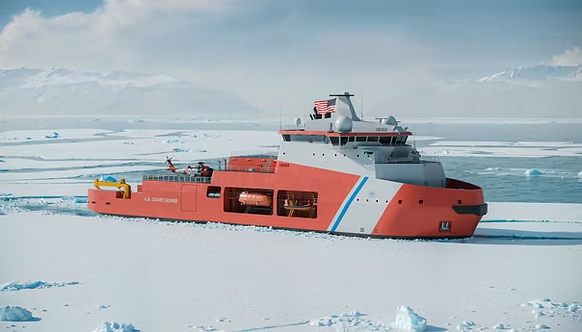
A digital rendering of a Davie MPPS-based Arctic Security Cutter. (Courtesy/U.S. Coast Guard)
The first two of 11 planned medium-weight icebreakers will be homeported in Alaska, although which cities remains to be determined, the U.S. Coast Guard announced Thursday.
The hope is a Finnish company building the vessels will deliver them by the end of 2028, according to a Coast Guard press release. That mirrors the same hoped-for timeline for the Storis icebreaker set to be homeported in Juneau once vessel updates and support infrastructure are sufficient for year-round deployment.
Coast Guard officials and Alaska’s congressional delegation hailed the announcement as a step toward the long-discussed plans to bolster the U.S. military’s presence in the Arctic. The Coast Guard in 2018 announced plans for new heavy-duty Polar Security Cutters that were supposed to be deployed starting in 2024, but with those vessels now delayed likely beyond 2030 efforts are shifting to other ships that can be put into service more rapidly.
“By strategically positioning these state-of-the-art icebreakers in Alaska, the Coast Guard will maximize our ability to defend our northern border and approaches, while reinforcing America’s maritime dominance in a crucial region of strategic importance,” Adm. Kevin E. Lunday, commandant of the Coast Guard, said in a prepared statement.
The first visit to Juneau of the Storis icebreaker — a private ship built in 2012 and purchased by the Coast Guard in 2024 in a politically controversial process due to its limited capabilities — was hailed as a significant first step toward the goal of an increased presence. The ship is scheduled to deploy to Alaska during warmer months and be upgraded in Seattle during the winter until 2028 or 2029, with up to 190 crew plus their families expected to be stationed in Juneau when the ship is homeported there year-round.
Funding for the 11 Arctic Security Cutters — to be built by companies in Finland and Canada — mentioned in Thursday’s announcement was approved by Congress last year as part of a large-scale U.S. Coast Guard expansion sought by President Donald Trump. U.S. Sen. Dan Sullivan, R-Alaska, said in January he was told by Lunday up to four of the ships would be stationed in Alaska.
Sullivan, during a press conference Thursday following the Coast Guard’s announcement two ships will be homeported in the state, said he isn’t advocating for which communities should be selected. He also acknowledged the hoped-for delivery date of 2028 “is a very aggressive timeline.”
“The Coast Guard has not determined where these two additional Arctic security cutters are going, but they estimate the crew ranges on these shifts would be from about 80 to 140 personnel,” he said.
Sullivan said it is not known whether any of the nine other ships might also be homeported in Alaska.
A statement issued Thursday that includes the other two members of Alaska’s all-Republican congressional delegation — Sen. Lisa Murkowski and Rep. Nick Begich III — states the Storis is the first icebreaker to be homeported in Alaska, with other existing icebreakers currently homeported in Seattle. It also notes last year’s budget bill includes funding for light icebreakers and other Coast Guard ships, helicopters and other aircraft, and shoreside infrastructure.
A halt on elective surgeries at Bartlett Regional Hospital has been extended through Tuesday following a fire Thursday that contaminated many of the facility’s surgical supplies, the hospital announced Friday.
The fire in a utility closet early Thursday afternoon resulted in an evacuation of the surgical area, but no damage to the operating rooms, according to an update posted on the hospital’s Facebook page. Elective surgeries were canceled Thursday and Friday as a construction crew did repair work expected to be completed Saturday.
“Unfortunately, many supplies within the unit were contaminated and we are working as quickly as possible to replace surgical supply inventory,” the post notes. “At this time, the Surgical Services unit will remain closed for elective surgeries through Tuesday.”
Staff are notifying patients about the change, according to the hospital.
Statue of Charles Bunnell, founder of the University of Alaska, at the UAF campus. (Photo by Yereth Rosen/Alaska Beacon)
In February 2025, to the shock of University of Alaska faculty, staff and students, the University of Alaska Board of Regents passed amotion that banned the use of the words “DEI,” “diversity,” “equity,” and “inclusion,” reversing decades of work by the universities to better serve Alaska and its diverse population. The decision forced staff to review all UA websites and other electronic or print material and remove those words from previously developed materials. The mandate was a reaction to a 2025 “Dear Colleague” letter from the U.S. Department of Education, which threatened to end funding at any institution that continued to use the words.
In the weeks following the passage of the BOR’s anti-DEI motion, the faculty union, United Academics, and faculty senates from all three campuses responded by passing statements and circulating a petition in opposition to the censorship and in defense of free speech and academic freedom.
Dear Colleague letters do not carry the force of law and this one was immediately challenged in court. In August of 2025, afederal court judge determined the Dear Colleague letter was illegal. The Federal Government withdrew its appeal of that ruling in February and the judge vacated the letter, making it unenforceable. Yet the UA BOR’s motion still stands, violating not only the U.S. Constitution but also the Constitution of the State of Alaska and the Board of Regents policy P04.04.010 on Academic Freedom.
The anti-diversity motion the BOR passed was an illegal attempt to limit free speech and academic freedom and to censor words based on political ideology. It also directly contradicts the mission statement of the University of Alaska, which specifically supports the state’s diversity: The University of Alaska inspires learning, and advances and disseminates knowledge through teaching, research, and public service, emphasizing the North and its diverse peoples.
The Board of Regents’ action has compromised not only the reputation of the entire University of Alaska as a place of learning and exploring systems of knowledge, but has also made our campuses feel less welcoming and less safe. It goes against specific protections established by the Civil Rights Act to create pathways to success for marginalized peoples. In one motion, the Board of Regents engaged in illegal censorship and violated its own mission.
We should be cognizant of Alaska’s colonial history that required assimilation in education, including the banning of Alaska Native languages and customs. If we now prohibit the very word diversity, we engage in a new form of forced homogeneity and exclusion. The University cannot say it is embracing its mission and values while simultaneously banning words that focus specifically on inclusion in education. The University cannot ban words while also claiming to value academic freedom.
Faculty and students waste precious time and energy deciding when to stand fast, how to “say it in a different way,” and when to adapt without compromising academic integrity. It affects the words we use when teaching, even if only to stop and second-guess ourselves. The writing is on the wall. Or, rather, the words are no longer on the websites, in the office names, promotion files or job descriptions. This illegal and uninformed censorship won’t stop without a course correction.
As faculty, we expect our students to be informed by research and accurate, provable information. We expect them to be straightforward in their work and to rely on open exploration of topics based on logic, history, critical thinking and diverse ways of knowing. We therefore cannot accept the motion of the Board of Regents.
As educators and researchers at UA, we have no desire to wade into politics. We want to teach, create and research in our areas of expertise. But we feel compelled to speak against the censorship of words and ideas, which is antithetical to the University of Alaska’s mission and the needs of a democratic and free society. It is past time for the UA Board of Regents to rescind their illegal, harmful motion.
As faculty at the University of Alaska, we expect better, and we can do better. We seek an end to this era of censorship and word banning that unnecessarily brings the university into disrepute and demonstrates a neglect of duty by violating the constitutions of the United States and the State of Alaska, not to mention their own policy and mission statement. We owe it to the current and future students to champion and uphold academic freedom, freedom of speech, and an educational system that is welcoming of all peoples without forcing them to assimilate to reduced identities.
Co-signed: Abel Bult-Ito, Anna Berge, Falk Huettmann, Debu Misra, Jak Maier, Sam Alexander, Jennifer Bernard, Iver Arnegard, Maria Williams, Pete Praetorius, Heather Batchelder, Robin Shoaps, Patrick Marlow, Jackie Cason, LaVerne Xilegg Demientieff, Diane McEachern, Michael Navarro, Chris Coffman, Leslie McCartney, Javier Fochesatto, Retchenda George-Bettisworth, Dave Evans, Connie Fuess, Seta Kabranian-Melkonian, Bettina Kipp Lavea, David P. Moxley, Micah Muer, Tim Hinterberger, Zoë Jones, Margaret Short, Sarah Dexter, Jamie Smith, Jessica Ross , Yvonne Chase, Maya Salganek, Deb Mole, Rachel Graham, Da-ka-xeen Mehner, Charleen Daazhraįį Fisher, Jonas Lamb, David Cox II, Eldri Waid Westmoreland, Loraliee Heagy, Mary Wegner, Kathleen Nevis, Deidre Berberich, Forest Haven, Andrea Dewees, Glenn Wright, Jay Szczepanski II, Carol Gray, Angie Goffredi, Rally Wolford, Éedaa Heather Burge
A crab walks across a field of mineral deposits blanketing the seafloor of the Atlantic Ocean during an exploratory federal expedition in 2021. (National Oceanic and Atmospheric Administration)
Tony Romeo is on the hunt for minerals, but he’s far from a typical prospector.
Based in South Carolina, Romeo doesn’t spend summers in the mountains with a rock pick, and he’s not interested in combing creek beds for gold.
His focus, rather, is miles beneath the surface of the ocean, where a new and highly speculative industry is racing to find and scoop up vast deposits of metals on the seafloor.
Romeo is chief executive of Deep Sea Rare Minerals, a company that recently expressed interest in mineral leasing offshore of Alaska, after the Trump administration announced earlier this year that it was considering opening federal waters near the state to miners.
The idea to mine the deep is still in its infancy, especially in Alaska: Much of the state’s seafloor remains unmapped, meaning its marine mineral resources are not well known. And the administration so far has received relatively sparse interest: Only a few companies have publicly signaled support for deep-sea mineral leasing off Alaska.
Still, the possibility has sparked discussions around the state — generating excitement among explorers like Romeo but also pushback from conservation groups, Indigenous leaders and commercial fishing groups, who say the industry could harm sensitive marine ecosystems and fisheries.
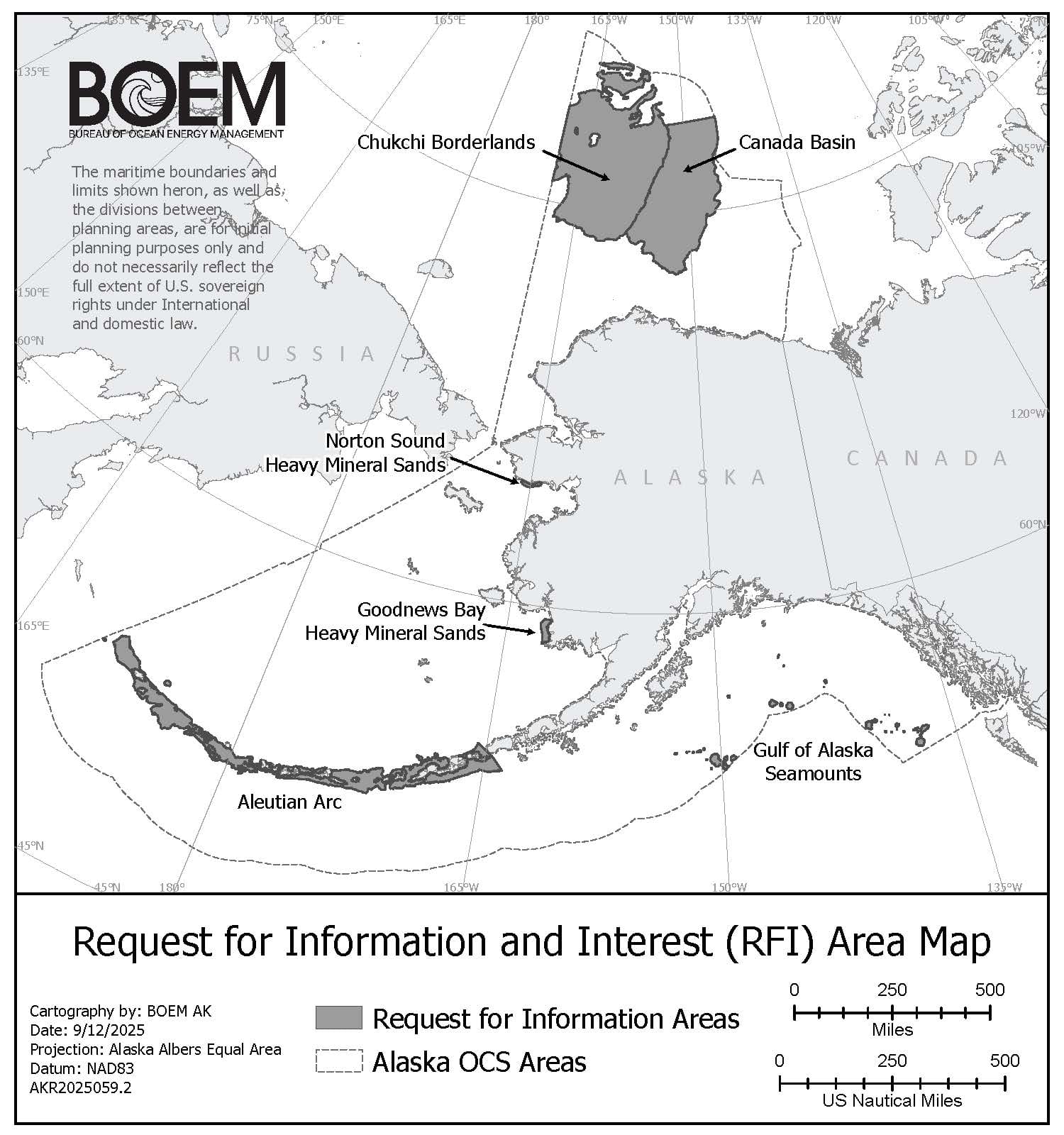
A map showing where the Trump administration has solicited interest in Alaska offshore mineral leasing. (U.S. Bureau of Ocean Energy Management)
Federal regulators received more than 90,000 responses to the idea during a public comment period that ended April 1. Of the more than 2,500 comments that the U.S. Bureau of Ocean Energy Management posted online, an overwhelming majority were opposed, according to a Northern Journal review.
“Arctic offshore seabed mining would occur within core marine mammal subsistence use areas and presents unique, unmitigable risks to Iñupiat subsistence, food security, and cultural continuity,” the Iñupiat Community of the Arctic Slope, the regional tribal government for Alaska’s North Slope, said in a comment. The industry, it added, offers “speculative benefits while exposing Arctic communities to irreversible harm.”
Supporters, meanwhile, include a handful of companies connected to the industry as well as Nome’s city government. They say tapping into Alaska’s marine minerals could reduce U.S. dependence on foreign countries for important metals, boost national security and stimulate the state’s economy.
A new kind of prospector
A former U.S. Air Force officer and commercial real estate investor, Romeo felt called during the pandemic to take up more adventurous pursuits, he said in a recent interview.
As a pilot, Romeo was fascinated by the enduring mystery of Amelia Earhart’s plane, which disappeared over the Pacific Ocean in 1937 when she was attempting to fly around the world. So, in May 2023, Romeo bought a submarine-shaped deep-sea drone equipped with sonar. He had two things in mind: “Finding Amelia’s plane, and then also getting into the deep-sea mining space.”
The plane search came first. After spending millions of dollars and scouring more than 5,000 square miles of seabed, Romeo came up empty-handed — though not without a promising sonar image eerily shaped like a plane that made global headlines. (It turned out to be some rocks.)
Last year, Romeo shifted fully to the business of looking for minerals.
Like a number of other ocean mining startups, Deep Sea Rare Minerals is now searching for ancient, baseball-sized rocks with high concentrations of metals — nickel, copper, cobalt — used in batteries and renewable energy. In some parts of the Pacific, these metal-rich nuggets, known as nodules, are strewn about the seafloor in dense clusters, two or three miles deep.
“Let’s at least find out what we have there,” said Romeo. “That’s the question mark, I think, for Alaska: Is there an abundance of nodules? If there is, I think you’ll see a whole ecosystem and industry develop in Alaska, which would be great.”
Romeo’s company is privately held and still seeking tens of millions of dollars in funding. It’s mainly focused on the preliminary steps of mapping and exploration, but it’s also designing mining equipment that it hopes one day to use if it finds enough nodules and can raise the money to extract them.
Deep Sea Rare Minerals is also wants to look for minerals near Guam and in the Clarion-Clipperton Zone, a region of international waters in the Central Pacific that’s become a hotbed for the new industry.
“It’s not going to happen in Alaska anytime soon.”
Even in the waters outside Alaska where the industry has concentrated its attention, mining companies face major obstacles, including high costs, technical challenges and environmental opposition.
Despite substantial investment, there’s no commercial production of deep-sea minerals anywhere in the world, according to John Wiltshire, a deep-sea mining expert and former professor at the University of Hawaiʻi.
The industry, as of now, is “nonexistent,” he said.
Wiltshire expects that to change fairly soon; the first production globally could start within five years, he said. But it’s likely further off in Alaska, he added.
“The remoteness, the environmental opposition, the fact that some of the minerals are of lower grade — all of these things, in my mind, would contribute to making this whole thing a more difficult proposition in Alaska than it would be in some other places,” Wiltshire said. “It’s not going to happen in Alaska anytime soon.”
Even on land, Alaska is a notoriously difficult place for resource development, with high labor and transportation costs and environmental conditions that can be technically challenging to engineer around. Operating offshore only magnifies the costs and challenges, experts say.
Plus, the nascent industry is already drawing intense scrutiny from Alaska-focused conservation groups and Indigenous organizations, including some typically pro-development corporations like Calista Corp. in Western Alaska and Arctic Slope Regional Corp. on the North Slope.
Opponents worry that mining the seabed would harm habitat for fish, marine mammals and other wildlife and could threaten the state’s huge commercial fishing industry and its Indigenous subsistence traditions.
The areas where the Trump administration has said it could open leasing — in parts of the Gulf of Alaska, the Aleutians, the Bering Sea and the Arctic Ocean — overlap with important marine habitats where there are already some protections, said Becca Robbins Gisclair, senior director of Arctic and northern waters at the Ocean Conservancy.
A key concern is the “direct destruction” of the seabed, Gisclair said in an interview. That “really cascades throughout the ecosystem,” she added.
Romeo, for his part, said his team has worked to design a system that minimizes impacts — one with “environmental considerations in every part of it.”
He distinguished the nodules that his company is targeting from other mineral deposits called ferromanganese crusts and massive sulfides, which could require more intrusive mining methods.
“It’s not tractors on the seafloor,” Romeo said, referring to his company’s proposed method. “It’s floating, and it’s got these tines, these kind of rake-like things in the front of it.”
It “scoops underneath and pops” nodules into a collector, then pipes them up to a ship on the surface, Romeo said.
A rendering of Deep Sea Rare Minerals’ proposed mining kit. (Deep Sea Rare Minerals)
Still, he acknowledged that the plans are conceptual. Deep Sea Rare Minerals is still years away from actual deep-sea mining in Alaska, he said — and that’s only if it’s ultimately authorized by the federal government.
“We’re building a mining vessel from scratch, right?” he said. “There’s only a couple in the world that have ever been built, and they’re all novel.”
Northern Journal contributor Max Graham can be reached at max@northernjournal.com. He’s interested in any and all mining related stories, as well as introductory meetings with people in and around the industry.
This article was originally published in Northern Journal, a newsletter from Nathaniel Herz. Subscribe at this link.
The war in Iran is risking what could be a catastrophic spike in the price of fuel in the rural villages and hub communities across Alaska’s coast — and distributors are also warning of possible supply shortages.
Even before the war, fuel prices in the state’s off-road system communities were eye-wateringly high: Unleaded gas was $6.72 a gallon this winter in the Western Alaska hub town of Bethel, while in the Northwest Alaska village of Ambler, the price of gas and heating fuel has been $17.50 a gallon for the past year, according to local officials.
Vendors that sell bulk fuel to those regions are now warning that prices could rise 50% due to the war-driven supply crunch, according to Ingemar Mathiasson, energy manager for the Northwest Arctic Borough, which held a meeting attended by fuel company representatives last week in the regional hub town of Kotzebue.
Rural communities can receive as little as a single bulk fuel delivery during a shipping season that runs only through the summer — meaning that rates can be locked in at that price for the whole next year, even if global commodity prices fall. Government and Native corporation subsidies can help offset costs, but prices are still high and about to get higher.
“We’re looking at, maybe, a survival scenario for rural Alaska,” Mathiasson said in a phone interview Monday. “At those prices, I would imagine that people are going to try to move into Anchorage. I don’t know if you can heat your house at over $20 a gallon.”
Policymakers say they’re tracking the problem but haven’t announced concrete steps to protect consumers.
“This is one of the things that is top of my list right now, this week, here in Washington — to raise this within the administration to try to get in front of it,” said U.S. Sen. Lisa Murkowski. “It has to be a full-on effort to make sure that these communities are not left high and dry.”
The energy shock from the Iran war is landing worldwide, as Iran’s effective shutdown of the Strait of Hormuz keeps some 20% of global oil production out of the markets.
The effects have landed particularly hard in Asia, the destination of 80% of the oil that typically transits the Strait. And Asian refineries produce much of the supply for the more than 160 Western Alaska communities that receive maritime fuel deliveries during the May through October season, according to the Alaska Chadux̂ Network, a tanker and fuel distribution industry trade group.
Buying fuel from other sources “may be possible,” but likely at “significantly elevated prices,” the network’s chief executive, Buddy Custard, wrote in a recent letter received by Alaska policymakers.
“Despite best efforts, a supply gap remains a credible risk,” Custard wrote in his letter, dated March 31. “An undefined portion of the estimated 140 million gallons of fuel may be at risk of non-delivery, affecting dozens of communities, regional hubs, and critical infrastructure that serve as lifelines for surrounding villages.”
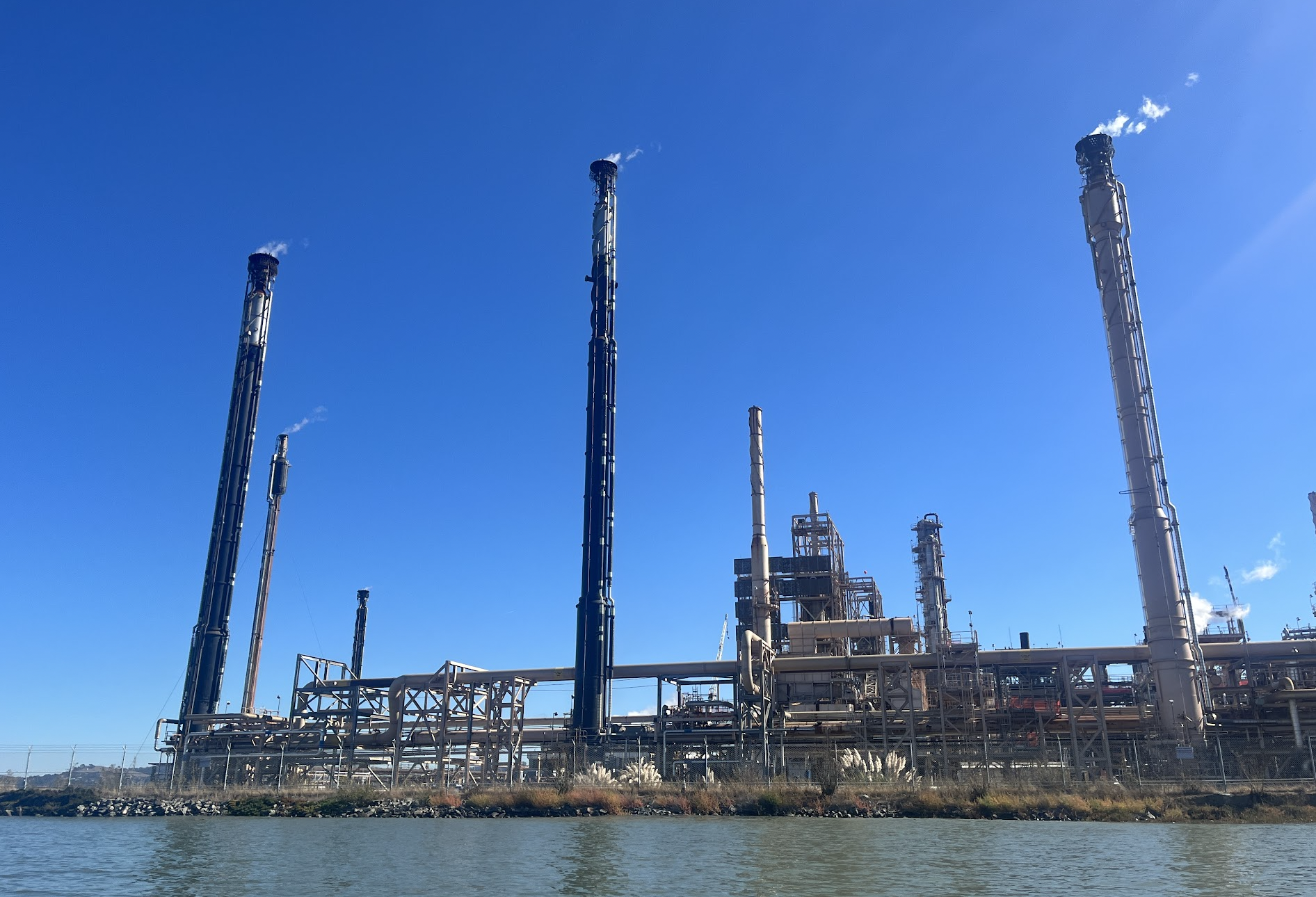
West Coast oil refineries, like this one operated by Chevron in Richmond, California, have also been hit hard by shortages in imports from the Middle East. (Nathaniel Herz/Northern Journal)
Custard said he was unavailable for an interview, but he shared additional correspondence with a state House member’s office from last week in which he said it’s difficult to “confirm specific outcomes or timelines” given the “highly dynamic and unpredictable” situation in the Middle East.
“It is not that alternative sources are entirely unavailable, but rather that they are constrained by a combination of limited refining capacity for the required fuel types, existing contractual commitments, and significantly higher costs,” Custard wrote. “In short, limited supply may be available, but not necessarily in the volumes, timeframe, or at the price points required to support Western Alaska communities.”
The uncertain outlook poses a dilemma for leaders at rural institutions that purchase fuel, including village governments and utilities, who are questioning whether to commit to fuel purchases now, later, in full, or in multiple orders to spread out the cost.
“I don’t know what to tell members who say, ‘Should I wait?’ I don’t know what to tell members who say, ‘I can do this much now, this much later,’” said Nils Andreassen, executive director of the nonprofit Alaska Municipal League, which supports local governments. “I don’t know how to keep ahead of it. And the current global uncertainty is not giving me a lot of confidence.”
Fuel vendors — which for Western Alaska include Vitus, Crowley and Delta Western — are urging customers to not delay placing their orders in hopes that prices will improve, according to a written summary of their comments from last week’s meeting in Kotzebue.
“We’re really getting squeezed on all this,” Tom Atkinson, the general manager of Kotzebue’s electric utility, said in a phone interview. “Nobody wants to lock in at this high price.”
Atkinson said that his utility’s diesel fuel supply for the past year cost $3.10 a gallon. This year’s delivery of a million gallons, he said, could come in at more than $6 a gallon.
In prior years, fuel companies have sometimes loaded their tankers with more supply than communities have ordered, expecting to sell the excess once the cargo arrives in Alaska. But this year, vendors say the price is too high for them to buy and transport fuel that risks going unsold.
A cold winter has also produced more sea ice than usual, which could shorten the delivery season. If communities miss the tanker delivery window, those that end up with shortages may have to turn to deliveries by plane, at even higher prices.
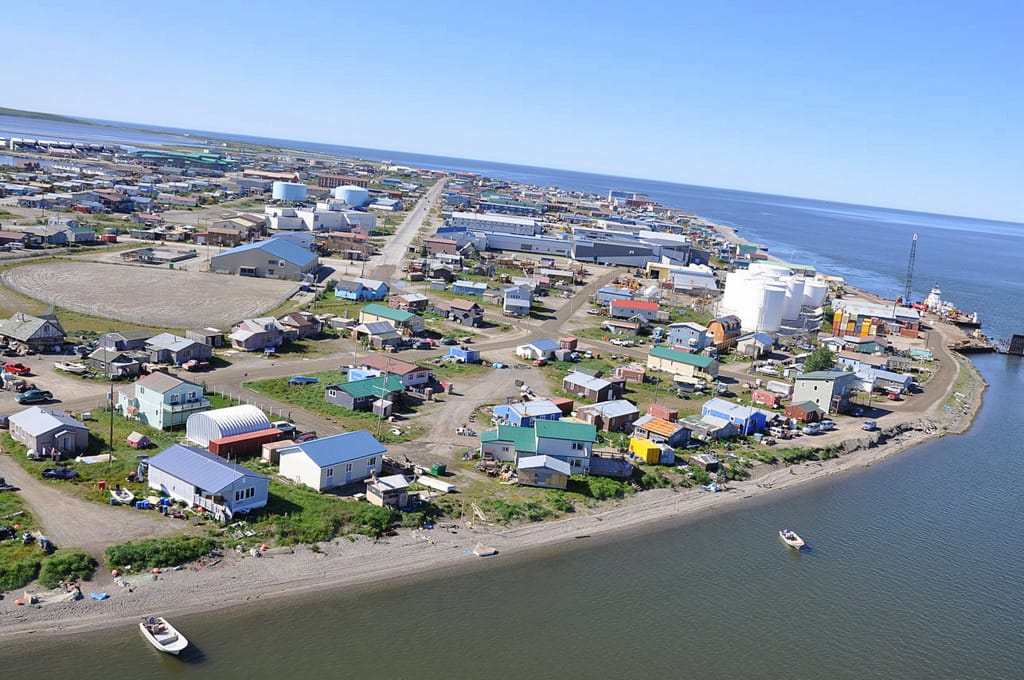
The Northwest Alaska hub town of Kotzebue sits on the Baldwin Peninsula. (ShoreZone under Creative Commons License)
“We end up with situations where if the communities don’t fill their tanks, we don’t have enough airplanes in Alaska to help,” said Mathiasson, the Northwest Arctic Borough energy manager. “You just can’t wait until the last minute.”
Energy shocks have hit Alaska before, notably in a major price spike in 2008. That year, lawmakers used a huge windfall in taxes paid by Alaska’s oil-producing companies to help fund a “resource rebate” added to the annual checks written by state government to residents. The total paid to each recipient that year was $3,269, double the amount of the previous year.
This year, given the state’s tighter budget, advocates are pushing for measures that more narrowly target the communities in need. One concept supported by the municipal league is boosting the $750,000 cap on a state program that offers loans to local governments and utilities when they make their bulk fuel purchases.
“I’m not done turning over every stone and seeing what we can do,” House Speaker Bryce Edgmon, who represents a rural legislative district centered in the Bristol Bay region, said in a phone interview from Juneau. “If this war continues, there’s no question it’s going to be catastrophic.”
Edgmon noted that rural Alaska communities already were seeing higher costs for groceries and goods delivered through a federal program called bypass mail, which had a 9% rate increase last year.
A spokesperson for Gov. Mike Dunleavy declined to comment on the outlook for rural Alaska fuel prices and policies under consideration to address them.
In a worst-case scenario of a $5-a-gallon increase, the overall hit to rural Alaska from the war-driven fuel price spike could reach hundreds of millions of dollars, according to one economist’s estimate.
Each rural Alaskan, on average, requires some 1,200 gallons of fuel a year to meet their demand for heat, transportation and electricity, according to economist Steve Colt, who works with the Alaska Center for Energy and Power. By Colt’s calculation, the added expense could reach $6,000 per person and $450 million across the state’s rural communities.
Even before the spike, electricity and heating fuel can cost households in one region of Western Alaska, the Kusilvak Census Area, some 45% of their income, according to data collected by the energy center’s founding director, Gwen Holdmann. That area already faces a poverty rate of more than 30%, triple the statewide level.
“It’s definitely a serious issue that we’re raising up to the highest level,” Mathiasson said.
Nathaniel Herz welcomes tips at natherz@gmail.com or (907) 793-0312. This article was originally published in Northern Journal, a newsletter from Herz. Subscribe at this link.
Alaska Gov. Mike Dunleavy has been appointed to the U.S. Arctic Research Commission at a time when the federal agency is pivoting from its longtime focus on environmental science to more emphasis on military defense and economic development.
Dunleavy is an ally of President Donald Trump. Dunleavy’s presidential appointment, announced by the commission this week, comes five months after Liz Qaulluq Cravalho’s position on the commission was terminated. Cravalho is vice president of lands at NANA Regional Corporation, the Alaska Native corporation for the state’s northwest region. She was initially appointed by then-President Joe Biden in 2021 and reappointed in 2024.
The commission, created in 1984, advises the president and Congress on research policy. Its seven commissioners are appointed by the president.
Dunleavy is the first sitting governor to be appointed to the commission, which advises the president and Congress on Arctic research. Past Alaska lieutenant governors have served on the commission, but not during their time in state office. Mead Treadwell chaired the commission prior to being elected in 2010 as lieutenant governor in the Parnell administration, and Fran Ulmer chaired it after serving as lieutenant governor in the Knowles administration and after serving as chancellor of the University of Alaska Anchorage.
In 2019, his first year in office, Dunleavy used his veto powers to cut state funding of the University of Alaska system by 41%, an action that at the time was characterized as devastating to the university’s Arctic research, among other activities. Much of the funding was later restored through a compromise Dunleavy made with the university.
In a statement released by the commission, Dunleavy praised the role of Arctic research, saying it helps Alaskans.
“Alaska sits at the forefront of the Arctic, and our communities, resources, and strategic position make us essential to advancing responsible research, economic development, and national security in the region,” he said in a statement released by the commission. “I look forward to working with fellow commissioners to ensure that Arctic research reflects the needs of Alaskans while strengthening America’s leadership in the Arctic.”
The Trump-appointed chair of the commission, speaking Wednesday at the Arctic Encounter Summit in Anchorage, said the organization is “tremendously thrilled” to have Dunleavy as a member.
Thomas Emanuel Dans, appointed by President Donald Trump as chair of the U.S. Arctic Research Commission, speaks at the Arctic Encounter Summit in Anchorage on April 15, 2026. (Photo by Yereth Rosen/Alaska Beacon)
“We’re super excited about that,” said Thomas Emanuel Dans, appointed in December. “We’ve got the very experienced hand and voice at our commission, and we’re looking to do big things here.”
A pivot to security needs
Dans, who also served on the commission during the first Trump administration, expressed an expansive view of the Arctic that he likened to that of 19th century explorers.
“We want to create the conditions that really unleash human flourishing. We want more. We want human life. We want people to have big dreams,” he said.
Rather than focusing on pure science, the commission is focused on security, as Dans described it.
“Security is probably the overriding, overarching theme of things,” he said.
But security has several facets, he said. It includes military security, international security, energy security and community security, “which can be interpreted broadly in terms of health and well-being” for Arctic residents and others in the nation and the world, he said.
Dans, who lives in Texas and spent most of his career in finance, served on the U.S. Arctic Research Commission during the first Trump administration. But his comments on Wednesday indicated some gaps in his Arctic and Alaska knowledge.
He mentioned Russia’s Wrangel Island, off the northern coast of Siberia, as a security threat. Wrangel island “is close to Alaska here,” he said in his speech. “And for a long time it was incorporated as part of the United States. Today we face missiles pointing at us from Wrangel Island.”
Canadian government brochures and fliers, displayed April 15, 2026, at the Arctic Encounter Summit in Anchorage, describe that country’s countribution to U.S. national defense. U.S. Arctic policy now has a stronger emphasis on national security. (Photo by Yereth Rosen/Alaska Beacon)
Wrangel Island was never part of the United States. There is a place with a similar name – Wrangell Island – that is located in Southeast Alaska. Since 2004, Russia’s Wrangel Island, located 300 miles from the nearest point in Alaska, has been designated as a UNESCO World Heritage Site. It is famous for its Arctic biodiversity, including the world’s largest concentration of Pacific walruses.
A decade ago, Russia built a military base on the island with a focus on radar systems to monitor airspace. The military use of the island is part of Russia’s military buildup in the Arctic, which has worried U.S. officials, and it is also considered to pose a potential threat to the natural resources there.
In his Arctic Encounter Summit comments, Dans hailed the planned expansion of the U.S. Coast Guard’s icebreaker fleet, saying the fleet has “gone from zero to maybe 14.” However, the Coast Guard for decades has operated two polar-class icebreakers: the Healy, which performs annual missions in Alaska and the wider Arctic, and the Polar Star, which usually sails in the Antarctic. The Coast Guard recently acquired another icebreaker for Arctic operations. Originally an oil industrial vessel called the Aiviq, the ship was renamed Storis and commissioned in a Juneau ceremony in August. The fleet is poised to expand: there was funding for more than a dozen new icebreakers in the Trump administration spending bill known as the One Big Beautiful Bill Act.
Concerning Russia, which holds more Arctic coastline and land than any other nation, Dans urged more cooperation and communication. “I’d love to have the younger generation in Alaska learn Russian,” he said.
Within a few miles from the Dena’ina Civic and Convention Center, where Dans spoke at the Arctic Encounter Summit, classes were being conducted in Russian language at elementary, middle and high schools through the Anchorage School District’s Russian immersion program. It was launched as a full-time program in 2024, according to the school district.
On March 31, President Trump issued a new executive order on citizenship records and mail‑in ballots entitled “Ensuring Citizenship Verification and Integrity in Federal Elections.” The order has nothing to do with election integrity — the name is like “Newspeak,” Orwell’s fictional language for a totalitarian state. It is an unlawful attempt to seize control of how Alaskans vote and to make an error‑ridden federal database the gatekeeper of our ballots.
Ever since statehood Alaska has built an election system that reflects our geography and our values. By‑mail and absentee voting are not mere conveniences here; they are how thousands of our neighbors who live in remote areas accessible only by air or sea participate in democracy at all. Yet the president now proposes to tell Alaska when and to whom we may send ballots by mail, based not on Alaska law, but on whether a voter’s name appears on a new federal “citizenship list.”
The order directs the Department of Homeland Security to compile state‑by‑state rosters of presumed U.S. citizens eligible to vote in federal elections and then directs the Postal Service to withhold mail ballots from anyone not on those lists. In one stroke, the president purports to rewrite who may receive a ballot by mail, how ballots travel through the postal system and which government gets the last word on whether an Alaskan can vote. That authority does not belong to him.
The U.S. Constitution is explicit in this matter. It reads in pertinent part: “The Times, Places and Manner of holding Elections . . .shall be prescribed in each State by the Legislature thereof; but the Congress may at any time by Law make or alter such Regulations . . .” Alaska’s Legislature has determined who may vote absentee, how those ballots are requested and mailed, and how they are counted. An executive order that conditions ballot delivery on a federally controlled citizenship list displaces those laws with presidential preference. That is not faithful execution of the law; it is legislation by directive. And it is patently unconstitutional.
The order also collides with bedrock principles of federalism. The federal government may not simply commandeer state election officials or local postmasters to administer a new federal scheme that overrides state choices about mail voting. By insisting that Alaska adapt its procedures to match a federal citizenship database that we did not design, do not control and cannot effectively challenge, the administration seeks to turn state election workers into unwilling agents of a national policy they never adopted.
Even if the president had such power—which he does not—the policy itself is dangerously unsound. The citizenship records he proposes to rely on are notoriously unreliable. Federal and state databases routinely misclassify naturalized citizens as non‑citizens, lag months or years behind status changes, and contain basic errors in names, dates of birth and addresses. Tying ballot delivery to a single “State Citizenship List” assembled from these imperfect sources is a recipe for widespread disenfranchisement.
Those errors will not fall evenly. Naturalized citizens, Alaska Natives whose names and records do not conform to federal bureaucratic expectations and rural voters with inconsistent or non‑standard addresses are all especially vulnerable to being left off or misflagged in a national database. If the Postal Service is instructed not to send a ballot unless it can confirm a match on that list, many eligible Alaskans will simply never receive a ballot at all.
In urban areas, some voters might fall back on in‑person early voting or Election Day polling places. In much of Alaska, that is unrealistic. An elder in a village accessible only by plane or boat, a deployed service member relying on an overseas ballot or a college student temporarily out of state cannot easily “work around” a missing ballot. For them, the executive order does not mean extra paperwork. It means no vote.
The order also offers no meaningful, timely remedy for those wrongly excluded. By the time a voter discovers that no ballot has arrived and tries to untangle why their name is missing from a federal citizenship list, the election may be over. We will never know how many voices were silenced by database error rather than voter choice.
Alaska has used absentee and by‑mail voting for years without any evidence of widespread non‑citizen voting or ballot fraud. Our challenges are logistical, not criminal: weather, distance and infrastructure, not hordes of ineligible voters swamping the polls. Imposing a rigid, centralized federal screen on top of that system does nothing to address real problems, and threatens to create a new one that is far worse: a loss of confidence that ballots will arrive at all.
Let’s not attempt to dress this order up as a mere “data‑sharing” exercise rather than the federal takeover it truly is.
An empty classroom at Juneau-Douglas High School: Yadaa.at Kalé in Juneau, Alaska (Photo by Lisa Phu/Alaska Beacon)
A professor at Furman University told the Alaska Legislature Task Force on Education Funding Wednesday afternoon that standardized test results might not be the most appropriate set of data on which to base education policy decisions.
During a routine presentation on the National Assessment of Educational Progress, known as the Nation’s Report Card, Paul Thomas backed a principle that legislators should not make decisions about students and schools based on a single standardized test.
“The key to understanding test data in Alaska is the information on poverty,” Thomas said.
Alaska’s NAEP scores of fourth- and eighth- grade Alaskans ranked lower than the national public in mathematics and reading in 2024. According to the Nation’s Report Card, approximately 69% of students performing below the 25th percentile are economically disadvantaged while economically disadvantaged students make up 48% of Alaskan students.
“Education policy and socioeconomic policy are really strongly connected,” Thomas said. “Test scores are a reflection of the socioeconomic status of the students.”
State education officials led legislators through a practice test of the Alaska System of Academic Readiness, commonly referred to as the AK STAR. Each fall, winter, and spring, Alaskan students in grades 3-9 take the MAP Growth assessment and each spring, Alaskan students take the AK STAR.
Kelly Melin, who works for the Department of Education and Early Development’s Assessments and Standards Administration, said the state’s standardized tests are designed to satisfy federal requirements set forth in the Every Student Succeeds Act.
“We’ve taken the power of an interim assessment and the need for a summative assessment as was dictated through ESSA and connected those to come up with what we have as AK STAR,” Melin said.
Kelly Manning, the department’s Director of Innovation and Education Excellence, said that the purpose of assessments is to measure the state’s ability to close the achievement gap and measure students’ ability to read at grade level by the third grade.
Statewide, about 33% of students tested at or above grade level expectations in language arts and 32% in math in 2025. Students in ninth grade demonstrated the greatest need for support in language arts and math.
The esting window for Alaska students closes on May 1. AK STAR results will be available to school districts in July and statewide in the fall.
Sen. Lyman Hoffman, D-Bethel, is seen in the Senate Finance Committee on Tuesday, April 25, 2023. A co-chair of the Senate Finance Committee, Hoffman is in charge of the state's capital budget. (Photo by James Brooks/Alaska Beacon)
By: Corinne Smith, Alaska Beacon
Sen. Lyman Hoffman, D-Bethel, is seen in the Senate Finance Committee on Tuesday, April 25, 2023. A co-chair of the Senate Finance Committee, Hoffman is in charge of the state’s capital budget. (Photo by James Brooks/Alaska Beacon)
The Alaska Senate Finance committee advanced a draft capital budget on Tuesday that would put nearly $250 million toward state facilities and maintenance projects next year.
The draft budget adds $88 million to Gov. Mike Dunleavy’s proposed capital budget of $159 million, with the largest additions going toward K-12 schools and university facilities maintenance.
That was a focused effort by the finance committee, said co-chair Sen. Bert Stedman, R-Sitka, who called funding for education facilities maintenance a “heavy concentration” on Wednesday.
Earlier this year, students and school officials testified to lawmakers that decades of deferred maintenance has reached crisis levels — with many rural school districts in particular grappling with deteriorating facilities, failing water and sewer systems — which they say is degrading student and staff morale. Lawmakers have expressed support and increased funding in recent years, but point to Gov. Mike Dunleavy’s history of vetoes as a roadblock for funding education.
The Senate draft includes $57.8 million in additional funding toward K-12 school maintenance through the Alaska Department of Education and Early Development and $17 million toward the University of Alaska. It also includes $5.7 million for the Alaska Court System’s facilities and $8 million for community infrastructure and workforce development programs through the Alaska Department of Commerce, Community, and Economic Development.
The Legislature relies on state ranked lists to prioritize where to direct funding to capital projects for K-12 schools, the university system and the court system.
For K-12 schools, the state’s current major maintenance list totals over $400 million needed for 103 school projects and repairs. Stedman said he recognized this year’s capital budget will only fund a fraction of those.
“Hopefully we get a quarter of it done, or something like that, but it’d be nice to retire the entire list,” Stedman said.
The draft budget would fund the top 15 school projects on the list, plus funds for three other schools in need of emergency fuel tank repairs. The top projects range from roof and boiler replacements to septic systems, fire suppression and safety upgrades in schools from Fairbanks to the Aleutian Islands.
In order to distribute funds more widely, members of the finance committee reduced funding for one project in Galena, in the Western Interior of Alaska, from roughly $35 million to $5 million for renovations to the Sydney C. Huntington Elementary and High Schools. They also allocated $17 million towards rebuilding the school in Stebbins in Western Alaska, after it burned down in 2024.
Mt. Edgecumbe High School student housing in Sitka is seen on Oct. 6, 2025. (Photo by Corinne Smith/Alaska Beacon)
The Senate draft also adds nearly $14 million in funding for the state-run Mt. Edgecumbe High School, which has been the focus of public attention and concern after a quarter of students disenrolled this year. The additional facilities dollars include $10 million to remodel the dining hall, $3.1 million to replace dorm windows, $460,000 to replace dorm furniture, $50,000 to replace mattresses and $125,000 to replace aging laundry machines.
Finance members added $17 million to fund the top nine projects across the University of Alaska system — three projects each within the three major campuses.
Sen. Jesse Kiehl, D-Juneau, serves on the finance committee and his district includes University of Alaska Southeast. He described the proposed funds as a “nickel” compared to the “colossal” deferred maintenance needs of the university system.
“That’s been built by Legislatures and Boards of Regents for 40 years,” he said on Wednesday, adding that it is a shared responsibility to put funding towards repairs and upgrades.
“The Constitution makes them a separate body within the executive branch that puts a lot of responsibility on them, too, more than the general state government,” he said “So university major maintenance is its own huge problem.”
The draft budget also includes $5.7 million for upgrades to state court facilities, mostly targeted to Anchorage and Sitka. It contains nearly $10 million for workforce development programs geared at the construction and oil and gas sectors, including for the Fairbanks Pipeline Training Center and Alaska Vocational Technical Center in Seward.
An amendment to add $25 million to the draft budget for the Port of Anchorage, sponsored by Sen. Kelly Merrick, R-Eagle River, was voted down on Tuesday by a 5 to 2 vote.
Before voting against the proposal, finance co-chair Sen. Lyman Hoffman, D-Bethel, said during committee deliberations the priority this year is to fund as many school maintenance projects on the list as possible, saying “schools are falling apart” and must be maintained to prevent further deterioration.
“Students that are trying to learn deserve better,” Hoffman said. “And if we are not able to provide this major maintenance, we are going to see these schools continue to crumble, and the financial burden to the state of Alaska will be hundreds of millions of dollars to rebuild schools.”
More funding for school maintenance and other capital projects could be added by the Alaska House of Representatives, who will take up the draft budget bill after it’s approved by the Senate in the coming weeks.
A model is silhouetted as she prepares to strut on the catwalk at the Far North Fashion Show, held April 15,, 2026, at the Anchorage Museum. The fashion show is part of the annual Arctic Encounter Summit. (Photo by Yereth Rosen/Alaska Beacon)
A model poses on the catwalk at the Far North Fashion Show, held April 15, 2026, at the Anchorage Museum. The dress she is wearing features red handprints on the collar, symbols of missing and murdered Indigenous people. (Photo by Yereth Rosen/Alaska Beacon)
Attendees of the Arctic Encounter Summit, held this week in Anchorage, took a break from heavy discussions about climate change, national security, shipping safety and other pressing concerns on Wednesday night to enjoy something more fun: high fashion.
Crystal Toolie of Nome and St. Lawrence Island, Cathy Apatiki of Gamble wait backstage wearing traditional designs that they would later display on the catwalk at the Far North Fashion Show, held April 15. 2026, at the Anchorage Museum. Looking on is designer Marisa Taylor of Savoonga and, also wearing one of Taylor’s designs, Mary Abraham of Toksook Bay. The Far North Fashion Show, in its seventh year, is part of the annual Arctic Encounter Symposium. (Photo by Yereth Rosen/Alaska Beacon)
The Far North Fashion Show, now in its seventh year, showcased the work of Indigenous designers from around Alaska.
“To be honest, the Far North Fashion Show is the highlight of so many attendees’ experiences, myself included,” Rachel Kallander, Arctic Encounter’s founder, said in brief remarks at the start of the show.
The celebration, which featured a catwalk bathed in pastel lights, pulsing music and refreshments, required a lot of work to pull together, Kallander told the audience.
“We have designers and models who have put in hundreds and hundreds of hours into what you are about to see,” she said.
A model walks on the catwalk at the Far North Fashion Show, held April 15, 2026, at the Anchorage Museum. The fashion show is part of the annual Arctic Encounter Summit.. (Photo by Yereth Rosen/Alaska Beacon)
A sparkly boot worn by a model catches the light at the Far North Fashion Show, held April 15, 2026, at the Anchorage Museum. The fashion show is part of the annual Arctic Encounter Symposium. (Photo by Yereth Rosen/Alaska Beacon)
Beyond their good looks, the clothing on display incorporated messages. Many were about traditions. Some were inspired by the animals that are important to different Indigenous Alaska cultures. A dress designed by Jackie Qataliña Schaefer, who is Inupiaq and originally from Kotzebue, paid homage to the caribou, for example. Another dress was designed with a train that resembled a whale fluke. And models, as they took their turns on the catwalk, sometimes made moves that are part of traditional Native dances.
Some of the works shown at the event had a more somber message. They incorporated the red handprint that symbolizes missing and murdered Indigenous people.
Attendees sitting by the catwalk, including some elders, watch and photograph models at the Far North Fashion Show, held April 15, 2026, at the Anchorage Museum. The fashion show is part of the annual Arctic Encounter Summit.(Photo by Yereth Rosen/Alaska Beacon)
Designers and models were from Inupiaq, Athabascan, Tlingit, Yup’ik and Aleut cultures, among others.
Along with Schaeffer, who is director of climate initiatives at the Alaska Native Tribal Health Consortium in addition to being an artist, the designers whose works were shown were Maria Shaa Tlaa Williams of Southeast Alaska, Marisa Taylor of St. Lawrence Island, Carlene Thayer of Unalaska, Alana Moses of Fairbanks, Reine Pavlik of Yakutat, Jeremiah James of Yakutat and Christina Waska, originally from Newtok.
The Arctic Encounter Symposium, which opened on Wednesday, runs through Friday. It has attracted attendees from 30 countries, Kallander said.
A model poses on the catwalk at the Far North Fashion Show, held April 15, 2026, at the Anchorage Museum. The fashion show is part of the annual Arctic Encounter Summit. (Photo by Yereth Rosen/Alaska Beacon)A model poses on the catwalk at the Far North Fashion Show, held April 15, 2026, at the Anchorage Museum. The fashion show is part of the annual Arctic Encounter Summit. (Photo by Yereth Rosen/Alaska Beacon)Martin Paul, a University of Alaska Fairbanks student from Kalskag and Kipnuk, makes traditional dance moves on the catwalk at the seventh annual Far North Fashion Show, held on April 15. 2026, at the Anchorage Museum. Paul’s outfit incorportes the red handprint that symbolizes missing and murdered Indigenous people. The fashion show is a highlight of the annual Arctic Encounter Summit. (Photo by Yereth Rosen/Alaska Beacon)