Categories
Alaska News

Proposed Mat-Su armed teacher program could cost $700,000

Deputy Matanuska-Susitna Borough School District Superintendent Katie Gardner and Superintendent Randy Trani discuss a concealed-carry weapons proposal during a regular school board meeting at the Matanuska-Susitna Borough School District in Palmer on May 5, 2026. (Photo by Amy Bushatz/Mat-Su Sentinel)

PALMER — A proposal to pay some Mat-Su teachers and school staff to carry handguns on campus could cost about $700,000 to roll out, even as the school district grapples with a major budget deficit heading into next year.

The proposed program is meant to boost school security by allowing certain trained staff to keep a handgun concealed on their body during the school day.

Costs for the program include about $133,000 in startup fees for a consultant, training development, and signage, according to Matanuska-Susitna Borough School District documents.

Running the program could cost about $562,000 annually for insurance, administration, and overhead for an estimated 150 participants, the documents state. Per-person costs are estimated at about $1,890, including a $500 training stipend and drug, health and psychological screening expenses.

Mat-Su School Board member Andrew Shane, who helped workshop and craft the weapons proposal over several months, said he plans to propose an amendment early next month that gives the board a path to approving the policy this year but allows the district to use it only if an outside entity covers the costs.

“We would submit the policy with an expectation that we cannot fund it all ourselves, but we want to make this policy available,” he said in an interview at a regular school board meeting this month.

He said he expects the program to cost less than its estimate because fewer than 150 staff members covered by the plan will take part as it gets started and because the district may be able to forgo a proposed dedicated program manager.

School board member Tom Bergey said he supports the policy but is concerned the price estimates are well below what is actually needed because of insurance increases and training costs.

“I think it’s going to cost a whole lot more than that by the time everything settles down and reality sets in,” he said.

The district is facing a $28 million funding deficit ahead of the 2026-27 school year, officials said during a budget presentation at the meeting, and plans to permanently close three schools next week as part of a sweeping set of cost-saving measures.

That shortfall estimate increased from $23 million late last month when the district received new information regarding upcoming staff health care costs, they said.

Shane and members of a joint Matanuska-Susitna Borough Assembly and school board committee discussed whether such funding could come through a taxpayer-funded grant from the borough, Assembly members Maxwell Sumner and Dmitri Fonov said.

But while both Fonov and Sumner said they support the policy itself, they also said they do not want to raise taxes to fund it.

“I’m not committed to anything right now, but I was always open to work with them if they get the program started,” Sumner said in an interview.

Participating in the program would be voluntary, and included staff would be paid about a $500 stipend to help cover training costs, district officials said during the meeting. Applicants would provide their own weapon and would go through a set of equipment and safety screenings, including a psychological exam, they said.

If the measure is approved, it would be the first of its kind in Alaska.

The policy will pair with a district program pays the Wasilla and Palmer police departments to place armed school resource officers at most middle and high schools across the region. That effort costs the district about $800,000 annually, according to contract documents.

School board members said they expect several more rounds of revisions before a final vote on the proposal later this year.

Among those discussion points will be how the district should manage and regulate the program, administrators said. The proposed board policy will establish a legal framework, while operational details would be outlined separately, they said.

“It really provides the legal framework and the governing principles for the program,” Deputy Matanuska-Susitna Borough School District Superintendent Katie Gardner said during the meeting. “It does not provide the answer to every question, and it does not provide every detail that the administration would develop in making sure that the program is able to be implemented.”

The proposal generated significant public concern ahead of the meeting, but fewer than five members of the public attended to speak for or against it.

Justin LaCoss, who represents district teachers in the Mat-Su Education Association union, said a poll of members showed most oppose the proposal. He was also part of an approximately 20-member task force late last year that helped provide feedback on the policy while it was under development.

“About 79% of our members oppose this board policy as it’s written,” he said. “They want us to emphasize the safety of our schools — they know that’s the first charge of our district, to educate these kids in a safe environment, and they’ve been trained to do that. But being a concealed weapon carrier is not what they’ve been trained to do.”

He said the question went out to teachers at every school in the district but did not have details on how many members voted in the poll.

Kevin Guinn, a retired U.S. marshal who led firearms trainings, told the board he supports the program as long as the district has firm guidelines and training requirements.

“You need stable, thoughtful, experienced people if you can get them,” he said during public comment. “The simple mission in an active shooter, active threat is stop the killing. It’s that simple. Is this person willing to run past wounded individuals screaming for help to address the threat so that more don’t end up like that?”

The measure was inspired by a bill crafted by former Sen. Shelley Hughes, a Palmer Republican. Hughes resigned in November to run for governor. The school board has included support for such a measure in its annual state legislative priorities list for the past three years.

Research on whether armed school staff deter violence remains limited, according to a review released this year by the nonpartisan RAND Corporation. About 30 states, including Alaska, allow some form of armed staff on school campuses.

Correction: This story was updated May 13 to clarify that Justin LaCoss represents district teachers in the Mat Su Education Association union.

This story was originally published by the Mat-Su Sentinel. Contact Amy Bushatz at contact@matsusentinel.com.

Categories
Alaska News

UAS, Goldbelt Heritage launch Indigenous health and healing ‘learning pathway’

The University of Alaska Southeast and Goldbelt Heritage Foundation signed a memorandum of agreement to develop coursework on Indigenous health and healing.

The agreement, completed Sunday, outlines a plan to deliver culturally grounded, for-credit learning opportunities at UAS that reflect Indigenous knowledge, values and approaches to wellness.

Elders, cultural specialists and Indigenous faculty will guide curriculum development and instruction, according to a press release.

They will work with faculty from the behavioral health program to create place-based courses that can grow into additional academic pathways, including an occupational endorsement or certificate.

“This is a critical opportunity to center Indigenous Science Concepts in health and wellness, honoring relationality, place, and cultural responsibility,” said Wendy K’ah Skáahluwaa Todd, a UAS term assistant professor of geoscience and member of the team building the pathway.

“Moving beyond the limits of Western medicine, it offers a meaningful path toward the development of truly culturally appropriate care grounded in Indigenous values, knowledges, and lived realities,” she said.

Courses will be offered through the Integrative Behavioral Health program and will be open to any student who wants to learn more about traditional knowledge systems, including dual-enrolled high school students.

The agreement aims to foster career opportunities for Alaska Native youth and provide additional training resources for all community members, grounded in traditional knowledge systems and Indigenous sciences.

“Goldbelt Heritage Foundation is committed to creating pathways for Alaska Native youth to enter healthcare professions while remaining grounded in Indigenous knowledge, language, and values,” said Neilg̱áa Koogéi Taija Revels, executive director of Goldbelt Heritage Foundation.

Revels said Goldbelt Heritage Foundation is excited to partner with the university to “expand behavioral health education and explore the development of future credential programs that can help meet critical community needs while supporting students in culturally grounded career pathways.”

UAS will offer new courses next spring, including “Haa Ḵusteeyí Yéi Ḵugax̱tusaneix̱, Our Way of Life will Heal People,” which “will explore Indigenous understandings of health and wellness as rooted in relationships with land, community, ancestors and spirit.”

A second course, “Dámaan agán hl ḵíng, Take Good Care of Yourselves,” will examine Indigenous health and well-being through the lens of subsistence practices, language, storytelling, plant knowledge and cultural arts.

Sarah Niecko, assistant professor of behavioral health and faculty lead for carrying out the agreement, said the “learning pathway” can broaden and deepen understanding of health.

“By lifting up Indigenous voices, traditions, sciences and ways of knowing, we hope to prepare healthcare providers, behavioral health professionals, educators and community leaders to serve Indigenous communities respectfully and effectively,” Niecko said. “It also enables students who are Alaska Native to learn more about their own knowledge system and how their culture is protective and heals.”

This story was originally published by the Juneau Independent.

The post UAS, Goldbelt Heritage launch Indigenous health and healing ‘learning pathway’ appeared first on Chilkat Valley News.

Categories
Alaska News Featured Juneau News juneau Juneau Local Juneau Local Ketchikan Local News Feeds Sitka Local

What’s on the docket in the final week of the legislative session, will it end on time?

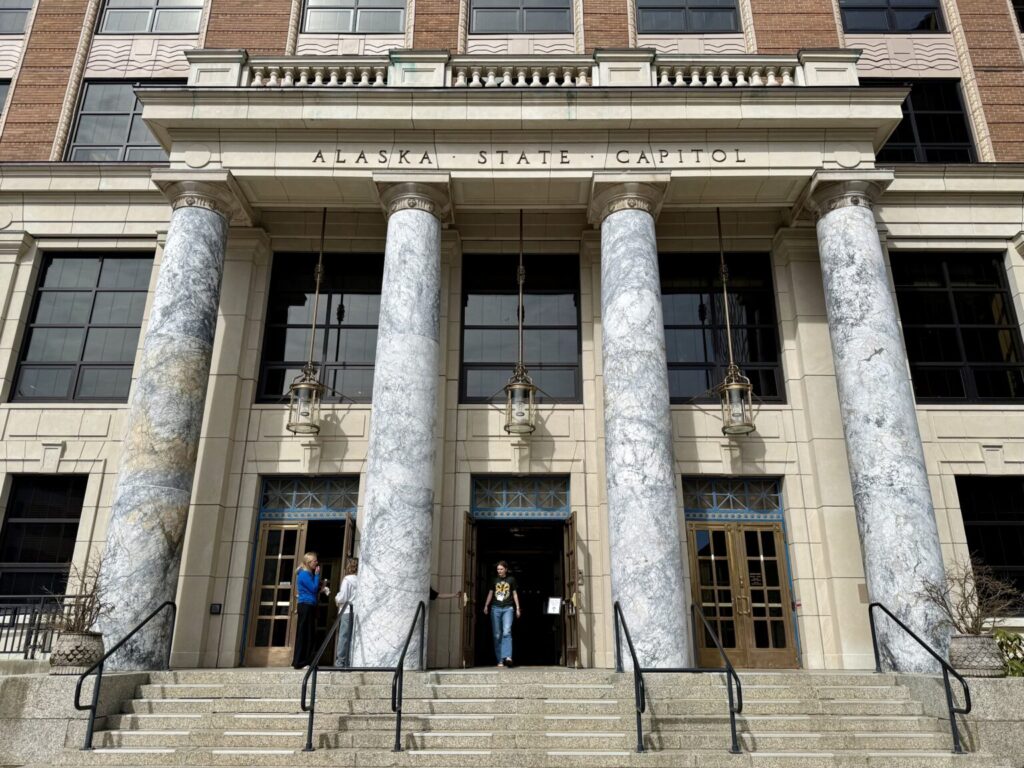
The Alaska State Capitol in Juneau is seen on Apr. 24, 2026. (Photo by Claire Stremple/Alaska Beacon)

NOTN- With just over a week left before Alaska lawmakers adjourn on May 20, the Legislature is entering its busiest stretch of the year as lawmakers scramble to pass budgets, major policy bills and a contentious natural gas tax proposal that lawmaker’s say has become the Governor’s biggest priority this session.

Alaska Public Media conjectured the final days of the session will likely center on three major areas: the state budget, the proposed Alaska LNG pipeline project and a flood of remaining legislation that must pass before the end of the two-year legislative cycle. Bills that don’t pass by adjournment will die and have to be reintroduced in a future session.

Negotiations are now underway between the House and Senate on the state operating budget. The House version includes a $1,500 Permanent Fund dividend, one-time school funding and expanded spending on child care and social programs. The Senate’s proposal is more conservative, with a $1,150 payment that includes an energy relief component and less education funding overall. Final negotiations may depend heavily on oil prices, which have recently remained above forecast levels.

Lawmakers are also debating how much tax relief should be offered to support the proposed Alaska LNG gasline project. Governor Mike Dunleavy has proposed replacing the state’s existing property tax on oil and gas infrastructure with a lower tax tied to pipeline throughput.

At the same time dozens of other bills are moving quickly through committees and floor votes, including a broad crime package, which includes bills targeting AI generated Child Sexual Abuse content, Sexual Assault kit tracking and raising the State’s age of consent.

There is a pension bill for state employees, a long time win for the legislature, that many expect Governor Dunleavy to veto before lawmakers leave Juneau.

But, the big question remains- will legislators pass these bills by the scheduled end of the session?

Juneau Senator Jesse Kiehl says it’s unclear pointing to that massive gas line bill that could push work into overtime.

“The Governor’s number one priority this year is the Gas line bill. He waited until two thirds of the way through the session to give us that.” He said, “The Resources Committees have been working like crazy, meeting multiple times a day. This is billions and billions of dollars worth of decisions, the kinds of things that will have impacts for 30 years to come. We’re working as hard and as fast as we can. Boy, it’s tough to see that passing before the end of the regular session. This time of year, it always looks like it’ll be overtime. Sometimes it is. Sometimes we can avoid it. But when I look at the issues that are pretty big, and may result in extra innings, we got that gas line bill on day 80 out of 121.”

Categories
Alaska News Featured Juneau News juneau Juneau Local Juneau Local Ketchikan Local News Feeds Sitka Local

Alaska Legislature considers exempting some Native corporations from public disclosure

By: James Brooks, Alaska Beacon

The Alaska State Capitol is seen behind other buildings on Tuesday, Feb. 10, 2026, in downtown Juneau. (James Brooks photo/Alaska Beacon)

A late amendment to a bill nearing final passage in the Alaska Capitol would exempt some Alaska Native village corporations from public financial disclosures required by state law.

On Monday afternoon, the Alaska Senate’s labor and commerce committee voted to amend House Bill 126 with a new section that reduces and caps the number of Native corporations required to share information annually with the Alaska Division of Banking and Securities. 

Sen. Jesse Bjorkman, R-Nikiski and chair of the labor and commerce committee, declined to answer questions when asked Tuesday about the change. 

In Monday’s committee hearing, Bjorkman said, “I think members of the media might be interested in information therein, but at the end of the day, I don’t know that information is their business because it happens within the confines of a Native corporation.”

State law currently requires corporations with at least 500 shareholders and $1 million in assets to provide financial documents to the state, which treats them as public records. 

Because Native corporations are exempted from federal disclosure requirements, existing state law provides the only free public avenue for non-shareholders to inspect their work. 

Of the state’s 200-plus Native corporations, 59 are currently required to file reports with the division, and the number is growing over time because shareholders are splitting their shares and passing them to their descendants, pushing more corporations over the 500-shareholder limit.

The new definition would limit disclosures to corporations with 500 shareholders when they were created, regardless of how many they currently have. 

That change would exempt at least seven village corporations — the division isn’t sure of the exact number and is reviewing another 30. None of the 12 regional corporations would be affected by the change because each had more than 500 shareholders when they were created. 

Shareholders of each exempted corporation would still have access to financial information, but members of the public would not.

Curtis McQueen, executive director of the Alaska Native Village Corporation Association, is supporting the change and wrote to the committee, saying that the modification brings state law back to its original intent.

“The amendment will exempt, as was originally intended, smaller village corporations from the filing requirements. This amendment will allow their staff and leadership to focus their time and energy on improving the health of their communities and providing benefits to their shareholders, not filling out forms and complying with the complex requirements of the division of banking and securities,” he said.

Attorney Christopher Slottee, representing the Village Corporation Association, testified separately, writing that no other private corporation in the state is subject to the same reporting requirements as Alaska Native corporations.

“It means that an ANC’s non-Native competitor in the same federal contracting market … faces no public disclosure obligation, while the ANC must publicly expose the financial details that inform its pricing, overhead structure, profit margins, and executive compensation to the exact same competitors,” he wrote. 

The original bill was from Rep. Neal Foster, D-Nome. On Monday, members of the labor and commerce committee asked a Foster aide if he was open to the change.

“It’s not core to what the bill itself does, but we are not opposed to it,” the aide said. 

Alaska has more than 200 village corporations and 12 regional corporations, which were created as part of the Alaska Native Claims Settlement Act of 1971.

Since that act, many of these corporations — legally distinct from tribes, which are sovereign governments — have become a powerful force in Alaska, holding vast swaths of land and employing tens of thousands of Alaskans.

Many corporations have also become important nationally because they receive preferential treatment under federal contracting rules. Under the 8(a) program — named for the relevant section of federal law — some Native corporations have become successful behemoths with more than a billion dollars in annual revenue. 

Most had humble beginnings, with just a few hundred initial shareholders. Federal law prohibits those shares from being publicly traded or sold, so Native corporations are not required to file documents with the federal Securities and Exchange Commission, as publicly traded corporations are.

On Monday, Sen. Forrest Dunbar, D-Anchorage, proposed an amendment with a different exemption criteria, but members of the committee rejected that proposal. 

After Monday’s action, members of the committee voted to advance the bill to the Senate Rules Committee, the last stop before a vote of the full Senate. 

Because the bill has already passed the House, Senate approval would trigger a single up-or-down vote in the House, which would be asked to agree or disagree with the change.

What are Native corporations required to disclose?

In the state-operated portal, you can find copies of all documents that qualifying Alaska Native corporations are required to disclose. As described by attorney Christopher Slottee, these include:

  • Named individual compensation — the total compensation of each of the five most highly compensated persons of the corporation and its subsidiaries, identified by name, including all deferred compensation, pension, and retirement plan contributions (3 AAC 08.345(b)(2));
  • Full audited consolidated financial statements — including balance sheet, income statement, statement of cash flows, and all footnotes (3 AAC 08.365);
  • Management’s Discussion and Analysis — a narrative analysis of financial condition, results of operations by segment, liquidity, and capital resources that reveals the internal financial architecture of the business (3 AAC 08.365);
  • Related-party transaction details — descriptions of all financial transactions exceeding $20,000 involving directors, executive officers, their family members, or entities in which they hold interests (3 AAC 08.345(b)(3)); and
  • A full description of the corporation’s business operations and subsidiary structure — including the principal products, services, markets, and significant subsidiaries through which operations are conducted (3 AAC 08.365).
Categories
Alaska News

Bit by bit, progress is made on the ambitious Alaska Long Trail plan

Anchorage officials and trail advocates, including Mayor Suzanne LaFrance, seventh from left. use shovels to ceremoniously break ground on May 9, 2026, on the Ship Creek connection between the city's Tony Knowles Coastal )rail and the Ship Creek Trail. (Photo by Yereth Rosen/Alaska Beacon)

Anchorage officials and trail advocates use shovels to ceremoniously break ground on May 9, 2026, on the Ship Creek connection between the city’s Tony Knowles Coastal Trail and the Ship Creek Trail. From left are: Shanna Gamble, director of Anchorage Parks and Recreation; state Sen. Löki Tobin, D-Anchorage; state Sen. Bill Wielechowski, D-Anchorage; Zara Fields; state Rep. Zach Fields, D-Anchorage; Anchorage Assembly member Daniel Volland; Anchorage Mayor Suzanne LaFrance; Anchorage Assembly member Sydney Scout; Aaron Leggett, president of the Native Village of Eklutna; and Beth Nordlund, executive director of the Anchorage Park Foundation. The new section of trail, about a mile long, will fill a gap in Anchorage’s system of paved bike trails. The trail connection is expected to be completed in the fall of 2027. The project includes a plaza at Ship Creek focused on Dena’ina culture. (Photo by Yereth Rosen/Alaska Beacon)

When Anchorage officials and outdoor recreation advocates gathered Saturday to ceremoniously mark the start of construction for a 1.3-mile section of trail near the city’s industrial port, they said they were taking a small step toward a big vision.

The connector will close a gap in the city’s existing network of paved bike trails and, supporters hope, eventually be part of what they call the “Alaska Long Trail,” an interlaced network spanning 500 miles from Fairbanks to Seward.

Anchorage Mayor Suzanne LaFrance characterized the Long Trail as a “dream trail connecting Seward to Fairbanks that will most definitely, most definitely, swing through downtown Anchorage.”

“Our parks and trails are the crown jewels of our community,” she said at the ceremony.

Supporters say trail expansions and improvements offer a big payoff to residents and to the economy, helping to diversify tourism activity that is otherwise highly dependent on the cruise ship industry.

The new trail connection is to include a plaza dedicated to Dena’ina heritage tied to Ship Creek, which in that Indigenous language is called Dgheyaytnu, meaning Stickleback Creek.

Farther south along the 500-mile corridor, another incremental step toward the Alaska Long Trail goal was completed last fall.

A new trail stretch at Moose Pass, a Kenai Peninsula community of about 225, offers a potentially unbroken hiking route down to Seward, about 30 miles to the south.

Anchorage Mayor Suzanne LaFrance speaks at a ceremonial groundbreaking on May 9, 2026, for a trail connection at Ship Creek. Next to her are, Beth Nordlund, executive director of the Anchorage Park Foundation, and Bill Bittner, chair of the Anchorage Park Foundation. (Photo by Yereth Rosen/Alaska Beacon)

The work, funded by the U.S. Forest Service, includes six miles of new trail along what is the historic Iditarod Trail route that was used in Gold Rush and territorial days for travel between Seward and Nome.

The work also includes four miles of improved trail and two new bridges, said Jane Boer, the Alaska Long Trail officer at the nonprofit organization Alaska Trails.

Boer described the work in a progress report on the Alaska Long Trail that she delivered last Friday at the annual Statewide Trails conference held in Anchorage and hosted by Alaska Trails.

“I think it’s really exciting that there’s a new trail down there, new adventures to be had,” she said.

Economic aspects of trails

To supporters, the trails that wind through Anchorage and other communities enhance quality of life and, in the longer run, the economy.

State Rep. Zach Fields, D-Anchorage, who rode to the Saturday groundbreaking ceremony with his daughter Zara on an e-bike, is among the supporters.

“Trails are Anchorage’s competitive advantage,” Fields said at the event. “I think we all appreciate that they’re amazing for our quality of life because they’re the single most important thing we can do to become more competitive in a global economy.”

Trails also support an aspect of the tourism industry that is independent of cruise ship companies.

“It’s independent travelers who spend more money and stay longer,” said Haley Johnston, executive director of Alaska Trails.

The Alaska tourism industry’s dependence on cruise ships is evident in visitor statistics from the state’s national parks.

People walk on May 9, 2026, on a trail in Anchorage's Campbell Creek tract, managed by the U.S. Bureau of Land Management. (Photo by Yereth Rosen/Alaska Beacon)
People walk on May 9, 2026, on a trail in Anchorage’s Campbell Creek tract, managed by the U.S. Bureau of Land Management. (Photo by Yereth Rosen/Alaska Beacon)

It took until last year for visitation to Alaska’s eight national parks to recover from big losses inflicted by the COVID-19 pandemic, which in turn depressed cruise travel, according to a new report in Alaska Economic Trends, the monthly magazine of the Alaska Department of Labor and Workforce Development.

In 2020, the first year of the COVID-19 pandemic – and a year when summer cruise travel virtually stopped – visitor numbers at Alaska’s eight national parks nose-dived by 86% in 2020. That compared to a 28% average drop across the country for national park visitation, according to the analysis.

The contrast was striking, said Karinne Wiebold, the state economist who wrote the article.

In the Lower 48, where national parks are within driving distance for most visitors, those lands became something like havens for people who wanted to recreate safely.

“For people it became a really enjoyable way to travel and be outside,” Wiebold said. But that social distancing did not work for people trying to travel to Alaska. “But when you come to Alaska, you’re not in a bubble.”

Much of the statewide trend has been driven by visitation at Glacier Bay National Park, which is visited almost entirely by cruise ship, and Denali National Park, which is a major destination for cruise passengers who add train or bus trips to their itineraries.

While visitation has returned to pre-pandemic levels, National Park Service employment is now well below that, despite a rebound that started in 2021, according to the analysis.

Trump administration cuts brought National Park Service employment down to 784 in 2025 from 865 the year before. In 2019, prior to the pandemic, Alaska had 869 park service jobs. The jobs support operations in all of Alaska’s National Park Service units, which include national preserves, national monuments, historical parks and other protected areas as well as the eight national parks.

The administration is proposing more cuts to both funding and employment. The budget it has proposed for the coming fiscal year would cut National Park Service employment in 2027 by more than 30% from 2025 levels.

Mixed prospects for future trail funding

The most recent trail connections and improvements have been paid for by a combination of federal, state, local and private funds.

Cyclists pedal past each other on Anchorage's Chester Creek trail by Westchester Lagoon on the afternoon of Aug. 29, 2025. (Photo by Yereth Rosen/Alaska Beacon)
Cyclists pedal past each other on Anchorage’s Chester Creek trail by Westchester Lagoon on the afternoon of Aug. 29, 2025. (Photo by Yereth Rosen/Alaska Beacon)

The Moose Pass-area projects, which are in the Chugach National Forest, were the beneficiary of about $12 million in federal appropriations secured over three fiscal years by Sen. Lisa Murkowski, R-Alaska, according to Alaska Trails.

The Ship Creek project, tentatively estimated to cost $19 million, is being paid for by a variety of sources, including federal transportation funds, state funds and local park bonds approved in recent years by Anchorage voters.

Over three budget cycles, the state has put over $6.7 million into Alaska Long Trail projects, according to Alaska Trails.

The concept of a “world-class trail” on par with the Appalachian and Pacific Crest trails continues to have lawmakers’ support, said Sen. Bill Wielechowski, D-Anchorage.

“I can’t emphasize enough how excited we are about the Long Trail,” Wielechowski said at the groundbreaking ceremony. “Every year in the legislature we’ve been trying to put a little bit more, a little bit more, towards it to build that out.”

There are no projects specific to the Alaska Long Trail in the 2027 fiscal year capital budget currently pending in the legislature, though there are several individual trail-related items.

The pending operating budget does propose an increase in funding for the state Division of Parks and Outdoor Recreation, which could benefit trail users. The budget passed by the legislature last year appropriated $23.9 million; after Dunleavy’s vetoes, the amount was whittled to $21.8 million. The new operating budget that lawmakers are now crafting for the coming fiscal year puts funding for the division at $27.7 million.

Along with the Forest Service, there are numerous sources of federal funds for Alaska trail projects, such as those available from the Department of the Interior under the Great American Outdoors Act. However, budget cuts may have closed off one of those federal opportunities.

Among the Trump administration cuts to the National Park Service was the elimination of the two positions administering the service’s Rivers, Trails and Conservation Assistance Program in Alaska.

The program assists locally led conservation and outdoor recreation projects, including trail construction and maintenance. In the past, the program supported projects around the state, from Prince of Wales Island in the southernmost part of Southeast to Nome on the Bering Sea coast.

A U.S. Geological Survey marker at the top of Bird Ridge in Chugach State Park is seen on June 12, 2021. The ridge overlooks Turnagain Arm. (Photo by Yereth Rosen/Alaska Beacon)
A U.S. Geological Survey marker at the top of Bird Ridge in Chugach State Park is seen on June 12, 2021. The ridge overlooks Turnagain Arm, and it is a popular destination in the park. The operating budget pending in the state legislature proposes an increase in funding for the Alaska Division of Parks and Outdoor Recreation. (Photo by Yereth Rosen/Alaska Beacon)

SUBSCRIBE: GET THE MORNING HEADLINES DELIVERED TO YOUR INBOX.

Categories
Alaska News

SEARHC plans new medical services building in Wrangell

SEARHC plans to build an 8,000-square-foot medical services building to consolidate dental and behavioral health services into a single campus, anchored by the hospital.

“We’re calling it the Wrangell Campus,” Ryan Matej, the Sitka-based chief administrative officer for the health care provider, said in a phone interview on Friday, May 1.

SEARHC has been looking at how to consolidate its multiple service locations in town, he said.

The dental clinic currently operates out of a SEARHC-owned building at Front and McKinnon streets, about a mile from the hospital. Behavioral health services are housed in a SEARHC-owned building at Church and St. Michaels streets.

Matej said no decision has been made on the future use of the two buildings after they are vacated.

“It’s really in the infant beginning stages,” he said of the construction project next to the hospital. “We’ve broken some ground,” with no specific timeline for construction.

Contractors will work over the next several months on site prep, preparing for a foundation and roughing in utilities, he said, but no actual construction.

At about 8,000 square feet, the medical services building will be about one-fifth the size of the Wrangell Medical Center, which SEARHC opened in 2021 with a hospital and long-term care unit.

The next phase, Matej said, will be the design work.

The health care provider has not yet applied for a building permit.

The new building also will include space for one or two optometry bays, he said, providing a dedicated area for visiting optometrists who currently work out of the hospital building.

SEARHC last month dedicated a new $300 million hospital and medical center on its Sitka campus. Charles Clement, who has served as president the past 14 years, talked about plans for Wrangell in a newspaper interview after the opening. “We have multiple facilities all over town, and we have enough land there to bring it all into a medical campus.”

SEARHC is the largest employer in Wrangell, with about 170 full-time equivalent employees and direct contractors in 2025, according to a Rain Coast Data economic report for the borough last fall.

The report said the health care payroll in Wrangell in 2024, at $15.2 million, exceeded all other industries in town.

SEARHC is the largest health care provider in Southeast, with facilities in 15 communities and traveling services for 13 more towns across the region.

This story was originally published by the Wrangell Sentinel.

The post SEARHC plans new medical services building in Wrangell appeared first on Chilkat Valley News.

Categories
Alaska News

State profiting from higher prices for Alaska oil on U.S. West Coast

The first month of the U.S. war against Iran caused crude oil prices to skyrocket around the world, and the price of Alaska’s oil has risen particularly far.

That rise is making tens of millions of dollars, maybe a few hundred million dollars if high prices persist, available for state services and the Permanent Fund dividend, even as it squeezes the finances of individual Alaskans.

In figures newly compiled by the Alaska Department of Revenue, the average price of a barrel of Alaska North Slope (ANS) crude was $111.17 in April.

That’s $8.70 higher than the average price of a barrel of Brent crude, a benchmark price for Europe’s North Sea oil. It was also $13.11 per barrel higher than the average price of West Texas Intermediate, the benchmark for oil from America’s second-largest state.

“The differential is the largest monthly value since the year 2000 and may be the highest value in history,” said the Department of Revenue, referring to the gap between Brent and North Slope crude.

“The large premium is due to a tightness in the Pacific basin oil market, where ANS is traded,” the department said.

Alaska crude goes to refineries in Washington state and California, with a small volume delivered to a refinery in Nikiski on the Kenai Peninsula.

In addition to Alaska oil, U.S. West Coast refineries obtain their crude from Canada, North Dakota and California oil fields, and a substantial volume from overseas suppliers.

“Uncertainty about shipping and delivery is incentivizing refiners to pay a premium for available crude that does not transit areas with substantial security risks. Crude grades from the Americas are the safest option. Brent primarily trades in the Atlantic basin, where the impacts from the Iran war are not quite as pronounced on a barrel-for-barrel basis.”

The premium now being paid for Alaska crude will have a significant impact on the state treasury if it continues for months.

Each $1 increase in the average price of a barrel of ANS crude for a full year is worth roughly $30 million to $50, depending on the price.

While more than half of the state’s general-purpose revenue now comes from the Alaska Permanent Fund’s investments, oil is still the No. 2 source of flexible spending money for the state, and prices — combined with production — cause the amount of available money to flex up and down each year.

Legislative budgeters write the state spending plan with an average crude price in mind for an entire fiscal year, from July 1 through June 30 of the following year.

In the current fiscal year, which ends June 30, the Department of Revenue expects prices to average $75.26 per barrel.

Thanks in part to the Alaska premium, the average through May 5 was $75.71. Every day that prices stay above that level, the more unexpected money the state will receive.

The state Senate already has a plan for that extra money.

The first $96 million would go to an “energy relief” payment that increases the amount of the 2026 Permanent Fund dividend by $150 per Alaskan. The next $111 million would be distributed to public schools, and anything above that would go into the state’s principal savings account, the Constitutional Budget Reserve.

While Alaska’s state treasury is receiving a boon from the high prices, legislators don’t expect it to last. In the fiscal year that starts July 1, they’re anticipating significantly lower average North Slope oil prices.

“The Senate operating budget, when combined with spending agreements for the capital budget, balances the budget on $73/barrel oil, with some money left over,” said Bethel Sen. Lyman Hoffman, co-chair of the Senate Finance Committee, speaking about the Senate’s budget proposal on May 6.

The post State profiting from higher prices for Alaska oil on U.S. West Coast appeared first on Chilkat Valley News.

Categories
Alaska News

Q&A: Corinna Cook on Ice, Memory and the Alaska-Yukon border

Juneau Author Corinna Cook is heading to the Chilkat Valley this week for an event centered on her newest book, Permafrost Is An Archive And Other Inheritances From The Alaska-Yukon Borderlands.  Cook, whose writing blends research and personal reflection, sat down with the Chilkat Valley News’ Rashah McChesney to talk more about the collection. 

This conversation has been edited for clarity and brevity. 

Rashah McChesney: Your essays move between reporting, memoir, philosophy, and literary criticism. What kind of reading experience are you trying to create for someone picking up this book for the first time?

Corrina Cook: I write in the tradition of the essay. I think that one thing that essayists are really involved in is trying to define what is an essay. We don’t agree. But what we do agree on is that an essay involves movement. The way that I teach it to my students is that an essay is always in motion between the three poles of research, lived experience and reflection. 

The research is anything we learn from outside of the body’s senses, and then personal experience is our lived life, and then reflection involves the movement of the mind. So, my interest in that form has everything to do with that sense of movement. In my perfect world, I’d like a reader to have a chance to think a thought that she hasn’t thought before…and also potentially rub up against questions that are not easy. 

One thing that I was really struck by is that a lot of nonfiction about climate change focuses on catastrophe or policy. Your work often seems more interested in memory, relationship, and meaning. I’m curious why you approach climate change in that way? 

I sometimes describe my interests as like, I’m interested in social problems with a geologic sense of time. I see a lot of exciting innovation in terms of climate grief adaptation coming out of the arts. 

I don’t want to live in a world that doesn’t have activists in it, I don’t want to live in a world that doesn’t have like policymakers in it. I want good attorneys making strong legal arguments on climate. But I also don’t think that arena is the only option, especially in this part of the north. 

Part of our colonial reality is that we’ve got these very local specific changes that our small communities and families and neighbors have to live with and have to figure out how to live with and at the same time are relying on federal powers, federal decision makers in very far away lands, on the other side of the continent. I just find that disconnect really fascinating. Someone will be making policy somewhere but, you know, in fjord country we’re seeing landslides and increased rainfall and decreased returns in salmon runs and how do we, in our small communities, find good enough ways of living with that kind of complicated loss that those changes entail? 

The title Permafrost Is an Archive treats land almost like a living record keeper. I am so curious what drew you to that metaphor?

Yeah, I was talking with a permafrost scientist, the director of Yukon University’s permafrost research lab. He made, to me, the very poetic and interesting point that ice and humans come into the land together. When you look at geologic epochs and this massive cooling event that happens on earth, it coincides with the evolution of Homo sapiens. So, this permafrost scientist told me that ice is a record of basically all of humanity so it’s very interesting that globally so much ice is melting. That’s like, our species’ most core library. So, I’m just very swept up in the kinship that implies between ice and the human animal. 

The Alaska-Yukon borderlands are central to this collection. I wonder if this region reveals anything to the north that outsiders often miss. 

I think of the drawing of borders up here as extremely strange. I think that might be a, kind of, basic answer to the question. It’s very weird that we have a line along the mountains and that on one side our neighbors have a Canadian healthcare system to contend with and on the other side of the mountains the neighbors have an American healthcare system to contend with. That’s just a surprising thing about the border. 

I think also there’s a lot of exchange and connection across these northern coast mountains. That goes very easily into geologic time, the accretionary belt of North America certainly doesn’t stop at the Alaska-Canada border. So kind of like the way that all of these jumbled bedrocks have landed in North America in the first place, that crosses the border. Then we have these generations and generations of kinship and trade ties, people walking back and forth over these mountains and sharing information, sharing material goods, trading information, trading material goods but also intermarrying, making really strategic choices about when to call a conflict a conflict and when to create alliances and avoid a conflict. That seems very integral to our inheritance here. 

Your writing often circles around the idea that the past is still present in the landscape. Do you think people in Alaska experience history differently because of the land itself and how close we are to that history? 

I think we’ve just got a hugely diverse set of people here. I think that you’re walking around with neighbors who find it very easy to truncate history at a specific moment, whether that’s contact or whether that’s pipeline. I certainly do have neighbors who help dig me out of the ditch who find it very easy to find Alaska history as starting with the pipeline. Then I have neighbors who dig me out of a ditch who don’t see it that way at all, who see a much longer extensive history and, you know, the deer’s use of the Hilda Creek estuary in early spring as this kind of standing long-term understanding of why we don’t disturb certain watersheds and shorelines. I think these time scales seem to exist side-by-side in Alaska. I think that really in the neighborly part of it is, I do not think the way that all of my neighbors think but I do rely on all of my neighbors. 

Is there one essay that feels especially important to read in Southeast Alaska? 

My larger agenda is that even though I focused on our border lands here, I think the collection is relevant to the Americas writ large and potentially globally. That aside, I think that the Kohklux Map essay is potentially the most regionally grounded in the Chilkat Valley and beyond. So that would be one that I think is really important to point at. 

Cook is scheduled to be at The Bookstore at 4 p.m. on Friday, May 15 for a meet and greet, followed by a 5:30 p.m. reading and discussion. 

The post Q&A: Corinna Cook on Ice, Memory and the Alaska-Yukon border appeared first on Chilkat Valley News.

Categories
Alaska News

Alaska to recognize Hispanic Heritage Month under new law

Sen. Elvi Gray-Jackson, D-Anchorage, leaves the floor of the Alaska Senate on Friday, Jan. 26, 2024. (Photo by James Brooks/Alaska Beacon)

Alaska will recognize Hispanic Heritage Month under a new law signed by Gov. Mike Dunleavy.

The month recognizing Hispanic heritage will be September 15 to October 15 each year. The legislation encourages schools, community groups and other public and private organizations to honor the history and culture of Hispanic Americans.

Sen. Elvi Gray-Jackson, D-Anchorage, is the bill’s sponsor, and said in a statement that the month is a time to honor and celebrate “the rich cultural tapestry that Hispanic and Latino Americans have woven into the fabric of our nation.”

Sen. Elvi Gray-Jackson, D-Anchorage, talks to fellow senators on Tuesday, May 10, 2022 on the floor of the Alaska State Senate in Juneau, Alaska. (James Brooks / Alaska Beacon)

There was no bill signing ceremony. A spokesperson for Dunleavy’s office said the governor signed the bill to acknowledge those contributions. “He believes it is important to recognize the rich traditions, history, and achievements of Hispanic Americans,” said Jeff Turner, Dunleavy’s communications director, by email Tuesday. 

The period also marks the anniversary of the independence of several Central American countries from Spain, including Guatemala, El Salvador, Honduras, Nicaragua, Costa Rica and Mexico. 

“While Alaska may seem distant from the heart of Latin America, the contributions of Hispanic and Latino Alaskans to our state’s history, culture, and economy are undeniable. From pioneers and settlers to artists, educators, and business leaders, Hispanic and Latino individuals have made significant impacts in every corner of our state,” Gray-Jackson wrote. 

Gray-Jackson said in an interview Tuesday her goal since being elected to the Alaska Senate was to spearhead recognition of diverse cultures in Alaska by enshrining them in law. Since 2019, she’s sponsored legislation to recognize Black History Month, Alaska Native Heritage Month, Filipino American History Month, Juneteenth and Women’s History Month, which passed last year. She said next she’d like to see June recognized as LGBTQ Pride month.

“All it takes is one person to begin the effort, and that one person happens to be me,” Gray-Jackson said. “And I’m grateful for all the support that I’ve gotten since 2019 and, No. 1 when it comes to our very diverse communities, I’m just really proud to welcome our neighbors to Alaska who enrich our communities.”

“I see them; I value them,” she added. “I appreciate their contributions to not only our community, but to the world.”

The law will take effect on August 6. 

SUPPORT: YOU MAKE OUR WORK POSSIBLE

Categories
Alaska News

State ignores bill to require scientific peer review of predator control

A subadult brown bear sniffs the air as it walks across the tundra in Katmai National Park and Preserve on Aug. 10, 2023. (Photo by F. Jimenez/National Park Service)

A subadult brown bear sniffs the air as it walks across the tundra in Katmai National Park and Preserve on Aug. 10, 2023. (Photo by F. Jimenez/National Park Service)

Last week, a state court approved the Alaska Department of Fish and Game’s plan to resume killing scores of brown bears, including newborn cubs, across a 40,000 square mile area in southwest Alaska. The goal of the extensive bear kill effort, according to ADFG, is to reduce the number of predators in order to increase the size of the Mulchatna caribou herd. 

The court stated:

“The Court is in no position to second guess the Department’s biologists in their technical conclusions. The Court must give deference to the Department on these technical game management decisions… The information considered by the Board (of Game) at the July 2025 meeting could be problematic or incorrect. However, the Court is not in the position, nor does it have the authority, to make that determination at this point in the proceedings. The Court simply does not possess the technical and specialized skills to do so.”

Indeed, this is a perpetual problem, and one that Rep. Andy Josephson’s bill, HB364 — “An Act relating to intensive management of big game prey populations” — seeks to resolve by requiring independent scientific peer review of all predator control proposals from the state. Science requires independent peer review.  

Regarding the ruling, the ADFG commissioner stated: “We are happy that science prevails.” They may be happy, but science clearly did not prevail.  

What did prevail is the state’s continued reliance on inadequate, anecdotal information to advance its objective of killing predators as political spectacle to mask its mismanagement, including its wildly unrealistic population goal of 30,000 – 80,000 for the Mulchatna caribou herd. Science points to lack of adequate nutrition, rather than predation, as the main driver of Mulchatna caribou numbers — a fact the state conveniently ignores.

Regarding HB364, the administration did not endorse the bill and the Legislature has ignored it entirely.  Obviously, predator control advocates do not want independent scientific review of their proposals, as they know such proposals would not survive independent scientific scrutiny.  

So “we the people” are left not to trust the state administration, the legislature or the courts on such matters of natural resource policy. And scores of brown bears will be killed in the next few weeks, without solid scientific justification, ostensibly on behalf of all Alaskans.

Hopefully, our next governor will better appreciate science and the need to apply it effectively in resource policy.

SUBSCRIBE: GET THE MORNING HEADLINES DELIVERED TO YOUR INBOX.