(The Center Square)—Several key Congressional Republicans are urging the Trump administration to consider designating the Council on American-Islamic Relations, a group that promotes Muslim rights, as a foreign terrorist organization, with U.S. Sen. Ted Cruz calling for an FTO designation…
Many Americans eating out this month may not realize they’ve stumbled into one of the best times of year to do it. September is one … Read moreThe post September is the best month of the year to eat at…
Keeping aging coal plants open, building new gas plants and choices about pollution controls affect electricity bills. Pollution adds health costs and climate damage that may not appear on those bills.
Many children are seeing aspects of their identity portrayed as problematic. Having regular conversations about identity can armor them against future harm.
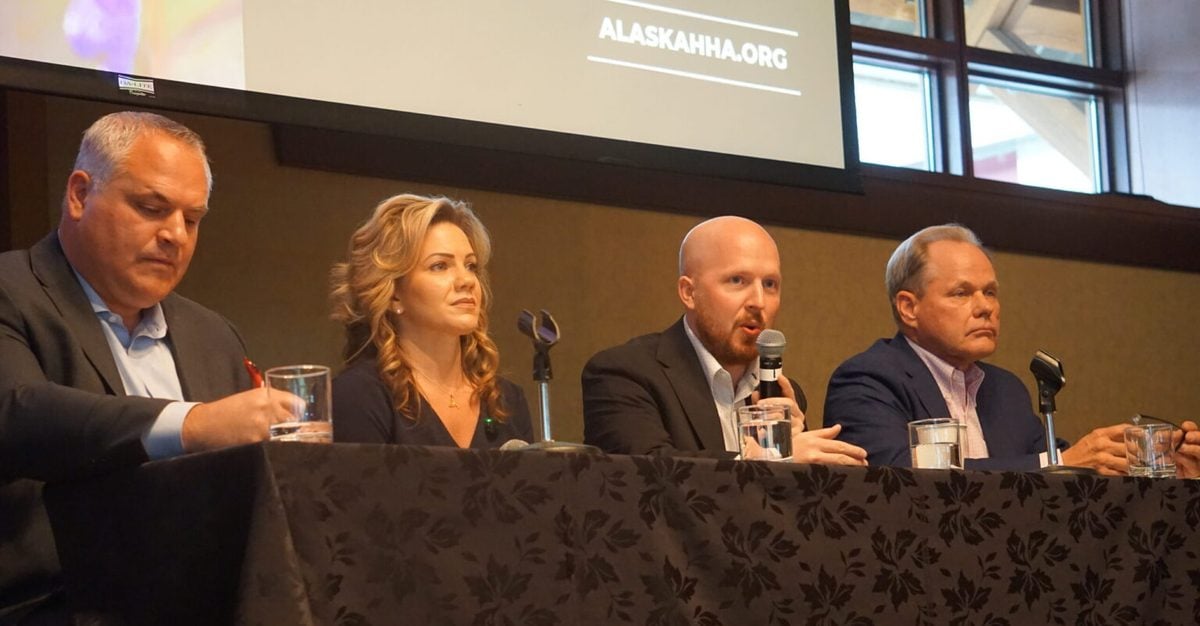
Former Anchorage Mayor Dave Bronson speaks at a gubernatorial candidate forum on Sept. 16, 2026, while former Attorney General Treg Taylor, Anchorage business owner and talk-show host Bernadette Wilson and former state Rep. Jonathan Kreiss-Tomkins listen. At the lecturn is Jared Kosin, president of the Alaska Hospital and Healthcare Association. The organization held the forum in Girdwood, and the event was focused on healthcare issues. (Photo by Yereth Rosen/Alaska Beacon)
On Tuesday, the advocacy arm of Planned Parenthood will endorse Democratic candidate Jonathan Kreiss-Tomkins to be Alaska’s next governor, according to an advance copy of the endorsement provided to the Alaska Beacon.
Planned Parenthood Alliance Advocates Alaska called JKT “a proven advocate for reproductive health and LGBTQ2S+ rights,” and labeled his three, anti-abortion Republican opponents — Bernadette Wilson, Dave Bronson and Treg Taylor — as “three extreme, out-of-touch politicians who are intent on rolling back Alaska’s constitutional rights.”
Morgan Lim, the Alaska state director for Planned Parenthood Alliance Advocates, said by phone that JKT was “a clear choice for us, and it’s a clear choice for folks who support access to abortion.”
Alaska Family Action, the most prominent antiabortion group in the state, is not making an endorsement in the governor’s race, said its president, Jim Minnery.
“Essentially they’re the same in many ways, if not most ways, in regard to our issues,” Minnery said of Wilson, Bronson and Taylor.
In place of a single endorsement, Minnery said, his group is instead urging voters to “rank the red” and choose all three Republican candidates in Alaska’s ranked choice general election system.
In Alaska, the state supreme court has repeatedly ruled that the right to an abortion is protected by the privacy clause of the Alaska Constitution.
As a result, Alaska has no legal limits on abortion, but in practical terms, access is limited. Few medical providers here offer abortion services, and public data indicates most abortions take place before the 10th week of pregnancy and are performed through medication.
In May, polling by Alaska Survey Research on behalf of Planned Parenthood found that 62% of Alaskans 18 and older believe that abortion should be legal in all or most cases.
The percentage rises to 71% among voters registered as undeclared or nonpartisan, those considered political independents.
In 2014, he voted against a law — later ruled unconstitutional — that would have restricted abortion to cases of rape, incest or medical necessity.
He has said he would continue backing the Supreme Court’s position if elected governor, stating in a May discussion on the website Reddit, “Medical privacy and reproductive freedom should be fundamental personal freedoms in America and Alaska. Our administration will treat them as such.”
Two of the three Republican candidates outlined their positions in a May forum hosted by Alaska Family Action. Bronson is a cofounder of the group, Minnery noted at the time.
“We, the state of New York and the state of California are the three worst states in the country for abortion,” Bronson said at the event.
“The important thing, the biggest tool the governor has, is a great big red pen. He vetoes any bit of money, any funding that goes towards abortion in any way,” Bronson said.
Wilson said that if elected, she would appoint a “pro-life advocate directly within the governor’s administration to monitor pro-life issues,” similar to an action taken by former North Dakota Gov. Kristi Noem.
She also said she would encourage the state to advertise the risks associated with medication abortions.
“I really think that it’s time for the state of Alaska and for the Department of Health to start running an education campaign on these matters,” she said.
She said she also would want her attorney general to create a restrictive definition for “medically necessary” abortion care and should continue to fight with the state supreme court on abortion restrictions.
Bronson also said he thinks the state’s next governor should fight the supreme court on the issue and advocated for the state to get rid of its current merit-based judge selection process, replacing it with judges appointed by election.
Taylor did not attend the May forum, but he has been open about his opposition to abortion and worked to restrict it while serving as attorney general under Gov. Mike Dunleavy.
Lim of Planned Parenthood said the group believes Alaskans will be more likely to support a candidate that supports abortion care than a candidate that opposes it.
“We’re about letting folks know where people stand on the issues that they care about, and the reality is that in this race, it is three anti-abortion extremists up against a proven champion, and that’s what the people of Alaska want to know,” Lim said.
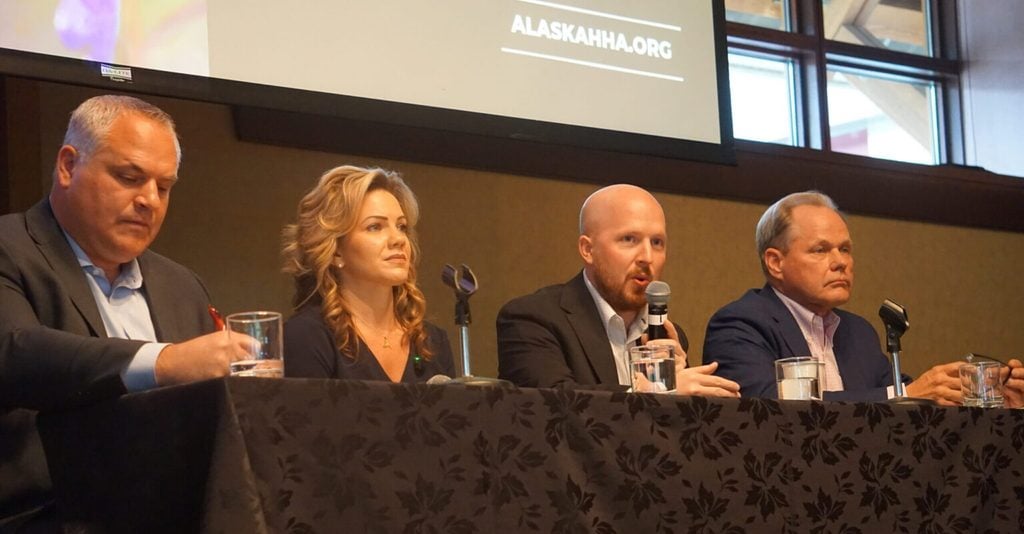
Former state Rep. Jonathan Kreiss-Tomkins, third from left, speaks at a gubernatorial candidate forum on Sept. 16, 2026, while former Attorney General Treg Taylor, Anchorage business owner and talk-show host Bernadette Wilson and former Anchorage Mayor Dave Bronson listen. The forum was held by the Alaska Hospital and Healthcare Association and the organization’s annual conference in Girdwood. Taylor, Wilson and Bronson are Republicans. Kreiss-Tomkins is a Democrat. (Photo by Yereth Rosen/Alaska Beacon)
In a candidate forum Thursday, three of the four candidates to be Alaska’s next governor voiced support for a long-debated plan to restructure the Alaska Permanent Fund in order to permanently cap the amount of money that can be spent from it without a statewide vote.
“You’ve got to protect the Permanent Fund. You simply have to,” said Republican candidate and former Anchorage Mayor Dave Bronson, speaking at the Commonwealth North forum.
Bronson referred to the Permanent Fund as “one of the two big engines” driving the state’s future. The other, he said, is developing Alaska’s natural resources.
Created in 1976, the Alaska Permanent Fund has been the No. 1 source of revenue for state services and the annual Permanent Fund dividend since 2018, when legislators and then-Gov. Bill Walker enacted a law that automatically diverts a portion of the now-$88 billion fund to the state treasury annually.
Even in years like this one, when oil prices are high and the state’s oil revenue booms, the annual transfer is worth more than oil and all other taxes combined and accounts for more than half of the state’s general-purpose revenue.
Currently, the Permanent Fund is divided into two parts. There’s the constitutionally protected corpus, which can only be spent via a statewide vote, and the earnings reserve, which collects the investment earnings of the corpus.
Money in the reserve can be spent by a simple majority vote of the Legislature and the assent of the governor.
Currently, only the 2018 law restricts spending from the earnings reserve, and that law is a flimsy limit — it could be overridden at any time by the Legislature and governor.
The trustees of the Alaska Permanent Fund have advocated that the two funds be combined into one, both to prevent overspending and to eliminate the possibility of the earnings reserve being drained, which would cause an instant state fiscal crisis.
“I think this is arguably the single most important question laying in wait for the next governor and the forthcoming Legislature,” said Democratic candidate Jonathan Kreiss-Tomkins. “I share Mayor Bronson’s belief that the Permanent Fund is a cornerstone of the state, and it is the single most important reform I want to pass as governor, working with the Legislature.”
Merging the two accounts would require a constitutional amendment. That needs the assent of two-thirds of the state House and two-thirds of the state Senate, plus a majority of voters in a statewide general election.
While serving as a member of the state House, Kreiss-Tomkins proposed such an amendment. His proposal passed through two legislative committees but was never voted upon by the full House or the full Senate.
Other, similar amendments have also failed to reach a vote of the House or Senate for two main reasons.
First, legislators would have to agree on the size of the Permanent Fund spending cap. Over the past eight years, the fund has struggled to earn enough money from its investments to make up for the annual transfer.
But reducing the size of the transfer means less money for services and dividends.
In 2025, state budgeters estimated that reducing the transfer by half a percentage point would open a $380 million gap in the budget. Reducing it by a full percentage point — to a level common in trust funds — would require finding $760 million per year in new revenue or cost cuts.
The second issue is the Permanent Fund dividend. Currently, legislators split the annual transfer from the Permanent Fund on an ad hoc basis, deciding each year how much to spend on dividends and services.
In practice, the Legislature has followed a “surplus dividend” strategy, setting the amount of the dividend based on what’s left over after services are paid for.
As operating costs have risen, the amount of money left for the dividend has shrunk. Some legislators now believe that without a policy change, the dividend is on course to disappear by the end of the decade.
State law mandates that dividends be paid using a specific formula in state law, but legislators have ignored that formula since 2016, and the Alaska Supreme Court upheld the legality of that approach.
“I’m going to fight like hell for that Permanent Fund dividend,” Wilson told Alaska Public Media in August.
She said she feels strongly about the issue because resources in Alaska are collectively owned by the state’s residents.
“It has nothing to do with the amount of a check. It has everything to do with the fact that Alaskans own the rights to those resources. And when you concede on that Permanent Fund dividend, you’re not just conceding on the amount of a check. You are conceding on the very idea that Alaskans no longer own those resources,” she said.
While permanently capping spending from the Permanent Fund does not directly alter the amount of the Permanent Fund dividend, it does eliminate a way to pay for larger dividends. Lawmakers who want larger dividends would have to either find new revenue or cut services in order to make money available for the dividend.
Some legislators have proposed that any revised structure for the Permanent Fund transfer reserve a portion of the transfer for dividends specifically, effectively guaranteeing a minimum payment.
Former Alaska attorney general Treg Taylor, speaking at an event in Kodiak, said he sees the Permanent Fund in the same way as the state’s fisheries — a resource that must be handled carefully in order to stay renewable.
Overfishing, or overspending, could endanger it.
“I think we have to lock up the Permanent Fund,” Taylor said, reiterating his position at this week’s Commonwealth North forum. “We have to protect that corpus. If we do not, there’s so much — I mean, JKT had it right. There’s just too much temptation to raid that. We’ve got to lock it up because that is our future.”