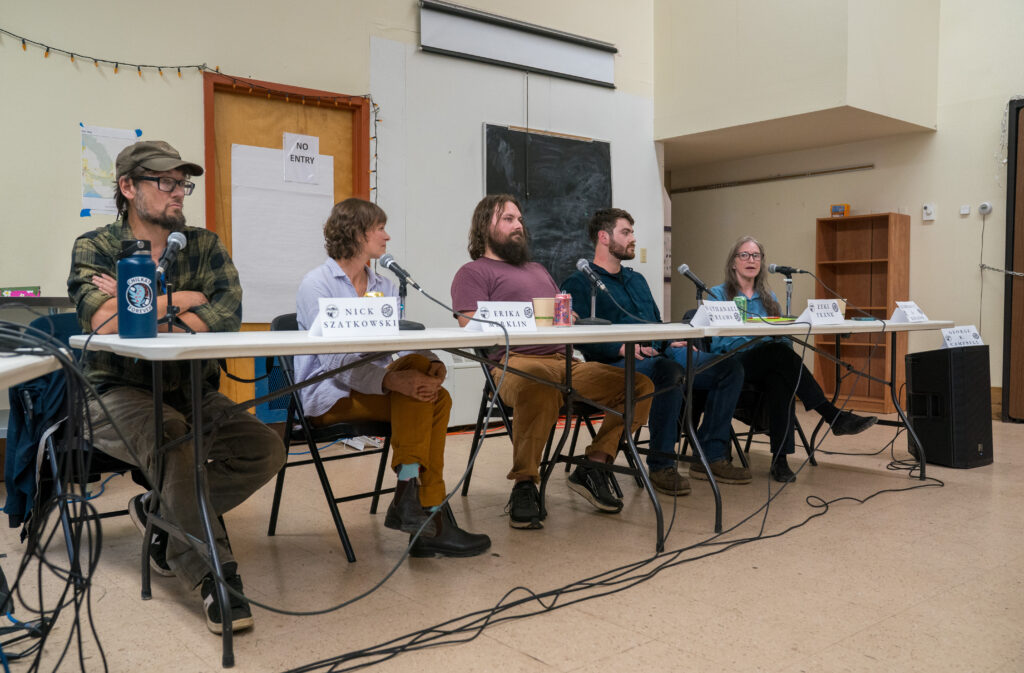
Six community members are competing for four seats on the school board this year. They all sat down with reporter Lizzy Hahn to talk more about why they want to run.
Editor’s note: This year the Chilkat Valley News partnered with KHNS on its election coverage in addition to hosting two candidate forums. A playlist of these profiles, as they are posted, can be found here.
Lizzy Hahn: Can you tell me why you’re running for school board?
Burl Sheldon: Well, I want to be a part of this group that meets and discusses and considers the needs of children and the ways that we can solve the problems of raising children in a very complicated environment, complicated for young families in our community, the complication of affordability, the complication of keeping great teachers. You know, we’ve had a lot of teacher turnover in the past decade and I’ve watched that and kind of been watching on the sidelines. And I want to be involved in that. I have some specific areas of interest, but the most important thing is just being a contributor and I guess sharing my passion about young children and helping families.
What are those biggest areas of interest for you?
The biggest areas of interest for me are that we’re aware of the health challenges that families and children face. We see that reflected in our national chronic disease statistics. And so children aren’t somehow immune to that. That’s where it gets going. And so health and things like cooking and making sure that children have clear information, that parents have clear information. The information that we have today, as far as the health side goes, is better than it’s ever been. So we have an opportunity there and I would say an obligation.
How would you approach that as a school board member to not alienate families?
Right. Slowly, slowly I think of it as a slow thing and the one thought that I’ve had and as a former school teacher and as a person who has spent, I spent a decade running a youth mentoring agency here, the Big Brothers Big Sisters program, and seeing children and families and understanding that in an interesting way. There’s really a neat opportunity and it’s not complicated, I don’t believe. But one integration that would be valuable is to integrate what is obviously a health issue, food, with classes like cooking and life science. You know, health class, cooking used to be called family and consumer science or before that it was home economics. I don’t know what they call it now, but life science, health and cooking are integral to our well-being and they are, it is integral to the well-being of children.
What do you think are some of the biggest challenges that you see for the Haines School District as a whole and how do you hope to address those? Like is nutrition one of those big issues?
You know, I think that it may be, no, I would say in terms of the obvious day-to-day things that Lily Boron and the school board have to deal with, we’ve had a really politically broken situation. Our relationship with the state funding of schools can best just be described as broken and I think that I won’t be shy in saying that Mike Dunleavy is perhaps the worst governor that Alaska has ever had.
He’s certainly been no friend of public school. So those are challenges that every school district in the state has to face. And so funding and as I started off talking about retaining great teachers, I think that if there’s one thing I want to emphasize in my interest in running for school board is that how do we over time develop the tools and the methods and the whatever it takes attitude so that we are recruiting and retaining great teachers because that’s what inspires children. I’m real interested in making sure that we’re talking about an in-person learning environment, a public school, a brick and mortar school, in-person learning. I’m not talking about online, nothing. I’m not saying we don’t need online or distance learning opportunities and more and more that’s become a reality. But I’m interested in a great in-person learning environment here in Haines.
What do you think makes a great in-person learning environment?
Great teachers. There’s just nothing, there’s no way to substitute that. Great inspirational people in the classroom who know what their subject, know their subject matter but more than that have the tremendous and unique characteristics of a teacher. And I know that from a person who came into teaching and really at one point hit the wall, I realized that this was really, wasn’t healthy for me. I was being tasked with too much and recognized that it wasn’t right for me and I didn’t do a career in public education. But you know it when you see it and your kids know it when they see it.
Do you have any children who have gone through the Haines school?
I have no children in the Haines Borough School District. I have no children. I grew up, my mother and father were both health and PE teachers. My father and mother coached, you know, swimming, football, baseball, diving, tennis. I met somebody not long ago who told me how my mother taught them how to swim in a lake. It was before the construction of, you know, pools, public swimming pools in the 1950s in our hometown. So I grew up literally two blocks from the school. And my dad was the guy with the keys to the gym. And so all that is something I grew up with, in a very intimate level. But no, I do not have children. But I did actually attend a pretty functional public education school and enjoyed a great athletic program. And that was really important to me then.
You touched on this a little bit earlier, but like school funding has been a common topic that we’ve been hearing about. What responsibility do you think the school board has in helping figure out, like, who helps fund the school?
Well, we can’t be doing it through bake sales. You know, we can’t be expecting that kind of, there literally are school functions that are funded by bake sales. I think the issues of funding principally at the state level are very important. We saw last year, if I’m not mistaken, the Haines Borough step up to fund at a level they’ve never been requested to fund before. And they did the absolutely right thing in doing that. If I were on that assembly, I would have done the same thing. And I applaud them for doing that. I think that the idea that a really huge part of the school district’s budget is going to be payroll and benefits and the idea that we’re going to get great teachers for less money. Good luck with that. At the same time, you know, we have a search clinic or a search system that is going to apparently build a hospital here. They have plans, I’ve been told secondhand, for staff housing. Now, all throughout Alaska, there are examples of communities where there’s housing for teachers. Was there housing for teachers in Nome?
There was.
There was. And the reality of it is the state of Alaska has also not maintained those housing units for teachers in many cases. They were built in rural places by the state and then allowed to go to you know what — and that’s tragic. But housing is an issue that teachers may need. And I’m not suggesting we house all teachers. But it’s my interest to, again, with the guidance of whatever it takes, consider some housing for teachers in Haines. And it doesn’t mean that we have to build every teacher a house. But perhaps there could be some transitional housing or transitional support so that great teachers can get here and not leave. That’s key.
If the Haines Borough School District were to build housing, where do you foresee the funding for this coming from? Do you think that would be a state or a borough issue?
I wouldn’t be able to say. I really wouldn’t be able to say. But again, I’m back to that, my original premise. How do we get great teachers here? And how do we get them to stay? So we need to discuss that.
AI is a very common topic now. Do you use AI? If so, how? And how would you like to see students either using it in the classroom or learning how to use it in a safe way?
I do use it. I use it in a query, you know, to just find out some source. Typically AI will provide you with a summary, but it will also give you the source. That allows you to go and look for yourself and consider whether that conclusion is a good one. I am concerned about AI and I’m concerned about the role of problem solving. Problem solving as a focus of education, what we call critical thinking and problem solving, those are synthesis level cognitive tasks, has always been part of the scholastic focus of schools, I think, for a long time. Beyond reading, writing, and arithmetic, like my grandfather who made it through the eighth grade. Once he knew reading, writing, and arithmetic in rural Wyoming, he was good to go. And he was back on the farm when he was 14 years old. That’s not the world we’re living in now. And we’re asking children to develop synthesis level cognition and things like problem solving and critical thinking are essential. So AI must not take the place of those things. Whether there’s AI involvement in education, and obviously there will be, we must not let go of the requirement for children to learn problem solving and that be a focus of education as well as critical thinking, meaning deciding in many cases whether it has merit and is appropriate.
What does a successful term look like for you in either a year from now or three years from now if you were to be elected?
I want to be part of the team. You know, I want to be part of the team. And I think I have no problem with the school board. I realized a couple days ago that I’m talking to Kevin Shove, who’s on the school board now, and he explained that I would be running against him. And it was like, ‘oh, I guess so.’
You know, I hadn’t even thought of that really. I just wanted to be on the slate. I wanted to run for public office. And the school board is where my passion is. The development of children and families and serving children and families through the Haines Borough School Board is really where I was focused. Could you repeat the question?
What does a successful term look like for you either a year from now or three years from now if you were to be elected?
That’s a great question. I think that, I mean, awareness of student health at the level of the school board, that it’s part of the conversation on a regular basis of the school board. And the health of students can be sort of distilled down. There’s stress and many, many stressors. We have new stressors, thousands, perhaps. They relate, they could relate to social media. There’s other physiological stressors, such as an inappropriate diet. That’s another huge one. There’s also the stressor of sleep. Are students getting enough sleep? So those are three very fundamental core issues that transcend learning, right? They’re really at the sub-level of student learning, that they are prepared to learn. Have they slept? Are they taking on undue stress? Have they been properly fed? Those are things I would hope that we would be talking about in three years and be aware of the challenges that modern families face in those areas and modern children.
All of the stressors that you bring up, like the diet and sleep and stress just in general. How do you as a school board member hope to help eliminate those problems? Is it like better nutrition in the cafeteria? How do you check on if a student’s getting enough sleep or not?
Well, that’s a great question. That’s really, really great. We’re not, generally, I mean, if you look at the United States population in 1940 and compare, and we’re essentially the same, biologically, we’re the same people as we were in 1940. We’re not getting nearly as much sleep as people got in 1940. And I don’t know exactly what the number is, but it’s significantly below the seven to nine hours that is generally recommended. And that goes for parents and parents as well. So being aware of that, there are no, there’s no human metric. That’s an example for just simply the discussion of sleep. There is no human metric for performance that is improved through the lack of sleep. And of course, that would include a child’s ability to learn, ability to solve problems, or ability to, you know, shoot baskets.
All human metrics of performance go down with the lack of sleep. There’s an example. We just experienced in our nation one of the largest, if not the largest lawsuit against a single company settled out of court for $17 billion. And that has to do with the Meta settlement that basically admits that they’re predatory on children, that their social media algorithms are predatory on children. And we should all be very concerned about that. We should not take that idly. School boards should be absolutely focused on that. States should be absolutely focused on that. And I believe that our states have a serious obligation because they have the financial and the legal muscle to do something about it.
Despite the thousands of stressors that children have, we only have one stress reaction. The body only has one, okay? And then the issues of nutrition. I mentioned three things. I mentioned sleep. I mentioned social media or chronic stressors. And then there’s the issue of nutrition. About 70% of the food that’s available, the individual food products in our local grocery stores would be fairly classified as highly processed. And the writing is pretty big, pretty on the wall that what we need to be consuming is the exact opposite. That foods lower on the totem pole, lower on the food chain, whole foods, whether they be meat or vegetables or whatever, are what we need. Frankly, the United States Department of Agriculture, the same organization that funds our school lunch program, is the cause, frankly, of a lot of this trouble and this trauma and drama that we see relating to food in America.
You mentioned this a bit earlier about how you’re running against Kevin, who’s currently on the board, and many others.
I didn’t even know, really, that I was running against him.
This is a pretty full ballot – there’s six people running for school board, yourself included, for four seats? Did you know this when you were applying? Did you realize that it was full?
Yes, I did. I thought I realized it was full at the time, and I don’t care. I want to be on the school board. And so the only way to get there is to file. Yeah. And I’ve had this conversation about some of these topics. These are not fresh. I’ve shared my in-depth concern with the school board in the past, in the past year in writing. And Lily Boron is very, very familiar with the concerns that I have. And it’s been a wonderful and friendly interaction.
What have been some of the reactions that you’ve gotten?
They think of it as somewhat tangential to what’s in front of them. And what I would say, and I’ll use a number. I’m a math guy. I’ll use some numbers because of its value in appreciating the extent to which I’m referring. We currently have about 30% of the United States walking around that is either pre-diabetic or diabetic, 30%. That’s pre and diabetic, 30%. And we have 40% of the population of the United States has a body mass index of over 30, which means they’re obese. In 25 years, that will be 60%. That’s the trajectory we’re on. Along with that is the chronic disease pandemic that is absolutely and has been proven to be linked to belt size. So those affect children, those in 2050, that 60% statistic will involve the children who are currently in Haines Borough schools. And I’m very concerned about that. We should all be concerned about the thriving of children. And in the face of, as with the Meta suit, as with the tobacco suit from the mid-90s, predatory marketing, predatory product development that is affecting the lives of children and their ability to thrive into the future.
Do you think that that just goes back to like the Whole Foods offered at the cafeteria? Or like how can the school board address that? Is that focusing on the cafeteria?
I mentioned one thing. It’s difficult, that’s a great question because we are offering a subsidized USDA school lunch. And yet we also have some benefits of being in Alaska. We have salmon and periodically there might be some moose on the menu. Those are all good things. I mentioned to you at the outset that I have a curriculum interest that I think will really benefit the health of youth and can benefit the health and well-being of youth and families. And that is integration of health, life science, and cooking. Those three are inextricably linked. You see the links once you appreciate the relationship between food, undue stress, lack of sleep, and chronic illness.
Is there anything else that you want to mention today about either running for school board or what it would mean to be elected or anything in general?
I’d just like to say that I have a lot of interesting and diverse experiences. I came here as a school teacher. I wrote grants for recreational use management at Chilkoot. I’ve written grants for PE programs, for U.S. history programs, for Alaska schools. I’ve done a lot of different grant writing projects over the years. I ran the Big Brothers Big Sisters program for a decade. I filed the articles of incorporation for Haines Friends of Recycling. I was its first board president for about five or six years and been involved in the community in a lot of different ways. Financially, I worked as a municipal grant manager and bookkeeper as well as working for a nonprofit museum as their grant writing, grant manager, and business manager. So I have a lot of budgeting and financial experience and knowledge as well as my interests in health and well-being and in children. So I have a lot to offer in terms of experience that is both volunteer and paid and feel like I’ll be an excellent contributor on the school board. And I have absolutely no problem with anybody who’s currently serving or with our school superintendent, who’s a lovely person who I’ve known for many years.
Thank you so much for joining me today, Burl. I appreciate you taking the time to explain why you’re running.
Thanks so very much.
The post Watch: An interview with Burl Sheldon, candidate for school board appeared first on Chilkat Valley News.