Greta Schuerch (left) and Click Bishop (right). (Campaign photograph)
Gubernatorial candidate Click Bishop, a former Republican state senator, on Wednesday announced he had chosen Greta Schuerch, an Alaska Native corporation board member, as his running mate.
Bishop is one of 18 candidates for Alaska governor. Incumbent Alaska Gov. Mike Dunleavy, a Republican, is constitutionally prevented from serving a third consecutive term.
Schuerch, 46, is from Kiana, a village in Northwest Alaska. She works as senior lead for government and external affairs for Teck Alaska, a Canadian mining company that operates Red Dog, an enormous but aging zinc mine near Kotzebue.
Schuerch was elected in 2025 to serve on the board of directors of NANA Regional Corp., an Alaska Native corporation that owns the land where Red Dog operates. The corporation serves more than 15,500 Iñupiat shareholders.
At a campaign event in Fairbanks, Schuerch said that she is motivated to run for lieutenant governor due to the high cost of energy and a state budget deficit impacting families and schools.
“The stakes are too high to sit on the sideline,” she said.
Schuerch is a registered nonpartisan. She ran for Alaska House in 2012 to represent the North Slope and Northwest Arctic. She lost in the Democratic primary election that year to Ben Nageak.
Bishop is the third gubernatorial candidate to name a running mate. Republican Bernadette Wilson named former GOP Sen. Mike Shower of Wasilla as her pick for lieutenant governor; former Anchorage Mayor Dave Bronson, a Republican, chose Josh Church as his running mate.
Bishop served 12 years in the Alaska Senate. He previously served as a state labor commissioner in Republican administrations.
Alaska lieutenant governors assume the governorship if the office becomes vacant. They are also Alaska’s top elected official overseeing state elections.
Candidates have until June 1 to file for the Aug. 18 primary election.
All gubernatorial candidates and their running mates will appear on the same primary election ballot. The top four vote-getters, regardless of party affiliation, will advance to the November general election.
Snow falls on the Alaska State Capitol on Monday, March 16, 2026, in Juneau, Alaska. (James Brooks photo/Alaska Beacon)
The chief of staff for a member of the Alaska House of Representatives was arrested early Sunday morning in Juneau and accused of driving under the influence of alcohol.
Kathryn “Katy” Giorgio, 45, is an aide to Rep. Genevieve Mina, D-Anchorage, and pleaded not guilty to a class A misdemeanor in an initial hearing on Monday.
Her arrest came less than a week after Forrest Wolfe, a Republican and aide to Gov. Mike Dunleavy, was also arrested for driving under the influence. It was Wolfe’s second DUI arrest and Giorgio’s first.
Giorgio was released without bail. Ordinarily, DUI release conditions require that accused Alaskans stay out of bars and other places where alcohol is served.
In Giorgio’s case, Judge Kirsten Swanson and the municipal prosecutor agreed to one exception: Giorgio will be allowed to play trombone this week in the Red Dog Saloon as part of an Alaska Folk Fest concert.
Mina declined comment when reached by phone Thursday evening but confirmed that Giorgio remains a member of her staff and that the matter is an internal personnel issue.
Giorgio declined on Thursday to speak at length about the incident but said “it was a bad decision.”
“I was not driving erratically. I was a block away from my house, and it was just an unfortunate situation, and I’m working through the system to do what I have to do,” she said.
In an affidavit submitted to prosecutors, Juneau Police Department Officer Joshua Shrader said he pulled over Giorgio about 2:30 a.m. Sunday morning after observing her car speeding and “driving down the center of the road” in Juneau’s Mendenhall Valley neighborhood.
“While Giorgio was searching for her registration,” he wrote, “I noted an open can of alcohol in the center console cup holder. Inside the center console glove box, Giorgio picked up another can of alcohol and attempted to conceal it in a napkin.”
Shrader said both Giorgio and the car smelled of alcohol, and her breath alcohol level measured at 0.126, more than the legal limit of 0.08.
A status hearing on Giorgio’s case has been preliminarily scheduled for April 24. A hearing in Wolfe’s case is scheduled for May 18. According to online court records, both have hired defense attorney August Petropulos.
(Lizzy Hahn/ Chilkat Valley News) Stella Swinton, 21 months old, holds an Easter egg during the egg hunt in the Haines High School on April 5, 2026.
(Lizzy Hahn/ Chilkat Valley News) Students rush to grab eggs during the Easter egg hunt in the Haines High School on April 5, 2026.
(Lizzy Hahn/ Chilkat Valley News) Lillee Grant hugs the dinosaur stuffy she got after finding a prize slip within an Easter egg in the Haines High School on April 5, 2026.
(Lizzy Hahn/ Chilkat Valley News) Students rush to grab eggs during the Easter egg hunt in the Haines High School on April 5, 2026.
(Lizzy Hahn/ Chilkat Valley News) Two-year-old Olen Leazier figures out how to get a lollipop out of an Easter egg during the egg hunt in the Haines High School on April 5, 2026.
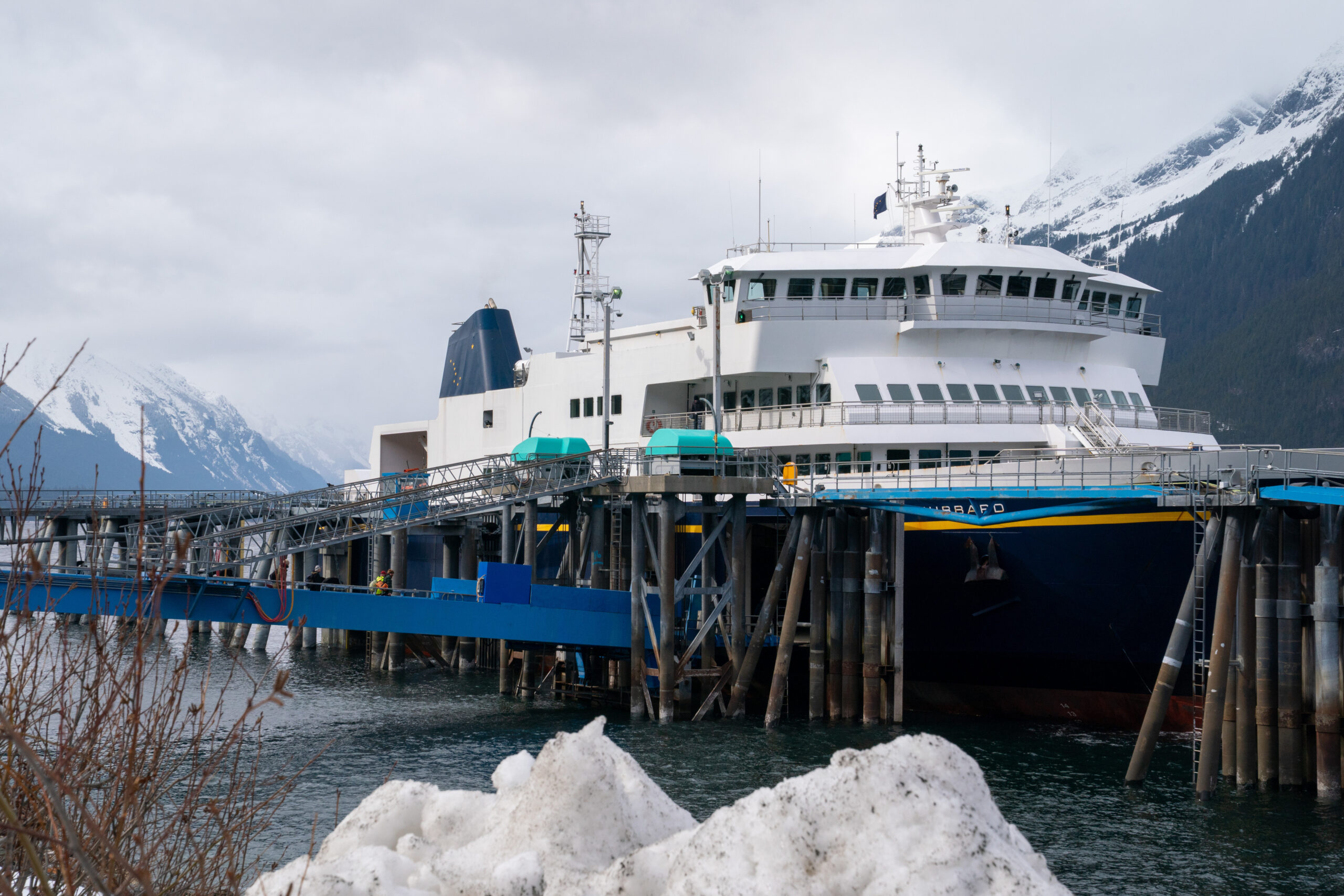
(Lizzy Hahn/ Chilkat Valley News) People walk down the causeway to board the MV Hubbard at the Haines Ferry Terminal on April 7, 2026 in Haines, Alaska.
(Lizzy Hahn/ Chilkat Valley News) Police officer Max Marty on April 2, 2026 in Haines, Alaska.
METLAKATLA, ALASKA — Across Alaska’s coastline, from the Indigenous communities of Bristol Bay to the Tlingit and Haida villages of the panhandle, rural harbors that once bustled with commercial fishing boats now sit unused and empty.
Abandoned boats covered with mold and algae line the shores of one Southeast town; others have seen their fleets sold off and relocated.
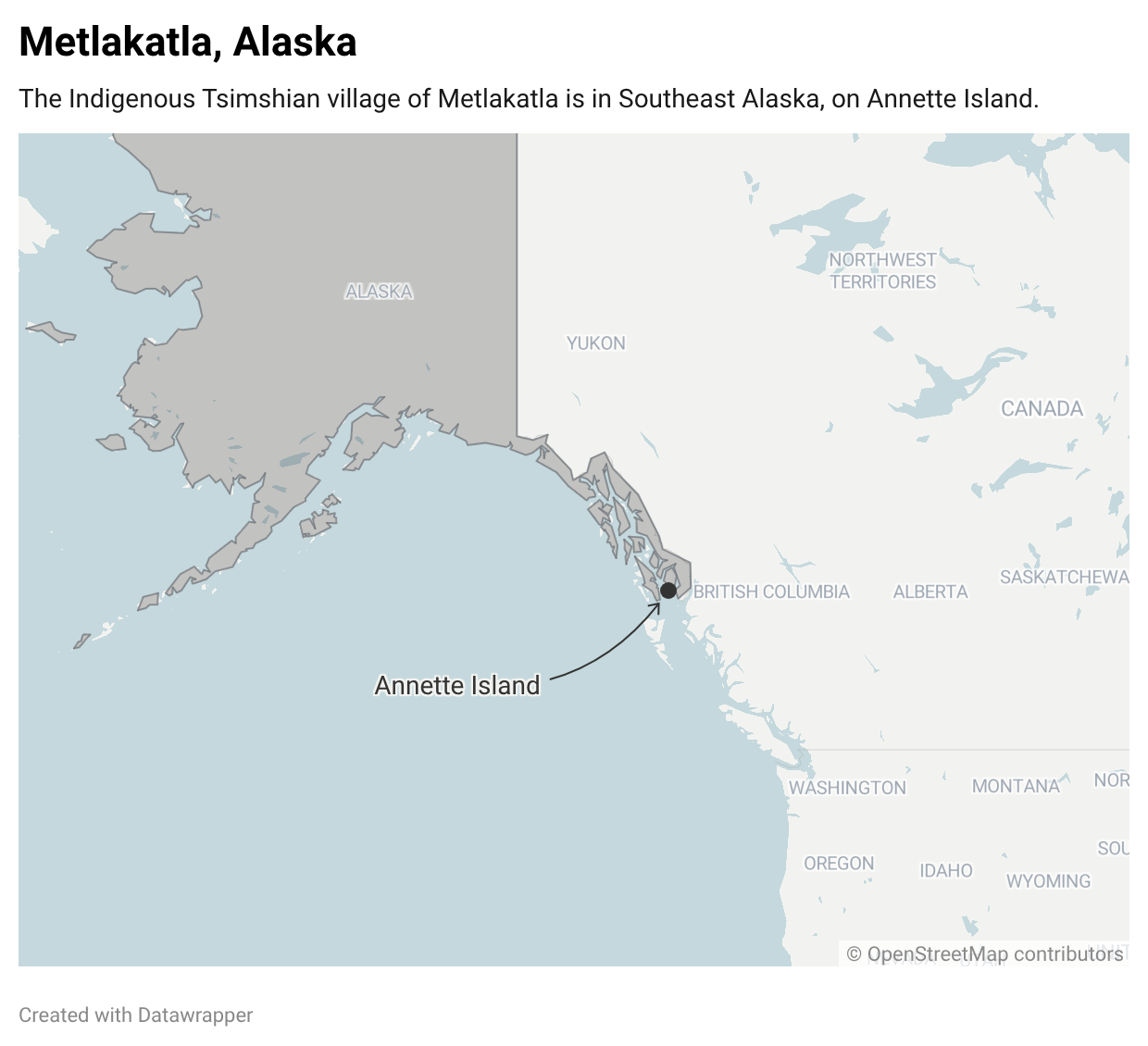
In the Indigenous village of Metlakatla, though, it’s a different story.
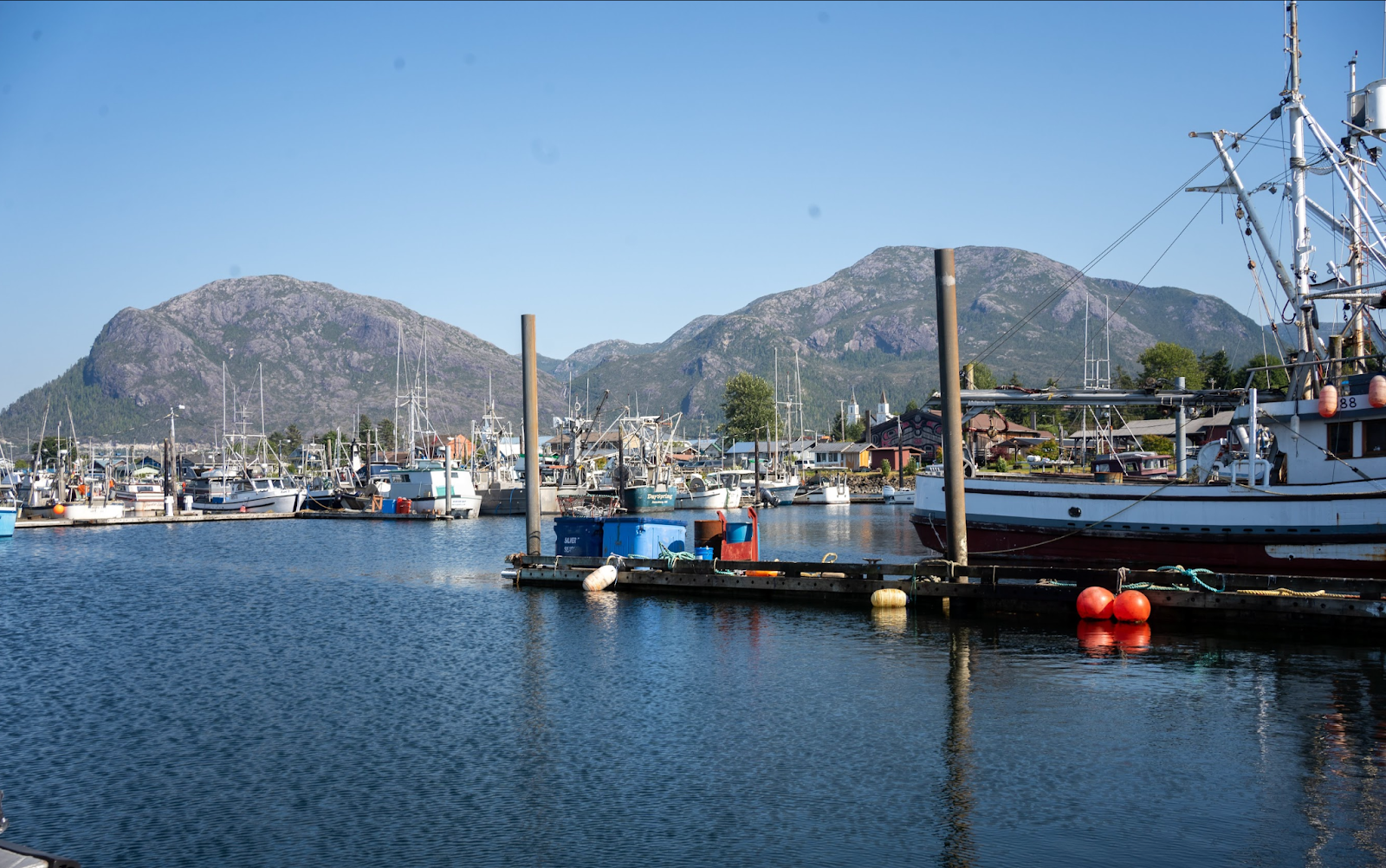
Fishing vessels pack the downtown harbor on Annette Island, which sits just off the coast at Alaska’s southernmost tip. Huge seiners, with onboard cranes to reel in fish-laden nets, loom over the docks, with many more slips filled in by smaller gillnetters. Fathers and grandfathers still fish with sons and grandsons.
Experts and industry players disagree about the exact reasons for the decline of commercial fishing in the rest of rural, coastal Alaska — with some blaming state policies and others pointing to global market trends.
In Metlakatla, local leaders say their success in sustaining their fishing culture stems from the community’s unusual history.
In the 1970s, the village stayed out of a land claims settlement between Alaska Natives and the federal government — a deal that could have brought cash in exchange for ceding Metlakatla’s reservation and residents’ collective right to pull fish from the waters off their shores. All the other Native reservations in the state were terminated.
Seine boats such as these in Metlakatla’s harbor use an onboard crane to help pull fish-laden nets on board. (Nathaniel Herz/Northern Journal)
As a result, Metlakatla is the only Native community in Alaska that manages its own commercial fishing harvest. The right to earn a living from the ocean waters surrounding the island is tied to tribal membership and can’t be sold off to outsiders — as happened in other rural and Native communities across the state.
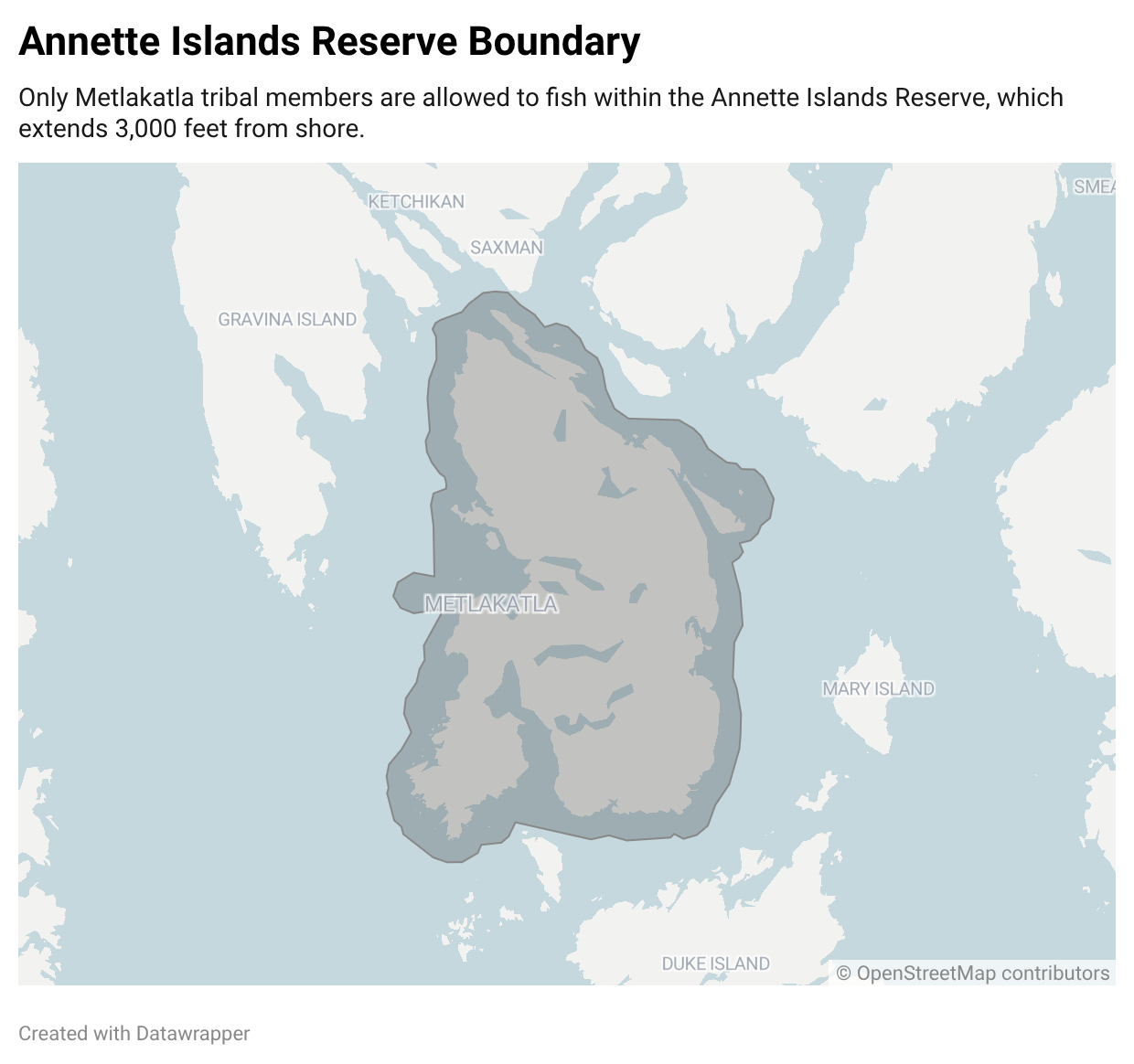
Elsewhere, Native residents of coastal villages and cities might have to pony up $100,000 or more for a permit to access state-managed commercial fisheries just offshore. Meanwhile, any Metlakatla tribal member with a boat and $25 can buy a permit and cast their net in the Indigenous-managed fishery that extends 3,000 feet around Annette Island.
“It’s 100% of the reason why we’re not down to one boat,” said Albert Smith, Metlakatla’s mayor.
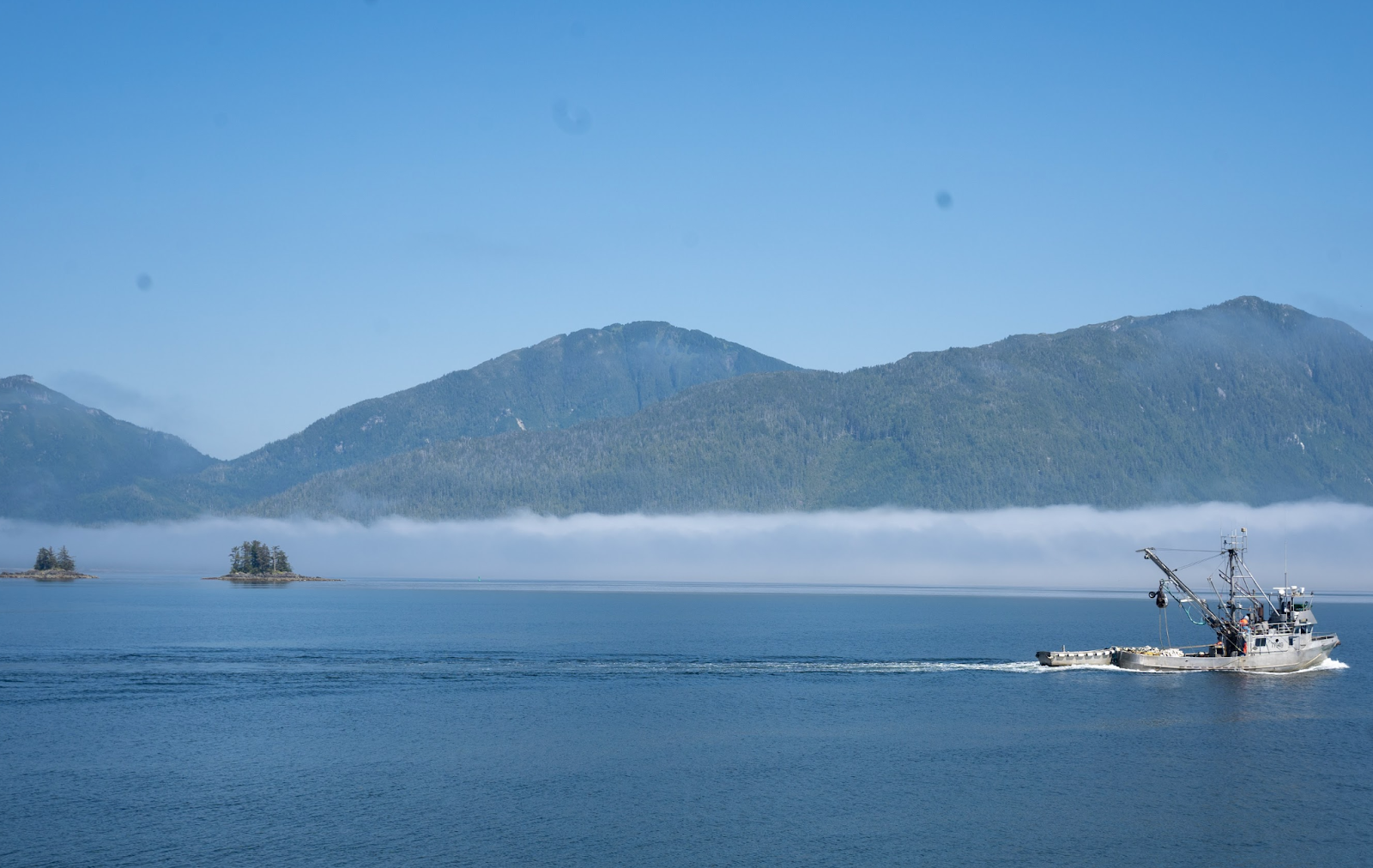
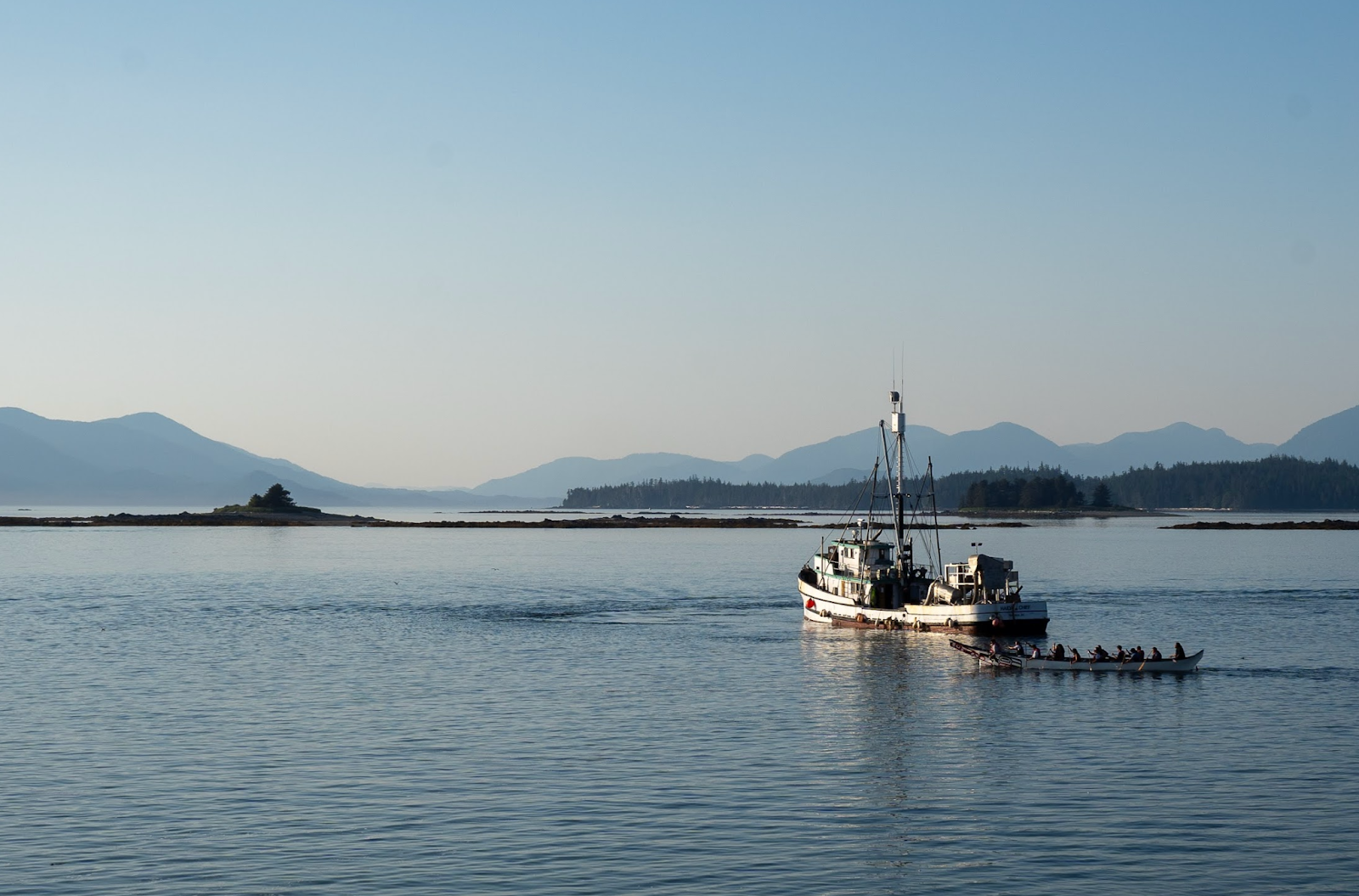
A seiner tows a small skiff along the ocean just outside Metlakatla in 2024. (Jack Darrell/KRBD)
The island fishery sustains the largest tribally managed salmon harvest in the United States. The 1,600-person community has dozens of active commercial fishing vessels, which harvested more than 1.3 million salmon in 2024, according to the most recent tribal data available.
The community stands today as a kind of experiment. Its fishery represents an alternate reality that could have unfolded in rural Alaska if more communities had the same opportunities to access nearby waters — or had state policymakers not chosen to privatize commercial harvest rights in the rest of Alaska’s big salmon fisheries, as they did in the 1970s.
Metlakatla’s narrative is a “direct refutation” of the argument that coastal Alaska Native villages are to blame for the loss of their fishing industries, said Jonathan Kreiss-Tomkins, who once represented Metlakatla in the state House and several years ago pushed an unsuccessful bill to boost access to rural commercial fishing careers.
In Metlakatla, “every slip in the harbor is full — high schoolers are deckhanding for their uncle, their dad, their best friend’s dad,” Kreiss-Tomkins said. “I think it’s a fascinating case study.”
Local leaders say they’ve still had to fight to sustain Metlakatla’s fleet and its tribal fishery.
The community is now in the midst of a six-year legal effort to expand the waters available to tribal members, which leaders say could help solidify the future of Metlakatla’s fishing industry. But its federal lawsuit faces opposition from Alaska Gov. Mike Dunleavy’s administration, competing fishermen and even neighboring Indigenous people.
Metlakatla’s main harbor is near the center of the village, next to a small casino and an artist workshop. (Jack Darrell/KRBD)
‘We’re the salmon people’
The Metlakatlans left northern British Columbia in the late-19th century amid conflicts over land ownership.
Residents secured an invitation to America from President Grover Cleveland and members of Congress at the behest of William Duncan, a charismatic Anglican minister. Duncan had worked with the region’s Indigenous Tsimshian people to establish the original Metlakatla in British Columbia, which he envisioned as a model Christian community.
After a mass migration in canoes and other vessels, the new Metlakatla was built 70 miles away on Annette Island, just across the international border in Alaska, where residents eventually built an enormous church.
A canoe passes by a fishing industry vessel just offshore of Metlakatla in 2024. (Jack Darrell/KRBD)
A cannery served as a market for residents’ ancestral fishing tradition, which the tribe has described as a “bedrock of the Coast Tsimshian culture and way of life.” A presidential proclamation from Woodrow Wilson in 1916 subsequently set aside the 3,000-foot strip around the island exclusively for use by the village’s fishermen.
For decades afterward, Metlakatla’s commercial fleet harvested both inside and outside the exclusive zone.
Skippers of today, who are mostly men, learned to fish from their fathers, who learned from their fathers and grandfathers before them.
Fishing is “one of the few things that remain unbroken from our forever history,” said David R. Boxley, a Metlakatla artist who served on the village’s tribal council until recently.
Artist and former tribal council member David R. Boxley details a traditional bentwood box in his workshop in Metlakatla. (Nathaniel Herz/Northern Journal)
“That’s our culture, even though it’s changed in how we do it,” he said. “It’s as old as our people. We’re the salmon people.”
Tribal fishery ‘saved our butts’
In 1971, Congress passed the Alaska Native Claims Settlement Act, which came with a painful tradeoff.
Newly formed, Indigenous-owned corporations would receive a total of $1 billion and some 45 million acres — roughly 10% of the state. In exchange for that money and property, Alaska’s Indigenous people would give up claims to larger swaths of traditional lands, and those that had reservations would surrender them.
Metlakatla had one of only 23 reservations in Alaska and exclusive fishing rights to boot, so it had more to lose. It may have also had less to gain, because the community’s emigration from Canada made its Alaska land claims less certain.
Some in Metlakatla wanted to pursue the payout anyway, according to Boxley.
But elders whose parents and grandparents had been through the exodus from the original village site in British Columbia saw their sovereignty as priceless, he explained.
“We’d already lost a Metlakatla,” Boxley said. “We had to build two communities — one was basically taken from us. Why would we do that again?”
The other 22 reservations in Alaska were dissolved as a result of the settlement. Today, only Metlakatla’s remains.
A few years after the other tribes settled, in an effort to prevent overfishing and make the industry more profitable, the state of Alaska established its “limited entry” program. The system capped the number of skippers in each commercial fishery and transformed fishing from a public right to a private privilege, one available only to those who could afford or inherit a permit. And since the supply of permits was limited, they became valuable commodities.
Commercial fishing permits can now be bought and sold on the open market, in some cases fetching six-figure prices. And over the years, residents of many rural and Indigenous communities have sold their permits to people from Alaska’s larger cities and towns, and from other states.
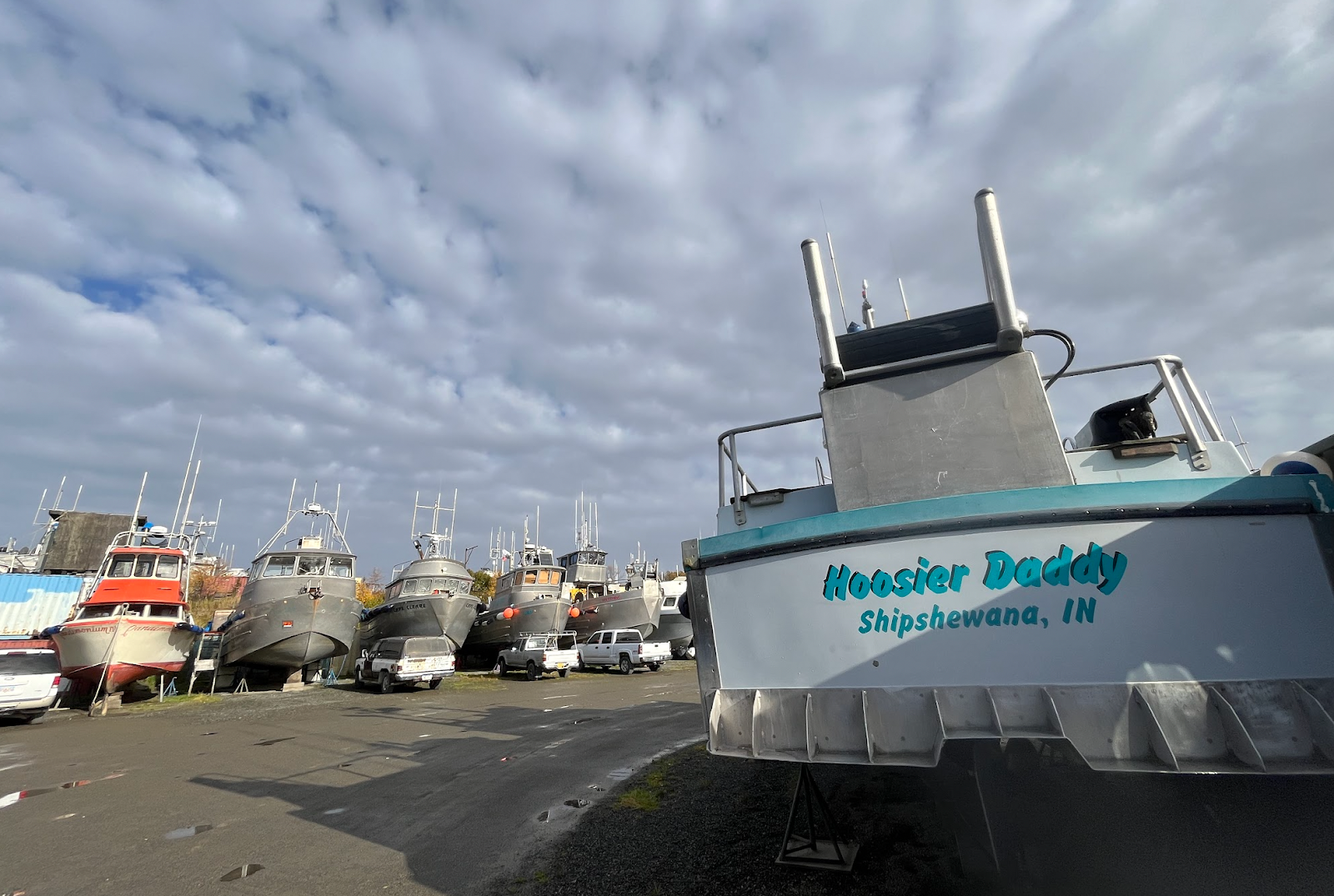
Fishing boats sit in winter storage in the Bristol Bay region, Alaska’s salmon fishing capital, where many skippers are out-of-state residents. (Nathaniel Herz/Northern Journal)
Rural fishermen also moved out of villages and took their permits with them. And those forces conspired to hollow out rural, coastal communities economically — even as Alaska lawmakers have done little to stem the tide.
In Metlakatla, though, tribal members don’t need those expensive permits to pursue a commercial fishing career. While many fishermen in the village have purchased them anyway — allowing harvests both inside and outside the 3,000-foot zone — other Metlakatlans fish only inside that exclusive strip.
Even top fishermen who roam well beyond Annette Island say that the tribal fishery has helped sustain them in lean years — particularly by providing lucrative catches of sea cucumbers and clams, which are harvested in underwater diving gear and fetch high prices in Asia.
“We’ve had terrible seasons seining,” said longtime Metlakatla fisherman Daniel Marsden, 48, referring to the technique of catching salmon with a huge, circular net. “And we go diving, and that saved our butts.”
A lawsuit to expand fishing rights
While commercial fishing remains vibrant in Metlakatla, the community’s fish processing plant is another story.
The business was long an economic mainstay for the village, providing local jobs and revenue for the tribal government.
But beginning in the 1990s, falling seafood prices challenged its profitability, and since 2018, it’s processed only small amounts of fish.
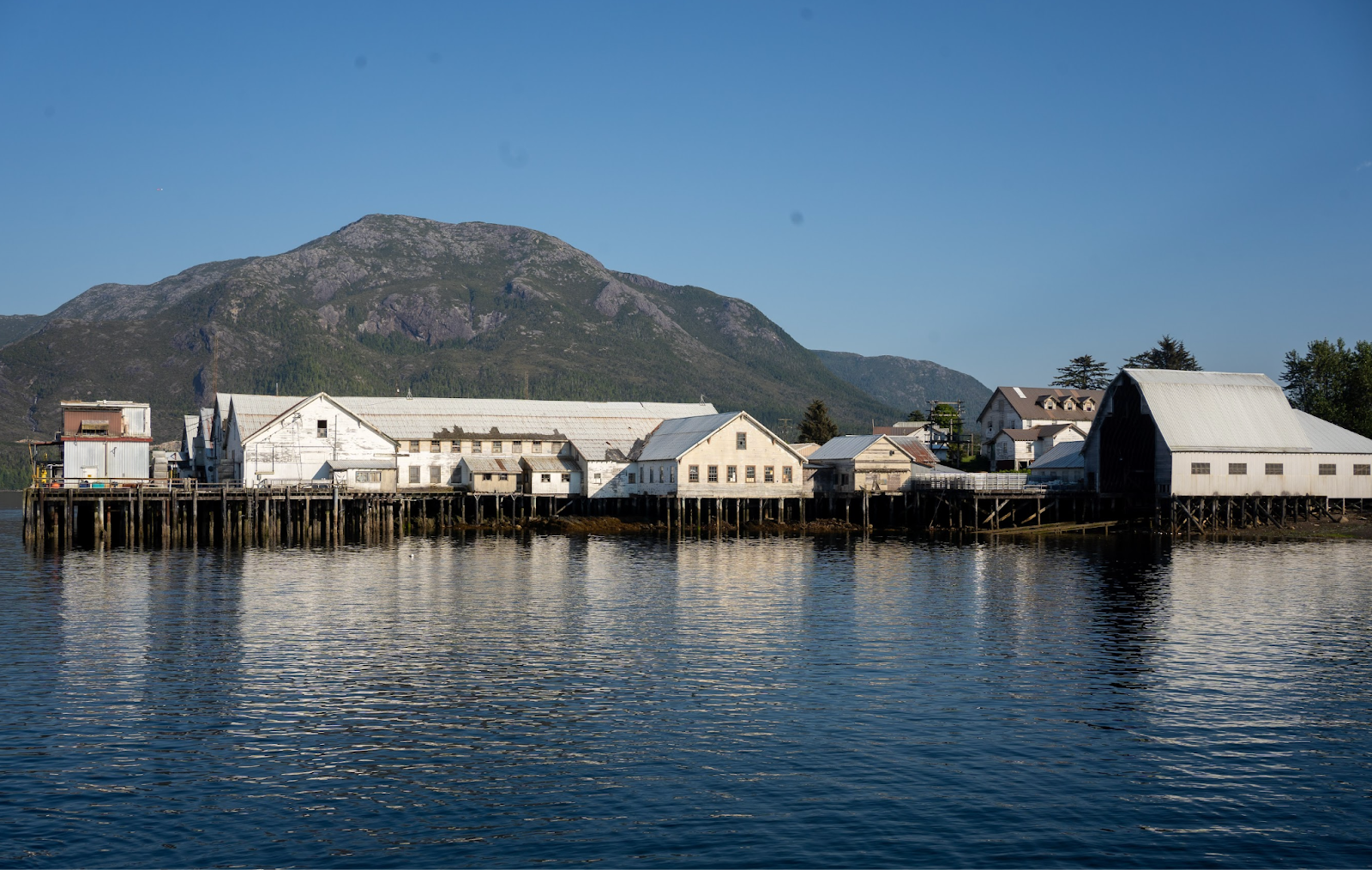
Metlakatla’s fish processing plant sits on the water near the village’s downtown. (Jack Darrell/KRBD)
Today, the cavernous waterfront processing buildings, with peeling white paint, operate at a fraction of their capacity.
Most fishermen who live in Metlakatla and dock their boats in the village harbor sell the salmon they harvest not to the tribally owned plant, but to processing businesses in Ketchikan, 15 miles north. The tribal plant currently lacks the equipment it needs to handle the large volumes of salmon netted by Metlakatla’s fleet, Smith explained.
If more of Metlakatla’s up-and-coming fishermen could harvest farther from the island without having to buy expensive state permits, he added, their catch could be large enough to justify reinvesting in the tribally owned plant.
The 3,000-foot strip around Annette Island, local leaders argue, is no longer the community’s breadbasket. It’s become a “cage” holding back the village’s fleet, according to one longtime fisherman, Edward Gunyah.
To break out of that cage, Metlakatla filed a lawsuit.
Albert Smith, Metlakatla’s mayor, leaves a courtroom in Juneau. (Eric Stone/Alaska Public Media)
Nearly six years ago, the tribe entered a complaint in federal court, asserting that the state of Alaska’s limited entry permit program was illegally barring Metlakatlans from harvesting in areas they were entitled to fish.
The tribe argues that an 1891 federal law granted it the right to enough fish to make the village self-sustaining — which should allow members to harvest anywhere within roughly a day’s travel from the reservation. The suit doesn’t seek to expel other skippers from the disputed waters, only to allow Metlakatla residents to fish there without buying pricey state permits.
“Congress intended to give the community an opportunity to prosper by accessing the fisheries in the waters surrounding the Annette Islands,” the tribe said in its amended complaint.
State and tribal opposition
Metlakatla’s attorneys filed the 2020 lawsuit in federal court on Aug. 7 — a yearly community holiday commemorating the 1887 arrival of the village’s advance party at Annette Island.
Since then, Metlakatla has won preliminary victories as the case has wound through rounds of lower court decisions and appeals.
But it has also faced strong opposition — from the state government, the fishing industry and other tribes.
“We’re going to see this through to the end,” Doug Vincent-Lang, Alaska’s fish and game commissioner, told a group of Ketchikan fishermen in 2024, according to a recording obtained by Northern Journal and APM Reports.
A win by Metlakatla, he said, would invite efforts from other tribes “that don’t have a treaty, or want to expand what they consider their rights to fish outside the state regulatory environment.”
Doug Vincent-Lang is Alaska’s fish and game commissioner. (Alaska Department of Fish and Game)
“We’re not against Metlakatla,” Vincent-Lang said in an interview. “We support their right to fish in their tribal waters. It’s just when you start fishing outside of those waters, there’s treaty implications and everything else that comes into play. How do you account for that? It’s just all kinds of questions that come up.”
Some of the group’s members are concerned about the potential for the lawsuit to expand Metlakatlans’ fishing rights in a way that increases competition, said Tom Meiners, who leads the group’s board.
“We don’t see the need for the island fishery to be expanded,” Meiners said, noting how numerous Metlakatla fishermen already have state permits and wouldn’t directly benefit if the tribe wins.
Salmon seiners operate outside the Southeast Alaska town of Sitka. (Nathaniel Herz/Northern Journal)
Meanwhile, nearly five years into the litigation, a group of other Southeast Alaska tribal governments, the Central Council of the Tlingit and Haida, filed their own motion to dismiss Metlakatla’s case.
The request, ultimately rejected by the judge, said Metlakatla’s Tsimshian residents were descended from Canadians and were infringing on traditional Tlingit and Haida harvest rights and tribal property.
The fight against the lawsuit, particularly by the state and the other tribes, has deeply frustrated Metlakatla’s leaders and allies, who say the village has long contended with hostility to its unique fishing rights. They also say that both written and oral tradition reflect the longtime presence of Tsimshian people on both sides of the U.S.-Canadian border before it was established, with traditional names for Southeast Alaska sites derived from Tsimshian names.
“We should be working together” against factory fishing boats that accidentally harvest salmon, and against out-of-state commercial permit holders, said Boxley, the former Metlakatla tribal council member. He added: “That’s who’s devastating the fishery. Not us.”
‘Control our own future’
After five years of the lawsuit ping-ponging between lower and appeals courts, a decision on the expansion of Metlakatla’s tribal fishing rights could come as soon as this year.
Smith, the mayor, said a victory could help rev the village’s processing plant back to life.
“The vision is to see it going full-fledged again,” he said.
While awaiting a decision, the tribe leased a corner of the plant to a start-up, Circle Seafoods, that is testing a new concept for fish processing. Rather than trying to fillet and pack the whole summer salmon harvest in a single frenetic push of a few weeks, Circle freezes fish whole, then thaws and cuts them in batches throughout the rest of the year.
Metlakatla’s plant currently processes only small quantities of fish. (Jack Darrell/KRBD)
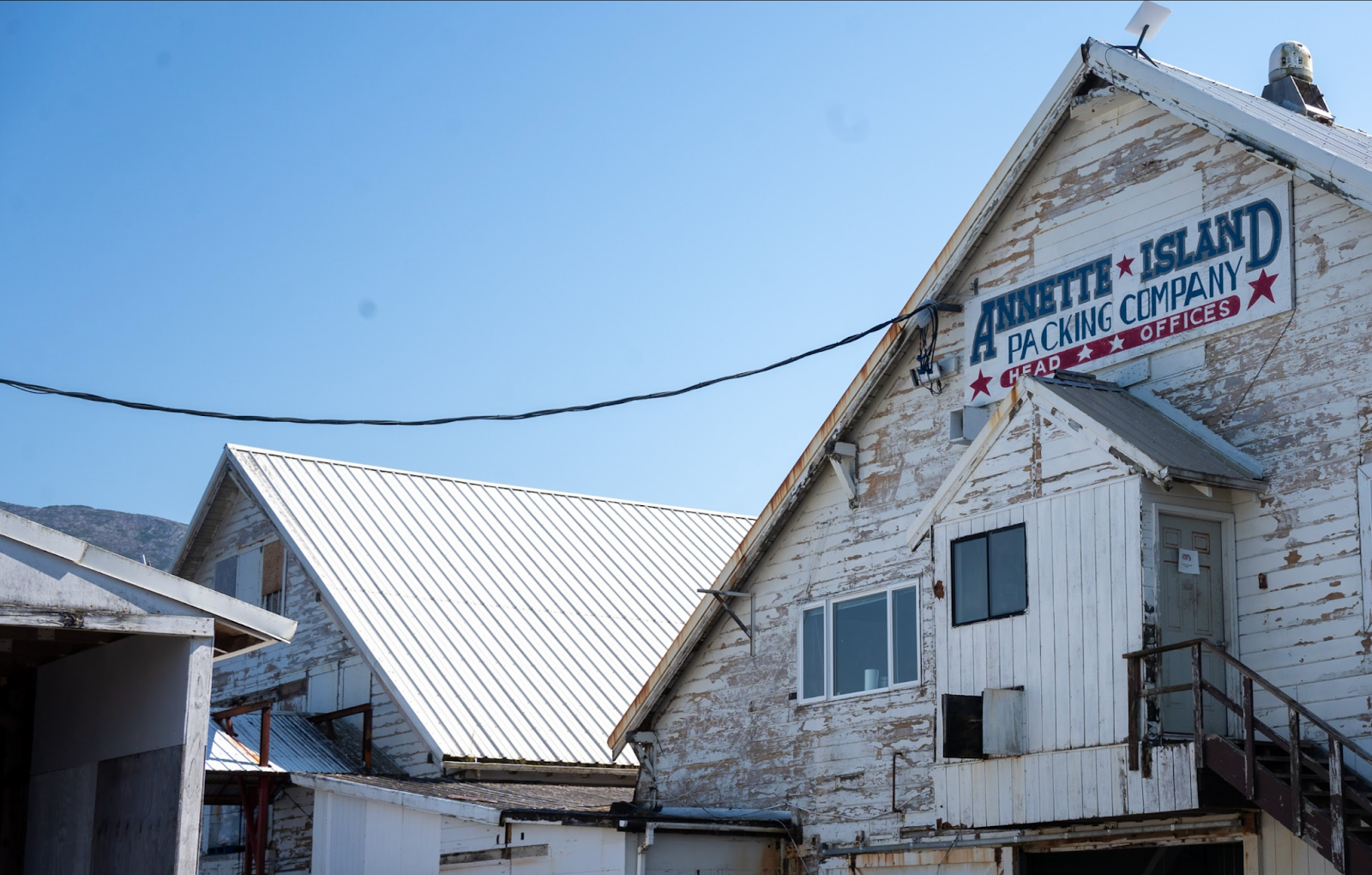
The tribe is interested in replicating the idea because it could sustain a year-round workforce in the village, Smith said. Meanwhile, Annette Island Packing Co., which is owned by the tribe, recently launched a line of freeze-dried salmon pet treats. They’re branded as Ksa Hoon — “just fish” in Sm’algyax, the Tsimshian language.
Operating at full capacity, the plant could churn out profits that the tribe could use to diversify — investing and expanding into other businesses such as ecotourism, Boxley said. He described the lawsuit as aligning with Metlakatlans’ decision a century ago to move from Canada to Alaska, where tribal members would have more autonomy.
“We did all this to be in control of our own future,” Boxley said. “That’s why we came here.”
This story was produced as part of the Pulitzer Center’s StoryReach U.S. Fellowship. It was reported and edited by Northern Journal and APM Reports.
Nathaniel Herz welcomes tips at natherz@gmail.com or (907) 793-0312. This article was originally published in Northern Journal, a newsletter from Herz. Subscribe at this link.
This symbol is inside of the Alaska Department of Corrections office on Sept. 7, 2022, in Douglas, Alaska. (Photo by Lisa Phu/Alaska Beacon)
The Alaska State Legislature is considering the reappointment of a governor’s nominee for the Alaska Board of Parole for another five year term. The decision comes amid questions about the board’s significant decline in grant rates to among the lowest in the nation.
At a Tuesday confirmation hearing, members of the House State Affairs Committee put questions to Steve Meyer, who has served on the board since 2016, before advancing his reappointment confirmation to the full Legislature.
The five-member parole board is appointed by the governor and confirmed by the Legislature, and its members review eligibility for parole and set conditions for release from Alaska prisons.
Meyer worked in the Alaska Department of Corrections beginning in 1991, including as a correctional officer, transportation officer and probation and parole officer until his retirement in 2014, according to his application to the board. In 2016, he was appointed to the parole board seat representing Southcentral Alaska including Anchorage and the Kenai Peninsula. Since serving on the board, he has participated in thousands of discretionary parole and final parole revocation hearings, he said in an updated resume.
The parole board has been the focus of concern from some lawmakers, advocates and members of the public in recent years as its parole approval rates have declined significantly.
Last year, the board denied 45% of applicants. In 2024, it denied 59% of applicants, and 58% the year before. In an analysis by the Prison Policy Initiative, a non-profit research group, found that from 2019 to 2022, Alaska reduced the number of people released through discretionary parole by 79% — the largest percent change nationwide.
Rep. Andi Story, D-Juneau, asked Meyer why the board is granting fewer people parole. “I’m just trying to get a feel for what is typical,” she said. “And the reasons for why the granting of parole has gone down.”
Members of the House State Affairs Committee consider the governor’s appointees for the Alaska Police Standards Council and the Board of Parole on Apr. 7, 2026. (Photo by Corinne Smith/Alaska Beacon)
“There’s certainly some validity in that, that perception,” Meyers said by phone. Higher numbers of people were granted parole before the repeal of Senate Bill 91 enacted in 2020, he said, when lawmakers increased prison sentences for most felonies and misdemeanors, and increased penalties for violating conditions of release.
“So there were less grants,” Meyer said. “But then there was quite a period of time during COVID, when a lot of the folks we were seeing hadn’t been able to do the programming that we usually look at for discretionary parole. And so that was part of the numbers of grants declining.”
Meyer said more recently, he sees grant rates increasing. “I think with discretionary (parole), there’s a bit of an ebb and flow to it. It’s largely dependent on a candidate, and what we see when we interview them for discretionary parole. So it’s very individualized,” he said.
Last year, of those granted parole, 11% were under discretionary parole, and 87% were under mandatory parole, meaning they had served their sentence.
Meyer explained the board receives a packet of information on each candidate with information like their criminal history, institutional history while incarcerated, and programs they’ve attended while incarcerated. Then they interview the candidate at their parole hearing.
“The packets, there’s a lot of information, but it’s kind of like a map,” he said. “You look at it, but you don’t really know what the terrain is until you actually physically get to see it. And it’s kind of that way with when we interview people, we get a chance to get to get a feel for the person, get to know them a little bit, and which makes it a pretty important part of the process.”
He said that after the parole hearing, board deliberations are done in private and decisions are made by a majority vote.
Story asked if state correctional facilities had restored rehabilitative programming since the COVID-19 pandemic, to help people become more eligible for parole.
Meyer said they have been somewhat restored, but the Alaska Department of Corrections does not have the resources to offer programs to everyone that needs them. “So not everybody’s able to access the things that that would be nice for them to access,” he said.
He said the programs in high demand are substance abuse treatment and sex offender treatment. “Which has always been a little bit lacking. It’s a very lengthy, lengthy, complex process, the sex offender treatment,” he said. “But that too, we’ve seen an increase in that.”
Rep. Rebecca Himschoot, I-Sitka, asked Meyer about low rates of parole for those who are old or terminally ill, who may pose very little risk to the public and be eligible for geriatric or medical parole.
The Board of Parole has not granted anyone geriatric or medical parole in the last five years, according to state data.
Meyer acknowledged the concerns at the rising costs of care for the aging prison population as “a huge issue.”
He said the board follows criteria in state statute. “It’s not my position to say what should be done,” he said. “We tend to not make too many demands of the system, if you will. But I think there’s certainly room for maybe some modification to those requirements that would allow more relief to those folks, because it certainly is an issue.”
Some legislators and advocates have expressed concern that DOC is keeping people incarcerated who may be eligible for parole — also who may have expensive medical needs — contributing to an all-time high corrections budget proposed this year at $523 million.
Himschoot asked Meyer what motivates him to serve on the board of parole.
Meyer said he spent most of his life working in corrections, and felt success as a parole and probation officer. “There’s a lot of reward to it. And you know, the best days are when you are able to grant everybody parole, or whenever you’re able to release everybody. And those are what makes doing the job worth it, I guess,” he said.
“And down the road, you know, having done this for a while now, seeing people that we put out to discretionary parole or other other things, being able to see them in community, being a part of the community, there’s a reward,” he said. “It’s just something that I’ve always felt like I had a good purpose.”
Fishing boats line the harbor in Metlakatla, a Tsimshian village south of Ketchikan in Southeast Alaska. (Jack Darrell/KRBD)
This story was produced as part of the Pulitzer Center’s StoryReach U.S. Fellowship. It’s the third in a series about access to commercial fisheries in rural Alaska; read Part Oneand Part Two.
METLAKATLA, ALASKA — Across Alaska’s coastline, from the Indigenous communities of Bristol Bay to the Tlingit and Haida villages of the panhandle, rural harbors that once bustled with commercial fishing boats now sit unused and empty.
Abandoned boats covered with mold and algae line the shores of one Southeast town; others have seen their fleets sold off and relocated.
In the Indigenous village of Metlakatla, though, it’s a different story.
Fishing vessels pack the downtown harbor on Annette Island, which sits just off the coast at Alaska’s southernmost tip. Huge seiners, with onboard cranes to reel in fish-laden nets, loom over the docks, with many more slips filled in by smaller gillnetters. Fathers and grandfathers still fish with sons and grandsons.
Experts and industry players disagree about the exact reasons for the decline of commercial fishing in the rest of rural, coastal Alaska — with some blaming state policies and others pointing to global market trends.
In Metlakatla, local leaders say their success in sustaining their fishing culture stems from the community’s unusual history.
In the 1970s, the village stayed out of a land claims settlement between Alaska Natives and the federal government — a deal that could have brought cash in exchange for ceding Metlakatla’s reservation and residents’ collective right to pull fish from the waters off their shores. All the other Native reservations in the state were terminated.
Seine boats such as these in Metlakatla’s harbor use an onboard crane to help pull fish-laden nets on board. (Nathaniel Herz/Northern Journal)
As a result, Metlakatla is the only Native community in Alaska that manages its own commercial fishing harvest. The right to earn a living from the ocean waters surrounding the island is tied to tribal membership and can’t be sold off to outsiders — as happened in other rural and Native communities across the state.
Elsewhere, Native residents of coastal villages and cities might have to pony up $100,000 or more for a permit to access state-managed commercial fisheries just offshore. Meanwhile, any Metlakatla tribal member with a boat and $25 can buy a permit and cast their net in the Indigenous-managed fishery that extends 3,000 feet around Annette Island.
“It’s 100% of the reason why we’re not down to one boat,” said Albert Smith, Metlakatla’s mayor.
A seiner tows a small skiff along the ocean just outside Metlakatla in 2024. (Jack Darrell/KRBD)
The island fishery sustains the largest tribally managed salmon harvest in the United States. The 1,600-person community has dozens of active commercial fishing vessels, which harvested more than 1.3 million salmon in 2024, according to the most recent tribal data available.
The community stands today as a kind of experiment. Its fishery represents an alternate reality that could have unfolded in rural Alaska if more communities had the same opportunities to access nearby waters — or had state policymakers not chosen to privatize commercial harvest rights in the rest of Alaska’s big salmon fisheries, as they did in the 1970s.
Metlakatla’s narrative is a “direct refutation” of the argument that coastal Alaska Native villages are to blame for the loss of their fishing industries, said Jonathan Kreiss-Tomkins, who once represented Metlakatla in the state House and several years ago pushed an unsuccessful bill to boost access to rural commercial fishing careers.
In Metlakatla, “every slip in the harbor is full — high schoolers are deckhanding for their uncle, their dad, their best friend’s dad,” Kreiss-Tomkins said. “I think it’s a fascinating case study.”
Local leaders say they’ve still had to fight to sustain Metlakatla’s fleet and its tribal fishery.
The community is now in the midst of a six-year legal effort to expand the waters available to tribal members, which leaders say could help solidify the future of Metlakatla’s fishing industry. But its federal lawsuit faces opposition from Alaska Gov. Mike Dunleavy’s administration, competing fishermen and even neighboring Indigenous people.
Metlakatla’s main harbor is near the center of the village, next to a small casino and an artist workshop. (Jack Darrell/KRBD)
‘We’re the salmon people’
The Metlakatlans left northern British Columbia in the late-19th century amid conflicts over land ownership.
Residents secured an invitation to America from President Grover Cleveland and members of Congress at the behest of William Duncan, a charismatic Anglican minister. Duncan had worked with the region’s Indigenous Tsimshian people to establish the original Metlakatla in British Columbia, which he envisioned as a model Christian community.
After a mass migration in canoes and other vessels, the new Metlakatla was built 70 miles away on Annette Island, just across the international border in Alaska, where residents eventually built an enormous church.
A canoe passes by a fishing industry vessel just offshore of Metlakatla in 2024. (Jack Darrell/KRBD)
A cannery served as a market for residents’ ancestral fishing tradition, which the tribe has described as a “bedrock of the Coast Tsimshian culture and way of life.” A presidential proclamation from Woodrow Wilson in 1916 subsequently set aside the 3,000-foot strip around the island exclusively for use by the village’s fishermen.
For decades afterward, Metlakatla’s commercial fleet harvested both inside and outside the exclusive zone.
Skippers of today, who are mostly men, learned to fish from their fathers, who learned from their fathers and grandfathers before them.
Fishing is “one of the few things that remain unbroken from our forever history,” said David R. Boxley, a Metlakatla artist who served on the village’s tribal council until recently.
Artist and former tribal council member David R. Boxley details a traditional bentwood box in his workshop in Metlakatla. (Nathaniel Herz/Northern Journal)
“That’s our culture, even though it’s changed in how we do it,” he said. “It’s as old as our people. We’re the salmon people.”
Tribal fishery ‘saved our butts’
In 1971, Congress passed the Alaska Native Claims Settlement Act, which came with a painful tradeoff.
Newly formed, Indigenous-owned corporations would receive a total of $1 billion and some 45 million acres — roughly 10% of the state. In exchange for that money and property, Alaska’s Indigenous people would give up claims to larger swaths of traditional lands, and those that had reservations would surrender them.
Metlakatla had one of only 23 reservations in Alaska and exclusive fishing rights to boot, so it had more to lose. It may have also had less to gain, because the community’s emigration from Canada made its Alaska land claims less certain.
Some in Metlakatla wanted to pursue the payout anyway, according to Boxley.
But elders whose parents and grandparents had been through the exodus from the original village site in British Columbia saw their sovereignty as priceless, he explained.
“We’d already lost a Metlakatla,” Boxley said. “We had to build two communities — one was basically taken from us. Why would we do that again?”
The other 22 reservations in Alaska were dissolved as a result of the settlement. Today, only Metlakatla’s remains.
A few years after the other tribes settled, in an effort to prevent overfishing and make the industry more profitable, the state of Alaska established its “limited entry” program. The system capped the number of skippers in each commercial fishery and transformed fishing from a public right to a private privilege, one available only to those who could afford or inherit a permit. And since the supply of permits was limited, they became valuable commodities.
Commercial fishing permits can now be bought and sold on the open market, in some cases fetching six-figure prices. And over the years, residents of many rural and Indigenous communities have sold their permits to people from Alaska’s larger cities and towns, and from other states.
Fishing boats sit in winter storage in the Bristol Bay region, Alaska’s salmon fishing capital, where many skippers are out-of-state residents. (Nathaniel Herz/Northern Journal)
Rural fishermen also moved out of villages and took their permits with them. And those forces conspired to hollow out rural, coastal communities economically — even as Alaska lawmakers have done little to stem the tide.
In Metlakatla, though, tribal members don’t need those expensive permits to pursue a commercial fishing career. While many fishermen in the village have purchased them anyway — allowing harvests both inside and outside the 3,000-foot zone — other Metlakatlans fish only inside that exclusive strip.
Even top fishermen who roam well beyond Annette Island say that the tribal fishery has helped sustain them in lean years — particularly by providing lucrative catches of sea cucumbers and clams, which are harvested in underwater diving gear and fetch high prices in Asia.
“We’ve had terrible seasons seining,” said longtime Metlakatla fisherman Daniel Marsden, 48, referring to the technique of catching salmon with a huge, circular net. “And we go diving, and that saved our butts.”
A lawsuit to expand fishing rights
While commercial fishing remains vibrant in Metlakatla, the community’s fish processing plant is another story.
The business was long an economic mainstay for the village, providing local jobs and revenue for the tribal government.
But beginning in the 1990s, falling seafood prices challenged its profitability, and since 2018, it’s processed only small amounts of fish.
Metlakatla’s fish processing plant sits on the water near the village’s downtown. (Jack Darrell/KRBD)
Today, the cavernous waterfront processing buildings, with peeling white paint, operate at a fraction of their capacity.
Most fishermen who live in Metlakatla and dock their boats in the village harbor sell the salmon they harvest not to the tribally owned plant, but to processing businesses in Ketchikan, 15 miles north. The tribal plant currently lacks the equipment it needs to handle the large volumes of salmon netted by Metlakatla’s fleet, Smith explained.
If more of Metlakatla’s up-and-coming fishermen could harvest farther from the island without having to buy expensive state permits, he added, their catch could be large enough to justify reinvesting in the tribally owned plant.
The 3,000-foot strip around Annette Island, local leaders argue, is no longer the community’s breadbasket. It’s become a “cage” holding back the village’s fleet, according to one longtime fisherman, Edward Gunyah.
To break out of that cage, Metlakatla filed a lawsuit.
Albert Smith, Metlakatla’s mayor, leaves a courtroom in Juneau. (Eric Stone/Alaska Public Media)
Nearly six years ago, the tribe entered a complaint in federal court, asserting that the state of Alaska’s limited entry permit program was illegally barring Metlakatlans from harvesting in areas they were entitled to fish.
The tribe argues that an 1891 federal law granted it the right to enough fish to make the village self-sustaining — which should allow members to harvest anywhere within roughly a day’s travel from the reservation. The suit doesn’t seek to expel other skippers from the disputed waters, only to allow Metlakatla residents to fish there without buying pricey state permits.
“Congress intended to give the community an opportunity to prosper by accessing the fisheries in the waters surrounding the Annette Islands,” the tribe said in its amended complaint.
State and tribal opposition
Metlakatla’s attorneys filed the 2020 lawsuit in federal court on Aug. 7 — a yearly community holiday commemorating the 1887 arrival of the village’s advance party at Annette Island.
Since then, Metlakatla has won preliminary victories as the case has wound through rounds of lower court decisions and appeals.
But it has also faced strong opposition — from the state government, the fishing industry and other tribes.
“We’re going to see this through to the end,” Doug Vincent-Lang, Alaska’s fish and game commissioner, told a group of Ketchikan fishermen in 2024, according to a recording obtained by Northern Journal and APM Reports.
A win by Metlakatla, he said, would invite efforts from other tribes “that don’t have a treaty, or want to expand what they consider their rights to fish outside the state regulatory environment.”
Doug Vincent-Lang is Alaska’s fish and game commissioner. (Alaska Department of Fish and Game)
“We’re not against Metlakatla,” Vincent-Lang said in an interview. “We support their right to fish in their tribal waters. It’s just when you start fishing outside of those waters, there’s treaty implications and everything else that comes into play. How do you account for that? It’s just all kinds of questions that come up.”
Some of the group’s members are concerned about the potential for the lawsuit to expand Metlakatlans’ fishing rights in a way that increases competition, said Tom Meiners, who leads the group’s board.
“We don’t see the need for the island fishery to be expanded,” Meiners said, noting how numerous Metlakatla fishermen already have state permits and wouldn’t directly benefit if the tribe wins.
Salmon seiners operate outside the Southeast Alaska town of Sitka. (Nathaniel Herz/Northern Journal)
Meanwhile, nearly five years into the litigation, a group of other Southeast Alaska tribal governments, the Central Council of the Tlingit and Haida, filed their own motion to dismiss Metlakatla’s case.
The request, ultimately rejected by the judge, said Metlakatla’s Tsimshian residents were descended from Canadians and were infringing on traditional Tlingit and Haida harvest rights and tribal property.
The fight against the lawsuit, particularly by the state and the other tribes, has deeply frustrated Metlakatla’s leaders and allies, who say the village has long contended with hostility to its unique fishing rights. They also say that both written and oral tradition reflect the longtime presence of Tsimshian people on both sides of the U.S.-Canadian border before it was established, with traditional names for Southeast Alaska sites derived from Tsimshian names.
“We should be working together” against factory fishing boats that accidentally harvest salmon, and against out-of-state commercial permit holders, said Boxley, the former Metlakatla tribal council member. He added: “That’s who’s devastating the fishery. Not us.”
‘Control our own future’
After five years of the lawsuit ping-ponging between lower and appeals courts, a decision on the expansion of Metlakatla’s tribal fishing rights could come as soon as this year.
Smith, the mayor, said a victory could help rev the village’s processing plant back to life.
“The vision is to see it going full-fledged again,” he said.
While awaiting a decision, the tribe leased a corner of the plant to a start-up, Circle Seafoods, that is testing a new concept for fish processing. Rather than trying to fillet and pack the whole summer salmon harvest in a single frenetic push of a few weeks, Circle freezes fish whole, then thaws and cuts them in batches throughout the rest of the year.
Metlakatla’s plant currently processes only small quantities of fish. (Jack Darrell/KRBD)
The tribe is interested in replicating the idea because it could sustain a year-round workforce in the village, Smith said. Meanwhile, Annette Island Packing Co., which is owned by the tribe, recently launched a line of freeze-dried salmon pet treats. They’re branded as Ksa Hoon — “just fish” in Sm’algyax, the Tsimshian language.
Operating at full capacity, the plant could churn out profits that the tribe could use to diversify — investing and expanding into other businesses such as ecotourism, Boxley said. He described the lawsuit as aligning with Metlakatlans’ decision a century ago to move from Canada to Alaska, where tribal members would have more autonomy.
“We did all this to be in control of our own future,” Boxley said. “That’s why we came here.”
This story was produced as part of the Pulitzer Center’s StoryReach U.S. Fellowship. It was reported and edited by Northern Journal and APM Reports.
Nathaniel Herz welcomes tips at natherz@gmail.com or (907) 793-0312. This article was originally published in Northern Journal, a newsletter from Herz. Subscribe at this link.
NOTN- An Alaska Senate committee on Wednesday advanced a resolution backing federal visa programs that lawmakers say are critical to the state’s seasonal workforce and public schools.
Senate Joint Resolution 28, heard in the Senate Labor and Commerce Committee, puts the Alaska Legislature on record in support of the J-1 and H-1B visa programs and urges the state’s congressional delegation to work with federal policymakers to preserve and strengthen them.
A similar resolution was heard in the Senate Education committee Wednesday as well, in support of H-1B international educators.
“Senate Joint Resolution 28 very simply, recognizes the important role that visa programs such as the J1 visa program, and the H-1B program, play to the economy and the education of children and young adults across Alaska.” Said legislative aide Mike Mason, “These international visa workers are vital to filling Alaska’s diverse workforce needs. If you travel around Alaska, especially this summer, you are going to see these visa workers filling very important jobs across the state. This resolution simply puts the Alaska legislature on record as supporting these visa programs.”
The measure also objects to a steep federal fee increase on certain H-1B petitions, from $5,000 to $100,000, which supporters say has effectively shut Alaska’s public schools out of the program.
“That fee effectively ended most employers ability to fill these open jobs through this program.” Mason said.
Lawmakers adopted an amendment, to explicitly include H-2B visas, which cover temporary nonagricultural workers.
Public testimony on the resolution was brief but supportive.
Jonathan Schaffer said his experience working with J-1 participants in seasonal jobs across the country showed clear benefits for both employers and workers.
“Having worked in seasonal employment across the United States with a number of J-1 enrollees, I can say that the program, in my opinion, benefits both employers and those enrolled in it. It is remarkable the opportunities that are provided for people in small communities to learn about the world around them from the people who travel there to serve visitors, who travel from all over the place. It is remarkable the benefit that those who enroll in the J-1 program have in gaining a more positive view of the United States, which they take back to their communities around the world.”
The committee voted without objection to move the resolution.
It now heads to further consideration in the Legislature.
The U.S. Supreme Court on Oct. 9, 2024. (Photo by Jane Norman/States Newsroom)
An Anchorage man is set to plead guilty for making violent threats against U.S. Supreme Court justices and their families.
Panos Anastasiou, 77, was charged with 22 crimes in the U.S. District Court of Alaska in 2024. He was accused of sending 465 messages to the Supreme Court starting in March of 2023.
Federal prosecutors said the messages contained threats to kill six justices, alongside racist and homophobic rhetoric.
Then-U.S. Attorney General Merrick Garland alleged that Anastasiou “made repeated, heinous threats to murder and torture Supreme Court Justices and their families to retaliate against them for decisions he disagreed with.”
According to court documents filed this week, Anastasiou is set to change his plea from not guilty to guilty in accordance with a plea agreement. The filing does not describe which charges he is set to plead guilty to.
Anastasiou’s federal public defender and the U.S. Attorney for the District of Alaska did not immediately respond to a request for a copy of his written guilty plea agreement.
Federal court filings did not identify the justices Anastasiou allegedly threatened.
State records show Anastasiou is a registered nonpartisan voter. Since 2016, he donated around $800 to ActBlue, a fundraising service that benefits Democratic Party candidates, according to federal campaign records.
A charge of making threats against a federal judge carries a maximum sentence of 10 years in prison.
(Lizzy Hahn/ Chilkat Valley News) Students rush to grab eggs during the Easter egg hunt in the Haines High School on April 5, 2026.
With baskets in hand, Haines youth filled the high school Sunday afternoon on the hunt for Easter eggs.
More than 160 children spread out throughout the school, filling their baskets and bags.
Organizer Krystal Lloyd said 14,000 eggs were in the building, a large number compared with the previous year’s 11,000 eggs and the 2024 count of 8,000 eggs. Most eggs had candy; however, 153 had prize slips within. The Salvation Army donated additional prizes “to make sure that we didn’t run out,” Lloyd said.
(Lizzy Hahn/ Chilkat Valley News) Lillee Grant hugs the dinosaur stuffy she got after finding a prize slip within an Easter egg in the Haines High School on April 5, 2026.
Lillee Grant, 9, collected more than 50 eggs and found a coveted prize slip. She used it to pick out a large, green Tyrannosaurus Rex.
“I’m getting this (dinosaur stuffy) ’cause it’s giant,” Grant said.
To keep from getting trampled in all of the excitement, the younger kids, like 2-year-old Olen Leazier and 21-month-old Stella Swinton, had a dedicated section in a different part of the school, where children could leisurely pick up eggs and fill bags their size.
(Lizzy Hahn/ Chilkat Valley News) Stella Swinton, 21 months old, holds an Easter egg during the egg hunt in the Haines High School on April 5, 2026.
Lloyd said 19 adults and two children helped her fill the plastic eggs with candy. In order to fill 14,000 eggs, Lloyd estimated about 60 people made donations. It took about 10 hours to fill 14,000 eggs with “a lot of donated stuffers.”
The eggs are reused each year with 100 to 200 broken ones. Lloyd has been organizing the local Easter egg hunt for the past five years. The first hunt had about 30 kids and has since grown exponentially.
“Unless we get a nice donation, like we did this year, for next year, it’ll be really hard to meet the 14,000,” Lloyd said.
This year, she said Jody Miller purchased the entire Amazon cart of goods for the event, becoming one of the biggest donors along with Howsers IGA, Oleruds and the Salvation Army.
Krystal Lloyd helped to organize the Haines community Easter egg hunt and hot dog social this year. She gathered volunteers to fill the plastic eggs for the 14,00-egg event at the school on Easter. On Friday and Saturday Ron Weibel, Sue Waterhouse, Joshua Lloyd, Serena Woods, Judy Weibel, Neil Einsbruch, Joan Degen, Megan Highfield-Stewart, Savannah Tinnes, Phyllis Sage, Gary “Bubba” Hinkle, Sophia Armstrong, Chloe Lloyd, Allie Lloyd, Christina Lloyd, Lynndsey Stearns, Kristy Hinkle, Lucille Lloyd and Gloria Kosinski all helped fill the eggs. According to Einsbruch and Waterhouse, the best items stuffed into plastic eggs included the rubber-band punching balloon and slapper wrist bands. The Twix candy bars and stickers were also noteworthy.
Three members of Haines Drama, Debate and Forensics team served salmon and halibut at the Mosquito Lake School on Wednesday. Chisel Triezenberg,Walther Jim, and Zorza Szatkowski helped with the meal and clean-up after an Interface for Change meetup. The fish were donated by Erika Merklin who helped coordinate locally for a 5-year Alaska EPSCoR project partnering with coastal communities on research. Alaska EPSCoR representatives held a community participation workshop where they shared research information about lake sediment using field data, analyses of red seaweed in the Lynn Canal, complete with an interactive memory game, and made VR equipment available for a closer look at what underwater farming looks like. And it came with a delicious dinner. Community members contributed side dishes including local foragers Mike Ogborn and Ron Maudlin who shared pickled fiddlehead salad with herring eggs, onion and garlic. The potato casserole, contributed by Tammy Hauser, was a popular side item also, reminiscent of the Cracker Barrel version of the dish. The lucky winners of swag bags that included an Olerud’s gift card were Mardell Gunn and Charles Peep. The Interface of Change team went on to host the same presentation in Haines at the Alaska Native Brotherhood and Sisterhood Hall on Thursday where CVN editor Rashah McChesney won a beanie for building the tallest tower out of tinker toys. She may, or may not, have been the only participant. At both locations, a photography project about wild foods, climate and community done by local middle and high school students was also on display.
Amy Kane is moving to Wrangell. Kane has lived in Haines for six years and is relocating for her job with the Alaska Marine Highway System. She is going to get health insurance! Some people know her as the face of The Book Store, before the new owners took over last year. Others know her as a quality source of focaccia bread at pop-ups and potlucks all over the Chilkat Valley. Kane relocated to Haines from Sitka, where she owned and ran the Larkspur Cafe. Kane’s focaccia bread was an important part of the restaurant even though she said she is not a bread maker. She turned out large trays of the bread for paninis and settled on the recipe after some trial and error. Kane calls it a forgiving bread and highlights the importance of a working class bread that can be whipped up quickly, while still allowing the baker to add and take away ingredients based on what is available. Before she moves on to a new chapter in Wrangell, Kane passed along her focaccia bread recipe to Brynn Murphy, who agreed to learn the recipe in a one-on-one baking afternoon. They started with separating the fresh rosemary and thyme, and spent a Friday afternoon practicing the technique for making a really great focaccia. Murphy took detailed notes while they went through the process. She left with her practice bread and a whole new skill set. Murphy intends to share the bread with Haines for years to come
Paul Swift moved to Haines in 1970 and has been thinking about snow and weather ever since. From 2012 to 2018 he was a local volunteer observer for the National Weather Service. In 2018 retired meteorologist Jim Green took over this responsibility. Some of those tasks include logging stats, recording minimum and maximum daily temperatures, snowfall and converting snowfall into liquid measurements. Swift’s wife Anne Boyce shared a picture of him on a porch from the winter of 2011-2012, showing the stark reality of springtime melt in the Chilkat Valley. That year, she said, nearly 360 inches of snow was recorded in Haines. Current NOAA observer Green said Haines has been a very reliable source of weather data for 100 years because of the volunteers in the Chilkat Valley. Both Swift and Green have found it challenging to take vacations, as not many house sitters are willing and able to measure the weather while they are gone. Fun fact, if the observer misses three days of data in a month the information can not be used historically.
Ketch Jacobson took some Haines locals out to test the new engine in the Fjordland Express and look for some wildlife along the way. What they found in Skagway was a pirate named Trevor Clark and a bundle of red rope. Clark needed some help moving his 750-pound engine across the boat yard. Trygve Bakke, Charlotte Martin, Lizzy Hahn, Baylee Pearson, Justin Letson, and Brooke Robinson were up to the task. The group made a plan to move the engine with the rope slung under it and over their shoulders while they shuffle stepped across the boat yard in their XtraTuffs. In the end, Clark got his engine moved and Jacobson tested his new engine. They spotted a few ducks, and everyone enjoyed Easter dinner in Skagway.
The team visiting Haines from Alaska EPSCoR, led by Davin Holen, hosted a mini Alaska science Olympiad at Klukwan School. Shk’oohaaleeJustina Hotch kept the children on schedule as they handed out medals to the winners for STEM-based team activities and practiced tower building with tinker toys. First-place tallest tinker-toy tower builders were Kyle Willard Wilson and Sampson Duffy-Webb. Their tower came in at 57.5 inches. Duffy-Webb has previous building experience, with a pirate fort at home. This might have contributed to the team’s win.
If you happened to be sitting in Rusty Compass on Tuesday morning, you might have noticed a group of 10 people quickly file in from the entrance at the rear of the building. They corralled chairs, ordered coffee and snacks and seemed to be having a grand old time when Kristy Hinkle walked in the front door and gasped. Shouts of “Happy Birthday” filled the space, and then someone started to sing the song – which most in the packed cafe joined in to sing. At some point, someone handed Hinkle a helium balloon which she held as she took turns hugging her well-wishers. She turned 41 on Tuesday, and was tricked into heading to the coffee shop by her sister Krystal Lloyd, who also corralled everyone into the surprise greeting. Recently, Derek Poinsette was snowmachining on Chilkat Lake when he encountered a moose who was maybe curious, maybe mad, maybe feeling territorial – it’s unclear. Regardless, as he passed it, the moose began following him and continued to do so for about a half mile or so, he estimated. Poinsette stopped to get video of it as it followed him across the lake. He kept having to take off to put distance between the two of them, and eventually it lost interest and moved along. Fish and Game wildlife biologist Hannah Manninen and wildlife education and outreach coordinator Abby McAllister viewed the video with some interest outside of the Haines library after a presentation they gave on Tuesday evening. The three speculated about why the moose followed Poinsette for so long. Manninen also noted that it appeared to be a female, and both McAllister and Manninen said she looked pregnant.