A 3.3-magnitude earthquake has struck Lancashire – with dozens of people saying it shook their homes or woke them up.The Latest News from the UK and Around the World | Sky News
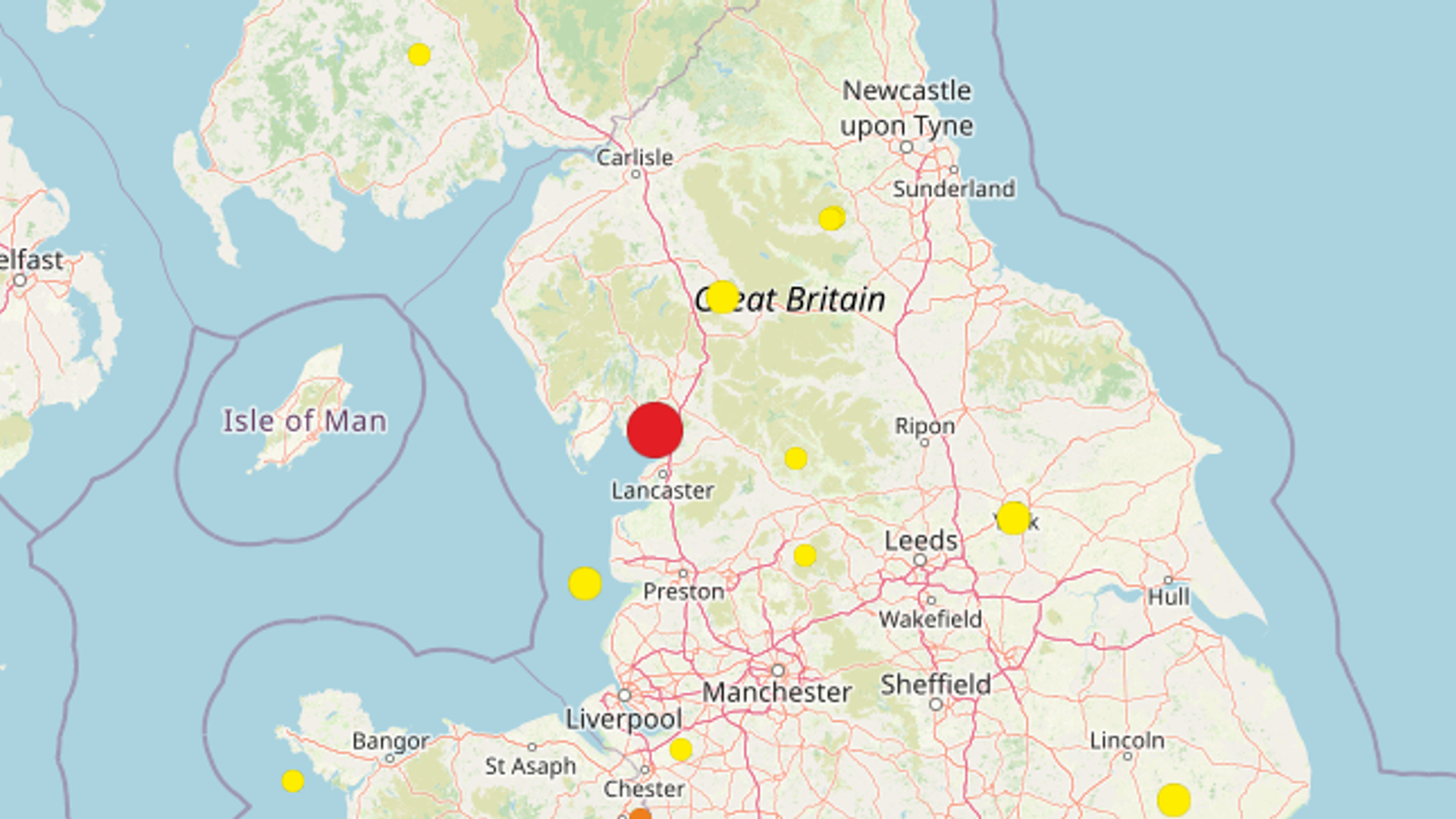









A 3.3-magnitude earthquake has struck Lancashire – with dozens of people saying it shook their homes or woke them up.The Latest News from the UK and Around the World | Sky News

As an opening gambit at PMQs, Kemi Badenoch attacked Labour’s knight, the prime minister, over his Treasury queen, Rachel Reeves.The Latest News from the UK and Around the World | Sky News

Images and video of Jeffrey Epstein’s private Caribbean island have been released by politicians in the US.The Latest News from the UK and Around the World | Sky News

Hundreds of UK online safety workers at TikTok have already signed agreements to leave the company, whistleblowers have told Sky News, despite the firm stressing to MPs that the cuts were “still proposals only”.The Latest News from the UK and Around the World | Sky News

The energy regulator has confirmed plans for a massive upgrade to the UK’s energy grids, adding £108 to customer bills by 2031.The Latest News from the UK and Around the World | Sky News

AP- Air travelers in the U.S. without a REAL ID will be charged a $45 fee beginning in February, the Transportation Security Administration announced Monday.
The updated ID has been required since May, but passengers without it have so far been allowed to clear security with additional screening and a warning. The Department of Homeland Security says 94% of passengers are already compliant and that the new fee is intended to encourage travelers to obtain the ID.
REAL ID is a federally compliant state-issued license or identification card that meets enhanced requirements mandated in the aftermath of the Sept. 11, 2001, terrorist attacks.
Obtaining the ID — indicated by a white star in a yellow circle in most states — means taking more documents to the motor vehicle agency than most states require for regular IDs. It was supposed to be rolled out in 2008 but the implementation had been repeatedly delayed.
Beginning Feb. 1, travelers 18 and older flying domestically without a REAL ID and who don’t have another accepted form of ID on them, such as a passport, will pay the non-refundable fee to verify their identity through TSA’s alternative “Confirm.ID” system.
TSA officials said that paying the fee does not guarantee verification, and travelers whose identities cannot be verified may be turned away. If approved, however, the verification covers a 10-day travel period.
The fee can be paid online before arriving at the airport. Travelers can also pay online at the airport before entering the security line, but officials said the process may take up to 30 minutes.
The TSA initially proposed an $18 charge for passengers without a REAL ID, but officials said Monday they raised it after realizing the alternative identification program would cost more than anticipated.
Other acceptable forms of ID include military IDs, permanent resident cards and photo IDs from federally recognized tribal nations. TSA also accepts digital IDs through platforms such as Apple Wallet, Google Wallet and Samsung Wallet at more than 250 airports in the U.S.

NOTN- As December arrives, Juneau’s Parks and Recreation Department has a busy schedule.
Newly appointed Parks and Recreation Director Marc Wheeler said he is excited to lead the department.
“I’ve always had a passion for Parks and Recreation. I think it’s a really wonderful thing for Juneau. It makes Juneau a great place to live and work and raise a family.” Said Wheeler, “I’m a power user of parks and recreation. I swim, I run on the trails. I love all our facilities and our programs, and it’s just great to be part of the team.”
The department oversees a vast array of operations, from local pools and indoor recreation to youth housing services and after-school programs.
Youth Services Manager Jordan Nigro said the city’s offerings for young people continue to grow, ranging from the nearly 80 year old Zach Gordon Youth Center to a youth shelter, transitional housing, rapid rehousing assistance, and after-school programs.
“The thing folks are most familiar with is Zach Gordon Youth Center, it’s been around for a long time, and it’s a pretty special place.” Said Nigro, “It’s got free drop in activities for youth of all ages. It’s a good reminder that the Holiday break is coming up, so come by over the break, we always have tons of things going on.”
Nigro said the department is recruiting young people with lived experience in housing instability to join its Youth Action Board.
“It’s young people working on issues around housing and homelessness, and right now we are doing a push for more youth to be involved with that. So this is specifically young people who have lived experience with challenges with housing, and housing insecurity.” Said Nigro, “We want to have your voice involved in making changes at the local and state level. The Alaska Coalition on Housing and Homelessness really helps with this so young people can get paid to be involved. It’s pretty great.”
Parks and Recreation is also offering “in-service day” camps when schools are closed, and registrations are open for youth basketball through Dec. 20.
Wheeler said community engagement is crucial as the department prepares for funding challenges.
“Our biggest constraints are funding with our budget. And the city is going to be looking at their budget really soon with the assembly, and it’s a great chance for people to get involved in that process. If you care about Parks and Rec, we would love to have your voice be heard.” Wheeler said.
The department’s annual Candy Cane Hunt is also starting today, and will run through Dec. 17. Participants can download a “Candy Cane Tracker” from the city website, then visit participating businesses to find candy canes displayed in their windows.
Completed trackers can be submitted online or dropped off at the Parks and Recreation office for entry into a prize drawing scheduled for Dec. 18.
“We started this during the pandemic, and a lot of downtown and businesses around town are participating. And you can see a candy cane in the window, you can go and get your candy cane, it’s super fun.” Wheeler said, “It’s super fun, there’ll be a lot of prizes with the drawing, and the prizes are good.”
Five giant candy canes placed around downtown CBJ facilities will offer entries for participants who snap selfies with each one.
Parks and Rec also has a deal on a Winter Pass.
“It’s a great bargain. For $200 you get unlimited access to the pools, to the Treadwell arena, to the Field house and the Mount Jumbo gym, and that’s free entry through March 31.” Wheeler said.
More information about programs and events is available on the department’s website and its social media pages.
Corinne Smith, Alaska Beacon

Gov. Mike Dunleavy has approved a U.S. Defense Department request for Alaska National Guard service members to assist the U.S. Immigration and Customs Enforcement office in Anchorage with “administrative support,” the guard office announced Tuesday.
The Alaska National Guard said five service members will assist with “administrative and logistical” duties at the Anchorage ICE office for up to a year.
“The Alaska National Guard members are administratively supporting the Enforcement & Removal Operations section and Homeland Security Investigations section, ensuring seamless operations at the Anchorage ICE office. Their mission includes a wide range of duties, from vehicle fleet management and safety compliance to office support and processing purchase orders,” the Guard statement said.
The announcement included a list of clerical duties, including data entry and creating reports, answering phones, managing fleet vehicles and checking fire extinguishers. Officials said the partnership is authorized by Title 32 Section 502(f) of the U.S. Code, which enables National Guard members to perform additional duties under the direction of the President or Secretary of Defense.
Grant Robinson, Dunleavy’s deputy press secretary, confirmed the governor approved the request.
“The Alaska National Guard members joined the guard to serve our nation. This support they are providing the Anchorage ICE office is in service of the nation,” he said by email Tuesday.
Grant did not say whether the National Guard would provide further assistance with immigration enforcement actions.
“Any future requests for administrative and logistical support will be considered on a case by case basis,” he said.
The Trump administration has continued to accelerate immigration enforcement operations, and officials have promised to “limit legal and illegal immigration,” after the shooting of two National Guard service members in Washington, D.C. last week. The Trump administration has also continued to roll back humanitarian programs for immigrants, including ending the temporary protected status of 330,000 nationals from Haiti last week.
While ICE has been conducting mass raids, court house arrests and large-scale detentions and deportation operations across the United States, in Alaska ICE has focused enforcement efforts on specific individuals identified through the U.S. Citizenship and Immigration Services or having interactions with law enforcement, according to the ACLU of Alaska.
Rep. Andrew Gray, D-Anchorage is the co-chair of the Alaska Joint Armed Services Committee and has been outspoken about his concerns about the Alaska National Guard being deployed domestically for “civil disturbance operations.”
“I see it’s a long list of boring, banal administrative tasks that are in no way controversial or concerning in and of themselves,” he said of the National Guard announcement. “What’s concerning is that Alaska ICE is requesting additional support, and the assumption that I make is that it’s because Alaska ICE intends to be doing more detainments, and intends to be doing more field operations in which they’re going to need this administrative support behind them. So that’s my concern.”
Gray was reached by phone Tuesday leaving a meeting with U.S. Sen. Dan Sullivan in Washington, D.C. Gray said he expressed his concerns at the meeting about the leadership of U.S. Department of Defense, which the Trump administration has renamed the “Department of War,” and Secretary Pete Hegseth.
Gray said he’s also concerned about a wider chilling effect of ICE activity and increased immigration enforcement in Alaska.
“It’s going to increase fear, not only in the undocumented folks that might be in Anchorage and the rest of Alaska, but also fear in people who are here legally, and even U.S. citizens who might be mistaken for someone who might be undocumented,” he said.
An October investigation by ProPublica found that more than 170 U.S. citizens were detained by ICE in raids and at protests, and the government does not track how many citizens are held by immigration agents.
Dunleavy’s office did not respond to requests for comment on the concern around ICE overreaching its authority, and arresting and detaining U.S. citizens.
“It seems that Alaska’s notorious SNAP backlog caused by a lack of workforce doing many of the tasks in this memo would be much better use of our Guard,” Gray added. “Why not deploy Guard members to feed Alaskans instead of deploying them to earn brownie points with the Trump administration?”
Cindy Woods, senior staff attorney on immigration rights with the ACLU of Alaska, said they have tracked at least 70 ICE arrests this year, as reported in the custody of the Alaska Department of Corrections. That’s an almost 500% increase from last year.
“We have been seeing a growing ICE presence in the state and a growing trend of ICE enforcement,” she said. The ICE activity has been largely in Anchorage, she said.
“We are very concerned about what this signals in relation to our state government’s willingness to cooperate with federal law enforcement, specifically in relation to ICE enforcement operations,” she said of the National Guard announcement. “I think it can’t be overstated the negative impact that increased enforcement has had across the country and Alaska, unfortunately, is not immune to that.”
An estimated 7.7% of the population, or more than 57,000 people, in Alaska are foreign-born, Woods pointed out, and the Trump administration’s continued restrictions on paths to legal immigration and citizenship, as well as humanitarian and refugee resettlement programs are impacting Alaskans.
“It’s kind of an assault from both sides, and so we’re really concerned about that as well,” she said.
Woods said the ACLU is not aware of any U.S. citizens being detained by ICE in Alaska, but there is heightened scrutiny.
“One case that we have heard of recently is of a longtime Anchorage resident who has been happily married and was going to their interview for their green card based on that marriage, and being arrested with basically accusations of marriage fraud,” she said. “And so we’re seeing folks who are in affirmative applications, who are not in any sort of civil enforcement proceedings, who are also being subject to heightened scrutiny and enforcement actions.”

A record number of Colorado children died in 2024 as a result of domestic violence, despite a statewide reduction in overall homicide.
Of the eight children who died, five were involved in active custody disputes. These deaths took place when families faced high stress but also when legal systems should have been well placed to intervene. Multiple children were killed alongside a sibling or a parent.
As a researcher studying domestic violence, crime and anti-violence policy, I have watched these numbers with a sense of resignation rather than surprise.
Domestic violence homicide is persistent. Local, state and federal governments spend millions of dollars each year to operate hotlines, fund shelters and engage in prevention programs for victims of domestic violence. Yet more than one-third of homicides of women are still perpetrated by intimate partners. And there has been a steady increase nationally in domestic violence-related deaths of children over the past 20 years.
It’s clear that something is different about domestic violence that resists our attempts to reduce overall violent crime. But researchers have struggled to identify exactly what those differences are in ways that can inform effective policy.
To start addressing these deaths, we first need to effectively measure them, a task that is more challenging than one might expect.
Studying domestic violence is, at best, difficult — not least because data is highly limited.
Researchers often try to ask causal questions about what works to prevent domestic violence. To do this, they use large-scale national datasets, including the Uniform Crime Reporting Program and the National Incident-Based Reporting System. However, these datasets are often incomplete or have inconsistent reporting from responding agencies.
Law enforcement may not recognize and interpret a fatality as resulting from domestic violence if abuse was not previously reported. It is particularly challenging to identify whether a death involved dating or sexual partners unless witnesses who knew the victim closely cooperate with the investigation.
Additionally, the vast majority of victims of domestic abuse do not contact law enforcement or seek medical care. Often, this is due to fears that police will not believe them or that their abuser will find out. Parents may worry their abuser could take custody of their children, or that calling 911 will instigate child welfare system involvement.
The result is that half of the perpetrators of domestic violence fatalities in Colorado in 2024 did not have a prior domestic violence-related arrest. Only one-fifth had been previously convicted of domestic violence.
Domestic violence affects more than intimate partners or spouses. It can also affect siblings, roommates and even neighbors, co-workers or bystanders. These are collateral victims – people harmed by domestic violence without directly being part of the abusive relationship.
Colorado and Wisconsin have expanded their definition of domestic violence fatalities to account for some of these collateral deaths. For years, Colorado has included abusers who died by suicide, or whom law enforcement killed in the line of duty, in statewide counts. But states disagree on how wide to cast the net, making comparisons between states difficult.
These fatality reviews are further hamstrung by the boundary between domestic violence and child abuse.
In Colorado, deaths due to child abuse and neglect are counted in the Domestic Violence Fatality Report only if the death can be traced to violence between intimate partners. Children can therefore get lost in the count when violence between parents or caregivers is hidden behind closed doors.
These data gaps present challenges to understanding, predicting and preventing domestic violence. Policymakers struggle to gather up-to-date information to make effective public safety policy, including over how and when to detain alleged abusers before their day in court.
In Colorado, pretrial detention recommendations are made using a rigid scoring rubric. This rubric includes the accused’s prior criminal sentences or time served in jail or prison. However, it does not include information about domestic violence protection orders or prior charges that did not result in conviction.
In general, this is a well-intended policy that upholds the principle of “innocent until proven guilty.” But in domestic violence cases, it creates a catch-22. The vast majority of abusers have never been found guilty in court. This can be due to dropped charges, lack of victim cooperation or unclear evidence. These abusers can have long histories of abusive behavior that aren’t visible to a judge when making pretrial detention decisions.
Despite these challenges, policymakers have made substantial steps forward.
In 2022, the national Bipartisan Safer Communities Act closed the so-called “boyfriend loophole” whereby married individuals convicted of domestic violence offenses were prohibited from gun ownership but dating partners were exempt. This is particularly important given that the majority of firearm mass shootings in the U.S. are domestic violence-related.
States and counties nationally are improving the way courts assign pretrial detention and arrest and charge offenders. Mandatory arrest policies require law enforcement to make an arrest when they suspect abuse. No-drop orders prevent abusers from intimidating survivors into dropping charges.
However, these laws have limited effectiveness and introduce new harms, including increasing domestic violence homicides. Colorado’s own mandatory arrest law has been criticized for increasing arrests of victims of domestic violence. This can threaten victims’ own custody of their children and cause further economic precarity, increasing the risk of lethal violence.
Because laws and law enforcement cannot do everything or support every survivor, solutions must come from outside of the criminal-legal system. Community-based services and programs such as emergency housing, counseling and cash assistance help survivors to overcome barriers to safety.
However, access to these programs and services varies. Not all counties – in Colorado or most other states – have emergency domestic violence shelters. Recent federal funding cuts threaten many programs’ continued operations. Even when programs exist, local availability of housing and services can limit service providers’ effectiveness for their adult clients and their children.
Failing to effectively measure, prevent and respond to domestic violence can be a matter of life and death. Given how survivors’ needs vary, policymakers need to recognize that policy solutions and programs are not one-size-fits-all. And tailored, local policy solutions require improved data and better resources.
Read more of our stories about Colorado.

Kaitlyn M. Sims receives funding from the Wisconsin Department of Children and Families, the Arnold Ventures Foundation, and the Institute for Humane Studies.
Politics + Society – The Conversation

American democracy is straining under countless pressures, many of them rooted in structural problems that go back to the nation’s founding. Chief among them is the “pick one” plurality voting system – also called winner-take-all – used to elect nearly all of the 520,000 government officials in the United States.
In this system, voters select one candidate, and the candidate who receives the highest number of votes wins.
Plurality voting is notorious for producing winners without majority support in races that have more than two candidates. It can also create spoilers, or losing candidates whose presence in a race alters the outcome, as Ralph Nader’s did in the 2000 presidential election. And it can result in vote-splitting, where similar candidates divide support, paving the way for a less popular winner. This happened in the 2016 Republican primaries when Marco Rubio, Ted Cruz and John Kasich split the anti-Donald Trump vote.
Plurality can also encourage dishonest voting. That happens when voters are pressured to abandon their favorite candidate for one they like less but think can win. In the 2024 elections, for example, voters whose preference for president was Jill Stein, the Green Party nominee, might have instead cast their vote for Democrat Kamala Harris.
An increasingly well-known alternative to plurality voting is ranked choice voting. It’s used statewide in Maine and Alaska and in dozens of municipalities, including New York City.
Whereas plurality voting allows voters to select only one candidate, ranked choice lets them rank candidates. If a candidate secures a majority of first-place rankings, they are the winner just like they would be under plurality.
But the two systems diverge when there is no majority winner. Plurality simply chooses the candidates with the most first-place votes, while ranked choice voting eliminates the person with the fewest first-place votes and transfers their votes to the next candidate on each ballot. The process is repeated until there is a majority winner.
Ranked choice voting makes use of more information from the voters than plurality, but does it avoid some of the problems plurality suffers from?
We are a team of mathematicians who recently concluded a study aimed at answering this and related questions. We analyzed some 2,000 ranked choice elections from the U.S., Australia and Scotland. We supplemented those real-world results with 60 million simulated elections.
The results were clear: Ranked choice voting performed much better across all the measures we tested, including spoiler, vote-splitting, strength of candidates and strategic voting.

Plurality voting produced a spoiler up to 15 times more often than ranked choice voting. And it was 50% more likely to elect an extreme candidate. Plurality, furthermore, was highly susceptible to vote-splitting, while ranked choice voting was nearly impervious to it.
Ranked choice voting picked strong candidates up to 18 times more frequently than plurality voting, where by “strong” we mean candidates who received many first-place votes and also had broad support, even among their noncore supporters. This method also rarely elects a weak or fringe candidate and typically elects a candidate near the electorate’s ideological center.
Ranked choice voting is also more resistant to various forms of strategic behavior such as bullet voting, where voters choose only one candidate despite the ability to rank more, and burying, where voters disingenuously rank an alternative candidate lower in the hopes of defeating them.
Our research also studied the ways in which election systems can influence behavior. In a plurality election, voters are afraid that their ballot could be “wasted” on a candidate who doesn’t have a shot at winning, or that they might contribute to a spoiler. Our study shows that ranked choice voting largely avoids these pitfalls, empowering voters to express their true preferences rather than being strategic.
We found that candidates in ranked choice voting elections do best when they adopt the policies the greatest number of people support, meeting the voters where they are.
In Alaska’s 2022 special U.S. House election, for example, Democrat Mary Peltola positioned herself firmly within Alaska’s center-left base – while still embracing some positions considered conservative outside of Alaska. She won by garnering enough second-place votes from supporters of Republican Nick Begich.
And in the New York mayoral primary in June 2025, Zohran Mamdani won by creating a coalition with another progressive candidate, Brad Lander, and occupying a progressive space representing a range of voters.
The Alaska and New York examples highlight some differences with plurality voting, which often favors appealing to a narrow base without the necessity of reaching out beyond it.

A mathematically interesting feature of Alaska’s 2022 special U.S. House election is that Begich beat both Peltola and Republican Sarah Palin in head-to-head contests – meaning that more people ranked Begich above Peltola than the other way around – but lost the ranked choice voting election to Peltola.
Critics seize on such cases as reasons to avoid ranked choice voting. But our work shows that these are statistical outliers, occurring fewer than 1% of the time.
Overall, our research shows that ranked choice voting elects candidates with broader support and greater democratic legitimacy than plurality. It therefore seems sensible that voting reform advocates continue to pursue this method as an alternative to plurality voting.
At a time when Americans are losing faith in democracy, voters cannot afford systems that hand victory to unrepresentative candidates and force them to play tactical games. The math is in, and the evidence is overwhelming: Plurality voting is broken. Ranked choice voting will not solve every democratic ailment, but it is a good step toward mending them.

Ismar Volić receives funding from Schwab Charitable.
Andy Schultz receives funding from Schwab Charitable. He is a registered Democrat.
David McCune receives funding from Schwab Charitable.
Politics + Society – The Conversation