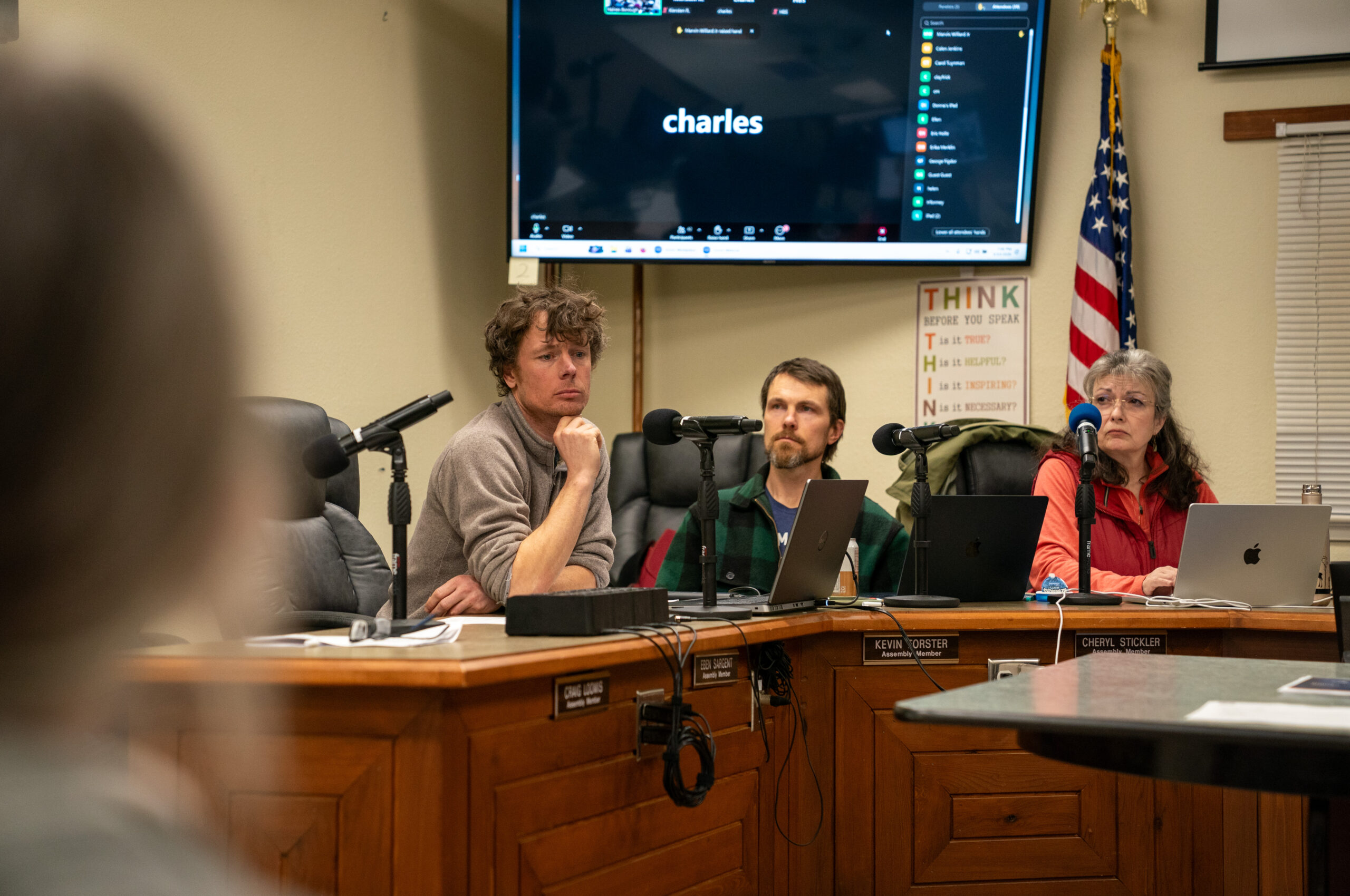
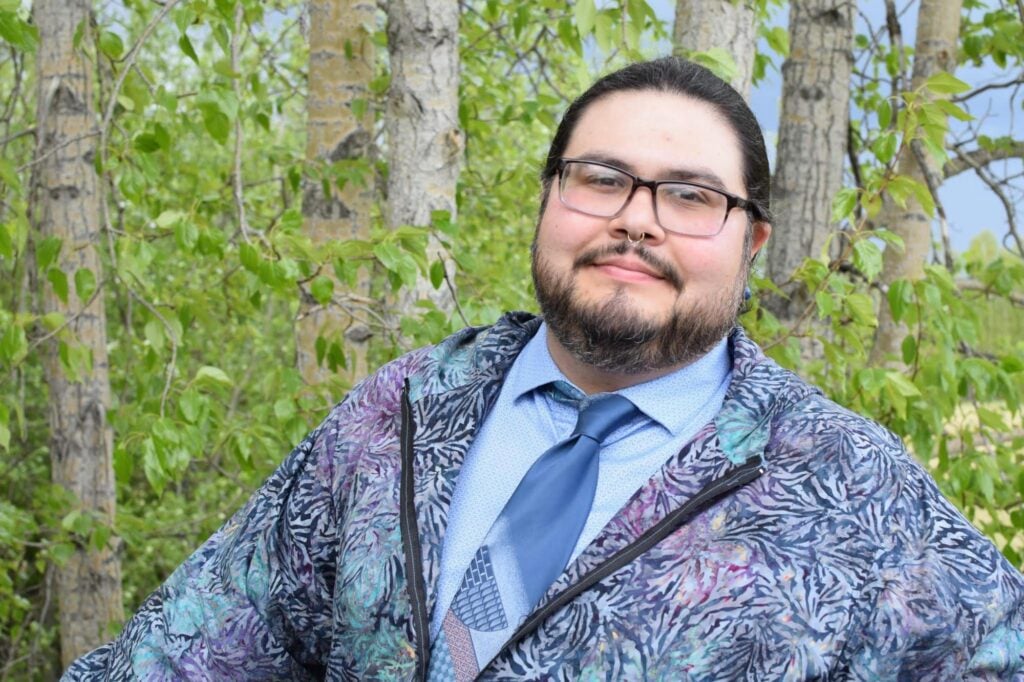
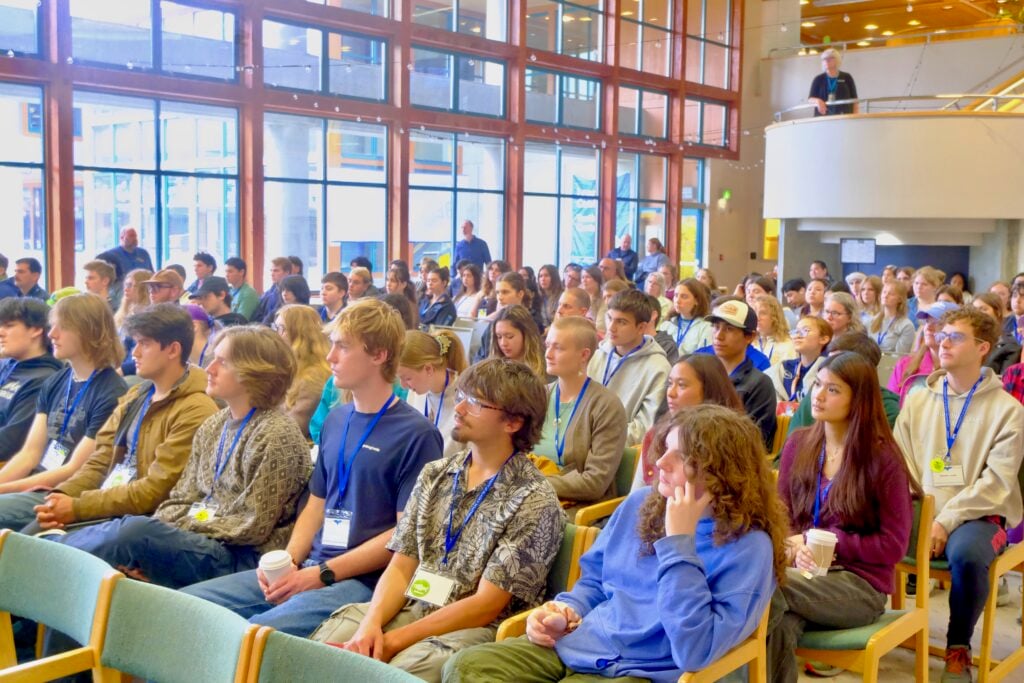
The Haines Borough Assembly will consider changing how borough staff handle lawsuits over conditional use permits. They’ll also discuss two more questions that could go on the ballot in front of voters this fall. KHNS’ Melinda Munson talked to the Chilkat Valley News’ Will Steinfeld to find out more.
Melinda Munson: “It seems like a little bit of a shorter agenda than usual, but don’t let that fool you.
Partipants in the Alaska Run For Women are seen at the race finish line at the University of Alaska Anchorage campus on June 11, 2022. The Healthy Alaskans program tracks a variety of indicators, including rates of obesity and exercise among adults and youth. (Photo by Yereth Rosen/Alaska Beacon)
Alaskans face chronic health problems that are not yet easing and, in some cases, getting worse, according to a new status report released by the Alaska Department of Health. At the same time, there are signs of improvement in health, health care and the socioeconomic conditions that support well-being, particularly among youth, according to the report.
The 2026 update is part of the long-term Healthy Alaskans program, a collaboration between the state Department of Health and the Alaska Native Tribal Health Consortium.
The program sets 10-year goals and uses a holistic approach that considers factors like food security, housing security, public safety, education and other indicators. The new report comes at about the midpoint of the period covered by the Healthy Alaskans 2030 State Health Improvement Plan.
“The State Health Assessment is a comprehensive health checkup for the whole state; it represents the health of all of us,” Dr. Robert Lawrence, the Department of Health’s chief medical officer, said in a statement. “Like any checkup, knowing where we are on target and where we can improve helps us be strategic on where we focus our time and attention to the benefit of all Alaskans.”
The report includes some bad news, some of which concerns obesity, poor diets and related ailments.
In 2024, 185,000 Alaska adults were identified as suffering from high blood pressure and 167,00 from high cholesterol, health conditions often tied to excessive weight, the report said.
Those totals represent significant proportions of the state population. As of 2025, Alaska’s population was estimated at 738,737, about three quarters of whom were adults.
Among high school students, 33% were overweight or obese in 2023, the report said. And the vast majority of Alaskans, whether adults or students, failed to consume the recommended daily amounts of fruits and vegetables and failed to engage in the recommended daily levels of exercise, the report said.
Alaskans’ life expectancy has not increased since 2014 and actually showed a slight downward trend through 2024, though there has been recovery since the dip caused by the COVID-19 pandemic. Broken down into demographic groups, Alaska’s Asian and Pacific Islander residents had the highest life expectancy in 2024, at 81.0 years, and Indigenous residents the lowest, at 67.6 years. The Alaska Native life expectancy in 2024 was 10 years shorter than the overall U.S. average, the report said.
The statistics on life expectancy are among several examples of health disparities resulting in poorer health for Alaska Natives. Those are related in part to unequal access to health care and other services, the report said. “The current and historical conditions, policies, rules, and power structures in communities underlie whether individuals have the best chance at living a healthy life, including practicing healthy behaviors,” it said.
Rates of infant mortality showed no improvement over the past decade, and a big disparity persists for Alaska Native people. The rate of infant deaths was 13 per 1,000 births among Alaska Native people in the years from 2020 to 2024 — about twice the rate for the state as a whole, according to the report.
Childhood vaccination rates in Alaska continue to lag national rates, the report said.
Bernadette Hartley and other volunteers assemble opioid-reversal kits at an Aug. 29, 2025, event in Anchorage. The kits contain naloxone. The event held at Anchorage’s Fairview Community Recreation Center was organized by the Alaska Department of Health’s Project HOPE and the Alaska Native Tribal Health Consortium. State officials recorded a reduction in overdose deaths in 2024, and that downward trend appears to have continued into 2025. (Photo by Yereth Rosen/Alaska Beacon)
There is good news in the report, though.
Among those positive signs is a significant increase over time in prenatal care. In 2008, only 39% of women who gave birth in Alaska had received adequate prenatal care starting in the first trimester; by 2024, that measure had risen to 67%
High school graduation rates are up as well. In the 2010-11 school year, 68% of Alaska students graduated high school within four years; by the 2023-24 school year, that rate has risen to 78%. Graduation rates for Alaska Native students lagged the state average, but they also improved during the period, from 51% to 65%, the report said.
That is important because education is linked to better health, the report said.
“In Alaska, 35% of adults without a high school degree reported five or more poor physical health days in the last 30 days, compared with 22% of adults with at least some college education,” it said.
Alaska teens are less likely to be exposed to secondhand tobacco smoke, part of an overall trend toward establishment of tobacco-free zones and similar policies, the report said. In 2011, 36% of high school students were exposed to tobacco smoke; the rate fell to 25% in 2024, the report said.
Some health-related metrics showed mixed signals as of 2024, according to the report.
Drug overdoses that spiked amid the national opioid crisis are showing signs of abatement. Alaska’s rate of fatal overdoses more than doubled from 2019 to 2024, from 18.1 per 100,000 people to 45.6 per 100,000 people, the report said. But the 2024 rate represented a 5% decrease from the peak rate hit the year prior. That was not as dramatic as the national drop of nearly 27% from 2023 to 2024, but indications are that the downward trend will continue into 2025, according to Department of Health records.
Climate change poses numerous health challenges, the report said. In rural areas, changes to fish runs, wildlife populations and berry crops have interfered with traditional harvests of wild foods and diminished food security. In various parts of the state, wildfire smoke is a health hazard. Risks of certain diseases have increased with the changing climate, the report added.
As those challenges mount, there are new programs and systems aimed at mitigating those threats, the report said.
Alaska’s extensive and continually improving trail system, which helps people reach sources of wild food, and also supports exercise. Contributes to overall health, the report said. More Alaska-grown food has become available over time. Organizations like the Food Bank of Alaska are reaching residents in need, including the state’s growing population of elderly residents.
Riley Green didn’t become a country star overnight. Now he’s getting real about what it’s been like watching his career and fame grow over the past decade. Continue reading…Country Music News – Taste of Country
Riley Green didn’t become a country star overnight. Now he’s getting real about what it’s been like watching his career and fame grow over the past decade. Continue reading…The Boot – Country Music News, Music Videos and Songs
Now, some of those last remaining lands free of roads are under threat from the Trump administration’s proposed rollback of the 2001 Roadless Rule. That includes southeast Alaska’s Tongass National Forest, where eagles, bears, salmon and many other species thrive in old-growth coastal forest along the Inside Passage.
In announcing its plan, the administration said rescinding the rule would remove prohibitions on road construction and logging on nearly 59 million acres of national forest, arguing that the rule slowed economic development. A 30-day public comment period on the formal proposal ends on Sept. 21, 2026. Instructions on how to submit comments are included in the proposal.
In Congress, another effort is underway to try to change the law through an amendment to the Wildfire Prevention Act. That change, if approved, would both remove the Roadless Rule and prevent the U.S. Forest Service from reinstituting it in the future, despite overwhelming public support for the rule.
As ecologists who have spent decades studying wilderness and the animals and ecological functions that depend on undisturbed habitats, we believe it’s important to understand that preserving roadless areas has value for environmental health, clean water, wildlife survival and people’s own well-being.
What is the Roadless Rule?
The National Forest Roadless Area Conservation Policy, better known as the Roadless Rule, was issued in January 2001 by President Bill Clinton. It has had overwhelming public support and received more public comments than any other rule in history.
The rule prohibits road construction, maintenance and commercial timber harvest in inventoried roadless areas within the National Forest System. It applies to over 58 million acres across the country, excluding Idaho and Colorado, which have their own state-specific roadless rules. While most of these roadless areas are in the western states and Alaska, 38 total states as well as Puerto Rico host roadless areas.
The nation’s inventoried roadless areas are primarily in the western U.S. and include large parts of southeast Alaska, where 14,779,000 acres of roadless areas are within National Forest System land. (US Forest Service Enterprise Map Services Program)
The primary goal of the Roadless Rule is to maintain forest health and productivity for future generations. It also helps avoid exacerbating the U.S. Forest Service’s road maintenance backlog by not making new roads.
The Roadless Rule prohibits new road construction, with very limited exceptions, as well as commercial logging in designated roadless areas. It does not restrict other uses that are compatible with the management plan, such as hiking and mountain biking, or resource uses such as grazing livestock and working existing mining claims.
Beyond providing vital habitat for species and enabling healthy forests, the rule protects drinking water for the millions of Americans whose water flows from national forests. It also preserves high-quality recreation opportunities – hiking, camping, hunting and fishing – that Americans cherish.
The problem with roads in national forests
While roads can provide benefits, such as access to forests, they can also do ecological harm.
Roads enable invasive weeds to spread by being carried on vehicle tires and deposited in exposed soils, erode sediments into streams and fragment habitat that wildlife rely on. Vehicles directly kill and injure animals through collisions. They occasionally start fires, too. A recent study found that fires are more likely to start in areas with roads than in areas without.
Studies show that road noise displaces wildlife, increases stress and can affect wildlife behavior patterns at distances of over a mile from the road.
And roads don’t just cause problems for species on land. Most roads cross streams and rivers, which requires building a way for those waters to keep flowing under the road (structures called culverts). While culverts can be designed to allow fish to pass through and maintain ecological connections, they are rarely built to do so. This leads to declines in the health of fish populations and can leave some species locally extinct.
The benefits of roadless areas
Inventoried roadless areas are among the most ecologically intact and wildest places left in the United States, yet – unlike Wilderness Areas and National Parks – there are no signs acknowledging their boundaries when you enter one.
Most are part of larger ecosystems, directly adjacent or ecologically connected to better known national parks and wilderness areas. Removing Roadless Rule protections would erode ecological buffers to these more famous protected lands.
For some species, roadless areas protect critical core habitat. For instance, over half the suitable habitat for relictual slender salamander, a critically imperiled species native to the Sierra Mountains of California, occurs in a roadless area. Nearly 40% of Mount Pinos, lodgepole chipmunk, an imperiled subspecies of the lodgepole chipmunk, also live in roadless areas in California.
Research shows that every formal roadless area provides habitat for at least two wildlife species of conservation concern – those facing risks to their long-term survival – with the median roadless area supporting 10 of these imperiled species. Some Arizona roadless areas contain habitat for up to 62 of these species.
Roadless areas also protect watersheds that supply drinking water to 47 million Americans.
Without this protection, these watersheds would still provide water, but their long-term health and hydrological sustainability could be compromised if roads block stream flow and increase sediments flowing into waterways. The result can be higher costs for water purification.
The Forest Service’s own watershed health assessment, known as the Watershed Condition Framework, uses road density as a key indicator of conditions that can disrupt water quantity and quality.
What is at risk in rescinding the Roadless Rule?
The Trump administration’s proposed rollback, expected to be formalized in 2026, would open these last wild places to development, fragmenting habitats that can never be restored.
The American public spoke loudly in 2001 when they supported the Roadless Rule. Two decades later, the public comments submitted on the recission notice overwhelming opposed rolling back the rules, a Center for Western Priorities review found, reaffirming that U.S. roadless forests remain as vital and valued as ever.
Protecting these areas is about promoting healthy ecosystems on public lands so they can provide hiking, hunting and fishing opportunities for generations to come to enjoy the tranquility of being in nature.
David Leslie, who’s currently sitting in fourth place in preliminary results in Alaska’s U.S. Senate race, says he’s not a “perennial candidate.” (Photo courtesy David Leslie)
This story was originally published in the Anchorage Press. Subscribe here.
Leading up to Alaska’s high-profile U.S. Senate primary, political groups spent millions of dollars to boost not only the leading Republicans and Democrats, but also fringe candidates who could tip the balance of a tight race in November.
Most of those efforts fell flat — namely, those that tried to boost spoiler candidates who don’t even live in Alaska, like Arizona resident and Green Party candidate Richard Grayson, who garnered just 343 votes in preliminary counts.
One novice candidate who did crack the top four, though, and is now poised to appear on the general election ballot is David Leslie — a Democrat, Democratic Socialist and Fairbanks resident who, unlike some of the other longshot candidates, has spent years in Alaska politics.
If preliminary results hold, Leslie’s presence on the general election ballot, as a Democratic candidate, could represent a win for conservatives who want to see as few Republicans as possible in the race, to avoid competition for votes for incumbent GOP U.S. Sen. Dan Sullivan.
But if Leslie were to drop out before an Aug. 31 withdrawal deadline, it could bump the fifth-placed finisher, Republican Gerald Heikes, onto the ballot — which some politically operatives say would boost the chances of Democratic challenger Mary Peltola.
We wanted to know what Leslie was thinking: why he’s in the race, and whether he might drop out. So, on Thursday, the Anchorage Press called him.
Below is a transcript of the interview, edited for clarity and length.
Nathaniel Herz: For people who don’t know David Leslie, who is he?
David Leslie: I am Iñupiaq. My mom was born in Kotzebue. She was sent to Nome for school when she was four or five, and she was raised in Fairbanks by my white adoptive grandparents, Chuck and Carol Leslie. Chuck was really high up in the plumber pipefitters union, Local 375. I grew up going to all of the union holiday parties. And I was born in Louisiana — my mom finished high school there. My mom was in a terrible car accident when she was pregnant with me — she survived, but that’s why, as soon as I could get on a plane when I was a few weeks old, we moved from Louisiana back to Fairbanks so my grandparents could raise me.
My biological grandfather was John Schaeffer, the first president and CEO of NANA.
Herz: What’s your history in politics?
Leslie: I first really got involved in activism when I was 16 years old, a junior in high school at Lathrop High School (in Fairbanks). I became the vice president of the Gay-Straight Alliance, especially because I was the only openly queer guy in my class. As an Iñupiaq person, raised by my white family, I’ve been on a journey of reconnecting and rediscovering my Iñupiaq family. I actually met a lot of my aunts and uncles through organizing around NANA’s ICE detention contracts, and that has been a silver lining — to realize that I’m not just against these contracts, but my family, who I’ve never met before, we all share these same values.
I was involved with Occupy Fairbanks when that went down in 2011, 2012. I was out there protesting for, like, six months at 50 below. I also was the union steward for the Fairbanks Pioneer Home, and for biographical purposes, I’m still on the board of the Northern Alaska Environmental Center.
If you follow politics, you know that I have been involved. I’m not this weird outsider person, a perennial candidate. I am someone who cares deeply about the community, and I’m deeply involved in many different facets of Alaska politics, and this is just the obvious next step.
Herz: How do your values differ from Mary Peltola’s, and why did you feel the need to run against her?
Leslie: There are three main issues why I decided to primary Mary Peltola. There also was ranked choice voting, which is an important part of why I made this decision. If we did not have ranked choice voting, I would not be running, because it is so important that we get Dan Sullivan and Republicans out of power.
But the biggest issue was the genocide in Palestine. Alaska Native people are still enduring a genocide here in Alaska. And if you can deny that blowing up children, blowing up grandparents, starving tens of thousands of people is a genocide — if you can deny that, you can deny the genocide of Alaska Native people happening in front of us here.
Herz: What do you mean by ongoing genocide of Native people?
Leslie: You talk to our elders, they remind us that this genocide never ended.
Our languages are still dying off, and the state and federal government are not ensuring that we don’t lose these languages. We have an epidemic of murdered and missing Indigenous women, two-spirit people, and just people in general. The cops still kill Alaska Native people at higher rates. And also we see our land being continually encroached upon by industry in ways that harm not only our people, but also make us less able to live off the land in our traditional ways — which is both harming us physically, but also harming us culturally. And we still have not seen a proper reckoning of the boarding school era, which didn’t end until the 1990s.
All of these things compound to show that there is still a genocide. There has not been reparations for boarding schools. There has not been a full-on attempt to stop the dying of our languages, and there has not been an investment in investigating all the murdered and missing Indigenous people in the state.
Herz: When it comes to Israel and Palestine, you’re critical of Mary Peltola’s position there?
Leslie: I really wanted to see Mary Peltola explain why she took AIPAC money, and then commit to not taking it, to saying that there are allegations of human rights abuses and crimes against humanity and genocide, and address that. But her Alaska-centric campaign is better fit for a gubernatorial candidate, and the fact that she has not answered these yet is such a huge issue.
Democrat Mary Peltola is leading in preliminary results in Alaska’s U.S. Senate election. (Nathaniel Herz/Northern Journal)
Another issue I decided to primary her on is the environment. Her support for the Willow project, as climate change is destroying our actual villages. You know, Kotzebue, my people’s ancestral homeland, damn near eroded into the ocean from one of the typhoon remnants. We saw how those typhoons destroyed other villages. We cannot continue to ignore how the oil companies are causing climate change, which is destroying our homelands and making them unlivable.
And then, third, when the U.S. Customs and Border Protection agents, ICE, murdered Alex Pretti and Renée Good, we need someone who’s going to say, ‘These ICE agents are murdering people. They are tools of violence. They’re equivalent to brown shirts, and that their camps are concentration camps that are crimes against humanity and must be shut down.’
( Peltola’s campaign did not respond to a request for comment on Leslie’s statements.)
Herz: What’s your take on Peltola, generally?
Leslie: Mary Peltola is obviously better than Dan Sullivan in so many ways, but we can’t be running campaigns on not being as bad as the other person. We need someone with strong vision and a strong value that actually aligns with our Alaska Native values to be the leaders in our country. And running concentration camps, continuing this rhetoric that borders are not under control — which has led to the murder and rape of immigrants — is not our Alaskan Native values. Native people don’t know borders. The borders crossed us.
Herz: Obviously, there is a concern among liberals, progressives — I think even among some folks who are very closely aligned with you politically — that your presence in the race, assuming the results hold, risks making you a spoiler to Peltola. I’m wondering what your response is to that contention.
Leslie: I have met so many people who will not vote for Mary Peltola because of her stance on the genocide in Gaza.
By having someone who will take a strong stance on Palestine and Gaza, I am encouraging people to show up to the ballot who normally wouldn’t, and will rank her second. These people have strong moral convictions, which is good — but they need someone to get them to the polls in the first place. I am that candidate that will allow these people to vote their values, and then they will rank Mary Peltola second. If I was not in this race, they would not be there at all.
Herz: Do you encourage them to rank Mary second?
Leslie: I do. When I first announced my declaration of candidacy, I said, ‘I will ask people to rank Mary Peltola second, because Dan Sullivan and the Republicans are the party of white supremacy, Christian nationalism, and genocide on our own lands. We must remove them from office, no matter what.’ (A Sullivan spokesman, Nate Adams, said in a statement: “Alaskans can come to their own conclusions about David Leslie’s radically liberal worldview, but at least he has principles.”)
I am running so that more progressives, liberals, and Democrats show up — so they will at least rank me and Peltola, so we can get Dan Sullivan out of office.
Herz: There are clearly, though, some Republicans that see you and your presence on the general election ballot as advantageous to them. How confident are you that your participation won’t hurt Peltola?
Leslie: I have had people express concern that people will only vote for who they believe in the most, and ultimately end up submitting an exhausted ballot. I really, truly believe we are still fully understanding the importance of ranked choice voting, as we continue to relitigate it.
There is so much power in ranked choice voting. It has been so important for us to have that in Alaska. We are setting the path for so many other states to join us. We have to believe that ranked choice voting operates as it should.
There are some people who are only going to vote for one person, and that is their right. But we must exercise our rights and tools of democracy to make sure that we get the best candidates we can. And I believe ranked choice voting is that way, and again, I am only running because we have it. It is so important that we maintain it and we use it to its fullest extent.
Herz: What consideration will you give to dropping out before the Aug. 31 deadline, if you do end up being the fourth-placed candidate in the primary?
Leslie: The things that I am running on, the values I hold, are strong. I am not here to waver in my beliefs. I think it’s good that we have two progressives in the race. I believe that by dropping out, I would be platforming dangerous Republicans who are white supremacists and Christian nationalists, and we must not allow their rhetoric to take hold. That is also dangerous.
Herz: Have you heard from Peltola or the Alaska Democratic Party since Tuesday?
Leslie: I’ll be meeting with someone from the leadership of the Alaska Democrats later today.
Herz: Is there a world in which, if there was a commitment from Peltola or others on the issues that matter to you, you would entertain the idea of dropping out?
Leslie: A lot can happen between now and Aug. 31. I don’t want to take any options off the table. But at this point in time, there’s so many huge issues that are important, and these issues will determine whether or not tens of thousands of people will die.
New students at the University of Alaska Southeast attend orientation at the Egan Library on the Juneau campus on Aug. 21, 2026. (Photo by Corinne Smith/Alaska Beacon)
Under a driving Juneau rain, dozens of new students at the University of Alaska Southeast gathered Friday for orientation and to kick off the fall semester. This year, the public university saw a boost in enrollment of out-of-state students, which officials and students say is largely due to a new policy eliminating the non-resident tuition rate.
UAS piloted the new tuition policy this year, called Alaska Unlocked, which offers the standard in-state tuition rate for all undergraduate courses, regardless of the student’s residency.
That’s resulted in an estimated 36% increase this year in out-of-state students enrolling at UAS compared to last year, according to university officials.
New students at the University of Alaska Southeast attend orientation at the Egan Library on campus in Juneau on Aug. 21, 2026. (Photo by Corinne Smith/Alaska Beacon)
“We are so thrilled with that much of an increase,” said UAS Chancellor Aparna Palmer, in an interview after her welcoming remarks to students at the Egan Library. “We know that a high percentage of our graduates stay in Alaska and work in Alaska within one year of graduation. And so most of these students are our future Alaskans.”
New students have arrived from 28 states, according to university data, with the top home states including Washington, California, Colorado, Idaho, Minnesota and Wisconsin.
The in-state tuition rate was a draw for 22-year-old Nicole Wilson of Phoenix, Arizona. After classes at community college, she enrolled at UAS to pursue a bachelor’s degree in marine biology with a focus on mammals. “I decided to come here both based on the in-state tuition and also because it was such, like, an ‘open to marine biology’ type school. My original plan was to go out to Hawaii, but it’s extremely expensive from out of state,” she said.
Wilson said housing was also a factor. “I did the math. If I were to take a dorm, which I would have had to, at any of the major universities in Arizona, it was actually more expensive than coming out to Alaska,” she said.
Cost of housing was the main consideration for 20-year-old Owen Kellon of Portland, Oregon, who is pursuing a bachelor’s degree in environmental sciences. “It was the bigger concern when it came to the cost of schooling, just because tuition was like a couple hundred bucks per class, which is perfectly reasonable. It’s about how much I was paying back at my community college in Portland, but the housing cost was the biggest factor.”
The John Pugh Hall student dorms houses 120 beds for students on-campus in Juneau, seen on Aug. 21, 2026. (Photo by Corinne Smith/Alaska Beacon)
The standard in-state tuition rate is expected to be available across the University of Alaska system next year. Earlier this month, the UA Board of Regents moved to eliminate out-of-state tuition rates for all locations and degree types, aiming to draw more students to Alaska.
Currently, out-of-state tuition is double to quadruple the amount of resident tuition, depending on degree type. The Board of Regents is expected to take up a final vote on the policy change in November.
UAS has the smallest student population of Alaska’s public universities, with roughly 3,600 students last year across campuses in Juneau, Ketchikan and Sitka.
This year’s preliminary enrollment data shows roughly the same number of students as last year, signalling Alaskan student enrollment may have declined. But Palmer emphasized that it’s too soon to tell, as enrollment numbers are subject to change in the next few weeks with more Alaska students possibly signing up for dual enrollment programs or classes beginning later in the fall.
University of Alaska Southeast Chancellor Aparna Palmer welcomes new students at orientation in Juneau on Aug. 21, 2026. (Photo by Corinne Smith/Alaska Beacon)
This year, UAS saw a 21% increase in applications from out-of-state students, and a 36% increase in newly enrolled out-of-state students. More than 80 new out-of-state students have enrolled this year, compared to 60 students last year, according to university officials.
UAS is an open access enrollment institution, Palmer noted. “What that means is, no matter where you are in life, whether you just graduated from high school, in high school, or whether you’re, you know, in your sixties or seventies, there is a way in which you can access UAS,” she said.
Most students are working adults or part-time students, Palmer said, and can enroll in classes in-person or online. “So, we do have a really diverse group of students,” she said.
In Juneau, new students had a jam-packed schedule for orientation week. On Friday, students were welcomed by UAS administrators, a Tlingit elder and student leaders, followed by a campus tour and briefings on campus resources, student clubs, tutoring, career counseling, and anti-discrimination and Title IX rights and reporting.
Students expressed excitement for the new school year and to be in Alaska, including Owen Kellon of Oregon.
“I love the rain,” he said. “ I am excited to see how the winter months will look like with only like six hours of sunlight. I’m scared, but I’m also excited.”
New students at the University of Alaska Southeast pose for a photo by Auke Lake during a campus tour as part of orientation in Juneau on Aug. 21, 2026. (Photo by Corinne Smith/Alaska Beacon)
Correction: This story has been updated to correct the number of students enrolled at UAS, which was roughly 3,600 students last year.