Categories
Alaska News

Governor vetoes Alaska bills on invasive species management, plastic food containers

Ashley Novella, an ecologist with the Anchorage Soil and Water Conservation District, removes mewly sprouting chokecherry seedings during a volunteer weed pull on June 17, 2026, along Anchorage's Lanie Fleisher Chester Creek Trail. Chokecherry trees, brought to Alaska as ornamentals, are aggressive invaders and have crowded out natural plants in parts of Anchorage and other communities. (Photo by Yereth Rosen/Alaska Beacon)

Ashley Novella, an ecologist with the Anchorage Soil and Water Conservation District, removes mewly sprouting chokecherry seedings during a volunteer weed pull on June 17, 2026, along Anchorage’s Lanie Fleisher Chester Creek Trail. Chokecherry trees, brought to Alaska as ornamentals, are aggressive invaders and have crowded out natural plants in parts of Anchorage and other communities. The ANchoraeg Soil and Water Conservation District is part of the Alaska Invasive Species Partnership, which advocated for a bill that would have established an invasive species council in the state Department of Fish and Game. (Photo by Yereth Rosen/Alaska Beacon)

Gov. Mike Dunleavy on Thursday vetoed two environmental-protection bills that had passed with broad bipartisan support from legislators.

Dunleavy vetoed a bill to establish an invasive species council, Senate Bill 174, that was intended to be similar to coordinating organizations managing invasive species in other states, and a bill to ban restaurants’ use of polystyrene containers, House Bill 25.

Dunleavy, in veto messages, characterized both bills as overly burdensome and unnecessary expansions of government.

The invasive species bill would have established a council within the Department of Fish and Game to coordinate efforts that participants say are currently too disjointed to be as effective as they could be.

It was supported by numerous science and resource organizations, including the Alaska Invasive Species Partnership, a coalition of agencies and organizations that try to combat invasive species.

In a letter to lawmakers, the partnership’s chair said the board strongly backed the bill. “This legislation represents a vital step toward strengthening the coordination, education, and actions needed to protect Alaska’s environment, economy, and public health from the growing threat of invasive species,” the letter said.

It passed the Senate unanimously on May 8 and it passed the House by a 35-5 vote on May 19. In addition to the bill’s sponsor, Sen. Forrest Dunbar, D-Anchorage, 14 other senators from both parties and 11 Democratic, Republican and independent House members signed on as cosponsors.

But Dunleavy, in his veto message, said there is no need to add new invasive species duties to the Department of Fish and Game.

“Rather than strengthening direct operational capacity, the bill adds a formal advisory layer that is not necessary for the department to continue its efforts,” Dunleavy said in his veto message.

Felled chokecherry trees, a fast-growing invesive species, lie along the edge of Anchorage's Lanie Fleisher Chester Creek Trail on June 17, 2026. In the background, working as part of a weed-pull crew to remove invasive species, is Lizzie Bishop of the Anchorage Soil and Water Conservation DIstrict. (Photo by Yereth Rosen/Alaska Beacon)
Felled chokecherry trees, a fast-growing invesive species, lie along the edge of Anchorage’s Lanie Fleisher Chester Creek Trail on June 17, 2026. In the background, working as part of a weed-pull crew to remove invasive species, is Lizzie Bishop of the Anchorage Soil and Water Conservation DIstrict. (Photo by Yereth Rosen/Alaska Beacon)

“The State should also be cautious about creating advisory structures that may become a vehicle for broader restrictions on land use, permitting, and responsible development.”

Dunbar called the governor’s reasoning “misguided” and “unfortunate.”

“In the battle over invasive species, Mike Dunleavy has joined the battle on the side of the invasive species,” he said.

As to why Dunleavy is contradicting state officials who are Alaska Invasive Species Partnership board members, “I think it boils down to animosity and ideology,” Dunbar said.

The animosity is because members of the Senate “have not been rolling over on certain issues,” he said. The ideology is the resistance to anything that appears to be an expansion of government, Dunbar said, even though experts advised that the more coordinated approach through the council the bill would have established would make invasive species effort more cost-effective.

Invasive species that threaten Alaska’s ecosystems and the livelihoods that depend on them, particularly seafood harvesting, include imported plants like elodea and fish species like northern pike, which prey on native salmon in Southcentral Alaska, and European green crabs, which eat native crabs and damage fishery habitat. European green crabs were first discovered in Alaska in 2022; since then, tens of thousands have been trapped in Southeast Alaska, but the species is expanding northward.

Ban on plastic foam containers nixed

The bill banning restaurant use of polystyrene containers was aimed at reducing plastic pollution in Alaska, particularly pollution from microplastics, the long-lasting remnants of crumbled-up plastic trash that have become ubiquitous in waterways and the food web, even in remote parts of Alaska.

Dunleavy, in his veto message, said the bill would have created an “unrealistic implementation timeline for businesses,” especially affecting rural Alaska.

A torn Styrofoam cup emerges with other trash from a melting pile of snow on April 26, 2026, in a parking lot by Northern Lights Boulevard in Midtown Anchorage. (Photo by Yereth Rosen/Alaska Beacon)

“A rapid transition away from customary packing could increase costs for businesses and consumers without giving affected businesses enough time to adapt,” he said.

The bill’s effective date was to be Jan. 1, but the measure included a provision allowing restaurants to continue to use stockpiled supplies of polystyrene containers until they were depleted.

The bill had bipartisan support, though the support was not as wide as that for the invasive species council measure.

It passed the House originally on April 21 by a 25-15 vote. It passed the Senate on May 18 by a 13-7 vote, and the House on May 19 concurred with Senate changes by a 26-14 vote.

Organizations that have been tracking plastics pollution in Alaska and advocated for the bill delivered angry reactions to the governor’s action.

“This veto is shameful,” Pamela Miller, executive director and senior scientist with Alaska Community Action on Toxics, said in a statement. “Governor Dunleavy had a chance to protect children, families, fish, wildlife, and future generations from unnecessary toxic exposure. Instead, he sided with plastics manufacturers and pollution. His time as governor is winding down and this veto will be part of his legacy, a legacy associated with divisiveness, negativity, and a refusal to act when human health is on the line.”

Dyani Lezama, state director of Alaska Environment, said she was “incredibly disappointed” by the veto.

“Polystyrene foam is bad for our health, produces a huge amount of litter and is incredibly hard to clean up. Products that we use for just a few minutes shouldn’t pollute our environment for hundreds of years,” she said in a statement.

“This is a bipartisan issue that most Alaskans agree on, despite significant lobbying from the plastics industry. It’s time to leave foam foodware in the past and I look forward to building greater public support to deliver a victory in 2027,” she said.


SUPPORT: YOU MAKE OUR WORK POSSIBLE

Categories
Alaska News Featured Juneau News juneau Juneau Local Juneau Local Ketchikan Local News Feeds Sitka Local

Alaska’s minimum wage set to increase on July 1, thanks to ballot initiative

By: Yereth Rosen, Alaska Beacon

Fliers posted at the University of Alaska Anchorage’s Avis Alaska Sports Complex on June 25, 2026, advertise summer job openings and internships for students. Even though the positions are entry-level, temporary or internships, posted hourly pay rates on some fliers are above $20 an hour. (Photo by Yereth Rosen/Alaska Beacon)

Starting next week, Alaska’s lowest-paid workers will be entitled to more money.

On July 1, the state’s minimum wage will rise to $14 an hour, a $1 bump from the current level. The increase is the result of a voter-approved ballot initiative that mandated paid sick leave, as well as stepped-up minimum wages.

The first increase took pay up to $13 an hour last year, and next year, the minimum wage is scheduled to rise to $15 an hour. In subsequent years, the state’s minimum wage is to rise with the inflation rate, under the voter-approved initiative.

Salaried workers are also covered by the minimum wage increase. Under state reuglations, minimum pay for salaried workers, with some exceptions, must be at least twice the hourly minimum wage, based on a 40-hour workweek.

Just how many workers will be affected by next week’s mandated pay increase is unclear.

Dan Robinson, research chief at the Alaska Department of Labor and Workforce Development, believes that there will be relatively few people affected by the change.

“This will not change very much because the situation for workers for a while now has been that employers have had to pay higher wages,” Robinson said.

Even a $14-an-hour wage for what are normally low-paid jobs was not high enough for many employers to attract workers, he said.GET THE MORNING HEADLINES.SUBSCRIBE

That is not because of any boom in available jobs in Alaska. The state’s picture is static, Robinson noted. Gains in private sector employment have been almost exactly offset by losses in government employment, mostly because of federal job losses, according to the state’s most recent analysis.

Rather, it is a product of demographic factors, including continued net-outmigration, meaning more people leaving Alaska than moving into the state. As of last year, Alaska had 13 consecutive years of net-outmigration, a post-World War II record.

Other factors shaping the labor force are Alaska’s aging population and immigration curbs.

Overall, there are “fewer people here seeking work than at other points in our history,” Robinson said. “So it’s kind of a feedback loop.”

The minimum wage increases are expected to affect more people in future years, when they are tied to inflation, he said.

A different perspective was offered in 2024 by the National Employment Labor Project, a nonprofit pro-labor advocacy group.

Prior to that year’s election, the organization estimated that 31,000 people in Alaska would earn more if the state’s minimum wage were raised. More women than men would see the benefits, since women are more likely to be in minimum wage-paying jobs, according to the analysis.

Robinson said the Department of Labor and Workforce Development does not have solid numbers on how many workers are earning minimum wage or anything closer to it.

The department does have information showing pay rates for different economic sectors and job categories, though that is also incomplete because it relies on surveys.

Alaska’s lowest-paid workers, based on those survey results, are in the food preparation and service sector, according to the Department of Labor and Workforce Development’s analysis. Within that sector, median hourly wages range from $12.65 for waiters and waitresses to $25.09 for chefs and head cooks, according to the survey data.

Alaska is among four states and more than two dozen municipalities with scheduled minimum wage increases going into effect in July. And by the end of the year, 88 jurisdictions across the country will have raised their minimum wages, according to the National Employment Labor Project.

As of Jan. 1, 20 states had minimum wages that were higher than Alaska’s $13-an-hour rate, according to the U.S. Department of Labor. Next week’s increase in Alaska, along with phased-in increases elsewhere, may change those rankings a bit.

The nation’s highest state minimum wage is in the District of Columbia, at $17.95 an hour, according to the U.S. Department of Labor. There are eight states with either no state-imposed minimum wage or a minimum wage that is lower than $7.25 an hour, the federal minimum, according to the department.

Categories
Music

Alan Jackson Signed His First Deal 37 Years Before Last Show

He’s gone on to one of the biggest careers in country music. Continue reading…​The Boot – Country Music News, Music Videos and Songs

Categories
Music

Alan Jackson Signed His First Deal 37 Years Before Last Show

He’s gone on to one of the biggest careers in country music. Continue reading…​Country Music News – Taste of Country

Categories
Sports Fox

Dembélé Hat Trick! France Star Scored Three Goals vs. Norway At World Cup

Not once, not twice, but thrice. France winger Ousmane Dembélé scored three goals in the first half of its World Cup match against Norway on Friday, putting the Paris Saint-Germain star firmly in the mix for the Golden Boot race for the tournament’s top-goal scorer. All of Dembélé’s goals came in the first 32 minutes of the match at Boston Stadium. He became the first player to score a first-half hat trick at a men’s FIFA World Cup since Russia’s Oleg Selenko in 1994, who finished with five goals in the match against Cameroon. The fastest World Cup hat trick took only 7 minutes, 42 seconds. Hungary striker Laszlo Kiss, who had come on as a substitute, managed that feat late in the match against El Salvador at the 1982 World Cup in Spain. Dembéé’s the second fastest from a starter. Dembélé completed the feat with three completely different goals. The third goal was a combination of his first two — a curler with his left foot from the same spot he powered his first goal in with his right foot. Dembélé entered Friday’s match with one goal. With four goals, he sits behind Lionel Messi (five goals) in the Golden Boot race. He joins Messi and Canada’s Jonathan David as the third player with a hat trick at this tournament. Dembélé is tied with France teammate Kylian Mbappé, with four goals at the tournament. Mbappé assisted on two of the goals. Dembélé By The Numbers 1: Ballon’Or award, which he won in 2025 as the world’s best player. 3: Dembélé is the third player to score a hat-trick for France at a men’s World Cup, after Just Fontaine (two in 1958) and Kylian Mbappé (one in 2022). 11: Number of international goals he now has, with his first coming back in 2017 in a friendly match vs. England. 19: The number of previous major international tournament games without scoring a goal before France’s last game; Dembélé now has four in the last two.20: By assisting Dembélé on two of his goals, Mbappé has tied Germany’s Miroslav Klose for the second-most most goal contributions (goals + assists) at the World Cup since 1966 (20: 16 goals, 4 assists). Only Lionel Messi has more than Mbappé (26). 32: The number of minutes for Dembélé to achieve his hat trick. It’s the second earliest ever in World Cup history (Austria’s Erich Probst did in 24 minutes in 1954 vs. Czechia).​Latest Sports News from FOX Sports

Categories
Alaska News Featured Juneau News juneau Juneau Local Juneau Local Ketchikan Local News Feeds Sitka Local

Alaska judge hears arguments in appeal of state striking Dan J. Sullivan from U.S. Senate race

By: Corinne Smith, Alaska Beacon

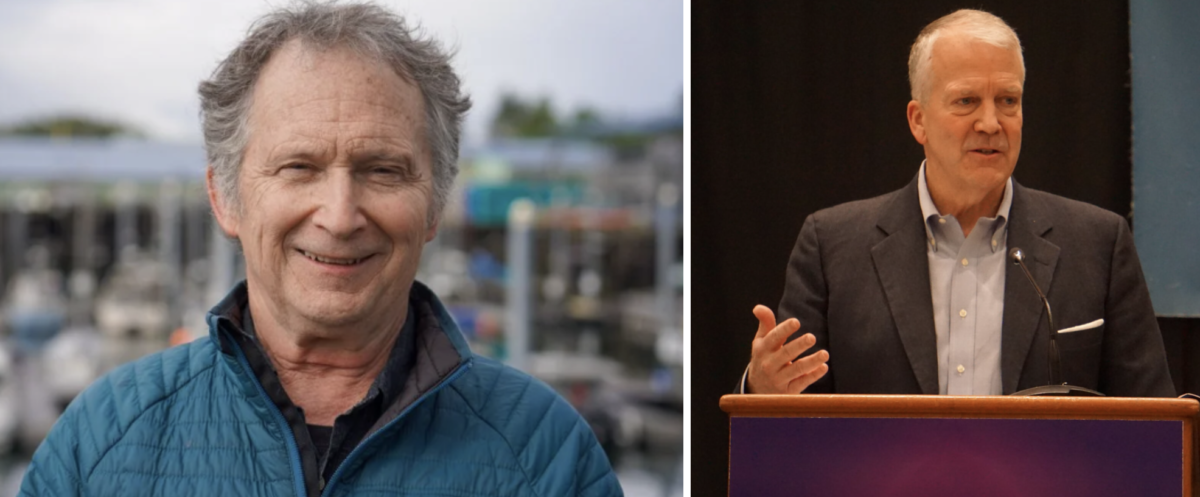
Dan Sullivan of Petersburg (left) filed to run against Republican incumbent U.S. Sen. Dan Sullivan. (Campaign photo by Dan Sullivan and photo of the senator by Corinne Smith/Alaska Beacon)

An Anchorage judge heard oral arguments on Thursday in a case poised to decide whether the Alaska Division of Elections has the authority to remove a candidate with the same name as the incumbent from the race for U.S. Senate. 

The court is expediting the case and a decision is expected Friday. Any appeals are expected to be before the Alaska Supreme Court on Monday, ahead of a looming deadline for the division to print primary ballots no later than noon on Tuesday, June 30. 

The division made the unprecedented decision to remove Dan J. Sullivan, a retired teacher from Petersburg, from the ballot on June 15, citing a “preponderance of evidence” the candidate had not filed a “good faith candidacy” and filed with the purpose to “confuse or mislead” voters. 

Sullivan appealed that decision, saying he meets all eligibility requirements to run for office. He challenged the state’s decision as unlawful, and requested the court overturn the decision and restore his candidacy on the Alaska ballot for U.S. Senate. 

In opening arguments, attorneys for the Division of Elections defended the decision to disqualify Sullivan from the ballot. They said the state has a duty to protect voters from confusion, and that the state is not obligated to place a candidate on the ballot where evidence shows t

Sullivan was one of sixteen candidates to file to run for one of Alaska’s U.S. Senate seats, challenging Republican incumbent U.S. Sen. Dan Sullivan in the high-stakes election that could determine the control of the U.S. Senate after the November elections. One candidate has withdrawn since then, leaving 14 challengers, including former Democratic U.S. Rep. Mary Peltola. The November election results will determine a candidate for a six-year term. 

Critics of Sullivan said he was trying to confuse voters to the benefit of Peltola, the Democratic front-runner. Officials with the Peltola campaign and the Alaska Democratic Party have said they have no affiliation with either Sullivan. 

Attorneys representing the Petersburg Sullivan and the Alaska Division of Elections went head to head in livestreamed Superior Court hearing, where over 300 viewers tuned in but others were not able to watch the stream. Officials with the court later apologized calling it a “record-breaking” livestream and posted a recording on their website.

Jeffrey Robinson, representing Sullivan, opened his argument reiterating that Sullivan met all the constitutional requirements to run for office: at least 30 years old, a U.S. citizen, and an inhabitant of Alaska if and when elected.

Jeffrey Robinson, an attorney for Dan J. Sullivan, argues his appeal case in Anchorage Superior Court on June 25, 2026. (Screenshot of court livestream)

“Mr. Sullivan unambiguously meets each of these criteria,” Robinson said. “As seen in previous cases, states are not allowed to add to those qualifications.”

He cited the case where the Alaska Democratic Party sought to remove Eric Hafner, a U.S. House candidate imprisoned out of state, and the division did not investigate his motives but found he met the qualifications to run for office. Robinson argued the state has subjectively and unlawfully added additional criteria for Sullivan, including restrictions on his perceived political goals, how he presents his name, campaign and his party affiliation. 

“Here the division imposed a substantive mental state-based qualification for U.S. Senate candidates in Alaska, and then it cynically and arbitrarily determined that Mr. Sullivan did not meet that qualification,” he said. 

Robinson said it’s up to political campaigns to distinguish candidates and educate voters. He agreed the division has the authority to make sure candidates appearing on the ballot do not confuse voters, and noted that there are state regulations that offer solutions, like adding middle initials. But he said there are no “good faith” requirements, nor any other regulations that would give the division such broad authority to look at a candidate’s motives for office. 

“They have no explicit authority in situations like this to even look into a candidate’s motives. Any subjective standard for candidates imposed by the division necessarily erodes the trust of voters,” he said. “If this standard were to apply, the director could challenge any or disqualify any potential reasons of personal dislike, or that the candidate may lose to their preferred candidate.”

Arguing for the Division of Elections, attorney Chris Murray said the division has the authority to review candidates and make sure the ballot is not presented in a way that would be confusing to voters.

Chris Murray, a state attorney for the Alaska Division of Elections, argues against the appeal of Dan J. Sullivan in Anchorage Superior Court on June 25, 2026. (Screenshot of court livestream)
Chris Murray, an attorney for the Alaska Division of Elections, argues against the appeal of Dan J. Sullivan in Anchorage Superior Court on June 25, 2026. (Screenshot of court livestream)

In this case, he said the division director, Carol Beecher, reviewed complaints against the candidate filed by the Alaska Republican Party and the National Republican Senatorial Committee, which works to elect Republicans, that say his name, party affiliation and campaign materials mimic the incumbent’s. Murray said Beecher found that Sullivan “accentuated the similarity” between himself and Sen. Sullivan. 

“She was stuck with the preponderance of the evidence pointing to this being a declaration of candidacy filed for the purpose of seeking office, but a declaration of candidacy filed for an ulterior purpose to cause voter confusion,” he said. “The director does not have the ability to permit that.”

Murray said in the Hafner case, there was no complaint filed prior to the primary on Hafner’s candidacy. He said the division has authority to review complaints and determine whether candidates made a “proper filing” before the primary, which they did for Sullivan.

“So where’s the line? The line is: the decision on qualification has to be made before somebody is placed onto the primary ballot, that is where Alaska law, that’s where the ‘properly filed’ comes in, that’s when there’s discretion in the Division of Elections — but that’s when the Division of Election decides who goes on the ballot, it’s before the primary election, that case was after the primary election,” he said. 

Judge Thomas Matthews asked Murray how the division would handle the situation of three Dan Sullivans, in a hypothetical situation where a former Anchorage mayor, Dan A. Sullivan decided to enter the U.S. Senate race.

Superior Court Judge Thomas Matthews presides over the appeal case brought by Dan J. Sullivan challenging the Division of Elections decision to disqualify him for running for U.S. Senate on June 25, 2026. (Screenshot of court livestream)

Murray said a “genuine candidate” would seek to distinguish himself from other candidates, and the division could use a middle initial or notation like “challenger” or “nonincumbent” on the ballot.

“I would say that if you were dealing with all of them, and all of them were trying to get on the ballot in order to win, I think they would all be cooperatively participating in a process where they could be effectively distinguished from each other, so as to avoid voter confusion. That’s not what we have here,” he said. 

Judge Matthews asked if there was a way to effectively distinguish the two Dan Sullivans.

Murray said he did not believe that is the division’s responsibility if the candidate’s goal is to confuse voters. “Where the confusion is the goal, Your Honor, we don’t believe the division is under an obligation to try and mitigate it or accommodate it,” he said. “The court could order that the division implement some method to distinguish him, and I’ll say right now, we don’t think a middle initial is sufficient.”

Murray also argued the court ruling would be an important precedent for the division to administer elections.

“If this decision is not affirmed, and it turns out that the court holds that Alaska is just simply powerless, and the division is powerless to stop this sort of behavior, we’re going to be inviting more of this,” he said.

Judge Matthews said he will announce a ruling by Friday, and it could be after business hours.

Attorneys for Sullivan also filed a stay with the court to delay the division printing primary ballots until a final decision is ruled on by the courts. Matthews said he would consider the petition.  

After the ruling, both parties are expected to appeal before the Alaska Supreme Court on Monday.

Categories
Entertainment

Luis de la Rosa Cause of Death: ‘Spider-Man: Across the Spider-Verse’ …

Reading Time: 2 minutes

We have tragic news to report out of France today.

Luis de la Rosa, the acclaimed animator, whose credits included Spider-Man: Across the Spider-Verse, died Friday after he was struck by a train while attending the Annecy International Animation Film Festival.

He was just 34 years old.

A commuter walks on a platform to catch her train at Paris Saint Lazare railway station on January 29, 2009 in Paris, France.
A commuter walks on a platform to catch her train at Paris Saint Lazare railway station on January 29, 2009 in Paris, France. (Photo by Pascal Le Segretain/Getty Images)

According to local newspaper Le Dauphiné Libéré (via TMZ), emergency crews responded after a man was hit by a locomotive near the train station in Annecy, a city located close to the French-Swiss border.

Despite their efforts, the victim could not be saved.

Authorities initially did not publicly identify the victim. However, the Annecy International Animation Film Festival later confirmed that the man killed was de la Rosa.

Early reports indicate that de la Rosa was killed while walking too close to the tracks, but that detail has yet to be confirmed by police.

De la Rosa had built an impressive resume over the past decade, beginning his career in animation in 2016 with work on Nickelodeon’s Pig Goat Banana Cricket.

He later contributed to several major productions, including My Little Pony: The Movie, Animaniacs, Space Jam: A New Legacy, and the Oscar-winning animated hit Spider-Man: Across the Spider-Verse.

He was reportedly attending the Annecy festival’s industry market to showcase his original project, Ash Raider World, while also meeting with fellow artists and potential collaborators.

Festival organizers have announced that Artistic Director Marcel Jean will honor de la Rosa during Saturday’s closing ceremony, recognizing both his contributions to animation and the devastating loss felt throughout the industry.

News of de la Rosa’s death has sent shockwaves through the animation community, with many remembering him not only for his talent but also for the promising career that was tragically cut short.

Our thoughts are with Luis de la Rosa’s family, friends, and colleagues during this incredibly difficult time.

Luis de la Rosa Cause of Death: ‘Spider-Man: Across the Spider-Verse’ … was originally published on The Hollywood Gossip.

​The Hollywood Gossip

Categories
Politics

A ‘pride match’ between Iran and Egypt — and Washington state’s gay leaders couldn’t be happier about it

SEATTLE — On Thursday, the Washington state House speaker and its Senate majority leader — likely the country’s first-ever pairing of openly gay state capital legislative leaders — met to strategize with progressive campaigners against a pair of conservative-backed ballot initiatives that would impose new rules on transgender children in schools and sports.

To defeat the measures, the campaign will have to convince voters beyond Seattle’s progressive enclaves to accept their arguments about privacy, liberty and acceptance.

But on Friday, Washington’s LGBTQ+ leaders were thinking about how they might address an even more hard-to-reach constituency: citizens of Egypt and Iran, whose governments criminalize homosexuality but have seen their national teams paired through a scheduling quirk in the World Cup’s only official “Pride Match.”

Members of Seattle’s World Cup organizing committee set out to make the June 26 game a showcase of the city’s inclusivity before a random draw ensured two of the world’s most repressive states toward sexual minorities would take the field. While FIFA has banned critics of the regime in Tehran from flying the country’s prerevolutionary flag (under rules prohibiting the display of political symbols), soccer’s governing body has said it will permit rainbow flags over objections from Iranian and Egyptian soccer officials.

“How many opportunities do you have to get positive messages about happy queer people beamed into Iran and Egypt?” said Senate Majority Leader Jamie Pedersen. “I don’t think there’s going to be any way for people who are watching the game and seeing images of the stands to be able to avoid the fact that there’s going to be a huge contingent of rainbow flags waving.”

Pedersen and state House Speaker Laurie Jinkins have known each other since the 1990s, when they first worked together on a failed campaign to pass a statewide nondiscrimination law. Both were subsequently elected to the legislature — she from Tacoma, he from a Seattle district encompassing Capitol Hill, the traditional seat of gay power — and rose to lead Democratic majorities in their respective chambers. Along the way they became friends, attending each other’s marriages and raising children in parallel.

Now they are collaborating with the No Hate in WA State campaign to defeat two separate initiatives that will appear on the November ballot after the two leaders refused to take them up in their legislative chambers. One, characterized as a parents-rights measure, would allow parents to opt out of classes related to sexual education or gender diversity and compel educators to notify parents if their children request medical attention. A separate measure would “prohibit biologically male students from competing with and against female students” in interscholastic sports, and require girls to receive a medical examination confirming their biological sex.

Both Pedersen and Jinkins said they expected to build on the coalition that helped enshrine gay and lesbian rights at the ballot, first by passing a domestic-partnership regime in 2009 and then three years later by approving a same-sex marriage law that had passed the legislature before facing a citizen’s-veto threat. (Let’s Go Washington, the campaign committee organized to pass the two transgender-related initiatives this year, did not immediately respond to a request for comment.)

“What we saw, going back to the 1980s and 1990s, is people didn’t think they knew anyone who was gay or lesbian. Once they started to realize they knew people, that started changing opinions dramatically,” said Jinkins. “It stopped the other side from being able to use stereotypes to characterize us.”

In interviews Friday morning, both of the legislative leaders cast the day’s unusual Pride matchup — and its likelihood for friction with soccer fans in Seattle’s streets — as a healthy development for the state’s LGBTQ+ community.

“That’s one of the best things about the World Cup, some of the exposure that different communities are having to one another,” said Jinkins. “It’s not just Iranian and Egyptian fans learning about Pride, it’s us learning about Iranian and Egyptian culture and thought.”

Neither, however, planned to attend the match itself despite receiving invitations to do so. Jinkins said she would likely visit a “fan zone” watch party being hosted by the Puyallup Tribe of Indians at its administrative headquarters in her Tacoma district. Pedersen, who concedes he is “not a sports fan,” was scheduled to participate in a Trans Pride event in Capitol Hill, the historic heart of gay Seattle where he is deep in an aggressive reelection campaign against a challenger to his left.

“I feel bad when I take up the ticket for something where there is a lot of demand,” Pedersen said. “People who really enjoy it should be having this experience, and probably not me.”

​Politics

Categories
Food

Starbucks Once Used This Controversial Ingredient In Its Strawberry Crème Frappuccino

The Strawberry Crème Frappuccino from Starbucks actually found itself at the center of a heated controversy in 2012 due to a specific ingredient.

​Food Republic – Restaurants, Reviews, Recipes, Cooking Tips

Categories
Music

Gretchen Wilson’s Best Songs After ‘Redneck Woman’

Include four overlooked ballads that deserve more respect. Continue reading…​The Boot – Country Music News, Music Videos and Songs