 After a new signature summer scent?
No matter what your nose is after (whether it’s something floral or fruity) there’s a perfume currently on sale up to 40% off during Amazon’s Summer Beauty…
E! Online (US) – Top Stories









After a new signature summer scent?
No matter what your nose is after (whether it’s something floral or fruity) there’s a perfume currently on sale up to 40% off during Amazon’s Summer Beauty…
E! Online (US) – Top Stories

The Los Angeles Rams shocked the football world when they took Alabama quarterback Ty Simpson with the 13th overall pick in the 2026 NFL Draft. While the Rams stunned just about everyone on Thursday night, though, the decision was the culmination of multiple months of work on Simpson, according to head coach Sean McVay. In an interview with FS1’s “The Herd,” McVay told Colin Cowherd that the Rams didn’t come to a sudden decision to select Simpson with the 13th overall pick as they still have the reigning MVP, Matthew Stafford, on their roster. “There wasn’t that a-ha moment, it was a combination of the work,” McVay said. “You like the body of work, and you say ‘Hey, this guy’s got the potential to develop one day into what we would deem a possible starting quarterback.’ We’ll welcome Ty into the building with open arms, but what I did think what was important for me to make sure that there was clarity on was, let’s not get it twisted. We’re trying to win right now, and we’ve got decisions for the short and long term.” Simpson only started at Alabama for one season, giving him less experience than most other quarterbacks taken in the first round in recent years. However, Simpson had an impressive year in his lone season as Alabama’s starter. He finished the season with 3,567 passing yards, 30 total touchdowns and five interceptions. He also had four consecutive wins over AP Top 25 teams, leading the Crimson Tide to their first College Football Playoff appearance under head coach Kalen DeBoer. As a result, Simpson was widely viewed as the No. 2 quarterback prospect in the 2026 NFL Draft, trailing only Fernando Mendoza. FOX Sports NFL Draft analyst Rob Rang gave the Rams a B grade for the pick of Simpson, calling it a “gutsy” pick. “There is no denying that he is a good fit in Sean McVay’s offense — he was listed as such in my best NFL team fits for each of this year’s QBs — but this is easily the gutsiest pick of the first round thus far,” Rang wrote. “This is obviously a move made for the long term. But I can’t help but wonder if the Rams, presumably Super Bowl contenders in 2026, will later wish they’d selected a player likelier to make an immediate impact.” Even though Rang and some others liked the selection of Simpson due to the positional value, there was still a massive elephant in the room with the pick. But McVay also made it clear that the team prioritized keeping Stafford in the loop when they were making the selection of Simpson. McVay said that communication was extremely important and called Stafford “a total stud” throughout the whole process. “If you can’t have a little comfort in the conflict, but it’s all rooted in I trust that person. I know what they’re saying is the truth … you can work through those things,” McVay said. “I think one of the biggest breakthroughs of our relationship was having to go through some of the tough conversations we had last season.” Stafford didn’t show any signs of aging last season, throwing for 4,707 yards, 46 touchdowns and eight interceptions as he led the Rams to the NFC Championship Game. He and the Rams are also reportedly discussing an extension to keep him under contract for a little longer. Still, Stafford turned 38 in February, and McVay admitted that the quarterback’s commitment is likely on a year-to-year basis at this point. Still, even if Simpson is the heir apparent to Stafford, he’ll have to work his way up the depth chart to become their backup quarterback first. As the team is in the midst of organized team activities (OTAs), McVay has iterated that Simpson will compete with Stetson Bennett for the top backup job.Latest Sports News from FOX Sports

When you dig into a dish and get an explosion of salt, you aren’t doomed to eat an unpleasant meal. There are multiple ways to weaken or mask the flavor.

Mashed – Fast Food, Celebrity Chefs, Grocery, Reviews

If you love pasta salad but want to work on getting in your protein-maxxing, then you need to try our Southwestern pasta salad with 18 grams of protein.

Food Republic – Restaurants, Reviews, Recipes, Cooking Tips

 West Wilson’s family is facing an unimaginable tragedy.
The Summer House star’s cousin Dakota Sweeney was arrested in Missouri and charged with allegedly murdering their grandmother Gayle R….
E! Online (US) – Top Stories

She just opened up about her pregnancy struggles. Continue reading…The Boot – Country Music News, Music Videos and Songs
She just opened up about her pregnancy struggles. Continue reading…Country Music News – Taste of Country

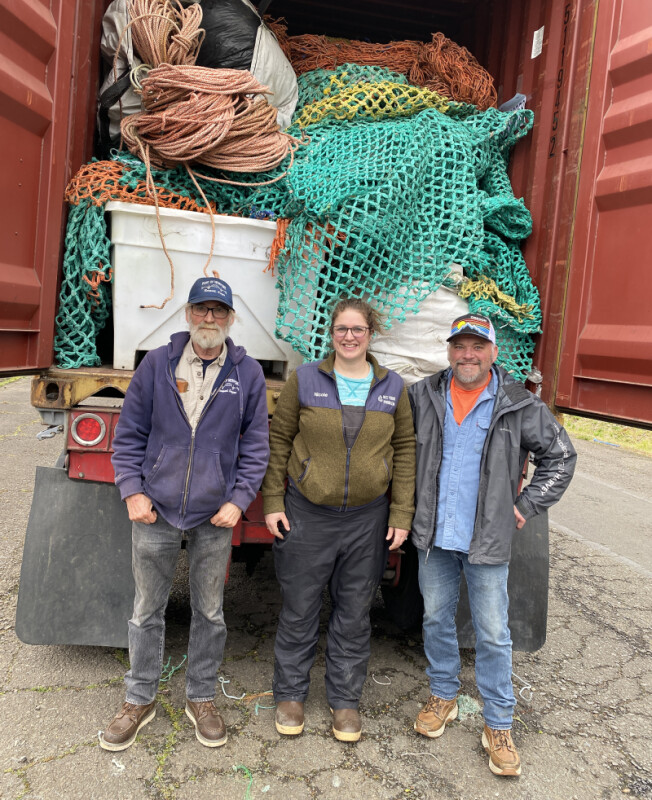
Brian Shaw (left) and Eric Klose stack retired commercial fishing nets for shipment to Ukraine, where they will be used to entangle Russian drones before they can explode — protecting soldiers in trenches and civilians in markets and homes. (Ground Squirrel Ventures photo)
This article originally appeared in National Fisherman and is republished here with permission.
Worn-out commercial fishing nets and lines from America’s Pacific Northwest are getting a new life protecting soldiers and civilians in Ukraine from exploding Russian drones.
These nets are hung over doorways and windows to entangle the drones before they can hit a target and explode.
On Wednesday, April 22, Nicole Baker of Net Your Problem, an Alaska-based maritime recycling firm, was in Newport, Ore., overseeing the loading of 29,000 pounds of worn-out trawl, gill, and seine nets and crab line from harvesters into a 40-foot container headed for Ukraine. The load included 19 trawl nets, four bags of seine web, one bag of gillnet web, and three bags of line.
Net Your Problem got involved last year when contacted by a Boston-based venture capital and private equity firm looking for commercial fishing nets to send to Ukraine. Nets from Net Your Problem became part of the firm’s first container load of nets to Ukraine.
“I could never have imagined this is what would happen to these nets, and I can’t think of a more fulfilling way to use them,” Baker said. “It’s literally saving people’s lives.”
“My sister is an ICU cardiac nurse, and she saves people’s lives. Now I do too,” she said.
The venture capital firm, Ground Squirrel Ventures, is a network of angel and seed stage investors founded by Eric Klose in 2018.
Klose said he learned on an earlier visit to Ukraine that discarded fish nets could save lives in the trenches of war zones and in buildings in besieged cities.
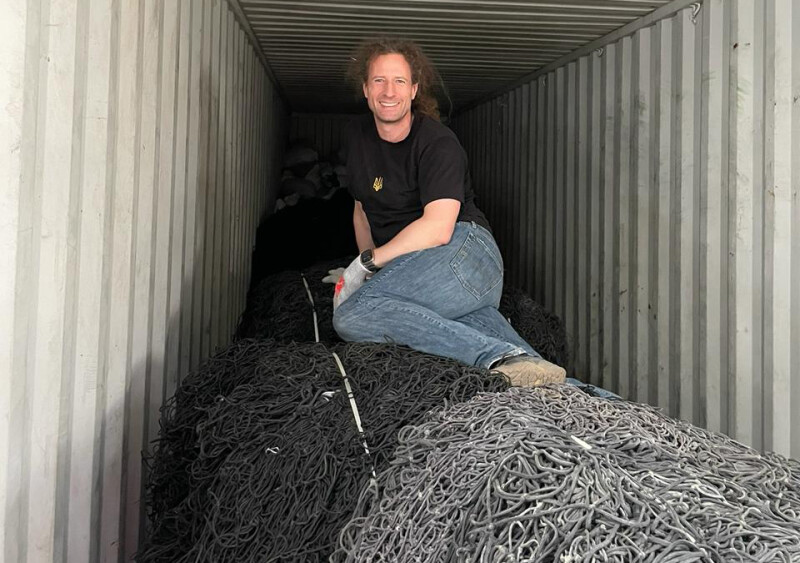
Klose hardly considers himself a hero, though. “I’m letting people do a lot and also keeping fishing nets out of the ocean,” he said. “I love that this also is saving lives and spreading freedom and democracy. I am just helping to connect people, and I am able to fund the shipping cost,” he said.
Klose, who earned a degree in public administration from the Harvard Kennedy School of Government, has friends in the Boston area of Ukrainian heritage.
On a trip to Ukraine with a group of graduate students, he sometimes slept in basement bomb shelters in Kyiv and also saw extensive war damage in Kharkiv.
He spoke with aid groups who were bringing clothing, medical supplies, and other needed items to Ukraine and asked what else was needed. “Fish nets,” they told him. They put him in touch with another volunteer in Vancouver, Canada, who was sending fish nets, medical supplies and more.
In December 2025, Ground Squirrel Ventures assembled its first container load of fish nets, including those from Net Your Problem, and shipped them to Ukraine. Volunteers there put the word out that more nets were available, and soldiers began collecting them to cover doors and windows to entangle Russian drones.
Other discarded nets, once used in crop farming and commercial fisheries across Europe, are also being used to cover roadways in Ukraine. CNN reported in January on Ukrainian soldiers raising nets donated by French fishermen and volunteer groups in Brittany to cover roads and protect vehicles traveling to and from supply lines. The nets are also used to protect hospitals, generators, and shopping areas with canopies of netting.

Oleksandr Tolokonnikov, deputy head of the Kherson Military Administration, told CNN in November that the Russians are launching an average of about 2,500 unmanned aerial vehicles every week. CNN also reported that Life Guardians, run by Klaas Pot in the Netherlands, has sent over 8,000 tons of nets to Ukraine. Additional nets were donated by Norwegian Volunteer Air and Pickups For Peace in the United Kingdom.
Ground Squirrel Ventures’ main focus is on impact-driven investments in climate mitigation and frontier markets. The firm manages a portfolio of 30 companies and operates with a team that includes Brian Shaw as portfolio and operations manager.
As of April 21, Shaw said Ground Squirrel Ventures was working on shipping its second container of about 10 tons of retired commercial fishing nets to Ukraine, with two more container loads planned over the next three months.
“This is our own way of supporting human dignity and the rights of people,” said Shaw. “We are just people living our lives, and we found a need. I am a problem solver by nature.”
“The goal is somewhere in the range of four to six containers a year,” he said. “A lot of fishermen and companies would previously have dumped these nets in their yard.”
“This provides a way for these nets to have a second life. Soldiers will hang them in windows of buildings they are working in.” The nets are also being used over community open markets and other civilian areas to tangle Russian drones and prevent them from hitting targets and exploding.
“Ukrainians are trying to free their own country, which does not seem like too much to ask,” Klose said.
Back in the Pacific Northwest, Baker said she plans to keep participating in the project. Fishing vessel owners and others who are interested can find more information online here.
By: Corinne Smith, Alaska Beacon
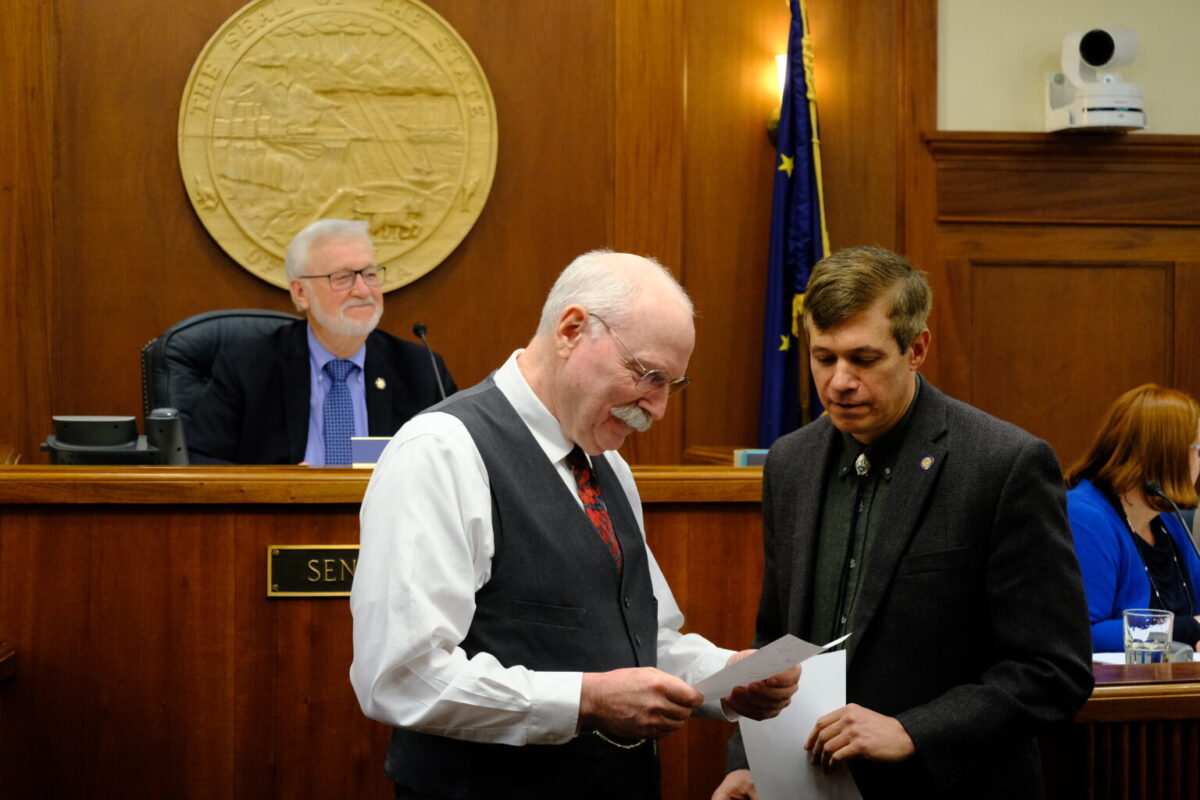
Members of the Alaska Senate voted to approve a long-awaited pension bill on Tuesday, amid debate on the cost of the new public retirement benefits system and responsibilities of the state and local community employers.
The Senate passed a revised version of a pension plan approved by the House last year. The vote was 12 to 8. Twenty years after lawmakers eliminated a public pension system, the vote marks the closest lawmakers have come to restoring a defined retirement benefit for thousands of Alaska’s public sector employees.

“It strikes me as a historic day,” said Sen. Cathy Giessel, R-Anchorage, after the vote. She has been working on the issue for several years. “When you figure 33 different offerings to correct this over the years — yeah, we’ve been trying for a long time.”
If enacted, the bill would reinstate a defined benefit retirement system for Alaska state employees, as well as teachers, public safety workers and municipal employees statewide.
The move comes as the state struggles to fill positions across state departments, including public safety, corrections and in education roles.
Supporters said the retirement benefit is crucial for hiring and retaining a skilled public sector workforce in Alaska for the long-term, while detractors say the uncertainty around the cost to the state and local municipalities isn’t worth the risk.

Senate Minority Leader Sen. Mike Cronk, R-Tok, said he opposes increasing state spending.
“We look at our federal government, we’re going to be $40 trillion upside down. That’s totally unacceptable,” he added. “And for adding this kind of burden for the future, generated cost is something that I just can’t be a part of. I know we have a problem. I think there are other solutions out there that can help this problem.”
The move was applauded by the state’s largest public employees union, the Alaska State Employees Association, which represents roughly 8,500 public employees.
“The impact is almost difficult to overstate,” said Heidi Drygas, its executive director, by phone on Tuesday. “Our membership overwhelmingly supports a defined benefit pension. And I think this will mean security for them, so that they can feel comfortable staying in their state jobs. It will attract more employees to work for the state.”
The bill passed the House last May, and the revised version now goes back to the House for a concurrence vote, before heading to Gov. Dunleavy’s desk for consideration.
The governor has been critical of previous pension proposals. Dunleavy receives a state pension for his previous employment as an educator and superintendent.
If the bill becomes law, current state employees would be allowed to switch from a defined contribution or a 401(k) style retirement plan to the new system. Retirement for teachers and public employees would be possible at age 60 or any age after 30 years of service. For public safety officers, including police and firefighters, it would be age 50 with 25 years of service, or age 55 with 20 years of service.
“Every other state offers a pension for at least some of the public servants. We do not,” Giessel said on the Senate floor. “And we are seeing the results. We ask our public employees to do difficult work, often in the hardest conditions. The question is whether we will give them a reason to build a career here.”
After several hours of debate, the Senate approved several amendments, including a change to allow cities and boroughs to choose whether to opt out of the new defined benefit retirement plan, instead of opt in.
“It’s better policy for local governments to follow the state’s lead,” said Sen. Matt Claman, D-Anchorage, who sponsored the provision. “If they don’t like our choice, they’re certainly allowed to make their own choice and opt out, but if they don’t take any action, they’re in.”
That means local cities and boroughs can choose whether to opt out of the plan, if enacted, between January and June of 2027, and then the new system would begin July 1 next year.
Under the revised bill, employees would contribute 8% of their pay to the pension plan. Employers would pay up to 22.5% for public sector employees, and up to 12.5% for teachers. Senators debated the cap and arrived at 22.5%, noting municipality officials public testimony and concern about cost.
Employers would also pay into a health reimbursement fund of up to 4% of workers’ salaries to supplement Medicare for those over age 65. Disability and death benefits would be included.
If passed, the bill would revive Alaska’s state pension that was eliminated in 2006, after the state ran into a multi-billion dollar shortfall and unfunded liabilities in the retirement system.
Sen. Bert Stedman, R-Sitka, a co-chair of the Senate Finance Committee, opposed the bill, citing the risk that the state will repeat the mistakes of the early 2000s.

“This proposal in front of us today diminished the benefit to the retired employee when it goes underfunded. Yeah, it won’t go unfunded until people retire. Normally, it takes about 30 years, but we’ve got 20 years already with the current defined contribution. So about 10 years out,” he said.
A recent estimate by the state’s actuary, Gallagher, projected state costs to total $467 million for the first 13 years, until FY 2039.
Stedman said the state is also still on the hook to pay billions to account for the old pension system. But Giessel said the new pension system has built in safeguards to prevent it from going underfunded, according to the actuary’s analysis.
“Even with a never before seen ‘black swan’ event of three consecutive years with zero investment returns, even then this pension holds up,” she said.
Giessel and other lawmakers cited the state’s current ballooning costs paying state employee overtime to cover vacancies and essential public services, called “premium pay.”
“It is costing us over $200 million a year in premium pay,” she said. “Just to keep basic services running — that number has grown nearly 80% in the past five years. We have, in effect, turned Alaska into a training ground, a place where people come, gain experience and then leave.”
Sen. Bill Wielechowski, D-Anchorage, described a crisis of families leaving the state, in part due to a lack of stable retirement. Alaska has seen more than a decade of consistent outmigration, according to state data.
“There has been a quiet, heavy crisis unfolding all across Alaska, in our schools, in our state office buildings, in our courts, in our communities all across Alaska, it’s the sound of a door slamming shut. Another family packs up to leave,” Wielechowski said on the Senate floor.
“We talk a lot about fiscal responsibility in this chamber, but I ask you, what is responsible about watching our most precious resource, our people walk out the door?”
Supporters of the pension plan also pointed to the state’s struggle with high turnover rates, including up to 30% of teachers in urban and rural districts alike each year.
Sen. Löki Tobin, D-Anchorage, and chair of the Senate Education Committee, said the high unseen costs of turnover of educators is magnified throughout the state.

“Because of high teacher turnover, we’re already paying $20 to $30 million a year,” she said. “We can either continue to pay that in turnover costs, or we can fund a quality retirement program that retains our quality educators, attracts new quality educators, and ensures that our kids get the best education they deserve.”
Senators in support of the pension plan noted a recent state audit of Alaska state government that reported hundreds of millions lost in federal reimbursements or incorrectly accounted for due to a variety of factors, including “staff turnover,” “competing priorities” or “inadequate supervisory review.”
Wielechowski pointed to one example of the Alaska Department of Military and Veterans Affairs underreported disaster spending for federal reimbursement by $297 million. The error was corrected once identified by auditors, according to the report.
“Dozens of projects incorrectly reported. And that’s just that’s just a fraction of the inaccuracies and the mistakes,” Wielechowski said.
Opponents of the pension bill pointed to other factors contributing to high turnover like work environment, leadership and a need to raise salaries.
That included Cronk who said he receives a pension after teaching for 25 years. “I would say focus should be on our pay,” he said.
Drygas, with the state’s public employees union, said while the pension plan is one important part of Alaska’s workforce issues, she sees it as crucial for stemming the tide of outmigration from the state.
“I cannot tell you how many people, just personal, friends and acquaintances that I know, that are leaving state service in particular because they can’t retire here. They can’t live on the retirement that our state offers,” she said. “So I think a lot of us are hopeful that, you know, five or 10 years in the future, if this legislation should pass and become law, we’ll see a turnaround in our state workforce again.”

Keith Urban will release his 13th studio album Flow State on June 12. The project features a mix of classic yacht rock covers alongside one original track, “We Go Back” featuring Michael McDonald.
Produced by Urban and Dann Huff and recorded at his Nashville studio, the album features collaborations with Little Big Town and John Mayer. The project highlights songs like “Baby Come Back” and “Just the Two of Us,” alongside the original track and a rendition of “Summer Breeze,” both available now.
Urban said the album came together organically while breaking in his brand-new studio, which used to be called the Tracking Room.
“It really started from me buying a studio in town…It’s been around a long time and I acquired that studio in ‘24. Spent about nine months getting it TLC back up and running. By the time it was ready to record in, I was hitting the road. And so, it was one of those frustrating things where, you know, I wasn’t going to get to record there very much. And so, I was trying to find something that would just be simple and fun to do to just record,” he explained in an interview with SiriusXM’s The Highway. “I called Dann Huff and I go, ‘How about we just do one or two yacht rock songs just just to break the studio in for a bit of fun.’ And that was it. There was no big preconceived idea. And we recorded two songs and the session band came in and we all looked at each other and we went, ‘These sound really good.’”
They began with just a few songs and before he knew it, a full album had come together.

In another statement, he shared that the project’s laid-back sound is meant to serve as both an escape and a reminder of what really matters in life.
“The origins of this kind of music was, in certain ways, a reaction and an antidote to the stresses of the times. Its sole mission (and soul mission) is unchanged…to bring us together and remind us that life is happening NOW- the eternal now- and we have far more in common than not. I hope wherever you hear this album you can feel the exhale, comfort and optimism these songs were originally written by and for.”
Urban is set to perform at several festivals and events throughout 2026, including ACM New Wave: Country’s Beach Bash in Las Vegas on May 16 and CMA Fest in Nashville on June 5.
1. Steal Away
2. Baby Come Back
3. Magnet and Steel (ft. Little Big Town)
4. Just the Two of Us
5. On and On
6. We Go Back (ft. Michael McDonald)
7. Help Is On It’s Way
8. How Much I Feel
9. Summer Breeze
10. I Just Wanna Stop
11. Guitar Man (ft. John Mayer)
The post Keith Urban Announces Yacht Rock Album, ‘Flow State’ appeared first on Country Now.
Country Now