Tucker Wetmore’s sizzling new track “Sunburn” captures the heat of a beachside romance. From sun-soaked days to late-night romance, the tune, out now via Back Blocks Music/MCA/ Mercury Records, immerses listeners in the thrill and intimacy of a secret summer fling.
Co-written by Ryan Hurd, Jaxson Free, and Daniel Ross and produced by Chris LaCorte, “Sunburn” tells the story of someone who embarks on a spontaneous solo getaway, with a goal of enjoying some down time and playing some songs on the beach. It was supposed to be a quick trip, but the man ends up “stayin’ all week” after meeting someone who was worth sticking around for.
“Was playin’ red red wine and you were sippin’ on yours/ You had your friend come up to me and ask if I’m on my own/ I asked her why and she said that girl over there wants to know/ A couple rum runners later and it was just me and you/ We said we won’t tell nobody but baby everyone knew ‘bout,” Wetmore sings in the opening verse.
Tucker Wetmore; Photo Provided
As he illustrates in the chorus, a few drinks eventually turn into an all-consuming, heat-of-the-moment rendezvous between him and a mystery girl. Though the pair only spend a few nights together, he admits they’re able to tune out the rest of the world, making it feel like “we had our own island.”
Wetmore continues, “Them hotel sheets we were under/ Couldn’t tell you which room or number/ All I know is I was fallin’ in deeper/ And that door said do not disturb/ Yeah you hit me like a heat wave/ We stayed up all night all day/ Waves crashin’ outside like thunder/ Your body on mine like a sunburn.”
The Washington native’s vocals glide effortlessly over the breezy, laid-back instrumentation, perfectly capturing the warmth and intensity of a fleeting summer romance. With its mix of playful storytelling and heartfelt desire, “Sunburn” can easily be described as a carefree, sun-soaked anthem that leaves listeners longing to feel the sand between their toes and the rush of a connection that burns with the hot summer sun.
“Sunburn” follows the success of Tucker Wetmore’s fan-favorite track, “Brunette” which recently topped the U.K. Radio Country Airplay chart for three consecutive weeks and earned a spot in the Top 15 at Country radio in the U.S. Spawning from his debut album, What Not To, the hit has also racked up more than 225M U.S. streams.
Tucker Wetmore is currently heating up stages with his growing list of hits on The Brunette World Tour presented by NÜTRL Vodka Seltzer. He kicked things off in February with sold-out shows in Boston and New York City as well as his first-ever arena headlining show in Harrisburg, Pa. 17 new dates have since been added to the run, including shows in major markets such as Los Angeles, Chicago and more.
Tucker Wetmore Sunburn Cover Art
Wetmore will be joined by Maddox Batson, William Beckmann, George Birge, Jacob Hackworth, Braxton Keith and Stella Lefty for select dates.
Additionally, he’s set to head down under for dates in Australia, perform across the U.K. and EU, including three sold-out nights in London, and join Jordan Davis, HARDY and Brooks & Dunn on tour for select dates.
Rep. Andy Barr (R-Ky.) has locked down his House district for over a decade. Democrats think his Senate bid presents them an opening in a seat that has raced away from the party.
Kentucky’s 6th District — anchored by Lexington in the heart of the Bluegrass State — hasn’t elected a Democrat to Congress since Ben Chandler in 2010. Barr has held the seat since 2013 and has proven difficult to dislodge. The last time a Democrat came close was in 2018, when fundraising juggernaut Amy McGrath came within about 3 points of defeating him.
If Barr had sought another term, Democrats privately concede they stood little chance.
But with Sen. Mitch McConnell (R-Ky.) retiring and Barr opting to run for his seat, a rare open seat is now in play — and firmly on Democrats’ target list.
In the Democratic primary, two candidates have emerged as frontrunners, according to national Democrats watching the race: Zach Dembo, a Navy veteran and former federal prosecutor, and Cherlynn Stevenson, a former Kentucky state representative. Each is offering a different theory for how to flip the deep-red district.
The question of how a Democrat could win the seat dominated a Democratic primary debate earlier this month, where candidates leaned on sharp criticisms of the Trump administration, ranging from its decision to strike Iran to affordability issues as a result of the president’s tariffs.
Stevenson has branded herself a “Mountain Democrat,” leaning into her Appalachian roots and pitching herself as someone who could mend the disconnect between the party and rural voters by focusing on cost-of-living pressures and access to affordable health care. She said her upbringing in a small mining town in eastern Kentucky and years living in Lexington allow her to bridge the district’s urban-rural divide.
“Winning right here in Kentucky requires cultural fluency and trust,” Stevenson said in an interview. “I know how to talk to working families, rural communities and independents because I am one of those people.”
She’s also got experience flipping seats. She was the first woman and first Democrat elected to represent Kentucky’s 88th state House district, where she also served as state House minority caucus chair.
Dembo, meanwhile, is pitching himself as a “Beshear Democrat” — a nod to Democratic Gov. Andy Beshear, who performed well in the 6th District during his 2023 reelection campaign.
“This is 100 percent a flippable district,” Dembo said in an interview, pointing to headwinds from “all of the terrible decisions of this Republican Congress.”
He has emphasized his experience as a Navy JAG officer and former federal prosecutor, arguing his resume gives him crossover appeal in a Republican-leaning district. Dembo resigned from his position at the Justice Department during Trump’s second term, saying he could no longer remain in his role amid what he described as corruption and the Trump administration’s “abuse of the criminal justice system.”
Both Dembo and Stevenson have posted solid fundraising numbers. And Republicans have a contested primary as well, in a race that includes state Rep. Ryan Dotson and former state Sen. Ralph Alvarado.
“We’re giving Republicans a run for their money in places that they never thought they would have to compete before, and now they do,” said DCCC spokesperson Madison Andrus.
But the race will still be incredibly challenging for Democrats, even though the DCCC has had the seat on its “Red to Blue” battleground list. Kentucky’s federal delegation remains overwhelmingly GOP. The seat also got nominally redder during the post-2022 redistricting process, making it even tougher terrain than during McGrath’s close call in the last Trump administration midterms eight years ago.
Most election watchers believe the seat is well outside the core House battleground as well, and it has not attracted notable outside spending, underscoring how steep the climb would be for Democrats to win even without an incumbent on the ballot.
Republicans dismissed the Democrats’ optimism outright.
“Democrats have been enjoying too much bourbon because their Kentucky 6 wishes are delusional,” said NRCC spokesperson Zach Bannon. “Republicans are poised to keep KY-06 red to retain and expand our majority.”
(Steve Curley/ American Solitude) Actor Joshuah Close, left, and Haines director Aaron Davidman talk on February 12, 2024 on the set of American Solitude.
A seasonal Haines resident is kicking off a Southeast Alaska tour of his new film “American Solitaire” at the Chilkat Center on Wednesday.
The film centers around main character Slinger, a veteran who came home to the United States from his final tour “somewhat wounded and somewhat traumatized and his journey to heal,” according to director Aaron Davidman.
It grapples with themes of suicide and the impacts of escalating gun violence in America.
Davidman said he came up with the idea for the movie after reading his screenplay Ghost Town Bardo at the Chilkat Center during the summer of 2021. That screenplay, a one-man show about violence, guns and individualism, turned out to be something of an early version of the story at the heart of American Solitaire.
“Gun violence is something that I really was drawn to,” Davidman said. “I was looking for a way to use art to broaden our public discourse.”
Davidson mentioned that nearly 47,000 people died from gun-related injuries in 2023, according to a Pew Research Center. Fifty-eight percent of the gun-related deaths in 2023 were suicides. Alaska has the third highest gun suicide rate in the country, according to the study.
In the film, another character tells Slinger that they “trained the violence in and the tenderness out during military training… to heal you have to reverse that.” The question at the center of this film, according to Davidman, is “How do we heal from those kinds of wounds?”
“I don’t think there’s been much movement around how our communities manage the issues of gun culture, gun violence, (that) gun safety statistics are holding,” he said.
But, despite the partisan battles over gun violence and regulation at the national level, Davidman said this is not a political movie. It is about a man trying to reintegrate into civilian life. After showing this film, Davidman said he hoped to have a “heartfelt conversation” and discuss issues brought up in the film, including masculinity.
“The film opens up another sort of subtle approach to ask a question around what is manhood and masculinity and also fatherhood, because someone is a father. What does that look like in a culture that’s so violent,” he said.
He chose to center his film around a veteran because of “their deep experience, in relationship to firearms professionally.” To prepare for this film, Davidman said he interviewed legislators, cops, trauma surgeons and veterans all over the country. He found that veterans had the “most moral authority to really speak to these issues.”
Davidman recalled speaking to a former Army captain who served multiple tours in Iraq and Afghanistan. That officer trained men and women to be on the firing line and use their weapons.
“There’s a lot of room to create more safety with these firearms, a lot of room to create more healthy community conversation around how we can reduce death and injury by these lethal weapons,” said Davidman.
The film, Davidman’s first in the director’s seat, first premiered in November 2025 at the Coronado Island Film Festival in San Diego. It will be shown in Haines on March 18, in Skagway on March 20 and in Juneau on March 23.
Locally, veteran Kyle Clayton will moderate a discussion after the 1 hour and 35 minute movie.
Clayton is part of Haines’ large veteran population, estimated to be at about 171 people according to the United States Census Borough report for Haines in 2024.
Clayton said he has already seen the film.
“There’s something there for everybody to consider, regardless of where you stand on certain issues. It’s an interesting movie and it makes you ask questions,” he said.
Returning to the Chilkat Center, Davidman believes that this film is “best served on a big screen in a dark room with a group of people, experiencing it together.”
“The power of storytelling, whether it’s live theater or cinema, is at its best when we experience it in community,” he said.
Carly Pearce had fans buzzing when she recently wiped her Instagram clean, leaving just a steamy preview of a music video featuring Riley Green to speculate over. At this point, it became clear that the pair would be teaming up for a new collaboration and today, the result of that partnership finally arrives with “If I Don’t Leave I’m Gonna Stay.”
The anticipation was worth the wait as the superstar duet effortlessly intertwines their vocals, creating a sultry, tension-filled narrative that keeps listeners hooked from the first note to the last.
Written by Devin Dawson, Seth Ennis, Jordan Minton, and Jordan Reynolds, the lyrics capture the emotions of a couple who can’t resist each other, , even though they know the consequences that lie ahead.
Carly Pearce; Photo Provided
Pearce and Green explore the thrill and danger of late-night temptation, where one more drink could lead to some bad decisions that will ultimately result in heartbreak. Still, they can’t help but give into the desire to start over and see where things could go. The pair admit, “We’re so good at striking matches, but we’re no good at ever putting out the flame.”
Their passion-filled vocals intertwine, with Pearce’s emotive tone perfectly complimenting Green’s raw delivery. The chemistry between the two artists is undeniable.
“If I don’t leave, I’m gonna stay/ If we don’t stop, we’re gonna start all over again/ And if I bend, I’m gonna break/ We’re gonna blame it on the rain, or on the wine/ We’re getting close to losing clothes/ I should go, look at the time, it’s getting late/ If I don’t leave, I’m gonna stay,” they sing on the chorus.
The release was also paired with a music video that’s sure to get fans’ hearts racing. Directed by Wes Edwards, the video finds Pearce and Green navigating the push-and-pull of whether to let the night continue or walk away.
Candlelit slow dance scenes intertwine with morning-after glimpses, showing a shirtless Green surveying a messy bed, burned-down candles, and empty wine glasses scattered across the living room. As he prepares a cup of tea, he reflects on the choices made the night before, but keeps fans wondering what really unfolded.
Co-produced by Pearce and longtime collaborator Ben West, “If I Don’t Leave I’m Gonna Stay” is a steamy, emotionally charged addition to both artists’ catalogs.
“Collaborating with artists I’m a fan of is one of my favorite things to do,” shares Pearce. “I’ve been a fan of Riley’s for so long and knew if we could find the right moment, it would be special. ‘If I Don’t Leave I’m Gonna Stay’ is the perfect moment for us!”
“I’ve been a huge fan of Carly and her voice for a long time, so it was cool to get the text from her about this song,” adds Green. “The harmonies were unique and there was something really different about it. I’m glad she thought of me for this song, it’s awesome to get to do something together.”
Carly Pearce, Riley Green; If You Don’t Leave I’m Gonna Stay
The new song is the latest in a string of releases that preview Pearce’s next era of music. Her collaboration with Riley Green follows “Church Girl” and “Dream Come True.” Pearce is continuing to prepare her fifth studio album, with more new music expected in the coming months.
This month, Pearce will head back to Australia to perform at CMC Rocks. In May, she will make her way to the UK and Ireland for her headlining Inside The Dream Tour, including a stop at the iconic Royal Albert Hall and a headline set at London’s Highways Festival.
Was the disappearance of Savannah Guthrie’s mother an isolated incident?
Sheriff Nanos doesn’t want people to assume so.
The fate of Nancy Guthrie remains unknown.
“Keep your wits about you,” he urges people. If it happened to the Guthries, it could happen to someone else.
Amidst her status as a missing person in early 2026, Nancy Guthrie’s image was shared far and wide in the hopes that someone knew something. (Image Credit: NBC News)
Believing that this was targeted and knowing are different things
On Thursday, March 12, Pima County Sheriff Chris Nanos answered some blunt questions about the tragic disappearance of Savannah Guthrie’s mother.
Speaking to NBC News, he admitted that the suspect could “absolutely” strike again.
“We believe we know why he did this,” he confirmed.
He also confirmed that officials “believe [Nancy] was targeted” for this crime.
However, he cautioned that investigators are understandably “not 100 percent sure of that.”
Sheriff Nanos quickly made it clear that he wants people to use their common sense.
“It’d be silly to tell people, ‘Yeah, don’t worry about it. You’re, you’re not his target,’” he reasoned.
In fact, he went on to encourage people to not think of home invasions and kidnappings as a one-and-done crime.
“Don’t think for a minute that because it happened to the Guthrie family, you’re safe,” he cautioned.
“No,” Nanos emphasized. “Keep your wits about you.”
Pima County sheriff Chris Nanos speaks on NBC News. (Image Credit: NBC News)
Each day that passes makes this worse and worse
The search of Nancy is nearing its sixth week.
Aside from her abductor, the last person to see Savannah Guthrie’s mother spotted her on January 31.
Nancy is 84 years old. She has medications that she needs to be taking in order to remain healthy.
Though the amount of blood found at her home was not considered in and of itself life-threatening.
However, everything — the unclear motive, the lack of proof of life, the weeks without results, and Nancy’s health — paint a dreadful picture.
Savannah has used her platform to share multiple pleas for her mother’s safe return.
She has also offered $1 million for information. The lack of response seems to suggest that safe return is no longer an option.
Savannah has acknowledged that her mother “may already be gone.”
She continued: “If this is what is to be, then we will accept it, but we need to know where she is. We need her to come home.”
Amidst massive public support, she has remained on hiatus from The Today Show as her thoughts and attention are with her mother.
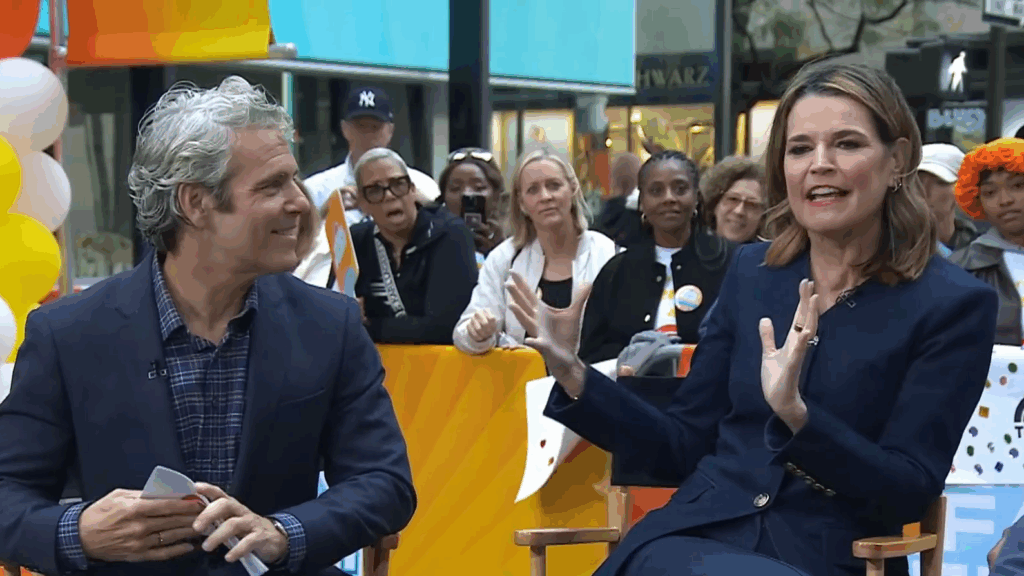
Andy Cohen had a chat with Savannah Guthrie while fans gathered and listened. (Image Credit: NBC)
This is a senseless crime
There is no good time to be kidnapped and possibly murdered. But 2026 is perhaps the worst time.
Right now, the federal government is disinterested at best in the plight of the Guthrie family.
As Savannah has poured her heart and soul into searching for answers, Trump’s head of the FBI went to party in the locker room of the men’s hockey team in Milan.
Was the search for Nancy botched? We don’t yet know.
At present, it appears that her abduction was botched. That’s a popular theory, at least.
This is a devastating tragedy. And everyone should remain on their guard.
The war with Iran has brought simmering tensions to a boiling point, and every day, millions of social media users — some of them former Trump supporters — are venting their frustrations online.
But in debating these issues, it’s important that we don’t forget our humanity — say, by harassing teenagers or bashing people for physical characteristics that can’t be helped.
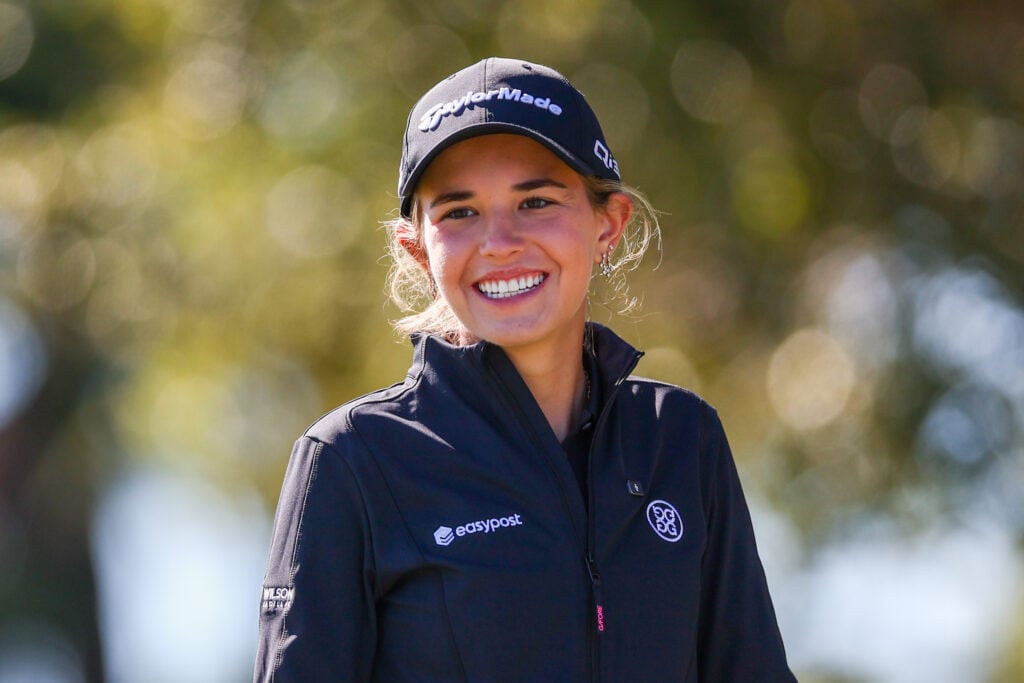
Amateur golfer Kai Trump looks on from the 11th tee prior to The ANNIKA driven by Gainbridge at Pelican 2025 at Pelican Golf Club on November 12, 2025 in Belleair, Florida. (Photo by Douglas P. DeFelice/Getty Images)
Yes, depending on your worldview, 18-year-old Kai Trump might be on the wrong side of history.
In fact, in her work as an influencer might — again, depending on where you fall on the political spectrum — be helping to normalize a homicidal regime that’s currently decimating and destabilizing a region that’s home to nearly half a billion people.
So it’s fair game to bash Kai and her family’s politics.
But if you feel inclined to insult her appearance or her way of speaking, maybe remind yourself that she’s a literal teenager.
Earlier this week, Kai posted a video in which she visited the ultra-posh supermarket Erewhon.
And the clip unexpectedly became a teachable moment, as it highlighted the kind of trash talk that’s acceptable in relation to political figures and the kind that’s wholly inappropriate.
Remember, if you bash a politician for being overweight (for example), the politician probably won’t see it — but your overweight friend will.
In Kai’s case, go ahead and talk trash about how she and her family are completely out of touch with the struggles of the average American.
Go ahead and joke about how tone deaf it is to flaunt the fact that you’re spending outrageous amounts of cash on luxury goods at a time when millions are struggling to put food on the table.
But don’t make wisecracks about Kai’s alleged “speech impediment” as so many on X (formerly Twitter) have done in response to her recent post and her previous public appearances.
“Does Kai Trump have a speech impediment? Not trying to be rude here, but she slurs her words a lot when talking,” one X user wrote.
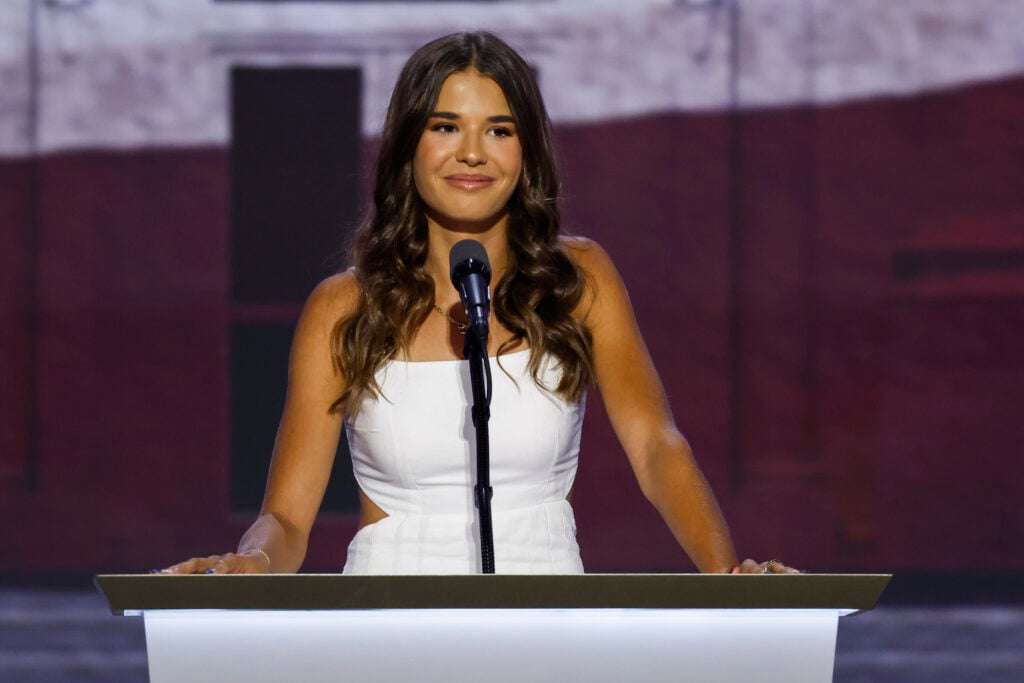
Daughter of Donald Trump Jr., Kai Trump speaks on stage on the third day of the Republican National Convention at the Fiserv Forum on July 17, 2024 in Milwaukee, Wisconsin. (Photo by Chip Somodevilla/Getty Images)
“Kai Trump got a speech impediment or something,” another added.
“Does Kai Trump have an accent or a speech impediment?” a third chimed in.
Don’t get us wrong, the clip — titled “I Brought My Secret Service to Erewhon” — is a tough watch.
But that’s because Kai really did bring her tax-payer-funded Secret Service detail to a grocery store for rich people so that she could make jokes about being poor.
“I’m about to go, like, bankrupt with this stuff,” she says in the video. “I’m going to need to file for bankruptcy.”
Yes, it’s a weird time for that sort of “humor.”
But if Kai does have a speech impediment, it’s extremely minor. And it’s not the sort of thing that adults (or anyone) should be commenting on.
There are much, much larger issues to focus on with regard to her family. In fact, you can be almost certain that some sort of new controversy unfolded in the time it took you to read this article.
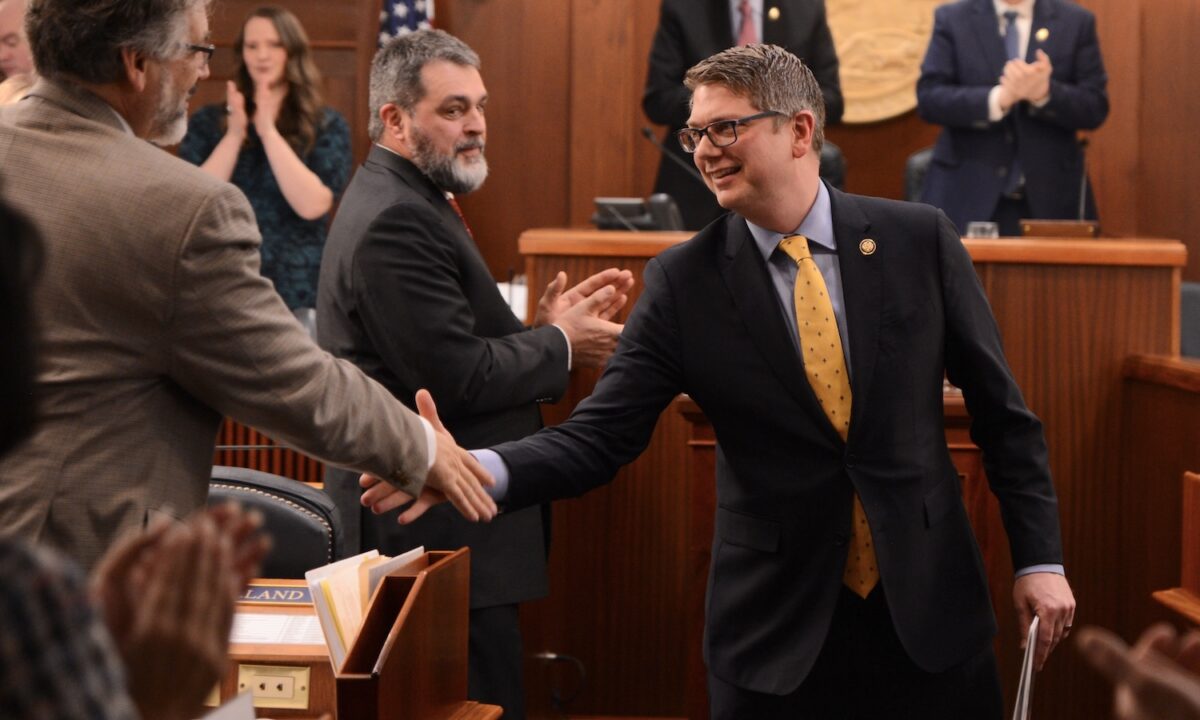
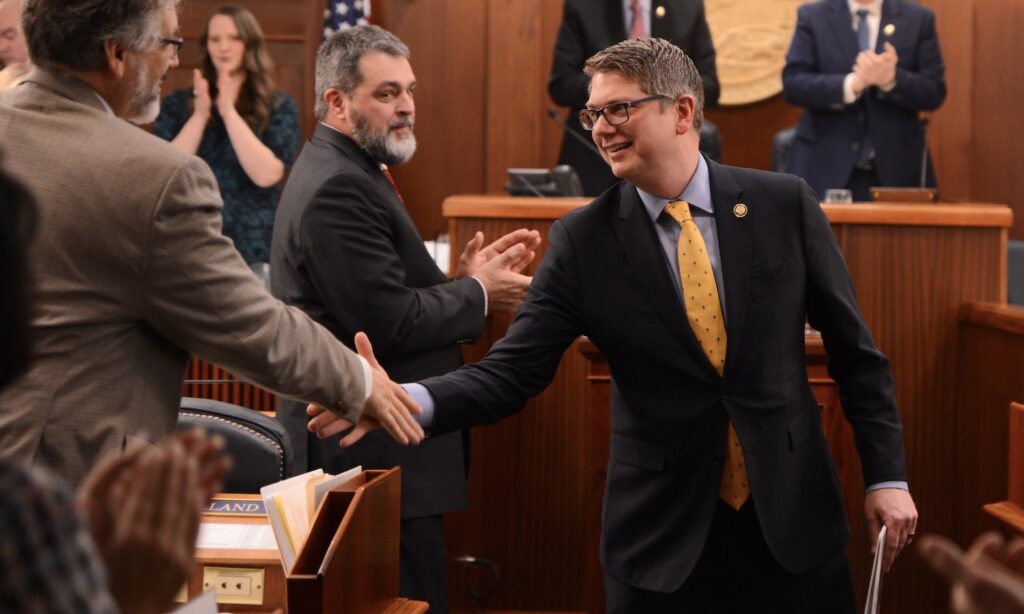
Rep. Nick Begich III, R-Alaska, shakes hands with state Rep. Ky Holland, I-Anchorage, as he leaves a joint session of the Alaska Legislature on Tuesday, March 10, 2026. (James Brooks photo/Alaska Beacon)
By: James Brooks, Alaska Beacon
Rep. Nick Begich III, R-Alaska, shakes hands with state Rep. Ky Holland, I-Anchorage, as he leaves a joint session of the Alaska Legislature on Tuesday, March 10, 2026. (James Brooks photo/Alaska Beacon)
In a speech to the Alaska Legislature this week, Alaska Rep. Nick Begich III urged state lawmakers to boost the development of a proposed trans-Alaska natural gas pipeline.
“The federal path is largely cleared, but investors also need state level clarity, fiscal predictability and simplicity,” Begich said. “Scrutinize it carefully, model it thoroughly. But my request to you is not to become a roadblock.”
But legislators who are dealing with the pipeline on a daily basis say they don’t have answers to basic questions, including how much the pipeline will cost and whether the gas it carries will be affordable to Alaskans.
“I have not seen any figures,” said Sen. Cathy Giessel, R-Anchorage and chair of the Senate Resources Committee.
Senate President Gary Stevens, R-Kodiak, said legislators are not going to be a roadblock.
“We’re not going to throw sand in the works. Everybody wants a pipeline. We all hope that it comes about, but it’s got to be done properly and make sure that we know what’s going on.”
Sen. Bill Wielechowski, D-Anchorage, said he has heard “from very credible sources” that the price of gas through the pipeline could be $50 per million cubic feet by 2046.
The current cost of gas from Cook Inlet for Southcentral Alaska is about $10 per MCF.
“Just imagine if you have utilities locked into 30-year contracts for gas at $50 an MCF. That would be catastrophic,” Wielechowski said. “That’s the sort of thing that we’re trying to protect Alaskan consumers all up and down the Railbelt from — an absolute catastrophe to our economic system.”
As currently proposed, the pipeline project consists of two phases. The first phase includes an 807-mile pipeline from the North Slope to the west side of Cook Inlet, with a tie-in to existing natural gas infrastructure around Anchorage.
The second phase would extend the pipeline to the Kenai Peninsula, where an export terminal would be built. The second phase would also include a processing plant on the North Slope.
Since the acquisition, Glenfarne has signed a number of nonbinding agreements with potential gas purchasers and gas sellers, but it has not disclosed estimates for the project’s cost, and it hasn’t disclosed what it expects the cost of gas to be.
Last year, company officials said they expected to make an investment decision by the end of 2025. In a subsequent filing with the Federal Energy Regulatory Commission, they said they would make the decision in February. A new timeline hasn’t been made public.
The lack of data is particularly problematic because legislators are considering whether to offer a property tax break to pipeline developers.
Those taxes are significant. Because Alaska does not have a statewide income tax or sales tax, its state budget suffers when people move into the state. More people means more demand for things like schools, parks and roads, but no increased revenue to pay for those things.
“That bill should be next week,” Dunleavy said during a Thursday news conference with U.S. Interior Secretary Doug Burgum, confirming the 0.2% rate will be part of the new legislation.
“Last couple weeks, we’ve been working with municipalities, getting their input as to what this should look like before (we) put the bill out,” he said. “So look forward to probably next week on that PILT bill, so that we can look at the economics of this line and also ways to ensure that municipalities benefit from this directly.”
This week, Begich expressed some support for a lower property tax rate, saying it could encourage people to invest in the pipeline.
“The classic 2% tax burden that would apply, say, to a $50 billion asset, would be a billion dollars in cash flow early in the project’s life cycle,” Begich said. “If that cash flow coming out of the project lowers the rate of return for investors, they’re not going to show up and invest. And so we need to make sure that our tax policy is A, doing what’s right for Alaskans. B, is not impeding the ability for the project to move forward. And I think we can do both of those things with some creative thinking and conversations with the industry.”
While a lower tax rate would benefit pipeline developers, it has the potential to harm residents who live near the pipeline.
If pipeline construction and operation mean more people moving to Alaska and municipalities are unable to raise revenue to meet the resulting demand for services, local governments could be forced to raise taxes or cut basic services in order to pay for the pipeline subsidy.
Last week, the Senate Resources Committee introduced Senate Bill 275, which imposes some transparency requirements on the pipeline project, eliminates a tax exemption relevant to the project, and imposes a new surcharge on gas processing plants.
That bill was introduced just days before Begich urged lawmakers not to be a “roadblock.”
Giessel, who chairs the resources committee, said she didn’t think Begich’s comments were directed at her or her committee’s bill.
“We’re not being a roadblock. We’re doing exactly what we’re supposed to do according to our constitution,” she said.
Asked whether he was thinking of Giessel’s bill during his speech, Begich said, “It was not my direct intention. No, I think it’s always worth having the conversation about the tax structure, about the incentive structure, though that’s an ongoing discussion that happens at the state legislature in Alaska. I think it’s important that when we have those conversations, they’re done in a way that is going to encourage, rather than discourage, industry from coming in and saying, ‘Yes, this is a good place for us to invest in.’”
Speaking to reporters after his speech, Begich said the state would benefit by getting more information from Glenfarne.
“I welcome more information,” Begich said. “I recognize that they’ve got certain restraints on what they can share. But look, I’d like to see more information shared. I’d like to see more of the economics of the project shared so we can understand what the full potential is and what’s on the table. I believe that’s going to come with time, but more information is better.”