When Princess Diana craved something sweet, she would ask her chef to whip up a pan of this British dessert, which boasts a long and storied history.

Mashed – Fast Food, Celebrity Chefs, Grocery, Reviews









When Princess Diana craved something sweet, she would ask her chef to whip up a pan of this British dessert, which boasts a long and storied history.
Mashed – Fast Food, Celebrity Chefs, Grocery, Reviews

Democrats in competitive primaries keep fighting about corporate PAC money. It has opened up a muddy and sometimes performative debate.
The issue has played out in contested Senate primaries, where Democrats have pledged not to accept corporate PAC money to signal their support for campaign finance reform and show voters that they are not beholden to special interests. Among the Democrats seeking to distinguish themselves: Lt. Gov. Juliana Stratton in Illinois, Lt. Gov. Peggy Flanagan in Minnesota, and both state Sen. Mallory McMorrow and former public health official Abdul El-Sayed in Michigan.
Corporate PACs, which raise money from their employees and distribute it to candidates, usually give in similar amounts to Republicans and Democrats. For several cycles, a growing number of Democratic candidates have sworn off the money, citing the outsized influence of business interests on politics.
But for many, the pledges not to take the money are mostly symbolic. Candidates who aren’t currently in office receive almost no corporate PAC donations anyway, as more than 99 percent of those funds have gone to sitting senators or representatives this cycle, according to a POLITICO analysis of data from the Federal Election Commission. And rejecting one specific type of donation doesn’t actually mean candidates can’t receive support from outside interests — often in much larger amounts than corporate PACs are allowed to send.
Corporate PAC money can also still end up indirectly supporting new candidates: A majority of Democratic senators receive the funding, as do official party groups, both of which donate to and otherwise help Senate hopefuls.
As a result, the escalating debate over corporate PAC money has comparatively little impact on Democratic candidates’ ability to raise money — but it has created an opening for heated attacks from all sides.
Stratton rejected donations from corporate PACs, but millions of dollars in support she has received from a super PAC has been the focus of a flurry of attack ads from Rep. Raja Krishnamoorthi (D-Ill.), one of her top rivals who himself has received millions in super PAC support. Flanagan and McMorrow have both faced criticism for accepting corporate money in past roles, despite their pledges not to do so in their respective Senate races now.
While the push by some Democrats to reject corporate money goes back several cycles, even emerging as a point of contention in the party’s 2020 presidential primary, the focus in Senate primaries is newer.
For Democrats looking for any advantage in crowded races, rejecting the money carries potential electoral benefits. Polling shows the issue resonates not only with a Democratic base interested in money-in-politics reform but also with independent and Republican voters.
“Pledging to forego corporate PAC money is one way that candidates signal to voters that they reject business as usual in Washington and want to work to fix our broken campaign finance system,” said Michael Beckel, director of money in politics reform at Issue One, a nonprofit advocacy group.
Still, “even when a candidate rejects a PAC check, there are still ways for corporate interests to curry favor,” Beckel said.
The debate among Democrats comes at a time when corporate PACs account for a smaller share of funds influencing races. Corporate PACs face strict limits for their political giving, $5,000 per cycle, a number that has not changed in decades, even as individual giving limits are indexed to inflation. Far more funds now flow through super PACs — which candidates are free to criticize but don’t have to reject.
And the questions are unlikely to fade: The Democratic National Committee has sought to explore how it could limit corporate money, along with harder-to-trace “dark money” that flows through nonprofit groups, in the party’s 2028 presidential primary.
“I think it just shows this fundamental shift even inside the Democratic Party, that running on anti-corruption is no longer a niche position,” said Tiffany Mueller, president of End Citizens United, which backs Democrats supportive of campaign finance reform and has, since 2018, had candidates sign pledges that include a promise to reject corporate PAC money.
The group’s pledge this cycle, which includes several money-in-politics reforms, has gotten signers quicker than past pledges, Mueller said.
In Illinois, where early voting is already underway ahead of Tuesday’s primary, Stratton has made rejecting corporate PAC money a key component of her campaign in a three-way primary against Krishnamoorthi and Rep. Robin Kelly. The lieutenant governor, who was endorsed by End Citizens United, accused both opponents of benefiting from a “broken” campaign finance system.
“I’m the only candidate rejecting corporate PAC money, because my campaign is about the people of Illinois, not special interests,” she said in a statement.
Kelly, in an interview, defended her own record of accepting some donations from corporate PACs, saying that the funds over the years supported Democrats and never influenced her voting record. She noted the much greater flow of super PAC money supporting both of her opponents.
“When I came to Congress, I didn’t know my dues were going to be the level that they were. I didn’t know that I was expected to give money to my other colleagues, or people that wanted to be my colleagues,” Kelly said. “And frankly, the money I collect, that’s where a lot of it has gone through the years, paying dues to the DCCC.”
While Stratton has sought to carve out a lane as the reformer, Krishnamoorthi’s campaign has gone after her finances, with ads running on both television and digital accusing her of taking “corporate and MAGA money” and calling attention to a super PAC backing her. Krishnamoorthi’s campaign did not respond to a request for comment.
Stratton has benefited from $11.8 million from a super PAC linked to Illinois Gov. J.B. Pritzker, with additional support from the Democratic Lieutenant Governor’s Association. Meanwhile Fairshake, backed by major cryptocurrency interests, has spent nearly $10 million attacking her to help Krishnamoorthi.
The scrutiny on corporate PAC money in primaries comes as a majority of sitting Democratic senators continue to take those donations for their campaigns and leadership PACs. That includes several senators who have actively been endorsing in the primaries, including Sen. Chris Van Hollen (D-Ct.), who has endorsed Flanagan in Minnesota, and Sen. Martin Heinrich (D-N.M.), who has endorsed both Flanagan and McMorrow.
Corporate PACs can — and do — give larger donations to party committees. That has been a point of conflict in Minnesota, where opponent Rep. Angie Craig has hit Flanagan for corporate PAC donations accepted by the DLGA while she was its chair. The group is now backing her campaign along with Stratton’s.
Flanagan’s campaign has said she did not have sole decision-making power over the DLGA’s donors. In a statement to POLITICO, a spokesperson for Flanagan accused Craig of “trying to distract from the fact that she’s taken millions of dollars from corporations and special interests.”
“Peggy is the only candidate in this race to reject corporate PAC money,” the spokesperson said. Craig’s campaign declined to comment.
The divide extends from safe-seat races to the most competitive. In the Michigan Senate primary, which sets up a must-win open seat for Democrats looking to take back control of the upper chamber, the issue has already arisen in candidate forums. El-Sayed, who previously ran for governor, has sought to distinguish himself on the basis that he has never taken corporate PAC money.
“There’s only one candidate in this race who’s understood corporate money to be the central disease of our politics from day one when they ran in 2018,” said Sophie Pollock, a spokesperson for El-Sayed’s campaign, in a statement.
Rep. Haley Stevens, meanwhile, received donations from corporate PACs as a representative and has continued to for her Senate campaign. Her campaign spokesperson, Arik Wolk, noted she repeatedly voted for campaign finance reform and recently received an “A” grade from End Citizens United on its anti-corruption scorecard.
And although McMorrow previously accepted corporate PAC money for her state legislative campaign and leadership PAC, she has rejected it for her Senate campaign.
“As a first-time candidate, there were people who said, ‘We need to fight like the Republicans fight. If we don’t, we will lose,’” McMorrow said in an interview. “And I’ve learned through my time in the legislature that, you can’t talk out of both sides of your mouth, that people won’t trust you. And also, not only can we fund campaigns without corporate PAC dollars, but frankly, we need to.”
Politics

With his new single, “Woman,” Kane Brown is making one thing clear: he loves his wife. He’s written love songs for Katelyn before, but this time he’s turning up the energy and shouting that passion from the rooftops, louder than ever before.
The song, penned by Brown with John Byron, Ashley Gorley, Ben Johnson and Taylor Phillips, was both inspired and dedicated to his other half, who he describes as being “one in a million.” The country star explained to Audacy’s Katie Neal that the title just fell into his lap and saved a writing session that was making him feel burnt out.
“We were finishing this one song we were working on and I just got up to go warm up my food and as I’m warming up my food, this title just falls in my lap, ‘They’re talking about girls, but I got a woman,’” he explained. “So I went and sat down and I told em, ‘I think I got the next song we’re going to work on.’ And they said, ‘What is it?’ And I told them, and they’re like, ‘Where’s that been all day?’ I said, ‘I literally just thought about it in the kitchen.’ And I don’t know, it kind of just wrote itself.”
He added that even Ashely Gorley, who has written over 80 No. 1 hits, felt that the song would become “massive.” And there’s no doubt that’s exactly what it’s destined for, not only because of its clever storyline, but also the fun nature behind the tune.
It’s a feel-good anthem about a man who admits he has no interest in going out chasing other girls because he already has everything he needs waiting at home. As hard as his friends try to convince him to hit the town, he makes it clear he’s staying put for the woman he loves. The carefree track carries an infectious spirit that practically begs listeners to dance and sing along.
“Yeah, they talkin’ ’bout girls (Girls)/ But I got a woman (I got a woman)/ Yeah, I got a woman right here in my hands/ They talkin’ ’bout girls (Girls)/ But I got a woman (I got a woman)/ Yeah, I got a woman/ Oh yeah, and she got a man,” Brown sings on the chorus.

With its upbeat groove that channels the energy of country classics like Shania Twain’s “I Feel Like A Woman” and a sound blending modern and pop country, Woman” feels destined to become the windows-down anthem of the summer.
“It’s brought me back to listening to ..I don’t know why, but ‘I Feel Like A Woman’ from Shania Twain and then ‘Girls Just Wanna Have Fun.’ For some reason it feels like it’s in that realm. It’s a big realm to be in, but I feel like that’s what it’s in…once we finished this one, it was a no-brainer that this was the single,” he notes.
Today’s release was also paired with a music video that was filmed at Universal Studios in Orlando, Florida to create a colorful ’90s throwback vibe that finds Brown showing off his dance moves, matching the fun-filled energy of the song. The video features Brown alongside his wife Katelyn and their oldest daughter, Kingsley, making it clear he’s got more than one female in his life who has stolen his heart.
According to the country star, this self-proclaimed “earworm” offers a glimpse into his new creative direction and previews his upcoming album. It also marks his first taste of new music since his 2025 record, The High Road.
The Sony Music Nashville artist explained that his next album is on track to be done by July. He says he has written “so many” new songs recently and he loves all of them, which means it’s going to be a difficult task to narrow down the track list.
Brown goes on to tease the project, noting it’s got, “A lot of good messages, a lot different than my last album. My last album, just to be completely honest with you, I felt like it was a little rushed. When people were asking me what the name was, I felt like I was kind of on autopilot. I just wasn’t there…But now I’m more motivated than ever, feel like this is like my jump. So this album’s the one.”
Kane Brown will get to showcase “Woman” and the other new music on the way throughout his string of festival dates in 2026.
The post Kane Brown Puts His Love for Wife Katelyn Front and Center in New, Feel-Good Single, ‘Woman’ appeared first on Country Now.
Country Now

Rep. Nick Begich III, R-Alaska, shakes hands with state Rep. Ky Holland, I-Anchorage, as he leaves a joint session of the Alaska Legislature on Tuesday, March 10, 2026. (James Brooks photo/Alaska Beacon)
In a speech to the Alaska Legislature this week, Alaska Rep. Nick Begich III urged state lawmakers to boost the development of a proposed trans-Alaska natural gas pipeline.
“The federal path is largely cleared, but investors also need state level clarity, fiscal predictability and simplicity,” Begich said. “Scrutinize it carefully, model it thoroughly. But my request to you is not to become a roadblock.”
But legislators who are dealing with the pipeline on a daily basis say they don’t have answers to basic questions, including how much the pipeline will cost and whether the gas it carries will be affordable to Alaskans.
“I have not seen any figures,” said Sen. Cathy Giessel, R-Anchorage and chair of the Senate Resources Committee.
Senate President Gary Stevens, R-Kodiak, said legislators are not going to be a roadblock.
“We’re not going to throw sand in the works. Everybody wants a pipeline. We all hope that it comes about, but it’s got to be done properly and make sure that we know what’s going on.”
Sen. Bill Wielechowski, D-Anchorage, said he has heard “from very credible sources” that the price of gas through the pipeline could be $50 per million cubic feet by 2046.
The current cost of gas from Cook Inlet for Southcentral Alaska is about $10 per MCF.
“Just imagine if you have utilities locked into 30-year contracts for gas at $50 an MCF. That would be catastrophic,” Wielechowski said. “That’s the sort of thing that we’re trying to protect Alaskan consumers all up and down the Railbelt from — an absolute catastrophe to our economic system.”
As currently proposed, the pipeline project consists of two phases. The first phase includes an 807-mile pipeline from the North Slope to the west side of Cook Inlet, with a tie-in to existing natural gas infrastructure around Anchorage.
The second phase would extend the pipeline to the Kenai Peninsula, where an export terminal would be built. The second phase would also include a processing plant on the North Slope.
One year ago, the state-owned Alaska Gasline Development Corporation sold 75% of the trans-Alaska natural gas pipeline project to Glenfarne, an international developer.
Since the acquisition, Glenfarne has signed a number of nonbinding agreements with potential gas purchasers and gas sellers, but it has not disclosed estimates for the project’s cost, and it hasn’t disclosed what it expects the cost of gas to be.
Last year, company officials said they expected to make an investment decision by the end of 2025. In a subsequent filing with the Federal Energy Regulatory Commission, they said they would make the decision in February. A new timeline hasn’t been made public.
The lack of data is particularly problematic because legislators are considering whether to offer a property tax break to pipeline developers.
Those taxes are significant. Because Alaska does not have a statewide income tax or sales tax, its state budget suffers when people move into the state. More people means more demand for things like schools, parks and roads, but no increased revenue to pay for those things.
Economists have called that the “Alaska disconnect.”
Alaska has a 2% property tax on oil and gas infrastructure. Most of that money is passed on to municipalities, which use it for local needs.
In December, Alaska Gov. Mike Dunleavy said he was considering a proposal to cap that property tax at 0.2% for the natural gas pipeline, creating a payment in lieu of taxes system.
“That bill should be next week,” Dunleavy said during a Thursday news conference with U.S. Interior Secretary Doug Burgum, confirming the 0.2% rate will be part of the new legislation.
“Last couple weeks, we’ve been working with municipalities, getting their input as to what this should look like before (we) put the bill out,” he said. “So look forward to probably next week on that PILT bill, so that we can look at the economics of this line and also ways to ensure that municipalities benefit from this directly.”
This week, Begich expressed some support for a lower property tax rate, saying it could encourage people to invest in the pipeline.
“The classic 2% tax burden that would apply, say, to a $50 billion asset, would be a billion dollars in cash flow early in the project’s life cycle,” Begich said. “If that cash flow coming out of the project lowers the rate of return for investors, they’re not going to show up and invest. And so we need to make sure that our tax policy is A, doing what’s right for Alaskans. B, is not impeding the ability for the project to move forward. And I think we can do both of those things with some creative thinking and conversations with the industry.”
While a lower tax rate would benefit pipeline developers, it has the potential to harm residents who live near the pipeline.
If pipeline construction and operation mean more people moving to Alaska and municipalities are unable to raise revenue to meet the resulting demand for services, local governments could be forced to raise taxes or cut basic services in order to pay for the pipeline subsidy.
Last week, the Senate Resources Committee introduced Senate Bill 275, which imposes some transparency requirements on the pipeline project, eliminates a tax exemption relevant to the project, and imposes a new surcharge on gas processing plants.
That bill was introduced just days before Begich urged lawmakers not to be a “roadblock.”
Giessel, who chairs the resources committee, said she didn’t think Begich’s comments were directed at her or her committee’s bill.
“We’re not being a roadblock. We’re doing exactly what we’re supposed to do according to our constitution,” she said.
Asked whether he was thinking of Giessel’s bill during his speech, Begich said, “It was not my direct intention. No, I think it’s always worth having the conversation about the tax structure, about the incentive structure, though that’s an ongoing discussion that happens at the state legislature in Alaska. I think it’s important that when we have those conversations, they’re done in a way that is going to encourage, rather than discourage, industry from coming in and saying, ‘Yes, this is a good place for us to invest in.’”
Speaking to reporters after his speech, Begich said the state would benefit by getting more information from Glenfarne.
“I welcome more information,” Begich said. “I recognize that they’ve got certain restraints on what they can share. But look, I’d like to see more information shared. I’d like to see more of the economics of the project shared so we can understand what the full potential is and what’s on the table. I believe that’s going to come with time, but more information is better.”

Reading Time: 4 minutes
Last year, Ray J made RICO allegations against the Kardashians without presenting any evidence.
Kris and Kim’s lawsuit against him that followed was no surprise.
The rapper then filed his own lawsuit, accusing the mother-daughter duo of releasing his and Kim’s infamous sex tape and blaming him for it.
Kris and Kim had to give sworn testimony. Now, Ray J accuses them of lying under oath.
Both Ray J and his mother are accusing Kim and Kris of perjury.
In sworn declarations this week, both mother and daughter flatly denied Ray J’s claim that they had orchestrated the 2007 sex tape’s release.
Specifically, they called the claim “a lie” and “absolutely false.” That’s not ambiguous!
“As a mother, the notion that I orchestrated or produced sex tapes involving my daughter, or was in any way involved in the creation or distribution of any sex tapes,” Kris Jenner wrote.
Her statement continued, saying that the claim “is not only entirely untrue but deeply offensive and harmful and has haunted me for decades.”

Kris expressed: “I was absolutely heartbroken, crushed, and devastated as a mother to see my daughter in this situation where her most intimate and private moments were exposed to the world.”
Meanwhile, Kim highlighted that she had spent money to counter Ray J’s story.
She highlighted how she’d gone to therapy as well as worked with legal experts and strategic communication specialists.
“His claim that I had a plan with my mother and others to release a sex tape, defraud the public, and file a ‘fake’ lawsuit against the porn company that released it to ‘create buzz’ is a lie,” Kim stated flatly.
These statements from Kim and Kris were part of a filing in Los Angeles Superior Court on Wednesday, March 11.

Now, Ray J and his mother are telling TMZ that Kim and Kris “completely lied about everything.” That is a serious allegation, especially without evidence.
“Are [Kim & Kris] out of their f–king minds?” he asked.
“The fact of the matter is, if you lie like that under oath, don’t you go to jail?” Ray J asked. “Don’t you get fined?”
He also explained that his goal for the lawsuit relates to his children, Melody and Epik.
Ray J argued that his kids “don’t deserve to grow up thinking their dad did something like revenge porn or hurt someone on purpose.”
“That’s not the truth,” Ray J claimed, “and I’m not going to let that narrative follow them through their lives.”
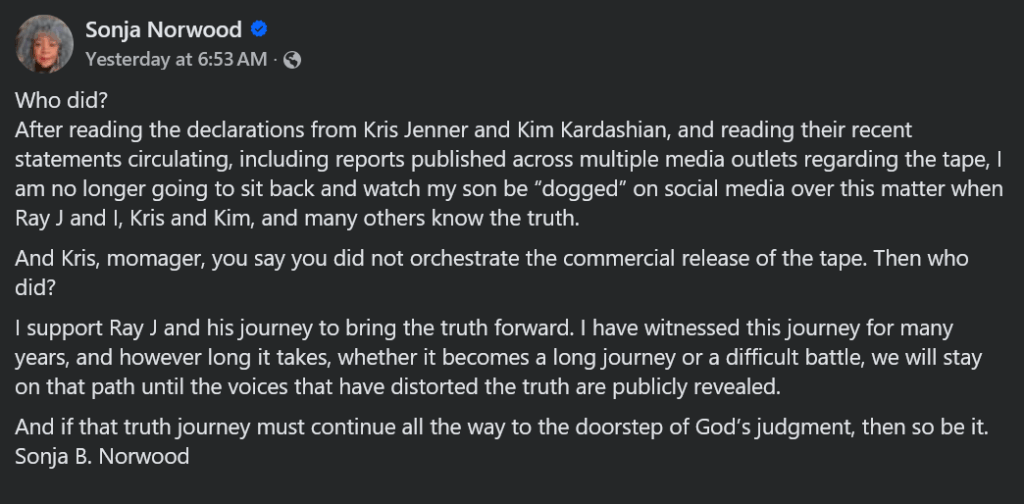
That same day, Sonja Norwood — his mother — took to Facebook to back up his side of the story.
“I am no longer going to sit back and watch my son be ‘dogged’ on social media over this matter when Ray J and I, Kris and Kim, and many others know the truth,” she declared.
“And Kris, momager, you say you did not orchestrate the commercial release of the tape,” she challenged. “Then who did?”
Norwood continued: “I support Ray J and his journey to bring the truth forward.”

Conventional wisdom has, for nearly two decades, said that Kim and Ray J’s sex tape leaked, and that Kris was saddened as a mom but excited as an opportunist.
Since then, Kim and Kris capitalized upon the attention, catapulting their family to a 10-figure fortune with multiple reality shows and businesses.
Ray J is presenting the claim that Kris and Kim are outright lying.
Is it possible that he has always believed that they released the tape — even if it’s untrue?
We cannot say that we know the inner workings of his mind. But accusing someone of perjury is a pretty serious allegation.
Ray J Accuses Kim Kardashian & Kris Jenner of PERJURY After They Testify that They … was originally published on The Hollywood Gossip.
The Hollywood Gossip

Reading Time: 2 minutes
Southern Hospitality star Grace Lilly is making quite a name for herself.
Unfortunately, it’s not for her onscreen charisma or talent for social media self-promotion.
No, Grace is becoming more famous than the show she stars on primarily because of her run-ins with the law.
Grace was arrested on Tuesday in South Carolina on drug possession charges.
If you’re keeping score at home, that marks her second arrest in less than three months.
She was also taken into custody on December 29 in Charleston, when cops found medication labeled as “Happy Pills” in her car, Page Six reports.
In her more recent arrest, Grace was booked on possession of a controlled substance charges.
She spent several hours in the Charleston County Jail before being released on her own recognizance.

This is the latest in a long line of brushes with the law for the troubled reality star.
When Grace was pulled over in December for an illegal lane change, officers noticed that she had a warrant out for her arrest for a second-degree harassment charge.
“Inside the purse, a small container with ‘Happy Pills’ imprinted on the top was located, which contained 12 circular white pills with a ‘P’ imprint on one side, and half of an oblong blue pill with no identifiable imprints,” reads the police report (via Page Six).
“When asked about the pills found inside the purse, the offender stated that the blue pill was Xanax and the white pills were birth control,” the report continues.

“The offender stated she had a prescription for the Xanax but did not have any proof of that information available at the time,”
Grace reportedly tried to pass the pills off as birth control, but cops were not convinced, in part because she was unable to remember the brand name of the alleged contraceptives.
Lilly has not yet spoken publicly about her latest arrest.
Most people would probably have to worry about trouble with their employer if they repeatedly ran afoul of the law in such a public fashion.
But this sort of thing is par for the course in the world of Bravo — in fact, Grace’s legal issues will likely serve as a storyline on Southern Hospitality Season 5.
We will have further updates on this developing story as new information becomes available.
Grace Lilly: ‘Southern Hospitality’ Star Arrested For Drug Possession AGAIN was originally published on The Hollywood Gossip.
The Hollywood Gossip

A new baby in the Rhett family means fresh adventures ahead, and it looks like friends are already gearing up to celebrate in style. Continue reading…The Boot – Country Music News, Music Videos and Songs
A new baby in the Rhett family means fresh adventures ahead, and it looks like friends are already gearing up to celebrate in style. Continue reading…Country Music News – Taste of Country

Americans have a reputation for being bad at world geography, and the current U.S. administration is no exception, particularly when it comes to correctly identifying what is – and is not – part of the United States of America.
President Donald Trump’s April 2025 executive order “unleashing America’s offshore critical minerals” provides an example. It purports to “unleash” seabed minerals both within and far outside U.S. jurisdiction.
The minerals on the U.S. seabed are America’s. The minerals on the international seabed are not “America’s.” The administration plans to authorize companies to mine in international areas, nonetheless.

I have studied the international agreements and customary rules governing the oceans since the Law of the Sea Convention entered into force in 1994. The Trump administration’s attempt to unilaterally exploit the seabed resources of the global commons will severely undermine part of the rules-based international order that the U.S. built and of which it has been the main beneficiary.
The U.S. has been trying to secure access to critical minerals that are essential for modern technology. These materials include nickel, manganese and cobalt for large batteries and copper for the power grid. All can be found on land, but some can also be found at the bottom of the sea.
Of particular interest are polymetallic nodules – agglomerations, typically smaller than a potato, containing manganese and other metals and found in the silt of the deep ocean floor. An Australian mining executive described these nodules as “an EV battery in a rock.”

The Clarion Clipperton Zone, in the middle of the Pacific Ocean, contains one of the highest concentrations of polymetallic nodules. But whose nodules are they?
In September 1945, President Harry Truman claimed for America a large part of the seabed extending from its shores, areas that, before Truman’s claim, were shared by the international community.
In reaction, countries around the world spent the next five decades hammering out a system to limit how much of the seabed that coastal countries could claim, and establishing rules that would govern the remaining shared areas of the oceans.
The resulting arrangement, finalized in 1994, gives countries that border the ocean authority over the resources in the water and seabed within 200 nautical miles (370 kilometers) of their coasts, known as “exclusive economic zones,” and, for some countries, additional areas of seabed beyond that limit.

The United States enjoys one of the world’s largest exclusive economic zones today. It includes an area totaling over 4 million square miles (10 million square kilometers) – larger than all 50 U.S. states combined – and an additional nearly 400 million square miles (1 million square kilometers) of seabed extending even farther offshore.
In those areas, the United States controls the exploitation and management of living and nonliving natural resources, including seabed minerals.
But exclusive economic zones were only one part of what the Law of the Sea Convention negotiators called a “package deal.”
The other part of the deal retains the remaining areas – approximately half of the planet’s seabed – for the international community. It’s known as “the Area,” and its resources are considered the common heritage of mankind. To prevent a free-for-all, no single country can authorize mining in the Area. Instead it is managed by the International Seabed Authority for the benefit of humankind as a whole. To date, the ISA has executed 31 contracts with countries and companies to explore the mineral resources in the Area.

One hundred and seventy-one countries have joined the Convention so far. However, the United States, despite being one of its primary architects, is the only industrialized nation remaining outside the treaty.
Nonetheless, the U.S. has long considered the treaty to reflect rules of customary international law. Where the Area is concerned, the U.S. respected the terms of the package deal – until now.
Trump’s offshore mining order relies on a U.S. statute enacted in 1980 as an interim measure pending completion of negotiations related to the Area. It authorized the National Oceanic and Atmospheric Administration to license exploration and permit commercial recovery of polymetallic nodules on the seabed in areas outside U.S. jurisdiction.
When that 1980 statute was enacted, there was a spurt of commercial interest. The U.S. issued four exploration licenses. Two were relinquished in the 1990s. In the 30-plus years since the international community finalized the package deal, even the company holding the two remaining NOAA licenses – Lockheed Martin – has considered them largely worthless unless the U.S. ratifies the Law of the Sea Convention.
That changed in April 2025 when Trump, citing the 1980 U.S. law, ordered the NOAA to “expedite the process for reviewing and issuing seabed mineral exploration licenses and commercial recovery permits in areas beyond national jurisdiction.”
A few days later, Canadian mining firm The Metals Company submitted an application via its wholly-owned subsidiary TMC USA to mine polymetallic nodules in the Area under U.S. unilateral authority. TMC USA touted its application for mining areas in the nodule-rich Clarion Clipperton Zone – in the middle of the Area – as a “world first”.
The International Seabed Authority condemned the move and reminded countries that “unilateral exploitation of resources that belong to no single State but to all of humanity is prohibited.”
So, does the Trump administration’s plan violate U.S. international obligations?
The answer is maybe.
The U.S. is not a party to the Law of the Sea Convention, so it is not bound by the treaty. But scholars disagree on whether U.S. unilateral mining would violate obligations arising from rules of customary international law.

The United States is not the only player in this game. If any of the 171 countries that have subscribed to the treaty were to participate in or allow their citizens to participate in U.S.-authorized mining activity in the Area, they would violate their treaty obligations. Any other Convention partner could bring them before the International Tribunal for the Law of the Sea in Hamburg, Germany.
Canada, home of TMC, could find itself in that position. So could many nations whose citizens or companies have worked with TMC. If those partners continued their work with TMC USA under U.S. authorization, their home countries could be exposed to legal action.
In announcing an expedited seabed mining application process in January 2026, NOAA Administrator Neil Jacobs mischaracterized polymetallic nodules in the Area as “a domestic source of critical minerals for the United States.”
To be clear, the United States has critical minerals on its land territory and within its area of exclusive seabed jurisdiction. It is beginning to explore those resources with an eye to possible future mining. These are domestic American sources of critical minerals – they are “America’s.” The minerals in the Area are not.
Yes, America needs critical minerals, but it should not undermine the system of international ocean governance – a system it engineered and from which it benefits perhaps more than any other nation – to get them.

Coalter G Lathrop does not work for, consult, own shares in or receive funding from any company or organization that would benefit from this article, and has disclosed no relevant affiliations beyond their academic appointment.
Politics + Society – The Conversation

Nearly one-third of U.S. children reported missing are Black, even though Black people constitute roughly 14% of the U.S. population.
To address one dimension of this problem, Pennsylvania and a few other states, including Alabama and Massachusetts, have in recent years proposed legislation to reform missing child alert systems. Not all missing children cases trigger an Amber Alert – the nationwide emergency alert system for missing children – but those that do receive greater public and media attention. These states suggest implementing an “Ebony Alert” that focuses on children of color.
Pennsylvania state Rep. Gina Curry introduced a bill “specifically tailored to finding missing Black and Brown youth” in June 2024 and reintroduced it in January 2025. It is currently sitting in the Children and Youth Committee.
Pennsylvania and the other states where these laws are pending are taking a cue from California, which started its statewide Ebony Alert program in January 2024. California’s system aims to guarantee that cases of missing Black youth are treated fairly by law enforcement agencies and the public is alerted in similar fashion and through the same venues offered under Amber Alerts.
I am a law professor who studies victimization and inequalities in the criminal legal system. In a recent legal paper, attorney Tanisha Brown and I examined how Ebony-like laws might save more Black children who go missing.
Our study focuses specifically on Black children, though we recognize that the disproportionate number of missing children from Native American and other marginalized communities also deserve attention and further inquiry.
Our original data analysis suggests that the probability of Black children going missing is three times that of white children.
The May 2025 Minority and Missing Report – a collaborative effort among leading law enforcement and various civil society groups – also highlighted the disproportionate number of missing Black, American Indian and Alaska Native children.
These disparities extend beyond reporting rates for missing children.
Black children are also more vulnerable to trafficking and exploitation than white children. Structural inequalities, such as poverty, housing instability and overrepresentation in the foster care system, compound their risks.
The Amber Alert system was adopted in the early 2000s. Amber stands for America’s Missing: Broadcast Emergency Response. It is a powerful and comprehensive alert infrastructure that distributes information about a missing child through radio, television, text messages, highway signs, email notifications and major online platforms, including Google and Facebook.

Many of the kids who go missing are victims of crime – abducted from their neighborhoods, homes and schools, subjected to physical and psychological abuse, and, in some tragic cases, killed. Amber Alerts mobilize communities to assist in the search process.
To issue an Amber Alert, law enforcement must determine that specific statutory conditions are met, including the age of the child, law enforcement’s belief in imminent danger of serious injury or death, and the sufficiency of existing information to assist in recovery. Crucially, children who are categorized as “runaways” are excluded from Amber eligibility.
Advocacy groups for missing children argue that for a host of reasons, including implicit and explicit racial bias, Black children who go missing are disproportionately labeled as runaways. This excludes them from the protections of the Amber system and reduces the likelihood of them being found.
Even when an Amber Alert is initiated, some data suggests that Black children are less likely to be recovered than white children.
California’s Ebony Alert system ensures that all cases involving missing Black youth receive public notification comparable in scope and visibility to Amber Alerts. It offers different criteria for the initiation of the alerts. For example, an Ebony Alert may be issued when law enforcement determines that an individual went missing under “unexplained and suspicious circumstances.”
The Pennsylvania proposal generally follows California’s provisions, while stating that it is intended for “young people of color.”
These efforts publicly acknowledge and attempt to address the disproportionate impact of missing-child crises on Black communities. They also shine light on the limitations of formally colorblind frameworks like Amber, as Amber’s race-neutral design has, in practice, produced racially disparate outcomes – with potential life-or-death consequences.
In order to fix the Amber Alert system in states without Ebony Alert legislation, we propose three reforms that would reduce flaws in its design.
1. A more holistic evaluation of missing child cases: Currently, all Amber factors must be present to initiate an alert. Our approach suggests that no single factor should stop an alert from being issued. Doing so will require law enforcement agents to approach each case with more complexity and nuance, including recognizing particular community needs.
2. A broader spectrum of “at risk” conditions: Law enforcement can issue alerts in cases beyond the most typical cases of “serious risk to bodily integrity or death.” This might include “unexplained and suspicious circumstances” or recognizing that the missing person might be subject to trafficking.
3. Shift the burden within law enforcement decision-making: To mitigate bias in alert initiation, we propose that law enforcement bear the burden of explaining why not to initiate an alert – instead of why to – when they cannot explain circumstances behind a child going missing.
Together, these reforms could significantly address existing problems within the Amber system itself.
The design of Ebony Alert laws, however, raises a constitutional question: Can such laws withstand equal protection challenges?
Under current doctrine, Ebony Alert laws would likely be considered a racial classification subject to strict scrutiny, an almost impassable legal hurdle. The 2020 Students for Fair Admissions Inc. v. President and Fellows of Harvard College, in which the Supreme Court ruled that several race-conscious admission programs at Harvard and the University of North Carolina violated the equal protection clause, might have further challenged this type of legislation.
To pass strict scrutiny, laws must be narrowly tailored interventions that serve a compelling state interest.
As Brown and I argue, the interests and context of Ebony Alert laws differ meaningfully from those in the Students for Fair Admission case. Ebony is law-enforcement legislation aimed at protecting children who are victims of crime. Courts have long recognized that “safeguarding the physical and psychological well-being of a minor” is a compelling interest.
Ebony Alert laws also address documented racial disparities in the Amber system that undermine equal protection and public safety. According to case law, race-conscious measures may be deemed compelling when “essential to accomplishing criminal system objectives within a community served,” including maintaining trust and perceptions of fairness. These points are developed more fully in our paper.
To be sure, Ebony Alerts are not a panacea. As the Minority and Missing Report emphasizes, there are broader issues, such as inconsistent reporting protocols, inadequate training and strained relations between marginalized communities and police.
Nonetheless, Ebony Alert proposals invite a broader reckoning with how race-neutral systems can produce racially unequal outcomes. Carefully designed race-conscious remedies may be necessary to fulfill the criminal legal system’s most basic promise: protecting children’s lives.
Read more of our stories about Philadelphia and Pennsylvania, or sign up for our Philadelphia newsletter on Substack.

Itay Ravid does not work for, consult, own shares in or receive funding from any company or organization that would benefit from this article, and has disclosed no relevant affiliations beyond their academic appointment.
Politics + Society – The Conversation

