There were plenty of memorable highlights at the 2026 Grammy Awards on Sunday night.
But there was one moment that music legend Cher would probably rather forget.
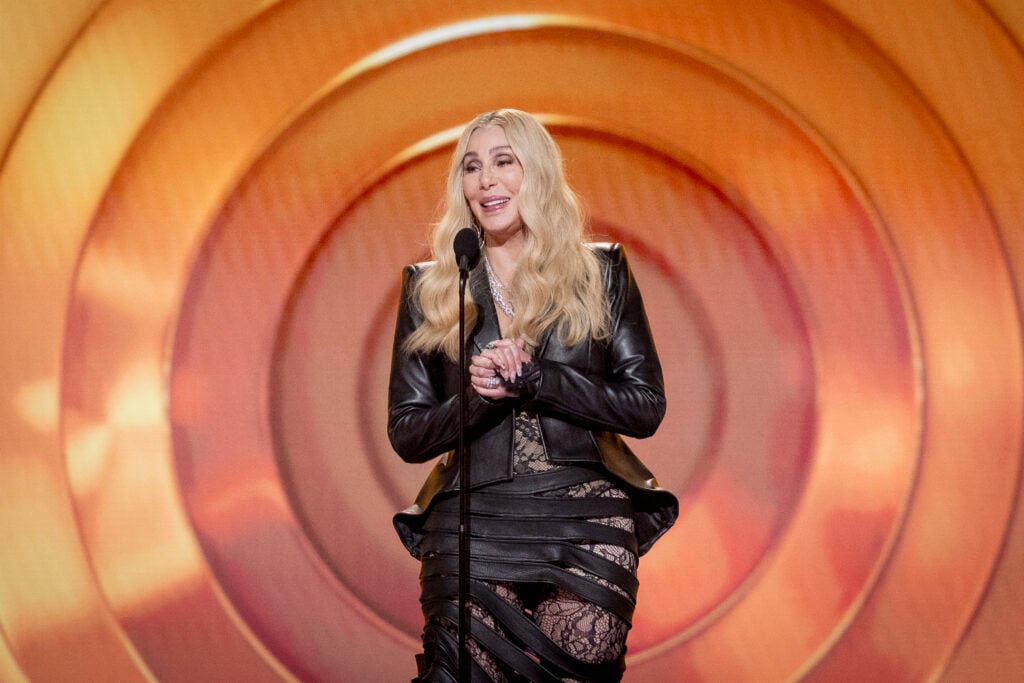
Before presenting the award for Record of the Year, Cher delivered a speech about her career and the Lifetime Achievement Grammy she’d received the day before.
Cher speaks onstage during the 68th GRAMMY Awards at Crypto.com Arena on February 01, 2026 in Los Angeles, California. (Photo by Emma McIntyre/Getty Images for The Recording Academy)
“I don’t do this part very well,” she began, adding:
“I first want to thank the Recording Academy for giving me this lifetime achievement award. And it’s a good thing that they did it now, because I have good genes and I wouldn’t have been here that much longer.”
“I’ve been in this business for 60 f–king years, but I just want to tell you, never give up on your dream, no matter what happens. Live it, be it, and if it’s not happening now, it will happen soon.”
At that point, Cher began to wrap things up.
“That’s all I have to say,” she concluded, while looking around the stage in apparent confusion. “I guess I’m supposed to walk off now. All right, I have to walk off.”
US singer and actress Cher presents the award for Record of the Year on stage during the 68th Annual Grammy Awards at the Crypto.com Arena in Los Angeles on February 1, 2026 (Photo by VALERIE MACON / AFP via Getty Images)
Yes, she seemed to have forgotten that she was supposed to present an award. Thankfully, host Trevor Noah was able to call her back to the stage in time.
“Cher, before you go, could we get you to announce the nominees?” Noah shouted as she walked off stage.
“I could do it, but it’s not the same. I don’t have the track record. Welcome back Cher, everybody.”
Crisis averted. But the awkward moments weren’t over.
First, Cher was unaware that she needed to open the envelope in her hand in order to find out who won.
Cher speaks onstage during the 68th GRAMMY Awards at Crypto.com Arena on February 01, 2026 in Los Angeles, California. (Photo by Emma McIntyre/Getty Images for The Recording Academy)
She explained that she thought the winner’s name would appear on the teleprompter. Understandable.
But then the situation deteriorated further when Cher announced that the winner was Luther Vandross.
Vandross, of course, passed away in 2005, and Record of the Year was actually won by Kendrick Lamar for his song “Luther.” Whoops.
Thankfully, the recipients were able to find the humor in the situation.
“First and foremost,” producer Sounwave said while accepting the award, “let’s give a shout out to the late great Luther Vandross.”
Any single one of those flubs could have happened to anyone. But the fact that so many of them took place in such rapid succession created concern among some viewers.
“Cher needs to be checked for earlier dementia. Mama is all over the place,” one X user wrote (via Radar Online).
“Somebody please check Cher in for a dementia check please, she is stressing me out,” another added.
The fact is, Cher is 79 years old, and live TV is always a high-wire act.
There’s no real reason to be worried about her cognitive health — so maybe we should all just be grateful for the unintentional comedy.
The ferry Tustumena is seen July 20, 2021, in southwestern Alaska. (James Brooks photo)
By: James Brooks, Alaska Beacon
The ferry Tustumena is seen July 20, 2021, in southwestern Alaska. (James Brooks photo)
After more than a decade of planning, design and false starts, the state of Alaska is once more attempting to build its first new mainline ferry in decades.
On Jan. 23, the Alaska Department of Transportation and Public Facilities began advertising for shipyards interested in building a replacement for the Tustumena, which sails between Homer, Kodiak and Unalaska on the longest, most remote state ferry route in the United States.
The new ship must be built in the United States and is expected to cost well over $325 million, based on a prior estimate provided by the state to the federal government and inflation since that 2022 projection.
The current bid listing states only that the “engineer’s estimate is greater than $100,000,000.”
The final operational requirements include a 330-foot-long ship with a range of 4,000 nautical miles, and a capacity of 250 passengers and 28 crew plus 58 vehicles.
A computer-generated mockup of the new Tustumena replacement ferry is seen in an undated image published by the Alaska Department of Transportation and Public Facilities. (DOT image)
The federal government is expected to pay for the majority of the project, which has been a state priority since 2013.
The Tustumena, variously nicknamed “Rusty Tusty” and “Trusty Tusty,” entered service in 1964.
The years and the rough seas of the North Pacific have taken their toll: In 2012, age-related problems sidelined the ship for months, cutting Kodiak off from the state road system. After an extended stay in drydock, it returned to service, but the experience caused the state to begin planning and designing a replacement.
Plunging oil prices and vanishing state revenue caused legislators and then-Gov. Bill Walker to slash the state’s budget, which put the replacement project on the back burner, and the Tustumena remained in service.
In 2016, part of the ship’s hull cracked badly enough that the Alaska Marine Highway System stopped sailing it in strong storms.
Subsequent repairs allowed the ship to return to full service, but the state renewed its efforts to replace the Tustumena. In late 2018, just as Walker was leaving office, the state signaled that it would soon begin soliciting bids for a replacement ship.
“The request for proposals will be issued in January 2019 and a ship builder should be selected by June-July 2019,” DOT said at the time.
Gov. Mike Dunleavy, who entered office in December 2018, froze the Tustumena replacement project and similar large-cost state projects as part of a new round of cost-cutting, and in his first years, he significantly cut the budget of the state ferry system, precluding it from going out to bid. By the end of 2021, the Dunleavy administration had relaxed its position on the Tustumena and named it a priority.
Ferry system officials said they would start a new bidding process in 2023, but that never came to pass. Plans for new bids in 2024 and 2025 also never came about.
In the meantime, the ship and its propulsion system were repeatedly redesigned, and the Tustumena is now intended to use a diesel-electric drive capable of cruising at 15 knots in moderate, 8-foot seas during the winter, with a maximum speed of 18 knots.
If you’re in a pinch, your microwave can double as a fryer. While this isn’t one of its more specialized functions, it can be effective in certain scenarios.
Speculation about Donald Trump’s death frequently dominates the daily discourse, with his health remaining headline news, but just how bad is it, really?
Health Digest – Health News, Wellness, Expert Insights
Get ready for a commercial that tugs at the heartstrings — Budweiser is pulling out all the stops this Super Bowl. Continue reading…Country Music News – Taste of Country
Rao’s lineup features nearly a dozen frozen entrees, one of which has become an Amazon shopper favorite thanks to its balance of convenience and flavor.
Drake Maye is fast becoming a superstar. Jaxon Smith-Njigba is arguably the NFL’s best receiver. Christian Gonzalez is on the shortlist of elite cornerbacks. Labeled a bust at the start of his career, Sam Darnold is firmly a top-10 quarterback these days. There’s star power on both sides of the Super Bowl LX matchup, but which team truly has the edge? Here’s a position-by-position comparison of the Seahawks and Patriots, who’ll square off Sunday for the Lombardi Trophy: Quarterback Seahawks: Sam Darnold Patriots: Drake Maye Darnold has had his issues in big games and had his share of turnovers this season, but he’s flipped the narrative of his career, especially by helping the Seahawks reach the Super Bowl. The two-time Pro Bowler was terrific in the NFC Championship Game, throwing for 346 yards and three touchdowns. In two playoff games, he has four total touchdowns with a 122.4 passer rating and zero turnovers. Maye, meanwhile, hasn’t been as sharp in the playoffs as he was in the regular season. Widely believed to be a top-two finalist for NFL MVP, the former North Carolina star has completed just 55.8% of his passes for 533 yards and four touchdowns with five turnovers (two interceptions, three lost fumbles) and an 84.0 passer rating in three postseason games. He’s done enough to help the Patriots reach this point — Maye had 10 carries for 65 yards in the AFC Championship Game, including the game-clinching third-down conversion just inside the two-minute warning — but New England’s defense has led the charge. Maye is also dealing with an injury to his throwing shoulder coming out of the AFC title game. Advantage: Seahawks Running back Seahawks: Kenneth Walker IIIPatriots: TreVeyon Henderson, Rhamondre Stevenson Entering the playoffs, both teams boasted strong running back tandems. But the Seahawks’ duo has been cut in half, as Zach Charbonnet — their leading touchdown scorer in 2025 with 12 — suffered a season-ending knee injury in the divisional round against the San Francisco 49ers. Walker has been left to take the bulk of the touches, but he’s responded in a big way. He had 19 carries for 116 yards and three touchdowns in the divisional round, then 23 touches for 111 scrimmage yards and a score in the NFC title game. For New England, rookie back Henderson was the leading rusher during the regular season, but it’s been Stevenson leading the way in the playoffs. The veteran tailback has 51 carries for 194 rushing yards compared to Henderson’s 24 carries for 57 yards. The Pats’ lone rushing touchdown this postseason, though, came courtesy of Maye in the AFC championship. Advantage: Seahawks Wide receiver Seahawks: Jaxon Smith-Njigba, Cooper Kupp, Rashid ShaheedPatriots: Stefon Diggs, Kayshon Boutte, Mack Hollins, DeMario Douglas Smith-Njigba was arguably the best wide receiver in football this season, leading the league with 1,793 receiving yards. Then he had 115 yards and a touchdown in the first half of the NFC Championship Game, including a one-handed grab for a first down. The Patriots have a true No. 1 receiver of their own in Stefon Diggs, but he’s been quiet these playoffs. The four-time Pro Bowler has just 73 receiving yards and a touchdown in three postseason games. Seattle may have the superior top-end talent at wide receiver, but New England has more depth at the position. The Patriots had four wide receivers with at least 400 receiving yards in the regular season (Diggs, Hollins, Boutte, Douglas) compared to just two for the Seahawks (Smith-Njigba, Kupp). Advantage: Patriots Tight end Seahawks: A.J. BarnerPatriots: Hunter Henry, Austin Hooper Barner is one of the better young tight ends in the NFL, but the Patriots have more depth at the position with Henry and Hooper, who combined for 81 receptions for 1,031 yards and nine touchdowns in 2025. An every down tight end for Seattle, Barner has just two catches for 13 yards in two playoff games. Henry and Hooper have caught a combined seven passes for 95 yards this postseason, including a 64-yard performance by Henry in the divisional round. Advantage: Patriots Offensive line Seahawks: LT Charles Cross, LG Grey Zabel, C Jalen Sundell, RG Anthony Bradford, RT Abraham LucasPatriots: LT Will Campbell, LG Jared Wilson, C Garrett Bradbury, RG Mike Onwenu, RT Morgan Moses The Seahawks clear the Patriots when it comes to pass protection. Seattle ranked fifth in sacks and pressure rate allowed during the regular season, compared to 23rd and 26th for the Patriots in the same categories, respectively. While Darnold has been sacked just five times in two playoff games, Maye has been sacked five times in each of New England’s postseason games. The Patriots ranked higher than the Seahawks in rushing offense in 2025 (New England was sixth; Seattle tied for 10th), but the latter has had the more effective rushing attack in the playoffs. The Seahawks have four rushing touchdowns to the Patriots’ one. Advantage: Seahawks Defensive line/Outside linebacker Seahawks: DE DeMarcus Lawrence, DT Byron Murphy II, DT Leonard Williams, DE Derick Hall, OLB Uchenna NwosuPatriots: OLB Harold Landry, DE Christian Barmore, NT Khyiris Tonga, DE Milton Williams The Seahawks arguably had a top-three defensive line in football this season, boasting incredible depth up front. Six of Seattle’s D-linemen generated at least 30 pressures, according to Next Gen Stats. No other team had more than four linemen do that. The Patriots’ defensive line has been terrific in these playoffs, but the team may be shorthanded in the Super Bowl. Landry, who led New England with 8.5 sacks during the regular season, sat out the AFC Championship Game with a lingering knee issue. Advantage: Seahawks Inside Linebacker Seahawks: ILB Drake Thomas, ILB Ernest Jones IVPatriots: ILB Robert Spillane, ILB Christian Elliss The Seahawks have the best inside linebacker in this matchup in Jones, who had 126 tackles, seven pass breakups, and five interceptions (one pick-six) in the regular season. Spillane’s status for the Super Bowl is unclear. He injured his ankle in the first quarter of the AFC Championship Game and didn’t return. Advantage: Seahawks Cornerback/nickel Seahawks: Devon Witherspoon, Josh Jobe, Riq Woolen, Nick Emmanwori (nickel)Patriots: Christian Gonzalez, Carlton Davis III, Marcus Jones (nickel) Gonzalez, the Patriots’ No. 1 cornerback, has gotten more attention nationally in New England’s run to the Super Bowl. He has four pass breakups these playoffs, including a late interception that helped the Patriots secure the AFC championship. The Seahawks, however, have more depth at corner. Witherspoon has been named to the Pro Bowl in each of his three NFL seasons, while both Jobe and Woolen ranked in the top five in fewest yards allowed per target in man coverage in 2025, per NGS. Emmanwori, a rookie second-round pick, gave up just two catches on five targets for eight yards against the Rams’ explosive offense in the NFC title game. Advantage: Seahawks Safety Seahawks: Coby Bryant, Julian LovePatriots: Jaylinn Hawkins, Craig Woodson The Seahawks’ safety tandem appears to have a bit more playmaking upside. Bryant and Love combined for five interceptions and 13 pass breakups in 2025, compared to four picks and nine passes defensed for Hawkins and Woodson. The Patriots’ duo has stood out in the playoffs, though. Hawkins and Woodson have a combined 30 tackles, including 20 from Woodson, who also has a quarterback hit, an interception, four pass breakups and a fumble recovery in three postseason games. Advantage: Patriots Specialists Seahawks: Jason Myers (K), Michael Dickson (P), Rashid Shaheed (PR/KR), Chris Stoll (LS)Patriots: Andy Borregales (K), Bryce Baringer (P), Marcus Jones (PR), Kyle Williams (KR), Julian Ashby (LS) Acquired from the New Orleans Saints, Shaheed has become one of the great midseason additions in recent NFL history for the Seahawks. He was named to his second career Pro Bowl as a returner, and he’s continued his terrific play in the playoffs. In the divisional round, Shaheed returned the opening kickoff 95 yards for a touchdown. He also caught a 51-yard pass in the NFC title game. If the Super Bowl comes down to the wire, will the Patriots be able to trust Borregales, a rookie kicker? The sixth-round pick missed two field goals in the AFC Championship Game, though that was in bad weather conditions in Denver. Advantage: SeahawksLatest Sports News from FOX Sports
In 2009, the U.S. Environmental Protection Agency formally declared that greenhouse gas emissions, including from vehicles and fossil fuel power plants, endanger public health and welfare. The decision, known as the endangerment finding, was based on years of evidence, and it has underpinned EPA actions on climate change ever since.
The Trump administration now wants to tear up that finding as it tries to roll back climate regulations on everything from vehicles to industries.
But the move might not be as simple as the administration hopes.
Transportation is the nation’s leading source of emissions, yet the federal government aims to roll back vehicle standards and other regulations written to help slow climate change. Kevin Carter/Getty Images
EPA Administrator Lee Zeldin sent a proposed rule to the White House Office of Management and Budget in early January 2026 to rescind the endangerment finding. Now, a Washington Post report suggests, action on it may be delayed over concerns that the move wouldn’t withstand legal challenges.
Cracks in the administration’s plan are already evident. On Jan. 30, a federal judge ruled that the Department of Energy violated the law when it handpicked five researchers to write the climate science review that the EPA is using to defend its plan. The ruling doesn’t necessarily stop the EPA, but it raises questions.
Several legal issues have the potential to stop the EPA’s effort. They include emails submitted in a court case that suggest political appointees sought to direct the scientific review.
To understand how we got here, it helps to look at history for some context.
The Supreme Court started it
The endangerment finding stemmed from a 2007 U.S. Supreme Court ruling in Massachusetts v. EPA.
The court found that various greenhouse gases, including carbon dioxide, were “pollutants covered by the Clean Air Act,” and it gave the EPA an explicit set of instructions.
The court wrote that the “EPA must determine whether or not emissions from new motor vehicles cause or contribute to air pollution which may reasonably be anticipated to endanger public health or welfare.”
But the Supreme Court did not order the EPA to regulate greenhouse gas emissions. Only if the EPA found that emissions were harmful would the agency be required, by law, “to establish national ambient air quality standards for certain common and widespread pollutants based on the latest science” – meaning greenhouse gases.
The Supreme Court under Chief Justice John Roberts in 2007 included seven justices appointed by Republican presidents. Front row, left to right: Anthony M. Kennedy (appointed by Ronald Reagan), John Paul Stevens (Gerald Ford), John Roberts (George W. Bush), Antonin Scalia (Reagan) and David Souter (George H.W. Bush). Standing, from left: Stephen Breyer (Bill Clinton), Clarence Thomas (George H.W. Bush), Ruth Bader Ginsburg (Clinton) and Samuel Alito Jr. (George W. Bush). AP Photo/J. Scott Applewhite
The EPA was required to follow formal procedures – including reviewing the scientific research, assessing the risks and taking public comment – and then determine whether the observed and projected harms were sufficient to justify publishing an “endangerment finding.”
That process took two years. EPA Administrator Lisa Jackson announced on Dec. 7, 2009, that the then-current and projected concentrations of six key greenhouse gases in the atmosphere – carbon dioxide, methane, nitrous oxide, hydrofluorocarbons, perfluorocarbons and sulfur hexafluoride – threatened the public health and welfare of current and future generations.
Challenges to the finding erupted immediately.
Jackson denied 10 petitions received in 2009-2010 that called on the administration to reconsider the finding.
On June 26, 2012, the U.S. Court of Appeals for the D.C. Circuit upheld the endangerment finding and regulations that the EPA had issued under the Clean Air Act for passenger vehicles and permitting procedures for stationary sources, such as power plants.
This latest challenge is different.
It came directly from the Trump administration without going through normal channels. It was, though, entirely consistent with both the conservative Heritage Foundation’s Project 2025 plan for the Trump administration and President Donald Trump’s dismissive perspective on climate risk.
Trump’s burden of proof
To legally reverse the 2009 finding, the agency must go through the same evaluation process as before. According to conditions outlined in the Clean Air Act, the reversal of the 2009 finding must be justified by a thorough and complete review of the current science and not just be political posturing.
That’s a tough task.
Energy Secretary Chris Wright has talked publicly about how he handpicked the five researchers who wrote the scientific research review. A judge has now found that the effort violated the 1972 Federal Advisory Committee Act, which requires that agency-chosen panels providing policy advice to the government conduct their work in public.
Scientific research available today clearly shows that greenhouse gas emissions harm public health and welfare. Importantly, evidence collected since 2009 is even stronger now than it was when the first endangerment finding was written, approved and implemented.
Many locations around the world had record or near-record warm years in 2025. Places with local record warmth in 2025 are home to approximately 770 million people, according to data from Berkeley Earth. Berkeley Earth, CC BY-NC
The Sixth Assessment of the Intergovernmental Panel on Climate Change, a report produced by hundreds of scientists from around the world, found in 2023 that “adverse impacts of human-caused climate change will continue to intensify.”
Summer temperatures have climbed in much of the U.S. and the world as greenhouse gas emissions have risen. Fifth National Climate Assessment
In other words, greenhouse gas emissions were causing harm in 2009, and the harm is worse now and will be even worse in the future without steps to reduce emissions.
In public comments on the Department of Energy’s problematic 2025 review, a group of climate experts from around the world reached the same conclusion, adding that the Department of Energy’s Climate Working Group review “fails to adequately represent this reality.”
What happens if EPA does drop the endangerment finding
As an economist who has studied the effects of climate change for over 40 years, I am concerned that the EPA rescinding the endangerment finding on the basis of faulty scientific assessment would lead to faster efforts to roll back U.S. climate regulations meant to slow climate change.
It would also give the administration cover for further actions that would defund more science programs, stop the collection of valuable data, freeze hiring and discourage a generation of emerging science talent.
Cases typically take years to wind through the courts. Unless a judge issued an injunction, I would expect to see a continuing retreat from efforts to reduce climate change while the court process plays out.
I see no scenario in which a legal challenge doesn’t end up before the Supreme Court. I would hope that both the enormous amount of scientific evidence and the words in the preamble of the U.S. Constitution would have some significant sway in the court’s considerations. It starts, “We the People of the United States, in Order to form a more perfect Union,” and includes in its list of principles, “promote the general Welfare.”
Gary W. Yohe does not work for, consult, own shares in or receive funding from any company or organization that would benefit from this article, and has disclosed no relevant affiliations beyond their academic appointment.
The U.S. Department of State has announced that starting on Jan. 21, 2026, it has indefinitely stopped issuing immigrant visas for people from 75 countries, claiming concerns that some immigrants may rely on public benefits once they get to the United States.
While applications may still be processed, no immigrant visas will be issued during the pause, including family-based visas for U.S. citizens to sponsor their parents.
This focus leaves little room for recognizing the unpaid caregiving and everyday family support provided by immigrant parents already living in the U.S., support that allows others, including their U.S. citizen children, to remain employed and households to stay stable.
As a scholar who studies family relationship dynamics and social capital, I have observed how these family ties are not simply private family matters but a public good that sustains community well-being. When parents are present, families are better able to share child care, navigate illness and remain economically active.
Family reunification as social infrastructure
The United States offers no national paid family leave, unlike countries such as Finland and Hungary, which guarantee paid time off to care for children, aging parents or ill family members. Instead, the U.S. provides only unpaid leave under federal law.
Consequently, many families rely on informal caregiving to balance work and care. Research shows that when adequate support is unavailable, workers, especially parents, are more likely to reduce hours or leave the labor force altogether.
This strain is widespread across the U.S.: Roughly 63 million Americans, nearly 1 in 4 adults, provide unpaid care for a family member with a serious health condition or disability, in addition to unpaid child care.
In many U.S. states, the cost of child care now exceeds in-state college tuition, pushing families to reduce formal care or rely on relatives.
Family reunification, therefore, functions as social infrastructure, filling gaps that markets and public systems do not, a role family scholars have emphasized.
Decades of research illustrates this dynamic. In their book “Immigrant America,” sociologists Alejandro Portes and Rubén G. Rumbaut show that immigrant families often rely on close family ties when government support is limited.
Families also pool resources by living together and combining time, skills and income to cover basic needs. These arrangements help households cope with job instability, illness and long work hours. They also reduce reliance on formal child care and paid domestic labor.
Economic development does not happen in isolation from family life. The Organization for Economic Co-operation and Development’s framework on measuring well-being emphasizes that economic performance, health, social connections and family support are interconnected rather than separate policy domains. When people are supported and less stressed, they are healthier and more productive.
Sociologist James Coleman similarly has noted that children raised in stable, supportive households are more likely to succeed in school and contribute meaningfully as adults. Family reunification, therefore, is an investment in the social relationships that underpin economic prosperity.
This kind of family involvement also helps explain what scholars call the “immigrant paradox,” in which many immigrant children achieve better-than-expected academic and emotional results despite socioeconomic challenges.
As of 2023, about 19 million U.S. children, roughly 1 in 4, have at least one parent who is an immigrant. Therefore, policies that restrict family reunification shape the everyday environments in which millions of children grow up. This influences the support they receive at home and the workforce they will help build as adults.
Social capital is not public dependency
Concerns raised by federal policymakers that immigrants will become a “burden on taxpayers” shape restrictions on family-based immigration. These concerns are reflected in federal policy through the Department of Homeland Security’s public charge rule, which allows immigration officials to assess whether applicants are likely to rely primarily on government assistance such as cash welfare or long-term public support for basic needs.
However, analyses of 2022 U.S. Census data show that immigrants overall use public assistance at lower rates than native-born Americans.
In practice, family reunification is less about public dependency and more about sustaining the relationships that allow families and the economy to function.
The question for policymakers is not whether the U.S. can afford to support family reunification, but whether it can afford not to. In a country facing caregiver shortages, rising parental stress and limited public care infrastructure, investing in social capital through family reunification may be one of the most effective and overlooked ways to support long-term economic growth.
Sothy Eng does not work for, consult, own shares in or receive funding from any company or organization that would benefit from this article, and has disclosed no relevant affiliations beyond their academic appointment.