NOTN- City officials are working with the U.S. Army Corps of Engineers to plan the next phase of flood-control work along the Mendenhall River.
Mayor Beth Weldon said Corps officials spent an entire day in Juneau last week discussing next steps and funding options for the multi-phase project.
“They came into town, and what we thought would be an hour turned into two hours and then turned into all day. ” Said Weldon, “That is good, because that means they’re very interested in us.”
Phase 1 repairs are underway to reinforce existing HESCO barriers and fix areas where water breached.
“Everybody knows that there are places we have to fix, especially where the trees struck through, and some areas had water coming through the pipes underneath the HESCO barriers.” Said Weldon “But their (U.S. Army Corp of Engineers) concern was, there were some places where the water actually lapped over, so part of this is we’re going to have to raise the HESCO barriers in some places.”
Phase 2, which would extend additional protection along the river, may not be completed in a single season because of cost constraints.
The city is seeking more federal support to meet its July construction deadline, but Weldon said the ongoing federal government shutdown has delayed progress.
“We were supposed to meet with the NRCS people, but they’ve been furloughed. So that is not good news for the people on View Drive, that’s the agency that was looking at the buyout program.” Said Weldon, “People don’t just come back to work and start running where they left off. View Drive will be a real challenge this next year.”
The Natural Resources Conservation Service the agency overseeing a federal buyout program for homeowners on View Drive, has been furloughed.
The current federal government shutdown has no end in sight.
Weldon added that new voter-approved tax limits may also restrict local funding options for flood control. “It’s going to tie our hands a bit,” she said. “It’s protecting the valley; if we protect the valley, it actually helps the whole city.”
Democratic U.S. House candidate Matt Schultz is seen in an undated photo published on his campaign website. (Screenshot)
An Anchorage pastor announced Monday that he is running for Alaska’s lone U.S. House seat, challenging incumbent Republican Rep. Nick Begich.
The Rev. Matt Schultz, of Anchorage’s First Presbyterian Church, is a registered Democrat with an extensive history of support for progressive policies and ideals. On Saturday, he spoke at Anchorage’s No Kings day rally.
In an interview on Tuesday, Schultz said he was motivated to run by his belief “that every person has a responsibility to use the many gifts and opportunities we have as a way to be of service to the world.”
Schultz said that what tipped him over into running was his sense that daily life has become too difficult. “The policies that our current legislators have put in place have made life unaffordable, just on the basics like food and rent and on the larger but just as important things such as health care.”
Schultz was born and raised in rural New York state, which he described as “a place that had more cows than people.”
He moved to Alaska with his wife in 1997. They have three children, two of whom are grown and one of whom attends high school in Anchorage.
Schultz and his wife left the state about four years after arriving in order to attend graduate school and returned in 2013 permanently.
Schultz’s father was a Catholic priest, his mother, a Catholic nun.
“They got married and excommunicated in the same moment,” he said, describing his family history.
“So I sort of inherited the family business, in a way, but I chose a different path slightly,” he said.
In regular opinion columns and letters submitted to the Anchorage Daily News, Schultz has espoused a progressive Christian viewpoint, with support for LGBTQ Alaskans, higher minimum wages and improved government-backed healthcare.
Begich, elected in 2024, has been a reliable vote for President Donald Trump, including on Trump’s signature budget proposal, which reduced federal services and increased federal tax breaks, particularly for wealthy Americans.
The Congressional Budget Office expects the proposal to significantly increase the federal debt, something Begich doubts.
Schultz said he felt the budget “really just put the hammer on people who are working hard to get by,” and he hasn’t been happy with Begich’s decision to eschew town hall meetings to discuss his vote.
“I don’t know how it’s possible to be a representative that doesn’t show up for things like town halls and to listen to the people’s concerns, so I will definitely be doing that as much as possible,” Schultz said.
Officially, Schultz is the second Democrat in the race; Fairbanks Democrat John Williams signed up for the race in July but has not raised any money or conducted significant campaign events.
Williams is the only candidate to have officially registered with the Alaska Division of Elections.
Schultz registered with the Federal Elections Commission on Monday, which allows him to begin fundraising and advertising. Williams and Begich have already registered, and according to the latest available FEC data, Begich had approximately $1.6 million available in his campaign account, discounting about $376,000 in debt.
More candidates may enter the race; the deadline to do so is June 1. The top four vote-getters in the August primary election will advance to the general election in November.
The Alaska and American flags fly in front of the Alaska State Capitol on Tuesday, April 22, 2025. (Photo by James Brooks/Alaska Beacon)
If the federal government shutdown continues, more than 66,000 Alaskans will lose federal food aid within weeks, the state of Alaska is warning.
On Monday, the Division of Public Assistance within the Alaska Department of Health said that the federal government “has directed states to stop the issuance of Supplemental Nutrition Assistance Program (SNAP) benefits for the month of November due to insufficient federal funds. This means that Alaskans may not receive SNAP benefits for November, even if they are authorized to receive them.”
The division estimates that 66,471 Alaskans would be eligible for benefits under the program.
In its written statement, the division said that it tried to pay for the program with state money “and determined that a state subsidy was not mechanically possible under the federal payment system.”
Similar warning messages went out from other states across the country starting Friday. In Kentucky, where one in eight residents receives food aid, Gov. Andy Beshear said the pending cut makes this “a scary and stressful time.”
Altogether across the country, more than 42 million Americans rely on the food stamp program, which the federal government funds and individual states administer.
Sixty votes in the U.S. Senate are needed to advance a House-passed stopgap funding bill. That would require the support of some Senate Democrats, but they oppose its passage unless lawmakers also agree to extend subsidies for health insurance purchased through the federal marketplace.
Existing subsidies are scheduled to expire at the end of the year, sending prices soaring.
Thus far, Republicans have been unwilling to agree to the Democratic demand, and Senate Republicans also have been unwilling to change the Senate’s filibuster rule. Doing so would allow them to advance the stopgap funding bill with 50 votes instead of 60.
If the world fails to rein in the greenhouse gas emissions driving climate change, studies suggest low-lying islands like these could be uninhabitable within decades.
Marshall Islands President Hilda Heine talks about climate risks to her homeland while in New York for the United Nations General Assembly in September 2025.
Climate change isn’t just a problem for islands. Countries worldwide are experiencing intensifying storms, dangerous heat waves and rising seas as global temperatures rise.
I study the dynamics of global environmental politics, including the United Nations climate negotiations. And I and my lab have been tracking countries’ latest climate pledges – known as nationally determined contributions, or NDCs – to see which countries have stepped up their efforts, which have slid back and who has ideas that can deliver a safer world for everyone.
Trump’s language no longer surprises world leaders, though. More than 100 other countries announced new climate commitments during a high-level summit a few days later.
China, currently the world’s largest greenhouse gas emitter, was lauded for hitting its green energy targets five years early. Its rapid expansion of low-cost renewable energy and electric vehicle manufacturing has reduced pollution in Chinese cities while also boosting its economy and expanding the government’s influence around the world.
Chinese President Xi Jinping announced the country’s first absolute emissions reduction goal at the summit, committing to cut its net greenhouse gas emissions by 7% to 10% from peak levels by 2035. China also committed to nearly triple its solar and wind power capacity and expand reforestation efforts.
While advocates and other governments had hoped for a stronger announcement from China, the new goals mark an important shift from the country’s earlier carbon intensity targets, which aimed to decrease the amount of greenhouse gas emissions per unit of economic output but still allowed emissions to grow over time.
The European Union has yet to submit its new commitments, but the group of 27 European countries delivered a letter of intent, saying it would commit to a 66% to 72% collective decrease in net greenhouse gas emissions by 2035 compared with 1990 levels. Europe has seen a swift rise in renewable energy, up sharply since Russia’s invasion of Ukraine put the continent’s natural gas supplies in jeopardy.
The EU has also made waves by extending its carbon pricing rules beyond its borders.
The EU’s Carbon Border Adjustment Mechanism, scheduled to begin in January 2026, will be the first system to charge for the climate impact of imported goods coming into Europe from countries that don’t have carbon prices similar to the EU’s. The measure, meant to even the playing field for EU industries, sets a global precedent for linking carbon emissions to trade.
However, the EU’s climate plans are also facing some headwinds. Its parliament is moving toward softening new corporate sustainability requirements after pressure from companies. And it may face calls from some member countries to delay a new carbon market meant to cut emissions from road transportation and buildings, Politico reported.
The EU has pledged to mobilize up to 300 billion Euros (about US$350 billion) to support the global clean energy transition in developing countries.
The United Kingdom, Japan and Australia submitted their most ambitious targets to date. All three put them on track to reach net-zero emissions by 2050, meaning any greenhouse gases they emit will be offset by projects that avoid carbon emissions or remove carbon from the atmosphere.
Norway committed to reduce its greenhouse gas emissions by at least 70% by 2035 compared with 1990 levels, which would align with the Paris Agreement goal to keep global emissions below 1.5 degrees Celsius (2.7 degrees Fahrenheit). However, it plans to remain a major oil and gas exporter.
Notably, many developing countries also stepped up their commitments.
However, while some new climate commitments signal important momentum in the fight against climate change, the tug-of-war between global ambition to slow climate change and strategic self-interests was palpable at the New York summit. The responses to Trump’s remarks revealed both veiled critiques and deceleration of climate action by some governments.
Brazil used the summit to call out countries that were late in submitting their updated climate commitments. Only about a third had submitted their updated pledges at that point.
Brazilian President Luiz Inácio Lula da Silva, who will host the 30th annual U.N. climate conference, COP 30, in November 2025, talks with other world leaders at the U.N. in September 2025. AP Photo/Peter Dejong
While it is difficult to parse out individual country motivations – economic stress, wars and political influence can all play a role – many scholars worry that U.S. backsliding will lead other countries to reduce their climate commitments, and some recent pledges appear to back this up.
Similarly, Argentina, among the world’s top holders of shale oil and gas reserves, has not released its updated commitments. Progress on its previous commitment has been undermined by political shifts since President Javier Milei’s election in 2023.
Argentine President Javier Milei meets with U.S. President Donald Trump during the United Nations General Assembly on Sept. 23, 2025, in New York. Trump offered Argentina a $20 billion currency swap to help Milei stabilize his struggling economy. AP Photo/Evan Vucci
Milei initially vowed to abandon the 2030 agenda entirely and withdraw from the Paris Agreement, though his administration later backtracked. His dismissal of climate change as a “socialist lie” has aligned Argentina closely with Trump, culminating in a recently planned US$20 billion aid package from the U.S. to Argentina and raising questions about whether Argentina’s climate stance reflects genuine policy or geopolitical strategy.
Also noticeably absent are commitments from India, Mexico, South Africa and Saudi Arabia. Angola weakened its climate pledge, citing lack of international funding.
A new way to make climate commitments?
While many countries are promising progress to reduce greenhouse gas emissions, the commitments formally submitted as of Oct. 20 were still far below the level needed to keep global temperatures from rising by 2 C (3.6 F), let alone 1.5 C.
Countries’ new climate pledges – known as nationally determined contributions, or NDCs – as of Oct. 20, 2025, compiled by ClimateWatch, were still far from keeping global warming under 2 C (3.6 F), let alone 1.5 C (2.7 F). The total includes 62 countries that had submitted pledges, including a U.S. pledge submitted before the Trump administration took office. It does not include China’s announced pledge or the European Union’s expected pledge. ClimateWatch, CC BY
To help boost national efforts and accountability, Brazil has proposed a new approach it calls a globally determined contribution. Unlike the 1997 Kyoto Protocol framework, which set fixed, country-specific emission reduction targets based on historical baselines, or the 2015 Paris Agreement’s pledge-as-you-can system, it would establish global targets aligned with the Paris Agreement’s temperature goals.
So, a globally determined contribution might state, for example, that the world will triple its renewable energy production and reverse deforestation by 2030. A target like that gives countries a clearer path of action. The new format would also allow city and state actions to be counted separately, increasing incentives for them to act.
As the host of the COP30 climate talks Nov. 10-21, 2025, Brazil is uniquely positioned to champion this concept. In the absence of U.S. leadership, the proposal could offer a rare opportunity for countries to collectively strengthen commitments and reshape treaty language in a way never seen before – leaving open the possibility for progress.
Wila Mannella, a research assistant and graduate student in environmental studies at USC, contributed to this article.
Shannon Gibson does not work for, consult, own shares in or receive funding from any company or organization that would benefit from this article, and has disclosed no relevant affiliations beyond their academic appointment.
Political attacks on teaching about gender in colleges and universities are about more than just gender: They are part of agrander projectof eroding civil and human rights, limiting personal freedoms and undermining democracy in the name of “traditional” values.
On the first day of his second term, President Donald Trump issued an executive order declaring there are two sexes determined solely by the kind of reproductive cells the body makes, and that the federal government would recognize nothing else. The order claims to protect the “freedom to express the binary nature of sex” and bans the use of federal funds to “promote gender ideology.” Legal experts have criticized the directive as unconstitutional and are challenging it in the courts.
Yet the order has provided fuel for conservatives, right-wing politicians and activists trying to remove so-called gender ideology from many places in American society, including classrooms. Right-wing activists are pushing for censorship of educational curricula in K-12 schools and in colleges and universities, and they have succeeded in Texas, Florida and other red states.
Why are conservative politicians so determined to control how Americans define sex and understand gender?
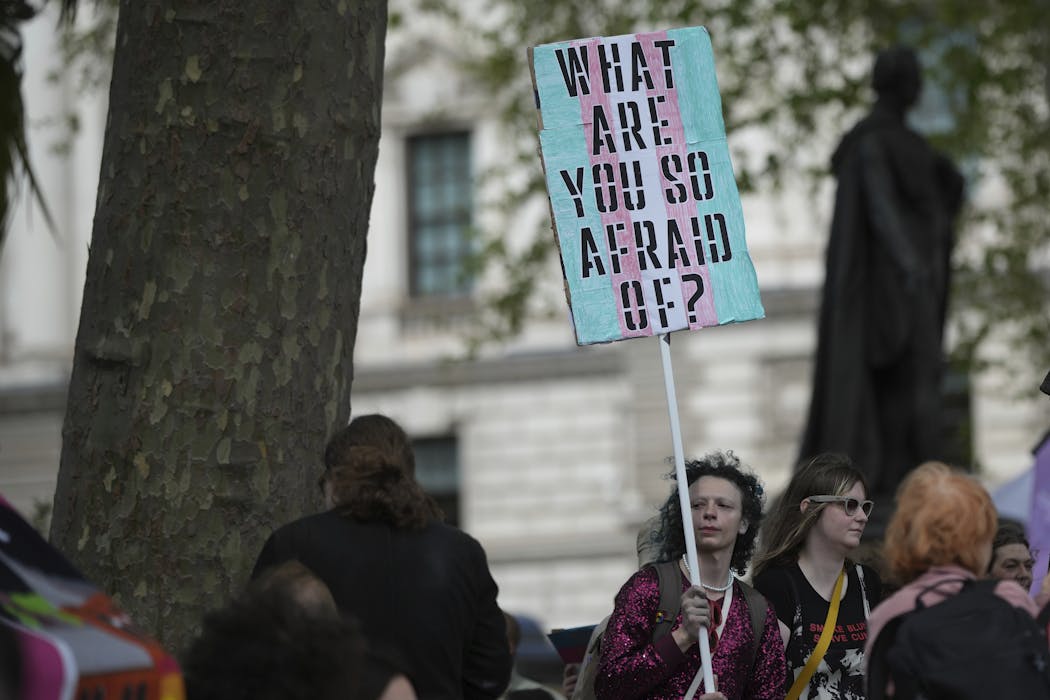
As sociologistswho research and teach about gender, we know that gender across disciplines is understood to be a complex topic of study, not an ideology. The study of gender represents the kind of free inquiry that allows people to decide for themselves how to live, free of coercion or government control.
In 2004, pushing back on the global women’s and gay rights movements, the Vatican declared in a letter to bishops that men and women are different by nature “not only on the physical level, but also on the psychological and spiritual.” The letter stated that the idea of gender “inspired ideologies” that sanction alternatives to the traditional two-parent family headed by men and treated homosexuality on par with heterosexuality.
Over the following decades, evangelical groups and far-right parties across the globe – from Hungary and Russia to Peru, Brazil and Ghana – have used the language of combating “gender ideology” to counter a host of social policies, including sex education in schools, the legalization of gay marriage and same-sex adoption, reproductive rights and transgender rights.
In the U.S., where the majority of Americans support gay marriageand abortion rights, targeting trans rights has become one of the conservative movement’s galvanizing issues. A flood of state bills not only ban books and discussions of gender, sexuality and race in schools but also criminalize abortion, ban gender-affirming health care and legalize discrimination in housing and employment on religious grounds.
What we talk about when we talk about gender
How gender is researched and taught in universities has becomea key target of anti-gender campaigns across the globe, in part because the study of gender raises questions about the universality of traditional social roles and the inequalities that can result from them.
Anti-gender campaigners argue there is nothing to understand about it because gender is given by nature or God. For them, gender is equivalent to sex, which is taken to be straightforward and without exception male or female.
Scientific evidence suggests, however, that sex is not always binary. In biology, sex refers to genes, reproductive organs, hormone systems and observable physical characteristics; different combinations of these lead to variations in sex. Far from straightforward, then, sex is complicated.
And a person’s assigned sex at birth does not always align with their deeply held sense of self – their gender identity.
Gender is both a feature of individual people and a mode of organizing social life. At the individual level, people have a subjective sense of and embody their gender by dressing and behaving in ways that encourage other people to see them as they want to be seen. A man might wear a tie at the office to convey masculinity. People will interact differently with a woman when she is wearing high heels and makeup than when she goes barefaced or dons a swimsuit. Someone who is gender fluid may appear more masculine or feminine at different times and experience prejudice and discrimination.
Gender roles shape society and culture in both subtle and glaring ways.
Gender shapes societies through norms and rules on everything from what you wear to how families operate, whom you are allowed to partner with and what jobs you are likely to hold. Whether in the spheres of culture, family, economic or civic life, gender roles and norms intersect with class, race and other social differences and shift across cultures and historical eras. Indigenous societies across the globe have long recognized more than two gender categories, and historical and contemporary examples of gender diversity abound.
A ban on learning about gender would sweep aside all this variation in favor of a homogeneous worldview that deliberately ignores biology, history and lived experience. Denying the diversity of gender makes it easier to impose a conservative worldview and roll back rights.
Education as a political target
Anti-gender campaigners view education as a major battleground in the fight over societal values. In the U.S., conservative efforts to ban the study of gender and sexuality initially centered on K-12 education, exemplified in bills such as Florida’s 2022 “Don’t Say Gay” law. But the movement has also affected colleges and universities.
Texas A&M’s president fired a professor in September 2025 after a student recorded her confrontation with her for discussing gender diversity in a literature course. The student alleged the course was “not legal” because it contradicted “our president’s laws” and her own religious beliefs. The university president also later resigned under pressure.
The same month, the chancellor of the Texas Tech University system, citing Trump’s executive order on “gender ideology,” banned all faculty members across its five universities from recognizing “more than two sexes” in any course or classroom.
As the Texas chapter of the American Association of University Professors reminds its members, faculty have a constitutional right to teach and discuss “all matters related to the subject matter of a class” without interference from administrators, politicians or government officials. Despite this, states led by conservative lawmakers have useda rangeof tacticsto eliminategender studies programs or curriculum from colleges.
These attacks on universities are attempts to control thought, subdue social movements advocating for change and promote an orthodoxy that upholds those in power.
Books on gender are among those conservatives are purging from libraries and classrooms. AP Photo/Rick Bowmer
Restricting rights, eroding democracy
These attacks on education are not only academic matters. They disempower women and marginalized groups that have achieved some legal protection or rights in recent decades. And they contribute to the erosion of democracy.
Authoritarian approaches to governing rely on scapegoating people, policing thought and speech, and punishing dissent. This is true whether it’s Viktor Orban’s Hungary, Vladimir Putin’s Russia or Donald Trump’s United States. By prohibiting questions and challenges, autocrats gain the power to limit how people think and control their bodies.
Victoria Pitts-Taylor is a member of the American Association of University Professors and the National Women’s Studies Association.
Elizabeth Anne Wood a senior strategist with the Woodhull Freedom Foundation. This is a volunteer position.
Demonstrators in Portland, Ore., protest on Oct. 4, 2025, against President Donald Trump’s plan to deploy the National Guard to the city.Spencer Platt/Getty Images
If you’re confused about what the law does and doesn’t allow the president to do with the National Guard, that’s understandable.
Days before, President Donald Trump, calling the city “a war zone,” had invoked a federal law allowing the government to call up the Guard during national emergencies or when state authorities cannot maintain order.
The conflict throws into relief a question as old as the Constitution itself: Where does federal power end and state authority begin?
One answer seems to appear in the 10th Amendment’s straightforward language: “The powers not delegated to the United States by the Constitution, nor prohibited by it to the States, are reserved to the States respectively, or to the people.” This text is considered to be the constitutional “hook” for federalism in our democracy.
The founders, responding to anti-Federalist anxieties about an overbearing central government, added this language to emphasize that the new government possessed only limited powers. Everything else – including the broad “police power” to regulate health, safety, morals and general welfare – remained with the states.
Yet from the beginning, the text has generated plenty of confusion. Is the 10th Amendment merely a “truism,” as Justice Harlan Fiske Stone wrote in 1941 in United States v. Darby, restating the Constitution’s structure of limited powers? Or does it describe concrete powers held by the states?
Turns out, there’s no simple answer, not even from the nation’s highest court. Over the years, the Supreme Court has treated the 10th Amendment like the proverbial magician’s hat, sometimes pulling robust state powers from its depths, other times finding it empty.
Will the Supreme Court justices weigh in on the Trump administration’s attempts to deploy the National Guard? Win McNamee/Getty Images
10th Amendment’s broad range
The arguments over the 10th Amendment for almost 200 years have applied not only to the National Guard but to questions about how the federal and state governments share powers over everything from taxation to government salaries, law enforcement and regulation of the economy.
For much of the 19th century, the 10th Amendment remained dormant. The federal government’s weakness and limited ambitions, especially on the slavery question, meant that boundaries were rarely tested before the courts.
The New Deal era brought this equilibrium crashing down.
The Supreme Court initially resisted the expansion of federal power, striking down laws banning child labor in Hammer v. Dagenhart in 1918, setting a federal minimum wage in 1923 in Adkins v. Children’s Hospital, and offering farmers subsidies in U.S. v. Butler in 1937. All these decisions were based on the 10th Amendment.
But this resistance wore down in the face of economic crisis and political pressure. By the time of the Darby case in 1941, which concerned the Fair Labor Standards Act and Congress’ power to regulate many aspects of employment, the court had relegated the 10th Amendment to “truism” status: The Amendment, wrote Stone, did nothing more than restate the relationship between the national and state governments as it had been established by the Constitution before the amendment.
The 1970s marked an unexpected revival. In the 1976 decision in National League of Cities v. Usery, a dispute over whether Congress could directly exercise control over minimum wage and overtime pay for state and local government employees, the court held that Congress could not use its commerce power to regulate state governments.
But that principle was abandoned nine years later, with the court doubling back on its position. Now, if the states wanted protection from federal overreach, they would have to seek it through the political process, not judicial intervention.
Yet less than a decade later, the court reversed course again. The modern federalism renaissance began in the ’90s with a pair of divided opinions stating that the federal government cannot force the states to enforce federal regulatory programs: this was the “anti-commandeering principle.”
That brings us back to the present, where Trump has deployed National Guard troops to Los Angeles to quell protests against immigration enforcement, and bids to send them to Portland and Chicago as well.
From the point of view of federalism, two factors lend this conflict some constitutional complexity.
One is the National Guard’s dual state-federal character. Most Guard mobilizations, including disaster relief, take place under Title 32 of the U.S. Code, which maintains state control of troops with federal funding.
By contrast, Title 10 allows the president to assert federal control over Guard units in case of “a rebellion or danger of a rebellion” against the government or where “the President is unable with the regular forces to execute the laws of the United States.”
The other factor is political.
Since World War II, the National Guard has been deployed only 10 times by presidents, mostly in support of racial desegregation and the protection of civil rights. All but one of these mobilizations came at the governor’s request – the lone exception, pre-Trump, being President Dwight Eisenhower’s 1957 mobilization of the Arkansas National Guard to desegregate schools in Little Rock over the wishes of Gov. Orval Faubus.
In sharp contrast, Trump has now attempted three times to send troops to large cities over the explicit objection of Democratic governors. Such is the case in Portland.
President Donald Trump has faced lawsuits when deploying the National Guard to states with Democratic governors. AP Photo/Evan Vucci
National Guard deployments and constitutional stakes
Oregon’s lawsuit argues that there is no national emergency in the city, and that deploying Guard troops to the state without Gov. Tina Kotek’s consent – indeed, over her explicit objection – and absent the extraordinary circumstances that might justify Title 10 federalization, is illegal. The National Guard, asserts the lawsuit, remains a state institution that federal authorities cannot commandeer.
The two deployments, in Oregon and Illinois, are making their way through the federal courts, and the Trump administration has asked the Supreme Court to intervene to authorize the deployments. What the court will do, if the cases reach it, is uncertain. Roberts has proved willing to invoke state sovereignty in some contexts while rejecting it in others.
For now, the court has upheld several Trump administration actions while constraining others, suggesting a jurisprudence driven more by specific contexts than categorical rules.
Whether Oregon’s challenge succeeds may depend less on the long and changing history of 10th Amendment doctrine than on how the court views immigration enforcement, presidential authority and the consequences of Trump’s frequent invocations of emergency power for American democracy.
Andrea Katz does not work for, consult, own shares in or receive funding from any company or organization that would benefit from this article, and has disclosed no relevant affiliations beyond their academic appointment.
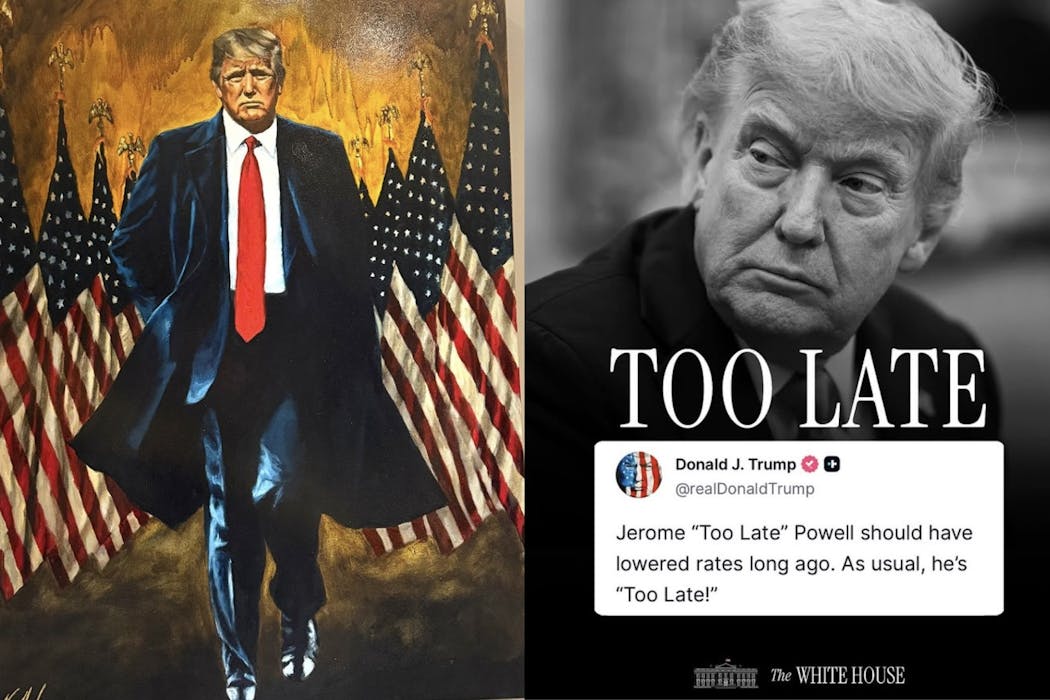
Two Instagram images put out by the White House.White House Instagram
A grim-faced President Donald J. Trump looks out at the reader,
under the headline “LAW AND ORDER.” Graffiti pictured in the corner of the White House Facebook post reads “Death to ICE.” Beneath that, a photo of protesters, choking on tear gas. And underneath it all, a smaller headline: “President Trump Deploys 2,000 National Guard After ICE Agents Attacked, No Mercy for Lawless Riots and Looters.”
In the Trump administration, White House social media posts often blur the lines between politics and entertainment, and between reality and illusion.
The White House has released AI images of Trump as the pope, as Superman and as a Star Wars Jedi, ready to do battle with “Radical Left Lunatics” who would bring “Murderers, Drug Lords … & well-known MS-13 Gang Members” into the country.
Most recently, on the weekend of the No Kings protests, both Trump and the White House released a video of the president wearing a crown and piloting a fighter jet, from which he dispenses feces onto a crowd of protesters below.
Underpinning it all is a calculated political strategy: an appeal to Trump’s political base – largely white, working-class, rural or small-town, evangelical and culturally conservative.
While populist political communication has become more common along with the proliferation of social media, the communication norms are further altered in Trump White House social media posts.
They are partisan, theatrical and exaggerated. Their tone is almost circuslike. The process of governing is portrayed as a reality TV show, in which political roles are performed with little regard for real-world consequences. Vivid color schemes and stylized imagery convert political messaging into visual spectacle. The language is colloquial, down-to-earth.
Just as other influencers in a variety of domains might create an emotional bond by tailoring social media messages, content, products and services to the needs and likes of individual customers, the White House tailors its content to the beliefs, language and worldview of Trump’s political base.
In doing so, the White House echoes a broad, growing trend in political communication, portraying Trump as “a champion of the people” and using direct and informal communication that appeals to fear and resentment.
Trump White House social media makes no effort to promote social unity or constructive dialogue, or reduce polarization – and often heightens it. Undocumented immigrants, for example, are often portrayed as inherently evil. White House social media amplifies dramatic, emotionally charged content.
In one video, Trump recites a poem about a kind woman who takes in a snake, a stand-in for an immigrant who in reality is a dangerous serpent. “Instead of saying thanks, that snake gave her a vicious bite,” Trump recites.
Talking to the base
While some scholars have called the White House social media style “amateurish,” that hasn’t resulted in change.
The lack of response to negative feedback is partially explained by the strategic goal of these communications: to appeal to the frustrations of Trump’s deeply disaffected political base, which seems to revel in the White House social media style.
Trump and the White House social media play to this audience.
On social media, the president is free to violate norms that anger his critics but have little effect on his supporters, who view the current political system as flawed. One example: A White House Valentine’s Day communication that said “Roses are red, violets are blue, come here illegally, and we’ll deport you.”
In addition, Trump and the White House social media use the president’s status as a celebrity, coupled with comedy and spectacle, to immunize the administration from fallout, even among some of its critics.
Trump’s exaggerated gestures, over-the-top language, his lampooning of opponents and his use of caricature to ridicule whole categories of people – including Democrats, the disabled, Muslims, Mexicans and women – is read by his political base as a playful and entertaining take down of political correctness. It may form a sturdy pillar of his support.
But prioritizing entertainment over facts has long-term significance.
Trump’s communication strategies are already setting a global precedent, encouraging other politicians to adopt similar theatrical and polarizing tactics that distort or deny facts.
These methods may energize some audiences but risk alienating others. Informed political engagement is reduced, and democratic backsliding is increasingly a reality.
Although the communication style of the White House is playful and irreverent, it has a serious goal: the diffusion of ideological messages whose intent is to create a sense of strength and righteousness among its supporters.
In simple terms, this is propaganda designed to persuade citizens that the government is strong, its enemies evil and that fellow citizens – “real Americans” – think the same way.
Scholars observe that the White House projection of the often comical images of authority echoes the visual style of authoritarian governments. Both seek to be seen as in control of the social and political order and thereby to discourage dissent.
The chief difference between the two is that in a deeply polarized democracy such as the U.S., citizens interpret these displays of authority in sharply different ways: They build opposition among Trump opponents but support among supporters.
The rising intolerance that results erodes social cohesion, undermines support for democratic norms and weakens trust in institutions. And that opens the door to democratic backsliding.
The authors do not work for, consult, own shares in or receive funding from any company or organization that would benefit from this article, and have disclosed no relevant affiliations beyond their academic appointment.
Earlier this week, Kristen Bell and Dax Shepard celebrated their 12th wedding anniversary, and while fans have always enjoyed the couple’s quirky sense of humor, there are many who believe they finally went too far.
Things started innocently enough, with Kristen posting a photo in which she and
But it was the caption that left some fans confused — and others downright furious.
Dax Shepard and Kristen Bell attend as Keep Memory Alive hosts star-studded lineup at annual “Power Of Love” gala at MGM Grand Garden Arena on February 22, 2025 in Las Vegas, Nevada. (Photo by Gabe Ginsberg/Getty Images for Keep Memory Alive)
Kristen Bell’s domestic violence joke rubs fans the wrong way
“Happy 12th wedding anniversary to the man who once said to me:
“I would never kill you. A lot of men have killed their wives at a certain point. Even though I’m heavily incentivized to kill you, I never would,” Kristen wrote.
Needless to say, that’s not your typical anniversary caption.
And while Kristen is clearly joking (at least we hope she’s joking!) the humor didn’t work for a lot of her followers.
Some went so far as to accuse the actress of making light of abusive relationships, and many pointed out that the post came durign Domestic Violence Awareness Month.
“Domestic violence isn’t a joke,” wrote one commenter.
“Is this… supposed to be funny?” another added.
“Not funny at all. What kind of man says that to his wife? Oh wait, I know exactly what kind. Get out now, Kristen,” a third chimed in.
But others were able to see the humor in the situatiom.
Dax Shepard and Kristen Bell attend the 82nd Annual Golden Globe Awards at The Beverly Hilton on January 05, 2025 in Beverly Hills, California. (Photo by Amy Sussman/Getty Images)
Kristen earns slave from celebrity friends
“He should write for Hallmark,” wrote Howie Mandel.
“You guys are the best,” actress Zoey Deutch added.
“He totally missed out on a lucrative career in greeting cards. Happy Anniversary!” another follower enthused.
So yeah, a bit of a mixed reaction, which we guess is to be expected when you’re dabbling in such dark humor.
We’re sure Dax and Kristen are used to it by now. It’s sort of their thing.
Now he’s describing the “last straw” moment — one that involved Paris Hilton and Lindsay Lohan.
Musician Britney Spears and trophy husband Kevin Federline arrive at the 2006 Grammy Nominees party. (Photo Credit: Matthew Simmons/Getty Images for Rolling Stone)
Fine, what is Kevin Federline saying about Britney Spears THIS time?
In You Thought You Knew, Kevin Federline claims that Britney Spears prioritized reckless partying over their children.
“I was in Miami for work, trying to stay focused on my commitments,” he claims in the tell-all memoir, according to TMZ. “And I got a call.”
The call was from Britney at the time — but she was not alone. There were two other very famous women with her.
“It was her, Paris Hilton, and Lindsay Lohan on the line,” Federline wrote.
He accused the three of them as being “drunk as hell, begging me to come over.” (Just for the record, people do not always know when someone is drunk)
Actress Paris Hilton and actress Lindsay Lohan pose for pictures at the Evening with an Icon – Happy Birthday Marilyn Monroe auction at Meson G on June 1, 2005. (Photo Credit: Michael Buckner/Getty Images)
“I could hear Preston and Jayden crying in the background,” Federline then alleged.
According to him, “It had to be three or four in the morning.”
While small children may cry for any number of reasons (sometimes due to dire circumstances, but also due to minor frustrations or environmental changes — being a kid is very difficult), those are not hours during which small children should be awake.
Federline insisted: “That call was the final straw.”
He wrote that it was not the first time — it was just very memorable.
This 11 February, 2002 file photo shows US pop star Britney Spears waiting to begin an interview. (Photo Credit: LUCY NICHOLSON/AFP via Getty Images)
This was, for him, the final straw
“I’d already seen the photos in the tabloids,” Kevin Federline wrote about Britney Spears, Paris Hilton, and Lindsay Lohan.
“The ones of her out with them all night,” he specified, “partying at Paris’s Malibu place.”
Federline then claimed: “But hearing my kids crying while she was doing God-knows-what? That was it.”
He wrote: “Any deep-seated sliver of hope that I’d held onto, that we might still somehow pull it together for the kids, died right then.”
According to Federline, he felt like Britney “wasn’t ready to change” in the ways that he wanted.
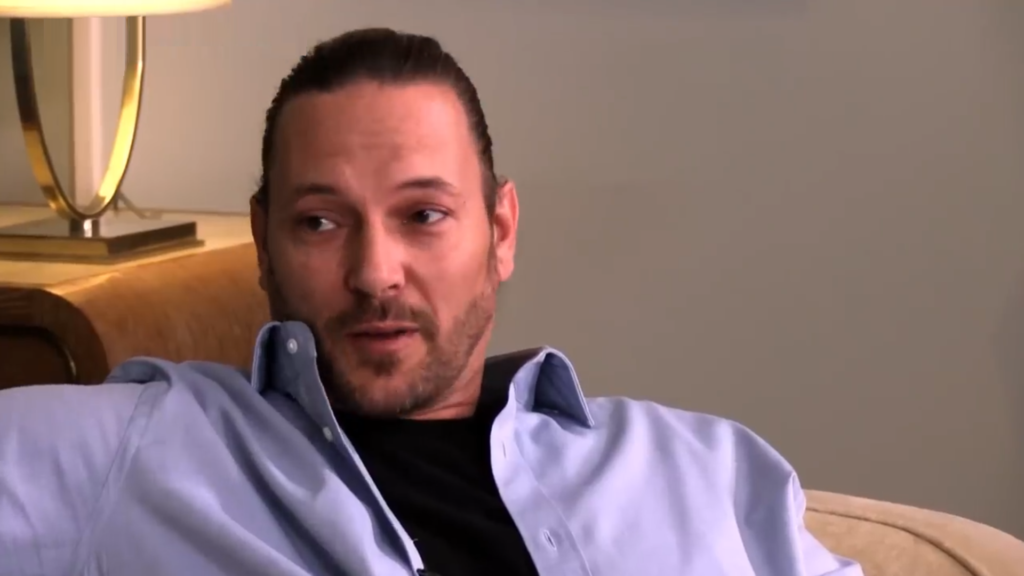
Kevin Federline blasts Britneyâs parenting in a scathing interview, claiming that her teenage sons are embarrassed by her antics. (Image Credit: CBS)
He complained that he “couldn’t keep waiting for her to figure it out.”
If you are hoping for someone to change in order for a relationship to work out, you are likely setting yourself up for disappointment.
Having kids doesn’t “fix” a marriage. Getting married doesn’t “fix” a relationship. And people tend to change at their own pace, if at all.
Obviously, we cannot verify any of what Federline is claiming about his ex-wife.
The truth of the matter is that Federline wrote his memoir and likely hopes that it will sell well. Beyond that … if he’s been nursing a grudge against his ex-wife for all of these years, this is one way to pay her back.
Amy also described her “true monster” grandfather inflicting horrific violence — particularly upon her mother, Deanna.
As it turns out, much of this eye-opening family information is news to Jill.
On Nightline, Jill Duggar discussed her strict cult upbringing. (Image Credit: ABC News)
Jill Duggar learned so much from cousin Amy’s book
Taking to Instagram Live, Jill Duggar Dillard and Amy Duggar King promoted the latter’s book, Holy Disruptor: Shattering the Shiny Facade by Getting Louder with the Truth.
“[The book is] definitely is deep,” Jill emphasized on the Live.
“Like, it goes into a lot of aspects [of the Duggar family],” she noted.
“It tells the whole truth and the reality of a lot of situations that our family lived, you know?” Jill added.
She affirmed: “Everyone is entitled to share their own story, whether we agree with them or not.”
That seems to be less a veiled hint at her own disagreements with Amy and perhaps more of a reminder that some of her siblings do not see eye to eye with Amy.
On the “Shiny Happy People” documentary, Jill Duggar tried to convey the complex emotions that she still feels towards her horrible parents. Husband Derick Dillard was by her side. (Image Credit: Amazon Prime)
Some family secrets were kept in the dark for too long
“It’s definitely a journey that she’s been on,” Jill Duggar said of cousin Amy Duggar.
“And you can tell that through her book,” she expressed.
Jill noted that reading the memoir “was very insightful.”
She added: “We learned more about our family history than we knew.”
Husband Derick Dillard chimed in to reveal: “Some things about her grandfather she didn’t know.”
Amy Duggar appeared on Marriage Boot Camp with her husband, Dillon King. (Image Credit: WEtv)
“He’s like, ‘Did you know this and that and the other about Grandpa Duggar?’” Jill recalled of chatting with Derick after he read Amy’s memoir.
“And I’m like, ‘No! Tell me more!’” she described. “And he’s like, ‘I’m literally telling you more about your grandfather than you knew.’”
Jill reiterated: “We learned more about our family history than we knew.”
She did share that they had “inklings” of what sort of person Jimmy Lee Duggar really was.
But, clearly, Deanna shared more with Amy than Jim Bob shared with his own children. (Also, because she lived with her maternal grandparents for a time, perhaps Amy simply knew them better)
Jill Duggar speaks to producers while filming a reality show for TLC. (Image Credit: TLC)
Burying painful truths because they’re inconvenient can make things worse
Jill Duggar spoke of how her late paternal grandmother could be judgmental, but was in many ways also very supportive.
“Obviously she kept a lot of things quiet for a very long time,” she acknowledged. “Because she didn’t want to deal with it.”
Jill speculated: “So I think [her reaction to our tell-all books] would have been very similar.”
She added: “She would have not have wanted everything to be talked about at that time.”
However, Jill and Amy have both chosen to speak about their family. Keeping silent can at times mean helping the worst people get away with their misdeeds.
Many of the Duggar girls learned that the hard way.




























.jpg)
