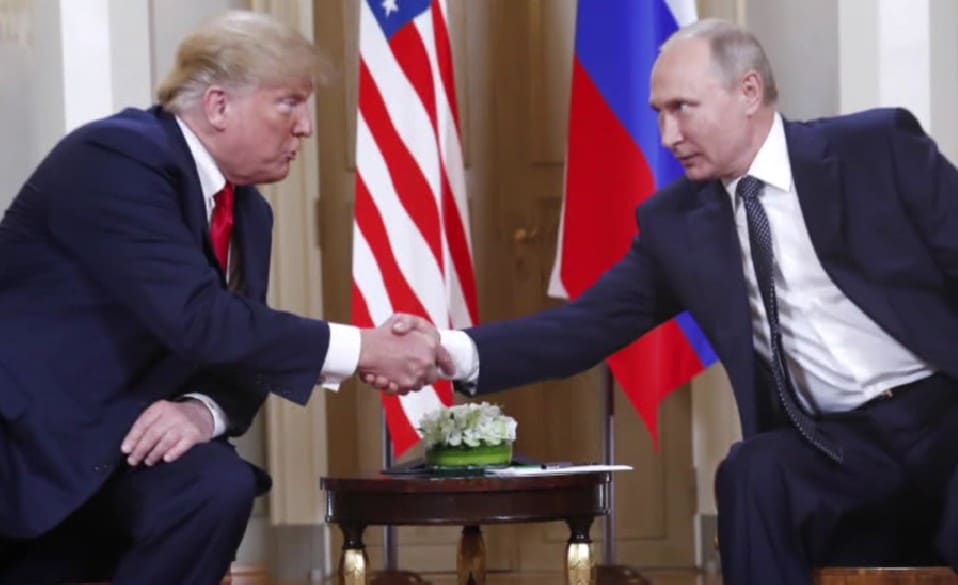
Hand pats, manspreading and tell-tale signs of discontent – there was plenty on display in the body language of Donald Trump and Vladimir Putin to show who had the upper hand in their Ukraine negotiations, an expert has told Sky News.The Latest News from the UK and Around the World | Sky News
The clear winner in Alaska is Vladimir Putin. A day in a global spotlight, equal billing with a true superpower leader, a red carpet welcome and most importantly for him no need to agree to a ceasefire.The Latest News from the UK and Around the World | Sky News
Ukrainian forces are increasing the intensity of long-range drone strikes deep into Russia, according to data released by Moscow, ahead of Friday's planned meeting between Presidents Donald Trump and Vladimir Putin in Alaska.
Ukrainian forces are increasing the intensity of long-range drone strikes deep into Russia, according to data released by Moscow, ahead of Friday’s planned meeting between Presidents Donald Trump and Vladimir Putin in Alaska.
Alaska (AP) — President Donald Trump failed to secure an agreement from Vladimir Putin on Friday to end Russia’s war in Ukraine, falling short in his most significant move yet to stop the bloodshed, even after rolling out the red carpet for the man who started it.
“There’s no deal until there’s a deal,” the U.S. president said, after Putin claimed they had hammered out an “understanding” on Ukraine and warned Europe not to “torpedo the nascent progress.” Trump said he would call Ukrainian President Volodymyr Zelenskyy and European leaders to brief them on the talks.
Trump, who for years has balked at American support for Ukraine and expressed admiration for Putin, had pledged confidently to bring about an end to the war on his first day back in the White House. Seven months later, after berating Zelenskyy in the Oval Office and stanching the flow of some U.S. military assistance to Kyiv, Trump could not bring Putin even to pause the fighting, as his forces make gains on the battlefield.
The U.S. president had offered Putin both a carrot and a stick, issuing threats of punishing economic sanctions on Russia while also extending a warm welcome at Joint Base Elmendorf-Richardson in Anchorage, but he appeared to walk away without any concrete progress on ending the war in Ukraine, now in its fourth year.
Instead, he handed Putin long-sought recognition on the international stage, after years of Western efforts to make him a pariah over the war and his crackdown on dissent, and forestalled the threat of additional U.S. sanctions.
In a sign that the conversations did not yield Trump’s preferred result, the two leaders ended what was supposed to be a joint news conference without taking questions from reporters.
During a subsequent interview with Fox News Channel before leaving Alaska, Trump insisted that the onus going forward might be somehow on Zelenskyy “to get it done,” but said there would also be some involvement from European nations. That was notable since Zelenskyy was excluded from Trump and Putin’s meeting.
The U.S. president had wanted to show off his deal-making skills, while Putin wanted to negotiate a deal that would cement Russia’s gains, block Kyiv’s bid to join the NATO military alliance and eventually pull Ukraine back into Moscow’s orbit.
“We had an extremely productive meeting, and many points were agreed to,” Trump said while standing next to Putin. “And there are just a very few that are left. Some are not that significant. One is probably the most significant, but we have a very good chance of getting there.”
He continued: “We didn’t get there.”
Putin says Trump ‘shows understanding’ that Russia has its own interests
For Putin, just being on U.S. soil for the first time in more than a decade was validation after his ostracization following his invasion of Ukraine.
His meeting with Trump may stall the economic sanctions that the U.S. president had promised unless Moscow worked harder to bring the fighting to a close. It also may simply lead to more meetings, giving his forces more time to make progress on the battlefield.
Putin said Russia and the United States should “turn the page and go back to cooperation.”
He praised Trump as someone who “has a clear idea of what he wants to achieve and sincerely cares about the prosperity of his country, and at the same time shows understanding that Russia has its own national interests.”
“I expect that today’s agreements will become a reference point not only for solving the Ukrainian problem, but will also mark the beginning of the restoration of businesslike, pragmatic relations between Russia and the U.S.,” Putin said.
Despite not reaching any major breakthrough, Trump ended his remarks by thanking Putin and saying, “we’ll speak to you very soon and probably see you again very soon.”
When Putin smiled and offered, “next time in Moscow,” Trump said “that’s an interesting one” and said he might face criticism but “I could see it possibly happening.”
During the interview with Fox News, Trump bragged that Putin echoed many of the U.S. president’s long-standing grievances, including about the 2020 election. This suggests that Putin, a former KGB officer, may have left Trump with the impression that he’d notched a big win even as he left empty handed.
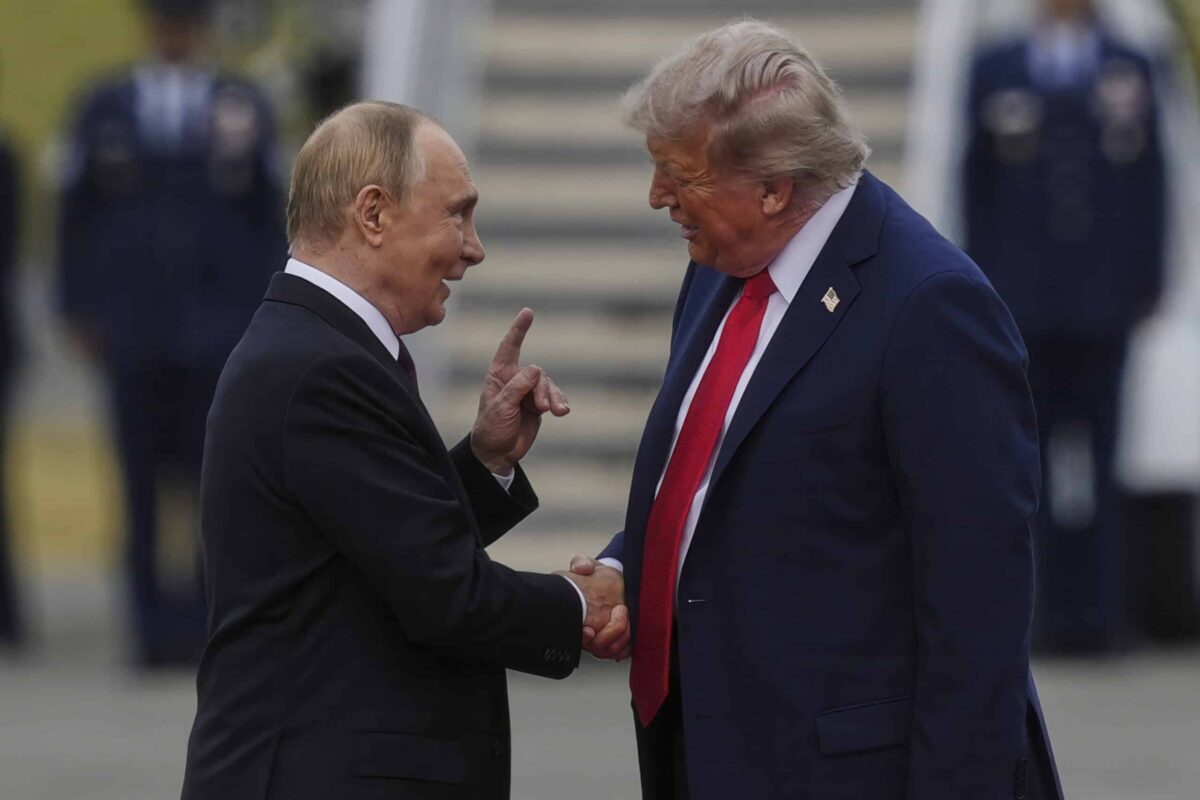
When Trump and Putin arrived in Alaska, they had greeted each other with a warm handshake, chatting almost like old friends, and gripped hands for an extended period on a red carpet rolled out at the military base. As they chatted, Putin grinned and pointed skyward, where B-2s and F-22s — military aircraft designed to oppose Russia during the Cold War — flew overhead. The two then shared the U.S. presidential limo for a short ride to their meeting site, with Putin offering a broad smile as they rolled past the cameras.
It was the kind of reception typically reserved for close U.S. allies and belied the bloodshed and suffering in the war Putin started in Ukraine. Although not altogether surprising considering their longtime friendly relationship, such outward friendliness likely raised concerns from Zelenskyy and European leaders, who fear that Trump is primarily focusing on furthering U.S. interests and not pressing hard enough for Ukraine’s.
Not a one-on-one meeting
White House press secretary Karoline Leavitt said shortly before Air Force One touched down that the previously planned one-on-one meeting between Trump and Putin would be a three-on-three discussion including Secretary of State Marco Rubio and special envoy Steve Witkoff. Putin was joined by Foreign Minister Sergey Lavrov and foreign affairs adviser Yuri Ushakov.
The change seemed to indicate that the White House was taking a more guarded approach than it did during a 2018 meeting in Helsinki, where Trump and Putin met privately with their interpreters and Trump then shocked the world by siding with the Russian leader over U.S. intelligence officials on whether Russia meddled in the 2016 campaign.
Zelenskyy’s exclusion was also a heavy blow to the West’s policy of “nothing about Ukraine without Ukraine.”
War still raging
Russia and Ukraine remain far apart in their demands for peace. Putin has long resisted any temporary ceasefire, linking it to a halt in Western arms supplies and a freeze on Ukraine’s mobilization efforts, which are conditions rejected by Kyiv and its Western allies.
The meeting comes as the war has caused heavy losses on both sides and drained resources. Ukraine has held on far longer than some initially expected since the February 2022 invasion, but it is straining to hold off Russia’s much larger army, grappling with bombardments of its cities and fighting for every inch on the over 600-mile (1,000-kilometer) front line.
Alaska is separated from Russia at its closest point by just 3 miles (less than 5 kilometers) and the international date line.
Joint Base Elmendorf-Richardson was crucial to countering the Soviet Union during the Cold War. It continues to play a role today, as planes from the base still intercept Russian aircraft that regularly fly into U.S. airspace.
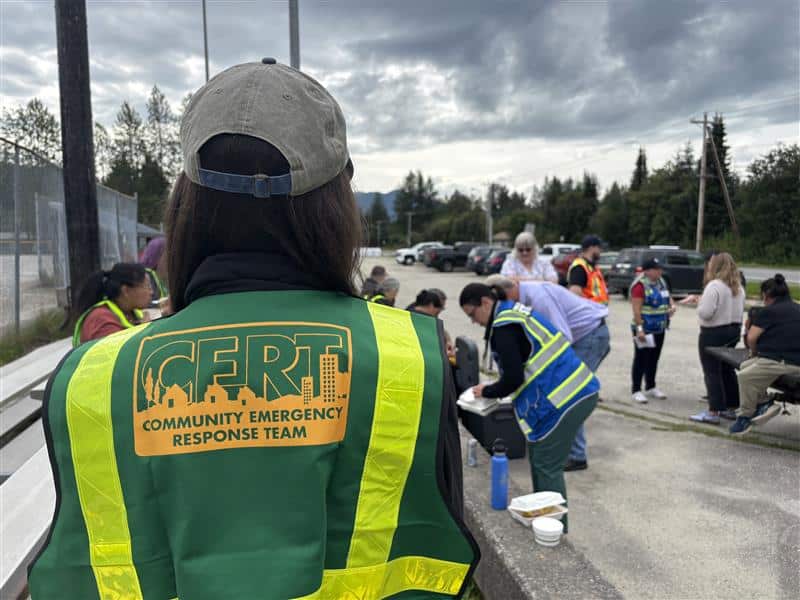
NOTN- Teams of organizations and volunteers from across Juneau—Tlingit & Haida, CBJ, Alaska Department of Environmental Conservation, USCG Sector Southeast Alaska, Community Emergency Response Team volunteers, Team Rubicon, American Red Cross, United Way of Southeast Alaska, and University of Alaska Southeast—worked together in the field to support impacted residents, identify any spills or safety hazards and to get a better understanding of the damage from this year’s flood. The teams assessed over 700 homes in the flood inundation area.
As a result, CBJ reports that overall damage levels are far below those of 2024. However, some homes and properties have suffered flood damage—especially to basements and crawlspaces—and will now begin recovery.
Crews will begin the first round of flood debris collection in Juneau on Monday, Aug. 17, starting at 8 a.m. in impacted neighborhoods on View Drive, Marion Drive, Meander Way and Meadow Lane.
Residents are asked to move debris to the right of way and sort it into three piles: large appliances such as refrigerators, freezers and lawn mowers; household hazardous waste including chemicals, pesticides, fuel, propane tanks and electronic waste; and all other debris, including construction materials and insulation.
Please be aware that CBJ, Tlingit & Haida and United Way are not accepting sandbags for disposal. Residents are strongly encouraged to keep and store sandbags for future outbursts for years to come.
President Donald Trump greets Russia's President Vladimir Putin Friday, Aug. 15, 2025, at Joint Base Elmendorf-Richardson, Alaska. (AP Photo/Julia Demaree Nikhinson)
President Donald Trump greets Russia’s President Vladimir Putin Friday, Aug. 15, 2025, at Joint Base Elmendorf-Richardson, Alaska. (AP Photo/Julia Demaree Nikhinson)
JOINT BASE ELMENDORF-RICHARDSON, Alaska (AP) — President Donald Trump and Russia’s Vladimir Putin kicked off their Alaska summit with a warm handshake on Friday, greeting each other like old friends before heading into hours of discussions that could reshape the war in Ukraine and relations between Moscow and Washington.
After descending from Air Force One, Trump applauded as Putin approached along a red carpet. They gripped hands for an extended period of time, with both men smiling, and Putin eventually grinned and pointed skyward, where B-2s and F-22s — military aircraft designed to oppose Russia during the Cold War — flew overhead to mark the moment at Joint Base Elmendorf-Richardson.
Reporters nearby yelled, “President Putin, will you stop killing civilians?” and Russia’s leader put his hand up to his ear but didn’t answer. Trump and Putin then both climbed in the U.S. presidential limo, with Putin grinning widely as the vehicle rolled past the cameras.
The pair’s chumminess, while not altogether surprising considering their longtime friendly relationship, was striking given the bloodshed and suffering in the war Putin started in Ukraine — the biggest land war in Europe since World War II. It was likely to raise concerns from Ukrainian President Volodymyr Zelenskyy and European leaders, who fear that Trump will primarily focus on furthering U.S. interests and fail to press hard for Ukraine’s.
Zelenskyy and European leaders were excluded from Friday’s meeting, and Ukraine’s president was left posting a video address in which he expressed his hope for a “strong position from the U.S.”
“Everyone wants an honest end to the war. Ukraine is ready to work as productively as possible to end the war,” he said, later adding, “The war continues and it continues precisely because there is no order, nor any signals from Moscow, that it is preparing to end this war.”
The summit was a chance for Trump to prove he’s a master dealmaker and peacemaker. He and his allies have cast him as a heavyweight negotiator who can find a way to bring the slaughter to a close — something he used to boast he could do quickly.
For Putin, it was an opportunity to try to negotiate a deal that would cement Russia’s gains, block Kyiv’s bid to join the NATO military alliance and eventually pull Ukraine back into Moscow’s orbit.
Not meeting one-on-one anymore
White House press secretary Karoline Leavitt said the previously planned one-on-one meeting between Trump and Putin was now a three-on-three discussion including Secretary of State Marco Rubio and special envoy Steve Witkoff. Putin was joined by Foreign Minister Sergey Lavrov and foreign affairs adviser Yuri Ushakov.
The change indicates that the White House is taking a more guarded approach than it did during a 2018 meeting in Helsinki, when Trump and Putin met privately just with their interpreters for two hours and where Trump shocked the world by siding with the Russian leader over U.S. intelligence officials on whether Russia meddled in the 2016 campaign.
Trump and Putin began their discussions Friday by sitting with their aides in front of a blue backdrop printed with “Alaska” and “Pursuing Peace.” Putin and Trump are expected to hold a joint press conference at the end of the summit.
There are significant risks for Trump. By bringing Putin onto U.S. soil — America bought Alaska from Russia in 1867 for roughly 2 cents per acre — the president is giving him the validation he desires after his ostracization following his invasion of Ukraine 3 1/2 years ago. Zelenskyy’s exclusion is a heavy blow to the West’s policy of “nothing about Ukraine without Ukraine” and invites the possibility that Trump could agree to a deal that Ukraine does not want.
Any success is far from assured since Russia and Ukraine remain far apart in their demands for peace. Putin has long resisted any temporary ceasefire, linking it to a halt in Western arms supplies and a freeze on Ukraine’s mobilization efforts, which are conditions rejected by Kyiv and its Western allies.
Trump said earlier in the week there was a 25% chance that the summit would fail, but he also floated the idea that if the meeting succeeds he could bring Zelenskyy to Alaska for a subsequent meeting with himself and Putin.
Trump has also expressed doubts about getting an immediate ceasefire, but he has wanted a broad peace deal done quickly. That seemingly echoes Putin’s longtime argument that Russia favors a comprehensive deal to end the fighting, reflecting its demands, and not a temporary halt to hostilities.
Trump has offered shifting explanations for his meeting goals
Trump said before arriving in Alaska that his talks with Putin will include Russian demands that Ukraine cede territory as part of a peace deal. He said Ukraine has to decide, but he also suggested Zelenskyy should accept concessions.
“I’ve got to let Ukraine make that decision. And I think they’ll make a proper decision,” Trump told reporters traveling with him to Alaska.
Trump said there’s “a possibility” of the United States offering Ukraine security guarantees alongside European powers, “but not in the form of NATO.” Putin has fiercely resisted Ukraine joining the trans-Atlantic security alliance, a long-term goal for Ukrainians seeking to forge stronger ties with the West.
Gen. Alexus Grynkewich, NATO’s supreme allied commander Europe, is in Alaska to provide “military advice” to Trump and Defense Secretary Pete Hegseth, according to a senior NATO military official who wasn’t authorized to speak publicly and spoke on the condition of anonymity. His presence is likely to be welcomed by European leaders who have tried to convince Trump to be firm with Putin and not deal over Kyiv’s head.
Potentially far-reaching implications
Foreign governments are watching closely to see how Trump reacts to Putin, likely gauging what the interaction might mean for their own dealings with the U.S. president, who has eschewed traditional diplomacy for his own transactional approach to relationships.
The meeting comes as the war has caused heavy losses on both sides and drained resources. Ukraine has held on far longer than some initially expected since the February 2022 invasion, but it is straining to hold off Russia’s much larger army, grappling with bombardments of its cities and fighting for every inch on the over 600-mile (1,000-kilometer) front line.
Alaska is separated from Russia at its closest point by just 3 miles (less than 5 kilometers) and the international date line.
Joint Base Elmendorf-Richardson was crucial to countering the Soviet Union during the Cold War. It continues to play a role today, as planes from the base still intercept Russian aircraft that regularly fly into U.S. airspace.
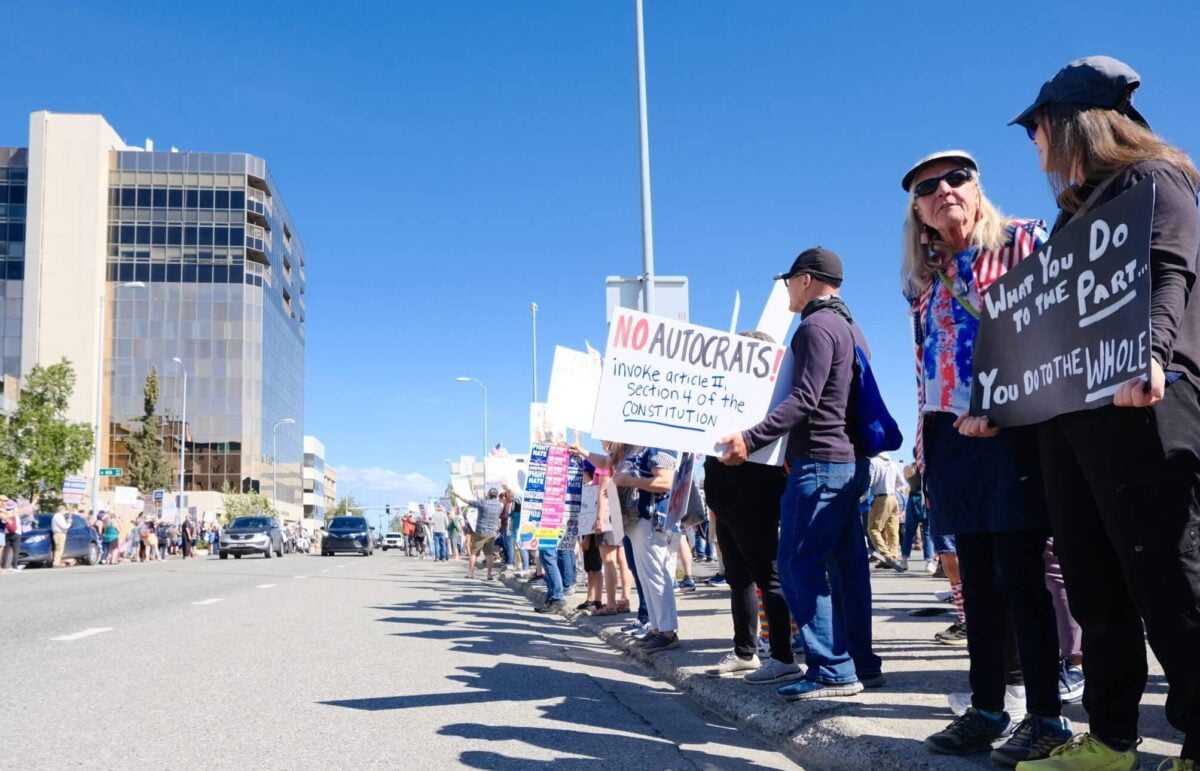
Protesters rally in downtown Anchorage as part of the nationwide “No Kings” protests on June 14, 2025. (Photo by Corinne Smith/Alaska Beacon)
Alaskans are planning demonstrations in solidarity with Ukraine across the state, ahead of the meeting between President Donald Trump and Russian President Vladimir Putin on ending the war in Ukraine.
Trump and Putin are expected to meet at the Anchorage military base, Joint Base Elmendorf-Richardson, at 11:30 a.m. on Friday. The two leaders then plan to hold a joint news conference following the meeting, which was confirmed by both the White House and the Kremlin, according to the political news outlet The Hill.
At least 16 protest events are scheduled to take place across Alaska from Thursday through Saturday, protesting the meeting and demonstrating solidarity with Ukraine, from Fairbanks to Kodiak to Ketchikan.
At least 16 events are planned in 15 communities across Alaska to show solidarity for Ukraine, as Trump and Putin are scheduled to meet in Anchorage on August 15, 2025 (Screenshot of map via marchagainst.org)
Nicole Collins is an organizer with the group Ketchikan Mayday for Democracy, which is planning a vigil on Thursday evening to show support for Ukraine.
“First and foremost, our goal is to communicate solidarity with our brothers and sisters in Ukraine, to let them know that we all watched in horror as Ukraine was invaded over three years ago now,” she said in an interview. “Even though we’re on this island in Southeast Alaska, we are members of the human race, and we’re all part of this world, and we want them to know that we see them and we stand with them.”
Collins said the group started monthly protests in the spring, when members watched a meeting between Trump and Ukraine President Volodymyr Zelenskyy.
“The majority of us felt like something wasn’t right,” she said, and community members have come together since to show support for Zelenskyy and the people of Ukraine.
The Thursday event is also to express outrage for the president’s invitation and welcome to Putin, she said. “Our secondary goal would be to show that we just have this utter disgust in a war criminal stepping foot on our precious Alaskan soil, our U.S. soil, and that we have great concerns over the fact that our president shows every sign of admiration towards this war criminal dictator that’s coming from Russia,” she said.
Putin has been widely condemned internationally for the invasion of Ukraine, where tens of thousands of people have been killed since 2022. More than 6.9 million Ukrainians have been displaced, and more than 13,000 civilians killed, according to the United Nations, which says the true number is likely far higher. Over 1 million Russians have been killed or injured.
The International Criminal Court has issued an arrest warrant for Putin related to war crimes. He risks being arrested if he travels to any of the 125 member states, which has impacted his ability to travel.
“This is far beyond left and right now, it’s about right and wrong,” Collins said. “And we feel like we have to speak out. We have to show our support for democracy and for decency, for honesty, for unity, not division.”
This will be the first in-person meeting between Trump and Putin since the war began.
Trump announced the meeting in Alaska last Friday, amid high-stakes negotiations around a peace deal between Russia and Ukraine, but the president has not provided details on what a long-term deal would look like. Zelenskyy was not invited.
Riza Smith, an organizer based in Anchorage who served in the Air Force at JBER, said it feels like an about face for Alaska to welcome Putin.
“If Russia decides to, you know, escalate things against the U.S., we’re right nearby. If Russia decided, ‘Hey, we want this portion of land,’ or, ‘Hey, we want these resources,’ or something, we’re right nearby. So I think it impacts a lot of people a lot more strongly, especially for the military,” they said.
Various branches of the U.S. military in Alaska conduct regular exercises, as part of homeland security efforts, including patrols of the airspace and maritime border with Russia. Currently the U.S. Northern Command is conducting military drills known as Arctic Edge throughout the state.
“(For) the past 20 years, we’ve been dealing with intercept flights,” Smith said. “That’s affected our military for years. So it’s a little confusing, since about like 2015, when that kind of escalated, to see like a complete nonrecognition of them.”
In addition to protesting Putin, Smith said the planned protest actions are also condemning the Trump administration.
“I think we’re fed up with corruption. We’re fed up with people trying to take something that isn’t theirs. And I think the prime example of that is Russia and Ukraine. … Vladimir Putin has overstepped his bounds repeatedly with Ukraine. Donald Trump has overstepped his bounds repeatedly with Alaska … making these different claims, like offering to sell resources, or whatever he wants to offer people,” they said. “I think people are just kind of done with people, you know, doing something without their input.”
Smith also helped coordinate a calendar of solidarity events taking place across the state, from vigils to protest actions to a plan to unfurl a Ukrainian flag at the Delaney Park Strip in Anchorage on Friday.
“So if you just want to visit an office, that’s an option. If you want to rally hard on the side of the building, that’s an option. If you want to do sign making, if you just want to do a local community thing, or a barbecue, like, people are just kind of coming together. So it’s every kind of opportunity to just kind of build that community in Alaska.”
Ukrainian forces are increasing the intensity of long-range drone strikes deep into Russia, according to data released by Moscow, ahead of Friday's planned meeting between Presidents Donald Trump and Vladimir Putin in Alaska.
Ukrainian forces are increasing the intensity of long-range drone strikes deep into Russia, according to data released by Moscow, ahead of Friday’s planned meeting between Presidents Donald Trump and Vladimir Putin in Alaska.
AP- U.S. President Donald Trump is meeting face-to-face with Russian President Vladimir Putin in Alaska on Friday for a high-stakes summit that could determine not only the trajectory of the war in Ukraine but also the fate of European security.
The sit-down offers Trump a chance to prove to the world that he is both a master dealmaker and a global peacemaker. He and his allies have cast him as a heavyweight negotiator who can find a way to bring the slaughter to a close, something he used to boast he could do quickly.
For Putin, a summit with Trump offers a long-sought opportunity to try to negotiate a deal that would cement Russia’s gains, block Kyiv’s bid to join the NATO military alliance and eventually pull Ukraine back into Moscow’s orbit.
There are significant risks for Trump. By bringing Putin onto U.S. soil, the president is giving Russia’s leader the validation he desires after his ostracization following his invasion of Ukraine 3 1/2 years ago. The exclusion of Ukrainian President Volodymyr Zelenskyy from the summit also deals a heavy blow to the West’s policy of “nothing about Ukraine without Ukraine” and invites the possibility that Trump could agree to a deal that Ukraine does not want.
Any success is far from assured, especially as Russia and Ukraine remain far apart in their demands for peace. Putin has long resisted any temporary ceasefire, linking it to a halt in Western arms supplies and a freeze on Ukraine’s mobilization efforts, which were conditions rejected by Kyiv and its Western allies.
“HIGH STAKES!!!” Trump posted on Truth Social as his motorcade idled outside the White House shortly after sunrise in Washington. An hour later, he waved as he boarded Air Force One but did not speak to reporters.
Trump on Thursday said there was a 25% chance that the summit would fail, but he also floated the idea that if the meeting succeeds he could bring Zelenskyy to Alaska for a subsequent, three-way meeting, a possibility that Russia hasn’t agreed to.
When asked in Anchorage about Trump’s estimate of a 25% chance of failure, Russian Foreign Minister Sergei Lavrov told reporters that Russia “never plans ahead.”
“We know that we have arguments, a clear, understandable position. We will state it,” he said in footage posted to the Russian Foreign Ministry’s Telegram channel.
Trump said in a Fox News radio interview Thursday that he didn’t know if they would get “an immediate ceasefire” but he wanted a broad peace deal done quickly. That seemingly echoes Putin’s longtime argument that Russia favors a comprehensive deal to end the fighting, reflecting its demands, not a temporary halt to hostilities.
The Kremlin said Trump and Putin will first sit down for a one-on-one discussion, followed by the two delegations meeting and talks continuing over “a working breakfast.” They are then expected to hold a joint press conference.
Trump has offered shifting explanations for his meeting goals
In the days leading up to the summit, set for a military base near Anchorage, Trump described it as “ really a feel-out meeting.” But he’s also warned of “very severe consequences” for Russia if Putin doesn’t agree to end the war and said that though Putin might bully other leaders, “He’s not going to mess around with me.”
Trump said Friday his talks with Putin will include Russian demands that Ukraine cede territory as part of a peace deal. He said Ukraine has to decide, but he also suggested Zelenskyy should accept concessions.
“I’ve got to let Ukraine make that decision. And I think they’ll make a proper decision,” Trump told reporters traveling with him to Alaska.
Trump said there’s “a possibility” of the United States offering Ukraine security guarantees alongside European powers, “but not in the form of NATO.” Putin has fiercely resisted Ukraine joining the trans-Atlantic security alliance, a long-term goal for Ukrainians seeking to forge stronger ties with the West.
Zelenskyy has time and again cast doubts on Putin’s willingness to negotiate in good faith. His European allies, who’ve held increasingly urgent meetings with U.S. leaders over the past week, have stressed the need for Ukraine to be involved in any peace talks.
Political commentators in Moscow, meanwhile, have relished that the summit leaves Ukraine and its European allies on the sidelines.
Dmitry Suslov, a pro-Kremlin voice, expressed hope that the summit will “deepen a trans-Atlantic rift and weaken Europe’s position as the toughest enemy of Russia.”
The summit could have far-reaching implications
On his way to Anchorage Thursday, Putin arrived in Magadan in Russia’s Far East, according to Russian state news agency Interfax.
Kremlin spokesman Dmitry Peskov said the visit would include meetings with the regional governor and stops at several key sites, including a stop to lay flowers at a WWII-era memorial honoring Soviet-American aviation cooperation.
Foreign governments will be watching closely to see how Trump reacts to Putin, likely gauging what the interaction might mean for their own dealings with the U.S. president, who has eschewed traditional diplomacy for his own transactional approach to relationships.
The meeting comes as the war has caused heavy losses on both sides and drained resources.
Ukraine has held on far longer than some initially expected since the February 2022 invasion, but it is straining to hold off Russia’s much larger army, grappling with bombardments of its cities and fighting for every inch on the over 600-mile (1,000-kilometer) front line.
Andrea Kendall-Taylor, a senior fellow and director of the Transatlantic Security Program at the Center for a New American Security, said U.S. antagonists like China, Iran and North Korea will be paying attention to Trump’s posture to see “whether or not the threats that he continues to make against Putin are indeed credible.”
“Or, if has been the past track record, he continues to back down and look for ways to wiggle out of the kind of threats and pressure he has promised to apply,” said Kendall-Taylor, who is also a former senior intelligence officer.
While some have objected to the location of the summit, Trump has said he thought it was “very respectful” of Putin to come to the U.S. instead of a meeting in Russia.
Sergei Markov, a pro-Kremlin Moscow-based analyst, observed that the choice of Alaska as the summit’s venue “underlined the distancing from Europe and Ukraine.”
Being on a military base allows the leaders to avoid protests and meet more securely, but the location carries its own significance because of its history and location.
Alaska, which the U.S. purchased from Russia in 1867, is separated from Russia at its closest point by just 3 miles (less than 5 kilometers) and the international date line.
Joint Base Elmendorf-Richardson was crucial to countering the Soviet Union during the Cold War. It continues to play a role today, as planes from the base still intercept Russian aircraft that regularly fly into U.S. airspace.
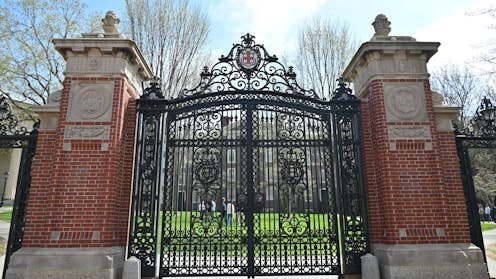
Brown University is one of the Ivy League universities that has recently made a deal with the White House to end the government’s inquiry into its treatment of Jewish students, among other practices, on campus. Kyle Mazza/Anadolu via Getty Images
The Trump administration and Harvard University are reportedly close to reaching a settlement that would require Harvard to pay US$500 million in exchange for the government releasing frozen federal funding and ending an investigation into antisemitism on campus.
This follows similar deals the White House struck with Columbia University and Brown University in July 2025. Both of those universities agreed to undertake campus reforms and pay a large sum – more than $200 million in the case of Columbia and $50 million for Brown – in order to receive federal funding that the Trump administration was withholding. The White House originally froze funding after saying that these universities had created unsafe environments for Jewish students during Palestinian rights protests on campus in 2024.
As a scholar of higher education politics, I examined the various deals the Trump administration made with some universities. When Harvard announces its deal, it will be informative to see what is different – or the same.
I believe the Columbia and Brown deals can be used as a blueprint for Trump’s plans for higher education. They show how the government wants to drive cultural reform on campus by giving the government more oversight over universities and imposing punishments for what it sees as previous wrongdoing.
Here are four key things to understand about the deals:
Columbia University students walk past police on commencement day on May 21, 2025, outside the campus on Broadway in New York. Selcuk Acar/Anadolu via Getty Images
1. Antisemitism isn’t a major feature of the agreements
The Trump White House accused Brown and Columbia of tolerating antisemitism during campus protests. But the administration neither followed federal standards for investigating antisemitism, nor did it dictate specific reforms to protect Jewish students.
Ahead of its deal, Columbia in March 2025 adopted a new, broader definition of antisemitism that was created by the International Holocaust Remembrance Alliance. The United Nations and most European Union countries also use this definition.
Yet the school’s 22-page deal mentions antisemitism only once, where it says Columbia is required to hire an additional staff member to support Jewish students’ welfare.
Brown’s deal, meanwhile, did not involve the university adopting a particular definition of antisemitism. But Brown did commit to offering “research and education about Israel, and a robust Program in Judaic Studies.” Brown already hosts a Judaic Studies program, and it is unclear from the agreement’s text what additional measures are required.
The deals also extend well beyond antisemitism concerns and into questions of gender and the composition of student bodies.
Columbia agreed to provide “single-sex” housing and sports facilities, for example. The university has an optional Open Housing program that allows mixed-gender roommates and several gender-neutral restrooms.
This places the school in line with Donald Trump’s January executive order that says a person’s gender is based on their sex as assigned at birth.
Brown’s deal also requires single-sex sports and housing facilities. In addition, Brown committed to using definitions of men and women that match Trump’s executive order.
Columbia, which enrolls about 40% of its students from other countries, also agreed to “decrease financial dependence on international student enrollment.”
The Brown deal says nothing about international education.
2. Both deals are expensive but vague about financial details.
Columbia must pay a fine of more than $200 million to the federal government, while Brown will make $50 million in donations to Rhode Island workforce development programs.
In both cases, it is not clear where the money will go or how it will be used.
Congress passed The Clery Act in 1990, creating a legal framework for fining campuses that failed to protect students’ safety.
Since then, the government has reached different settlements with universities.
Liberty University, in Lynchburg, Virginia, was required to pay the federal government $14 million in 2024, for example, for failing to investigate sexual assault allegations.
But Columbia’s payment is far larger than any previous university and government settlement. Columbia will make three payments of about $66 million into the Treasury Department over three years, according to The Chronicle of Higher Education. But it isn’t clear how the money will exactly be spent and what will happen after those three years, The Chronicle of Higher Education reported in August 2025.
Only Congress can legally decide how to spend Treasury Department funds. But Trump has ignored Congress’ appropriation directives on a number of occasions.
Brown, meanwhile, will not pay the government anything. Instead, its deal will go “to state workforce development organizations operating in compliance with anti-discrimination laws, over the ten years.”
The Brown deal doesn’t say what qualifies as qualified workforce development organizations.
3. Trump wants to influence university admissions.
While the Brown and Columbia deals have several differences, the agreements have nearly identicallanguage giving the Trump administration oversight of the way they admit students.
The deals say that the universities must provide the government with detailed information about who applied to the schools and was admitted, broken down by grades and test scores, as well as race and ethnicity. The government could then conduct a “comprehensive audit” of the schools, based on this information.
This information could also be used to determine if universities are showing a preferences for students of color. Without providing evidence, conservative activists have alleged that selective colleges discriminate against white people and that this is a violation of the Civil Rights Act of 1964.
Experts have said that these reporting requirements appear to be intended to increase the number of white students admitted to Ivy League schools.
Harvard President Alan Garber greets graduating students at Harvard’s commencement on May 29, 2025, in Cambridge, Mass. Rick Friedman/AFP via Getty Images
4. The deals could open more doors to federal intrusion.
Claire Shipman, Columbia’s acting president, said in July that the deal would allow the university’s “research partnership with the federal government to get back on track.”
Christina Paxson, Brown’s president, also defended the agreement in a statement, writing that it “enables us as a community to move forward after a period of considerable uncertainty in a way that ensures Brown will continue to be the Brown that our students, faculty, staff, alumni, parents and friends have known for generations.”
But the deals could invite more scrutiny from the federal government.
Both deals spell out the government’s right to open new investigations against Brown and Columbia, or to reopen old complaints if the administration is not satisfied with how the universities are implementing the agreement.
Trump is now pressuring Harvard, UCLA and other universities to strike deals, also based on similar antisemitism allegations.
The White House announced on Aug. 8 that it could seize the research patents, worth hundreds of millions of dollars, that Harvard holds. Since 1980, universities have been able to legally hold, and profit from, patents resulting from federally funded research.
The federal government has long influenced higher education through funding and regulation. But the government has never tried to dictate what happens on campus before now.
Higher education experts like me believe that political goals now drive the way the government approaches higher education. Some of Trump’s conservative allies are now urging the president to go even further, saying “we have every right to renegotiate the terms of the compact with the universities.”
Brendan Cantwell does not work for, consult, own shares in or receive funding from any company or organization that would benefit from this article, and has disclosed no relevant affiliations beyond their academic appointment.
Historian Nell Painter remarked in 2011, “Being white these days isn’t what it used to be.”
For the past decade, wave upon wave of protests against police violence and mass incarceration have drawn the public’s attention toward the continued significance of America’s color line, the set of formal and informal rules that maintain white Americans’ elevated social and economic advantages.
How are white people making sense of these tensions?
In his 1935 publication “Black Reconstruction in America,” sociologist W.E.B. Du Bois described the “public and psychological wage” paid to white workers in the post-Reconstruction era on account of their being white. Today those “wages of whiteness” remain durable as ever. Nearly 60 years removed from the high water mark of the Civil Rights movement, its aims have not been met.
Some white Southerners we spoke with fit those tropes. Many others do not. Overall, we found white Southerners across the political spectrum actively grappling with their white racial status.
As Walter, 38, from Clarksdale, Mississippi, told us, “It’s a complicated time to be a white Southerner.” We use pseudonyms to protect anonymity.
Crises cast a long shadow
The Italian political theorist Antonio Gramsci defined a crisis as a historical period in which “the old is dying and the new cannot be born.” Within this space between, Gramsci argued, “morbid phenomena of the most varied kind come to pass.”
For some, the political rise of Donald Trump and his willingness to traffic in racist rhetoric constituted a crisis, too. “He embodies everything that is immoral,” said Ned, 45, from Vardaman, Mississippi. The town Ned is from is named for James K. Vardaman, former governor of Mississippi who once declared that “if it is necessary every Negro in the state will be lynched; it will be done to maintain white supremacy.”
Taken together, these crises cast a long shadow of uncertainty over white people’s elevated social position and anchor how white Southerners understand their white racial status.
Resistance to desegregation
Miriam, 61, from Natchez, Mississippi, grew up under the last gasps of Jim Crow. She recalled her parents pulling her from public school and sending her to a nearby private school shortly after the Supreme Court’s 1969 Alexander v. Holmes ruling, which ordered the immediate desegregation of Southern schools.
“You didn’t go over there, by the Black school,” Miriam recalled. “You stayed over by the white school. … I remember as a kid that made quite an impression.”
Reflecting on what it means to be a white Southerner today, Miriam drew from these experiences living under the region’s long shadow of segregation.
“There’s been so much hatred and so much unpleasantness. I want to do everything I can to make relations better,” she said. “I think that is part of being white in the South.”
Daryl, 42, a self-described conservative, lived in several Southern communities as a child, including Charlotte, North Carolina, in the mid-1980s as the city wrestled with its court-ordered school busing program. Daryl recalled his parents and other white people complaining about the poor quality of newly integrated schools, including telling him “stories of things like needles on the playground.”
Daryl rarely, if ever, talked with his own parents about race, but he broaches these topics with his own children today.
A self-described “childhood racist,” Daryl draws from his experiences to frame his conversations with his own children. “I remind them that there used to be this day where this was OK, and this is how things were thought of,” he says.
‘Good reason to be mad’
The region’s history also includes more contemporary crises.
Lorna, 34, is a registered Republican from Marion, Arkansas. She described how recent protests against police violence are affecting her understanding of America’s color line.
“I feel like Black people are mad or angry. They’re tired of violence and, you know, profiling,” she said. “And I don’t think it’s just in the South. I think it’s all over the United States. And they have a good reason to be mad.”
Kenneth, 35, lives in Memphis. Like Lorna and others, Kenneth’s sense of what it means to be white has been shaped by more recent crises, including the racial backlash to Obama’s elections in 2008 and 2012 that motivated Trump’s election in 2016.
Reflecting on these episodes, Kenneth believes he has an obligation as a white Southerner to become more informed about “the legacy of racism in the South and the impact that it still has today.”
Becoming more informed, Kenneth says, “will cause me to reflect on how I should think about that, and what, if anything, I should do differently now.”
The scholars interviewed one woman who was sent to a segregation academy, like this one in Virginia, by her parents. ‘There’s been so much hatred. … I want to do everything I can to make relations better,’ she said. Trikosko/Library of Congress/Interim Archives/Getty Images
Uncovering what’s minimized or ignored
Our interviews reveal a range of beliefs and attitudes among white Southerners often discounted or dismissed altogether by more popular and scholarly treatments of the region.
Contrary to research that finds white people minimizing or ignoring their elevated social status, the white Southerners we spoke with showed a profound awareness of the advantages their white racial status affords them.
“I have to admit I’m glad I’m white,” said Luke, 75, from Melber, Kentucky. “Because in the United States you probably have a little advantage.”
Our research also shows that how white people make sense of who they are is also a matter of where they are.
Places – and not just Southern ones – are imbued with ideas and beliefs that give meaning and significance to the people within them. The region’s history of racial conflict, meanwhile, renders the “wages of whiteness” more plain to see for white Southerners in ways we are only beginning to understand.
Put plainly: Place matters for how race matters.
Emphasizing this more complicated understanding of race and place allows for a more complete account of the South, including how the unfolding racial dramas of the past several decades continue to shape the region and its people.
James M. Thomas’s research has been funded by the National Science Foundation and the Russell Sage Foundation
Many rural Coloradans, especially in agricultural communities, feel looked down on by their urban counterparts. One cattle rancher I spoke to put it plainly. “It’s an attitude … we are the idiots … we are the dumb farmers … we don’t really matter.”
“It’s the one constant in life. You build something worth having, someone’s gonna try to take it,” says patriarch John Dutton. He was facing repeated threats by developers from “the city” to annex his land for a luxury hotel and resort development.
As a policy scholar, I’ve talked to and interviewed many dozens of people in rural areas in Colorado. I’ve also read hundreds of newspaper articles and watched hundreds of hours of legislative testimony that capture the sentiment of rural people being left behind, left out and snubbed by their urban counterparts.
Recently, I studied the divide between rural and urban Coloradans by looking at their responses to four statewide policies. A designated day to forgo eating meat, two political appointees and the ongoing wolf reintroduction.
These policies, while specific to Colorado, are symptoms of something larger. Namely, an ever-urbanizing, globalized world that rural, agricultural citizens feel is leaving them behind.
‘MeatOut’ or misstep?
My expertise doesn’t just come from my research – I’ve lived it.
I grew up in a rural community in Elbert County, Colorado, about an hour- and-a-half southeast of Denver.
Supported by the Farm Animal Rights Movement, MeatOuts have been promoted across the U.S. since the 1980s. Typically, gubernatorial proclamations, of which hundreds are passed each year and are completely ceremonial and devoid of any long-term formal policy implications, go largely unnoticed. And in Denver, Colorado’s metropolitan center, this one did too.
Not so in rural Colorado.
My neighbors in Elbert County promptly responded with outrage, flying banners and flags declaring their support for agriculture and a carnivorous diet.
One rancher from Nathrop painted a stack of hay bales to say, “Eat Beef Everyday.”
Communities all over the state, and even in neighboring states, responded with “MeatIns,” where they gathered to eat meat and celebrate agriculture and the rural way of life. They also coupled these events with fundraisers, for various causes, for which hundreds of thousands of dollars were raised across the state. While Polis backed off the MeatOut after 2021, Denver Mayor Mike Johnston has, just this year, supported a similar “Eat Less Meat” campaign, prompting similar rural outrage.
Did I mention there are nearly 36,000 cattle in Elbert County? This is relatively typical of a rural Colorado county, particularly on the Plains.
In Colorado, 2.7 million cattle are raised annually, with a value of US$4.5 billion. The industry is consistently the top agricultural commodity and the second-largest contributor to Colorado’s GDP, at about $7.7 billion per year.
This came on the heels of several policies supported by Polis prior to the MeatOut controversy that critics considered anti-agriculture.
In 2020, he appointed Ellen Kessler, a vegan and animal rights activist, to the State Veterinary Board. Kessler criticized 4-H programs, designed to educate youth on agriculture and conservation, on her social media, insisting they “don’t teach children that animal lives matter.” Kessler resigned in March 2022, just days before she was cited for 13 counts of animal cruelty. More recently, in May 2025, Polis appointed Nicole Rosmarino to head the State Land Board. Rosmarino has ties to groups that oppose traditional agricultural practices, historically a key component of Colorado State Land Board operations.
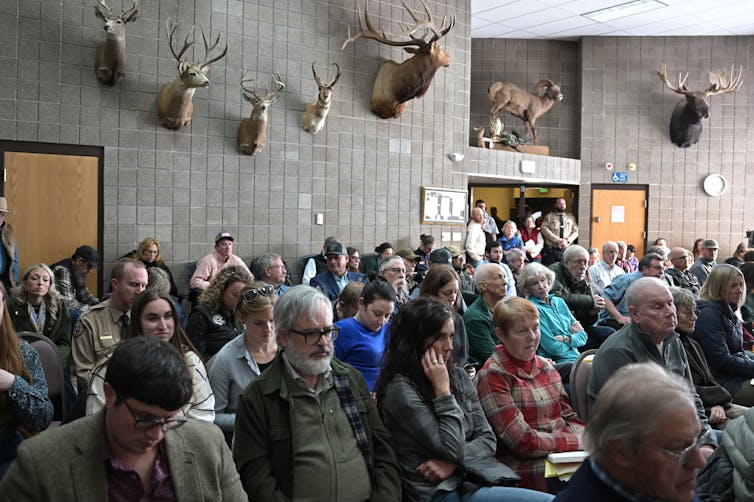
Community members gather at the Colorado Parks and Wildlife hunter education building in Denver. Colorado ranchers petitioned the state’s wildlife commission to delay the next round of wolf releases in September 2024. The petition was denied. Hyoung Chang/Getty Images
Rural residents in Colorado have told me they feel excluded. This is not new or exclusive to Colorado, but a story as old as America itself.
University of Wisconsin political scientist Katherine J. Cramer wrote about this rural exclusion in Wisconsin, calling it “rural resentment.” Berkeley sociologist Arlie Russell Hochschild called it “stolen pride.” In their book, Tom Schaller, a political scientist at the University of Maryland, and Paul Waldman, a longtime journalist, characterize it as “white rural rage.”
It’s a dynamic that descends from slavery. Isabel Wilkerson, in her book “Caste: The Origins of Our Discontents,” demonstrates that while Black Americans have historically been relegated to the bottom of the hierarchy of an American caste system, poor white people are strategically positioned just above them but below white Americans of higher socioeconomic status. As Wilkerson explains, this is a durable system sustained by norms, laws and cultural expectations that feel “natural.” But they are entirely constructed and designed by the American upper class to intentionally exploit resentment of working-class white people.
The result is what sociologist Michael M. Bell calls a “spatial patriarchy” that characterizes rural America as dumb, incapable, racist, poor and degraded as “white trash.”
This spatial patriarchy is as old as industrialization and urbanization. One of the first policy iterations was rural school consolidation during the turn of the 20th century, designed to modernize schools and make them more efficient. Urban policymakers were influenced by eugenics and the assumption that rural schools “were populated by cognitively deficient children whose parents had not been smart enough or fortunate enough to leave the decaying countryside,” according to sociologist Alex DeYoung.
So, states around the country consolidated schools, the lifeblood of rural communities. Where a school closed, the town often died, as in small towns, schools are not just socioeconomic hubs but centers of cultural and social cohesion.
Environmental impact
The same concept – that urban policymakers know better than rural Americans – is manifest in the modern environmental movement. Like with the MeatOut, rural communities also distrust environmental policies that, in their view, intentionally target a rural way of life. Rural communities take the position that they’ve been made to bear the brunt of the transformations of the global economy for generations, including those that deal with energy and the environment.
But, there’s a huge, untapped potential for environmental policies that use language consistent with rural attitudes and values, such as ideas about conservation and land stewardship. Political scientists Richard H. Foster and Mark K. McBeth explain, “Rural residents perceive, probably correctly, that environmental ‘outsiders’ are perfectly willing to sacrifice local economic well-being and traditional ways of life on the altar of global environmental concerns.” They instead suggest “emphasizing saving resources for future generations” so that rural communities may continue to thrive.
The Food and Agriculture Organization of the United Nations attribute between 18% to 24% of greenhouse gas emissions to agriculture, while the International Panel on Climate Change places the estimate closer to 10%. However, agricultural producers point out that, while they may be responsible for that 10%, just 100 companies, such as BP and ExxonMobil, have produced 70% of all emissions. Agricultural producers say policies such as livestock taxes would disproportionately impact small-scale farmers and intensify rural inequality.
Kayla Gabehart does not work for, consult, own shares in or receive funding from any company or organization that would benefit from this article, and has disclosed no relevant affiliations beyond their academic appointment.