Categories
Featured Juneau News Juneau Local Ketchikan Local News Feeds Sitka Local

Alaska US senators split votes on cuts to public broadcasting, foreign aid

By Corinne Smith, Alaska Beacon

Alaska Republican U.S. Sens. Lisa Murkowski and Dan Sullivan (Alaska Beacon file photos)

Alaska’s two U.S. senators voted differently on a bill requested by President Donald Trump to block federal funding for foreign aid and public broadcasting. 

The cuts include $1.1 billion for public broadcasting over two years, with more than $20 million in funding for Alaska’s 27 public radio and television stations. The measure is known as a rescission package, because it claws back funding that Congress had already approved earlier this year.

The overall bill includes $9 billion in cuts, with most in foreign aid.

The bill passed 51 to 48, with Alaska’s Republican senators voted differently: U.S. Sen. Dan Sullivan voted for the rescission, and U.S. Sen. Lisa Murkowski voted against. 

Sullivan spokesperson Amanda Coyne sent a statement by email on Thursday repeating the senator’s position that he had warned public media, NPR and the Corporation for Public Broadcasting for years about their “biased reporting” that “would eventually jeopardize federal support for both national and local radio stations,” she said.

However, Coyne added, Sullivan has advocated for rural stations and has been working with other senators and White House officials on alternative sources of funding to keep rural stations on the air, particularly Native stations in Alaska.

“Currently, there is approximately $10 million available for tribal and Native stations in the country. Alaska has 11 Native stations. Going forward, Senator Sullivan will continue working to provide resources to support as many Alaska rural radio stations as possible. He was discussing this funding issue with a senior administration official this morning,” Coyne said.

Coyne did not respond to questions on how much would be available for Alaska stations, when, or what stations would be eligible. 

Murkowski was outspoken and critical of the rescission bill, voting no.

In a statement on Thursday, she first cited a lack of clarity by the Trump administration for what programs and amounts would be rescinded, especially for global health programs. “We still lack necessary details, including which ones will be zeroed out. There is no way to determine the implications for lifesaving care and vital resources for women and children abroad,” she said.

“I also strongly oppose the rescission of funding for the Corporation for Public Broadcasting. My colleagues are targeting NPR but will wind up hurting – and, over time, closing down – local radio stations that provide essential news, alerts, and educational programming in Alaska and across the country,” she said. 

Murkowski introduced an amendment on the Senate floor late Wednesday night to protect CPB funding, and it was voted down 51 to 47. 

Murkowski told reporters on Thursday afternoon in an audio recording shared with the Alaska Beacon, when asked about the fate of rural stations in Alaska, that her office was also looking into funding for stations from federal tribal grants.

“Some of them, about a dozen, will be able to access these tribal grants,” she told the reporters.

“But that’s less than half of the Alaska stations. So what happens to KUCB going forward?” she said, referring to the public radio station in Unalaska that broadcast a tsunami warning and emergency evacuation order for remote Aleutian Island communities following a magnitude 7.3 earthquake the day before.  

“So what we’re trying to do is kind of identify how perilously close are many of these small stations to being in a shut down mode. How much do they have to carry them forward?” she said.

In her statement, Murkowski emphasized her opposition to the rescission process, driven by the White House Office of Management and Budget, as undermining Congress’ authority. 

“Finally, and most importantly, approving this package in this manner further shifts the balance of power over the federal budget to the executive branch. Congress, not OMB, holds the power of the purse under the Constitution. To the extent that certain appropriations are not necessary to comply with the laws passed by Congress, we can best address that through the annual budgeting process, where we routinely rescind funds every year.”

The rescission bill now advances back to the U.S. House, which passed an earlier version of the measure. As of Thursday evening it had not been taken up for a vote.

Categories
Featured Juneau News Juneau Local Ketchikan Local News Feeds Sitka Local

Searching for pennies: With the cut in federal funding public broadcasters are looking to cope

Elayna Cunningham, a college student interning at Koahnic Broadcast Corp., records a program on July 10, 2025, at the Anchorage, Alaska, studios of KNBA, the flagship station for National Native News. (AP Photo/Mark Thiessen)

AP- Lauren Adams, general manager for KUCB public radio in Unalaska, Alaska, didn’t have much time to reflect on Congress, 4,000 miles away, stripping federal funding for public media this week. She’s been too busy working.

Sirens blared in the Aleutian Islands community Wednesday warning of a potential tsunami, with a voice over public loudspeakers urging the community’s 4,100 residents to seek higher ground immediately and tune into the radio — to Adams’ station.

At the same time in Washington, the Senate was voting on a measure that would eliminate nearly $1.1 billion that had already been appropriated for NPR and PBS — a process that didn’t end until early Thursday morning. The House is expected to complete the process in time for President Donald Trump to sign it before a Friday deadline.

Trump had called for the cuts, saying public media’s news programming was biased against him and fellow Republicans, and threatened GOP members of Congress with primary challenges if they didn’t fall in line.

Adams, her news director, a reporter and an intern kept broadcasting and updating KUCB’s social media feed until the danger passed. Then she made time for one more task — texting U.S. Sen. Lisa Murkowski and urging her to vote against the bill. Murkowski was one of two Republican senators, along with Susan Collins of Maine, to publicly dissent.

“I thought that it was such a telling story of why her constituents have a different relationship to public radio than maybe some other regions of the United States,” Adams said.

Hard decisions ahead for stations across the country

The federal money is appropriated to the Corporation for Public Broadcasting, which distributes it to NPR and PBS. Roughly 70% of the money goes directly to the 330 PBS and 246 NPR stations across the country, although that’s only a shorthand way to describe its potential impact.

The cuts are expected to weigh most heavily on smaller public media outlets away from big cities, and it’s likely some won’t survive. Katherine Maher, NPR’s president and CEO, estimated as many as 80 NPR stations may face closure in the next year. Some stations are already fielding offers from commercial entities to buy their broadcast licenses, she said.

“Many of our stations which provide access to free unique local programming and emergency alerts will now be forced to make hard decisions in the weeks and months ahead,” said Paula Kerger, PBS president and CEO. “There is nothing more American than PBS. Despite today’s setback, we are determined to keep fighting to preserve the essential services we provide to the American public.”

The measure will cost PBS and NPR stations in Mississippi roughly $2 million, about 15% of the budget, said Royal Aills, executive director of Mississippi Public Broadcasting.

Already, Mississippi Public Broadcasting has decided to eliminate a streaming channel that airs children’s programming like “Caillou” and “Daniel Tiger’s Neighborhood” to the state’s youngsters 24 hours a day, said Taiwo Gaynor, the system’s chief content officer.

“This is important for families, to have access to content that they don’t have to pay for,” Gaynor said. “That is a sad thought, to think that we … might not be able to provide that for a generation of children.”

Maine’s public media system is looking at a hit of $2.5 million, or about 12% of its budget, for the next fiscal year, said Rick Schneider, president and chief executive officer of Maine Public. He said he’s not ready to identify specific cuts, but the system is preparing to reinvent itself to make certain it continues serving the state’s residents.

Maine’s rural residents rely heavily on public media for weather updates and disaster alerts, said Molly Curren Rowles, executive director of ACLU of Maine. Rowles said public media was a “lifeline” to her growing up off the grid.

Bracing for trouble at stations that take pride in music discovery

NPR’s Maher fears what the cuts might mean for the system’s journalism, not just in rural areas where local news can be hard to come by, but in telling the rest of the country what is going on there. Less funding will also mean less support for popular television and radio programming, although it’s too soon to tell which programs will be affected.

NPR stations also use millions of dollars in federal money to pay music licensing fees. Now many will have to renegotiate these deals, which could mean less music, or a more limited variety of music, on outlets where music discovery is a big part of their identity. For example, Maher estimates that some 96% of all classical music broadcast in the United States is on NPR stations. “That is essentially taking an entire art form out of public access,” she said.

The affair transcends violins and piccolos. NPR received support Thursday from the heavy metal band Gwar, whose lead singer Blothar the Berserker posted a call on social media for fans to pay attention to what is going on with public media.

Already, public media is seeing an increase in donations from reader and viewers to support its mission, and stations are actively sounding the alarm. In a plea to listeners on its website Thursday, Philadelphia’s WXPN radio pointed to its legacy in helping people discover new music. “The most important thing you can do is support WXPN and the public media system in a way that is meaningful to you,” the station urged on its website.

But donations aren’t going to fill the hole left by the loss in federal funding, Maher said. The public media leaders have already turned to lobbying Congress to restore some of the funding through the appropriations process for next year’s budget. They don’t know how much time they have; Maher said it would be inordinately costly, and perhaps prohibitive, to reopen a radio station that is forced to close.

Public media isn’t getting any help from states, either. At least five states have reduced their own outlays for public media this year, either for budget or political reasons.

Gov. Ron DeSantis, for example, vetoed nearly $6 million that Florida lawmakers had set aside for public broadcasters the day before the state’s budget took effect on July 1. “Done in Florida,” DeSantis responded on social media to a Trump post calling public broadcasting a “monstrosity” that should be defunded.

Meanwhile, back in Alaska …

Back in Alaska, KMXT public radio station’s general manager, Jared Griffin, called the Senate vote a “devastating gut punch.” He estimated that the cuts would amount to 22% of KMXT’s budget. Griffin said the station’s board has already agreed on a plan to furlough staff members one day a month, and he’s taking a 50% pay cut.

The station covers Kodiak Island, home to one of the nation’s largest U.S. Coast Guard bases.

“We have to dip into our savings while we figure out what KMXT is going to look like over the next six months, Griffin said. ”At least for the next year we’ll be fine but we’re probably going to have to look at leasing space in our building to other organizations to help fill that gap.”

Unalaska resident Nikki Whittern said KUCB plays a vital role in the community during emergencies like the tsunami warning.

“They broadcast everything, and they make sure that everybody knows and everybody’s safe,” said Whittern, a bartender. She spoke while preparing to open the Norwegian Rat Saloon — known to local fishermen simply as “the Rat” — on Thursday morning.

Categories
Politics

Philly’s City Council turned down a new rental inspection program − studies show that might harm tenants’ health

Tenants who complain to landlords about housing conditions can risk eviction. Photo Jeff Fusco/The Conversation U.S., CC BY-NC-ND

As Philadelphia Mayor Cherelle Parker’s US$2 billion housing plan moves forward, heated debates continue about another set of municipal housing proposals that could transform Philadelphia tenants’ rights.

In June 2025, Philadelphia’s City Council considered three housing bills, collectively known as the Safe Healthy Homes Act. The package was introduced by Nicolas O’Rourke, an at-large council member who belongs to the Working Families Party.

One of the bills authorized the city to create a fund for tenants to relocate if their buildings are condemned by city inspectors. It was signed into law, though it remains unclear how the fund will be financed.

The other two bills stalled. One was an ordinance that would broadly strengthen tenants’ rights, and the other – known as the Right to Repairs – would shift how Philadelphia ensures housing is safe for tenants, empowering the city to proactively inspect rentals for housing code violations.

These bills deal with housing policy, but they’re also matters of public health.

I know this because I am a researcher in Philadelphia who studies how housing affects our health outcomes. And in particular, recent research by myself and others suggests the fate of the Rights to Repairs legislation could have major implications for Philadelphians’ well-being.

Housing protections today

To understand this new evidence, it’s important to first understand the system of housing regulations Philadelphia has now, in the absence of the proposed Right to Repairs legislation.

When a landlord rents an apartment, Pennsylvania law mandates that apartment must be habitable and free of hazards such as mold, cockroaches and dangerous dilapidation.

This legal principle is known as the “implied warranty of habitability.”

All 50 states except Arkansas have some kind of policy like this, though they vary in how much they hold landlords responsible for tenants’ safety.

Under Pennsylvania’s warranty and related municipal law, if conditions deteriorate in a rental property, Philadelphia tenants are first supposed to alert their landlord, who has 30 days to fix the given violation – such as rodents or lead exposure.

If landlords refuse, however, tenants are in a bind. They could file a complaint with the Department of Licenses and Inspections, which might come and issue a citation. Tenants could also file a lawsuit against their landlord, and they are entitled to withhold rent. But all of these options risk provoking your landlord – at potentially high cost.

Invoking your warranty rights as a tenant can therefore be tricky. You have to know your rights, document repair requests in writing, and be willing to take your landlord to task legally.

That’s challenging in a city like Philadelphia, where most renters – outside of a pilot program in some ZIP codes – aren’t guaranteed lawyers in housing court.

Indeed, nationally, 9 in 10 landlords have lawyers in housing cases, while 9 in 10 tenants do not.

The stakes are high for tenants. If they complain, they risk eviction – and that’s amid a shortage of affordable housing in Philadelphia and across the country.

In 2018 alone, according to a local news investigation, Philadelphia landlords filed over 2,000 eviction cases soon after tenants raised habitability issues, despite such retaliatory evictions being illegal. More up-to-date estimates are hard to come by, as these illegal evictions are not systematically tracked.

Tenants have little choice. Philadelphia does not require that an apartment pass an inspection before the city issues rental licenses or certificates of rental suitability. If housing violations arise, it’s on tenants to assert and defend their rights.

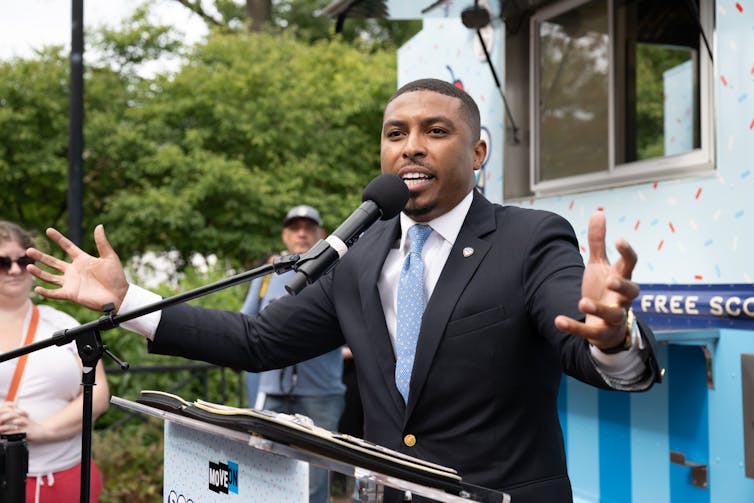
A man dressed in dark suit and light blue tie gestures while speaking outdoors at a podium
Philadelphia City Council member Nicolas O’Rourke introduced a housing legislation package guided by three rights – the right to safety, the right to repairs and the right to relocation. Only the right to relocation bill was passed.
Lisa Lake for MoveOn via Getty Images

Do habitability laws work?

Housing quality protections for tenants, in other words, largely boil down to implied warranties of habitability, plus associated fines the city can issue. But this works only if tenants are able to properly document violations, submit complaints and defend themselves from the blowback.

Despite warranties forming the backbone of Philadelphia’s housing quality governance system – and concerns that these laws saddle tenants with unreasonable enforcement responsibilities – little is known about whether warranties are even effective. Do they keep tenants from getting sick due to poor housing conditions?

To find out, fellow researchers and I examined what happened when nine states enacted implied warranty of habitability laws like the one in place in Pennsylvania today. We wanted to know whether renters’ health improved after warranty policies were enacted, compared with other states where such laws didn’t go into effect over the same period.

We also used homeowners as a control group, comparing whether renters’ health uniquely improved when these laws were enacted. Homeowners are useful here because we wouldn’t expect homeowners’ health to be affected by these laws.

Our findings were stark: We found no improvements for renters at all, across a slew of housing-related health outcomes, even 10 years after enactment.

There were no effects on renters’ asthma, respiratory allergies, bronchitis, mental health, hospitalizations, or even less clinical outcomes such as self-rated health.

To be clear, implied warranties of habitability are important laws and are surely helpful for individual tenants. Broadly speaking, however, our findings suggest that these policies simply don’t work.

That is likely especially true in Pennsylvania, a state whose implied warranty of habitability was given an F- by researchers who evaluated the comprehensiveness of states’ policies for protecting tenants’ well-being.

A 2014 study in neighboring New Jersey helps shed light on why these policies fall short.

Researchers there examined 40,000 eviction cases, looking for whether tenants successfully raised implied warranty of habitability violations as a defense. Given how often landlords retaliate after violation complaints are made, one might expect thousands of tenants party to these lawsuits to have invoked their warranty rights.

The result? Only 80 tenants did so – 80 out of 40,000.

In practice, then, existing data paints a bleak picture: The vast majority of tenants lack the financial resources, legal knowledge, alternative housing options or freedom from fear necessary to protect themselves from unsafe conditions at home.

Proactive rental inspections show more success

What policies might work instead? Cities such as Rochester, New York, may provide an answer.

In 2005, Rochester implemented a more proactive rental inspection program to combat their child lead-poisoning crisis – a problem Philadelphia shares.

This meant that Rochester’s municipal inspectors began proactively inspecting rental units on a regular basis and issuing fines for any violations they found. Tenants did not have to file a complaint and therefore weren’t forced into adversarial disputes with their landlords.

The results were dramatic. By 2012, childhood lead poisoning in Rochester had dropped by 85%. This decline was nearly 2.5 times faster than the rest of New York state.

Further, scientists found that units that were inspected every three years had one-third of the rate of housing code violations as units inspected every six years.

Whether the Right to Repair is good policy for Philadelphia is a question for city legislators. But research is increasingly clear: The city’s current housing policies do not protect tenants from unsafe housing, while proactive rental inspections show real promise for fighting persistent housing-related health problems.

Read more of our stories about Philadelphia.

The Conversation

Gabriel L. Schwartz’s research described in this article was funded through a pilot grant from the UCSF Benioff Homelessness and Housing Initiative. UCSF had no role in the design, completion, or reporting of that study. The views expressed in this article solely represent the scientific opinion of the author, and do not necessarily represent the opinion of either UCSF or his employer.

​Politics + Society – The Conversation

Categories
Politics

Supreme Court news coverage has talked a lot more about politics ever since the 2016 death of Scalia and GOP blocking of Obama’s proposed nominee

Reporters used to treat the Supreme Court as a nonpolitical institution, but not anymore. Tetra Images/Getty

The U.S. Supreme Court has always ruled on politically controversial issues. From elections to civil rights, from abortion to free speech, the justices frequently weigh in on the country’s most debated problems.

And because of the court’s influence over national policy, political parties and interest groups battle fiercely over who gets appointed to the high court.

The public typically finds out about the court – including its significant decisions and the politics surrounding appointments – from the news media. While elected officeholders and candidates make direct appeals to their voters, the justices and Supreme Court nominees are different – they largely rely on the news to disseminate information about the court, giving the public at least a cursory understanding.

Recently, something has changed in newspaper coverage of the Supreme Court. As scholars of judicial politics, political institutions and political behavior, we set out to understand precisely how media coverage of the court has changed over the past 40 years. Specifically, we analyzed the content of every article referencing the Supreme Court in five major newspapers from 1980 to 2023.

Of course, people get their news from a variety of sources, but we have no reason to believe the trends we uncovered in our research of traditional newspapers do not apply broadly. Research indicates that alternative media sources largely follow the lead of traditional beat reporters.

What we found: Politics has a much stronger presence in articles today than in years past, with a notable increase beginning in 2016.

When public goodwill prevailed

Not many cases have been more important in the past quarter-century or, from a partisan perspective, more contentious than Bush v. Gore – the December 2000 ruling that stopped a ballot recount, resulting in then-Texas Governor George W. Bush defeating Democratic candidate Al Gore and winning the presidential election.

Bush v. Gore is particularly interesting to us because nine unelected, life-tenured justices functionally decided an election.

A New York Times front page story from Dec. 13, 2000, with banner headline 'BUSH PREVAILS.'
The New York Times story about the Supreme Court’s decision in Bush v. Gore indicated the justices’ names and votes but neither the party of the president who appointed them nor their ideological leanings.
Screenshot, The New York Times

Surprisingly, the court’s public support didn’t suffer, ostensibly because the court had built up a sufficient store of public goodwill.

One reason public support remained steady following Bush v. Gore might be newspaper coverage. Although the court’s decision reflected the justices’ ideologies, with the more conservative members effectively voting to end the recount and its more liberal members voting in favor of the recount, newspapers largely ignored the role of politics in the decision.

For example, the New York Times case coverage indicated the justices’ names and their votes but mentioned neither the party of the president who appointed them nor their ideological leanings. The words “Democrat,” “Republican,” “liberal” and “conservative” – what we call political frames – do not appear in the Dec. 13, 2000, story about the decision.

This epitomizes court-related newspaper articles from the 1980s to the early 2000s, when reporters treated the court as a nonpolitical institution. According to our research, court-related news articles in The New York Times, The Washington Post, Chicago Tribune, Los Angeles Times and The Wall Street Journal hardly used political frames during that time.

Instead, newspapers perpetuated a dominant belief among the public that Supreme Court decisions were based almost completely on legal principles rather than political preferences. This belief, in turn, bolstered support for the court.

Recent newspaper coverage reveals a starkly different pattern.

A contemporary political court

It would be nearly impossible to read contemporary articles about the Supreme Court without getting the impression that it is just as political as Congress and the presidency.

Analyzing our data from 1980 to 2023, the average number of political frames per article tripled. To be sure, politics has always played a role in the court’s decisions. Now, newspapers are making that clear. The question is when this change occurred.

Across the five major newspapers, reporting about the court has gradually become more political over time. That isn’t surprising: America has been gradually polarizing since the 1980s as well, and the changes in news media coverage reflect that polarization.

Take February of 2016, when Justice Antonin Scalia unexpectedly died. Of course, justices have died while serving on the court before. But Scalia was a conservative icon, and his death could have swung the court to the center or the left.

How the politics of naming his successor played out after Scalia’s death was unprecedented.

President Barack Obama’s nomination effort to put Merrick Garland on the court were stonewalled. The Senate majority leader, Republican Mitch McConnell of Kentucky, said the Senate would not consider any nomination until after the presidential election, nine months from Scalia’s death.

Republican candidate Donald Trump, seeing an opening, promised to fill the vacancy with a conservative justice who would overturn Roe v. Wade. The court and the 2016 election became inseparable.

People bowing their heads next to a U.S. flag-covered casket.
President Barack Obama and first lady Michelle Obama pay respects to Justice Antonin Scalia, whose 2016 death brought lasting change in newspaper coverage of the court.
Tom Williams/CQ Roll Call via Getty Images

Scalia vacancy changed everything

February 2016 brought about an abrupt and lasting change in newspaper coverage. The day before Scalia’s death, a typical article referencing the court used 3.22 political frames.

The day after, 10.48.

We see an uptick in political frames if we consider annual changes as well. In 2015, newspapers averaged 3.50 political frames per article about the Supreme Court. Then, in 2016, 5.30.

Using a variety of statistical methods to identify enduring framing shifts, we consistently find February 2016 as the moment newspapers shifted to higher levels of political framing of the court. We find the number of political frames in newspapers remained elevated through 2023.

How stories frame something shapes how people think about it.

If an article frames a court decision as “originalist” – an analytical approach that says constitutional texts should be interpreted as they were understood at the time they became law – then readers might think of the court as legalistic.

But if the newspaper were to frame the decision as “conservative,” then readers might think of the court as ideological.

We found in our study that when people read an article about a court decision using political frames, court approval declines. That’s because most people desire a legal court rather than a political one. No wonder polls today find the court with precariously low public support.

We do not necessarily hold journalists responsible for the court’s dramatic decline in public support. The bigger issue may be the court rather than reporters. If the court acts politically, and the justices behave ideologically, then reporters are doing their job: writing accurate stories.

That poses yet another problem. Before Trump’s three court appointments, the bench was known for its relative balance. Sometimes decisions were liberal; other times, conservative.

In June 2013, the court provided protections to same-sex marriages. Two days earlier, the court struck down part of the Voting Rights Act. A liberal win, a conservative win – that’s what we might expect from a legal institution.

Today the court is different. For most salient issues, the court supports conservative policies.

Given, first, the media’s willingness to emphasize the court’s politics, and second, the justices’ ideologically consistent decisions across critical issues, it is unlikely that the news media retreats from political framing anytime soon.

If that’s the case, the court may need to adjust to its low public approval.

The Conversation

The authors do not work for, consult, own shares in or receive funding from any company or organization that would benefit from this article, and have disclosed no relevant affiliations beyond their academic appointment.

​Politics + Society – The Conversation

Categories
Politics

Poll finds bipartisan agreement on a key issue: Regulating AI

Are concerns about AI a bridge across the polarization divide? ZargonDesign/iStock via Getty Images

In the run-up to the vote in the U.S. Senate on President Donald Trump’s spending and tax bill, Republicans scrambled to revise the bill to win support of wavering GOP senators. A provision included in the original bill was a 10-year moratorium on any state law that sought to regulate artificial intelligence. The provision denied access to US$500 million in federal funding for broadband internet and AI infrastructure projects for any state that passed any such law.

The inclusion of the AI regulation moratorium was widely viewed as a win for AI firms that had expressed fears that states passing regulations on AI would hamper the development of the technology. However, many federal and state officials from both parties, including state attorneys general, state legislators and 17 Republican governors, publicly opposed the measure.

In the last hours before the passage of the bill, the Senate struck down the provision by a resounding 99-1 vote. In an era defined by partisan divides on issues such as immigration, health care, social welfare, gender equality, race relations and gun control, why are so many Republican and Democratic political leaders on the same page on the issue of AI regulation?

Whatever motivated lawmakers to permit AI regulation, our recent poll shows that they are aligned with the majority of Americans who view AI with trepidation, skepticism and fear, and who want the emerging technology regulated.

Bipartisan sentiments

We are political scientists who use polls to study partisan polarization in the United States, as well as the areas of agreement that bridge the divide that has come to define U.S. politics. In April 2025, we fielded a nationally representative poll that sought to capture what Americans think about AI, including what they think AI will mean for the economy and society going forward.

The public is generally pessimistic. We found that 65% of Americans said they believe AI will increase the spread of false information. Fifty-six percent of Americans worry AI will threaten the future of humanity. Fewer than 3 in 10 Americans told us AI will make them more productive (29%), make people less lonely (21%) or improve the economy (22%).

While Americans tend to be deeply divided along partisan lines on most issues, the apprehension regarding AI’s impact on the future appears to be relatively consistent across Republicans and Democrats. For example, only 19% of Republicans and 22% of Democrats said they believe that artificial intelligence will make people less lonely. Respondents across the parties are in lockstep when it comes to their views on whether AI will make them personally more productive, with only 29% − both Republicans and Democrats − agreeing. And 60% of Democrats and 53% Republicans said they believe AI will threaten the future of humanity.

On the question of whether artificial intelligence should be strictly regulated by the government, we found that close to 6 in 10 Americans (58%) agree with this sentiment. Given the partisan differences in support for governmental regulation of business, we expected to find evidence of a partisan divide on this question. However, our data finds that Democrats and Republicans are of one mind on AI regulation, with majorities of both Democrats (66%) and Republicans (54%) supporting strict AI regulation.

When we take into account demographic and political characteristics such as race, educational attainment, gender identity, income, ideology and age, we again find that partisan identity has no significant impact on opinion regarding the regulation of AI.

State of anxiety

In the years ahead, the debate over AI and the government’s role in regulating it is likely to intensify, on both the state and federal levels. As each day seems to bring new advances in AI’s capability and reach, the future is shaping up to be one in which human beings coexist – and hopefully flourish – alongside AI. This new reality has made the American public, both Democrats and Republicans, justifiably nervous, and our polling captures this widespread trepidation.

Lawmakers and technology leaders alike could address this anxiety by better communicating the pitfalls and potential of AI, and take seriously the concerns of the public. After all, the public is not alone in its trepidation. Many experts in the field also have substantial worries about the future of AI.

One of the fundamental political questions moving forward, then, will be to what degree regulators put guardrails on this emerging and transformative technology in order to protect Americans from AI’s negative consequences.

The Conversation

The authors do not work for, consult, own shares in or receive funding from any company or organization that would benefit from this article, and have disclosed no relevant affiliations beyond their academic appointment.

​Politics + Society – The Conversation

Categories
Politics

Clawback of $1.1B for PBS and NPR puts rural stations at risk – and threatens a vital source of journalism

Nathan Heffel and Grace Hood rehearse their Colorado Public Radio public affairs program in Centennial, Colo., in 2017. Andy Cross/The Denver Post via Getty Images

The U.S. Senate narrowly approved on July 16, 2025, a bill that would claw back federal funding for the Corporation for Public Broadcasting, which distributes money to NPR, PBS and their affiliate stations. The US$9 billion rescission package will withdraw $1.1 billion Congress had previously approved for the CPB to receive in the 2026 and 2027 fiscal years. In addition, it makes deep foreign aid cuts. All Democrats present voted against the measure, joined by two Republicans: Sens. Susan Collins of Maine and Lisa Murkowski of Alaska. As long as the House, which approved a previous version, votes in favor of the Senate’s version of the bill by midnight July 18, Trump will be able to meet a budgetary deadline by signing the measure into law in time for it to take effect.

What will happen to NPR, PBS and local stations?

NPR and PBS provide programming to local public television and radio stations across the country. The impact on them will be direct and indirect.

Both NPR and PBS receive money from the Corporation for Public Broadcasting, an independent nonprofit corporation Congress created in 1967 to receive and distribute federal money to public broadcasters. More than 70% of the money it distributes flows directly to local stations. Some stations get up to half of their budgets from the CPB.

But NPR and PBS get much of their funding from foundation grants, viewers’ and listeners’ donations, and corporate underwriting. And local public radio and TV stations also get support from an array of sources besides CPB.

“There’s nothing more American than PBS,” said the network’s CEO, Paula Kerger, at a congressional hearing on March 26, 2025.

Only about 1% of NPR funding, and 15% of PBS funding, comes directly from the government via the CPB. However, once local radio and television stations lose federal funding, they’ll be less able to pay NPR and PBS for the programs they produce.

The nearly 1,500 public media stations in the U.S. rely on a mix of NPR, PBS and third-party producer programming, such as American Public Media and PRX, for the programs they offer. Local stations also produce and air regional news and provide emergency broadcasts for the government.

In rural areas with few broadcast stations and spotty cellphone coverage, public broadcast stations are vital sources of information about important community news and updates during emergencies. Federal support is essential for the programming and day-to-day operations of many local stations and allows for the maintenance of equipment and personnel to operate these vital community resources.

We believe that stations in communities that most need them, especially in rural locations, would be hit especially hard because they rely heavily on CPB funding.

Why are Republicans taking this step?

Public broadcasting has long been a target of conservative Republicans. They say that with a highly diversified media landscape, the public no longer needs media that is subsidized by federal dollars. They also claim that public broadcasting has a liberal bias and taxpayers should not be required to fund media that slants to the left politically.

Why is public media necessary when there’s news on the internet?

As journalism revenue has plummeted, public broadcasting has remained a vital source for news in communities across the nation. This is especially true in rural communities, where economic and political pressures have threatened the survival of local journalism.

In addition, with much online news coverage placed behind paywalls, public radio and television plays an important role in making quality journalism available to the American public.

An online ad for a program, 'Water News,' on a public radio station.
Want crucial information about water systems in your drought-prone community? Public radio station KVMR in Nevada City, Calif., has a program for you.
KVMR screenshot

Why did Congress approve these funds 2 years ahead?

Public broadcasting has gotten roughly $550 million per year from the federal government in recent years. The CPB has always approved and designated those funds two years in advance, due to a provision in the Public Broadcasting Act of 1967, after Congress has voted to provide that money. The CPB then has distributed that funding primarily through grants to PBS and NPR affiliate stations to support their technical infrastructure, program development and audience research.

What are the consequences for Native communities?

Dozens of Native American stations are at risk of closing once the CPB is defunded. Native Public Media, a network of 57 radio stations and four TV stations, is a key source of news and information for tribal communities across the nation and relies on CPB support.

U.S. Sen. Mike Rounds, a South Dakota Republican, publicly stated that he secured an agreement with the White House to move $9.4 million in Interior Department funding to two dozen Native American stations. But there is no provision related to this promise within the legislation.

The Conversation

Allison Perlman is the co-chair of the Scholars Advisory Committee of the American Archive of Public Broadcasting.

Josh Shepperd and Allison Perlman are under contract to co-author an update of the history of public broadcasting for Current, public media’s trade journal, and the Corporation for Public Broadcasting. Josh and Allison are not paid employees or vendors of either institution.

​Politics + Society – The Conversation

Categories
Entertainment

Rashee Rice: Kansas City Chiefs WR Sentenced to Jail Time Following Hit-and-Run Crash

Reading Time: 3 minutes

Kansas City Chiefs wide receiver Rashee Rice is headed to prison.

The 25-year-old NFL veteran has been sentenced to five years probation and 30 days behind bars in connection with a car crash that injured at least seven people.

In April of last year, Rice turned himself in to police following a six-car “chain reaction collision” that was allegedly the result of illegal street racing.

Today, he pleaded guilty to two felonies: causing a collision involving a serious bodily injury and racing on a highway causing bodily injury.

Rashee Rice #4 of the Kansas City Chiefs warms up before Super Bowl LVIII against the Kansas City Chiefs at Allegiant Stadium on February 11, 2024 in Las Vegas, Nevada.
Rashee Rice #4 of the Kansas City Chiefs warms up before Super Bowl LVIII against the Kansas City Chiefs at Allegiant Stadium on February 11, 2024 in Las Vegas, Nevada. (Photo by Jamie Squire/Getty Images)

According to a new report from ESPN’s Adam Schefter, now that Rice has been sentenced, the league will accelerate its own disciplinary process and decide if he should be suspended during the upcoming season.

“We have been closely monitoring all developments in the matter which remains under review,” NFL spokesman Brian McCarthy told Schefter.

Rashee Rice admits fault, asks forgiveness following multi-car accident

According to a report from the New York Post, Rice and several other men fled the scene on foot after the crash and did not pause to see if the occupants of the other vehicles had survived.

Rashee Rice #4 and Patrick Mahomes #15 of the Kansas City Chiefs walk off the field after a win over the Atlanta Falcons at Mercedes-Benz Stadium on September 22, 2024 in Atlanta, Georgia.
Rashee Rice #4 and Patrick Mahomes #15 of the Kansas City Chiefs walk off the field after a win over the Atlanta Falcons at Mercedes-Benz Stadium on September 22, 2024 in Atlanta, Georgia. (Photo by Todd Kirkland/Getty Images)

“After the collision, Mr. Rice failed to check on the welfare of the victims and fled on foot,” Dallas prosecutors said in court.

“There have been a lot of sleepless nights thinking about the damages that my actions caused, and I will continue working within my means to make sure that everyone impacted will be made whole,” Rice’s lawyer, Royce West, said today in a statement on his client’s behalf. “I urge everyone to mind the speed limit, drive safe and drive smart.

“Last and certainly not least, I am profoundly sorry for the physical damages to person and property. I fully apologize for the harm I caused to innocent drivers and their families.”

Another setback in a turbulent career

Following a promising start to his career in 2023, Rice missed the majority of the 2024 season after suffering an LCL injury.

Rashee Rice #4 of the Kansas City Chiefs runs against the Atlanta Falcons during the second quarter at Mercedes-Benz Stadium on September 22, 2024 in Atlanta, Georgia.
Rashee Rice #4 of the Kansas City Chiefs runs against the Atlanta Falcons during the second quarter at Mercedes-Benz Stadium on September 22, 2024 in Atlanta, Georgia. (Photo by Kevin C. Cox/Getty Images)

Now, he’s almost certain to miss several games of the 2025 campaign.

But while he’s likely to be suspended, it sounds like Rice will not be forced to serve his sentence during the season.

“The Judge is allowing Mr. Rice to find a time or times to serve the jail time and Mr. Rice/his attorney have to follow up with the court about when he will serve the jail time,” reads a statement from Dallas DA spokesperson Claire Crouch, according to NBC News.

We’ll have further updates on this developing story as new information becomes available.

Rashee Rice: Kansas City Chiefs WR Sentenced to Jail Time Following Hit-and-Run Crash was originally published on The Hollywood Gossip.

​The Hollywood Gossip

Categories
Entertainment

Justin Bieber Bailed Out of Massive Debt by Hailey Bieber $1 Billion Fortune

Reading Time: 3 minutes

Justin is relying upon Hailey Bieber to pay his massive debts, a new report shares.

It’s no secret that Hailey’s $1 billion beauty brand sale has made her the family breadwinner.

That extends to Justin’s substantial debt to the infamous Scooter Braun, it turns out.

Fortunately, it’s Hailey to the rescue!

Justin Bieber and Hailey Bieber in February 2024.
Singer-songwriter Justin Bieber and his wife US model Hailey Bieber watch Super Bowl LVIII between the Kansas City Chiefs and the San Francisco 49ers at Allegiant Stadium in Las Vegas, Nevada, February 11, 2024. (Photo Credit: PATRICK T. FALLON/AFP via Getty Images)

Is Hailey paying Justin Bieber’s debts?

According to a report from TMZ on Thursday, July 17, an insider dished that Justin Bieber won’t have to pay his notorious former manager until Hailey Bieber’s $1 billion deal closes.

As we reported, Hailey secured the sale of Rhode earlier this year.

Most of the $1 billion sale price goes straight to her, with a couple hundred million contingent upon how well the business continues to do.

When e.l.f. Cosmetics pays out, Justin has to pay Scooter Braun … but not a moment sooner.

Hailey Bieber at the 2025 Met Gala.
Hailey Bieber attends the 2025 Met Gala Celebrating “Superfine: Tailoring Black Style” at Metropolitan Museum of Art on May 05, 2025. (Photo Credit: Savion Washington/Getty Images)

In 2022, Justin Bieber’s canceled “Justice” tour landed him in massive debt.

Remember, Justin’s Ramsay Hunt syndrome caused facial paralysis.

Scooter Braun, for all of his faults, loaned tens of millions to Justin through his HYBE Corporation.

An audit determined how much Bieber owed. In addition to $26 for Braun covering the cost of the canceled tour, the Biebs owed over $11 million in unpaid commissions.

(He only has to pay half of that second amount, however)

Justin and Hailey Bieber in April 2022.
Singer-songwriter Justin Bieber (L) and US model Hailey Bieber arrive for the 64th Annual Grammy Awards at the MGM Grand Garden Arena in Las Vegas on April 3, 2022. (Photo Credit: ANGELA WEISS/AFP via Getty Images)

Fortunately, it’s Hailey Bieber to the rescue!

When Justin and Hailey Bieber first tied the knot, it was a rushed affair.

Likely because he felt that he had to get married, for personal or religious reasons. And after things didn’t pan out with Selena Gomez, Hailey was the other gorgeous ex-girlfriend in his rolodex.

Either way, at that time, some of his most devoted fans openly and publicly worried about the Biebers reportedly not getting a prenup.

At the time, Justin’s net worth outweighed Hailey’s by about 100-to-1.

Hailey Bieber on March 2, 2025.
Hailey Bieber attends the 2025 Vanity Fair Oscar Party Hosted By Radhika Jones at Wallis Annenberg Center for the Performing Arts on March 02, 2025. (Photo Credit: Neilson Barnard/Getty Images for Vanity Fair)

However, since then, numerous reports have alleged that Justin is … well, bad with money is an understatement.

Multiple sources have lamented his alleged spending habits.

This isn’t, like, “whoa I forgot that bill” or “maybe I should skip ordering in tonight” reckless — but apparently racking up 6-figure bills in a short time.

Allegedly, Justin has spent much of his fortune, sold most of his music catalogue to recoup his wealth, and then spent too much of that again. Now, it’s Hailey to the rescue.

Hailey Bieber and Justin Bieber on February 13, 2022.
Singer Justin Bieber and Hailey Bieber attend Super Bowl LVI between the Los Angeles Rams and the Cincinnati Bengals at SoFi Stadium on February 13, 2022. (Photo Credit: Kevin C. Cox/Getty Images)

Is someone exaggerating the financial issues?

There have been suggestions that malefactors are making false claims about Justin Bieber spending too much and Hailey riding to his rescue.

That isn’t to say that Justin hasn’t lost a lot of his erstwhile fortune.

Rather, his defenders claim that it’s more complex than a few poor choices, and has more to do with the entertainment industry at large.

Maybe so! We hope so, even. Either way, Hailey’s new wealth eclipses anything that Justin has ever made.

Now, she’s the one who might regret not having a prenup in the event of a divorce.

Justin Bieber Bailed Out of Massive Debt by Hailey Bieber $1 Billion Fortune was originally published on The Hollywood Gossip.

​The Hollywood Gossip

Categories
Entertainment

Donald Trump Diagnosed with Rare Vein Condition

Reading Time: 3 minutes

As it turns out, despite what his administration may want you to think, Donald Trump is NOT in peak medical condition.

On Thursday, the public learned that President Trump has been diagnosed with a “benign and common” vein condition known as chronic venous insufficiency after he noticed swelling in his legs.

The White House confirmed this news itself.

Donald Trump speaks to the media as he departs the White House on July 15, 2025 in Washington, DC. Trump is traveling to Pittsburgh, Pennsylvania, to speak at an artificial intelligence and energy summit. (Photo by Anna Moneymaker/Getty Images)

The president’s physician, Sean Barbabella, said in an official memo that the Commander-in-Chief underwent a complete health examination after he noticed mild swelling in his legs.. and it revealed no evidence of a more serious condition such as deep vein thrombosis or arterial disease.

White House press secretary Karoline Leavitt read the memo at Thursday’s press briefing, and then the White House released it.

For those wondering:

Chronic venous insufficiency is a condition in which valves inside certain veins don’t work the way they should, which can allow blood to pool or collect in the veins.

About 150,000 people are diagnosed with it each year, and the risk goes up with age. Symptoms can include swelling in the lower legs or ankles, aching or cramping in the legs, varicose veins, pain or skin changes.

Treatment may involve medication or, in later stages, medical procedures.

President Donald Trump celebrates following the FIFA Club World Cup 2025 Final match between Chelsea FC and Paris Saint-Germain at MetLife Stadium on July 13, 2025 in East Rutherford, New Jersey. (Photo by David Ramos/Getty Images)

Elsewhere on Thursday afternoon, Leavitt addressed bruises periodically visible on the back of Trump’s hand.

She said they were caused by irritation from “frequent handshaking,” coupled with his aspirin regimen.

Photos of the president at the Club World Cup soccer final in New Jersey over the weekend depicted him with noticeably swollen ankles, fueling speculation about the cause.

“All results were within normal limits,” the doctor’s memo said. “An echocardiogram was also performed and confirmed normal cardiac structure and function. No signs of heart function, renal impairment, or systemic illness were identified.”

Leavitt, meanwhile, concluded:

“The president remains in excellent health, which I think all of you witness on a daily basis here.”

U.S. President Donald Trump answers questions during a multilateral lunch with African leaders in the State Dining Room of the White House July 9, 2025 in Washington, DC.
U.S. President Donald Trump answers questions during a multilateral lunch with African leaders in the State Dining Room of the White House July 9, 2025 in Washington, DC. (Photo by Win McNamee/Getty Images)

Trump is likely happy for any news that takes attention away from The Epstein Files.

He’s under major fire from his own supporters, many of whom have demanded the Trump White House release the names of celebrities who had a strong connection with late financier Jeffrey Epstein, who was convicted years ago of sex trafficking and who later committed suicide in prison.

A whole bunch of folks out there believe Trump is on this list and likely had sexual relationships with young women he met through Epstein.

That’s just a theory. We’re not saying it’s true. People are just asking questions.

Donald Trump Diagnosed with Rare Vein Condition was originally published on The Hollywood Gossip.

​The Hollywood Gossip

Categories
Entertainment

Bryan Braman Cause of Death: Philadelphia Eagles Linebacker Passes Away at 38

Reading Time: 3 minutes

We have tragic news to report from the world of sports:

Former NFL linebacker Bryan Braman, who won a Super Bowl during his time with the Philadelphia Eagles, has passed away at the age of 38.

News of Braman’s passing comes courtesy of a statement from Barman’s agent, Sean Stellato.

Bryan Braman #50 of the Philadelphia Eagles celebrates after defeating the New England Patriots 41-33 in Super Bowl LII at U.S. Bank Stadium on February 4, 2018 in Minneapolis, Minnesota.
Bryan Braman #50 of the Philadelphia Eagles celebrates after defeating the New England Patriots 41-33 in Super Bowl LII at U.S. Bank Stadium on February 4, 2018 in Minneapolis, Minnesota. (Photo by Patrick Smith/Getty Images)

Bryan Barman’s agent shares news of his passing

“I got the horrible news early in the morning after one of his best friends reached out and said that he took his last breath while surrounded by friends and family,” Stellato told NBC affiliate KPRC in Houston today.

“Bryan, people saw this enormous human being, but his heart was as big as his body. His spirit was so motivating. He was so real and genuine with everybody. That made him special,” he continued, adding:

“It’s hard. I feel like I lost my firstborn. This kid, he gave me his bed every time I came to Philadelphia. He would threaten me if I didn’t stay with him.

“That’s something I’ll always cherish. My heart hurts today.”

Accotding to the New York Post, Braman had been battling “a rare form of cancer.”

Bryan Braman attends the Comedy Central Roast of Bruce Willis at Hollywood Palladium on July 14, 2018 in Los Angeles, California.
Bryan Braman attends the Comedy Central Roast of Bruce Willis at Hollywood Palladium on July 14, 2018 in Los Angeles, California. (Photo by Rich Fury/Getty Images)

He played six seasons in the NFL, three each for the Texans and Eagles

“Today is a tough day that hits close to home. I always admired Bryan’s ability to overcome life’s obstacles, his passion for the game, and the love he had for his friends and family,” Eagles star lineman Lane Johnson wrote on X (formerly Twitter) today. “Rest in peace, Brother.”

“Rest in Peace brother. Gone far too soon,” NFL legend J.J. Watt chimed in.

A life of triumph cut short by tragedy

A native of Spokane, Washington, Braman was part of the Eagles squad that shocked the world by defeating the juggernaut New England Patriots in Super Bowl LII.

Bryan Braman #50 of the Philadelphia Eagles celebrates with his kids and the Vince Lombardi Trophy after defeating the New England Patriots 41-33 in Super Bowl LII at U.S. Bank Stadium on February 4, 2018 in Minneapolis, Minnesota.
Bryan Braman #50 of the Philadelphia Eagles celebrates with his kids and the Vince Lombardi Trophy after defeating the New England Patriots 41-33 in Super Bowl LII at U.S. Bank Stadium on February 4, 2018 in Minneapolis, Minnesota. (Photo by Patrick Smith/Getty Images)

It was the final game of his NFL career, but Braman went out in memorable fashion.

After making the game-winning tackle, he celebrated on the field with his two children, Blakely, now 11, and Marlowe, 8.

A GoFundMe stated by Braman’s family offered frequent updates about his condition throughout his battle.

“The main problem has been that Bryan has not been able to recover from the procedures because of his lowered immunity due to all of these treatments,” the GoFundMe reads.

“By the time he was able to recover so he could continue with the chemo, the cancer has grown exponentially faster, and is is now growing around his vital organs.”

Our thoughts go out to Bryan Braman’s loved ones during this devastating time.

Bryan Braman Cause of Death: Philadelphia Eagles Linebacker Passes Away at 38 was originally published on The Hollywood Gossip.

​The Hollywood Gossip