Rep. Alexandria Ocasio-Cortez, Michigan candidate Abdul El-Sayed and U.S. Sen. Bernie Sanders at “The People v. The Powerful” rally at the Detroit Opera House on July 18, 2026. Sarah Rice/Getty Images
Or it’s Connecticut Sen. Chris Murphy, who after the 2024 election declared, “Democrats must reclaim our identity as the party of the working class.”
Or a new generation of candidates – tattooed veterans, mechanics, bartenders – whose biography is supposed to do the political work that policy has not.
Graham Platner, the Maine Senate candidate who had become the left’s latest blue-collar savior until he ended his campaign in the wake of a sexual assault allegation, put the theory in its most unguarded form.
“We are in a form of class war,” he says. “And if the Democratic Party is going to have a future with working people, it needs to pick the side of working people.”
Still, El-Sayed’s victory has led to a familiar refrain: Somewhere out there is a latent working-class majority, held together by shared economic grievances, waiting to be politically reassembled to vote for Democrats. The New Deal did it – “economic populism” can do it again.
I’m a political scientist who has written extensively about rural and working-class communities. I believe it is an open question whether these reformist Democrats are really interested in understanding working-class voters on their own terms. Because working-class voters, as they tell us themselves, are not simply waiting to be activated by the right program, messenger or phrase. “Fight the oligarchy” probably isn’t going to do it.
Working-class voters have a worldview. For 50 years, it has been growing less compatible with the Democratic Party’s – not because working-class voters changed, but because Democrats did.
Working-class identity
Since the early 1950s, the American National Election Studies has asked respondents whether they think of themselves as members of the working class. This article uses my analysis of that data.
While a larger proportion of the electorate has obtained a college degree and household incomes have risen, the share of Americans who consider themselves working class has remained remarkably stable: roughly 35% of voters for the past 70 years, 38% in 2024.
Working-class identity is more durable and culturally grounded than a description of who isn’t a billionaire. It’s a specific way of looking at the world.
Conventional definitions of the working class often miss how people understand their own place in society. In the 2024 American National Election Studies, for example, 21% of those who identify as working class have a college degree, only 5% belong to a private-sector union, and 37% own stocks. Conversely, most Americans without a college degree do not identify as working class.
Working-class voters have never been a predominantly Democratic group – not even at the height of the New Deal coalition. Based on the American National Election Studies self-report measure, the working-class share of the Democratic coalition peaked around 56% in 1960 and has fallen more or less continuously since, sitting at just about 30% today.
Meanwhile, the share of working-class voters who identify as Democrats has been declining for half a century: A majority did so in 1958, but not since.
Working-class voters have not become Republicans. Only in 2020 and 2024 – the first time in the survey’s history – did more working-class voters identify as Republican than Democrat, and even then by narrow margins.
The data shows a politically homeless working class: estranged from the Democrats, not captured by the Republicans, stuck in the middle with diminishing attachment to either party.
Economic abandonment
What drove them out?
A segment of the progressive left has a ready answer: Democrats abandoned working-class voters economically – on trade, wages and industrial policy. Working-class voters responded rationally. Fix the economics and the coalition comes back.
Trade is the strongest argument. In 1988, roughly 74% of both Democrats and working-class voters groups favored limits on imports to protect American jobs.
By 2024, only 26% of Democrats favored limits, while 54% of working-class voters continued to do so.
In 1984, Democrats and working-class voters broadly agreed that treating people more equally would mean fewer social problems. A divergence opened after 2008 and accelerated after 2016, with Democrats now 28 points more likely than working-class voters to think we should worry more about equality.
In 1986, half of mainstream Democrats and a slightly smaller percentage of working-class voters agreed with the idea that Black Americans don’t succeed because they don’t try hard enough. By 2024, Democratic agreement had collapsed to 13%. Working-class voters also declined, to 32%.
Working-class voters, who historically understood their own lives through a framework of hard work and earned reward, did not shift so dramatically.
Alignment becomes division
On cultural questions, the pattern persists: Working-class voters did not move right in reactionary revolt. Democrats moved left.
In 1986, similar levels of Democrats and working-class voters agreed with the statement “This country would have many fewer problems if there were more emphasis on traditional family ties.” By 2024 a 25-point gap emerged.
On whether religion is an important part of their life: a near-zero gap through the early 1990s, but 17 points by 2024. On abortion, a 3-point gap in 1980 became 30 points in 2024. Whether immigration levels should be increased, the two groups were virtually identical in 2000 – around 8% support. By 2020 Democrats were at 48%, working-class voters at 24%.
Even where working-class voters nominally agree with a Democratic policy goal, they don’t trust the institution asked to deliver it – a distrust decades in the making.
How the ‘system’ plays
In 1958, working-class voters and Democrats were within 5 points of each other on whether government wastes a lot of tax money. By 2024 that gap reached 27 points – not because working-class voters lurched toward anti-government extremism, but because mainstream Democrats became dramatically more trusting of government as an instrument of social change.
Working-class voters are 17 points more likely than Democrats to say people like them have no say in what government does. In 2024, 88% of working-class voters and 75% of Democrats said government is run by a few big interests. Both groups agree the system is captured.
Yet the Democratic policy response, invariably, is to expand the system.
On support for expanding government – from healthcare to jobs to environmental programs – Democrats and working-class voters have diverged dramatically since the 1980s. By 2024, there were approval gaps of between 20 and 30 points on providing government health insurance, environmental spending and a guaranteed jobs program.
On every major plank of the progressive economic agenda, Democrats are now substantially to the left of the workers they claim to champion.
Not all class war
Working-class voters have been telling pollsters for 60 years that the political system doesn’t hear them. Democrats, over the same period, have grown more comfortable with the institutions working-class voters have increasingly less faith in.
To be fair, this is precisely what the new crop of reform candidates say they want to fix. The argument that the right candidate can move the needle is not crazy. Candidate quality matters. Personal trust can substitute for institutional trust, at least at the margins.
But economic-grievance politics is a very small slice of what working-class voters are telling us. The data documents a comprehensive, decades-long divergence in how working-class voters and mainstream Democrats understand fairness, government, personal responsibility and social change.
Reducing that to class war jams working-class voters into a prefabricated progressive agenda rather than taking seriously what they are actually saying.
Nicholas Jacobs does not work for, consult, own shares in or receive funding from any company or organization that would benefit from this article, and has disclosed no relevant affiliations beyond their academic appointment.
For nearly 70 years, Cuba has “waged a sustained campaign of subversion against the United States,” according to a newly released State Department report.
Beginning in the 1960s, rumors spread that Cuban communists were engaged in the U.S. Civil Rights Movement. Those stories, like those the State Department is now telling, are false and peaked in the late 1960s.
Cuban communist agents in Alabama?
The 1959 Cuban Revolution did inspire many Americans to reassess their nation’s Cold War policies.
Immediately, conspiracy theories arose along these lines: Because many activists who supported Cuba’s communist government also supported civil rights in the U.S., therefore all civil rights activism was somehow shaped by Cuba.
Along with airing accusations that Martin Luther King Jr. and other civil rights leaders were communists, the Manion Forum, an anticommunist media outlet, asked whether the “Communist Hand of Cuba” was “fingering Haiti, Venezuela, Panama, Birmingham?” The suggestion: Communists were directing civil rights protests in Alabama.
The State Department’s 2026 report on Cuba cites the subcommittee’s hearings as its only evidence that the Fair Play for Cuba Committee was subversive. Although more than 65 years have passed, the government has offered no new evidence.
These conspiratorial fears reached their zenith at the height of the Black Power movement, which emphasized racial pride and economic empowerment, when protests against the Vietnam War were widespread.
Although few Americans have ever completely endorsed the Cuban regime, many U.S. leftists did admire Cuba’s educational and healthcare achievements, which contributed to their own ideas about how to address U.S. poverty.
This page from the State Department’s ‘Cuba: The Capital of 21st Century Communism’ that blames Cuba for leftist activism largely focuses on events that took place at least half a century ago. U.S. State Department
Radio Free Dixie
The most frequently cited example of the alleged links between Cuban communism and U.S. civil right protests was a man named Robert F. Williams, a U.S. military veteran and North Carolina civil rights leader.
Anticommunist conspiracy theories quickly used Williams’ residence in Cuba as proof that the Caribbean country was the force behind civil rights and antiwar protests.
Typically a moderate when it came to anticommunism, U.S. Sen. Thomas J. Dodd, a Connecticut Democrat, blamed Williams’ Radio Free Dixie radio broadcasts for sparking unrest in Los Angeles and encouraging similar uprisings across the United States.
Williams spent some years in China after his stay in Cuba, returning to the United States in 1969. Criminal charges against him were dropped with little fanfare, since conspiracy theorists were now focused on other radical civil rights figures who followed his example.
Very few civil rights leaders, whether nonviolent or militant, moved to the island for good. Despite the new report’s emphasis on these links as the central channel through which Cuban communism influenced contemporary U.S. social movements, the State Department does not identify any prominent activist living there today.
Distracting from real issues
These conspiracy theories are more than exaggerations for a broader audience. Such beliefs distract from important issues relating to Cuba that I believe are more urgent, such as assessing the impact of U.S. policies on the island or finding the best way to establish a democratic government there.
The State Department provides no evidence to support its assertion that Cuba is “extraordinarily influential over left-wing politics in the United States today.” Instead, the report names several examples that are indirect, exaggerated and hard to follow.
Take the Standing Rock protests against oil pipelines that would jeopardize Native Americans’ resources. The report ties those protests to the National Lawyers Guild, a group of progressive lawyers the report accuses, in turn, of being part of “Cuba’s U.S. network.”
The State Department also offers no substantive evidence of current meddling in U.S. affairs beyond the social media posts that Cuba-linked sites have made at a much smaller scale than those emanating from Russia, China and elsewhere.
It seems absurd that the Cuban government, which can’t afford to import the oil it needs for its economy to function, would be able to afford to do this meddling now, if it ever could. But the report doesn’t delve into how Cuba can possibly be masterminding activism in the U.S. while struggling to get the lights back on at home.
Aaron Coy Moulton received funding from the New England Regional Fellowship Consortium, the Dirksen Congressional Center, the Hoover Presidential Foundation, the Frances S. Summersell Center for the Study of the South, the University of Wyoming American Heritage Center, and the University of Connecticut Archives & Special Collections.
Want recurring revenue instead of one-off course sales? Here’s how to build a course membership site with WordPress: three honest paths, real costs, no hype.
WordPress 7.0.3 is now available which features several security fixes. Because this is a security release, it is recommended that you update your sites immediately.
You can update to WordPress 7.0.3 by downloading it from WordPress.org, or visiting your site’s Dashboard → Updates and clicking Update Now. Sites that support automatic background updates will begin updating shortly.
The security team would like to thank the following people for responsibly reporting vulnerabilities and allowing them to be fixed in this release:
Pre-auth reflected cross-site scripting (XSS) on the login screen with potential to lead to PHP code execution reported by the team at pwn.ai.
Contributor+ stored cross-site scripting (XSS) in posts via the emoji settings element reported by Asaf Mozes (amosec)
Contributor+ stored cross-site scripting (XSS) in the Post Content block reported by N05ec@LZU
Contributor+ stored cross-site scripting (XSS) in Quick Edit on sites with a large number of users reported by Naveen S and Ajmal Moochingal
Contributor+ stored cross-site scripting (XSS) in the Post Date block reported by Alex Concha of the WordPress Security Team
A privilege escalation issue on multisite networks with user registration enabled, allowing a user to create a new site reported by Aikido Security
An information disclosure issue in the Latest Comments block exposing comments on password-protected posts reported by Ehtisham Siddiqui of the WordPress Security Team
Disclosure of notes in comment feeds reported by Elio Gubser
Author+ CSS injection via a bypass of the safe CSS attribute filter reported by Anthropic
Bypass of the email address confirmation flow reported by Omar Hasan
A server-side request forgery (SSRF) issue in URL validation allowing requests to link-local ranges reported by Andrew Mohawk and multiple independent reporters
Backports
As a courtesy, these fixes are being backported, where necessary, to all branches eligible to receive security fixes (currently through 4.7). As a reminder, only the most recent version of WordPress is actively supported. The backports are in progress and will ship as they become ready.
WordPress 7.1 RC2 has also been released, containing all applicable fixes.
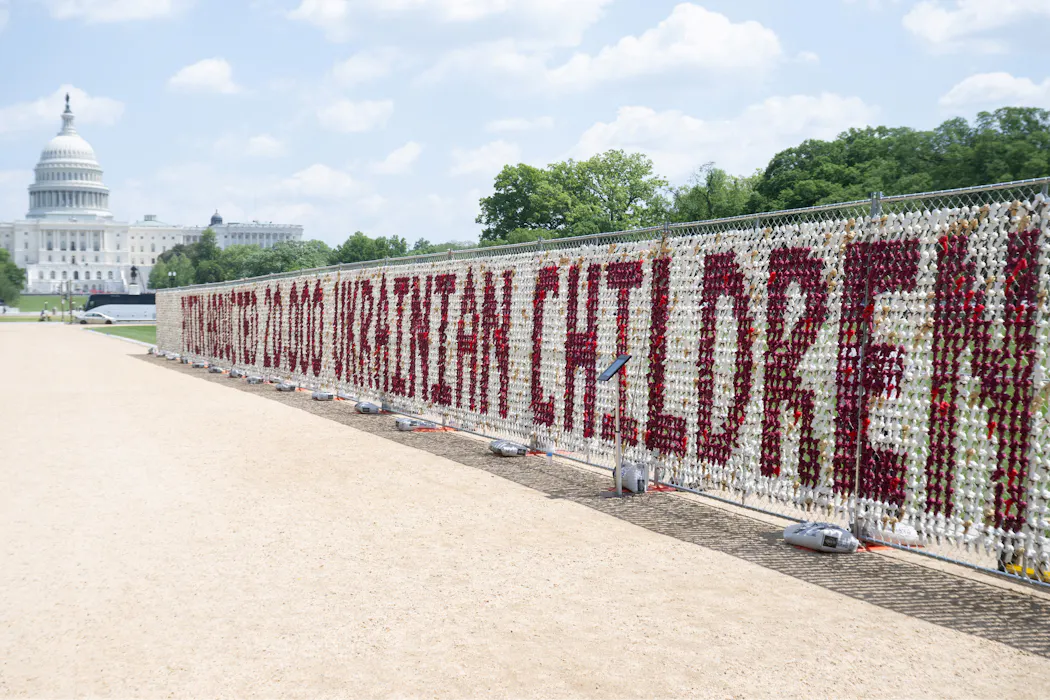
A fence featuring 20,000 stuffed teddy bears, each representing a Ukrainian child abducted by Russia, on the National Mall in Washington, D.C., on April 23, 2026.Saul Loeb/AFP via Getty Images
“Crimes against humanity.”
That’s what an investigation in March 2026 called Russia’s “deportation and forcible transfer” of Ukrainian children and “their enforced disappearance.”
The Independent International Commission of Inquiry on Ukraine wrote that “thousands of children have been deported to the Russian Federation or transferred to occupied areas in Ukraine by Russian authorities.”
In response to the Russian actions, the U.S. State Department announced, also in March 2026, a new US$25 million effort to identify, return and rehabilitate Ukrainian children and young people forcibly transferred by Russia or otherwise held away from their families and communities. The programs are intended to support both the work of locating children and the services they need after returning.
The U.S. announcement is important because bringing Ukrainian children home is a race against time. Russia is doing more than moving children. It is trying to remake them, from Ukrainians into Russians.
This strategy did not begin with Russia’s full-scale invasion of Ukraine in 2022. Since occupying the portion of Ukraine known as Crimea and parts of Ukraine’s Donbas in 2014, Russia has steadily reshaped children’s education, legal status, language and sense of belonging. For many children growing up under occupation, it is the only life they have ever known.
I have spent the past year and a half studying Russia’s treatment of Ukrainian children for my forthcoming book, “Child Abduction in the War in Ukraine: Erasing Ukrainian Identity as a Tool of War,” to be published open-access by Routledge in late fall 2026. The book draws on more than 50 interviews with returned young people, caregivers, Ukrainian officials, investigators, legal experts and child-protection advocates, together with government and nonprofit organization reports, international legal materials, historical research and open-source investigations.
My research points to a simple conclusion: Russia is not just moving Ukrainian children. It is taking away their identities.
Protesters gather in London on May 24, 2025, to demand the return of the Ukrainian children abducted by Russia. Alishia Abodunde/Getty Images
Beyond the official count
Ukraine’s Bring Kids Back UA, the official tracker of abducted children, lists over 20,000 possible cases of forcible deportation and transfer of children by Russia. However, Yale University’s Humanitarian Research Lab estimates the number is closer to 35,000.
The precise number is difficult to establish because Russia has not provided complete or verifiable information about the Ukrainian children it has forcibly transferred or deported, or their whereabouts.
International humanitarian law prohibits the forcible transfer or deportation of children from occupied territory except in narrowly defined emergency circumstances. Even then, evacuations must be temporary, preserve family unity, maintain records to facilitate reunification, and, when children must be moved outside occupied territory, take them to a neutral country rather than the territory of the occupying power.
Instead, many Ukrainian children have been coercively transferred into camps – organized sites used to house, instruct, reeducate or militarize Ukrainian children – institutions and foster or adoptive placements inside Russia or Russian-controlled territory.
Some are told Ukraine abandoned them, that their families no longer want them, or that their future lies with Russia. In many cases, their names, citizenship and legal status have been changed, making them more difficult to identify and return.
But even the official Ukrainian count does not convey the full scale of the crisis.
Approximately 1.6 million Ukrainian children are believed to be living under Russian occupation or in territories Russia has controlled since 2014.
These children may never have crossed an international border, but their schools, documents, language, media and daily lives are being reorganized around Russian rule. They are required to attend schools using the Russian curriculum, where Ukrainian history and identity are replaced with Russian narratives. Ukrainian-language instruction has been eliminated in occupied areas, and many children have been issued or required to obtain Russian passports.
These measures are designed not simply to govern occupied territory but to reshape how children understand their history, citizenship and future
A child does not have to be carried across a border to be separated from Ukraine. Occupation itself can become a method of identity removal.
Language that sounds protective
To outsiders, some of Russia’s actions can be difficult to recognize because they are often described in official language that sounds humanitarian or routine.
During the first months of the invasion, Russian forces removed many children from orphanages, residential institutions and other forms of state care, transferring many into Russia or Russian-controlled territory.
Other children were separated from parents or relatives during attacks on their communities, chaotic evacuations and Russia’s “filtration” process – a system of screenings and interrogations used to control civilians fleeing occupied areas.
Words used by Russia to describe its actions, such as “evacuation,” “child protection,” “recreation camp,” “guardianship,” “foster care” and “adoption,” usually suggest that adults are protecting children.
In occupied Ukraine, these terms cannot be taken at face value. They must be understood within a system of coercion designed to separate children from their families, communities and Ukrainian identity.
The language of rescue can conceal the reality of coercion.
A Ukrainian teen describes how he found his way back home after being abducted by Russia.
Changing more than location
Russia’s strategy extends beyond physically removing children from Ukraine. It also seeks to reshape the lives of those who remain under occupation.
Over time, Russian schools, laws and public institutions reinforce the message that these children are Russian rather than Ukrainian, making that identity feel normal and permanent. Children sent to so-called “recreation,” “health” or educational camps inside Russia often experience the same process, as temporary stays are extended and return becomes increasingly difficult.
The goal is not simply to control territory but to influence how children understand themselves.
Russian authorities have portrayed Ukraine as an artificial nation and Ukrainians and Russians as “one people.” Children are especially important to that project of erasing Ukrainians’ independent identity because they carry a nation’s language, family history, citizenship and future. As they grow older, many are also pulled into an expanding system of military-patriotic education that presents service to Russia as a civic duty.
This effort has intensified since the full-scale invasion. Russia has dramatically increased spending on military-patriotic education, expanding youth organizations and military instruction in occupied territories, where participation is often mandatory.
Every day matters
The International Criminal Court issued arrest warrants in 2023 for Russian President Vladimir Putin and Russia’s commissioner for children’s rights, Maria Lvova-Belova, over the alleged unlawful deportation and transfer of Ukrainian children.
Yet international legal recognition of this crime has not been effective.
Russia controls the information needed to reunite children with their families. International organizations can document violations and press for returns, but they do not know where many children are and have little independent access to occupied territories or Russian institutions.
The new U.S. funding can help strengthen that work. But it will need to be provided over the long term to be effective. Identifying a child, reconstructing documents and arranging a safe return can take months. Recovery may take much longer. Many need help restoring documents, returning to school, reconnecting with relatives and rebuilding trust.
Oleksandra Matviichuk, chair of Ukraine’s Center for Civil Liberties, which was awarded the 2022 Nobel Peace Prize, told me that one obstacle to an effective international response is a “lack of imagination.” People living in stable societies can find it difficult to believe that a government could invade another country, occupy its territory and attempt to erase the identity of its children.
But that is happening now.
The question is whether the world will act before changed names, lost records and years of forced assimilation make the damage even harder – or impossible – to reverse.
Thom Reilly receives funding from The Rogers Foundation (Las Vegas, Nevada) to make the book open source and to support research assistants.
Some of these memes adhered to conventional forms of political satire. One, for example, quoted a speech from the movie “A Bug’s Life,” in which a villainous grasshopper argues for the need to punish the movie’s ant protagonist to keep the other ants in line. In this meme, the political point was clear: Elites preserve power by making examples of insignificant ants who dare to challenge them.
Nonetheless, memes like those received serious reactions from social commentators and political pundits who interpreted them as evidence that America’s young adults are nihilistic and morally indifferent.
I believe these reactions are better understood not as a rejection of value but as a refusal to participate in conversations that feel selective and disconnected from young people’s broader economic and political frustrations. In my assessment, Gen Z’s dark and nonsensical humor does not show a lack of moral values, but it’s instead the product of its desire to engage in more authentic conversations about what they believe.
Alienation, not indifference
Research shows deep levels of alienation among Gen Z, or young people born between 1997 and 2012. Having grown up with smartphones and social media, this generation has come of age in an increasingly online world. Despite the internet’s capacity for instantaneous interaction, followers have proved a poor replacement for friends.
Many are pessimistic about achieving the American Dream and question the value of higher education. What was once considered the optimal vehicle for living a better life is instead viewed as a barrier.
If the American Dream feels out of reach, and college seems like an expensive obstacle, calls to take them seriously may feel inauthentic, alienating and absurd.
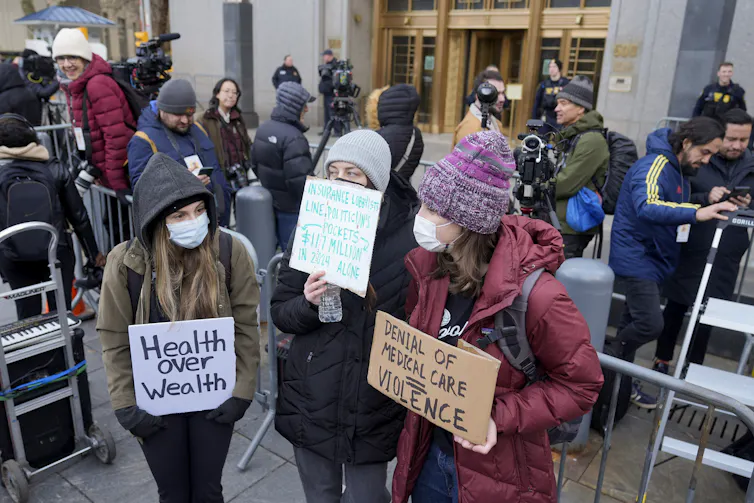
Demonstrators stand outside the Manhattan federal courthouse in New York shortly after Luigi Mangione, the suspected killer of UnitedHealthcare CEO Brian Thompson, arrived for a hearing in December 2024. AP Photo/Seth Wenig
When seriousness gets suspended
Discussions about values require some seriousness if they are to resonate with their audience.
If, for example, a commencement speaker praising the value of artificial intelligence is met with jeers from graduates – as former Google CEO Eric Schmidt was in May 2026 – the speaker’s message is immediately rendered inert.
These students’ jeers fell short of offering an argument against the speaker’s claims; instead, they created an atmosphere that prevented those claims from receiving consideration. For graduates pessimistic about AI’s implications for the labor market, claims professing its value feel inauthentic.
Together, their jeers not only provided an escape from what felt like an alienating and inauthentic message about the value of AI, but they also created a sense of solidarity through a shared suspension of seriousness.
A supporter of Luigi Mangione wears the Nintendo character Luigi’s green hat outside a New York courthouse in February 2025. AP Photo/Stefan Jeremiah
Humor offers an escape
Far from being unique to Mangione, this suspension of seriousness recurs throughout online meme culture.
The OceanGate implosion prompted similar memes, including one depicting a pod of orcas with the caption “The water is safe, send more billionaires.”
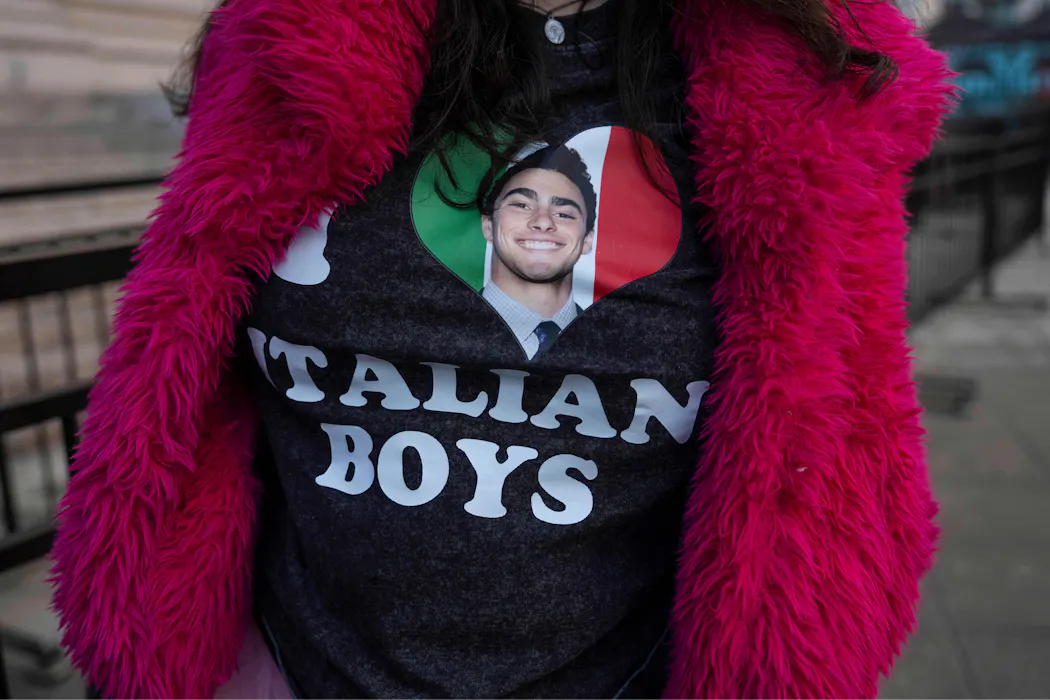
Even Charlie Kirk’s assassination became material. In a trend known as “Kirkification,” users superimposed his face onto images ranging from the Mona Lisa to women in bikinis, transforming a grim event into a shared absurdity.
In my assessment, Gen Z’s creation and circulation of memes offers an escape from otherwise serious conversations – for example, conversations about the value of the UnitedHealthcare CEO’s life. This may be especially true when demands to condemn Mangione appear to ignore inequities within an American health insurance system perceived as corrupt and unjust.
Memes about Mangione, or even campus lookalike contests centered on him, fall short of offering a precise moral argument in favor of largely suspending seriousness.
This style of humor can be seen in Mangione’s alleged decision to leave a backpack containing Monopoly money in Central Park. It was seen, too, on shell casings recovered after Kirk’s killing, which included video game commands, a sexually suggestive internet saying and “if you read this you are gay lmao.”
Miscast explanations of nihilism
With the help of approximately a dozen undergraduate students, I examined the psychological and situational factors associated with Gen Z’s reactions to Mangione and other events – like Kirk’s assassination and the Kamala Harris is “Brat” phenomenon during the 2024 presidential election – in two studies currently under review.
Our findings indicate that favorable attitudes toward Mangione were associated not only with superficial factors, such as his perceived attractiveness, but also with higher levels of political cynicism.
Perceived systemic bias in the American justice system, for example, was addressed in a meme depicting Mangione walking into court with the text “You can kill dozens of kids and get a lesser sentence because their lives don’t matter as much as a CEO’s.” Federal prosecutors were seeking the death penalty against Mangione for a charge a judge dismissed in January 2026.
Casting Gen Z’s reactions as nihilistic obscures the values and institutional distrust connected to them and fails to appreciate their egalitarian and pragmatic ideals. Dismissing them may deepen the alienation that allowed the death of a father of two to become a joke.
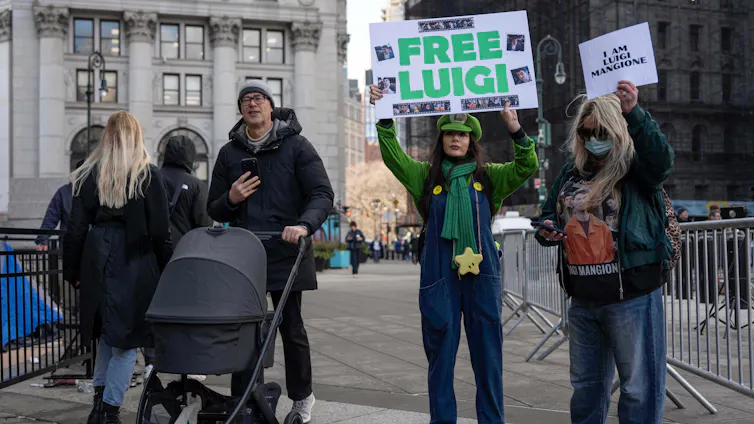
Supporters of Luigi Mangione raise signs outside the Manhattan federal courthouse in New York in January 2026. AP Photo/Yuki Iwamura
Why simple moral messages alienate
Although political commentators disagree about how to interpret the response to Mangione, many accept a seemingly basic principle: Killing should never be justified.
Yet decades of research on moral judgment shows that people do not apply that principle consistently. Instead, in certain situations, like in the famous “trolley problem,” people frequently judge killing to be morally permissible – especially when that killing is expected to promote the well-being of others.
Simplistic and sweeping moral injunctions not only fail to appreciate people’s actual moral attitudes, but they also eliminate the possibility of having authentic and nuanced conversations.
Those conversations need not end by endorsing Mangione as a sympathetic figure. However, an open and authentic conversation about Mangione cannot be realized in spaces that require all discussion of the event to be reduced to affirmations that, as has been advocated by some, “Murder is bad. Period.”
Such requirements can make conversations about significant moral issues – even controversial ones, like the morality of Mangione’s alleged actions – little more than demands for conformity. In this case, those boundaries risk ignoring and, thus, further alienating Gen Z.
Gen Z’s humor shows that almost anything can become a joke. I believe the danger of that is not that young people reject values, but that continued alienation may leave them laughing when seriousness is most required.
Evan Clarkson does not work for, consult, own shares in or receive funding from any company or organization that would benefit from this article, and has disclosed no relevant affiliations beyond their academic appointment.
In Allegheny County, where Pittsburgh is located, approximately 17,000 people have already lost their benefits. That’s the second-highest total of any county in Pennsylvania. Roughly 162,000 Allegheny County residents receive SNAP, or about 14% of the county’s population.
As a food economist and clinical dietition working in western Pennsylvania, I have seen how SNAP policy changes affect real people firsthand. Many of my patients are having more trouble making ends meet over the past few years, especially as grocery prices have risen roughly 25% in nominal terms since 2022 – a jump that has outpaced wage growth for many low-income households.
New SNAP work requirements
In November 2025, Pennsylvania began implementing the federal government’s expanded work requirements. The rules previously applied to adults ages 18 to 54 without a disability or dependent children, but they now reach up to age 64. Under these rules, these adults must work, volunteer or take part in education or training programs for at least 20 hours a week to keep receiving SNAP benefits.
Certain groups are especially likely to be affected by this rule change, including early retirees, first-time moms, children and people with disabilities who haven’t applied or been approved for disability benefits.
The new work requirements could also worsen food insecurity, which occurs when people cannot obtain enough safe and nutritionally adequate food for an active and healthy life.
Up to 5.4 million people nationwide could lose some or all of their SNAP benefits under the expanded work requirements, including 1.5 million children.
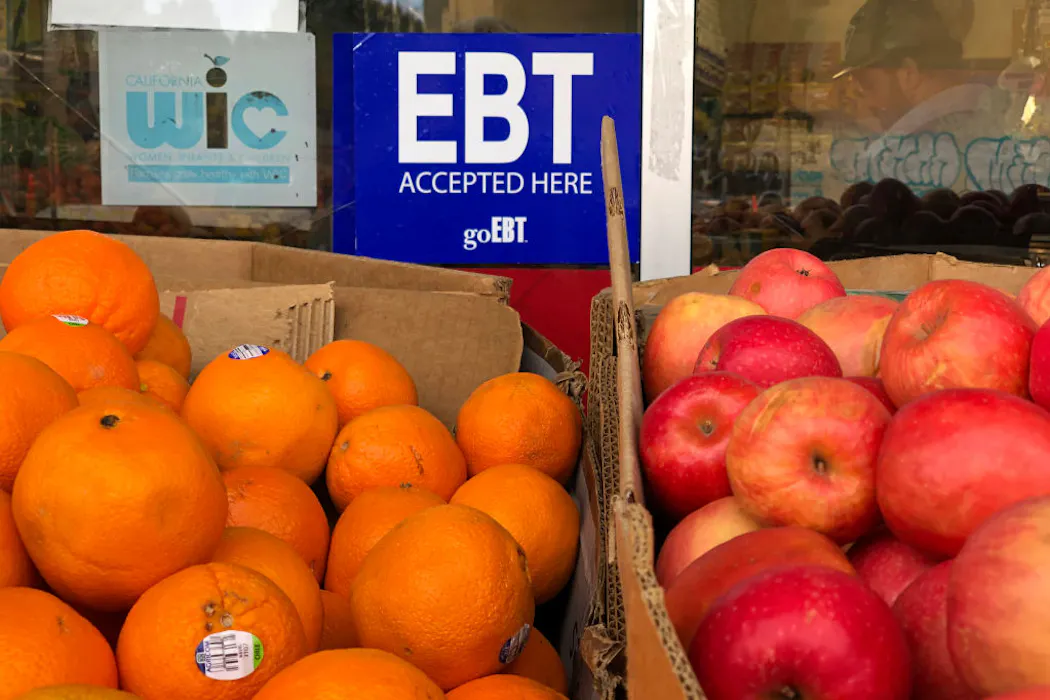
Supermarkets and other stores that sell food must be certified to accept SNAP benefits for payment. Beyond helping individual households, SNAP spending boosts local economies, as those benefits get spent at grocery stores and other retailers.
Retailers that sell food are now required to offer seven varieties of foods in each of four staple food categories: grains, vegetables and fruits, dairy, and protein. Stores could meet the new requirements for grains, for example, by offering corn tortillas, whole wheat bread, white bread, brown rice, white rice, oats and infant cereal for sale.
In the 12th and 17th congressional districts that make up Allegheny County, 10.4% and 8.7% of people, respectively, live in areas where it is difficult to get healthy foods. According to data from the Institute for Local Self-Reliance, there are 191 grocery stores in these districts, about 28% of which are either small chains or independent stores that may have a harder time complying with the new requirements.
While the stated goal of the new rules is to increase the availability of healthier foods, simply requiring stores to stock them doesn’t mean that customers will eat a better diet. Whether these new retailer policies ultimately improve diets is an open question.
Additional restrictions on purchases
Some states are placing additional restrictions on what people can buy with benefits. Purchasing hot prepared foods, alcohol, vitamins or diapers with SNAP benefits was already prohibited, but 23 states are now restricting the use of benefits to buy sugar-sweetened beverages and some other items that contribute to nutritionally inadequate diets.
While Pennsylvania has not adopted those additional restrictions, some of its neighboring states, such as Ohio and West Virginia, have.
Almost 14,000 people in Allegheny County were projected to lose SNAP benefits under the new work requirements. Tony Dejak/AP
SNAP helps people pay for groceries, but the benefit amount is typically less than what a household would spend on food. SNAP covers some of what a family would’ve spent on groceries anyway, leaving that money for other needs – rent, diapers, utility bills and the like. As a result, research shows the program doesn’t significantly change what or how much people eat, on average.
Amelia B. Finaret does not work for, consult, own shares in or receive funding from any company or organization that would benefit from this article, and has disclosed no relevant affiliations beyond their academic appointment.












 Want to display multiple RSS feeds on one page in WordPress? This guide builds a self-updating news wall or niche digest with the free Feedzy plugin.