The latest news and information from your Alaska news station.









The latest news and information from your Alaska news station.

The latest news and information from your Alaska news station.

Repairs continue at the Skagway Ferry Terminal with no reopening date set yet. Plus, Alaska extends wildfire season in three areas, Juneau prepares to launch PulsePoint Respond, and a Fairbanks fire station celebrates facility upgrades.

Friday Night: Periods of rain. Low near 50F. Winds SE at 5 to 10 mph. Chance of rain 100%. Rainfall near a quarter of an inch. Saturday: Cloudy with periods of rain. High 56F. Winds ESE at 10 to 15…

Friday Night: Cloudy with showers. Low 49F. SE winds at 15 to 25 mph, decreasing to 5 to 10 mph. Chance of rain 60%. Saturday: Mostly sunny skies. High 62F. Winds NNW at 5 to 10 mph.

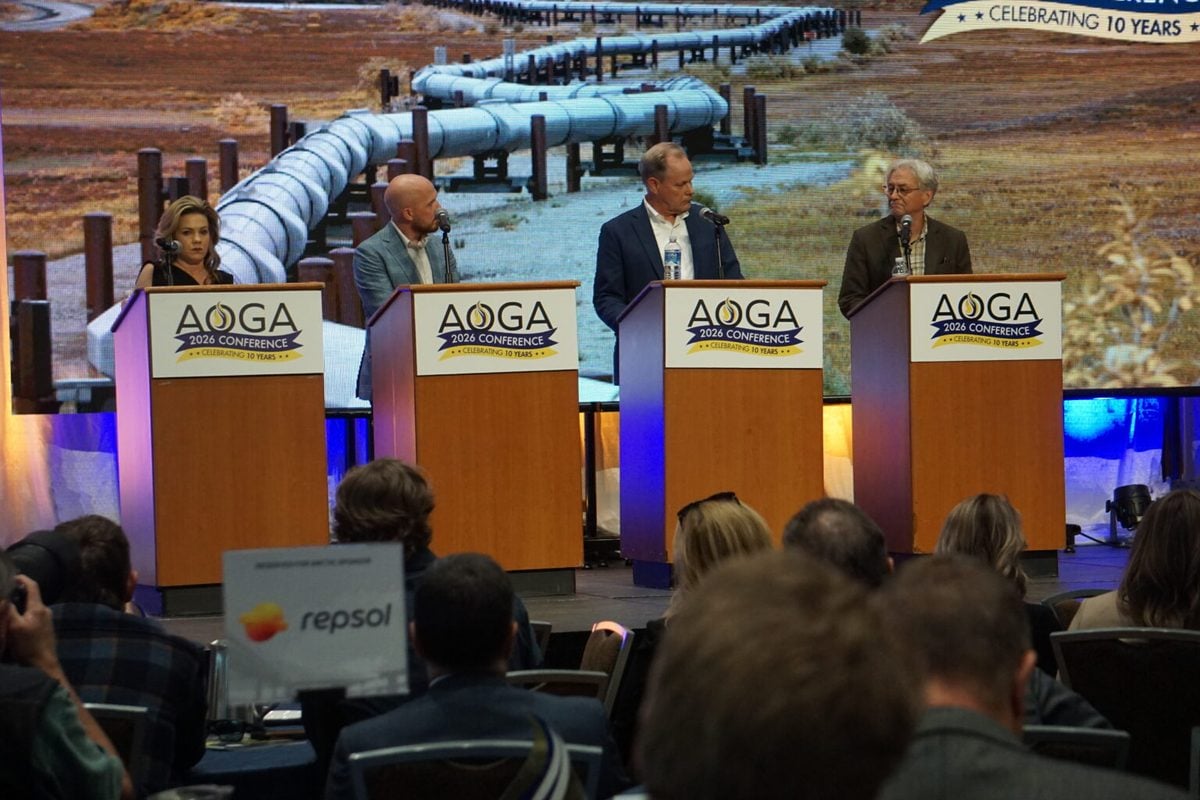
Sen. Dan Sullivan, R-Alaska, and former U.S. Rep. Mary Peltola, D-Alaska, listen to a question at a candidate forum held Aug. 27, 2026, by the Alaska Oil and Gas Association. The Alaska Senate race is considered critical to control of the body, which currently has a Republican majority. (Photo by Yereth Rosen/Alaska Beacon)
Editor’s note: This story has been updated with new results released on Friday by the Alaska Division of Elections.
In their first faceoff since the Aug. 18 primary election, Republican U.S. Sen. Dan Sullivan used the term “Lower 48 liberal” or some variation of it 16 times to attack his opponent, Democrat Mary Peltola.

Speaking at a candidate forum held Thursday at the Alaska Oil and Gas Association’s annual conference in Anchorage, Sullivan used nearly every question as an opportunity to tie Peltola, a former U.S. House member, to former Democratic President Joe Biden, whom he accused of maliciously trying to destroy Alaska’s economy.
“My opponents’ liberal Lower 48 anti-Alaska allies in the Congress and the White House were focused on completely shutting down Alaska oil and gas and killing thousands of jobs,” he said.
Sullivan and Peltola are the front-runners among four top vote-getters advancing to the general election. The winner will represent Alaska in the U.S. Senate for a six-year term.
Sullivan claimed Peltola “consistently voted with Lower 48 liberal allies of hers against our interests, and that is why this election is so important.”.
And he warned that a Peltola victory would allow Democrats and environmentalists to resume what he chacterized as deliberate attempts to harm Alaska. They would continue their efforts to block oil development in the Arctic National Wildlife Refuge and impose environmental restrictions on development elsewhere in Alaska, he said.
“If my opponents’ liberal Lower 48 allies get power again, the Democrats, if (Senate Minority Leader) Chuck Schumer is in charge again — she’s committed to supporting them — they will,” he said. “If elected, she would once again empower, vote with, and be beholden to the same far-left politicians who for decades have worked to crush our state.”
The primary election results indicate that Sullivan is facing headwinds as he runs for a third term in the Senate.

In the nonpartisan, open primary, Sullivan had about 41.4% of the total vote, 8 percentage points behind Peltola, who was at 49.5%, according to the most recent count, released on Friday.
The race is considered pivotal to control of the Senate, where Republicans currently hold the majority.
At Thursday’s event, Peltola largely refrained from attacking Sullivan directly.
She described herself as pro-development and a champion for the oil industry.
Peltola was the first Alaska Native woman elected to U.S. Congress in 2022, and served a two-year term before being defeated by current U.S. Rep. Nick Begich III in 2024.
At the event, she took credit for winning approval for ConocoPhillips’ huge Willow project on the North Slope from a reluctant President Biden.
She is “proud of the work that I did within the Biden administration to talk about Willow in a way that they could understand,” she said. “And we moved Willow forward, thanks to me.”
Sullivan took issue with that statement, pointing out that Willow development had been approved in the first Trump administration, before Peltola was elected to the House. However, a court ruling in 2021 overturned that Trump approval, finding it to be based on flawed analysis that violated federal law. That left the decision about Willow approval up to the new Biden administration.
Peltola, in line with a message common among Alaska Republicans, used several remarks at the forum to criticize Lower 48 regulators whom she said do not understand Alaska conditions. Among those conditions are seasonal restrictions, she said.
“Our construction windows are so short in Alaska. They’re like nowhere else. Developing in the Arctic is so unique,” she said. “If we miss a barge, that can cause a year’s delay or two years’ delay. if we miss a shipping window that can have devastating effects for the life of the project.”
Overall, Peltola lauded the Alaska oil industry as critical to the state and its economy.

“You know, over 80% of the oil revenues, of the revenues that state of Alaska operates with are generated by oil and gas and in large part the Trans Alaska Pipeline,” she said.
That percentage is outdated, however. Oil royalties, taxes and fees once provided as much as 90% of the money used for state government operations, that percentage has diminished over time. As of December, oil royalties, taxes and fees provided only about a quarter of the unrestricted general funds, according to the Alaska Department of Revenue. Investment earnings of the Alaska Permanent Fund, the state’s sovereign wealth fund that was established with oil revenues, actually provide the majority of unrestricted-use revenues, and that has been the case for several years.
In many of her remarks at the AOGA forum, Peltola had somewhat similar comments to those Sullivan made. She lobbed a bit of criticism at the Biden administration. Her specific target was former Interior Secretary Deb Haaland.
Peltola faulted Sullivan for voting to confirm Haaland, the first Native American to serve in that position. She claimed Haaland was “one of the biggest stumbling blocks Alaska has ever seen.”“We need to make sure that we’re confirming secretaries that are going to understand our mission and not be roadblocks and not be activists,” she said.
Haaland, a Laguna of Pueblo tribal member, is now running for governor in New Mexico. While serving as Interior Secretary, she visited Alaska and spoke at the Alaska Federation of Natives conventions and was celebrated by that organization.
Most of the AOGA event focused on issues directly related to the oil industry. High-profile issues like inflation, healthcare policy and the Iran war and their effects on Alaskans were not discussed.
Peltola did slip in a mention of fisheries issues, which have become a hot debate topic in this year’s election.
She said she worked to prevent an Endangered Species Act listing for Alaska Chinook salmon, and that such a listing would have had unintended ripple effects on other fisheries. Other species of salmon, such as sockeyes and chums, swim with Chinook salmon, she said. “If we preclude Alaskans from being able to harvest Chinook, that means we’re precluding them from harvesting just about everything during the summer,” she said.
Peltola also voiced a specific criticism of the Trump administration.
The mass federal government firings carried out through the administration’s so-called Department of Government Efficiency, or DOGE, exacerbated staffing shortages that were already slowing needed federal services in Alaska – including permitting for development projects, she said.

“DOGE impacted Alaska more than any other state, and no other state is more impacted by our federal agencies and our federal employees in Alaska,” she said. “No other state is as dependent on the decisions and the work of our federal employees as Alaska is. We’ve got to fully staff all of our agencies from top to bottom.”
Sullivan has tied himself closely to the Trump administration, delivering effusive praise for the president and his cabinet members. As he has elsewhere, he spoke at the forum of his close relationship with Trump and said he has helped the president focus on pro-development Alaska policies.
“We were able to get the Trump administration, who issued an executive order on day one to unleash Alaska’s extraordinary resource potential,” he said, referring to an order that overturned Biden-era environmental protections around the state.
Trump administration cabinet members, in turn, have praised Sulivan in their recent visits to Alaska and described him as a close Trump ally.
One was U.S. Energy Secretary Chris Wright, a keynote speaker at the AOGA conference. In his speech to the industry audience on Thursday, he said Sullivan has been a staunch ally of oil developers and the Trump efforts to reverse past environmental policies and deemphasize renewable energy in favor of oil, natural gas and coal.
He said Sullivan and the other two members of Alaska’s all-Republican congressional delegation, with their defense of fossil fuel production, “have been there in a battle to try to roll back some of these choosing-expensive-energy policies that have so burdened Americans.”
Earlier in the month, at an airport stop during a tour of Alaska, U.S. Homeland Security Secretary Markwayne Mullin also praised the senator.
“No one advocates for Alaska and what is the need today and the future buildout of what it’s going to look like down the road than Dan does,” Mullin said during a brief airport news conference on Aug. 11 with Sullivan and the commandant of the U.S Coast Guard. “It’s amazing, because he’s got such a good relationship with the president, which, that’s vital to be able to get something done.”
But support among voters has declined. Recent polling puts Trump’s national approval rating below 40% and indicates that he has net disapproval in almost all states, including Alaska.
Candidates in Alaska’s other federal race, the contest for the state’s sole U.S. House seat, met later in the day for what turned out to be a more congenial and low-key forum.

Incumbent Rep. Nick Begich III, R-Alaska, and independent challenger Bill Hill delivered largely similar messages on what they said was a need for regulatory certainty, development opportunity and the benefits of oil and gas production in the state.
Begich used the forum to talk about what he said were his successes during his first term in office. Begich has also aligned closely with President Trump and his administration.
“I’m only one member of the United States House out of 435, but we have delivered historic wins for our great state,” he said.
He cited numerous bills that mandate more oil drilling and other resource development on public lands in Alaska. Those successes, he said, included opening the Arctic National Wildlife Refuge to oil development and winning a higher share of future royalties from oil produced on federal land. Those victories “are 50-year objectives” that generations of Alaskans have tried to achieve, he said.
“I’m also proud to report that I’ve passed more legislation into law than any other member of Congress in the 119th Congress,” he said. “I’m also proud to report that we have passed more legislation, had more legislative wins than any freshman in House history.”
Begich, though a Republican and an ally of President Trump, is a member of a Democratic family active in Alaska politics. His grandfather, also named Nick Begich, was a Democratic U.S. House member who died in a plane crash in 1972. One of his uncles, Mark Begich, was Anchorage’s mayor and served one term as a Democratic U.S. senator. Another uncle, former state Sen. Tom Begich, is currently a Democratic candidate for governor.
Hill, a former teacher and school superintendent whom polls indicate is not well known among a wide swath of Alaska voters, used the forum to describe his biography.
He is a Dena’ina Athabascan from the Bristol Bay region and has fished commercially since he was 8 years old, he told the AOGA audience. He worked as a construction worker, spent 25 years working in education and is the owner of a small business, he said.
Hill said he is grateful for the benefits that oil development has brought to the state.
“As a young kid, I worried about the idea that I would have to fly out of my home community of Kokhanok to attend high school,” he said, naming the Iliamna Lake village where he grew up. “But then the oil and gas industry came to Alaska. It transformed Alaska. It transformed opportunities in Alaska.”

Oil revenues paid for schools, services like water and sewer systems and produced a Permanent Fund dividend program that has transformed Alaskans’ lives, he said.
“So I am a product of the oil and gas industry,” he said.
As an independent, he would be in position to work effectively if control of the administrative or legislative branches switched in the midterms or later, he said.
“We can weather the swings between administrations. Part of that requires having somebody who can work across party lines, and I would like to do that work for you,” he said.
The forum ended on a friendly note, with both candidates naming their preferred fish — red salmon for Begich, Bristol Bay salmon for Hill — and discussing their affinities for muktuk and pilot bread, two iconic Alaska food items.
But the morning after the forum, the National Republican Congressional Committee issued a news release attacking Hill as an anti-fossil fuel “radical” who wants Alaska to transition from its oil dependence.
“Liberal Bill Hill wants to bring back Biden’s failed energy policies and put D.C. Democrats ahead of Alaskans. Hill’s radical agenda would raise costs, crush Alaska’s economy, and kill jobs. Liberal Bill Hill will be resoundingly rejected this fall,” committee spokesperson Zach Bannon said in the statement.
As of Friday, Begich had 44.6% of the vote in the open primary, while Hill had 32.5%, according to the Division of Elections. Matt Schultz, a Democrat who suspended his campaign in July and threw his support to Hill, had 8.1%, according to the results. He has now officially withdrawn from the race. In third place is Eric Hafner, a Democrat currently serving a federal prison sentence in New York, with 3.8% of the vote. Democrat John Williams got 2.7% of the vote and fourth place, advancing to the general election in November.


A voter joins a line of voters waiting to cast their ballots on Aug. 15, 2022, at the state Division of Elections office in Anchorage. (Photo by Yereth Rosen/Alaska Beacon)
The Alaska Supreme Court issued a fast-tracked ruling on Thursday, affirming a lower court’s decision that the Alaska Division of Elections’ language for an elections overhaul ballot measure is “true and impartial,” but ordered the division to make one additional change.
The Court issued the ruling days after hearing oral arguments from two groups of plaintiffs on opposing sides of the current ranked-choice voting system. The groups appealed a lower court’s ruling issued in June, challenging the language of Ballot Measure 2 as unclear, politically partisan and containing omissions they sought to change.
Ballot Measure 2, which will appear on the ballot as 24ESEG, would repeal the state’s current ranked choice voting and open primary systems, as well as repeal campaign disclosure rules enacted by voters in 2020.
The Supreme Court ruling Thursday affirmed a Superior Court’s finding that the Alaska Division of Elections’ fulfilled its legal duty in preparing the ballot measure title and summary in a “true and impartial” manner.
But the justices identified one omission: the division must add language that explains if the measure is approved, and nonpartisan, open primaries are eliminated, candidates for Governor and Lieutenant Governor would run for election separately.
Currently, candidates for Governor and Lieutenant Governor run together on a combined ticket in the primary election. The top-four vote getters in the open primary advance to the ranked choice general election.
A spokesperson for the Alaska Department of Law, which defended the division and its ballot measure language in court, said by email Friday they welcomed the ruling and would make the change.
“We are pleased that the Alaska Supreme Court rejected nearly all the challenges to the lieutenant governor’s true and impartial ballot summary,” said Sam Curtis, an information officer. He called the court’s directive a small change.
“The State had considered this a minor detail that did not need to be in a ballot summary, but the Court disagreed,” he said. “The Office of the Lieutenant Governor will issue a revised summary soon.”
The revised language is expected to be published by the division before a ballot printing deadline of Sep. 2.
Both groups of plaintiffs that filed appeals in court expressed mixed reactions, saying they were “disappointed” but “appreciated” the court’s decision.
One group of plaintiffs that also sponsored the ballot measure, called the “Repeal Now” campaign, filed a lawsuit challenging the language in court. Among a series of language changes requested, they had argued for language to explain the governor and lieutenant governor would run separately. Their attorney Julie Pack said by email Thursday they maintained concerns.
“We’re disappointed that the summary will continue to incorrectly state that open primaries would end with Ballot Measure 2,” Pack wrote. “Primaries would remain defaulted at open following Ballot Measure 2’s passage, just like they previously were.”
The group argued, in part, that if approved Alaskans would still vote in “open primaries.”
But the ballot measure language states “the act would get rid of open party primaries.” That’s because if voters approve the measure, the elections system would revert to a partisan primary system in which political parties establish rules governing which candidates may appear on their ballot and which voters may participate.
Voters in the primary would no longer be able to vote for candidates of any party running for statewide and federal offices, as they currently do.
The issue is of particular concern to another group of plaintiffs that filed suit in court, represented by attorney Scott Kendall, who was one of the primary sponsors of the 2020 ballot implementing the current ranked-choice voting system.
He argued the current language on the ballot measure related to how the primaries would change is incomplete.
“Our specific request was that it be made more clear that each political party will have the power to not only close their primaries, but to close them and make it unlawful for undeclareds and nonpartisans to vote,” Kendall said in an interview Friday. “There’s some language in the ballot measure that gestures at that, but I don’t think it really makes it clear.”
Overall Kendall said the group is grateful to the court and division for rejecting language proposed by Repeal Now he called “radical changes.”
“We’re very, very grateful that the court correctly rejected those baseless edits,” he said.
Kendall said the Supreme Court’s added change is “a good one.”
“It wasn’t so much about what’s good policy, bad policy. It was when a voter steps into the booth and picks up the pen, are they equipped with full knowledge of what their yes or no vote means?”
Correction: This story has been updated to clarify that if approved, the ballot measure would enact a partisan primary system where political parties establish rules governing which candidates may appear on their ballot and which voters may participate.
By: Yereth Rosen, Alaska Beacon
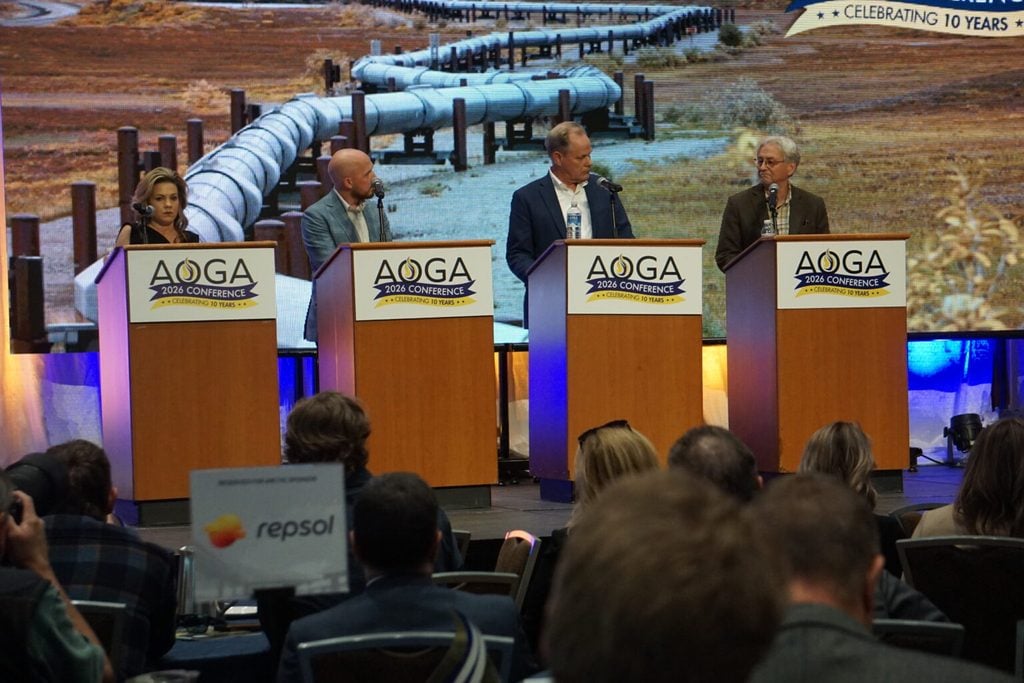
At their first candidate forum since the Aug. 18 primary election, the four remaining gubernatorial hopefuls pitched visions for the state’s future that revealed sharp political divides.
Speaking at the event, held at the Alaska Oil and Gas Association’s annual conference in Anchorage, were Democrats Jonathan Kreiss-Tomkins and Tom Begich and Republicans Bernadette Wilson and Dave Bronson. Kreiss-Tomkins has been leading in the still-ongoing primary election vote count, with 22.2 %, followed by Begich at 20.5%, Wilson at 10.2% and Bronson at 8.2%.
The four emerged as the top vote-getters among 17 candidates for governor. Alaska’s election system uses open, non-partisan primaries and ranked choice voting in the general election.
Kreiss-Tomkins and Begich, both former state legislators, presented mostly similar positions. Wilson, a talk-show host, and Bronson, a former Anchorage mayor, also presented largely similar positions that contrasted with the Democrats’ views.
Oil and gas taxes figured prominently in the event.

Both Democrats told the petroleum industry audience that they favored changes that would bring the state more revenues from oil producers. Their plans include a statewide corporate income tax on oil producers that are S corporations, also known as pass-through corporations, that currently do not pay them.
The main company affected by such a tax would be Hilcorp, a privately held company based in Texas that is a major Alaska producer. As of 2020, Hilcorp had acquired all of BP’s Alaska assets when that oil giant left the state, and now it operates Alaska’s largest oil field in Prudhoe Bay, among others. Unlike BP, Hilcorp pays no corporate income tax to the state. Legislative leaders have been pushing to change that.
Hilcorp is also a main sponsor of the AOGA conference.
Begich said a tax on S corporations and other changes to the state’s tax system would bring in an extra $400 million to the treasury each year.
He acknowledged that the oil industry crowd might not like those changes at first. But ultimately, “it will be forward-thinking for private investment,” he said. “If we have that revenue coming in, we can improve our education system. We can improve our economy in general and make our energy significantly more affordable up here. In doing that, you’re going to attract people to this state.”
Kreiss-Tomkins said all sectors, including the oil industry, will have to contribute taxes to correct a structural deficit problem in Alaska that, for now, threatens to wipe out the state’s savings.
“I am pro-math, and math just doesn’t lie. And balancing a budget is ultimately a math problem, and I think you have to be clear-eyed about where the state is,” he said. Compromises will be needed to address that, including compromises from the oil industry, he added.
Wilson and Bronson, in contrast, said they adamantly oppose tax changes that would wring more revenue out of the oil industry.
Wilson called for deep slashes to the state budget.

“We do not have a revenue problem in this state. We have a spending problem in this state,” she said.
“The reality is we need to come into this budget, and we need to DOGE the heck out of it,” she said, referring to the mass firings and cuts imposed by the Trump administration through the so-called Department of Government Efficiency, or DOGE.
Bronson said Alaska has made too many changes already to its oil and gas tax system, and that “changing the rules of the game and the tax structure midway through” scares off investment.
“The reality is we don’t have a whole lot of businesses that are lining up to do business with Alaska,” he said.
Both Wilson and Bronson accused the state legislature of blocking a proposed massive natural gas pipeline that would carry product from the North Slope about 800 miles to a yet-unbuilt liquefaction plant in Southcentral Alaska, known as the AKLNG project
There have been efforts over the past half century to build such a pipeline, but none have been economic. In pushing the latest version, Gov. Mike Dunleavy called the legislature into three special sessions this summer to try to get them to approve sweeping tax concessions for the investment company now involved with the project, the Glenfarne Group. Lawmakers ultimately rejected Dunleavy’s demands.
Wilson said the Glenfarne plan pushed by Dunleavy, unlike all other plans over the past half century, made economic sense, but lawmakers blocked it.
“You had a couple of legislators specifically that are hell bent on seeing Alaska fail. That’s why you don’t have a gas line,” she said.
Bronson drew a similar conclusion.

“We’ve got personal animosities in Juneau, and it comes down to just a few people that are shutting that project down,” he said.
Glenfarne, like Hilcorp, is a sponsor of the AOGA conference.
Kreiss-Tomkins and Begich, in turn, criticized Dunleavy, describing his policies as a major reason why Alaska has had more people leave the state than move to it for 13 consecutive years – the most ever recorded. They were particularly critical of his policies on education.
Under Dunleavy, they said, Alaska has stagnated.
“This governor has just set a record for the most number of vetoes by any governor in Alaska history since we became a state,” Kreiss-Tomkins said. “That is a sign of political failure, not political success.”
This year, Dunleavy set the record for the most vetoes by an Alaska governor in a single two-year Legislature, while the number of bills passed has also dropped significantly in recent years.
Candidates also discussed national politics at the forum. The two Republican candidates aligned themselves with President Donald Trump, and they portrayed themselves as hard-liners.
“I’m a hardcore conservative, and I’m proud of that,” said Bronson, who described the differences between candidates as stark.
“We’re at an inflection point in this country and in this state, in this election,” he said. “You can choose socialism. . .Or you can choose capitalism. That’s the choice in this race right now.

Wilson said the biggest danger to the state came from two of the three men who shared the stage with her.
“The greatest policy threat is, God forbid, this state elect a Democrat to this governor’s office.” she said. Wilson said Democratic Party policies regarding oil and gas “are the greatest threat to this industry.” She urged the audience to stick with Republicans and take advantage of the next two years of the Trump administration.
In contrast, the two Democrats emphasized consensus-building.
“Beyond a doubt, I disagree with Bernadette,” Begich quipped in comments directly following those by Wilson.
More broadly, Begich spoke about his approach to governing. While the governor has a responsibility to “be an advocate for the state of Alaska at all times,” including pushing back against the federal government, if necessary, that does not mean unrelenting combativeness, he said.
“What I won’t do is use the state’s power to attack people that are not even living in our state. I think that’s ridiculous,” he said.
Kreiss-Tomkins took a similar tone. He spoke of his time serving in a bipartisan coalition in the legislature that “set aside the more fringe and polarizing issues that I think often bring government and the legislature to a standstill” and prevent progress.
“That is a North Star principle for me. . .trying to find compromise, trying to work from a common-sense, common-ground agenda and get things done to move the state forward,” he said.
Ballots are still being counted, but the top four candidates for governor are unlikely to change. The Division of Elections’ primary election schedule calls for all absentee and questioned ballots to be counted within 10 days of the primary, resulting in a deadline of Aug. 28. The results are to be certified on Aug. 31, which is also the deadline for candidates to drop out.
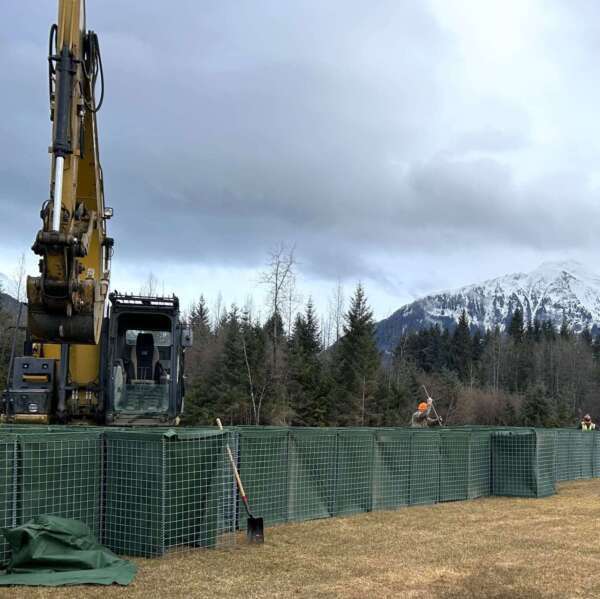
NOTN- A memo from City Manager Katie Koester says the city could be responsible for 25% of the cost of an accelerated Army Corps of Engineers project, rather than the 10% local share associated with previous proposals.
First reported by the Juneau Independent, Koester writes Juneau could establish a new service area and tax to help pay for ongoing flood protection and the city’s share of a permanent solution to the annual glacial lake outburst floods.
The Assembly Committee of the Whole will meet on Monday to discuss.
The city has spent millions of dollars on temporary flood protection, including HESCO barriers, while the U.S. Army Corps of Engineers pursues a permanent solution for annual flooding from Suicide Basin.
Koester said the Corps is seeking proposals from industry for an emergency water conveyance prototype capable of permanently addressing the floods. The goal is to keep water levels in Suicide Basin below 1,100 feet so any eventual release would be significantly smaller.
The project is being pursued under the federal Flood Control and Coastal Emergencies authority, which allows for a faster process but requires a 25% local share of construction costs for permanent flood control projects.
The city is working with Alaska’s congressional delegation to change that cost share to 10%, similar to the federal share available for projects involving tribal lands.
The total cost of a permanent project has not yet been determined, but the city expects it to exceed the amount currently available through the federal emergency account. The account receives about $40 million annually for flood control projects nationwide, meaning Juneau will need to advocate for additional federal funding.
Koester recommends the Assembly consider putting a bond or debt proposition before voters once the Corps provides a more reliable estimate of the project’s total cost.
In the meantime, Juneau is continuing to spend money on temporary protections. Nearly $50 million in federal, state and local funding was spent this summer on flood mitigation in the Mendenhall Valley, according to the memo.
Koester said the city expects to remain responsible for regular HESCO maintenance, including inspections, repairs from settling, responding to vandalism and refilling the barriers. The city also must continue coordinating with homeowners, maintaining property access and handling permitting.
She writes the work has also diverted city staff and resources from other projects, according to the memo.
One option under consideration is creating a service area with its own mill rate to fund flood protection and related services. The tax could apply either to properties within the protected area or citywide.
A service area would require approval by voters living within its boundaries. Koester said a citywide property or sales tax could also be appropriate because the annual floods have been characterized as an existential threat to Juneau as a whole, rather than a localized disaster affecting only the Mendenhall Valley.
Koester also recommended that the city push the Alaska Legislature to make construction of a lake emergency water conveyance prototype a state priority during the next legislative session, which begins in January.

A years-long battle to make a small downtown land parcel “Indian Country,” and thus largely under the jurisdiction of tribal law, is facing yet more legal skirmishing due to the Trump administration reversing the Biden administration’s support of such agreements.
Sovereignty rights for the 787-square-foot vacant lot are being sought by its owner, the Central Council of the Tlingit and Haida Indian Tribes of Alaska, which in early 2023announced a deed putting the land…